Fundamentals of
        Nuclear Engineering


Module 12: Two Phase Heat Transfer and Fluid Flow

              Joseph S. Miller, P.E.


                                               1
2
Objectives:
Previous Lectures described fluid flow, heat transfer and
    reactivity in single phase systems. This lecture:
1. Describe two-phase Systems
2. Describe important thermal-hydraulic concepts important
    to a BWR
3. Describe two-phase flow equations
4. Describe two phase heat transfer rates from fuel to
    coolant and Boiling Transition
5. Describe steady state core temperature profiles
6. Describe fluid flow, and pressure drops in two phase
    systems
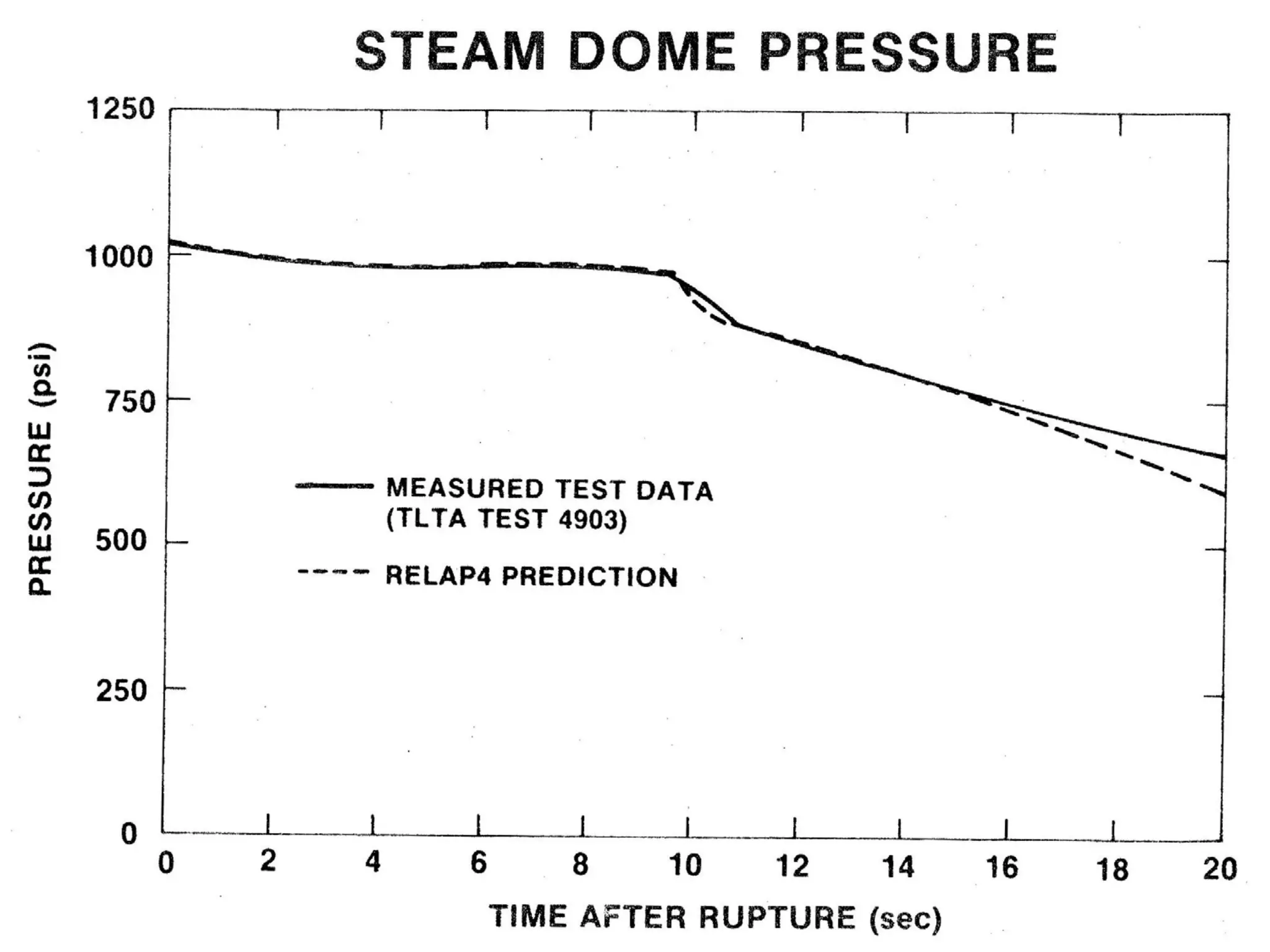
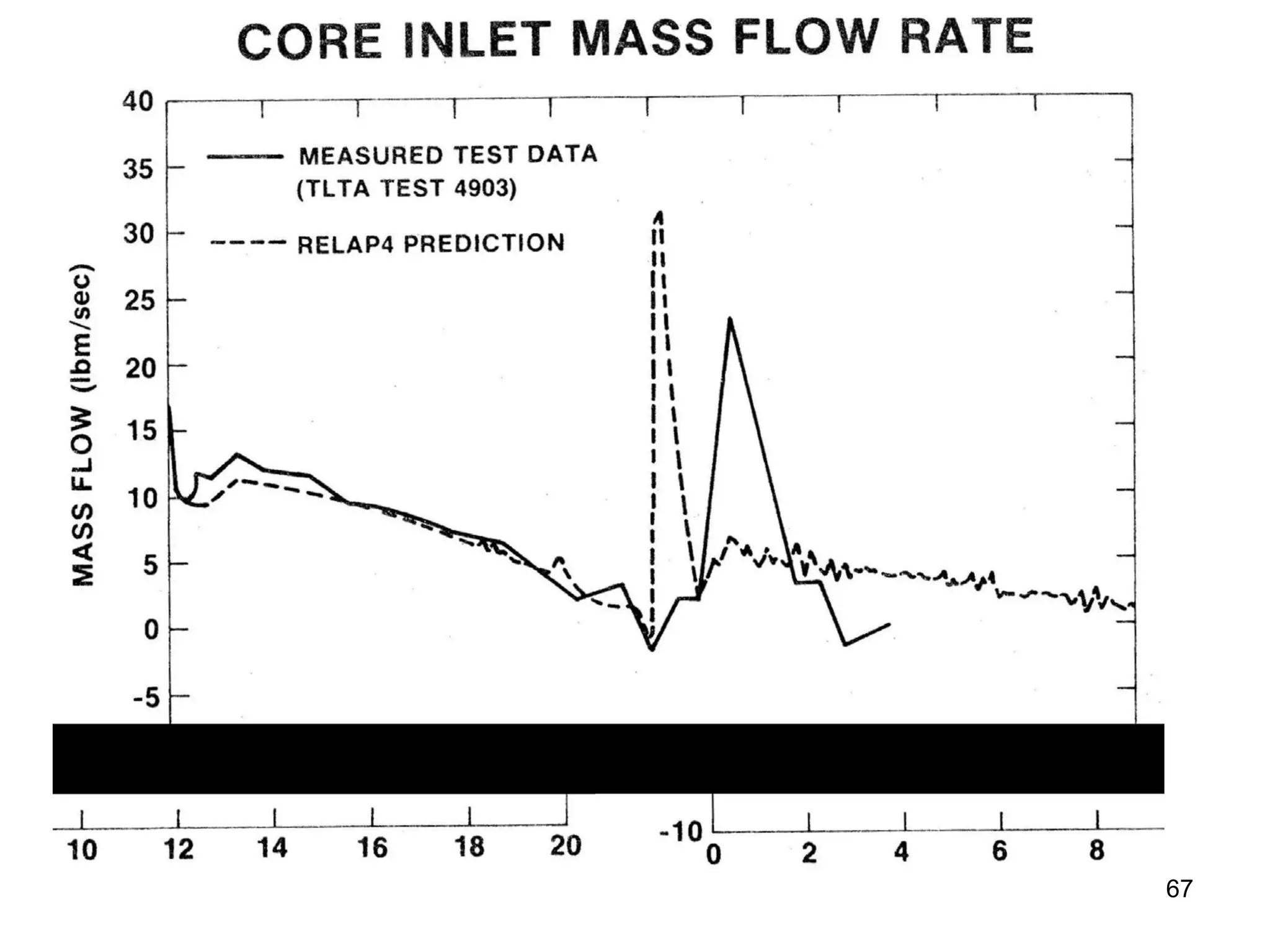
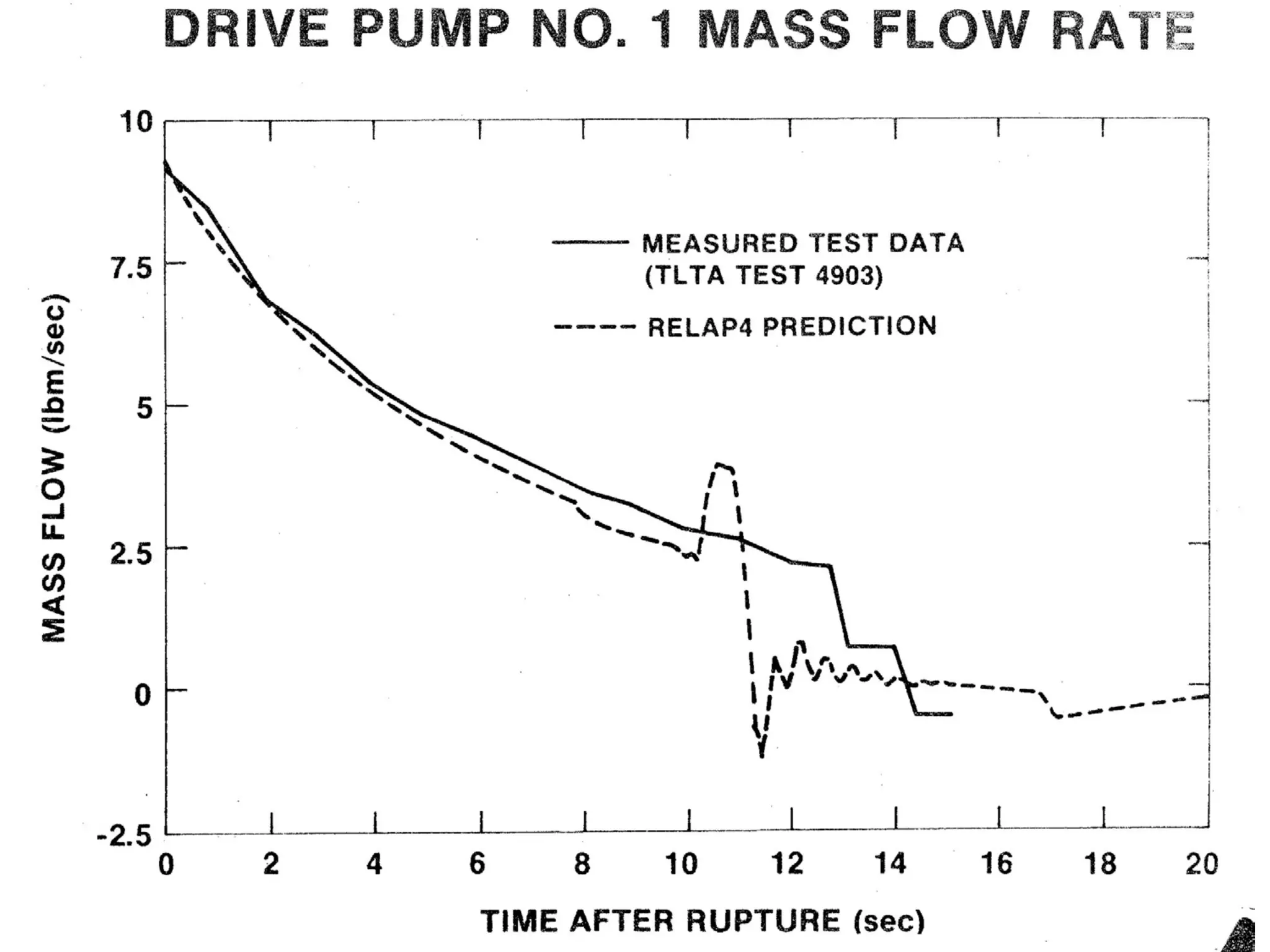
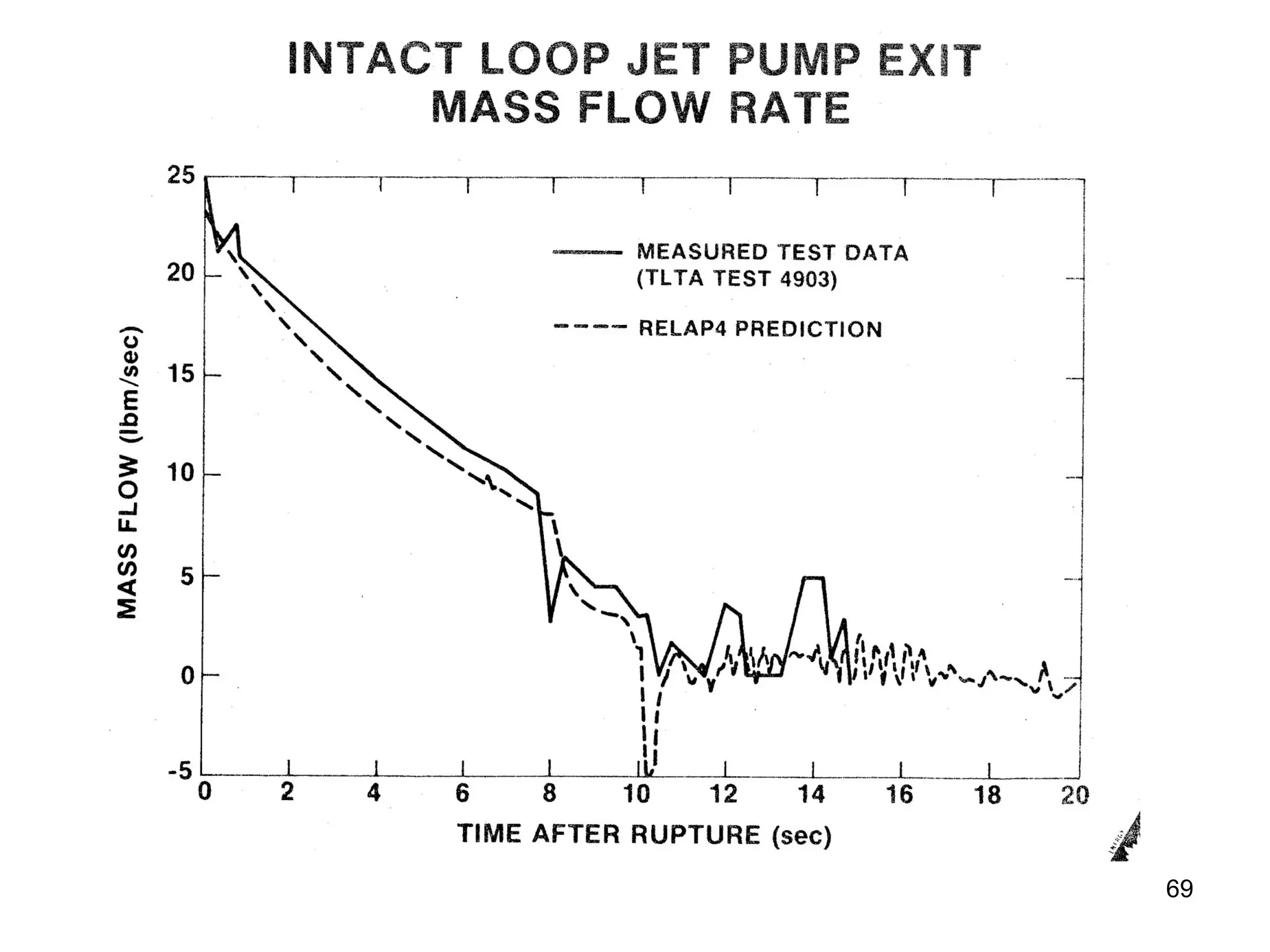
7. Describe behavior of system during accident

                                                       3
1. Two Phase Fluid Systems


                             4
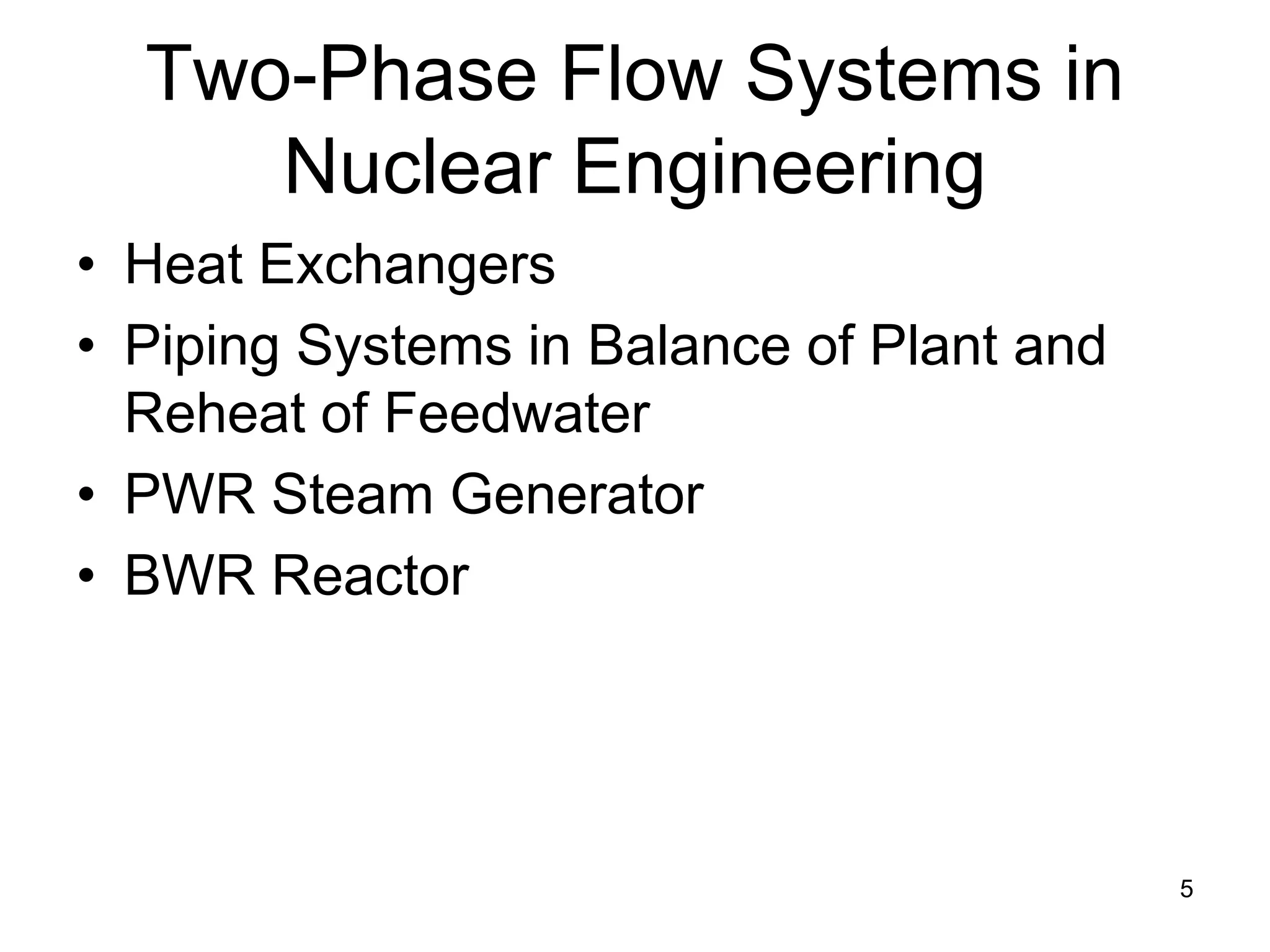
Two-Phase Flow Systems in
     Nuclear Engineering
• Heat Exchangers
• Piping Systems in Balance of Plant and
  Reheat of Feedwater
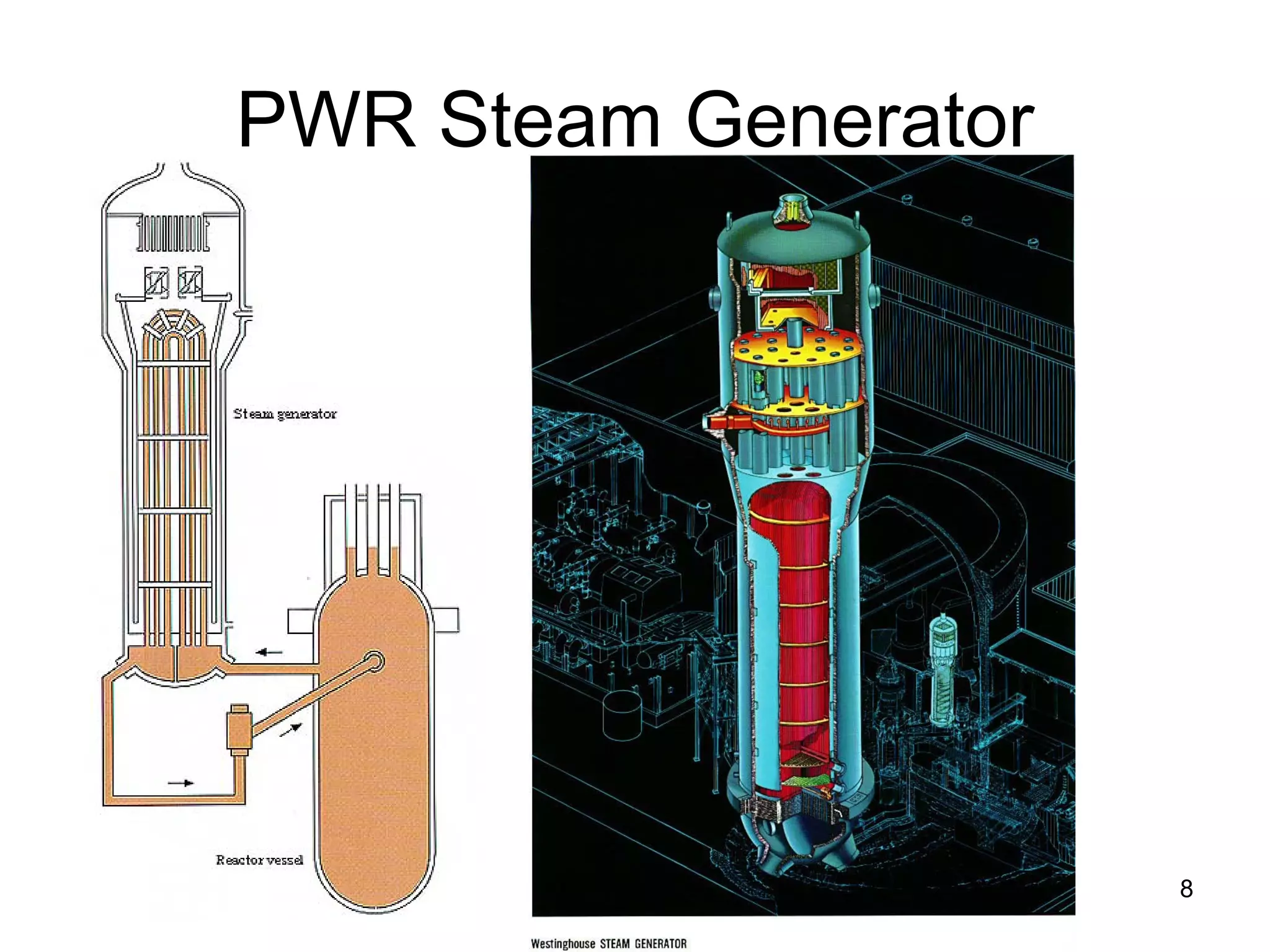
• PWR Steam Generator
• BWR Reactor


                                           5
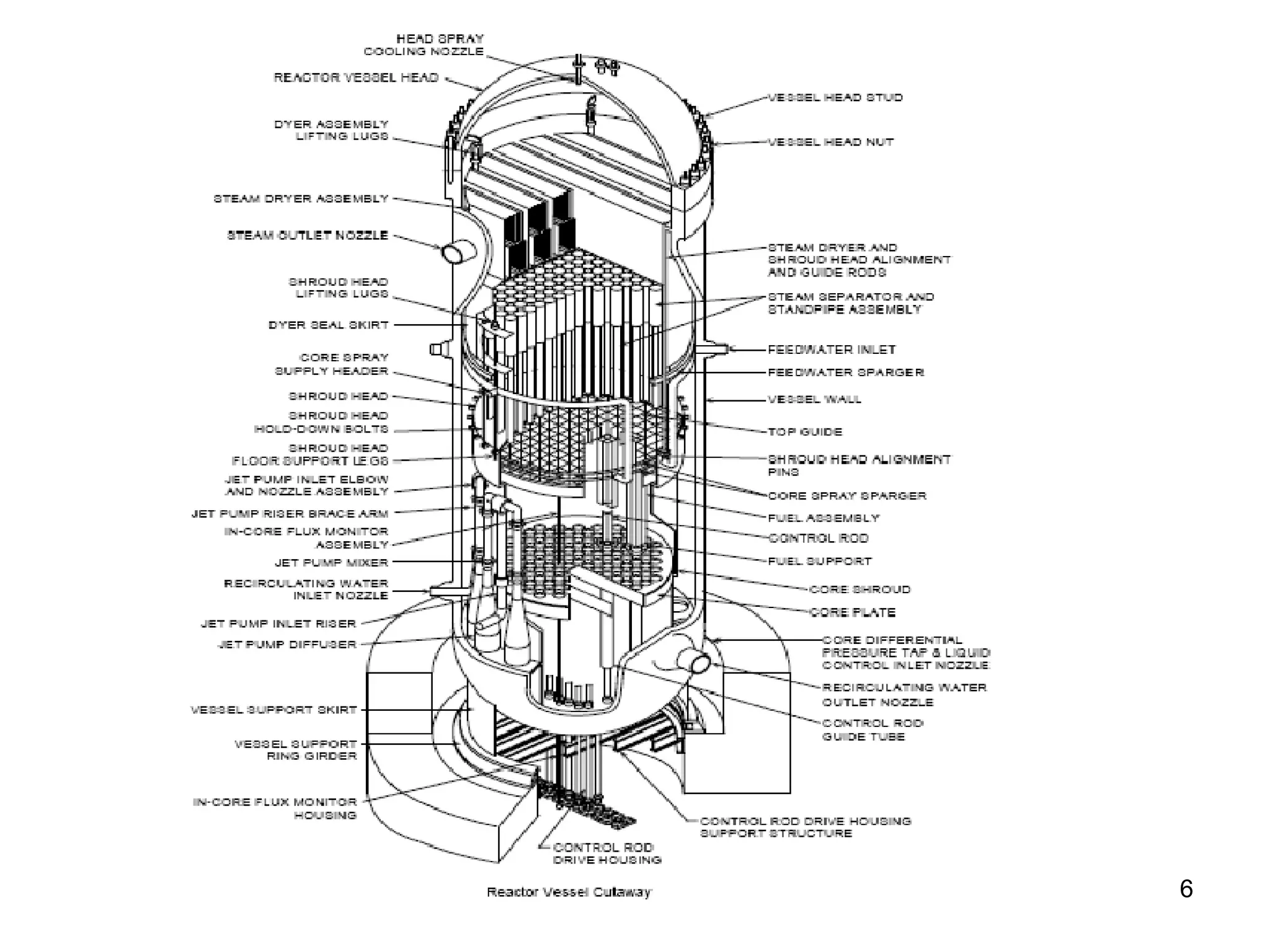
6
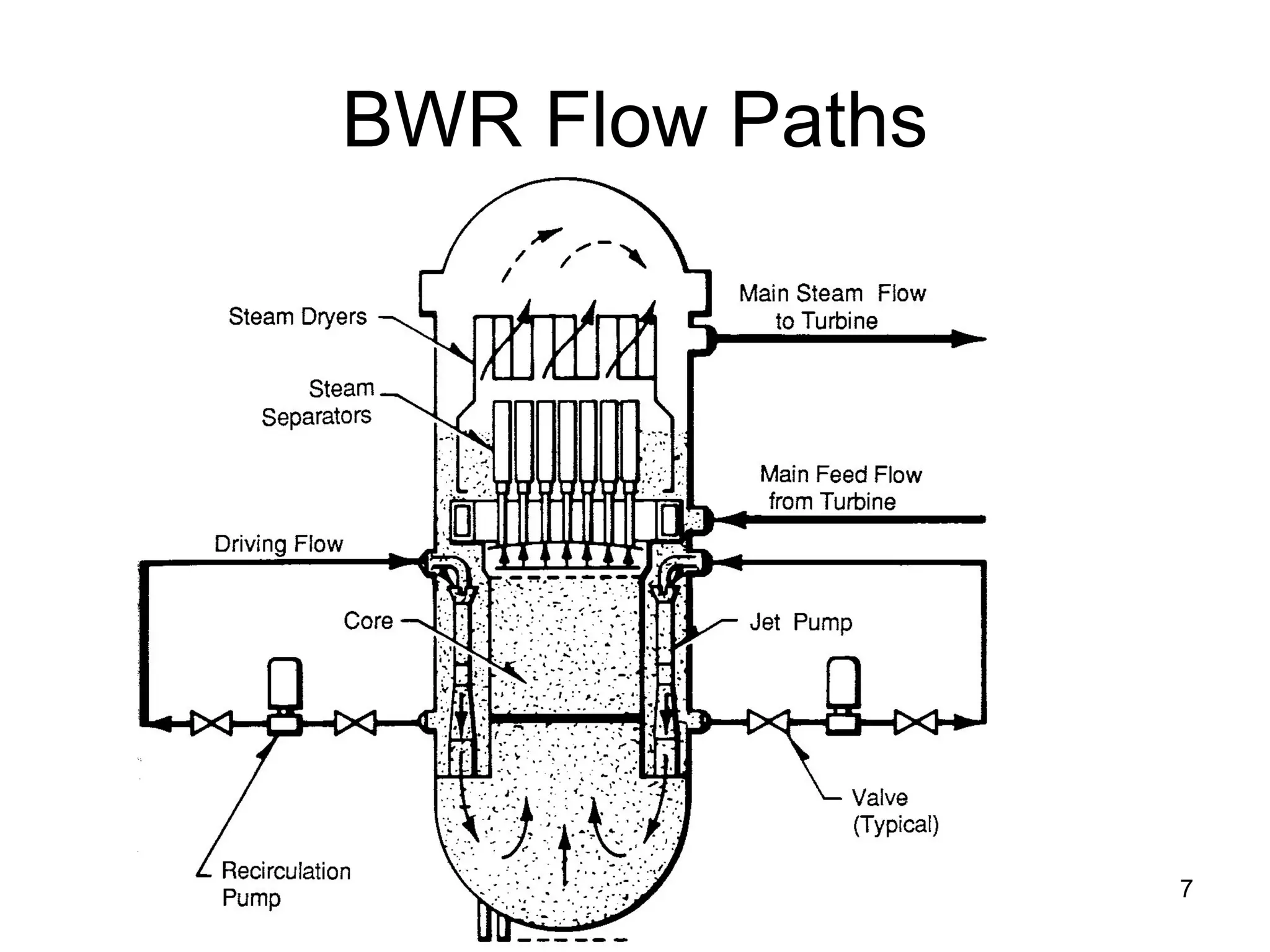
BWR Flow Paths


                 7
PWR Steam Generator


                      8
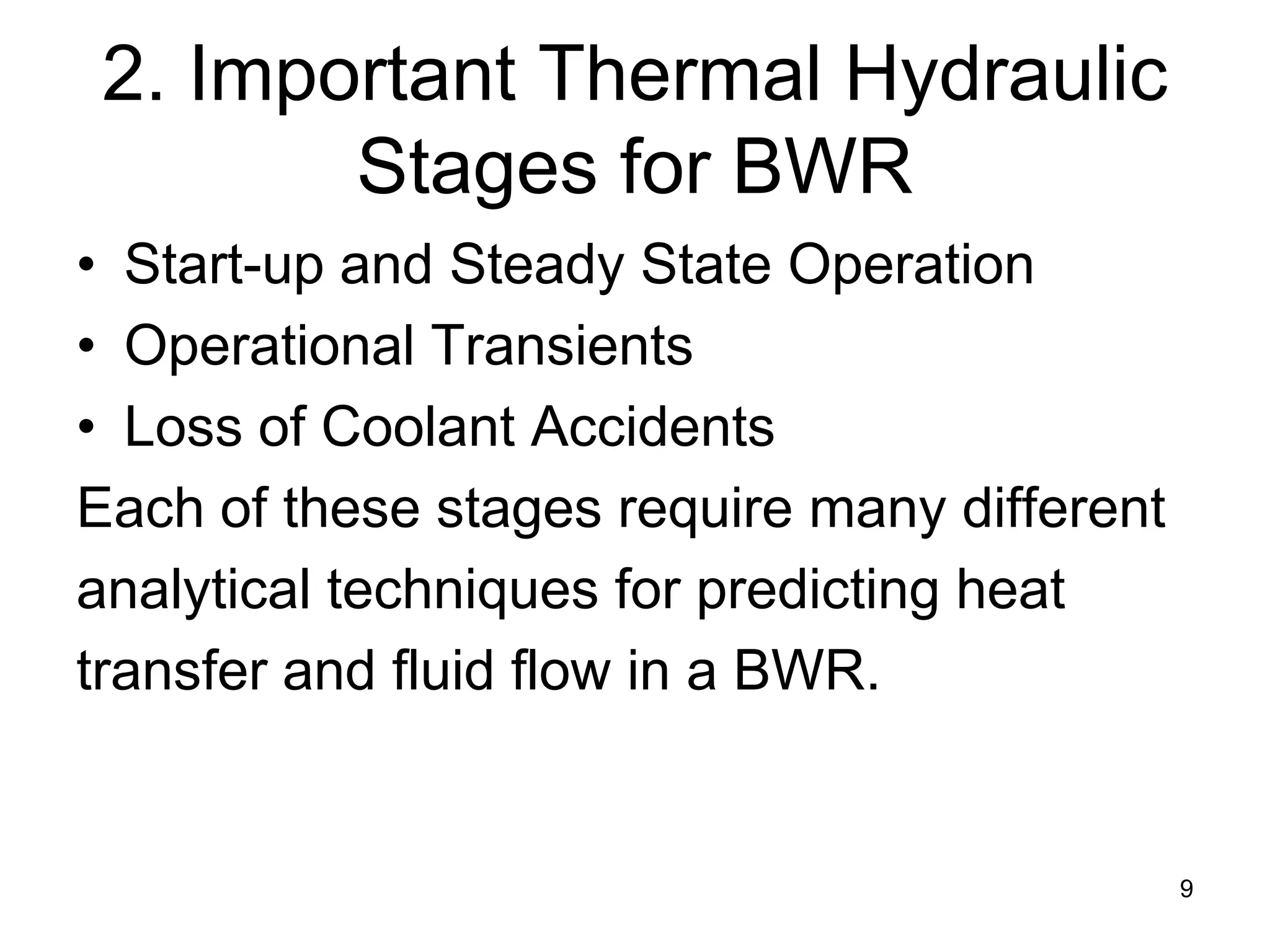
2. Important Thermal Hydraulic
        Stages for BWR
• Start-up and Steady State Operation
• Operational Transients
• Loss of Coolant Accidents
Each of these stages require many different
analytical techniques for predicting heat
transfer and fluid flow in a BWR.


                                              9
Start-up and Steady State
            Operation
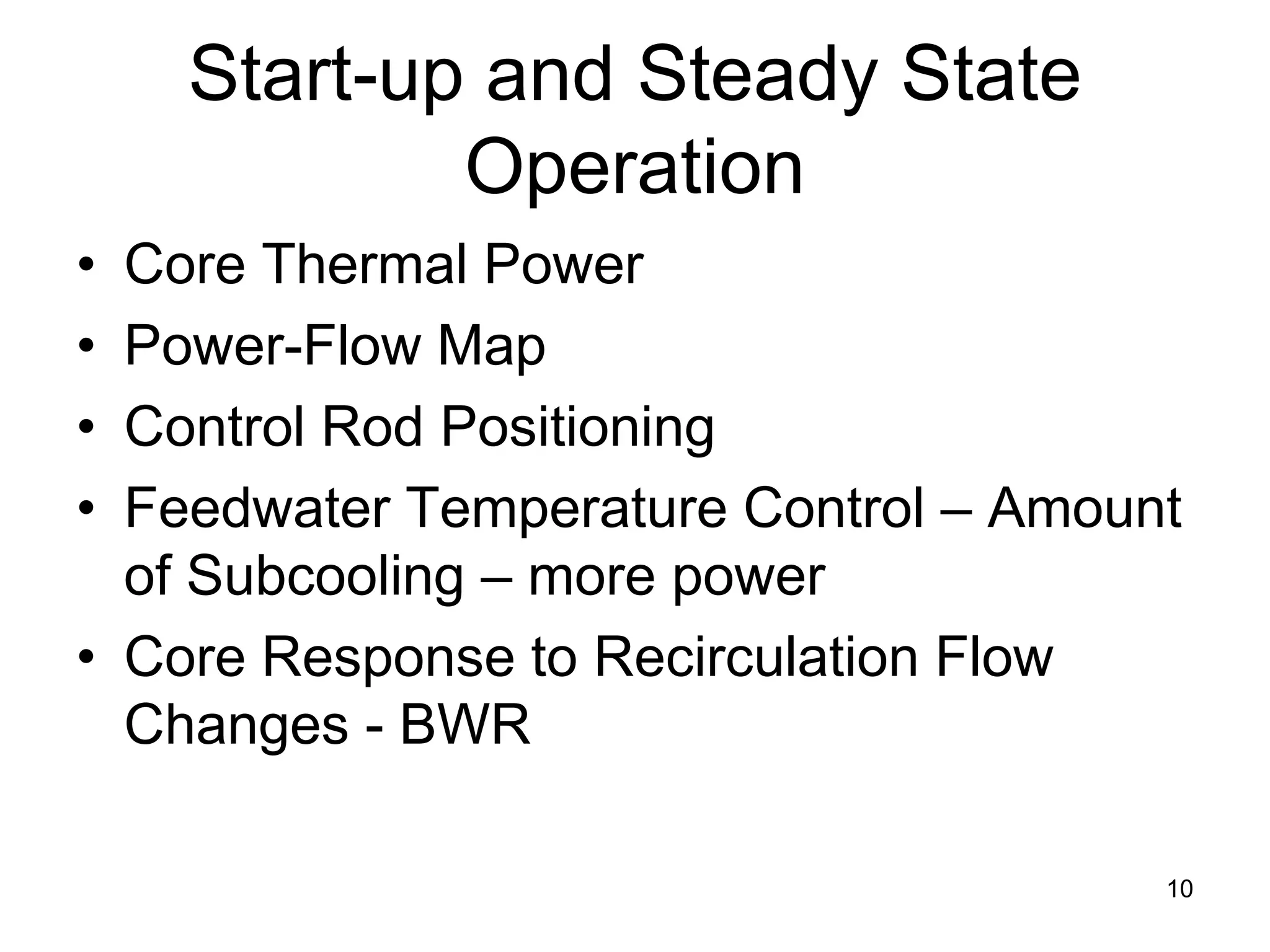
• Core Thermal Power
• Power-Flow Map
• Control Rod Positioning
• Feedwater Temperature Control – Amount
  of Subcooling – more power
• Core Response to Recirculation Flow
  Changes - BWR

                                       10
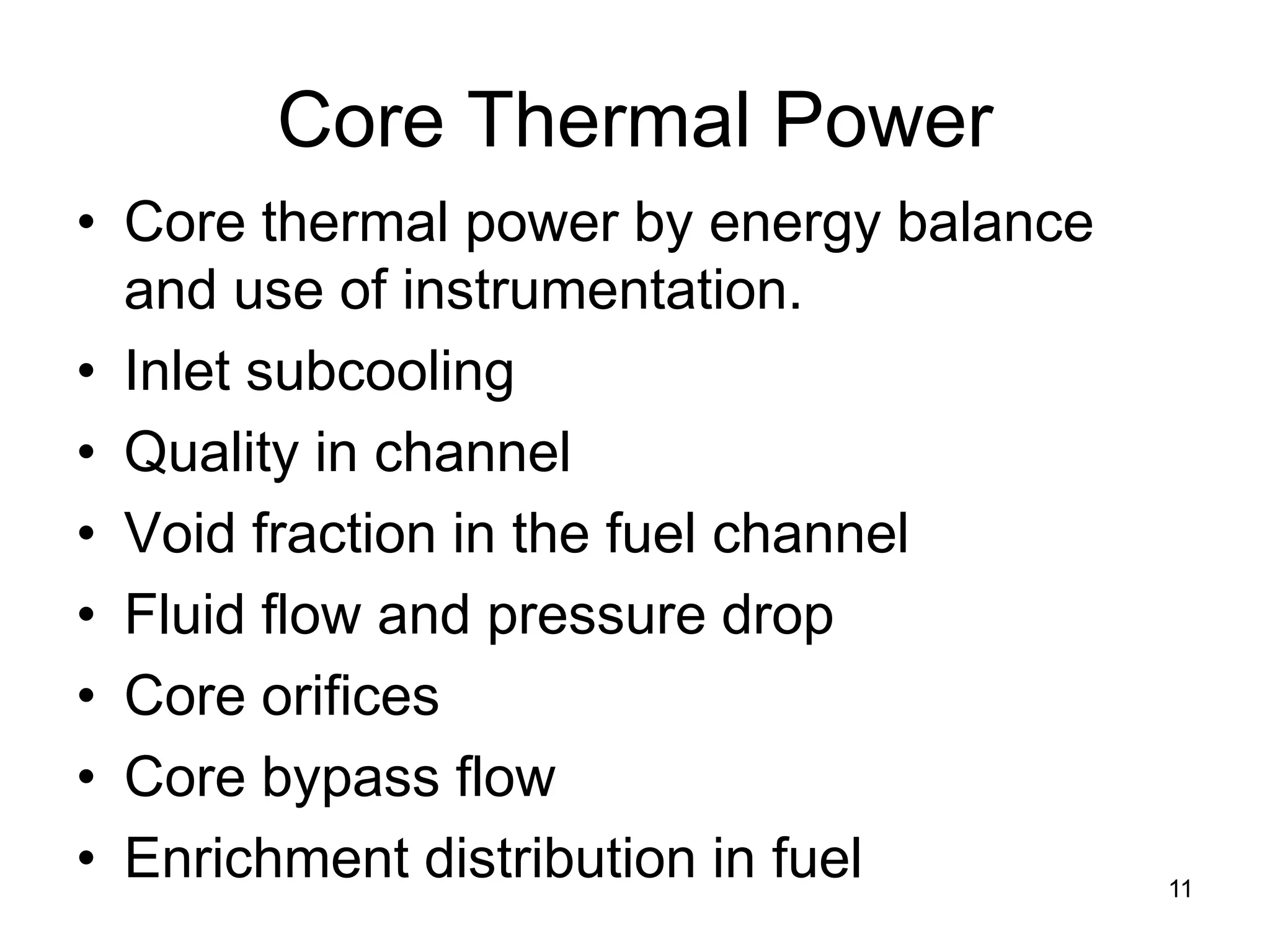
Core Thermal Power
• Core thermal power by energy balance
  and use of instrumentation.
• Inlet subcooling
• Quality in channel
• Void fraction in the fuel channel
• Fluid flow and pressure drop
• Core orifices
• Core bypass flow
• Enrichment distribution in fuel        11
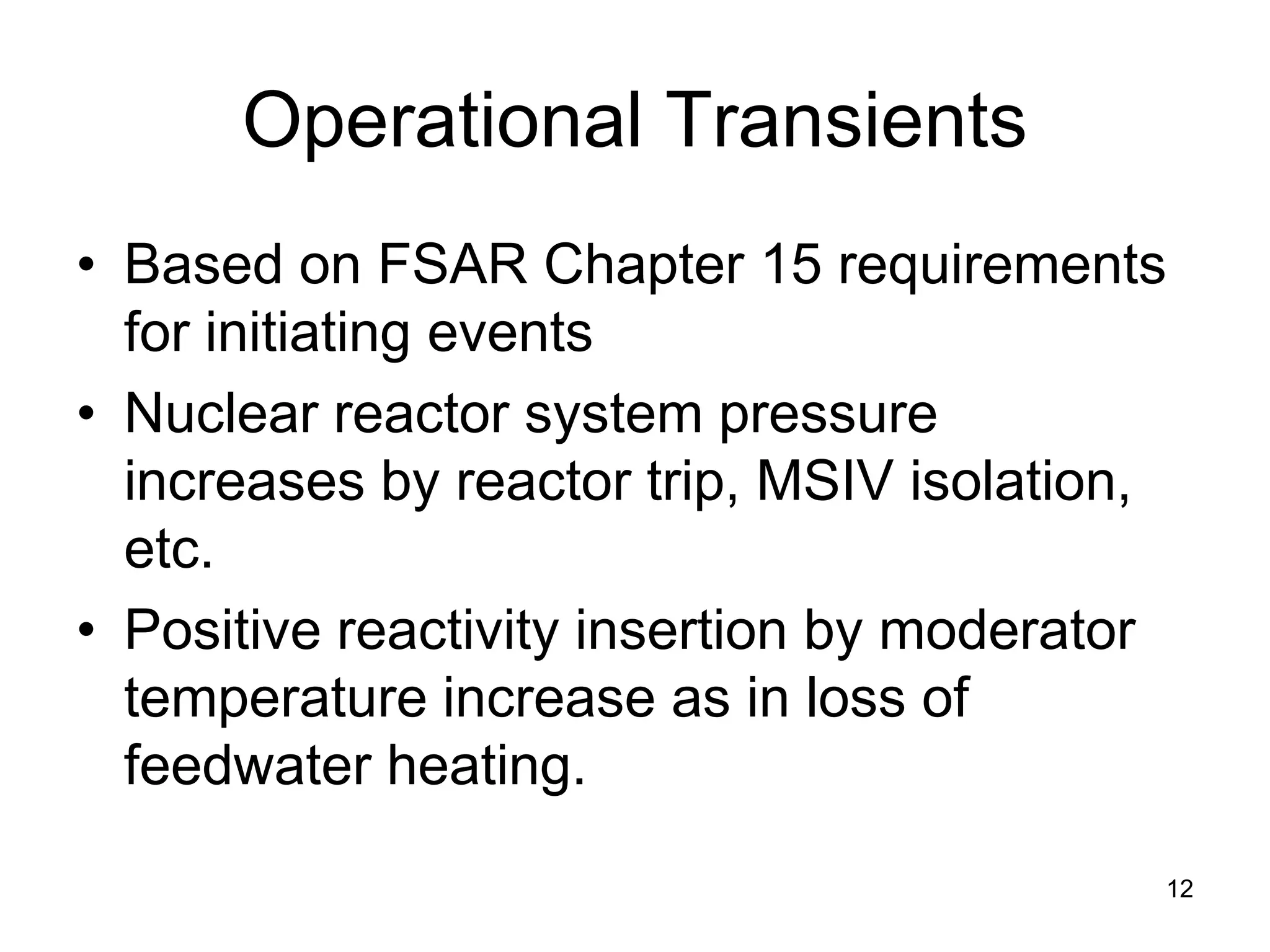
Operational Transients
• Based on FSAR Chapter 15 requirements
  for initiating events
• Nuclear reactor system pressure
  increases by reactor trip, MSIV isolation,
  etc.
• Positive reactivity insertion by moderator
  temperature increase as in loss of
  feedwater heating.

                                           12
Loss of Coolant Accidents
• Large breaks
• Small breaks
• Intermediate breaks


                                13
3. Two Phase Flow Equations


                              14
General Terminologies
• Two-phase flow
   – Simultaneous flow of any two phases (liquid-gas/vapor) of a
     single substance
   – Examples: reactor fuel channels, steam generators, kettle on a
     hot stove
   – Also referred to as “Single-component two-phase flow”


• Two-component flow
   – Simultaneous flow of liquid and gas of two substances
   – Examples: oil-gas pipelines, beer, soft drink, steam-water-air
     flow at discharge of safety valve.
   – Also referred to as “Two-component, two-phase flow”

                                                                      15
Terminology Unique to Two Phase
• In static (non-flowing system) steam quality: χ is defined:
        χ = (mass of steam) / (total mass of steam + liquid)
• In static (non-flowing system) void fraction: α is defined:
α = (volume of steam in mixture) / (total volume of steam + liquid)
• Void fraction can be expressed in terms of steam quality
   and specific volumes (from Steam Tables) as follows:
   α = χvg / ((1- χ )vf + χvg ) = 1 / {1 + [(1 – χ)/ χ] vf / vg }
• Where:        vg is specific volume of steam in ft3/lb-m
                 vf is specific volume of liquid in ft3/lb-m
                 vfg = vg - vf is difference in specific volumes

Good source for fluid properties: http://webbook.nist.gov/chemistry/fluid/
                                                                             16
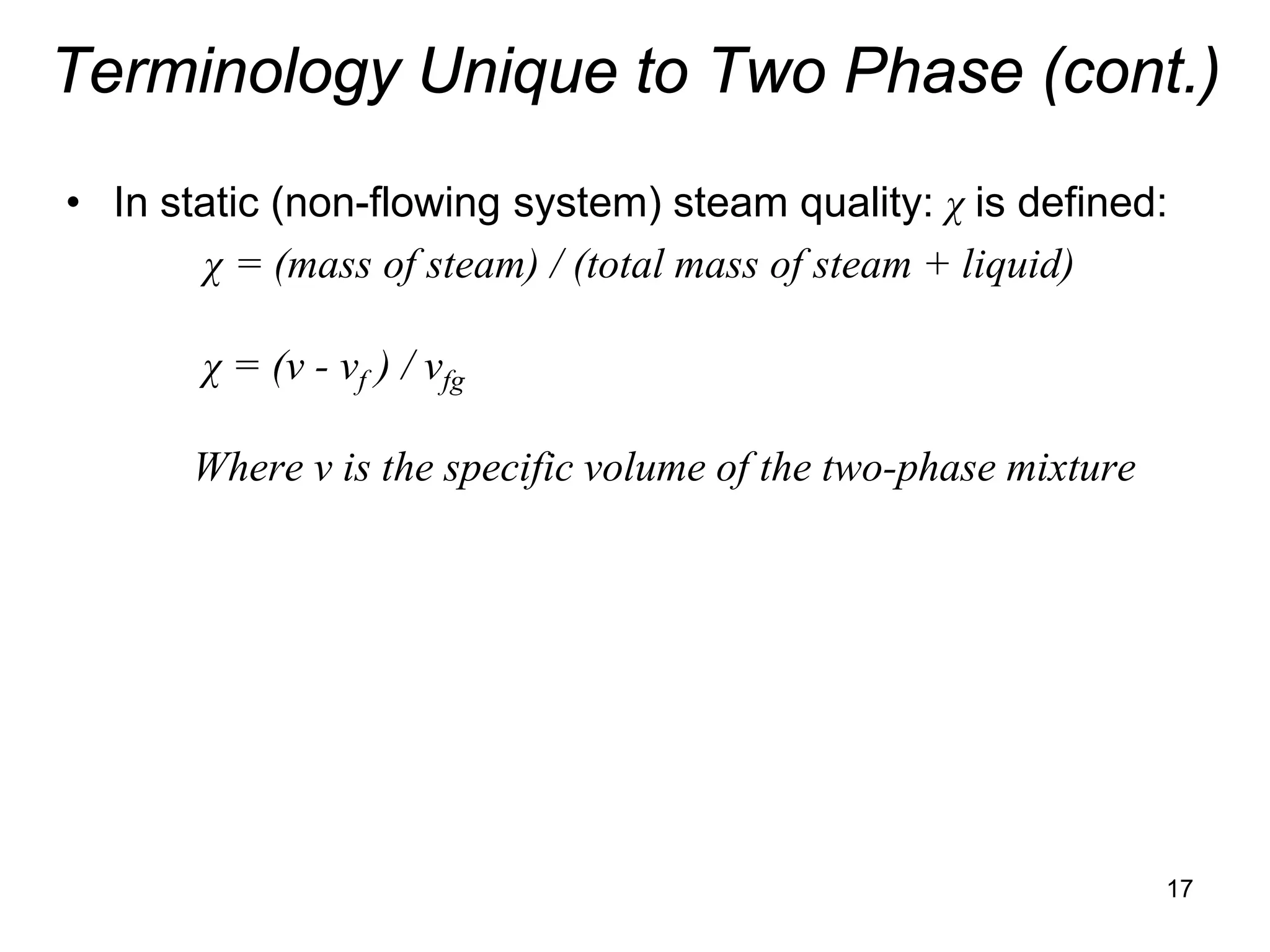
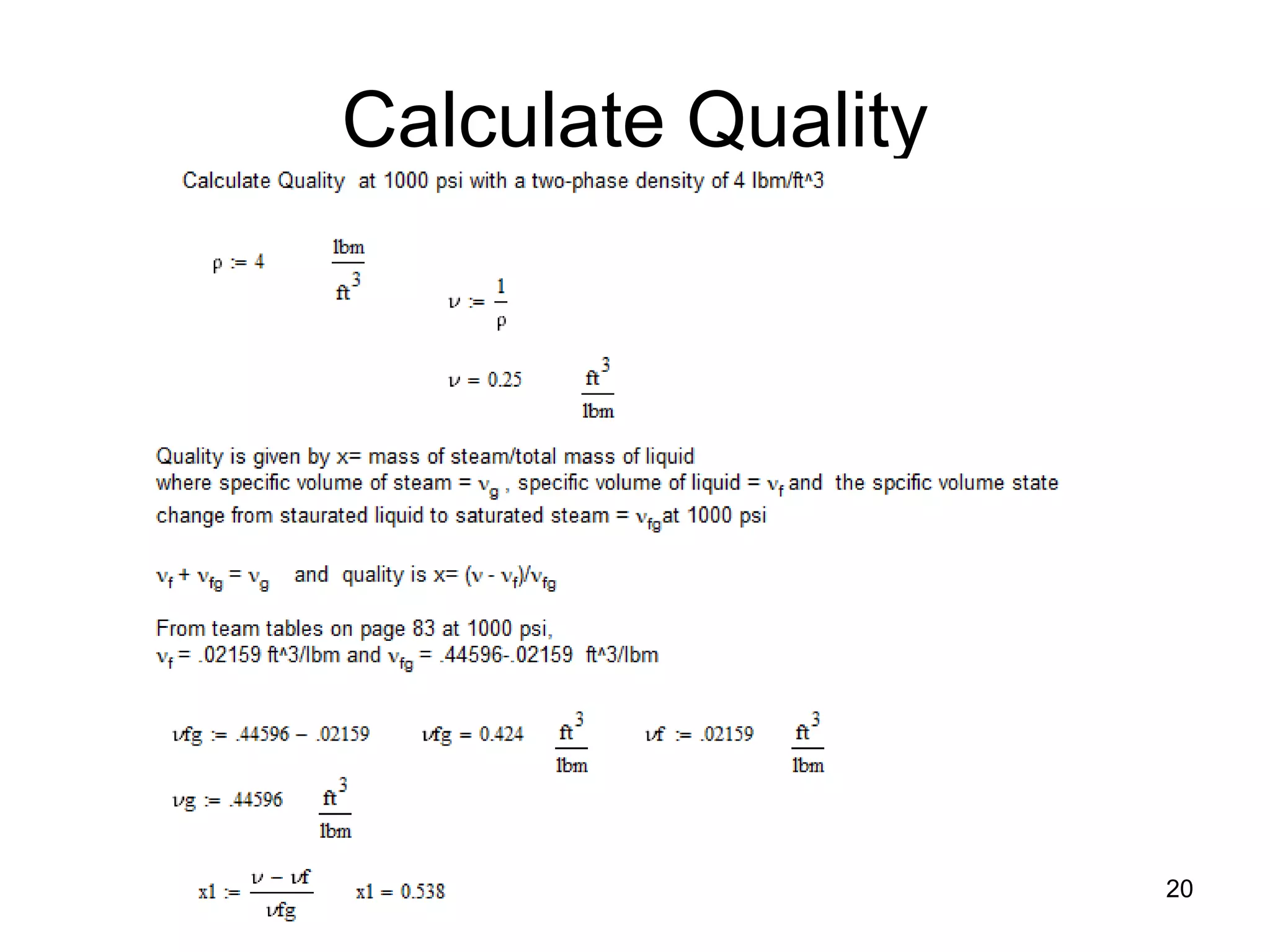
Terminology Unique to Two Phase (cont.)
• In static (non-flowing system) steam quality: χ is defined:
       χ = (mass of steam) / (total mass of steam + liquid)

       χ = (v - vf ) / vfg

       Where v is the specific volume of the two-phase mixture


                                                                 17
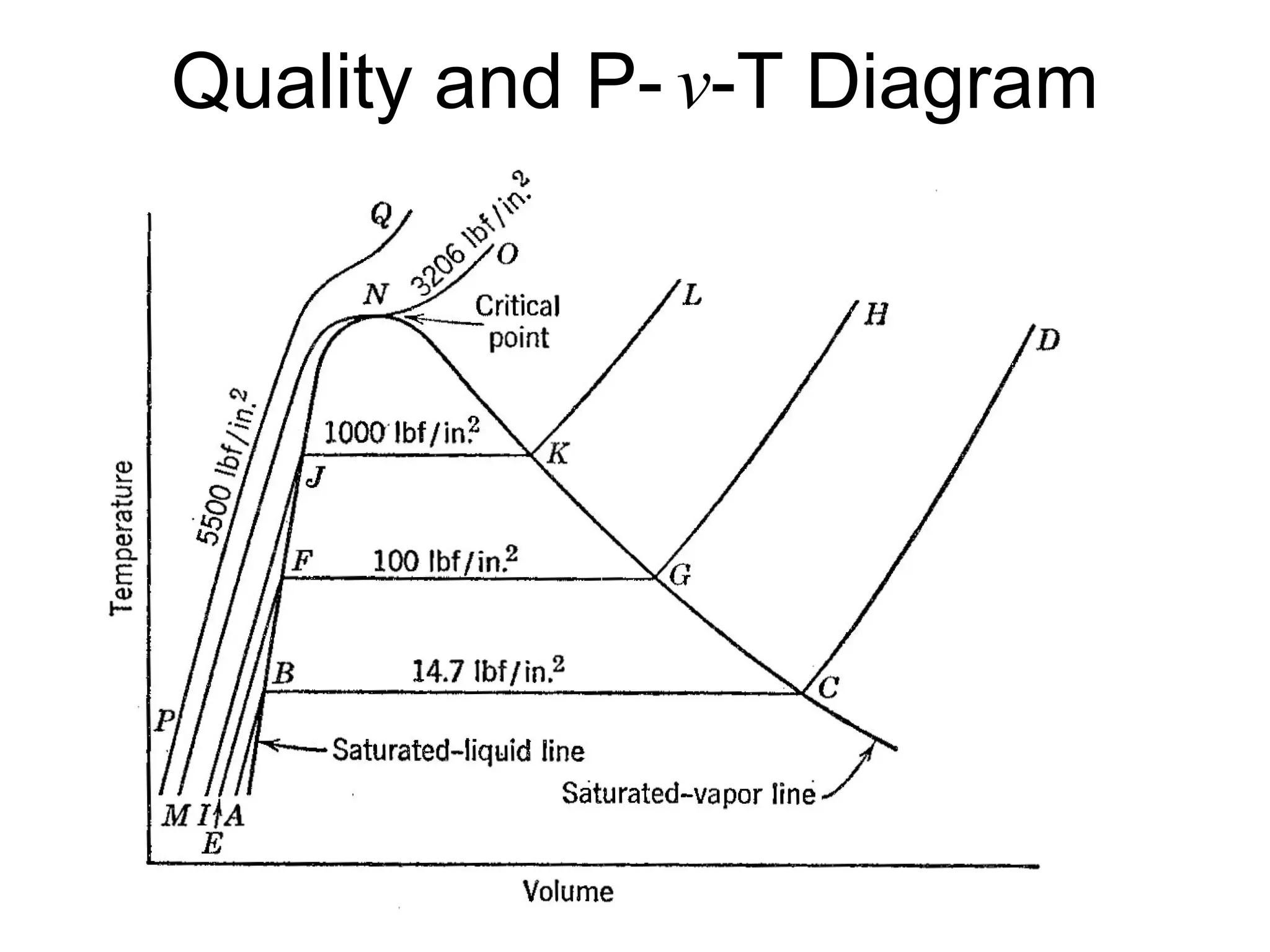
Quality and P- v-T Diagram


                             18
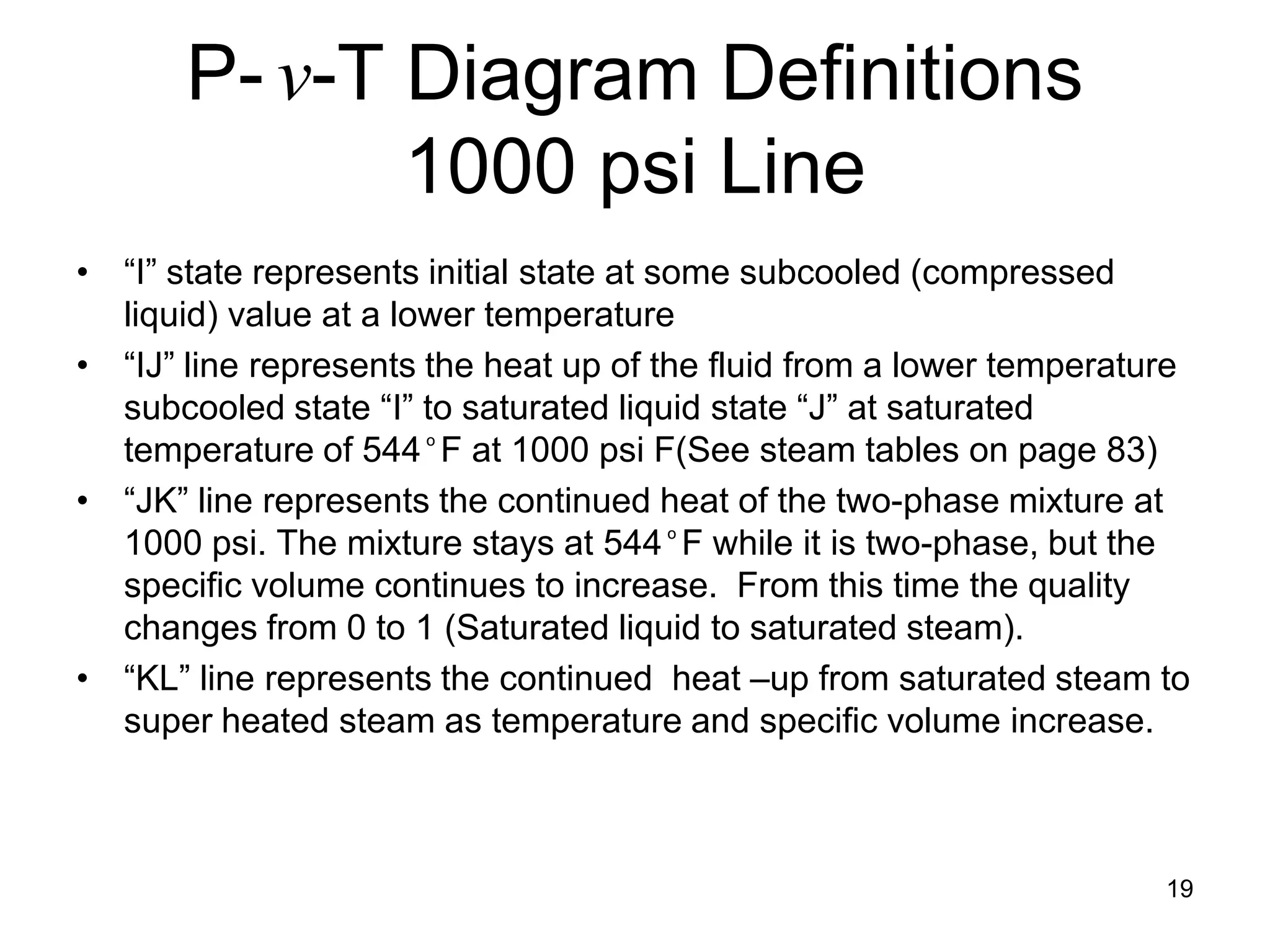
P- v-T Diagram Definitions
              1000 psi Line
• “I” state represents initial state at some subcooled (compressed
  liquid) value at a lower temperature
• “IJ” line represents the heat up of the fluid from a lower temperature
  subcooled state “I” to saturated liquid state “J” at saturated
  temperature of 544 ͦ F at 1000 psi F(See steam tables on page 83)
• “JK” line represents the continued heat of the two-phase mixture at
  1000 psi. The mixture stays at 544 ͦ F while it is two-phase, but the
  specific volume continues to increase. From this time the quality
  changes from 0 to 1 (Saturated liquid to saturated steam).
• “KL” line represents the continued heat –up from saturated steam to
  super heated steam as temperature and specific volume increase.


                                                                      19
Calculate Quality


                    20
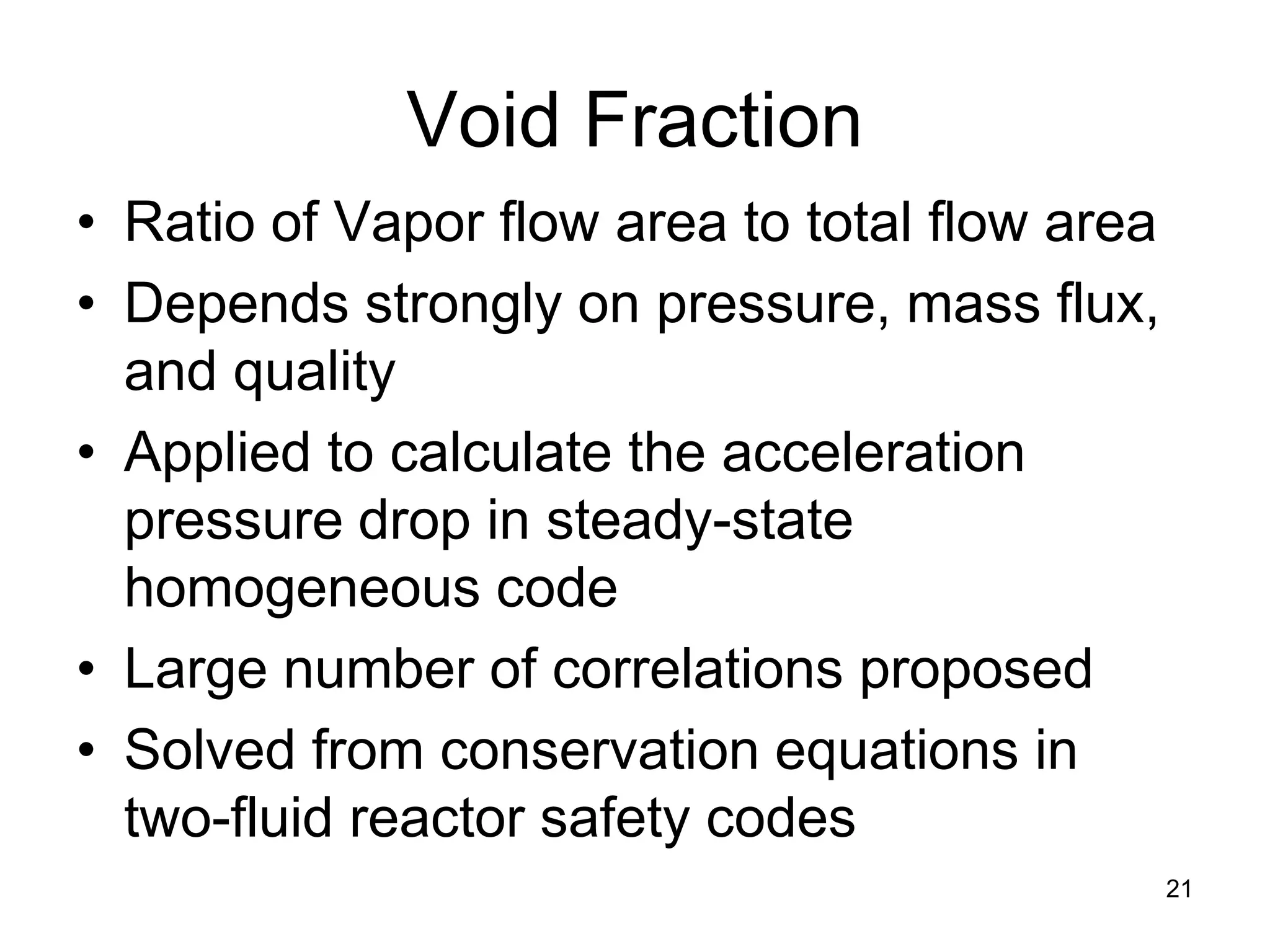
Void Fraction
• Ratio of Vapor flow area to total flow area
• Depends strongly on pressure, mass flux,
  and quality
• Applied to calculate the acceleration
  pressure drop in steady-state
  homogeneous code
• Large number of correlations proposed
• Solved from conservation equations in
  two-fluid reactor safety codes
                                                21
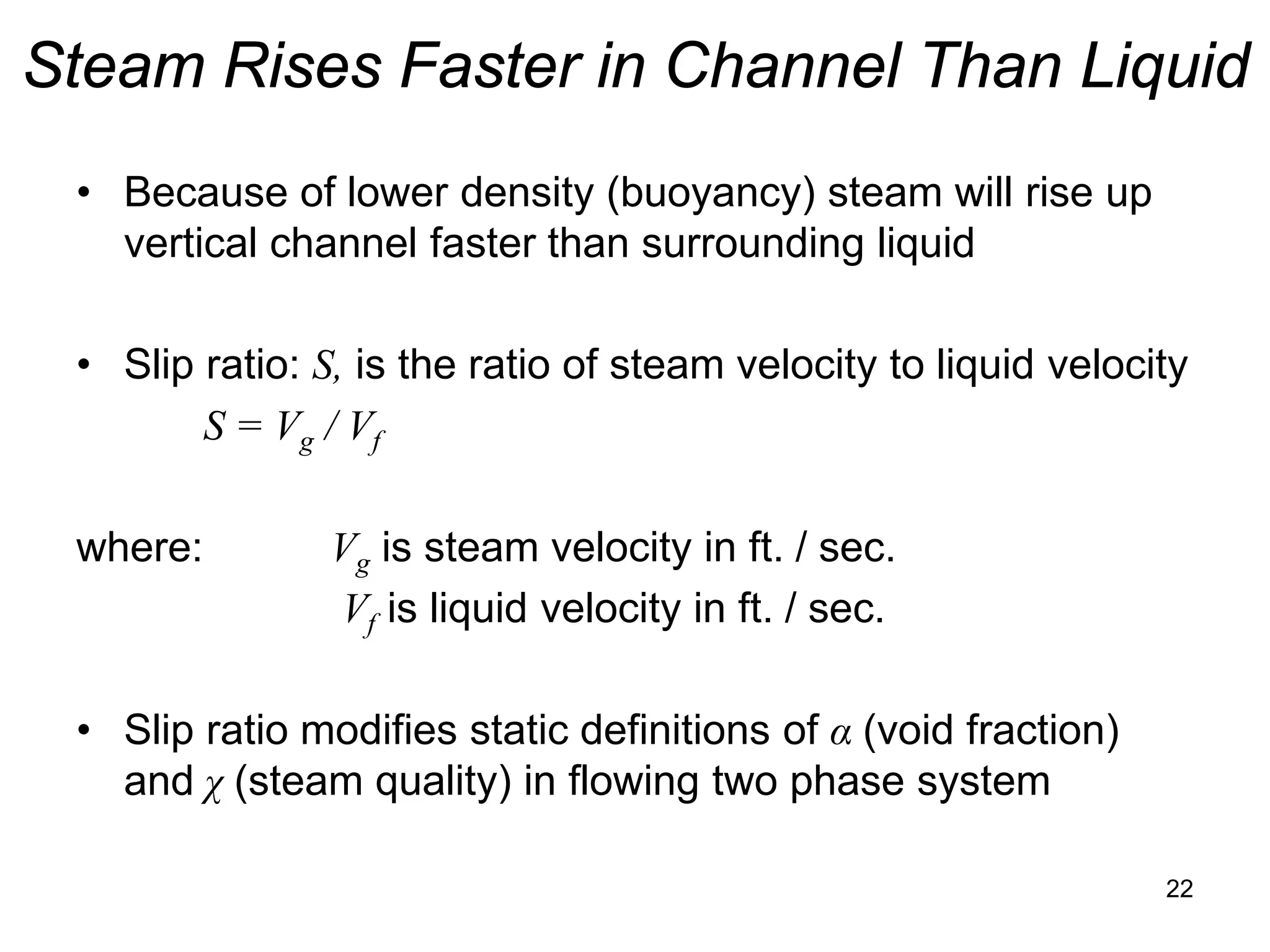
Steam Rises Faster in Channel Than Liquid
 • Because of lower density (buoyancy) steam will rise up
   vertical channel faster than surrounding liquid

 • Slip ratio: S, is the ratio of steam velocity to liquid velocity
        S = Vg / Vf

 where:         Vg is steam velocity in ft. / sec.
                Vf is liquid velocity in ft. / sec.

 • Slip ratio modifies static definitions of α (void fraction)
   and χ (steam quality) in flowing two phase system

                                                                 22
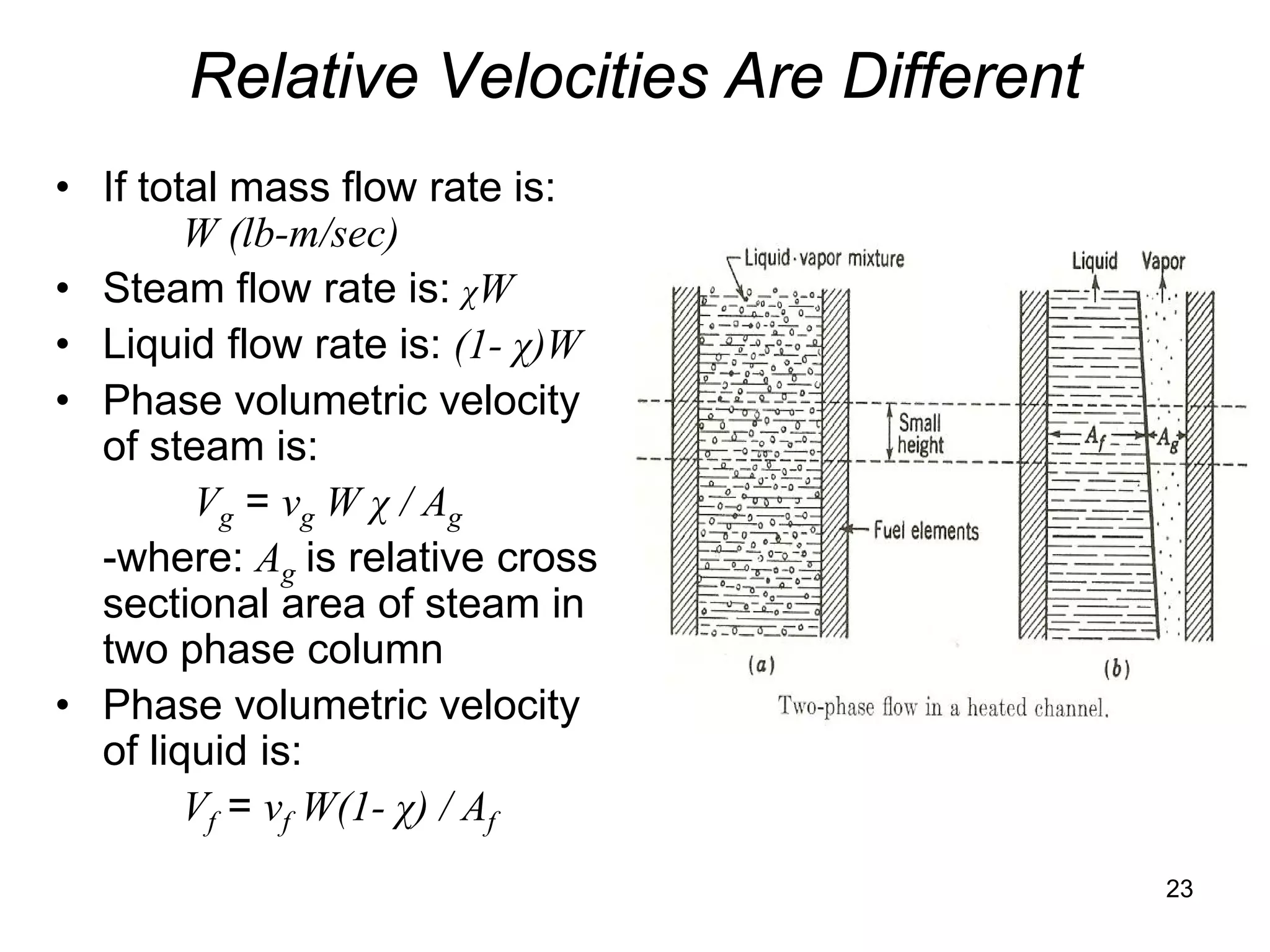
Relative Velocities Are Different
• If total mass flow rate is:
        W (lb-m/sec)
• Steam flow rate is: χW
• Liquid flow rate is: (1- χ)W
• Phase volumetric velocity
  of steam is:
        Vg = vg W χ / Ag
  -where: Ag is relative cross
  sectional area of steam in
  two phase column
• Phase volumetric velocity
  of liquid is:
        Vf = vf W(1- χ) / Af
                                           23
Definition of Slip in Terms of
      Steam Quality and Void Fraction
• Slip: S = Vg / Vf
• Slip defined in terms of steam quality by combining:
       Vg = vg W χ / Ag
       Vf = vf W(1- χ) / Af
• This yields:
       S = (χ / 1- χ)(Af / Ag)(vg / vf)
• Noting that in small slice of column, ratio of steam to total
  mixture is: α = Ag / Ag+ Af , rearranging this:
       (Af / Ag) = (1 – α )/ α
• Slip can then be expressed:
       S = (χ / 1- χ)[(1 – α )/ α](vg / vf)
                                                              24
Definition of Void Fraction in Terms of
          Steam Quality and Slip
• Slip equation can be rearranged to define void fraction: α
  in terms of steam quality and Slip:
                                 1
                  α=
                            (1 − χ )  v f   
                       1+ [         ]       S
                               χ  vg
                                             
                                             
• When S = 1: steam and liquid move at exact same speed

Effect of slip:

• Slip decreases void fraction α(χ) below that which exists in
  situation of no slip between steam and liquid             25
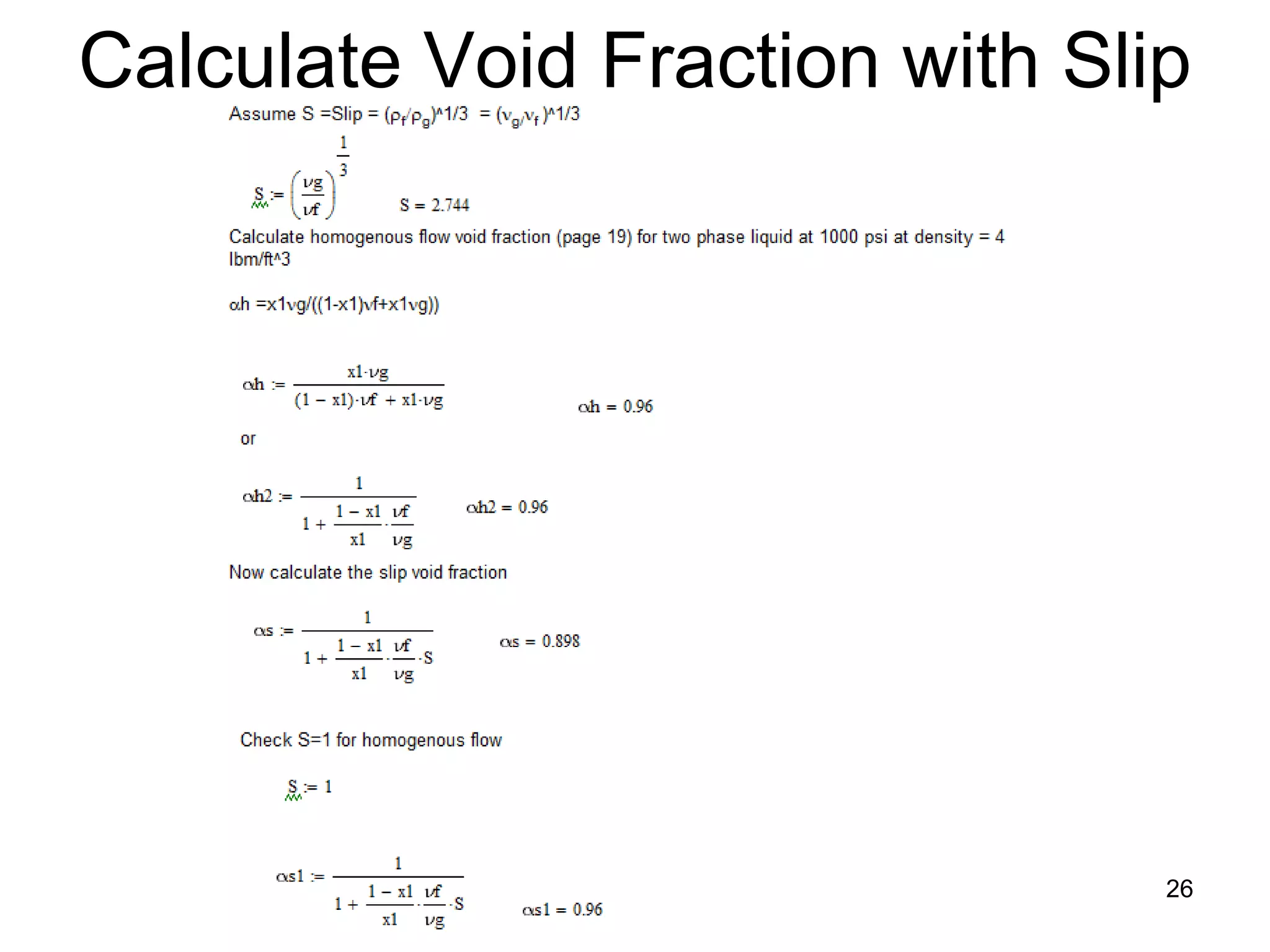
Calculate Void Fraction with Slip


                                26
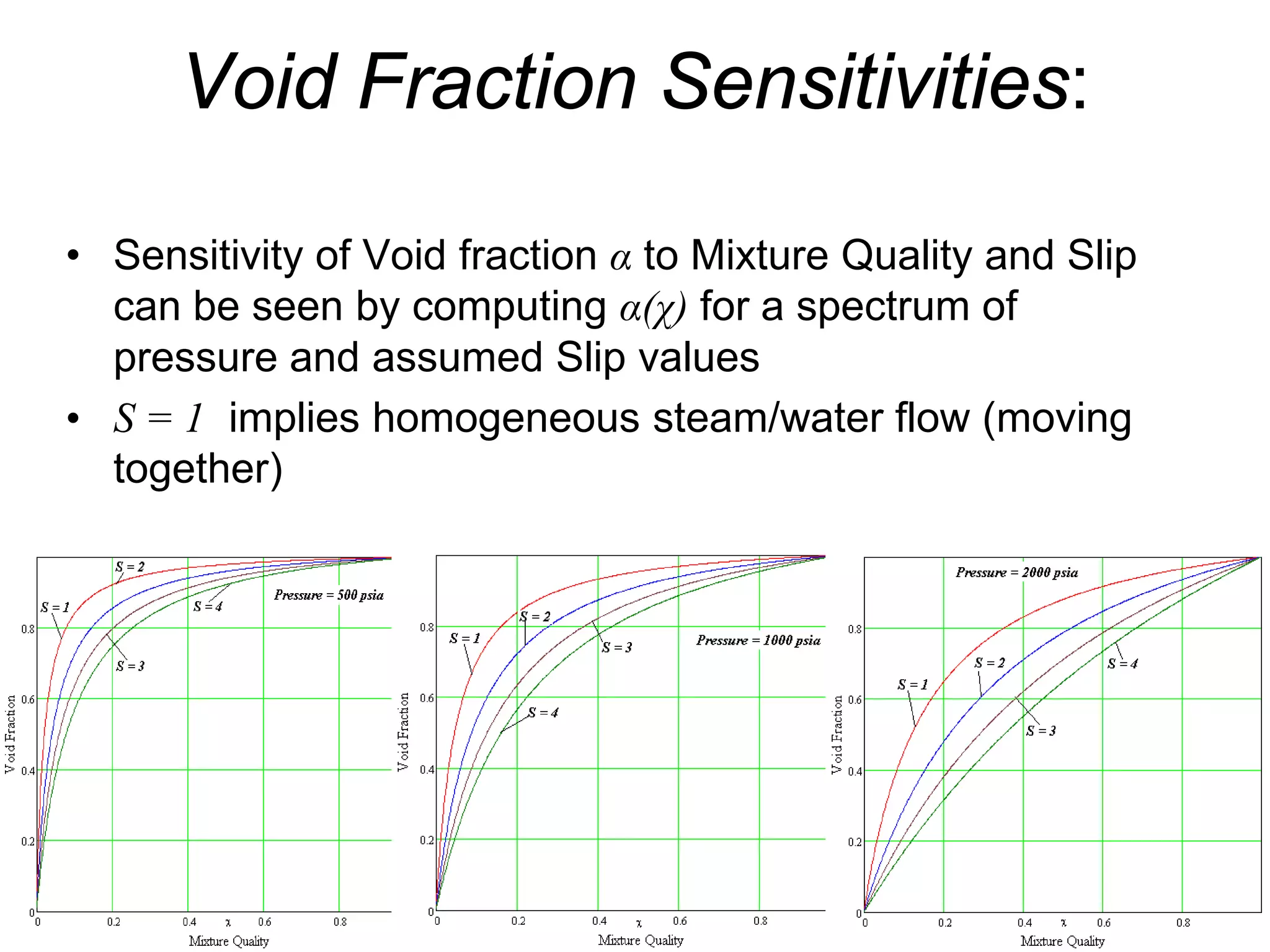
Void Fraction Sensitivities:

• Sensitivity of Void fraction α to Mixture Quality and Slip
  can be seen by computing α(χ) for a spectrum of
  pressure and assumed Slip values
• S = 1 implies homogeneous steam/water flow (moving
  together)


                                                               27
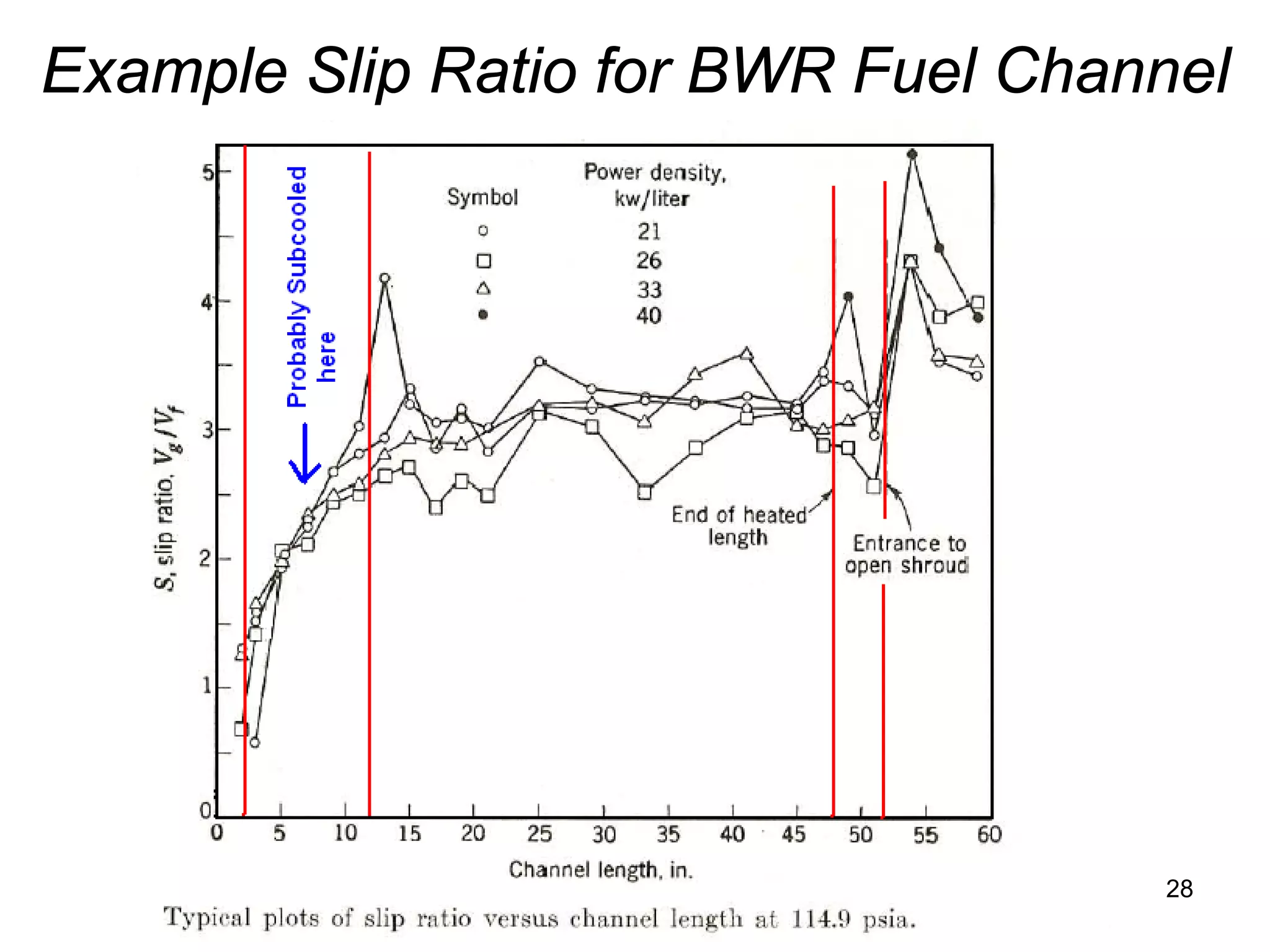
Example Slip Ratio for BWR Fuel Channel


                                    28
What Does Slip Mean to the Core Fluid Flow?
  Low S value (S = 1) implies:
  • Voids and water travel about same speed

  Higher S value (S = 2,3) implies:
  • Steam carries out higher enthalpy water thus heat is
    removed faster
  • Voids swept out of channel faster which is benefit for
    neutron economy
  • Predicting Slip from first principles is not easy
  • Designers rely upon tests and scaling-up from previous


                                                        29
4. Two Phase Heat Transfer
Rates from Fuel to Coolant and
       Boiling Transition


                             30
Two Phase Heat Transfer Regimes


                             31
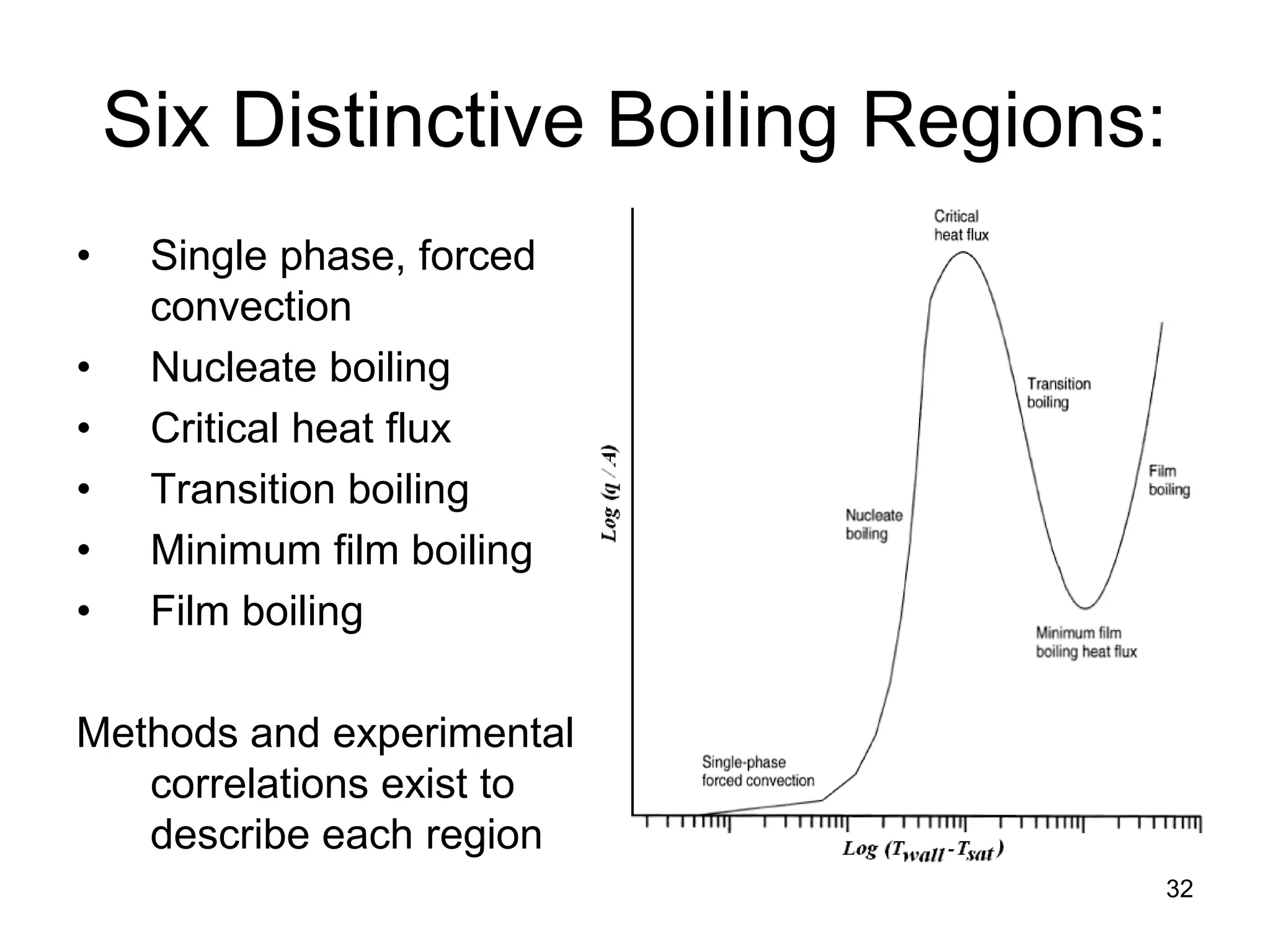
Six Distinctive Boiling Regions:
•    Single phase, forced
     convection
•    Nucleate boiling
•    Critical heat flux
•    Transition boiling
•    Minimum film boiling
•    Film boiling

Methods and experimental
   correlations exist to
   describe each region
                                   32
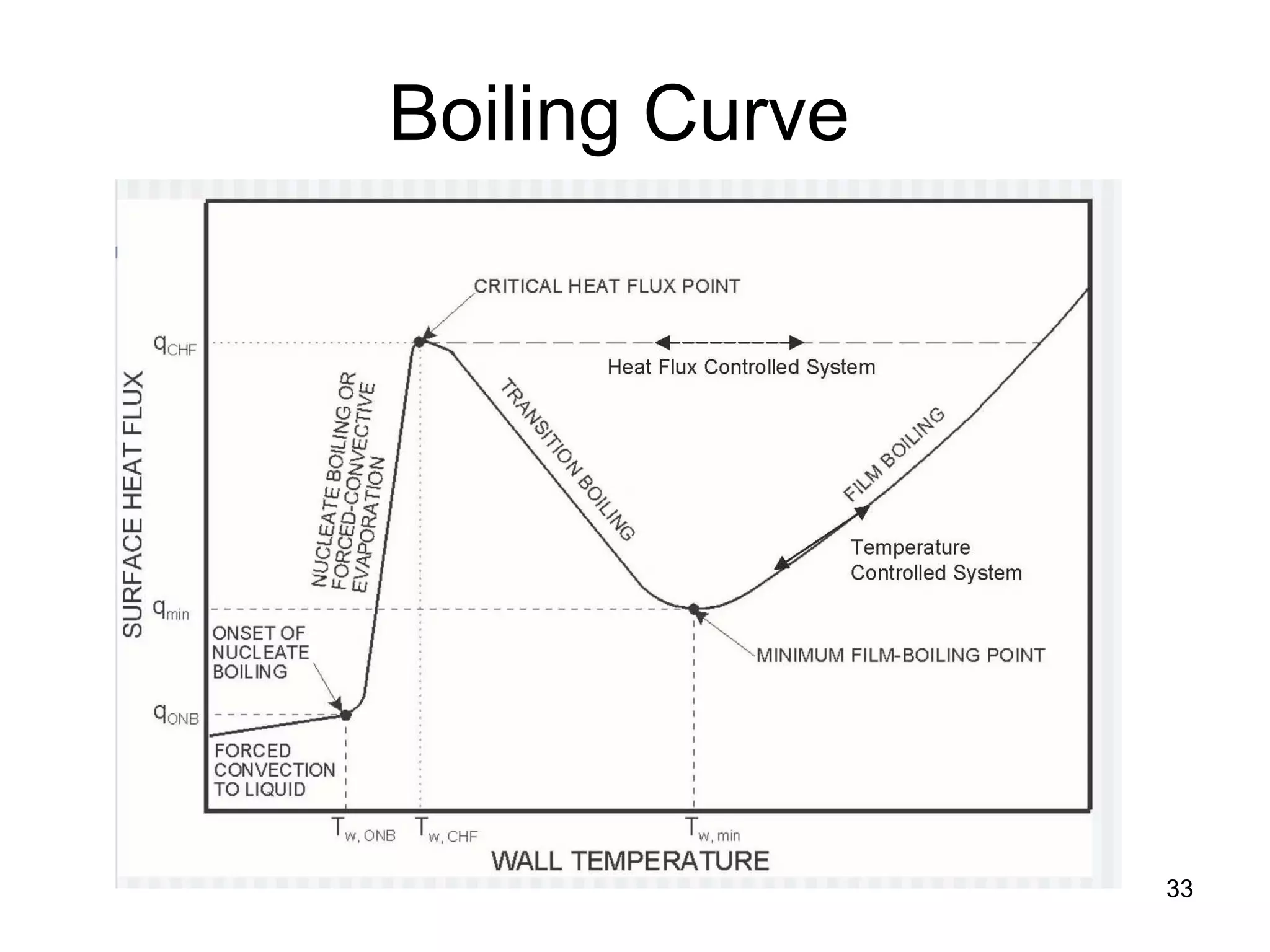
Boiling Curve


                33
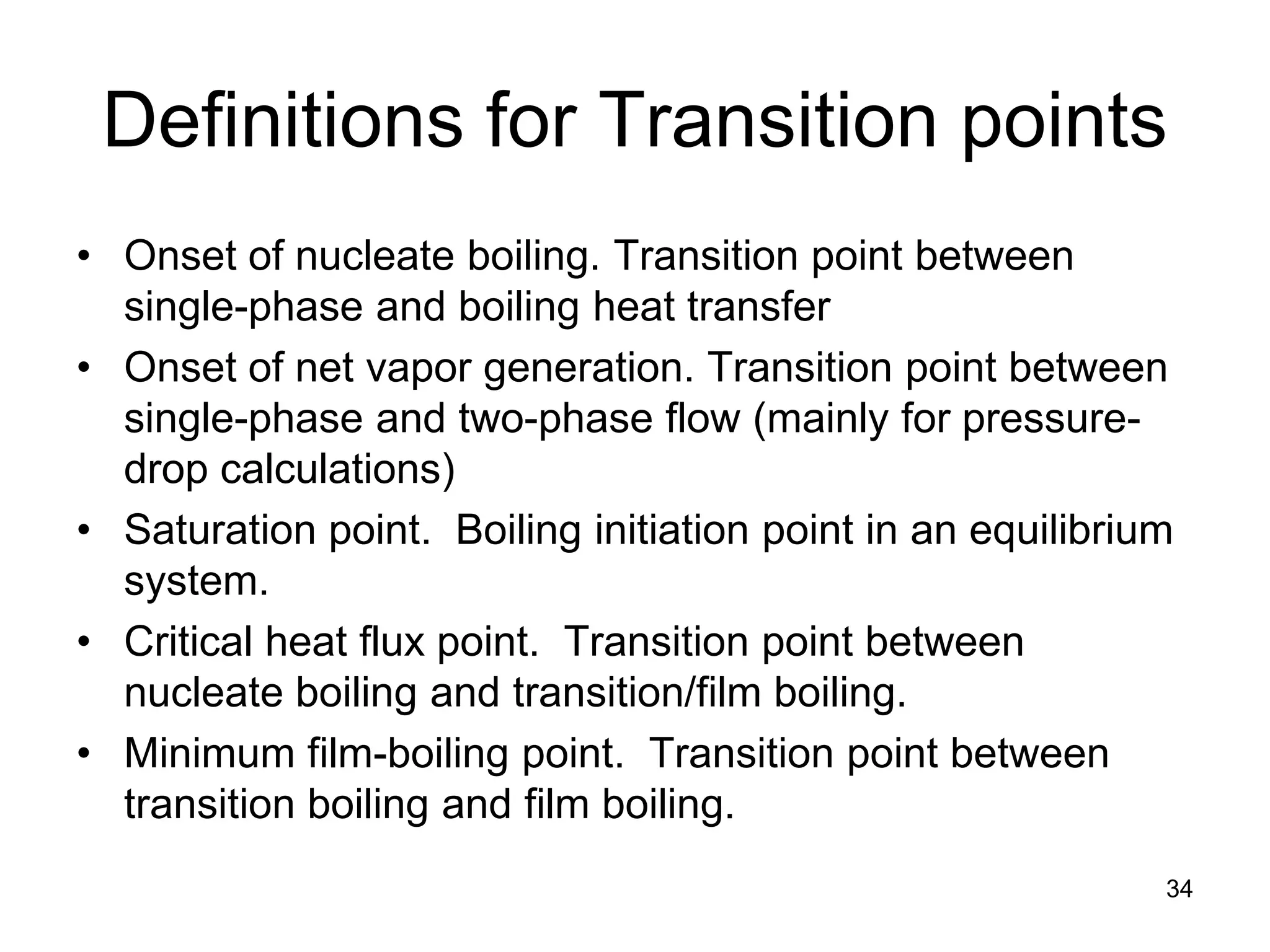
Definitions for Transition points
• Onset of nucleate boiling. Transition point between
  single-phase and boiling heat transfer
• Onset of net vapor generation. Transition point between
  single-phase and two-phase flow (mainly for pressure-
  drop calculations)
• Saturation point. Boiling initiation point in an equilibrium
  system.
• Critical heat flux point. Transition point between
  nucleate boiling and transition/film boiling.
• Minimum film-boiling point. Transition point between
  transition boiling and film boiling.
                                                             34
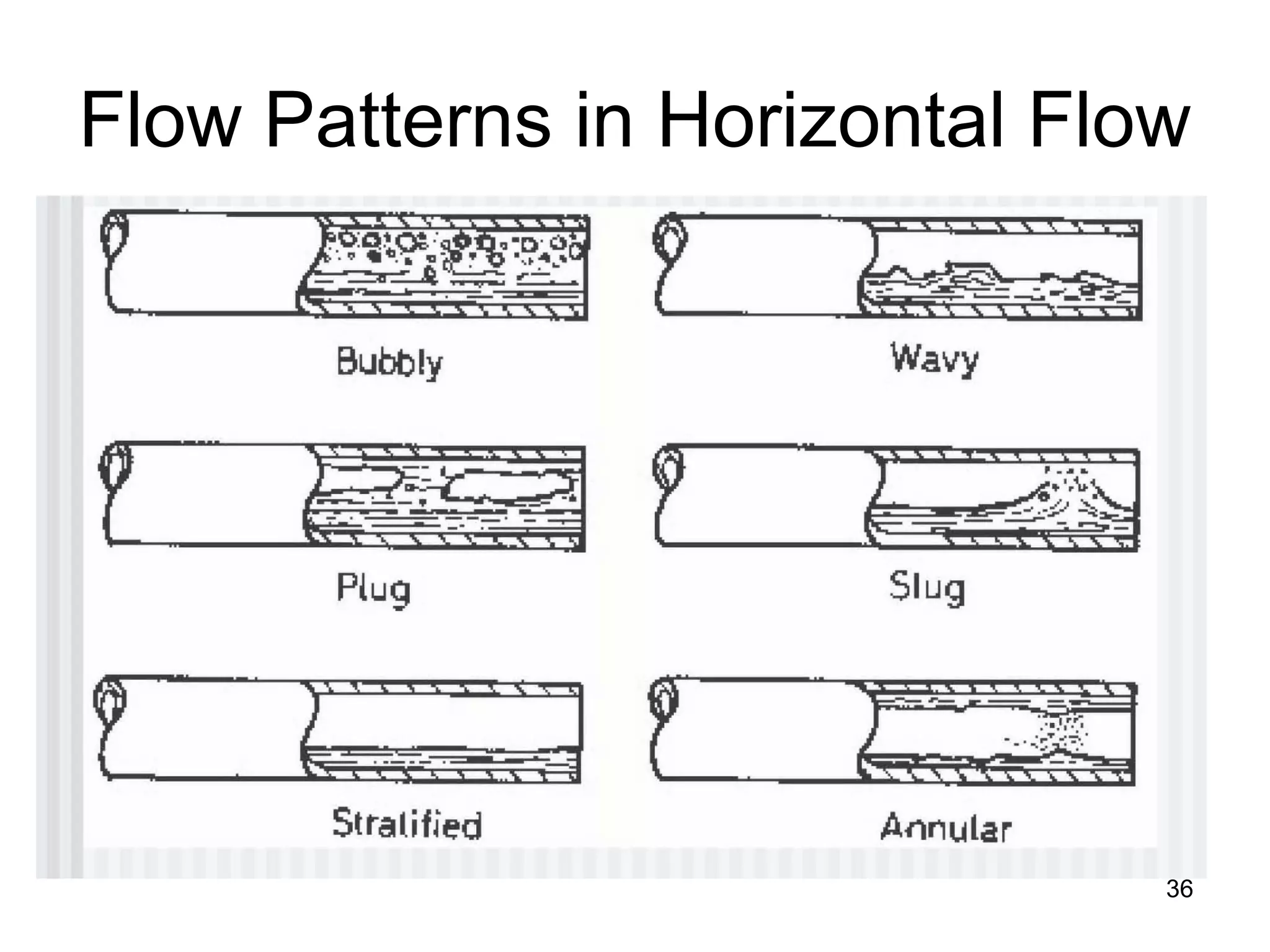
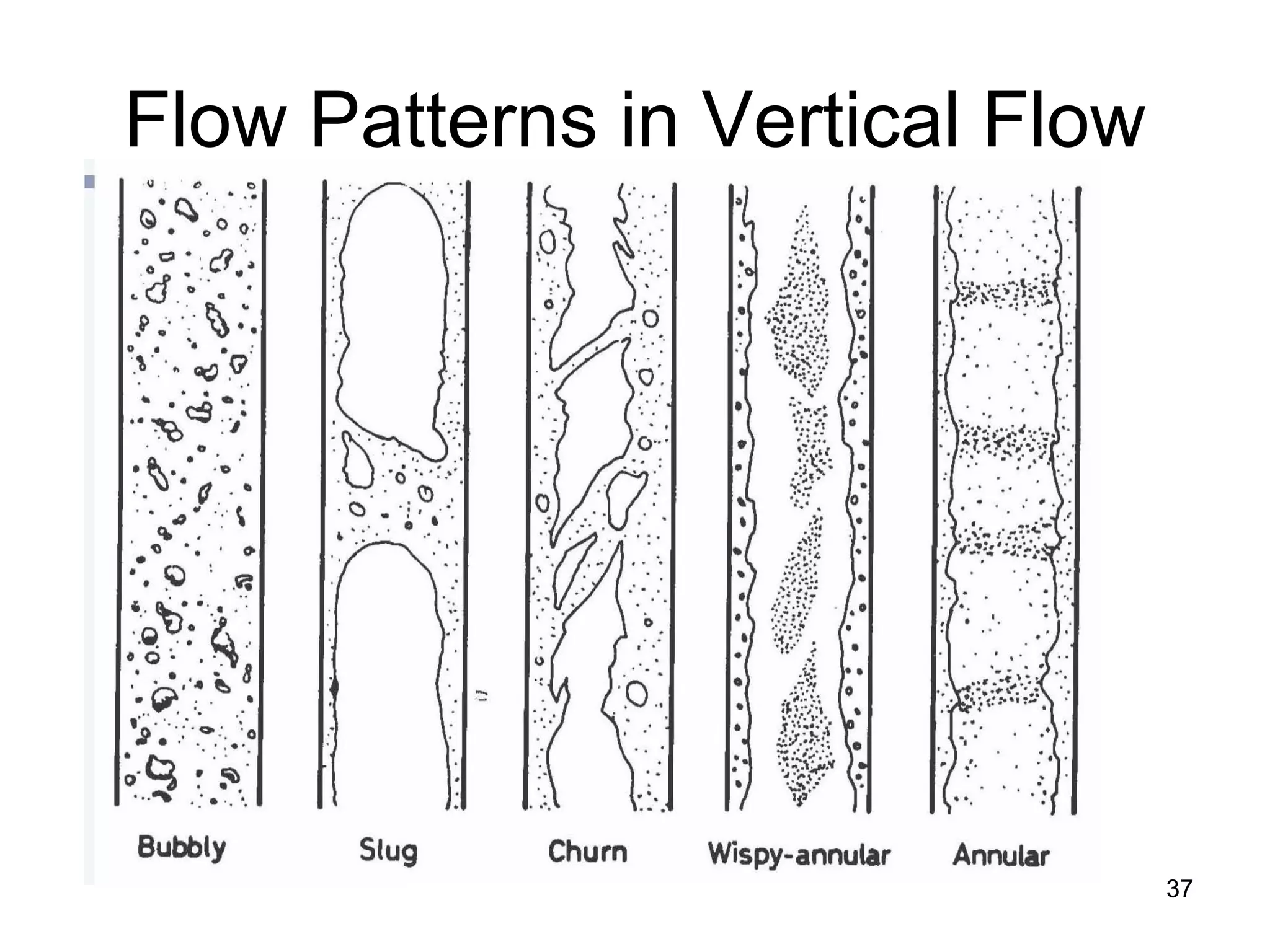
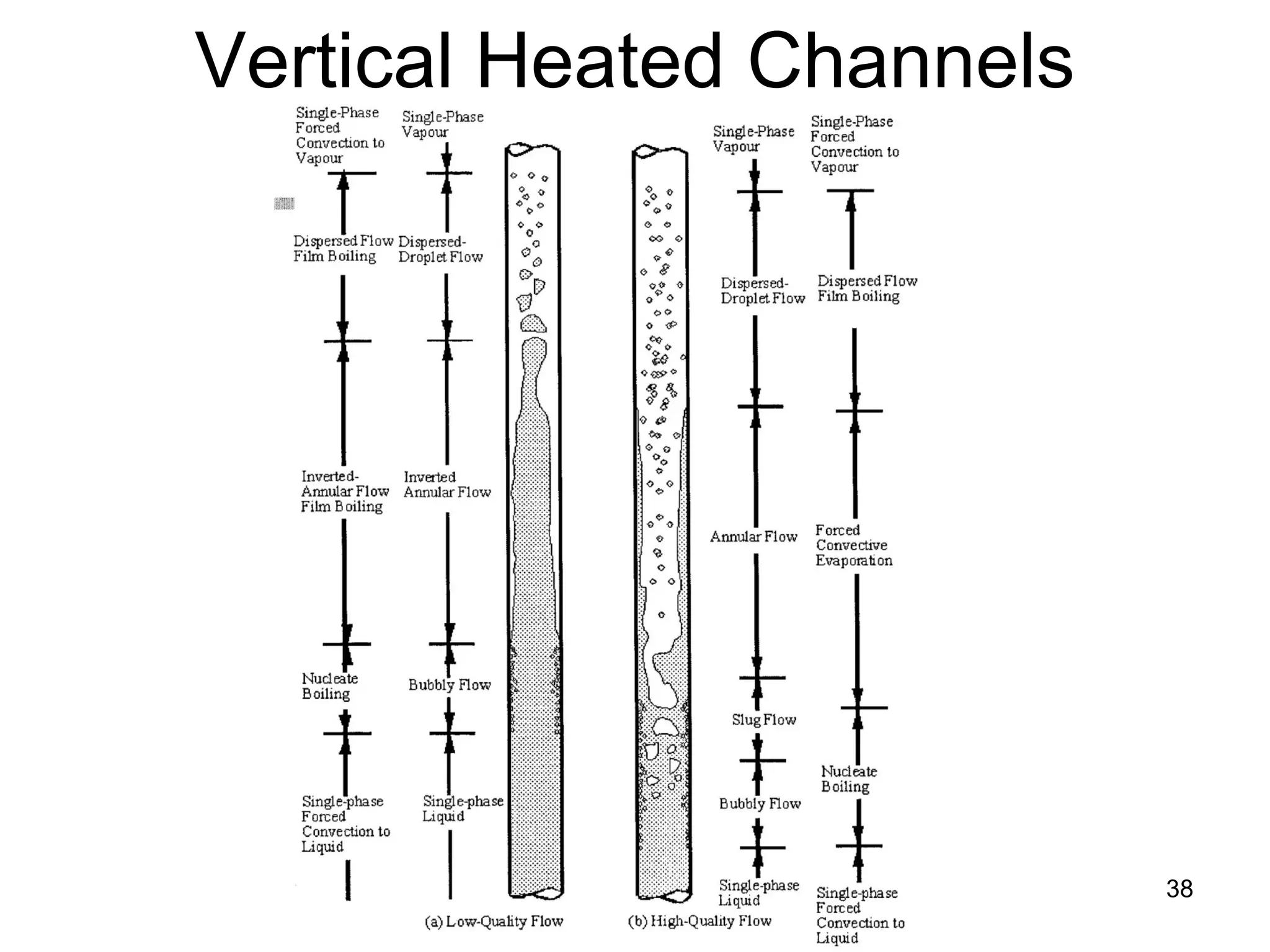
Flow Patterns
• Distribution of phases inside a confined
  area
• Depend strongly on liquid and vapor
  velocities
• Channel geometry
• Surface Heating


                                             35
Flow Patterns in Horizontal Flow


                               36
Flow Patterns in Vertical Flow


                                 37
Vertical Heated Channels


                           38
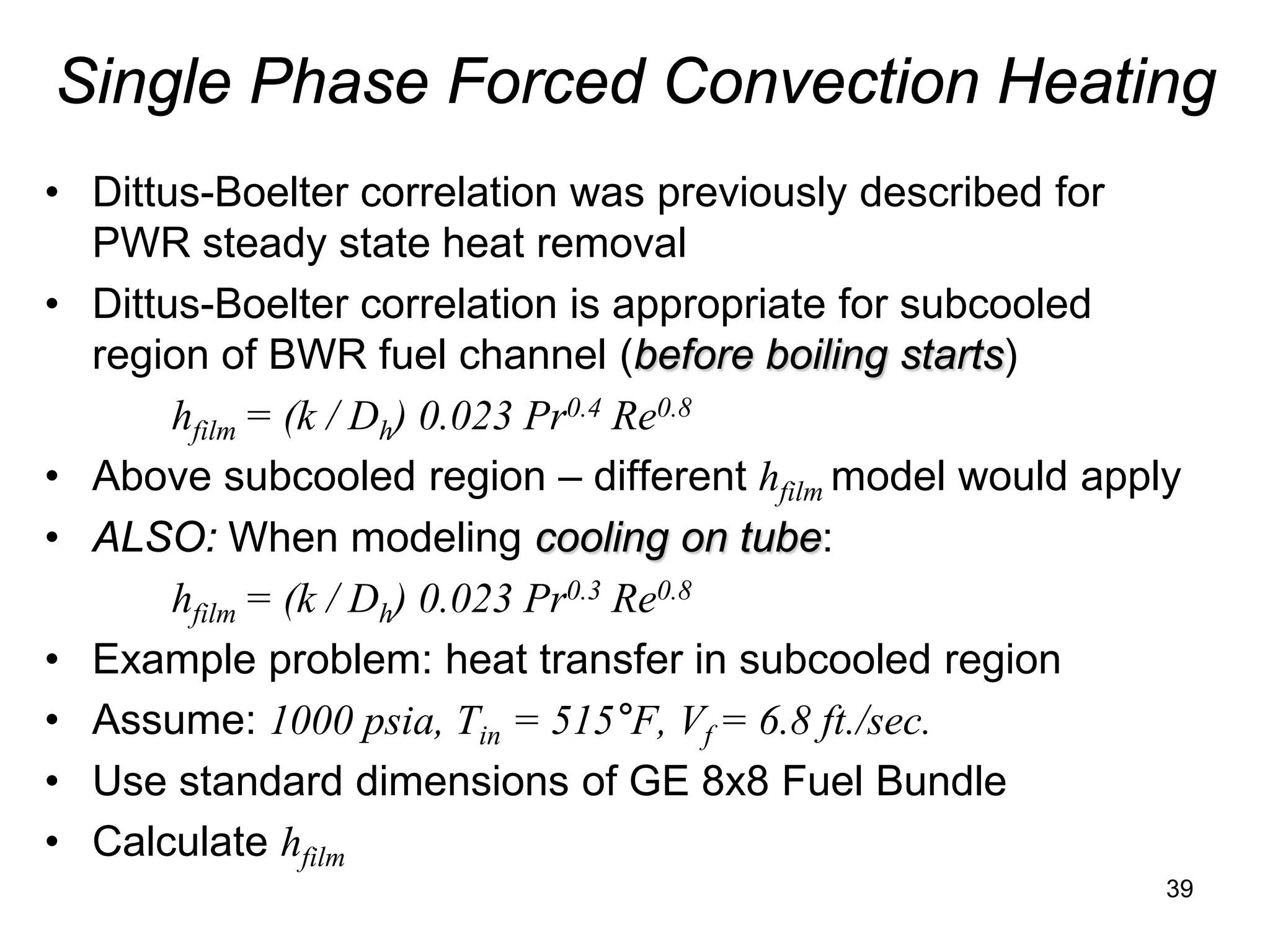
Single Phase Forced Convection Heating
• Dittus-Boelter correlation was previously described for
  PWR steady state heat removal
• Dittus-Boelter correlation is appropriate for subcooled
  region of BWR fuel channel (before boiling starts)
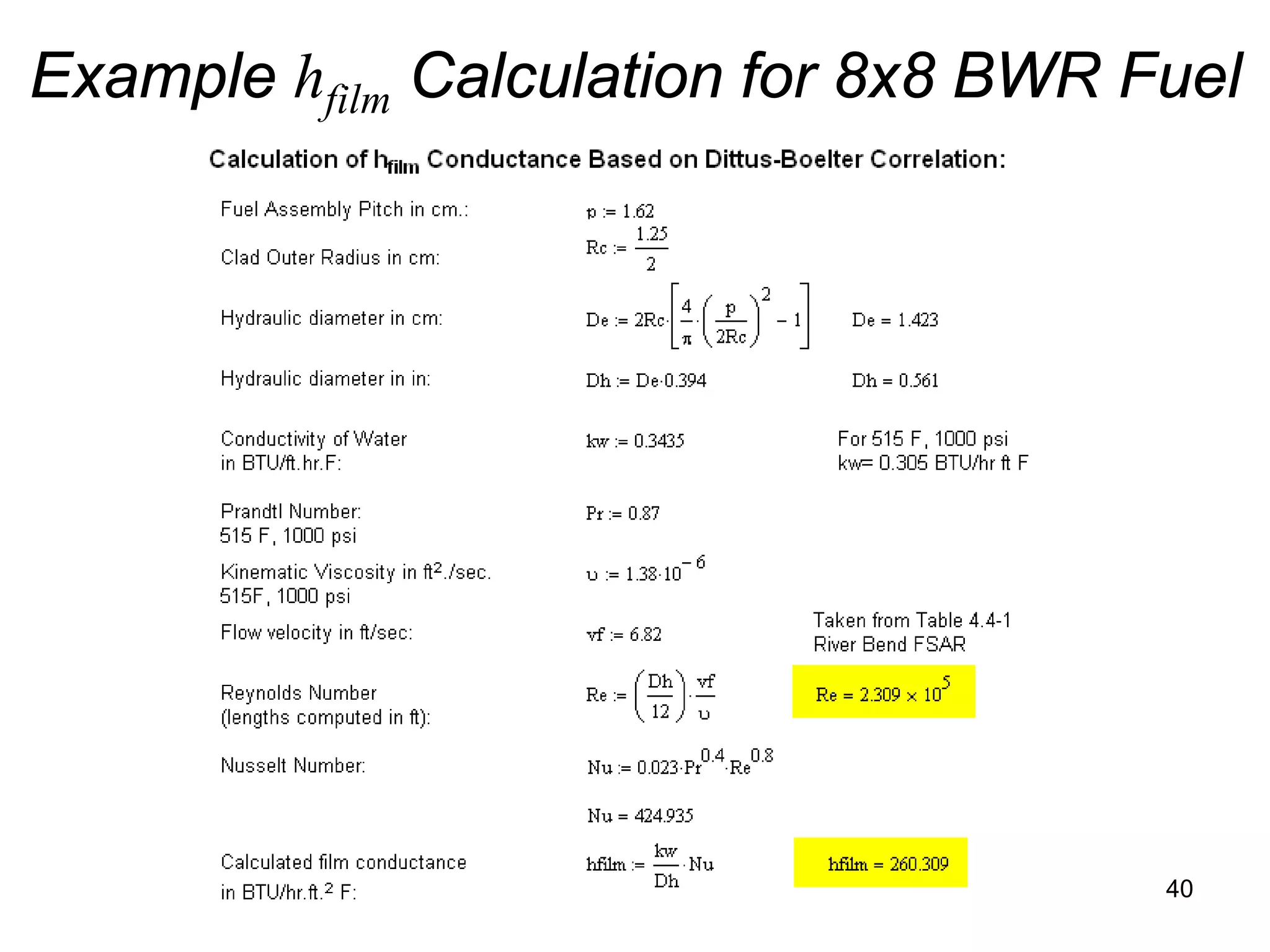
       hfilm = (k / Dh) 0.023 Pr0.4 Re0.8
• Above subcooled region – different hfilm model would apply
• ALSO: When modeling cooling on tube:
       hfilm = (k / Dh) 0.023 Pr0.3 Re0.8
• Example problem: heat transfer in subcooled region
• Assume: 1000 psia, Tin = 515°F, Vf = 6.8 ft./sec.
• Use standard dimensions of GE 8x8 Fuel Bundle
• Calculate hfilm
                                                           39
Example hfilm Calculation for 8x8 BWR Fuel


                                       40
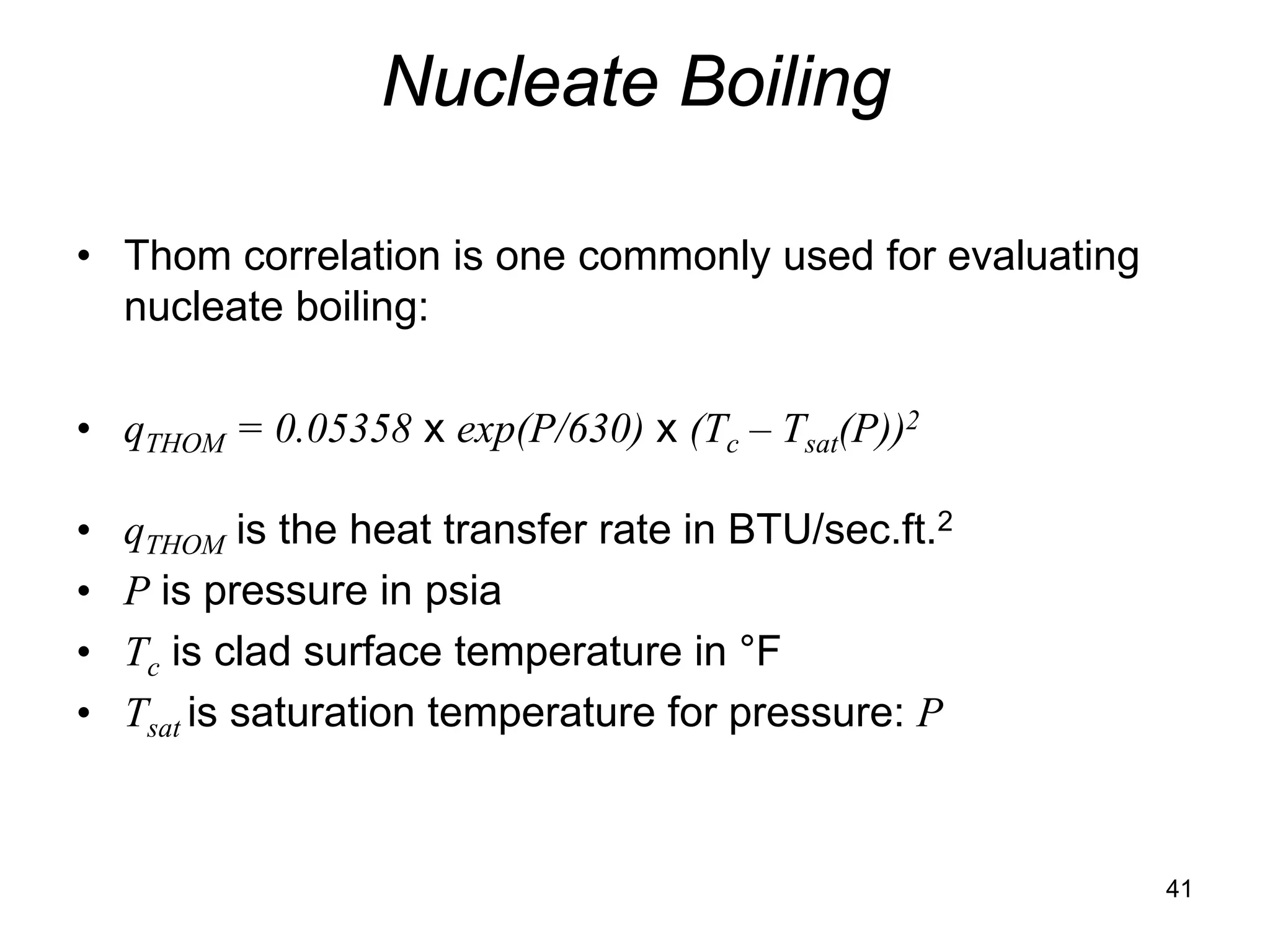
Nucleate Boiling

• Thom correlation is one commonly used for evaluating
  nucleate boiling:

• qTHOM = 0.05358 x exp(P/630) x (Tc – Tsat(P))2

•   qTHOM is the heat transfer rate in BTU/sec.ft.2
•   P is pressure in psia
•   Tc is clad surface temperature in °F
•   Tsat is saturation temperature for pressure: P


                                                         41
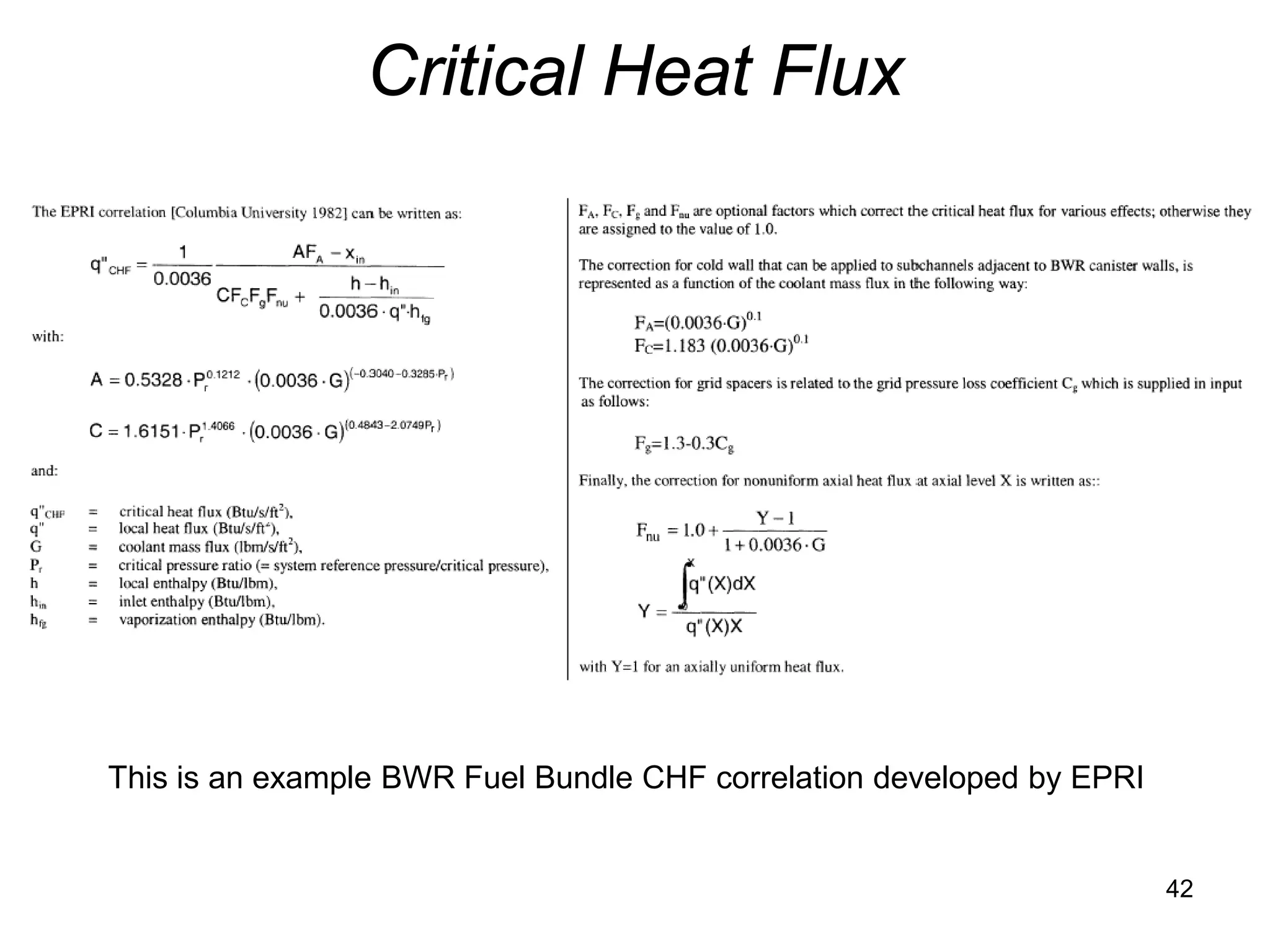
Critical Heat Flux


This is an example BWR Fuel Bundle CHF correlation developed by EPRI


                                                                       42
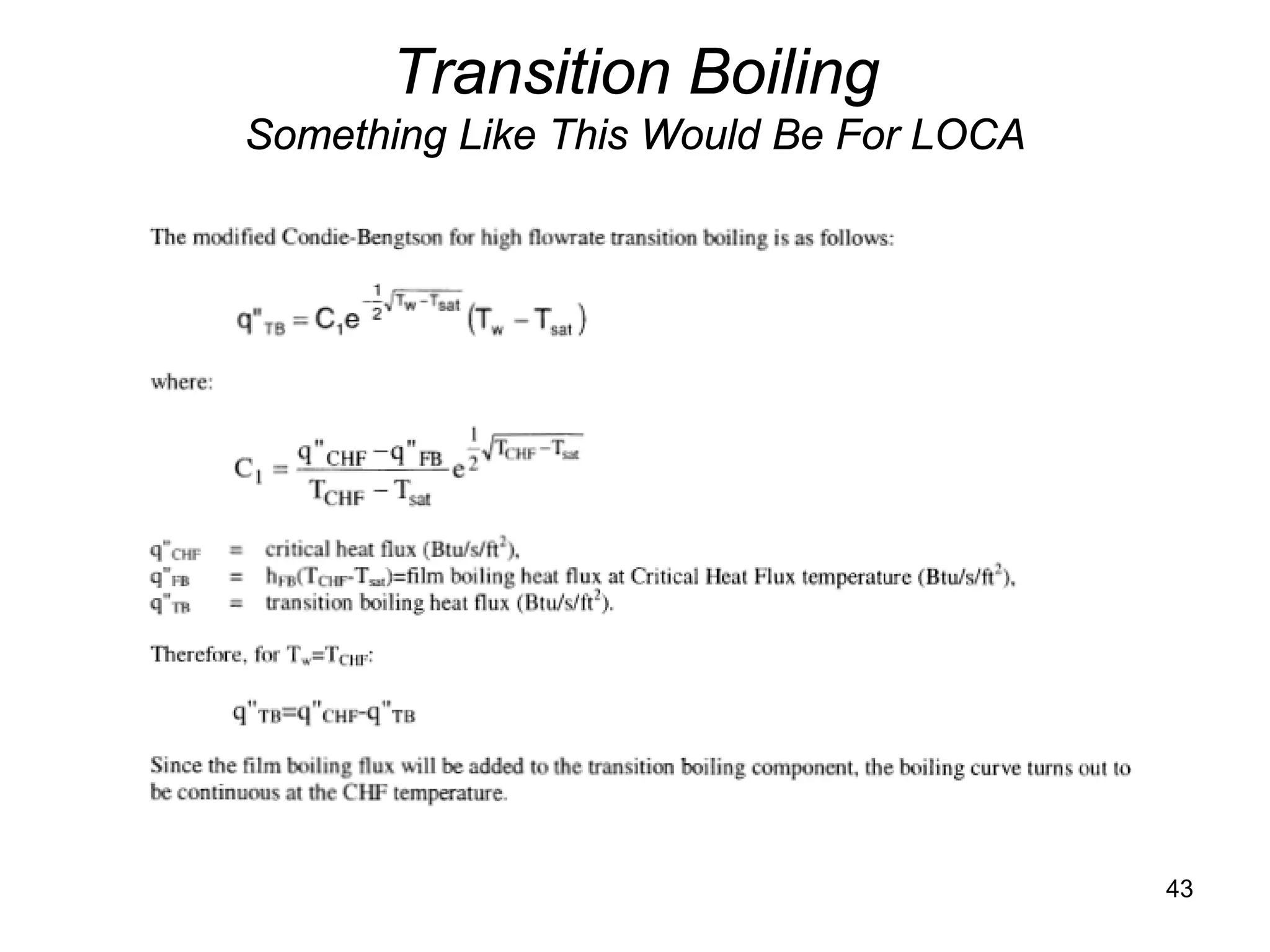
Transition Boiling
Something Like This Would Be For LOCA


                                        43
5. Steady State Core
Temperature Profiles


                       44
BWR Axial Heat Transfer


                          45
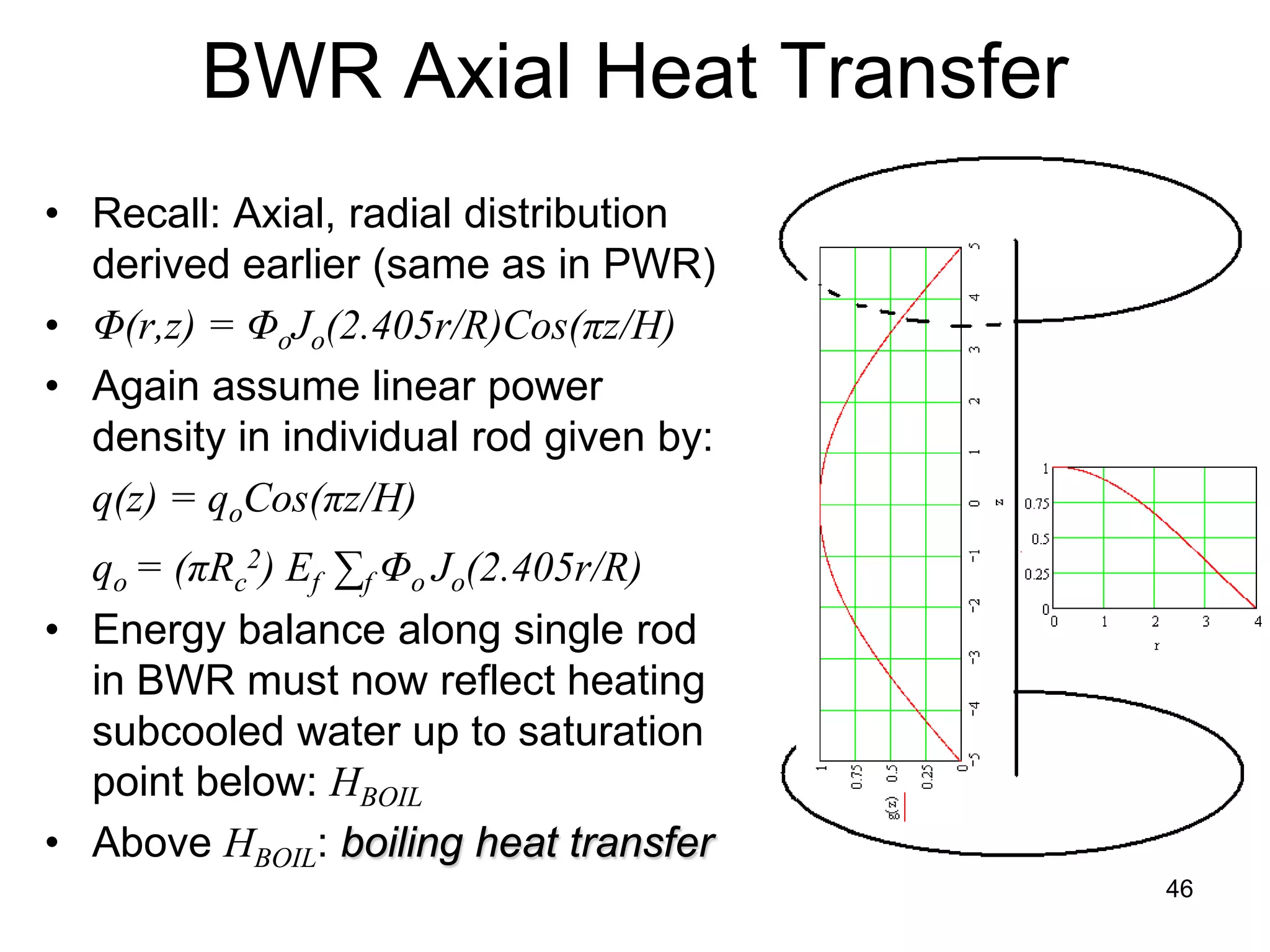
BWR Axial Heat Transfer
• Recall: Axial, radial distribution
  derived earlier (same as in PWR)
• Φ(r,z) = ΦoJo(2.405r/R)Cos(πz/H)
• Again assume linear power
  density in individual rod given by:
  q(z) = qoCos(πz/H)
  qo = (πRc2) Ef ∑f Φo Jo(2.405r/R)
• Energy balance along single rod
  in BWR must now reflect heating
  subcooled water up to saturation
  point below: HBOIL
• Above HBOIL: boiling heat transfer
                                        46
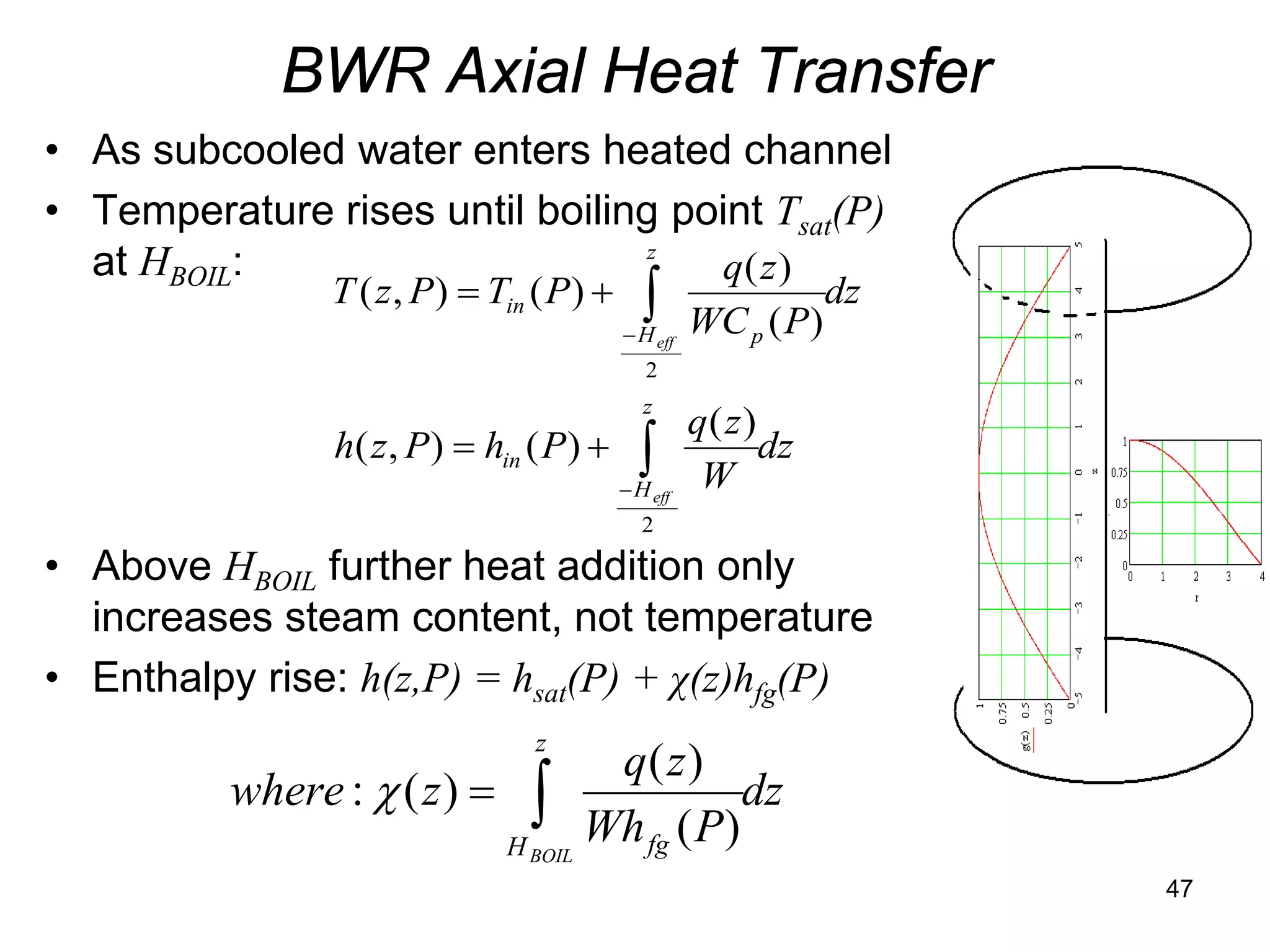
BWR Axial Heat Transfer
• As subcooled water enters heated channel
• Temperature rises until boiling point Tsat(P)
                                 z
  at HBOIL:                         q( z )
                T ( z , P ) = Tin ( P ) +      ∫
                                            − H eff   WC p ( P )
                                                                   dz
                                               2
                                               z
                                                      q( z )
                h( z , P ) = hin ( P ) +      ∫
                                            − H eff    W
                                                             dz
                                               2

• Above HBOIL further heat addition only
  increases steam content, not temperature
• Enthalpy rise: h(z,P) = hsat(P) + χ(z)hfg(P)
                                  z
                                   q( z )
          where : χ ( z ) = ∫                dz
                           H BOIL
                                  Wh fg ( P)
                                                                        47
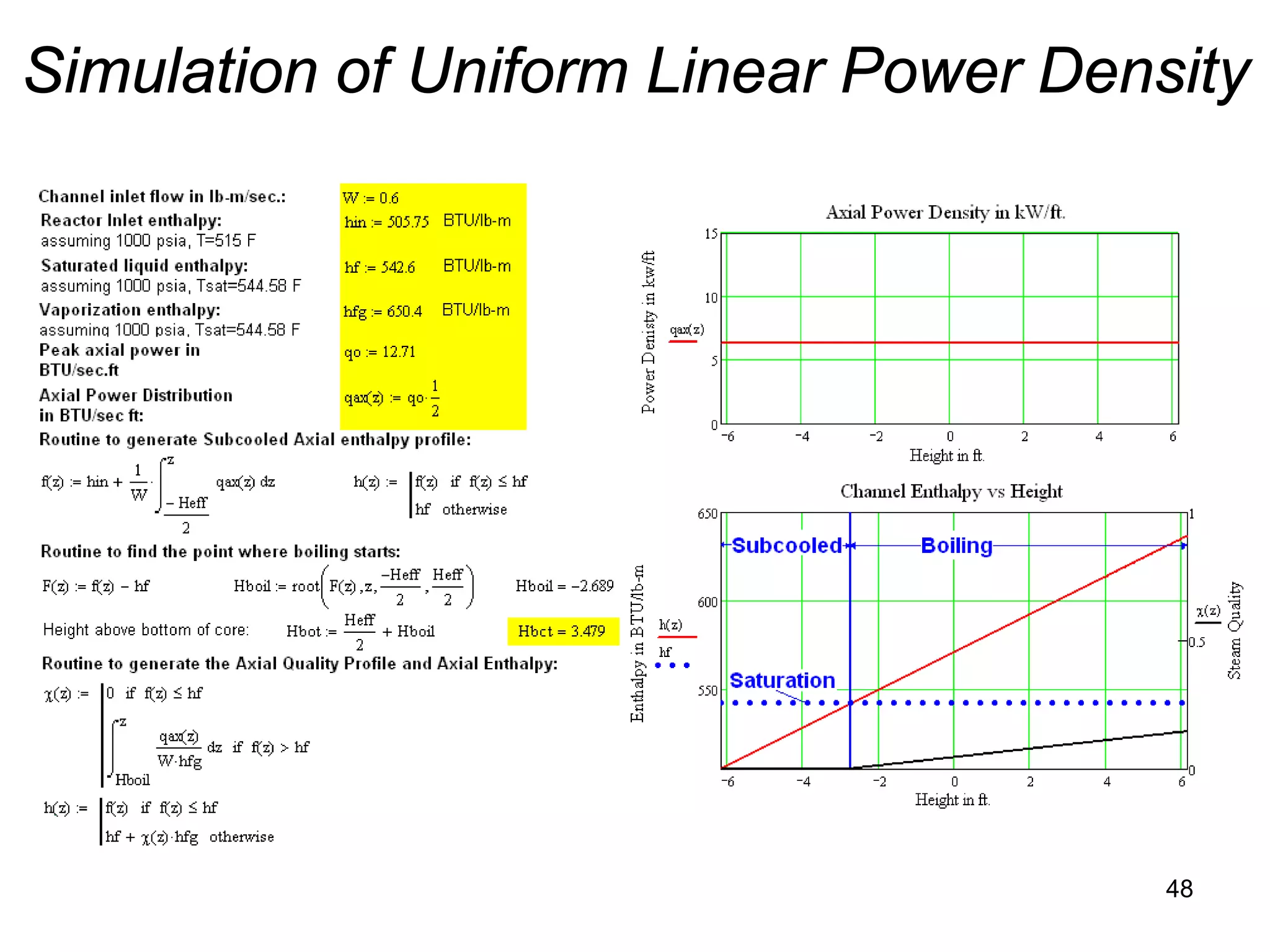
Simulation of Uniform Linear Power Density


                                       48
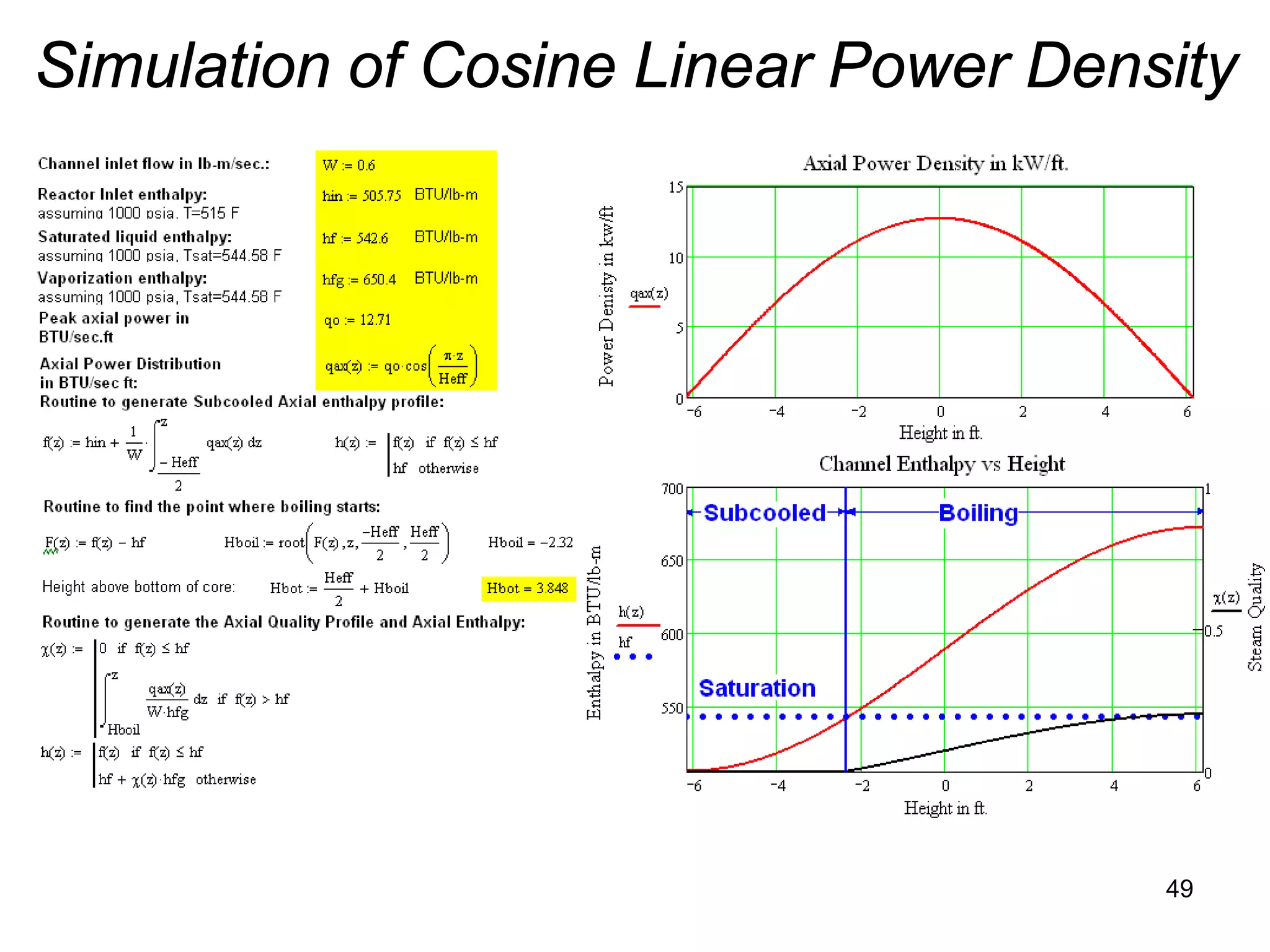
Simulation of Cosine Linear Power Density


                                      49
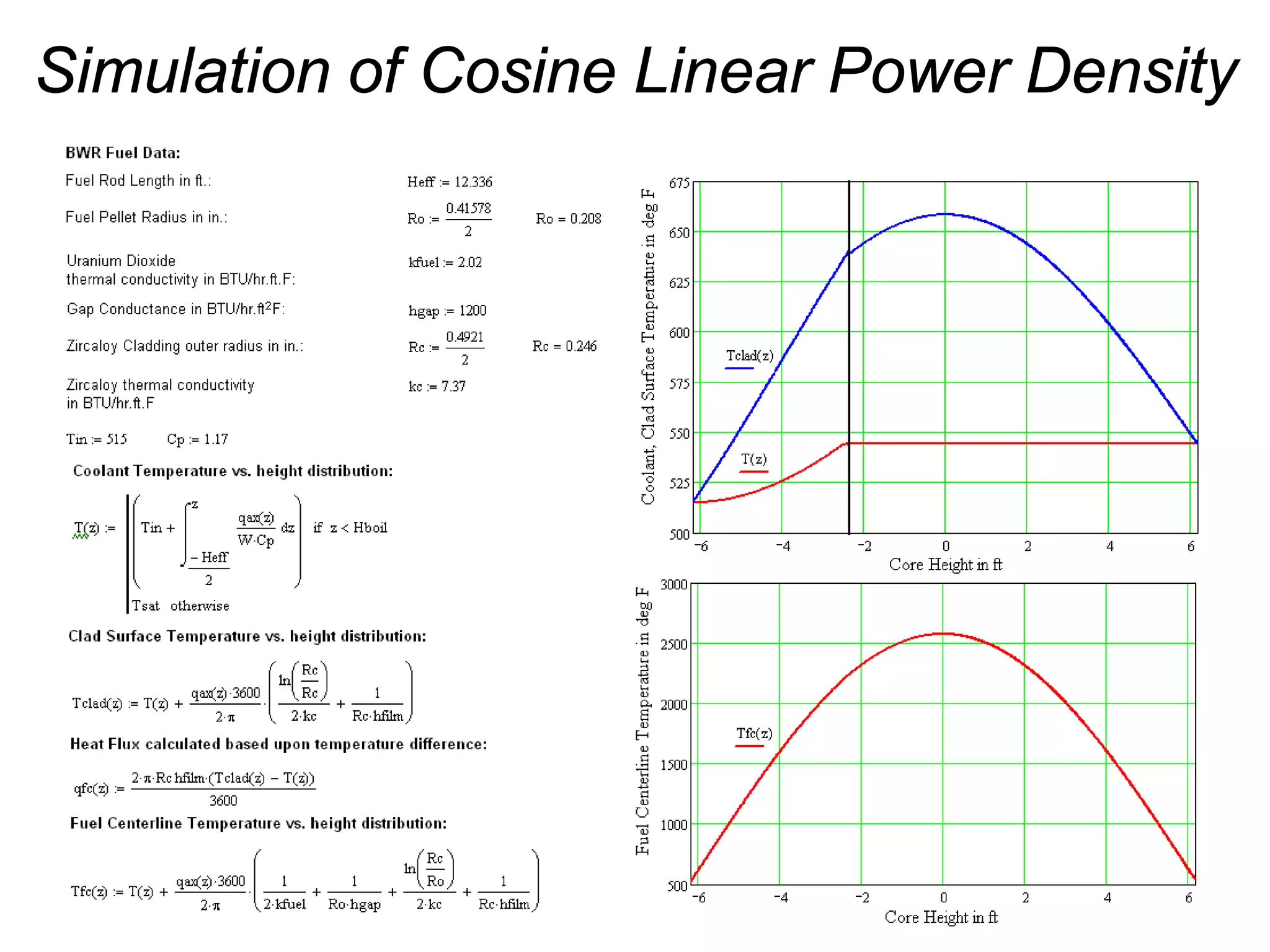
Simulation of Cosine Linear Power Density


                                      50
6. Fluid Flow and Pressure
Drops in Two-Phase Systems


                              51
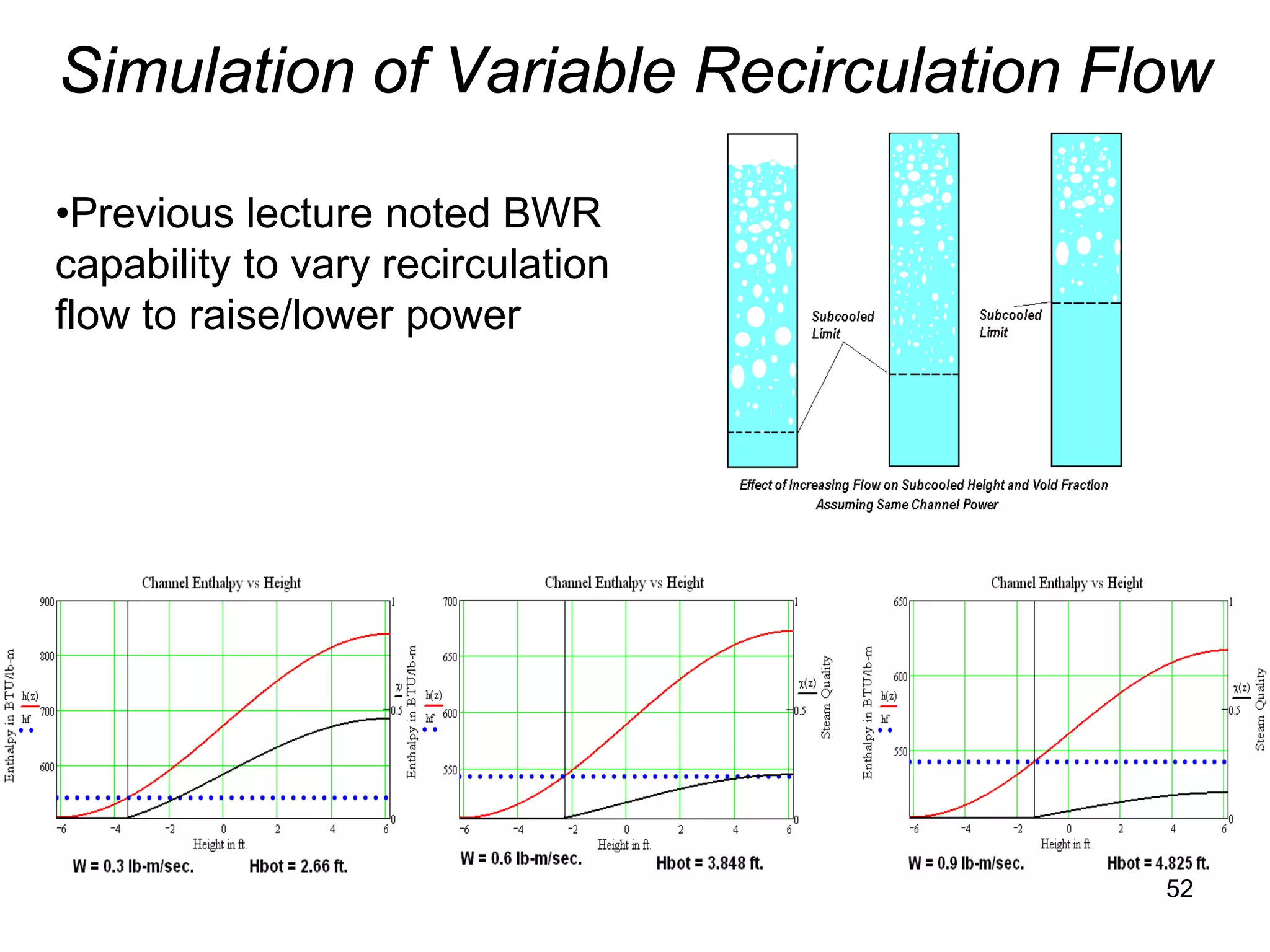
Simulation of Variable Recirculation Flow

•Previous lecture noted BWR
capability to vary recirculation
flow to raise/lower power


                                       52
Two Phase Flow Pressure Drop


                           53
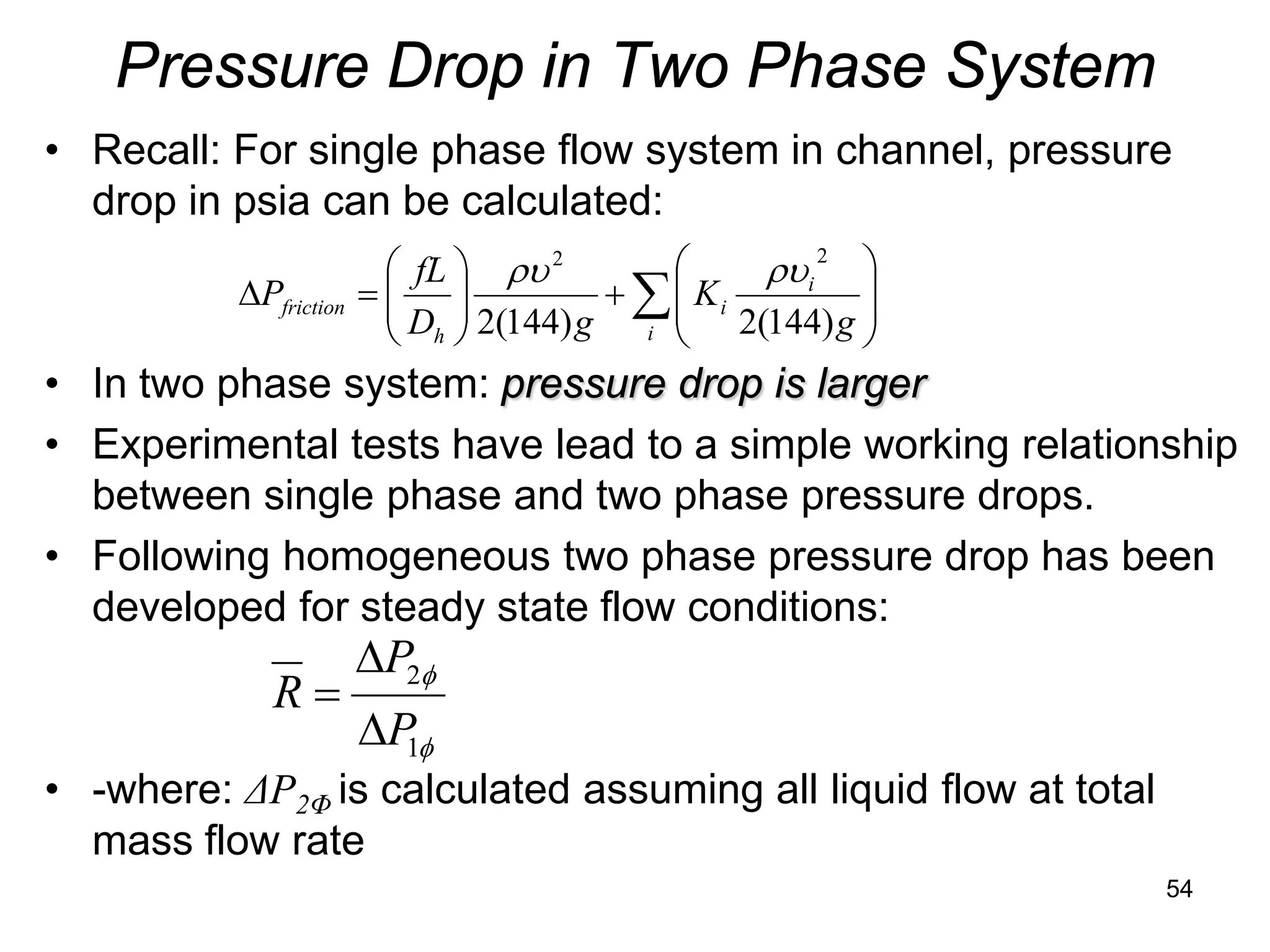
Pressure Drop in Two Phase System
• Recall: For single phase flow system in channel, pressure
  drop in psia can be calculated:
                         fL  ρυ 2               ρυi 2 
                         D  2(144) g + ∑  K i 2(144) g 
          ∆Pfriction   =                                
                             
                         h             i               
• In two phase system: pressure drop is larger
• Experimental tests have lead to a simple working relationship
  between single phase and two phase pressure drops.
• Following homogeneous two phase pressure drop has been
  developed for steady state flow conditions:
                       ∆P2φ
             R=
                       ∆P φ
                         1
• -where: ΔP2Φ is calculated assuming all liquid flow at total
  mass flow rate
                                                                 54
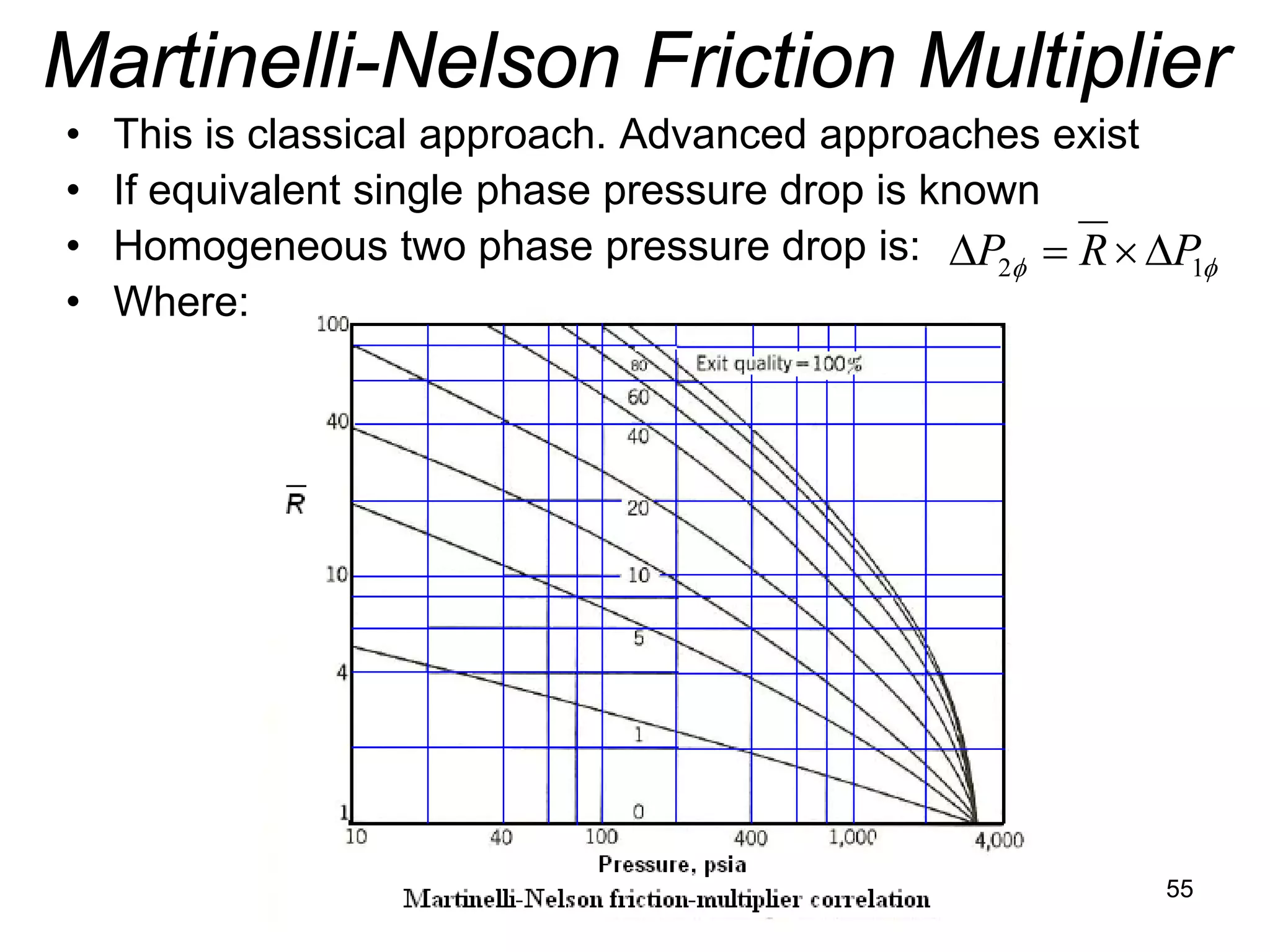
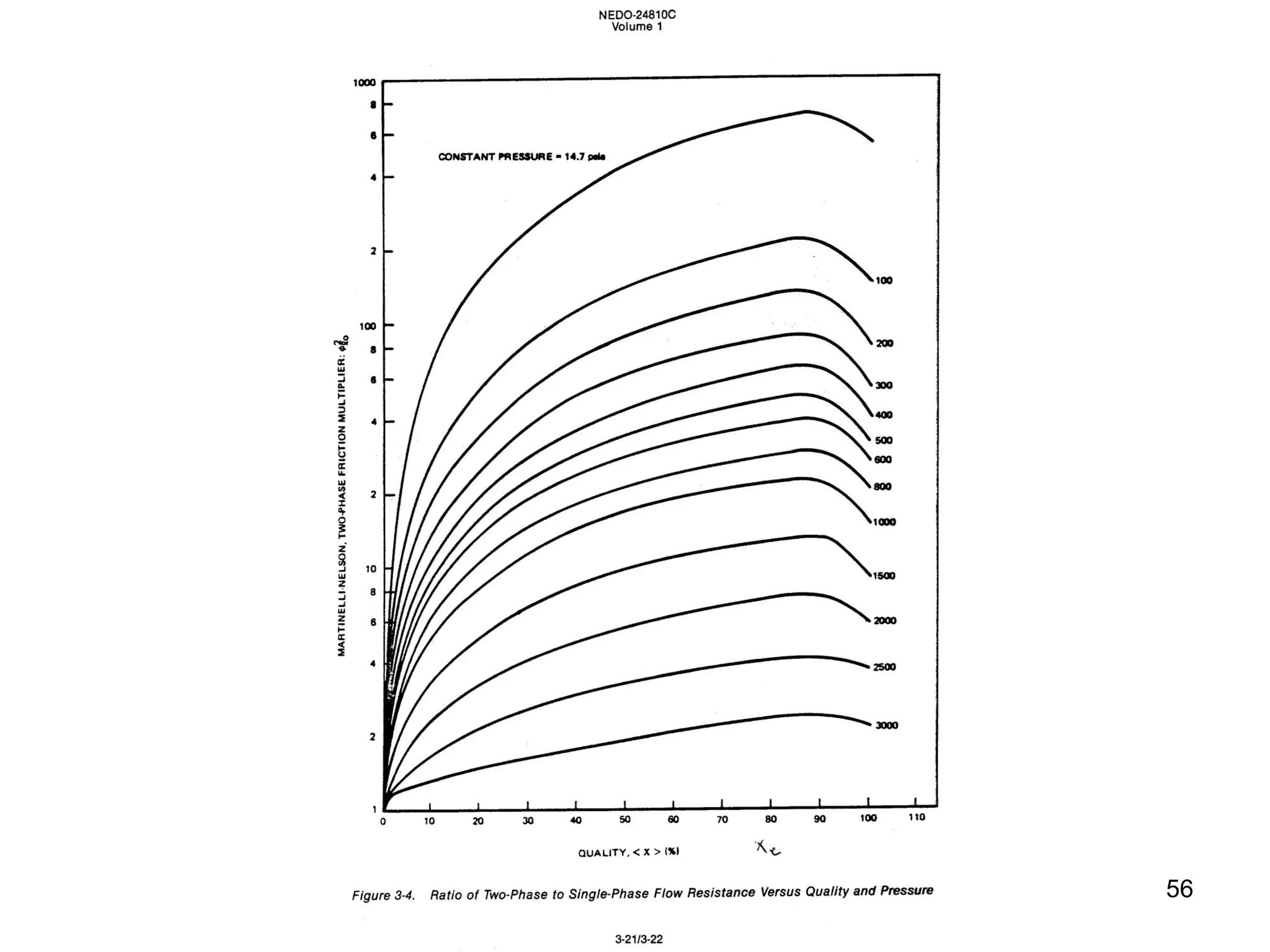
Martinelli-Nelson Friction Multiplier
•   This is classical approach. Advanced approaches exist
•   If equivalent single phase pressure drop is known
•   Homogeneous two phase pressure drop is: ∆P2φ = R × ∆P φ
                                                          1
•   Where:


                                                        55
56
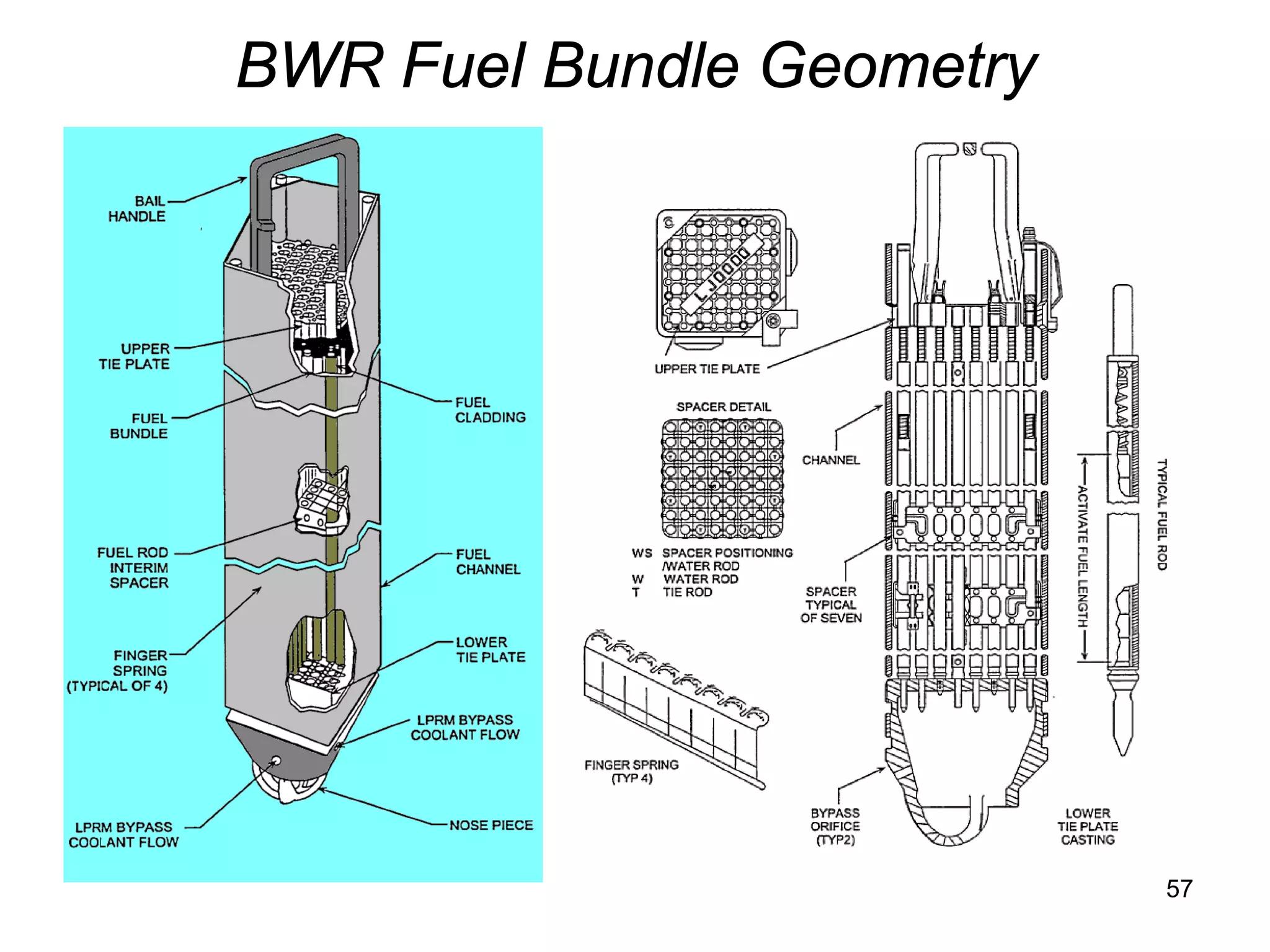
BWR Fuel Bundle Geometry


                           57
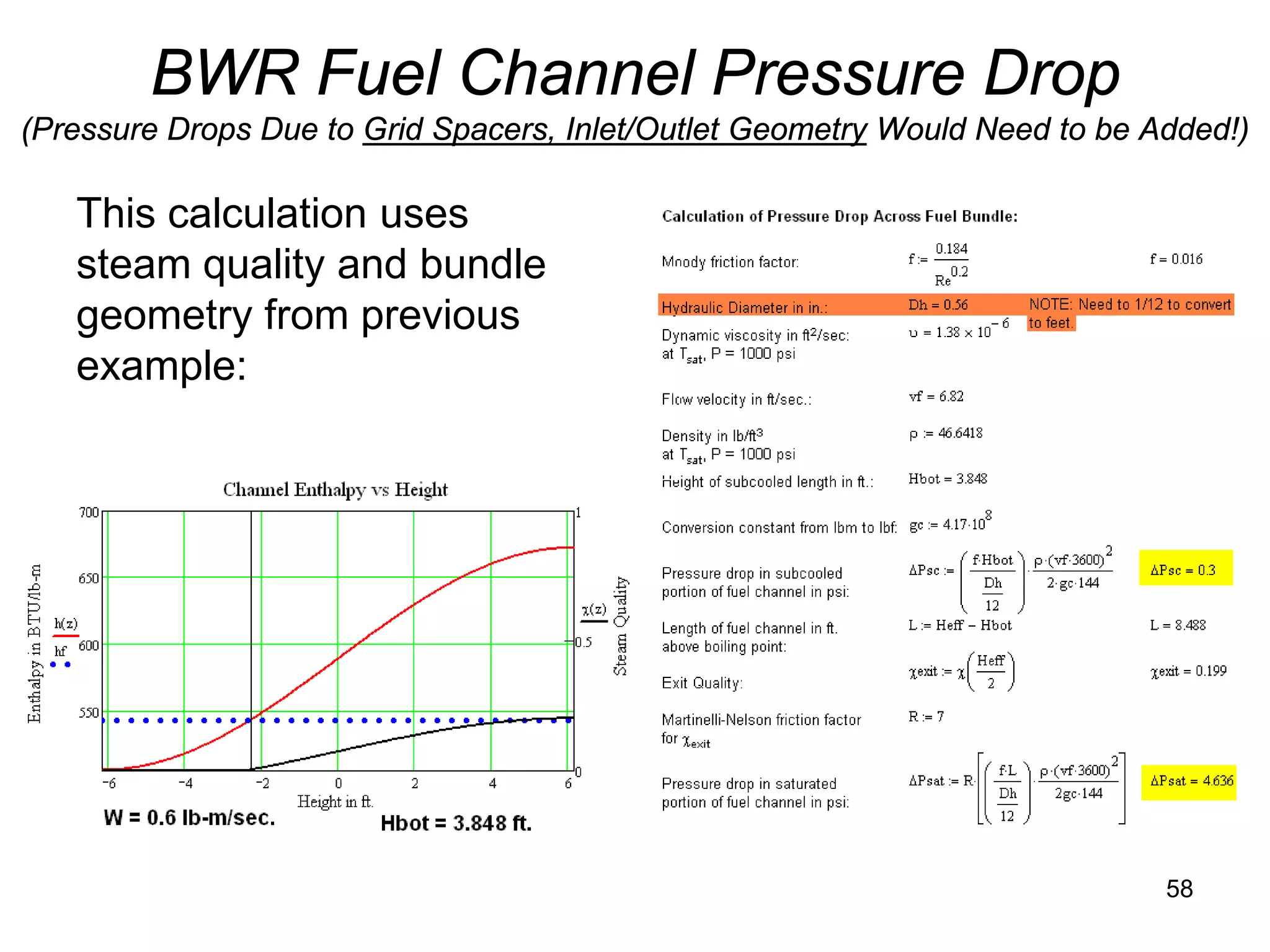
BWR Fuel Channel Pressure Drop
(Pressure Drops Due to Grid Spacers, Inlet/Outlet Geometry Would Need to be Added!)

   This calculation uses
   steam quality and bundle
   geometry from previous
   example:


                                                                             58
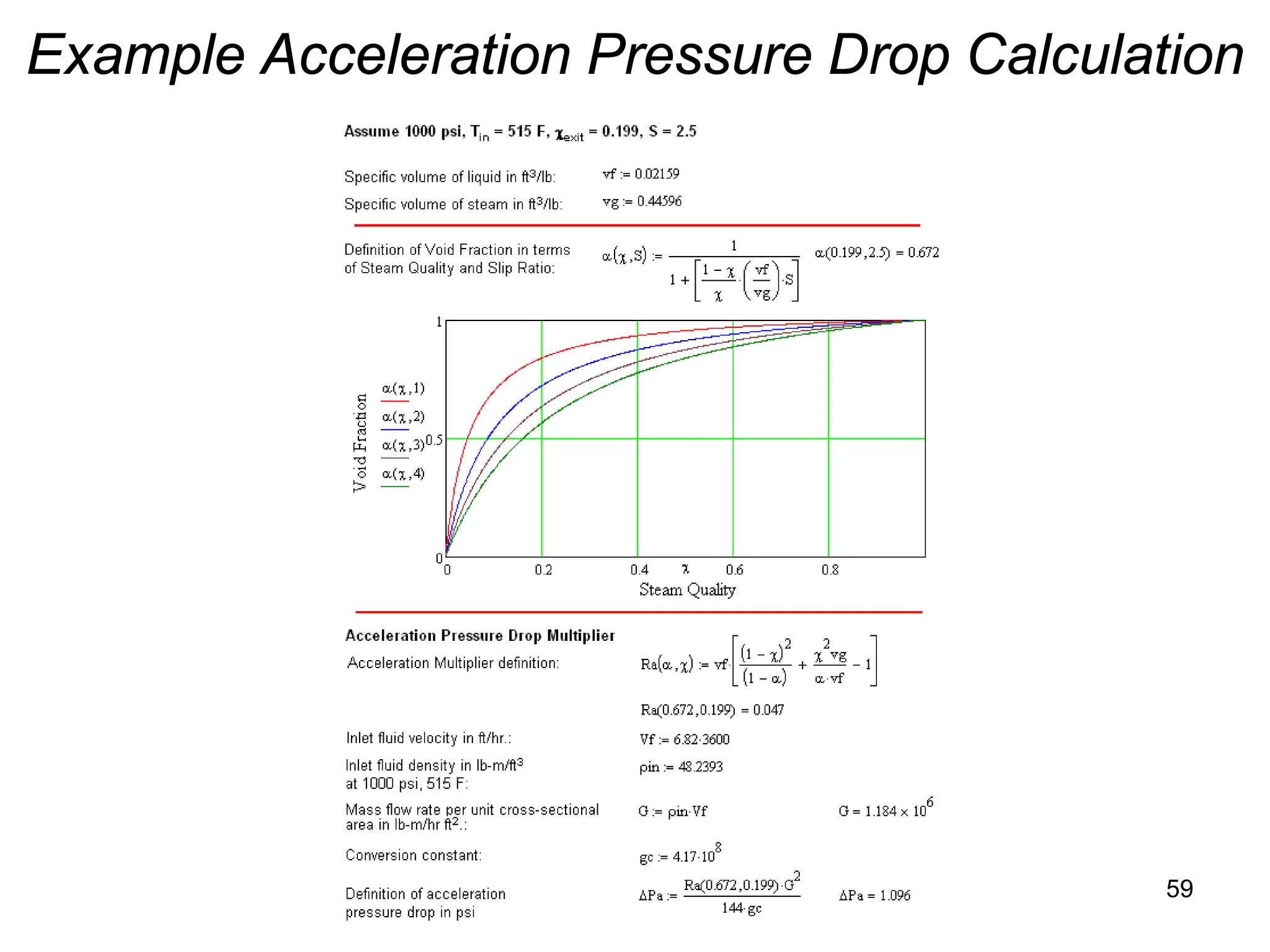
Example Acceleration Pressure Drop Calculation


                                           59
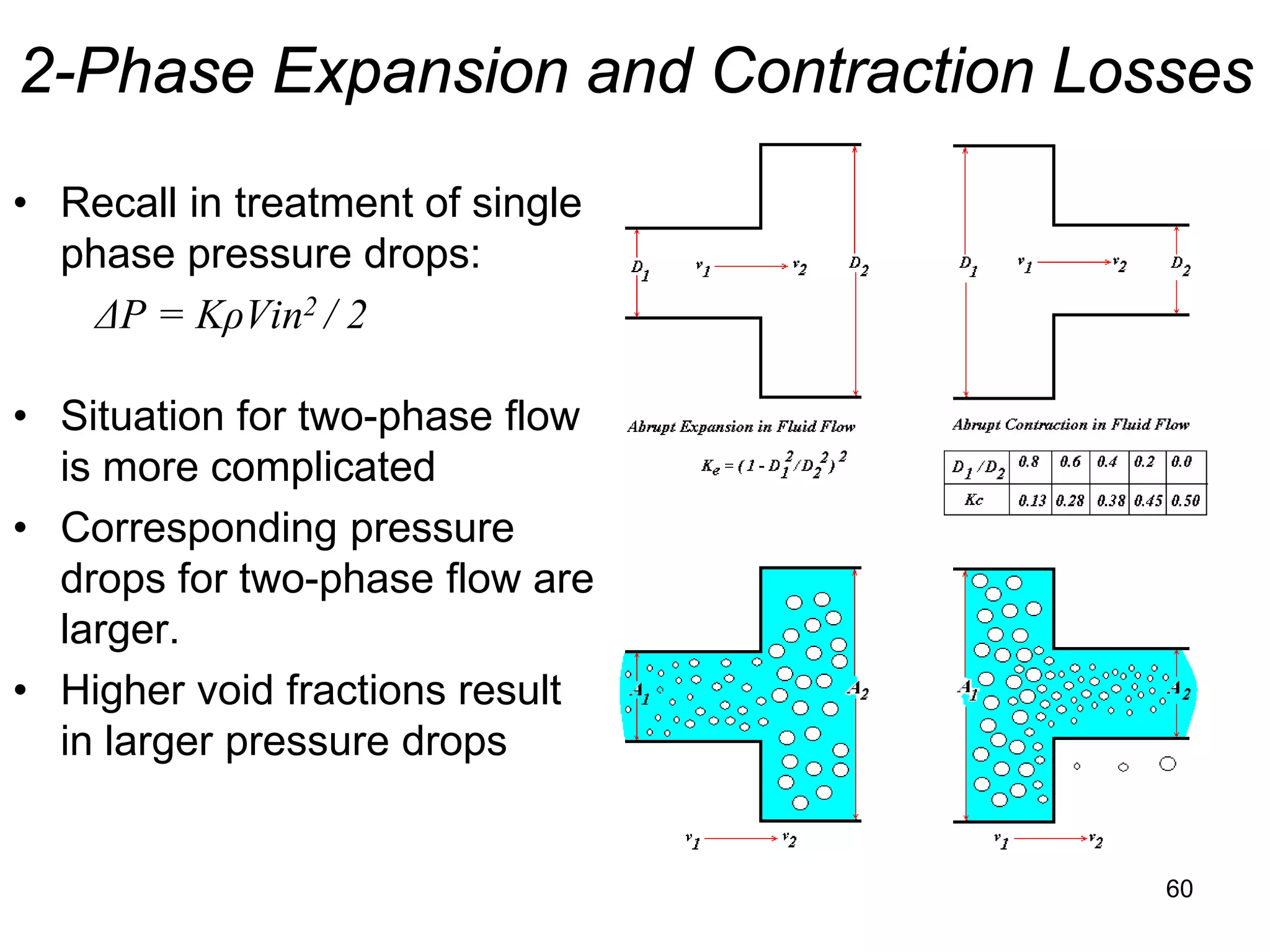
2-Phase Expansion and Contraction Losses
• Recall in treatment of single
  phase pressure drops:
   ΔP = KρVin2 / 2

• Situation for two-phase flow
  is more complicated
• Corresponding pressure
  drops for two-phase flow are
  larger.
• Higher void fractions result
  in larger pressure drops


                                     60
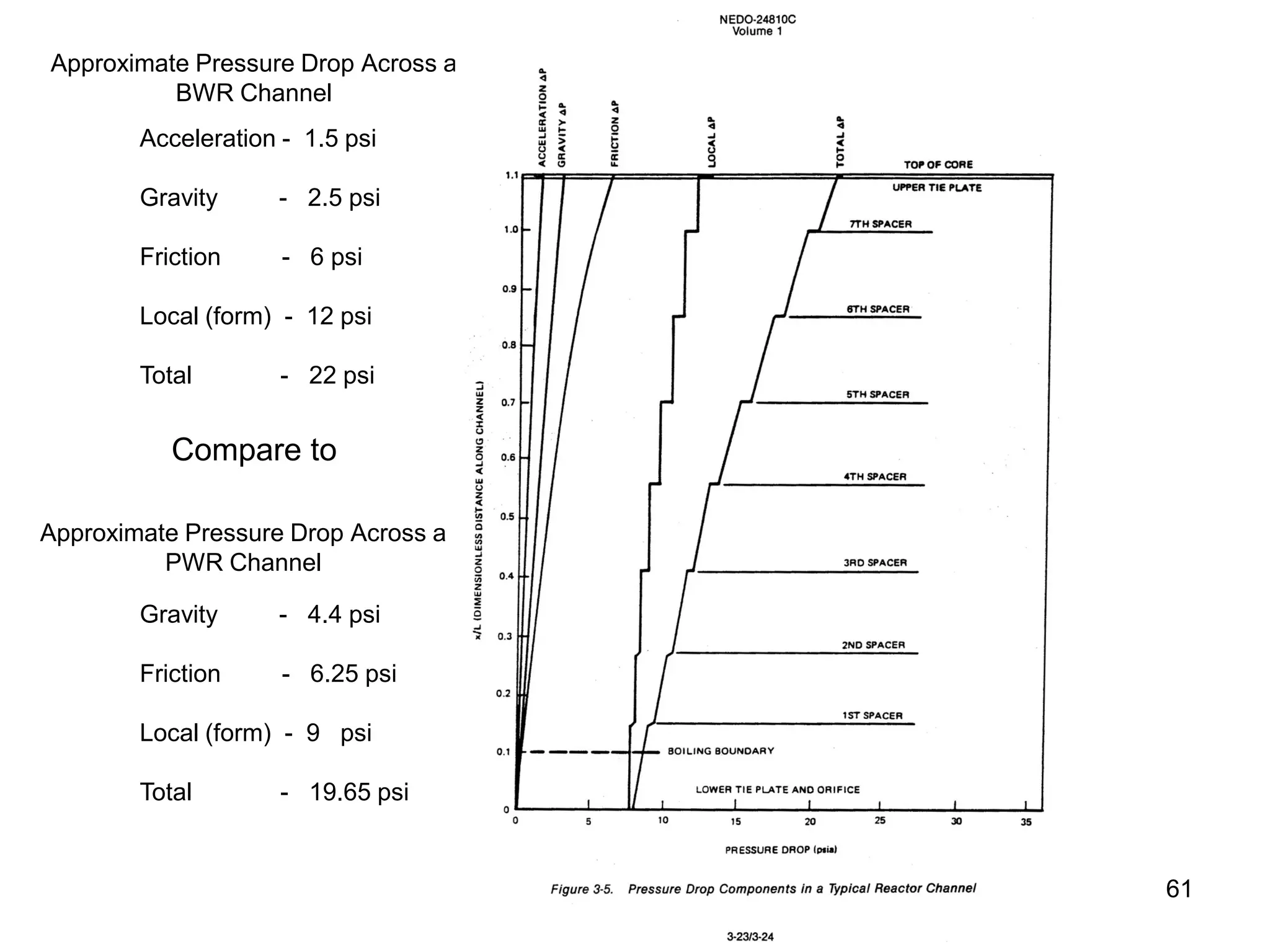
Approximate Pressure Drop Across a
          BWR Channel
        Acceleration - 1.5 psi

        Gravity     - 2.5 psi

        Friction     - 6 psi

        Local (form) - 12 psi

        Total        - 22 psi


           Compare to

Approximate Pressure Drop Across a
          PWR Channel

        Gravity     - 4.4 psi

        Friction     - 6.25 psi

        Local (form) - 9 psi

        Total        - 19.65 psi


                                     61
7. Behavior of System During
          Accident


                               62
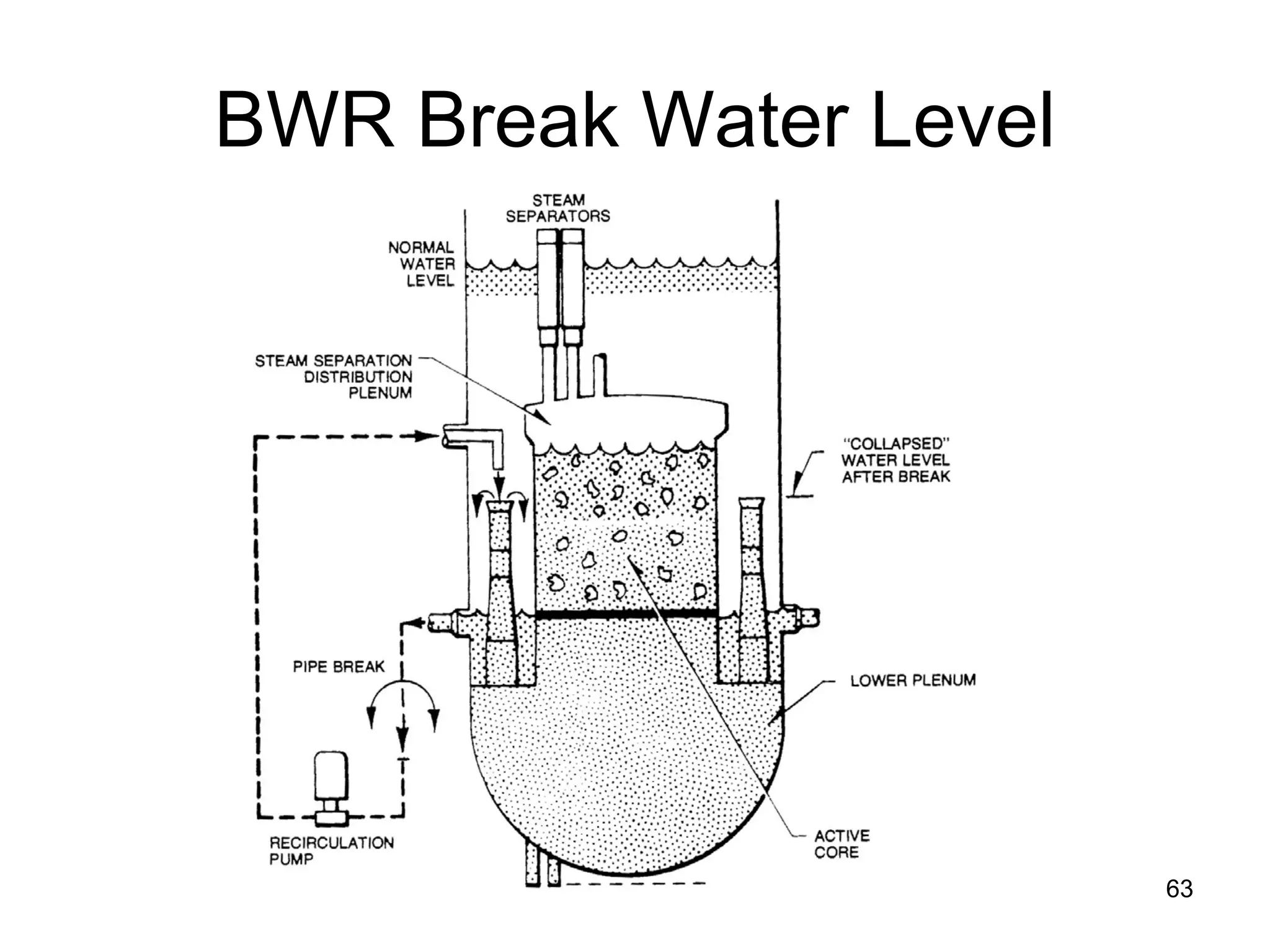
BWR Break Water Level


                        63
64
65
66
67
68
69
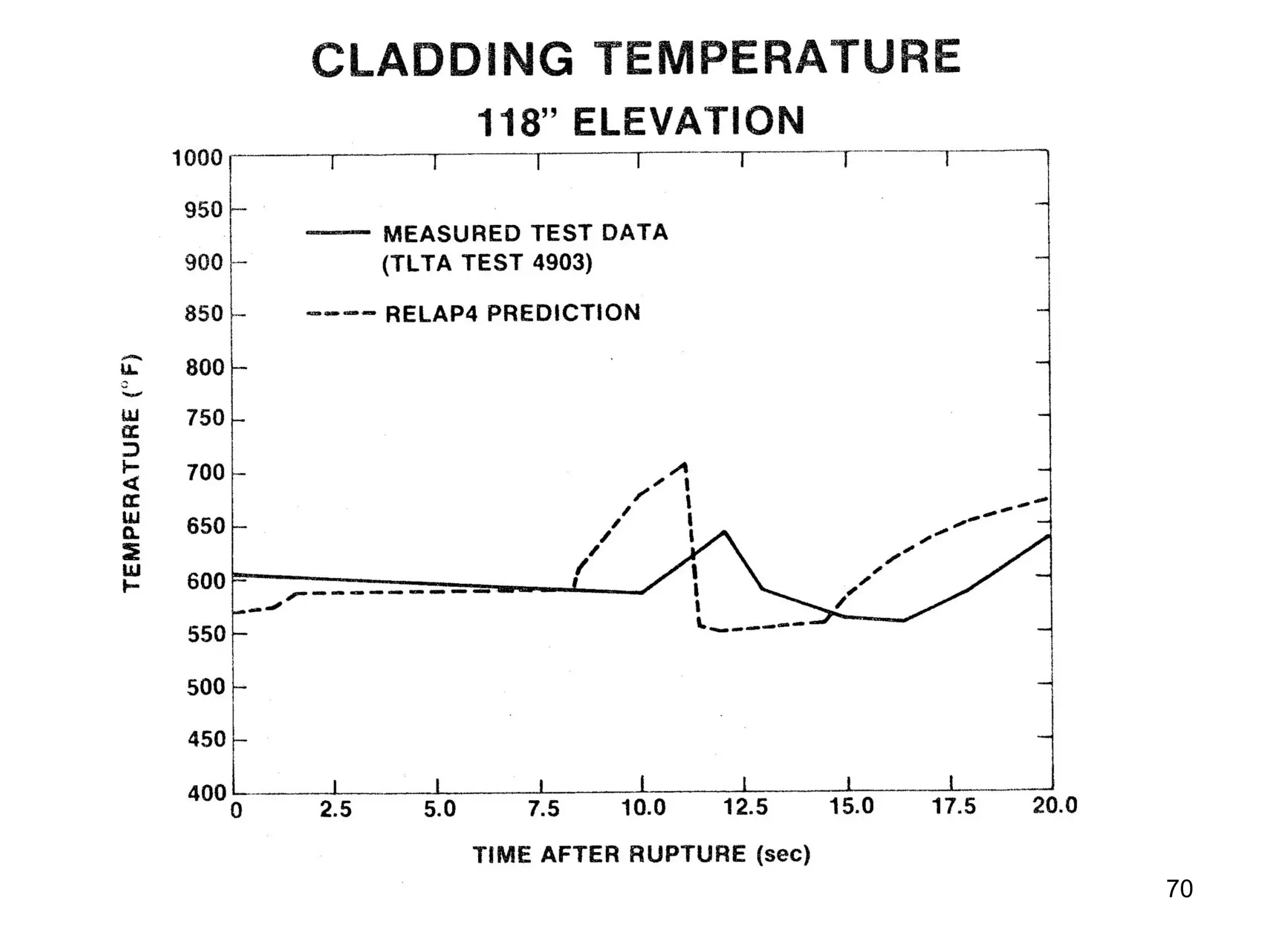
70
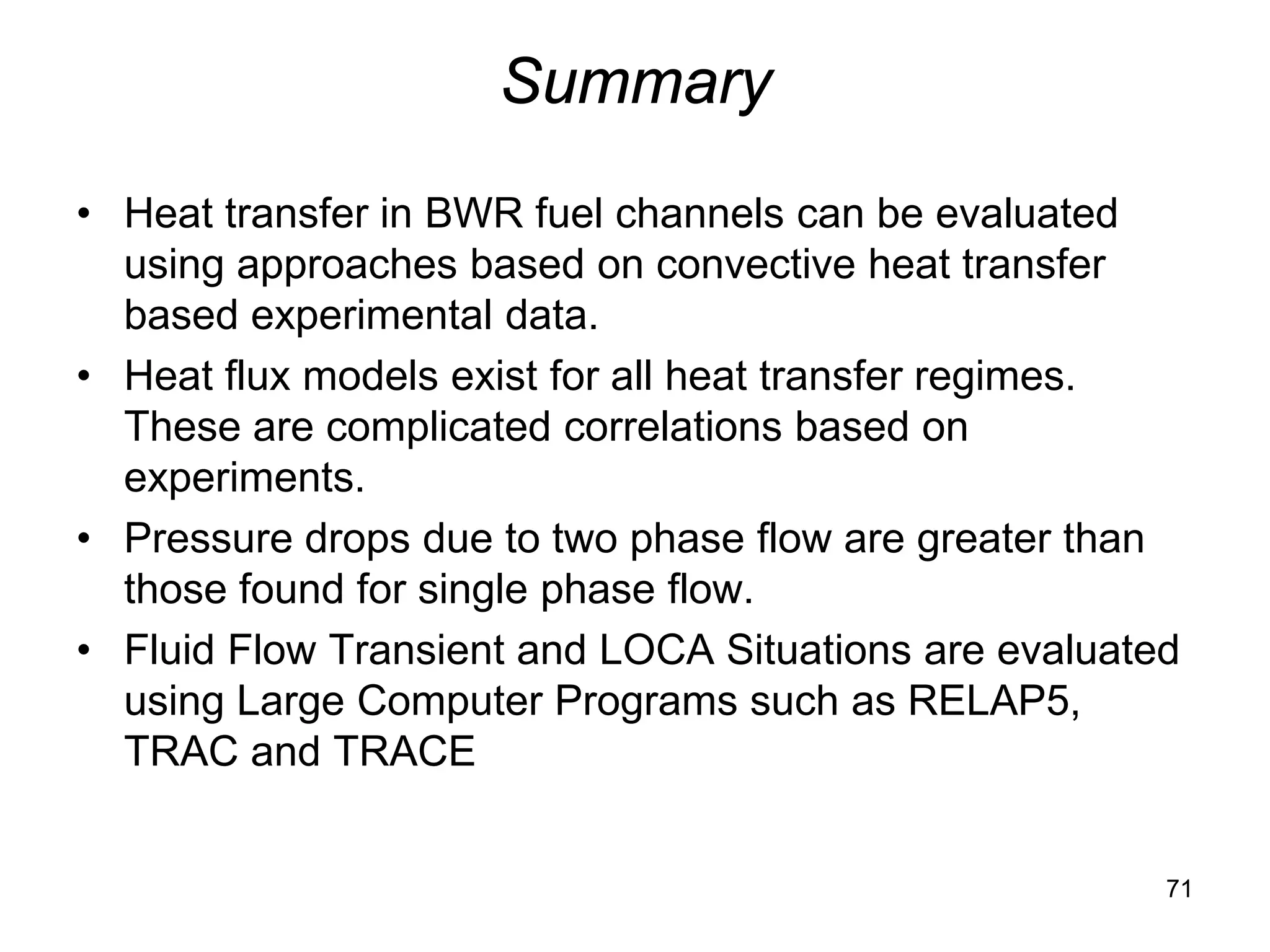
Summary
• Heat transfer in BWR fuel channels can be evaluated
  using approaches based on convective heat transfer
  based experimental data.
• Heat flux models exist for all heat transfer regimes.
  These are complicated correlations based on
  experiments.
• Pressure drops due to two phase flow are greater than
  those found for single phase flow.
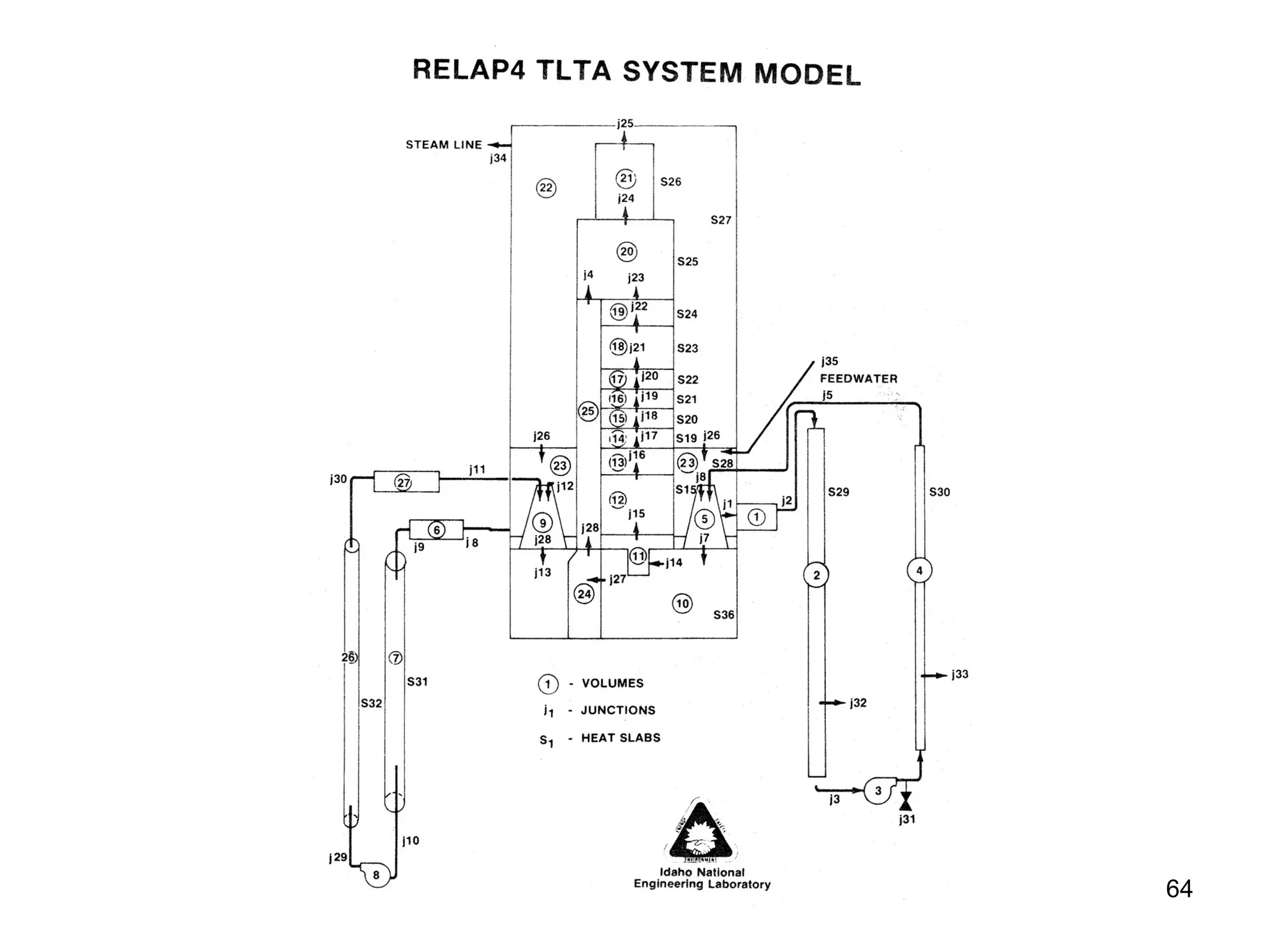
• Fluid Flow Transient and LOCA Situations are evaluated
  using Large Computer Programs such as RELAP5,
  TRAC and TRACE


                                                       71
Important Links

• Some good course material two-phase
  flow to review -
  http://www2.et.lut.fi/ttd/studies.html
• Basic Nuclear Energy -
  http://www.nrc.gov/reading-rm/basic-
  ref/students.html
• Basic BWR - http://www.nrc.gov/reading-
  rm/basic-ref/teachers/03.pdf
                                            72
References
1. Wallis G.B., One-dimensional two-phase flow, McGraw-Hill
   Book Company, New York (1969)
2. Lahey R.T., Moody F.J., The thermal-hydraulics of a boiling
   water nuclear reactor, 2nd Ed., American Nuclear Society
   (1993).
3. N. Todreas and M Kazimi, ”Nuclear Systems I – Thermal
   Hydraulic Fundamentals”,Taylor & Francis”, (1993).
4. N. Todreas and M Kazimi, ”Nuclear Systems II – Elements of
   Thermal Hydraulic Design”,Hemishere Publishing
   Corporation, (1990).
5. Bird, R.B., Steward, W.E., and Lightfoot, E.N., ”Transport
   Pheomena”, New York: Wiley, (1960)
6. ASME Steam Tables
7. L.S. Tong & Joel Wiesman, ”Thermal Anhalu=ysis of
   Pressurized Water Reactors”, third edition, American Nuclear
   Society, La Grange Park, Il, (1996)
                                                                  73
References (cont)
8. M.M. El-Wakil, “Nuclear Energy Conversion”, American
   Nuclear Society, La Grange Park, Il, Third Printing, (January
   1982)


                                                                   74
Extra Information
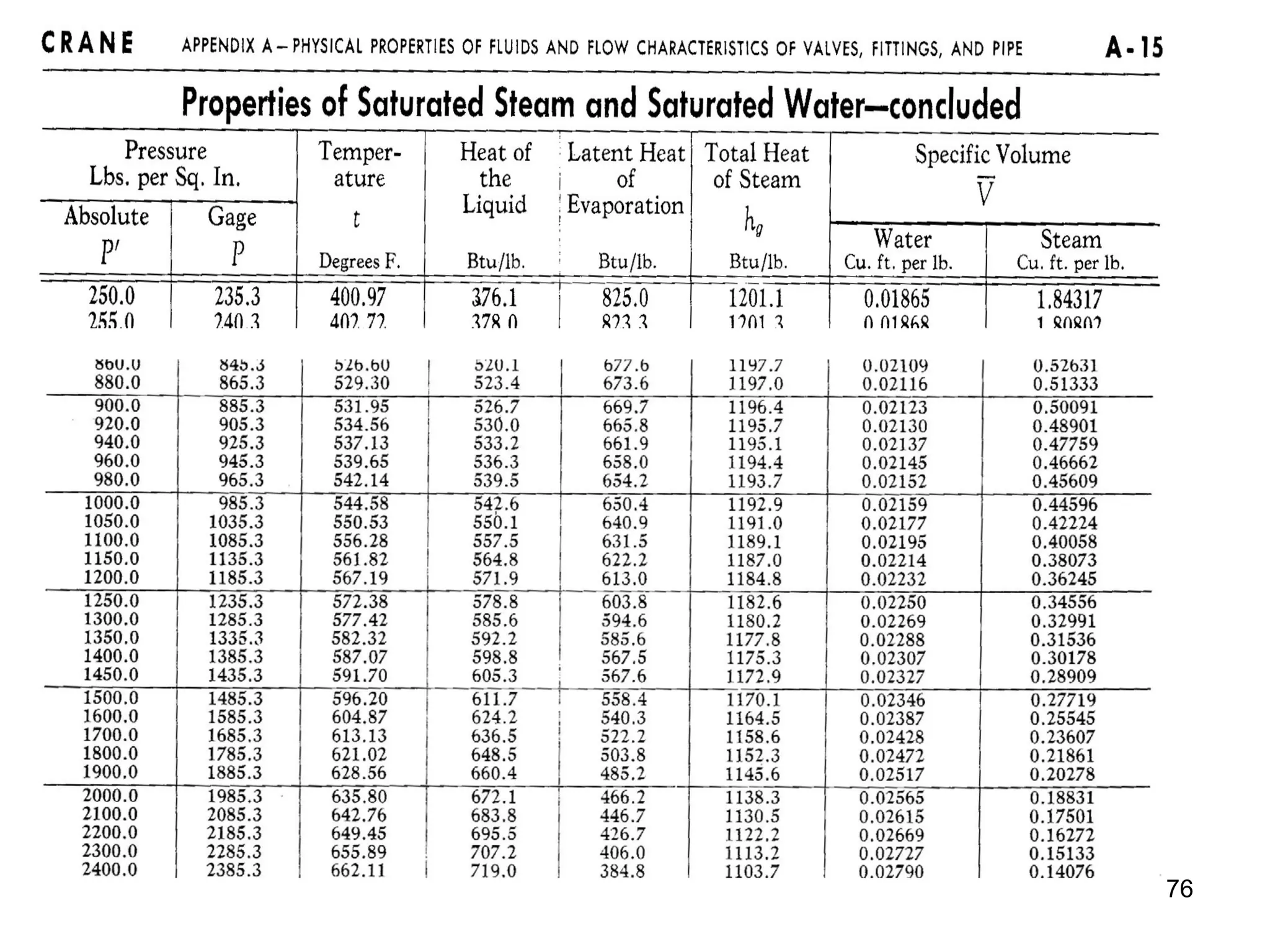
 Steam Tables


                    75
76

Module 12 Two Phase Fluid Flow And Heat Transfer 2010 June Nrc

  • 1.
    Fundamentals of Nuclear Engineering Module 12: Two Phase Heat Transfer and Fluid Flow Joseph S. Miller, P.E. 1
  • 2.
  • 3.
    Objectives: Previous Lectures describedfluid flow, heat transfer and reactivity in single phase systems. This lecture: 1. Describe two-phase Systems 2. Describe important thermal-hydraulic concepts important to a BWR 3. Describe two-phase flow equations 4. Describe two phase heat transfer rates from fuel to coolant and Boiling Transition 5. Describe steady state core temperature profiles 6. Describe fluid flow, and pressure drops in two phase systems 7. Describe behavior of system during accident 3
  • 4.
    1. Two PhaseFluid Systems 4
  • 5.
    Two-Phase Flow Systemsin Nuclear Engineering • Heat Exchangers • Piping Systems in Balance of Plant and Reheat of Feedwater • PWR Steam Generator • BWR Reactor 5
  • 6.
  • 7.
  • 8.
  • 9.
    2. Important ThermalHydraulic Stages for BWR • Start-up and Steady State Operation • Operational Transients • Loss of Coolant Accidents Each of these stages require many different analytical techniques for predicting heat transfer and fluid flow in a BWR. 9
  • 10.
    Start-up and SteadyState Operation • Core Thermal Power • Power-Flow Map • Control Rod Positioning • Feedwater Temperature Control – Amount of Subcooling – more power • Core Response to Recirculation Flow Changes - BWR 10
  • 11.
    Core Thermal Power •Core thermal power by energy balance and use of instrumentation. • Inlet subcooling • Quality in channel • Void fraction in the fuel channel • Fluid flow and pressure drop • Core orifices • Core bypass flow • Enrichment distribution in fuel 11
  • 12.
    Operational Transients • Basedon FSAR Chapter 15 requirements for initiating events • Nuclear reactor system pressure increases by reactor trip, MSIV isolation, etc. • Positive reactivity insertion by moderator temperature increase as in loss of feedwater heating. 12
  • 13.
    Loss of CoolantAccidents • Large breaks • Small breaks • Intermediate breaks 13
  • 14.
    3. Two PhaseFlow Equations 14
  • 15.
    General Terminologies • Two-phaseflow – Simultaneous flow of any two phases (liquid-gas/vapor) of a single substance – Examples: reactor fuel channels, steam generators, kettle on a hot stove – Also referred to as “Single-component two-phase flow” • Two-component flow – Simultaneous flow of liquid and gas of two substances – Examples: oil-gas pipelines, beer, soft drink, steam-water-air flow at discharge of safety valve. – Also referred to as “Two-component, two-phase flow” 15
  • 16.
    Terminology Unique toTwo Phase • In static (non-flowing system) steam quality: χ is defined: χ = (mass of steam) / (total mass of steam + liquid) • In static (non-flowing system) void fraction: α is defined: α = (volume of steam in mixture) / (total volume of steam + liquid) • Void fraction can be expressed in terms of steam quality and specific volumes (from Steam Tables) as follows: α = χvg / ((1- χ )vf + χvg ) = 1 / {1 + [(1 – χ)/ χ] vf / vg } • Where: vg is specific volume of steam in ft3/lb-m vf is specific volume of liquid in ft3/lb-m vfg = vg - vf is difference in specific volumes Good source for fluid properties: http://webbook.nist.gov/chemistry/fluid/ 16
  • 17.
    Terminology Unique toTwo Phase (cont.) • In static (non-flowing system) steam quality: χ is defined: χ = (mass of steam) / (total mass of steam + liquid) χ = (v - vf ) / vfg Where v is the specific volume of the two-phase mixture 17
  • 18.
    Quality and P-v-T Diagram 18
  • 19.
    P- v-T DiagramDefinitions 1000 psi Line • “I” state represents initial state at some subcooled (compressed liquid) value at a lower temperature • “IJ” line represents the heat up of the fluid from a lower temperature subcooled state “I” to saturated liquid state “J” at saturated temperature of 544 ͦ F at 1000 psi F(See steam tables on page 83) • “JK” line represents the continued heat of the two-phase mixture at 1000 psi. The mixture stays at 544 ͦ F while it is two-phase, but the specific volume continues to increase. From this time the quality changes from 0 to 1 (Saturated liquid to saturated steam). • “KL” line represents the continued heat –up from saturated steam to super heated steam as temperature and specific volume increase. 19
  • 20.
  • 21.
    Void Fraction • Ratioof Vapor flow area to total flow area • Depends strongly on pressure, mass flux, and quality • Applied to calculate the acceleration pressure drop in steady-state homogeneous code • Large number of correlations proposed • Solved from conservation equations in two-fluid reactor safety codes 21
  • 22.
    Steam Rises Fasterin Channel Than Liquid • Because of lower density (buoyancy) steam will rise up vertical channel faster than surrounding liquid • Slip ratio: S, is the ratio of steam velocity to liquid velocity S = Vg / Vf where: Vg is steam velocity in ft. / sec. Vf is liquid velocity in ft. / sec. • Slip ratio modifies static definitions of α (void fraction) and χ (steam quality) in flowing two phase system 22
  • 23.
    Relative Velocities AreDifferent • If total mass flow rate is: W (lb-m/sec) • Steam flow rate is: χW • Liquid flow rate is: (1- χ)W • Phase volumetric velocity of steam is: Vg = vg W χ / Ag -where: Ag is relative cross sectional area of steam in two phase column • Phase volumetric velocity of liquid is: Vf = vf W(1- χ) / Af 23
  • 24.
    Definition of Slipin Terms of Steam Quality and Void Fraction • Slip: S = Vg / Vf • Slip defined in terms of steam quality by combining: Vg = vg W χ / Ag Vf = vf W(1- χ) / Af • This yields: S = (χ / 1- χ)(Af / Ag)(vg / vf) • Noting that in small slice of column, ratio of steam to total mixture is: α = Ag / Ag+ Af , rearranging this: (Af / Ag) = (1 – α )/ α • Slip can then be expressed: S = (χ / 1- χ)[(1 – α )/ α](vg / vf) 24
  • 25.
    Definition of VoidFraction in Terms of Steam Quality and Slip • Slip equation can be rearranged to define void fraction: α in terms of steam quality and Slip: 1 α= (1 − χ )  v f  1+ [ ] S χ  vg   • When S = 1: steam and liquid move at exact same speed Effect of slip: • Slip decreases void fraction α(χ) below that which exists in situation of no slip between steam and liquid 25
  • 26.
  • 27.
    Void Fraction Sensitivities: •Sensitivity of Void fraction α to Mixture Quality and Slip can be seen by computing α(χ) for a spectrum of pressure and assumed Slip values • S = 1 implies homogeneous steam/water flow (moving together) 27
  • 28.
    Example Slip Ratiofor BWR Fuel Channel 28
  • 29.
    What Does SlipMean to the Core Fluid Flow? Low S value (S = 1) implies: • Voids and water travel about same speed Higher S value (S = 2,3) implies: • Steam carries out higher enthalpy water thus heat is removed faster • Voids swept out of channel faster which is benefit for neutron economy • Predicting Slip from first principles is not easy • Designers rely upon tests and scaling-up from previous 29
  • 30.
    4. Two PhaseHeat Transfer Rates from Fuel to Coolant and Boiling Transition 30
  • 31.
    Two Phase HeatTransfer Regimes 31
  • 32.
    Six Distinctive BoilingRegions: • Single phase, forced convection • Nucleate boiling • Critical heat flux • Transition boiling • Minimum film boiling • Film boiling Methods and experimental correlations exist to describe each region 32
  • 33.
  • 34.
    Definitions for Transitionpoints • Onset of nucleate boiling. Transition point between single-phase and boiling heat transfer • Onset of net vapor generation. Transition point between single-phase and two-phase flow (mainly for pressure- drop calculations) • Saturation point. Boiling initiation point in an equilibrium system. • Critical heat flux point. Transition point between nucleate boiling and transition/film boiling. • Minimum film-boiling point. Transition point between transition boiling and film boiling. 34
  • 35.
    Flow Patterns • Distributionof phases inside a confined area • Depend strongly on liquid and vapor velocities • Channel geometry • Surface Heating 35
  • 36.
    Flow Patterns inHorizontal Flow 36
  • 37.
    Flow Patterns inVertical Flow 37
  • 38.
  • 39.
    Single Phase ForcedConvection Heating • Dittus-Boelter correlation was previously described for PWR steady state heat removal • Dittus-Boelter correlation is appropriate for subcooled region of BWR fuel channel (before boiling starts) hfilm = (k / Dh) 0.023 Pr0.4 Re0.8 • Above subcooled region – different hfilm model would apply • ALSO: When modeling cooling on tube: hfilm = (k / Dh) 0.023 Pr0.3 Re0.8 • Example problem: heat transfer in subcooled region • Assume: 1000 psia, Tin = 515°F, Vf = 6.8 ft./sec. • Use standard dimensions of GE 8x8 Fuel Bundle • Calculate hfilm 39
  • 40.
    Example hfilm Calculationfor 8x8 BWR Fuel 40
  • 41.
    Nucleate Boiling • Thomcorrelation is one commonly used for evaluating nucleate boiling: • qTHOM = 0.05358 x exp(P/630) x (Tc – Tsat(P))2 • qTHOM is the heat transfer rate in BTU/sec.ft.2 • P is pressure in psia • Tc is clad surface temperature in °F • Tsat is saturation temperature for pressure: P 41
  • 42.
    Critical Heat Flux Thisis an example BWR Fuel Bundle CHF correlation developed by EPRI 42
  • 43.
    Transition Boiling Something LikeThis Would Be For LOCA 43
  • 44.
    5. Steady StateCore Temperature Profiles 44
  • 45.
    BWR Axial HeatTransfer 45
  • 46.
    BWR Axial HeatTransfer • Recall: Axial, radial distribution derived earlier (same as in PWR) • Φ(r,z) = ΦoJo(2.405r/R)Cos(πz/H) • Again assume linear power density in individual rod given by: q(z) = qoCos(πz/H) qo = (πRc2) Ef ∑f Φo Jo(2.405r/R) • Energy balance along single rod in BWR must now reflect heating subcooled water up to saturation point below: HBOIL • Above HBOIL: boiling heat transfer 46
  • 47.
    BWR Axial HeatTransfer • As subcooled water enters heated channel • Temperature rises until boiling point Tsat(P) z at HBOIL: q( z ) T ( z , P ) = Tin ( P ) + ∫ − H eff WC p ( P ) dz 2 z q( z ) h( z , P ) = hin ( P ) + ∫ − H eff W dz 2 • Above HBOIL further heat addition only increases steam content, not temperature • Enthalpy rise: h(z,P) = hsat(P) + χ(z)hfg(P) z q( z ) where : χ ( z ) = ∫ dz H BOIL Wh fg ( P) 47
  • 48.
    Simulation of UniformLinear Power Density 48
  • 49.
    Simulation of CosineLinear Power Density 49
  • 50.
    Simulation of CosineLinear Power Density 50
  • 51.
    6. Fluid Flowand Pressure Drops in Two-Phase Systems 51
  • 52.
    Simulation of VariableRecirculation Flow •Previous lecture noted BWR capability to vary recirculation flow to raise/lower power 52
  • 53.
    Two Phase FlowPressure Drop 53
  • 54.
    Pressure Drop inTwo Phase System • Recall: For single phase flow system in channel, pressure drop in psia can be calculated:  fL  ρυ 2  ρυi 2   D  2(144) g + ∑  K i 2(144) g  ∆Pfriction =     h i   • In two phase system: pressure drop is larger • Experimental tests have lead to a simple working relationship between single phase and two phase pressure drops. • Following homogeneous two phase pressure drop has been developed for steady state flow conditions: ∆P2φ R= ∆P φ 1 • -where: ΔP2Φ is calculated assuming all liquid flow at total mass flow rate 54
  • 55.
    Martinelli-Nelson Friction Multiplier • This is classical approach. Advanced approaches exist • If equivalent single phase pressure drop is known • Homogeneous two phase pressure drop is: ∆P2φ = R × ∆P φ 1 • Where: 55
  • 56.
  • 57.
    BWR Fuel BundleGeometry 57
  • 58.
    BWR Fuel ChannelPressure Drop (Pressure Drops Due to Grid Spacers, Inlet/Outlet Geometry Would Need to be Added!) This calculation uses steam quality and bundle geometry from previous example: 58
  • 59.
    Example Acceleration PressureDrop Calculation 59
  • 60.
    2-Phase Expansion andContraction Losses • Recall in treatment of single phase pressure drops: ΔP = KρVin2 / 2 • Situation for two-phase flow is more complicated • Corresponding pressure drops for two-phase flow are larger. • Higher void fractions result in larger pressure drops 60
  • 61.
    Approximate Pressure DropAcross a BWR Channel Acceleration - 1.5 psi Gravity - 2.5 psi Friction - 6 psi Local (form) - 12 psi Total - 22 psi Compare to Approximate Pressure Drop Across a PWR Channel Gravity - 4.4 psi Friction - 6.25 psi Local (form) - 9 psi Total - 19.65 psi 61
  • 62.
    7. Behavior ofSystem During Accident 62
  • 63.
  • 64.
  • 65.
  • 66.
  • 67.
  • 68.
  • 69.
  • 70.
  • 71.
    Summary • Heat transferin BWR fuel channels can be evaluated using approaches based on convective heat transfer based experimental data. • Heat flux models exist for all heat transfer regimes. These are complicated correlations based on experiments. • Pressure drops due to two phase flow are greater than those found for single phase flow. • Fluid Flow Transient and LOCA Situations are evaluated using Large Computer Programs such as RELAP5, TRAC and TRACE 71
  • 72.
    Important Links • Somegood course material two-phase flow to review - http://www2.et.lut.fi/ttd/studies.html • Basic Nuclear Energy - http://www.nrc.gov/reading-rm/basic- ref/students.html • Basic BWR - http://www.nrc.gov/reading- rm/basic-ref/teachers/03.pdf 72
  • 73.
    References 1. Wallis G.B.,One-dimensional two-phase flow, McGraw-Hill Book Company, New York (1969) 2. Lahey R.T., Moody F.J., The thermal-hydraulics of a boiling water nuclear reactor, 2nd Ed., American Nuclear Society (1993). 3. N. Todreas and M Kazimi, ”Nuclear Systems I – Thermal Hydraulic Fundamentals”,Taylor & Francis”, (1993). 4. N. Todreas and M Kazimi, ”Nuclear Systems II – Elements of Thermal Hydraulic Design”,Hemishere Publishing Corporation, (1990). 5. Bird, R.B., Steward, W.E., and Lightfoot, E.N., ”Transport Pheomena”, New York: Wiley, (1960) 6. ASME Steam Tables 7. L.S. Tong & Joel Wiesman, ”Thermal Anhalu=ysis of Pressurized Water Reactors”, third edition, American Nuclear Society, La Grange Park, Il, (1996) 73
  • 74.
    References (cont) 8. M.M.El-Wakil, “Nuclear Energy Conversion”, American Nuclear Society, La Grange Park, Il, Third Printing, (January 1982) 74
  • 75.
  • 76.