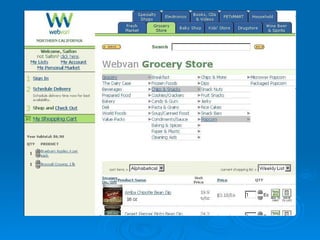
Webvan Case Study
          Submitted By:
                          Ashwin Ramesh
                          Hardik Doshi
                          Himani Garg
                          Punit Biyani
What happened here? Why did the
     business fail so spectacularly?
 Louis Borders in 1997 wanted to take advantage of
  people making purchases online
 Raised approximately $800 million from private
  investors and the public via an IPO
 Expected to breakeven in five quarters
 Challenges compared to regular grocery stores :
       Razor thin margins
       Wide product range
       Temperature requirements
What happened?
 Invested heavily in inventory forecasting
 Wanted to avoid costs involved in stocking
 Aggressive expansion
 Extra costs incurred by Webvan DCs
       Packing carts with customer orders
       Delivering the ordered items
 Projected annual revenue of $300 million per DC but
  all DCs operated at around 25 – 35% capacity
 Bottlenecks include:
       Misaligned totes
       Misread displays
       Incomplete orders
Why Business failed?
   Webvan tried to expand too quickly without
    maximizing operating efficiency
   Too much money plugged into technology
    without working on increasing demand
   Company should have worked on making
    existing operations more efficient
What was supposed to happen?

   A faster, cheaper & more efficient model of delivering items to
    customers.
   Deliver goods within a specified 30 min window.
   DCs will operate at breakeven capacity within five quarters of
    being launched.
   Attract audience first and then monetize eyeballs to bring in
    additional revenues & do it on a global scale.
   Economies of scale.
   Inventory turnover 24 times annually as compared to 9 to 11
    times in traditional supermarkets.
On what basis Webvan’s founders and initial investors
            hoped for success of their venture??

   No other online grocery store successful at that time and the inability of existing
    grocers to offer same day delivery.
   Webvan founders planned to deliver the same day within 30-min delivery
    window. This was their Unique Selling Proposition.

   Predicting Growth
   International Data corporation estimated 177 mn web users by end of 2003.
   Consumer purchases of online grocery to increase from 12.4 bn in 1998 to 75 bn
    in 2003.
   Most people view grocery shopping as an inconvenient & nearly 55% of
    Americans considered time to be their most precious commodity.
   35% of the market would buy groceries on the internet by 2003-04
Were Webvan goals too ambitious?
   Webvan entered into agreement with Bechtel to construct 26 expensive
    Distribution Centers across the country at a cost of $1B. The money spent on
    infrastructure far exceeded sales growth.

   Acquired HomeGrocer.com, though for some analysts it was hard to believe
    the success of two weak companies merging up.

   Despite realized losses, Webvan expanded in Atlanta, Sacramento, Chicago,
    New Jersey. No focus on minimizing losses and curb spending

   Recruited a Dream team consisted of senior executives from Andersen
    Consulting, Yahoo!, Benchmark Capital, Sequioa Capital, etc. of which none
    had management experience in e-commerce.

   Emphasized on 30-minute window delivery model; did not consider that
    many working customers would prefer their groceries delivered at home at
    night.
“You don’t build a rocket to go halfway to
                      Mars”
   Webvan had invested over $1B in expensive DC’s
   Bought software from Optum Inc. and Descartes System.
    Also hired 80 software programmers
   Planned to spend up to 200MUSD on advertising
   Over-confident about their plans
   Webvan wished to increase their market share and hence
    invested heavily to attain their mission.
What could the company have done differently to
          increase their chances of success?
   Target fewer related products in a segment at a time instead of all
    products in the first go.

   A Step by step approach to grow both organically and
    inorganically after evaluating the revenue structure.

   Webvan spent 3 yrs and hired 80 software programmers. It was
    not a tried and tested model. Ideally a smaller pilot project should
    be developed and taken further if successful.

   Webvan planned to invest $200m which was way higher than
    required. Changing advertising structure and channel might help.

   Hire senior executives who have experience in similar domain

   Probably think of relocating the store in a higher population area

   Organize online food festival which will attract customers to their
    website
Do you think large number of people
     will ever buy on internet?
 Yes

 Total US market--$650 billion.

 63 million web users in united states at the end of 1998
  were projected to grow to 177 million users by end of 2003.

 Forrester Research projected that 5% of US household
  would be buying groceries online in a few years and Jupiter
  communications forecast says $3.5 billion.

 55% of Americans considered grocery shopping as an
  inconvenience and time as their most precious commodity.

 faster cheaper and more efficient way of delivering items to
  consumers.
Do you think large number of people
     will ever buy on internet?

 Lower price of purchasing—as no building cost and less operating
  stores which can be passed on to customers.

 Order frequency.

 30-minute delivery window.

 Convenience of ordering anytime, pay by credit card and schedule
  deliveries.

 Busy and high salaried employees would find it extremely useful.

 Door to door delivery.
What lessons do you take away from
the Webvan story about the “dot-com
              era”?
  Over ambitious goals
  Simultaneous over expansion.
  Due to dot-com era and online groceries has to do with last mile
   ecommerce they were able to raise lot of money initially from the
   market but failed badly when bubble blast.
  Customers have weekly shopping ingrained in their behavior.
  Mismatch between demand forecast and actual demand.
  Losses kept on increasing due to capital-intensive business plan.
  Failed to meet operating targets at many places quarter on quarter
   and it kept on accumulating.
  Decreasing repurchase frequency
Webvan Final

Webvan Final

  • 1.
    Webvan Case Study Submitted By: Ashwin Ramesh Hardik Doshi Himani Garg Punit Biyani
  • 3.
    What happened here?Why did the business fail so spectacularly?  Louis Borders in 1997 wanted to take advantage of people making purchases online  Raised approximately $800 million from private investors and the public via an IPO  Expected to breakeven in five quarters  Challenges compared to regular grocery stores :  Razor thin margins  Wide product range  Temperature requirements
  • 4.
    What happened?  Investedheavily in inventory forecasting  Wanted to avoid costs involved in stocking  Aggressive expansion  Extra costs incurred by Webvan DCs  Packing carts with customer orders  Delivering the ordered items  Projected annual revenue of $300 million per DC but all DCs operated at around 25 – 35% capacity  Bottlenecks include:  Misaligned totes  Misread displays  Incomplete orders
  • 5.
    Why Business failed?  Webvan tried to expand too quickly without maximizing operating efficiency  Too much money plugged into technology without working on increasing demand  Company should have worked on making existing operations more efficient
  • 6.
    What was supposedto happen?  A faster, cheaper & more efficient model of delivering items to customers.  Deliver goods within a specified 30 min window.  DCs will operate at breakeven capacity within five quarters of being launched.  Attract audience first and then monetize eyeballs to bring in additional revenues & do it on a global scale.  Economies of scale.  Inventory turnover 24 times annually as compared to 9 to 11 times in traditional supermarkets.
  • 7.
    On what basisWebvan’s founders and initial investors hoped for success of their venture??  No other online grocery store successful at that time and the inability of existing grocers to offer same day delivery.  Webvan founders planned to deliver the same day within 30-min delivery window. This was their Unique Selling Proposition.  Predicting Growth  International Data corporation estimated 177 mn web users by end of 2003.  Consumer purchases of online grocery to increase from 12.4 bn in 1998 to 75 bn in 2003.  Most people view grocery shopping as an inconvenient & nearly 55% of Americans considered time to be their most precious commodity.  35% of the market would buy groceries on the internet by 2003-04
  • 8.
    Were Webvan goalstoo ambitious?  Webvan entered into agreement with Bechtel to construct 26 expensive Distribution Centers across the country at a cost of $1B. The money spent on infrastructure far exceeded sales growth.  Acquired HomeGrocer.com, though for some analysts it was hard to believe the success of two weak companies merging up.  Despite realized losses, Webvan expanded in Atlanta, Sacramento, Chicago, New Jersey. No focus on minimizing losses and curb spending  Recruited a Dream team consisted of senior executives from Andersen Consulting, Yahoo!, Benchmark Capital, Sequioa Capital, etc. of which none had management experience in e-commerce.  Emphasized on 30-minute window delivery model; did not consider that many working customers would prefer their groceries delivered at home at night.
  • 9.
    “You don’t builda rocket to go halfway to Mars”  Webvan had invested over $1B in expensive DC’s  Bought software from Optum Inc. and Descartes System. Also hired 80 software programmers  Planned to spend up to 200MUSD on advertising  Over-confident about their plans  Webvan wished to increase their market share and hence invested heavily to attain their mission.
  • 10.
    What could thecompany have done differently to increase their chances of success?  Target fewer related products in a segment at a time instead of all products in the first go.  A Step by step approach to grow both organically and inorganically after evaluating the revenue structure.  Webvan spent 3 yrs and hired 80 software programmers. It was not a tried and tested model. Ideally a smaller pilot project should be developed and taken further if successful.  Webvan planned to invest $200m which was way higher than required. Changing advertising structure and channel might help.  Hire senior executives who have experience in similar domain  Probably think of relocating the store in a higher population area  Organize online food festival which will attract customers to their website
  • 11.
    Do you thinklarge number of people will ever buy on internet?  Yes  Total US market--$650 billion.  63 million web users in united states at the end of 1998 were projected to grow to 177 million users by end of 2003.  Forrester Research projected that 5% of US household would be buying groceries online in a few years and Jupiter communications forecast says $3.5 billion.  55% of Americans considered grocery shopping as an inconvenience and time as their most precious commodity.  faster cheaper and more efficient way of delivering items to consumers.
  • 12.
    Do you thinklarge number of people will ever buy on internet?  Lower price of purchasing—as no building cost and less operating stores which can be passed on to customers.  Order frequency.  30-minute delivery window.  Convenience of ordering anytime, pay by credit card and schedule deliveries.  Busy and high salaried employees would find it extremely useful.  Door to door delivery.
  • 13.
    What lessons doyou take away from the Webvan story about the “dot-com era”?  Over ambitious goals  Simultaneous over expansion.  Due to dot-com era and online groceries has to do with last mile ecommerce they were able to raise lot of money initially from the market but failed badly when bubble blast.  Customers have weekly shopping ingrained in their behavior.  Mismatch between demand forecast and actual demand.  Losses kept on increasing due to capital-intensive business plan.  Failed to meet operating targets at many places quarter on quarter and it kept on accumulating.  Decreasing repurchase frequency