Using WebQuests by Desireé Caskey This presentation is available on  http://www.slideshare.net Search for Caskey
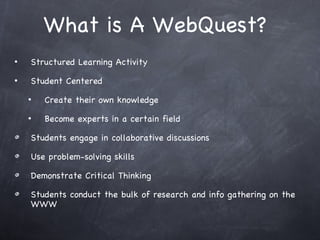
What is A WebQuest?  Structured Learning Activity Student Centered Create their own knowledge Become experts in a certain field Students engage in collaborative discussions Use problem-solving skills Demonstrate Critical Thinking Students conduct the bulk of research and info gathering on the WWW
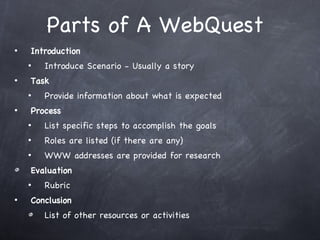
Parts of A WebQuest  Introduction Introduce Scenario - Usually a story Task Provide information about what is expected Process List specific steps to accomplish the goals Roles are listed (if there are any) WWW addresses are provided for research Evaluation Rubric Conclusion List of other resources or activities
Introduction Should orient the learner as to what is coming Should raise some interest in the learner through a variety of means
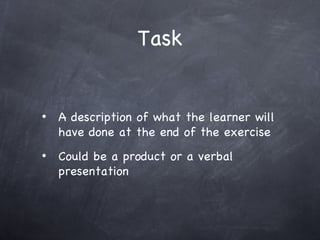
Task A description of what the learner will have done at the end of the exercise Could be a product or a verbal presentation
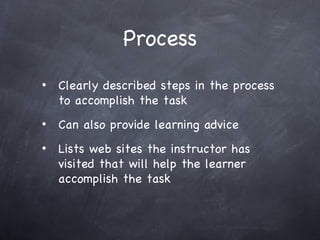
Process Clearly described steps in the process to accomplish the task Can also provide learning advice Lists web sites the instructor has visited that will help the learner accomplish the task
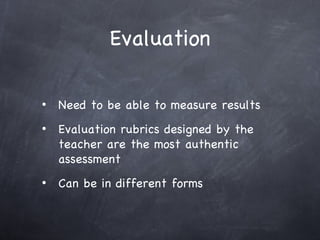
Evaluation Need to be able to measure results Evaluation rubrics designed by the teacher are the most authentic assessment Can be in different forms
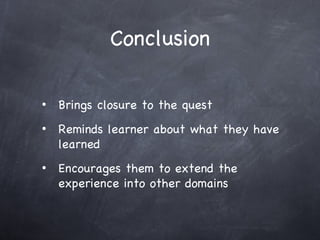
Conclusion Brings closure to the quest Reminds learner about what they have learned Encourages them to extend the experience into other domains
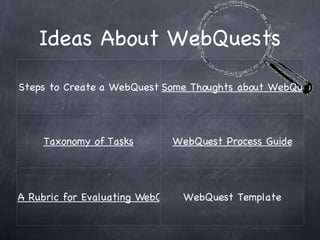
Ideas About WebQuests Steps to Create a WebQuest Some Thoughts about WebQuests Taxonomy of Tasks WebQuest Process Guide A Rubric for Evaluating WebQuests WebQuest Template
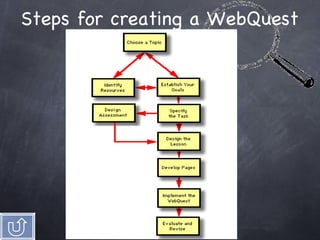
Steps for creating a WebQuest
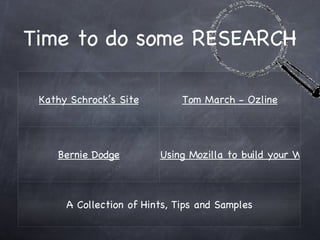
Time to do some RESEARCH Kathy Schrock’s Site Tom March - Ozline Bernie Dodge Using Mozilla to build your WebQuest A Collection of Hints, Tips and Samples
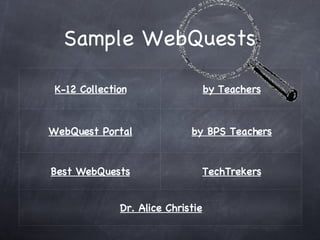
Sample WebQuests K-12 Collection by Teachers WebQuest Portal by BPS Teachers Best WebQuests TechTrekers Dr. Alice Christie

Web Quests

  • 1.
    Using WebQuests byDesireé Caskey This presentation is available on http://www.slideshare.net Search for Caskey
  • 2.
    What is AWebQuest? Structured Learning Activity Student Centered Create their own knowledge Become experts in a certain field Students engage in collaborative discussions Use problem-solving skills Demonstrate Critical Thinking Students conduct the bulk of research and info gathering on the WWW
  • 3.
    Parts of AWebQuest Introduction Introduce Scenario - Usually a story Task Provide information about what is expected Process List specific steps to accomplish the goals Roles are listed (if there are any) WWW addresses are provided for research Evaluation Rubric Conclusion List of other resources or activities
  • 4.
    Introduction Should orientthe learner as to what is coming Should raise some interest in the learner through a variety of means
  • 5.
    Task A descriptionof what the learner will have done at the end of the exercise Could be a product or a verbal presentation
  • 6.
    Process Clearly describedsteps in the process to accomplish the task Can also provide learning advice Lists web sites the instructor has visited that will help the learner accomplish the task
  • 7.
    Evaluation Need tobe able to measure results Evaluation rubrics designed by the teacher are the most authentic assessment Can be in different forms
  • 8.
    Conclusion Brings closureto the quest Reminds learner about what they have learned Encourages them to extend the experience into other domains
  • 9.
    Ideas About WebQuestsSteps to Create a WebQuest Some Thoughts about WebQuests Taxonomy of Tasks WebQuest Process Guide A Rubric for Evaluating WebQuests WebQuest Template
  • 10.
  • 11.
    Time to dosome RESEARCH Kathy Schrock’s Site Tom March - Ozline Bernie Dodge Using Mozilla to build your WebQuest A Collection of Hints, Tips and Samples
  • 12.
    Sample WebQuests K-12Collection by Teachers WebQuest Portal by BPS Teachers Best WebQuests TechTrekers Dr. Alice Christie