Science Fair
Transformation
Science Fair
Transformation:


              Alissa Royal
       K-12 Engineering Coordinator
         aroyal@melissaisd.org
              Dollie Green
        5th Grade Science Teacher
         dgreen@melissaisd.org
               Kelli Gobel
        5th Grade Science Teacher
         kgobel@melissaisd.org
Science Fair          Kids’ Inquiry Conference
 scientific method            scientific method
 competition                  non-competitive
 rigid guidelines             choice
 showing of work through      showing of work through
  display boards                variety of mediums to
                                audiences
                               authentic experiences
                               fosters collaboration
                               become experts on topic
                               integration of technology
                                beyond word processing
 Get others excited about
  science

 Authentic, non-competitive
  environment

 Students sharing science
  experiences

 Greater awareness of their own
  science knowledge

 Strengthened presentation,
  communication and
  technology skills
 Determine scope of KIC for
    your campus
   Establish support from
    colleagues
   Foster science inquiry in
    classrooms
   Introduce KIC to students
   Student Developed Question
   Establish a student timeline
   Establish parent roles
   Gather materials
 Decide on the level of involvement: 1 class, 1
 grade, whole department

 Decide what type of KIC: single school or
 multi-school

 Determine location: rooms for presentations
 and demonstrations, welcome area, keynote
 address
 Determine date: time of year and day of
 week

 Determine time: begin with KIC Pep Rally,
 how many sessions, length of sessions,
 morning group and afternoon group.

 Determine needs for implementation:
 technology, materials, volunteers, mentors
 Establish rubrics
 Student/Teacher
  conferencing
 Assist students in
  evaluating their plan
 Mini-Lessons
 Monitor progress
 Establish roles
 Investigation
  Planning sheets
 Experimentation
 Blurbs
 Presenters Bios
 Journal Articles
 Presentation Prep
 Rehearsals
 Video                     Photo Story or Vodcast
   Flipvids                   Digital camera
   8mm video camera           Microsoft Photo Story
   Microsoft MovieMaker    Demonstration
 Webpage                   Presentation with Visual
   TeacherWeb               Aid
   Google Sites               Microsoft PowerPoint
   Glogster                   Prezi
   TeacherTube             Podcast
   Weebly                     Audacity
   MOODLE                  Live Streaming
                               ustream.tv
Websites

                           Demonstrations

                               Videos

                              Vodcast

                           Display Boards

                   Oral Presentations/PowerPoint

                           Live Streaming

Cardinal Learning Online
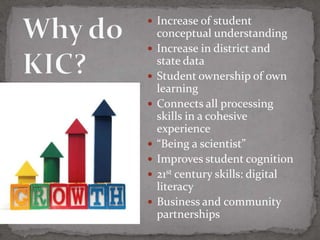
 Increase of student
    conceptual understanding
   Increase in district and
    state data
   Student ownership of own
    learning
   Connects all processing
    skills in a cohesive
    experience
   “Being a scientist”
   Improves student cognition
   21st century skills: digital
    literacy
   Business and community
    partnerships
Short Course
                          Saturday
                         9:00-12:00
                              Register Today!
The next step in transforming a science fair into a Kids’ Inquiry Conference to
support the rigor and complexity of our newest standards. Attendees will
experience life as a student presenter of a Kids' Inquiry Conference by designing
and implementing an investigation. Attendees will be provided with all of the
resources that have been created over the last 7 years of the Melissa Cardinals
KIC to take back to their district and start your very own Kids' Inquiry
Conference.
Dieckman, Dona, Charles R. Pearce, and Wendy Saul. Beyond the Science
   Fair: Creating a Kids' Inquiry Conference. Chicago: Heinemann, 2005.
   Print.

"The Kids' Inquiry Conference Homepage." The Elementary Science
   Integration Projects. N.p., n.d. Web. 1 Nov. 2010.
   <http://www.esiponline.org/kic/

"Science Education Products and Supplies | ETA/Cuisenaire."
   ETA/Cuisenaire: Hands-On Manipulatives and Supplemental
   Educational Materials for Grades PreK-12. N.p., n.d. Web. 1 Nov. 2010.
   <http://www.etacuisenaire.com/catalog/department?deptId=SCIENCE
   &d0=SCIENCE>.

"Melissa Ridge Elementary - KIC: Kids' Inquiry Conference." Melissa Ridge
  Elementary - Index. N.p., n.d. Web. 1 Nov. 2010. <http://melissa-
  ridge.groupfusion.net/modules/cms/pages.phtml?pageid=3036&sessio
  nid=fea16593c11b978dda2befd292dcf250
Structured                                    Guided                  Student-
                                                                               Initiated


Student:   focuses on                               focuses on more           focuses on
           one aspect                               than one aspect           all aspects


Teacher: model and guide                            model and guide           defines
           supporting aspects                       supporting aspects        learning goals


           guide reasoning                          guide reasoning           guide reasoning
                                                                              with discretion
                  Stixy.com
                  Scientific Inquiry Model: NW Regional Educational Library

Kic cast 2012 1hr

  • 1.
  • 2.
    Science Fair Transformation: Alissa Royal K-12 Engineering Coordinator aroyal@melissaisd.org Dollie Green 5th Grade Science Teacher dgreen@melissaisd.org Kelli Gobel 5th Grade Science Teacher kgobel@melissaisd.org
  • 5.
    Science Fair Kids’ Inquiry Conference  scientific method  scientific method  competition  non-competitive  rigid guidelines  choice  showing of work through  showing of work through display boards variety of mediums to audiences  authentic experiences  fosters collaboration  become experts on topic  integration of technology beyond word processing
  • 6.
     Get othersexcited about science  Authentic, non-competitive environment  Students sharing science experiences  Greater awareness of their own science knowledge  Strengthened presentation, communication and technology skills
  • 8.
     Determine scopeof KIC for your campus  Establish support from colleagues  Foster science inquiry in classrooms  Introduce KIC to students  Student Developed Question  Establish a student timeline  Establish parent roles  Gather materials
  • 9.
     Decide onthe level of involvement: 1 class, 1 grade, whole department  Decide what type of KIC: single school or multi-school  Determine location: rooms for presentations and demonstrations, welcome area, keynote address
  • 10.
     Determine date:time of year and day of week  Determine time: begin with KIC Pep Rally, how many sessions, length of sessions, morning group and afternoon group.  Determine needs for implementation: technology, materials, volunteers, mentors
  • 11.
     Establish rubrics Student/Teacher conferencing  Assist students in evaluating their plan  Mini-Lessons  Monitor progress
  • 12.
     Establish roles Investigation Planning sheets  Experimentation  Blurbs  Presenters Bios  Journal Articles  Presentation Prep  Rehearsals
  • 13.
     Video  Photo Story or Vodcast  Flipvids  Digital camera  8mm video camera  Microsoft Photo Story  Microsoft MovieMaker  Demonstration  Webpage  Presentation with Visual  TeacherWeb Aid  Google Sites  Microsoft PowerPoint  Glogster  Prezi  TeacherTube  Podcast  Weebly  Audacity  MOODLE  Live Streaming  ustream.tv
  • 14.
    Websites Demonstrations Videos Vodcast Display Boards Oral Presentations/PowerPoint Live Streaming Cardinal Learning Online
  • 15.
     Increase ofstudent conceptual understanding  Increase in district and state data  Student ownership of own learning  Connects all processing skills in a cohesive experience  “Being a scientist”  Improves student cognition  21st century skills: digital literacy  Business and community partnerships
  • 16.
    Short Course Saturday 9:00-12:00 Register Today! The next step in transforming a science fair into a Kids’ Inquiry Conference to support the rigor and complexity of our newest standards. Attendees will experience life as a student presenter of a Kids' Inquiry Conference by designing and implementing an investigation. Attendees will be provided with all of the resources that have been created over the last 7 years of the Melissa Cardinals KIC to take back to their district and start your very own Kids' Inquiry Conference.
  • 17.
    Dieckman, Dona, CharlesR. Pearce, and Wendy Saul. Beyond the Science Fair: Creating a Kids' Inquiry Conference. Chicago: Heinemann, 2005. Print. "The Kids' Inquiry Conference Homepage." The Elementary Science Integration Projects. N.p., n.d. Web. 1 Nov. 2010. <http://www.esiponline.org/kic/ "Science Education Products and Supplies | ETA/Cuisenaire." ETA/Cuisenaire: Hands-On Manipulatives and Supplemental Educational Materials for Grades PreK-12. N.p., n.d. Web. 1 Nov. 2010. <http://www.etacuisenaire.com/catalog/department?deptId=SCIENCE &d0=SCIENCE>. "Melissa Ridge Elementary - KIC: Kids' Inquiry Conference." Melissa Ridge Elementary - Index. N.p., n.d. Web. 1 Nov. 2010. <http://melissa- ridge.groupfusion.net/modules/cms/pages.phtml?pageid=3036&sessio nid=fea16593c11b978dda2befd292dcf250
  • 18.
    Structured Guided Student- Initiated Student: focuses on focuses on more focuses on one aspect than one aspect all aspects Teacher: model and guide model and guide defines supporting aspects supporting aspects learning goals guide reasoning guide reasoning guide reasoning with discretion Stixy.com Scientific Inquiry Model: NW Regional Educational Library

Editor's Notes

  • #3 Alissa
  • #4 AlissaEvolution of the cell phone in comparison to the evolution of science standards of the nation, state, instruction, technology, science fairWith each generation on the cell phone, the technology gets smart and more efficient!
  • #5 AlissaWhich words stand out the most to you?Explain research and wordleA Kids’ Inquiry Conference provides students with opportunities to share their excitement about discoveries with other students, to critically evaluate the credibility of their own research and testing, and to draw on the discoveries of other students to further their interest in science, math, engineering and technology. Beyond the Science Fair. Creating a Kids’ Inquiry Conference by Dieckman, Neutze, Pearce &amp; SaulEvolution of KIC for Melissa ISD
  • #6 KelliNew Expectations in TEKS: K-4 descriptive investigations, 5 descriptive and experimental (but we need to include comparative), 6-12 all 3What similarities and differences do you see?We know that students really develop the conceptual understanding of the concept if they can teach it to others. This also allows for the concept to go into the long term memory bank.Digital literacy skills are the vehicle for preparation and presentations
  • #7 Kellithink, act, speak like scientistsWant kids to be inspired and to inspire others.
  • #8 Pictures Say a 1,000 process skills! These are picture of students preparing for and presenting at a KIC conference…What process skills do you see in these pictures?What you will see preparing for and on the day of the conference: Measuring Observing collecting identifying analyzing interpreting modeling demonstrating evaluating organizing creating synthesizing presenting designing testing controlling variables controlling testing standards researching communicating concluding inferring classifying predicting formulating hypotheses
  • #9 Dollie
  • #10 Dollie
  • #11 Dollie
  • #12 DollieConferencing about question development, evaluating their planMonitor progress with experimentation, presentation preparation
  • #13 Dollie
  • #14 AlissaWhat we have triedGoogle sitesEducation.Weebly.comMoodleGlogsterTeacher webPreziFlip vids8 mm video cameraDigital cameraLive streaming: ustream.tv, camera quality, band width, micsNetbooksComputer lab
  • #15 AlissaCheck linksDemonstration&gt; 6th Gr 2010&gt; Elephant Toothpaste&gt; Katherine MurphyPPT&gt; Video&gt; 6thGr 2010&gt; Cabbage water indicator&gt; Brianna Cole
  • #16 AlissaOur 1st year of doing KIC our student’s TAKS scores went from 73% - 100% passingSince, our students have maintained 90% or higher with a commended rate of 59%Include this year’s SE data…look at trends in last 3 yrs. process skills
  • #17 Alissa
  • #19 Difference between deductive inquiry (cook book labs where student do very little thinking) and inductive inquiry (where students develop conceptual understanding through questioning and hypothesizing.)Rote memorization does not promote conceptual understanding.