WebQuests Promoting Engaged Learning Online
What is a WebQuest? Inquiry-oriented activity in which most or all of the information used by learners is drawn from the Web Responsibility shift  Teachers prepare resources Learners respond and interact Designed to use learners' time well, to focus on using information rather than looking for it, and to support learners' thinking at the levels of analysis, synthesis and evaluation.
How did WebQuests come to be? The Father of the WebQuest Bernie Dodge Original article Professor Educational Technology, SDSU
A Great WebQuest Must have: An engaging,  doable task   Authenticity Higher order thinking skills Creative  or  critical Problem solving ,  judgment ,  analysis ,  synthesis click on links for examples
Types of WebQuests Short-term A week or less in duration Instructional goal is knowledge acquisition and integration Student deals with a significant amount of new information and makes sense of it Long-term A week or more in duration Instructional goal is extending and refining knowledge Students analyze a body of knowledge, transform it, and demonstrate understanding by presenting it in some way
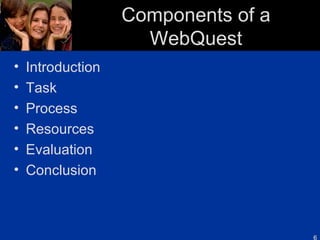
Components of a WebQuest Introduction Task Process Resources Evaluation Conclusion
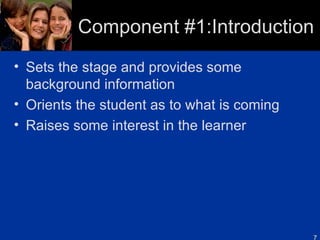
Component #1:Introduction Sets the stage and provides some background information Orients the student as to what is coming Raises some interest in the learner
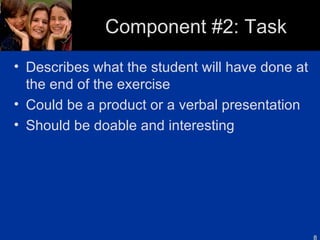
Component #2: Task Describes what the student will have done at the end of the exercise Could be a product or a verbal presentation Should be doable and interesting
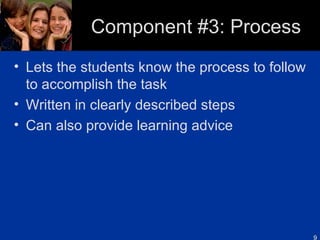
Component #3: Process Lets the students know the process to follow to accomplish the task Written in clearly described steps Can also provide learning advice
Component #4: Resources A list of websites which the instructor has located that will help the student accomplish the task May also include resources not found on the Internet Since resources are included, the learner is not left to wander through webspace completely adrift
Component #5: Evaluation Used to measure results Rubrics designed by the teacher are the most authentic
Component #6: Conclusion Brings closure to the activity Reminds students about what they have just learned Encourages them to extend their knowledge and experience into other domains
Keys to a Great WebQuest Quality of the web resources Match the  audience Match the learner objective Out of the ordinary Challenge to the students Key is a well designed task Engagement, analysis, synthesis, or evaluation Students asked to do  out of the ordinary  tasks
Keys to a Great WebQuest Use the technology to your advantage Could not be easily done “on paper” Student blogs Multimedia  Web 2.0 tools
Quality WebQuests Choices Find thousands of pre-made WebQuests on the Internet (your next lesson!) Tweak an existing WebQuest Create your own WebQuest (This will be one of your project choices for this unit.)

S T E Ps Web Quests

  • 1.
  • 2.
    What is aWebQuest? Inquiry-oriented activity in which most or all of the information used by learners is drawn from the Web Responsibility shift Teachers prepare resources Learners respond and interact Designed to use learners' time well, to focus on using information rather than looking for it, and to support learners' thinking at the levels of analysis, synthesis and evaluation.
  • 3.
    How did WebQuestscome to be? The Father of the WebQuest Bernie Dodge Original article Professor Educational Technology, SDSU
  • 4.
    A Great WebQuestMust have: An engaging, doable task Authenticity Higher order thinking skills Creative or critical Problem solving , judgment , analysis , synthesis click on links for examples
  • 5.
    Types of WebQuestsShort-term A week or less in duration Instructional goal is knowledge acquisition and integration Student deals with a significant amount of new information and makes sense of it Long-term A week or more in duration Instructional goal is extending and refining knowledge Students analyze a body of knowledge, transform it, and demonstrate understanding by presenting it in some way
  • 6.
    Components of aWebQuest Introduction Task Process Resources Evaluation Conclusion
  • 7.
    Component #1:Introduction Setsthe stage and provides some background information Orients the student as to what is coming Raises some interest in the learner
  • 8.
    Component #2: TaskDescribes what the student will have done at the end of the exercise Could be a product or a verbal presentation Should be doable and interesting
  • 9.
    Component #3: ProcessLets the students know the process to follow to accomplish the task Written in clearly described steps Can also provide learning advice
  • 10.
    Component #4: ResourcesA list of websites which the instructor has located that will help the student accomplish the task May also include resources not found on the Internet Since resources are included, the learner is not left to wander through webspace completely adrift
  • 11.
    Component #5: EvaluationUsed to measure results Rubrics designed by the teacher are the most authentic
  • 12.
    Component #6: ConclusionBrings closure to the activity Reminds students about what they have just learned Encourages them to extend their knowledge and experience into other domains
  • 13.
    Keys to aGreat WebQuest Quality of the web resources Match the audience Match the learner objective Out of the ordinary Challenge to the students Key is a well designed task Engagement, analysis, synthesis, or evaluation Students asked to do out of the ordinary tasks
  • 14.
    Keys to aGreat WebQuest Use the technology to your advantage Could not be easily done “on paper” Student blogs Multimedia Web 2.0 tools
  • 15.
    Quality WebQuests ChoicesFind thousands of pre-made WebQuests on the Internet (your next lesson!) Tweak an existing WebQuest Create your own WebQuest (This will be one of your project choices for this unit.)