1
‫المعلومات‬ ‫مراكز‬ ‫في‬ ‫الرقمية‬ ‫الخدمات‬
‫اعداد‬
:
‫روال‬ ‫الطالبة‬
‫مسعود‬
‫مقدم‬
‫إلى‬
:
‫د‬
.
‫فرح‬
‫السبيتي‬
‫ماستر‬
2
‫معلومات‬ ‫ادارة‬
‫تقديم‬
:
‫مسعود‬ ‫روال‬
‫إلى‬ ‫مقدم‬
:
‫سبيتي‬ ‫فرح‬ ‫الدكتورة‬
2022-2023
2
Content 3
Online public access catalogue (OPAC)
Web OPAC
Web OPAC features and functions
Development of OPAC
 Web OPAC during the Covid-19 Pandemic
OPAC and Smart Devices
4
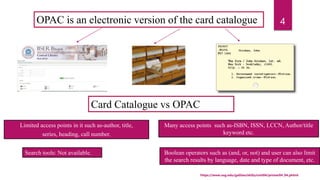
OPAC is an electronic version of the card catalogue
Card Catalogue vs OPAC
Search tools: Not available.
Limited access points in it such as-author, title,
series, heading, call number.
Many access points such as-ISBN, ISSN, LCCN, Author/title
keyword etc.
Boolean operators such as (and, or, not) and user can also limit
the search results by language, date and type of document, etc.
https://www.usg.edu/galileo/skills/unit04/primer04_04.phtml
5
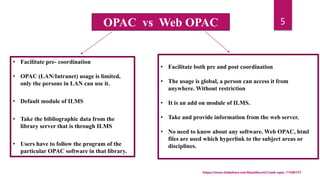
• Facilitate both pre and post coordination
• The usage is global, a person can access it from
anywhere. Without restriction
• It is an add on module of ILMS.
• Take and provide information from the web server.
• No need to know about any software. Web OPAC, html
files are used which hyperlink to the subject areas or
disciplines.
• Facilitate pre- coordination
• OPAC (LAN/Intranet) usage is limited,
only the persons in LAN can use it.
• Default module of ILMS
• Take the bibliographic data from the
library server that is through ILMS
• Users have to follow the program of the
particular OPAC software in that library.
OPAC vs Web OPAC
https://www.slideshare.net/AkashKurmi1/web-opac-71568157
6
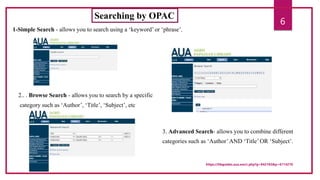
1-Simple Search - allows you to search using a ‘keyword’ or ‘phrase’.
Searching by OPAC
3. Advanced Search- allows you to combine different
categories such as ‘Author’AND ‘Title’ OR ‘Subject’.
2.. . Browse Search - allows you to search by a specific
category such as ‘Author’, ‘Title’, ‘Subject’, etc
https://libguides.aua.am/c.php?g=842183&p=6114210
7
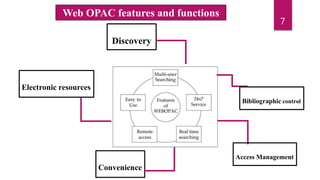
Web OPAC features and functions
Bibliographic control
Discovery
Access Management
Convenience
Electronic resources
8
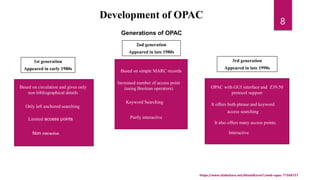
Development of OPAC
3rd generation
Appeared in late 1990s
2nd generation
Appeared in late 1980s
1st generation
Appeared in early 1980s
Generations of OPAC
OPAC with GUI interface and Z39.50
protocol support
Non interactive
Based on circulation and gives only
non bibliographical details
Only left anchored searching
Limited access points
It offers both phrase and keyword
access searching
It also offers many access points.
Interactive
Based on simple MARC records
Partly interactive
Increased number of access point
(using Boolean operators)
Keyword Searching
https://www.slideshare.net/AkashKurmi1/web-opac-71568157
9
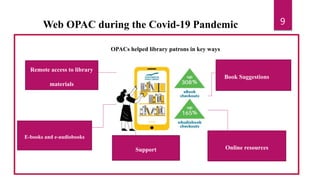
Web OPAC during the Covid-19 Pandemic
Remote access to library
materials
Online resources
E-books and e-audiobooks
Book Suggestions
Support
OPACs helped library patrons in key ways
10
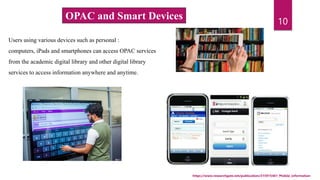
OPAC and Smart Devices
Users using various devices such as personal :
computers, iPads and smartphones can access OPAC services
from the academic digital library and other digital library
services to access information anywhere and anytime.
https://www.researchgate.net/publication/315915461_Mobile_information
..
11
Conclusion
The development of technology and changes have a major impact on libraries.
WEB OPAC is an instrument of change in today’s libraries. Librarians must continue
to play the role of an “Agents of Change” in the use of online catalogues.
In all of his writings, Wilfred Lancaster (1981) stresses the acceleration of electronic and digital advances, and the emergence
of paperless information systems, and indicates that we are approaching the day when a great library of science can be within
an area of ​​less than 10 square meters, containing only electronic outlets and equipment….
12
rola.massoud78@gmail.com
Farah.sbeity.1@ul.edu.lb
13
https://www.usg.edu/galileo/skills/unit04/primer04_04.phtml
Ejovwokoghene, E. R. (2019, 5). Use of Online Public Access Catalogue (OPAC) in
Selected University Libraries in South-South Nigeria. Retrieved from
researchgate: www.researchgate.net
References
https://www.slideshare.net/AkashKurmi1/web-opac-71568157
https://libguides.aua.am/c.php?g=842183&p=6114210
https://www.researchgate.net/publication/315915461_Mobile_information_services_and_initiatives_in_uni
versity_libraries_A_new_way_of_delivering_information/figures?lo=1&utm_source=google&utm_medi
um=organic

OPAC

  • 1.
    1 ‫المعلومات‬ ‫مراكز‬ ‫في‬‫الرقمية‬ ‫الخدمات‬ ‫اعداد‬ : ‫روال‬ ‫الطالبة‬ ‫مسعود‬ ‫مقدم‬ ‫إلى‬ : ‫د‬ . ‫فرح‬ ‫السبيتي‬ ‫ماستر‬ 2 ‫معلومات‬ ‫ادارة‬
  • 2.
  • 3.
    Content 3 Online publicaccess catalogue (OPAC) Web OPAC Web OPAC features and functions Development of OPAC  Web OPAC during the Covid-19 Pandemic OPAC and Smart Devices
  • 4.
    4 OPAC is anelectronic version of the card catalogue Card Catalogue vs OPAC Search tools: Not available. Limited access points in it such as-author, title, series, heading, call number. Many access points such as-ISBN, ISSN, LCCN, Author/title keyword etc. Boolean operators such as (and, or, not) and user can also limit the search results by language, date and type of document, etc. https://www.usg.edu/galileo/skills/unit04/primer04_04.phtml
  • 5.
    5 • Facilitate bothpre and post coordination • The usage is global, a person can access it from anywhere. Without restriction • It is an add on module of ILMS. • Take and provide information from the web server. • No need to know about any software. Web OPAC, html files are used which hyperlink to the subject areas or disciplines. • Facilitate pre- coordination • OPAC (LAN/Intranet) usage is limited, only the persons in LAN can use it. • Default module of ILMS • Take the bibliographic data from the library server that is through ILMS • Users have to follow the program of the particular OPAC software in that library. OPAC vs Web OPAC https://www.slideshare.net/AkashKurmi1/web-opac-71568157
  • 6.
    6 1-Simple Search -allows you to search using a ‘keyword’ or ‘phrase’. Searching by OPAC 3. Advanced Search- allows you to combine different categories such as ‘Author’AND ‘Title’ OR ‘Subject’. 2.. . Browse Search - allows you to search by a specific category such as ‘Author’, ‘Title’, ‘Subject’, etc https://libguides.aua.am/c.php?g=842183&p=6114210
  • 7.
    7 Web OPAC featuresand functions Bibliographic control Discovery Access Management Convenience Electronic resources
  • 8.
    8 Development of OPAC 3rdgeneration Appeared in late 1990s 2nd generation Appeared in late 1980s 1st generation Appeared in early 1980s Generations of OPAC OPAC with GUI interface and Z39.50 protocol support Non interactive Based on circulation and gives only non bibliographical details Only left anchored searching Limited access points It offers both phrase and keyword access searching It also offers many access points. Interactive Based on simple MARC records Partly interactive Increased number of access point (using Boolean operators) Keyword Searching https://www.slideshare.net/AkashKurmi1/web-opac-71568157
  • 9.
    9 Web OPAC duringthe Covid-19 Pandemic Remote access to library materials Online resources E-books and e-audiobooks Book Suggestions Support OPACs helped library patrons in key ways
  • 10.
    10 OPAC and SmartDevices Users using various devices such as personal : computers, iPads and smartphones can access OPAC services from the academic digital library and other digital library services to access information anywhere and anytime. https://www.researchgate.net/publication/315915461_Mobile_information
  • 11.
    .. 11 Conclusion The development oftechnology and changes have a major impact on libraries. WEB OPAC is an instrument of change in today’s libraries. Librarians must continue to play the role of an “Agents of Change” in the use of online catalogues. In all of his writings, Wilfred Lancaster (1981) stresses the acceleration of electronic and digital advances, and the emergence of paperless information systems, and indicates that we are approaching the day when a great library of science can be within an area of ​​less than 10 square meters, containing only electronic outlets and equipment….
  • 12.
  • 13.
    13 https://www.usg.edu/galileo/skills/unit04/primer04_04.phtml Ejovwokoghene, E. R.(2019, 5). Use of Online Public Access Catalogue (OPAC) in Selected University Libraries in South-South Nigeria. Retrieved from researchgate: www.researchgate.net References https://www.slideshare.net/AkashKurmi1/web-opac-71568157 https://libguides.aua.am/c.php?g=842183&p=6114210 https://www.researchgate.net/publication/315915461_Mobile_information_services_and_initiatives_in_uni versity_libraries_A_new_way_of_delivering_information/figures?lo=1&utm_source=google&utm_medi um=organic