Discovery Platforms
TECHNOLOGIES, TOOLS AND ISSUES


                                   Saiful Amin
                    39th Five Laws Lecture (2011)
Evolution of Discovery Tools

 Printed catalogues
 Traditional (Web)OPAC
 Integrated OPAC portals
 Federated search services
 Discovery interfaces
 Web-scale discovery services
 Integrated discovery platform
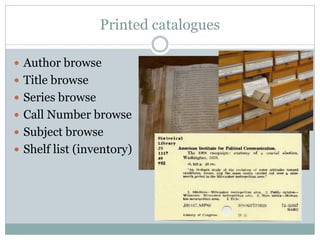
Printed catalogues

 Author browse
 Title browse
 Series browse
 Call Number browse
 Subject browse
 Shelf list (inventory)
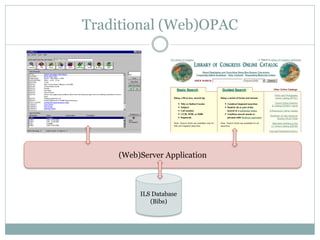
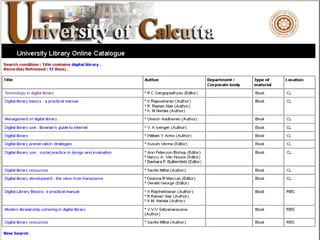
Traditional (Web)OPAC


    (Web)Server Application


         ILS Database
            (Bibs)
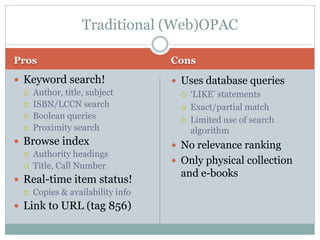
Traditional (Web)OPAC

Pros                              Cons
 Keyword search!                  Uses database queries
    Author, title, subject          „LIKE‟ statements
    ISBN/LCCN search                Exact/partial match
    Boolean queries                 Limited use of search
    Proximity search                 algorithm
 Browse index                     No relevance ranking
    Authority headings
                                   Only physical collection
    Title, Call Number
                                    and e-books
 Real-time item status!
    Copies & availability info
 Link to URL (tag 856)
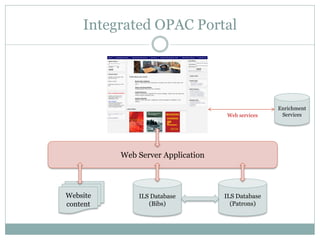
Integrated OPAC Portal


                                                  Enrichment
                                   Web services    Services


          Web Server Application


Website       ILS Database         ILS Database
content          (Bibs)              (Patrons)
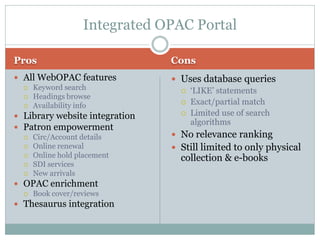
Integrated OPAC Portal

Pros                            Cons
 All WebOPAC features           Uses database queries
   Keyword search
                                   „LIKE‟ statements
   Headings browse
                                   Exact/partial match
   Availability info
                                   Limited use of search
 Library website integration
                                    algorithms
 Patron empowerment
   Circ/Account details         No relevance ranking
   Online renewal               Still limited to only physical
   Online hold placement
                                  collection & e-books
   SDI services
   New arrivals

 OPAC enrichment
   Book cover/reviews

 Thesaurus integration
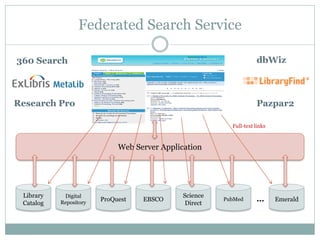
Federated Search Service

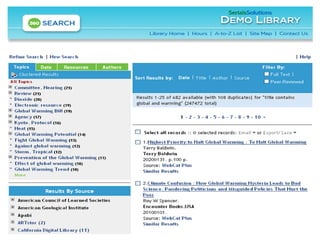
360 Search                                                          dbWiz


Research Pro                                                        Pazpar2

                                                          Full-text links


                             Web Server Application


 Library    Digital                           Science
 Catalog   Repository
                        ProQuest   EBSCO
                                               Direct
                                                        PubMed      …       Emerald
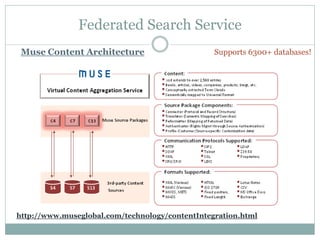
Federated Search Service
 Muse Content Architecture                       Supports 6300+ databases!


http://www.museglobal.com/technology/contentIntegration.html
Federated Search Service

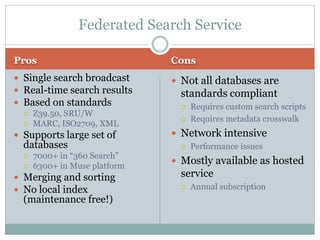
Pros                           Cons
 Single search broadcast       Not all databases are
 Real-time search results       standards compliant
 Based on standards                Requires custom search scripts
   Z39.50, SRU/W
                                    Requires metadata crosswalk
   MARC, ISO2709, XML

 Supports large set of         Network intensive
  databases                         Performance issues
     7000+ in “360 Search”
                                Mostly available as hosted
     6300+ in Muse platform
 Merging and sorting            service
 No local index                    Annual subscription
  (maintenance free!)
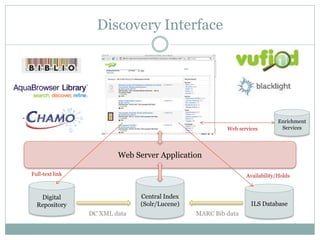
Discovery Interface


                                                                            Enrichment
                                                        Web services         Services


                         Web Server Application

Full-text link                                                 Availability/Holds


   Digital                     Central Index
  Repository                   (Solr/Lucene)                     ILS Database
                 DC XML data                   MARC Bib data
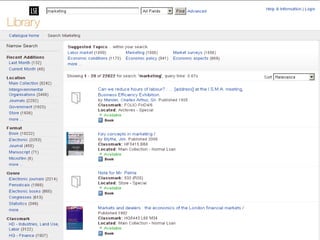
Discovery Interface
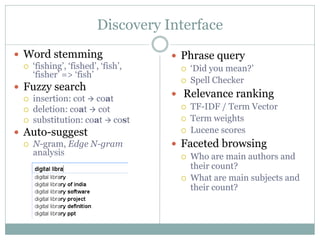
 Word stemming                      Phrase query
    „fishing‟, „fished‟, „fish‟,       „Did you mean?‟
     „fisher‟ => „fish‟
                                        Spell Checker
 Fuzzy search
    insertion: cot  coat           Relevance ranking
    deletion: coat  cot               TF-IDF / Term Vector
    substitution: coat  cost          Term weights
 Auto-suggest                          Lucene scores
    N-gram, Edge N-gram             Faceted browsing
     analysis                           Who are main authors and
                                         their count?
                                        What are main subjects and
                                         their count?
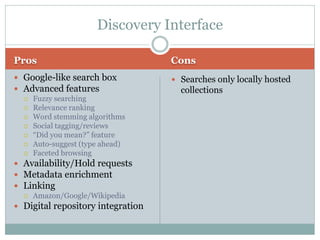
Discovery Interface

Pros                               Cons
 Google-like search box            Searches only locally hosted
 Advanced features                  collections
   Fuzzy searching
   Relevance ranking
   Word stemming algorithms
   Social tagging/reviews
   “Did you mean?” feature
   Auto-suggest (type ahead)
   Faceted browsing

 Availability/Hold requests
 Metadata enrichment
 Linking
   Amazon/Google/Wikipedia

 Digital repository integration
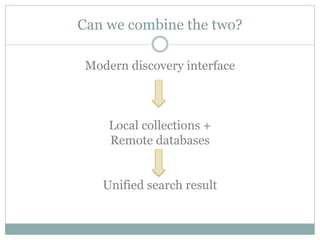
Can we combine the two?

 Modern discovery interface


     Local collections +
     Remote databases


    Unified search result
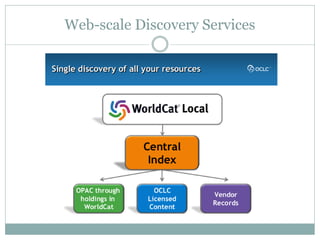
Web-scale Discovery Services


  EBSCO


 ProQuest


ABI Inform
                                          Web Server Application
 PubMed
                                                                        Availability
                                                                        Full-text link
 Science
  Direct                                                             Library

   …                                    Central Index
                                                        MARC data    Catalog

               Full-text and metadata
                                                                     Digital
Lexis-Nexis                                                         Repository
                                                         DC data
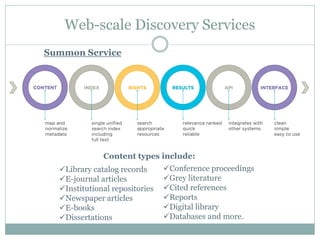
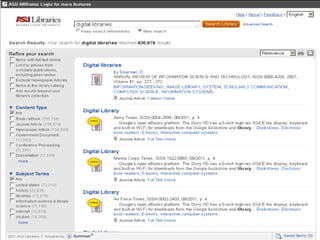
Web-scale Discovery Services
Summon Service


              Content types include:
  Library catalog records      Conference proceedings
  E-journal articles           Grey literature
  Institutional repositories   Cited references
  Newspaper articles           Reports
  E-books                      Digital library
  Dissertations                Databases and more.
Web-scale Discovery Services

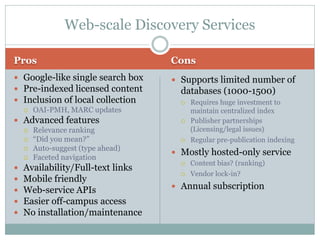
Pros                              Cons
 Google-like single search box    Supports limited number of
 Pre-indexed licensed content      databases (1000-1500)
 Inclusion of local collection        Requires huge investment to
   OAI-PMH, MARC updates               maintain centralized index
 Advanced features                    Publisher partnerships
   Relevance ranking                   (Licensing/legal issues)
   “Did you mean?”                    Regular pre-publication indexing
   Auto-suggest (type ahead)
                                   Mostly hosted-only service
   Faceted navigation
                                       Content bias? (ranking)
 Availability/Full-text links
                                       Vendor lock-in?
 Mobile friendly
 Web-service APIs                 Annual subscription
 Easier off-campus access
 No installation/maintenance
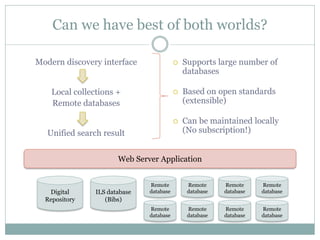
Can we have best of both worlds?

Modern discovery interface                   Supports large number of
                                              databases

    Local collections +                      Based on open standards
    Remote databases                          (extensible)

                                             Can be maintained locally
   Unified search result                      (No subscription!)


                       Web Server Application


                               Remote          Remote     Remote     Remote
   Digital      ILS database   database        database   database   database
  Repository       (Bibs)
                               Remote          Remote     Remote     Remote
                               database        database   database   database
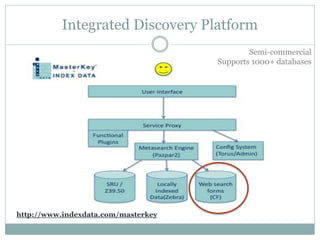
Integrated Discovery Platform
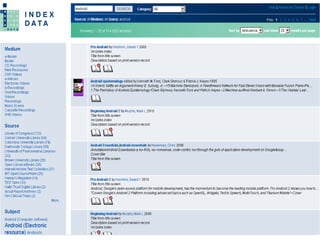
                                             Semi-commercial
                                     Supports 1000+ databases


http://www.indexdata.com/masterkey
Integrated Discovery Platform
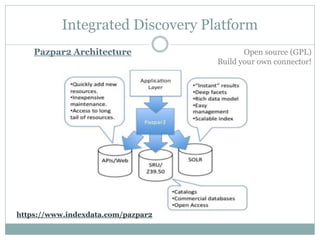
    Pazpar2 Architecture                   Open source (GPL)
                                    Build your own connector!


https://www.indexdata.com/pazpar2
Conclusion

 Each platform has its own goals:
     Pure library catalog can provide expressive search (high precision)
     Federated search improves content coverage in single search
     Discovery interfaces are designed to improve user experience for
      local collections
     Web-scale discovery provides unified search experience for local and
      remote collections (still way short in content coverage)
     Integrated platform provides extensibility (but requires significant
      effort in development and maintenance)
 One size does not fit all. No single system is perfect.
 As content becomes more open, the focus of discovery
  solutions should be on open platforms that are extensible
  as well as affordable.
Questions and Discussions

Discovery platforms: Technology, tools and issues

  • 1.
    Discovery Platforms TECHNOLOGIES, TOOLSAND ISSUES Saiful Amin 39th Five Laws Lecture (2011)
  • 2.
    Evolution of DiscoveryTools  Printed catalogues  Traditional (Web)OPAC  Integrated OPAC portals  Federated search services  Discovery interfaces  Web-scale discovery services  Integrated discovery platform
  • 3.
    Printed catalogues  Authorbrowse  Title browse  Series browse  Call Number browse  Subject browse  Shelf list (inventory)
  • 4.
    Traditional (Web)OPAC (Web)Server Application ILS Database (Bibs)
  • 6.
    Traditional (Web)OPAC Pros Cons  Keyword search!  Uses database queries  Author, title, subject  „LIKE‟ statements  ISBN/LCCN search  Exact/partial match  Boolean queries  Limited use of search  Proximity search algorithm  Browse index  No relevance ranking  Authority headings  Only physical collection  Title, Call Number and e-books  Real-time item status!  Copies & availability info  Link to URL (tag 856)
  • 7.
    Integrated OPAC Portal Enrichment Web services Services Web Server Application Website ILS Database ILS Database content (Bibs) (Patrons)
  • 9.
    Integrated OPAC Portal Pros Cons  All WebOPAC features  Uses database queries  Keyword search  „LIKE‟ statements  Headings browse  Exact/partial match  Availability info  Limited use of search  Library website integration algorithms  Patron empowerment  Circ/Account details  No relevance ranking  Online renewal  Still limited to only physical  Online hold placement collection & e-books  SDI services  New arrivals  OPAC enrichment  Book cover/reviews  Thesaurus integration
  • 10.
    Federated Search Service 360Search dbWiz Research Pro Pazpar2 Full-text links Web Server Application Library Digital Science Catalog Repository ProQuest EBSCO Direct PubMed … Emerald
  • 11.
    Federated Search Service Muse Content Architecture Supports 6300+ databases! http://www.museglobal.com/technology/contentIntegration.html
  • 13.
    Federated Search Service Pros Cons  Single search broadcast  Not all databases are  Real-time search results standards compliant  Based on standards  Requires custom search scripts  Z39.50, SRU/W  Requires metadata crosswalk  MARC, ISO2709, XML  Supports large set of  Network intensive databases  Performance issues  7000+ in “360 Search”  Mostly available as hosted  6300+ in Muse platform  Merging and sorting service  No local index  Annual subscription (maintenance free!)
  • 15.
    Discovery Interface Enrichment Web services Services Web Server Application Full-text link Availability/Holds Digital Central Index Repository (Solr/Lucene) ILS Database DC XML data MARC Bib data
  • 17.
    Discovery Interface  Wordstemming  Phrase query  „fishing‟, „fished‟, „fish‟,  „Did you mean?‟ „fisher‟ => „fish‟  Spell Checker  Fuzzy search  insertion: cot  coat  Relevance ranking  deletion: coat  cot  TF-IDF / Term Vector  substitution: coat  cost  Term weights  Auto-suggest  Lucene scores  N-gram, Edge N-gram  Faceted browsing analysis  Who are main authors and their count?  What are main subjects and their count?
  • 18.
    Discovery Interface Pros Cons  Google-like search box  Searches only locally hosted  Advanced features collections  Fuzzy searching  Relevance ranking  Word stemming algorithms  Social tagging/reviews  “Did you mean?” feature  Auto-suggest (type ahead)  Faceted browsing  Availability/Hold requests  Metadata enrichment  Linking  Amazon/Google/Wikipedia  Digital repository integration
  • 19.
    Can we combinethe two? Modern discovery interface Local collections + Remote databases Unified search result
  • 20.
    Web-scale Discovery Services EBSCO ProQuest ABI Inform Web Server Application PubMed Availability Full-text link Science Direct Library … Central Index MARC data Catalog Full-text and metadata Digital Lexis-Nexis Repository DC data
  • 21.
  • 22.
    Web-scale Discovery Services SummonService Content types include: Library catalog records Conference proceedings E-journal articles Grey literature Institutional repositories Cited references Newspaper articles Reports E-books Digital library Dissertations Databases and more.
  • 24.
    Web-scale Discovery Services Pros Cons  Google-like single search box  Supports limited number of  Pre-indexed licensed content databases (1000-1500)  Inclusion of local collection  Requires huge investment to  OAI-PMH, MARC updates maintain centralized index  Advanced features  Publisher partnerships  Relevance ranking (Licensing/legal issues)  “Did you mean?”  Regular pre-publication indexing  Auto-suggest (type ahead)  Mostly hosted-only service  Faceted navigation  Content bias? (ranking)  Availability/Full-text links  Vendor lock-in?  Mobile friendly  Web-service APIs  Annual subscription  Easier off-campus access  No installation/maintenance
  • 25.
    Can we havebest of both worlds? Modern discovery interface  Supports large number of databases Local collections +  Based on open standards Remote databases (extensible)  Can be maintained locally Unified search result (No subscription!) Web Server Application Remote Remote Remote Remote Digital ILS database database database database database Repository (Bibs) Remote Remote Remote Remote database database database database
  • 26.
    Integrated Discovery Platform Semi-commercial Supports 1000+ databases http://www.indexdata.com/masterkey
  • 28.
    Integrated Discovery Platform Pazpar2 Architecture Open source (GPL) Build your own connector! https://www.indexdata.com/pazpar2
  • 29.
    Conclusion  Each platformhas its own goals:  Pure library catalog can provide expressive search (high precision)  Federated search improves content coverage in single search  Discovery interfaces are designed to improve user experience for local collections  Web-scale discovery provides unified search experience for local and remote collections (still way short in content coverage)  Integrated platform provides extensibility (but requires significant effort in development and maintenance)  One size does not fit all. No single system is perfect.  As content becomes more open, the focus of discovery solutions should be on open platforms that are extensible as well as affordable.
  • 30.