Using the LMS to increase student engagement in self-directed learningKristin Bird, PrincipalSevenstar AcademyJackie Mangieri, Teacher/Peer CoachUniversity of Phoenix/MVPS
Current ResearchActive learning is superior to passive learning:
Increases retention
Increases depth of understanding
Increases achievement level
Technology increases potential for learning
Learning communities:
Increase learning
Increase achievement
 Create active learners http://www.njc.edu/titleiii/faculty.html
What is Student Engagement?An engaged student is one who is intrinsicallymotivated to learn—that is, motivated from a desire for competence and understanding, or simply from a love of learning, rather than a desire for a good grade, a teacher's approval, or acceptance into a good college.http://www.ascd.org/publications/newsletters/infobrief/feb02/num28/Motivating_Students_to_Learn.aspx
What Increases Student Engagement?According to education researchers, children have certain basic needs and are most likely to become engaged in the learning process when the learning environment is compatible with those needs.Can online learning do that?   If so, how?  (Newmann, Wehlage, & Lamborn, 1992; McCombs, n.d.)
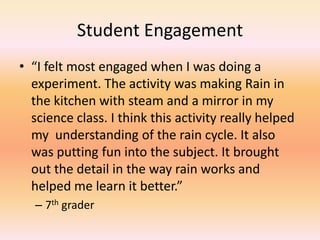
Student Engagement“I felt most engaged when I was doing a experiment. The activity was making Rain in the kitchen with steam and a mirror in my science class. I think this activity really helped my  understanding of the rain cycle. It also was putting fun into the subject. It brought out the detail in the way rain works and helped me learn it better.” 7th grader
Student Engagement“I think I learned better as a result of being engaged in the active learning, opposed to lecture. Being in a lecture, you only get what the teacher gives you. In online classes, you can go explore outside of the course, and learn more than you ever would if you were sitting through a lecture.”10th grader
Student Engagement“When I'm engaged in active learning I learn the material better because I am more challenged to apply them.  This encourages me to learn the concepts more in depth.  I feel I am taking more ownership over my education.  When I listen to a lecture I may forget some of what the teacher says.  I remember the concepts better by reading the content.”12th grader
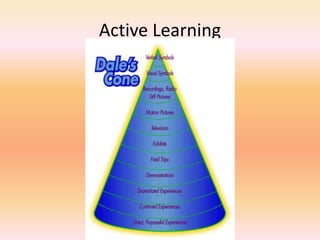
Active Learning
Active learning increases effectiveness of teaching/learningINPUT- from multiple sources through multiple senses (hearing, seeing, feeling, etc.)PROCESS-  interacting with other people and materials, accessing related schemata in the brain, stimulating multiple areas of the brain to act.OUTPUT- requiring students to produce a response or a solution or some evidence of the interactive Learning that is taking place.
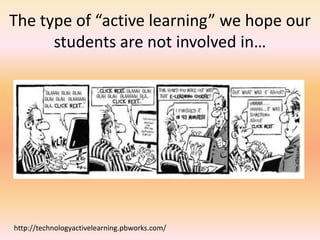
The type of “active learning” we hope our students are not involved in…  http://technologyactivelearning.pbworks.com/
The role of the InstructorTo create a dynamic and academically effective learning environmentPalloff and Pratt (2001) state “the key to success in our online classes rests not with the content that is being presented but with the method by which the course is being delivered” (p. 152). 
Biggest Challenge of Online InstructorsTo create an interactive learning environment allows us to expect more out of our students.
How can we do this?
By creating a consistent level of interaction that fosters genuine learning and cultivates a community atmosphere.Why is Interaction Necessary?According to the Department of Educational Technology at Northern Illinois University, “Interaction is one of the most important elements of online instruction because it is helpful for learners in getting feedback from the instructor about their performance in course-related activities and also for encouraging learners to engage in active learning.”
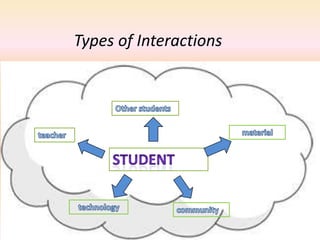
Types of InteractionsOther studentsmaterialteacherStudenttechnologycommunity
Steps to Adding InteractionDecide on goal/purposeDecide how you will meet that goalWhat methods will you use?What tools will be required?Add the interaction into the courses only if it is more benefit than “harm”
Key PhilosophyWhat is the key philosophy of my teaching point of view that will drive all the decisions I make as a teacher?This is about finding the “core” of what you want communicated through the course“A designer knows he has achieved perfection not when there is nothing left to add, but when there is nothing left to take away.”- Antoine de Saint-Exupery
Where do we start?Start in your learning environment Think:  What tools do I have in the LMS that will help me increase interaction with my students and create a better learning experience for them?
Interaction Tools in the LMS Question:  What is the #1 tool in every LMS that is used for interaction?Answer:  Discussion Forums
DiscussionsYou must decide:Why you want them to use online discussions(explore new ideas, review concepts, compare experiences …) What you want them to base their discussion on(readings, in-class discussion, personal opinion …) How you expect them to use it(when, how often, types of postings: original vs. response …)
Tips for DiscussionsRequire students to participateGrade their effortInvolve learning teamsBuild a structure into the discussionsPose questions/scenarios that require students to use their own experienceMake questions relate to research they have done ahead of timeRelate the discussion to course objectives
Discussion Questions that involve InteractionOnes that avoid asking yes/no questionsDB’s that aren’t based on purely factual answersDB’s that ask for reflection, interpretation, problem-solving, analysisQuestions that solicit personal experience and/or opinionOnes that require engagement with other class members (require students to “talk” to each other and respond to each other)Questions that require connections to be made between previous and present course material

Using_the_LMS_to_increase_student_engagement%2520in1[1]

  • 1.
    Using the LMSto increase student engagement in self-directed learningKristin Bird, PrincipalSevenstar AcademyJackie Mangieri, Teacher/Peer CoachUniversity of Phoenix/MVPS
  • 2.
    Current ResearchActive learningis superior to passive learning:
  • 3.
  • 4.
    Increases depth ofunderstanding
  • 5.
  • 6.
  • 7.
  • 8.
  • 9.
  • 10.
    Create activelearners http://www.njc.edu/titleiii/faculty.html
  • 11.
    What is StudentEngagement?An engaged student is one who is intrinsicallymotivated to learn—that is, motivated from a desire for competence and understanding, or simply from a love of learning, rather than a desire for a good grade, a teacher's approval, or acceptance into a good college.http://www.ascd.org/publications/newsletters/infobrief/feb02/num28/Motivating_Students_to_Learn.aspx
  • 12.
    What Increases StudentEngagement?According to education researchers, children have certain basic needs and are most likely to become engaged in the learning process when the learning environment is compatible with those needs.Can online learning do that? If so, how? (Newmann, Wehlage, & Lamborn, 1992; McCombs, n.d.)
  • 13.
    Student Engagement“I feltmost engaged when I was doing a experiment. The activity was making Rain in the kitchen with steam and a mirror in my science class. I think this activity really helped my  understanding of the rain cycle. It also was putting fun into the subject. It brought out the detail in the way rain works and helped me learn it better.” 7th grader
  • 14.
    Student Engagement“I thinkI learned better as a result of being engaged in the active learning, opposed to lecture. Being in a lecture, you only get what the teacher gives you. In online classes, you can go explore outside of the course, and learn more than you ever would if you were sitting through a lecture.”10th grader
  • 15.
    Student Engagement“When I'm engagedin active learning I learn the material better because I am more challenged to apply them.  This encourages me to learn the concepts more in depth.  I feel I am taking more ownership over my education.  When I listen to a lecture I may forget some of what the teacher says.  I remember the concepts better by reading the content.”12th grader
  • 16.
  • 17.
    Active learning increaseseffectiveness of teaching/learningINPUT- from multiple sources through multiple senses (hearing, seeing, feeling, etc.)PROCESS- interacting with other people and materials, accessing related schemata in the brain, stimulating multiple areas of the brain to act.OUTPUT- requiring students to produce a response or a solution or some evidence of the interactive Learning that is taking place.
  • 18.
    The type of“active learning” we hope our students are not involved in… http://technologyactivelearning.pbworks.com/
  • 19.
    The role ofthe InstructorTo create a dynamic and academically effective learning environmentPalloff and Pratt (2001) state “the key to success in our online classes rests not with the content that is being presented but with the method by which the course is being delivered” (p. 152). 
  • 20.
    Biggest Challenge ofOnline InstructorsTo create an interactive learning environment allows us to expect more out of our students.
  • 21.
    How can wedo this?
  • 22.
    By creating aconsistent level of interaction that fosters genuine learning and cultivates a community atmosphere.Why is Interaction Necessary?According to the Department of Educational Technology at Northern Illinois University, “Interaction is one of the most important elements of online instruction because it is helpful for learners in getting feedback from the instructor about their performance in course-related activities and also for encouraging learners to engage in active learning.”
  • 23.
    Types of InteractionsOtherstudentsmaterialteacherStudenttechnologycommunity
  • 24.
    Steps to AddingInteractionDecide on goal/purposeDecide how you will meet that goalWhat methods will you use?What tools will be required?Add the interaction into the courses only if it is more benefit than “harm”
  • 25.
    Key PhilosophyWhat isthe key philosophy of my teaching point of view that will drive all the decisions I make as a teacher?This is about finding the “core” of what you want communicated through the course“A designer knows he has achieved perfection not when there is nothing left to add, but when there is nothing left to take away.”- Antoine de Saint-Exupery
  • 26.
    Where do westart?Start in your learning environment Think: What tools do I have in the LMS that will help me increase interaction with my students and create a better learning experience for them?
  • 27.
    Interaction Tools inthe LMS Question: What is the #1 tool in every LMS that is used for interaction?Answer: Discussion Forums
  • 28.
    DiscussionsYou must decide:Whyyou want them to use online discussions(explore new ideas, review concepts, compare experiences …) What you want them to base their discussion on(readings, in-class discussion, personal opinion …) How you expect them to use it(when, how often, types of postings: original vs. response …)
  • 29.
    Tips for DiscussionsRequirestudents to participateGrade their effortInvolve learning teamsBuild a structure into the discussionsPose questions/scenarios that require students to use their own experienceMake questions relate to research they have done ahead of timeRelate the discussion to course objectives
  • 30.
    Discussion Questions thatinvolve InteractionOnes that avoid asking yes/no questionsDB’s that aren’t based on purely factual answersDB’s that ask for reflection, interpretation, problem-solving, analysisQuestions that solicit personal experience and/or opinionOnes that require engagement with other class members (require students to “talk” to each other and respond to each other)Questions that require connections to be made between previous and present course material

Editor's Notes

  • #15 Scott
  • #17 My point here is more about finding the MEANING in all the tools available and knowing how they help you make connections through your course content. I’d like to share an example of Southwest Airlines finding their core message of “THE low-fare airline.” That simple message steers the actions of everything that company does at every level. If a VP of marketing comes to the CEO and says, “Our research shows that people on our Dallas to Las Vegas flight would like a small chicken salad on their flight.” The CEO responds, “Will this chicken salad help us to become THE low-fare airline? And if not, then we’re not serving any chicken salad!”