SOCIAL MEDIA AND
SOCIAL LEARNING: BUSINESS
       MI-AECT – March 31, 2011
         Copyright Tim Boileau
KEY PREMISE
KEY PREMISE


• Sociallearning is a fundamental shift in how people work--
 leveraging how we have always worked, but now with new
 tools to accelerate and broaden individual and organizational
 reach.
KEY PREMISE


• Sociallearning is a fundamental shift in how people work--
 leveraging how we have always worked, but now with new
 tools to accelerate and broaden individual and organizational
 reach.

• Focus    on connecting with the people, and the tools will all make
 sense.
SOME DEFINITIONS
SOME DEFINITIONS

• Social
       Networks – virtual communities enabled by Web 2.0
 technologies e.g., Facebook, LinkedIn, Google Buzz, Orkut,
 Bebo, Ning, MySpace, et al.
SOME DEFINITIONS

• Social Networks – virtual communities enabled by Web 2.0
  technologies e.g., Facebook, LinkedIn, Google Buzz, Orkut,
  Bebo, Ning, MySpace, et al.
• Social Media – set of Internet-based technologies designed to
  be used by three or more people for publishing and
  consuming rich media content e.g., YouTube, Flickr, Slideshare,
  Delicious, Digg, Picasa Yelp, et al.
SOME DEFINITIONS

• Social Networks – virtual communities enabled by Web 2.0
  technologies e.g., Facebook, LinkedIn, Google Buzz, Orkut,
  Bebo, Ning, MySpace, et al.
• Social Media – set of Internet-based technologies designed to
  be used by three or more people for publishing and
  consuming rich media content e.g., YouTube, Flickr, Slideshare,
  Delicious, Digg, Picasa Yelp, et al.
• Social Learning – learning with and from others;
  participating with others to make sense of new
  ideas or realities [70/20/10]
WHY IS SOCIAL LEARNING
       RELEVANT NOW?
The convergence of three workforce trends has accelerated the need for
social learning:
WHY IS SOCIAL LEARNING
       RELEVANT NOW?
The convergence of three workforce trends has accelerated the need for
social learning:
• Expanding   opportunities for personal connection
WHY IS SOCIAL LEARNING
       RELEVANT NOW?
The convergence of three workforce trends has accelerated the need for
social learning:
• Expanding   opportunities for personal connection
• Emerging   expectations from shifting workforce demographics
WHY IS SOCIAL LEARNING
       RELEVANT NOW?
The convergence of three workforce trends has accelerated the need for
social learning:
• Expanding    opportunities for personal connection
• Emerging     expectations from shifting workforce demographics
• Increasing   reach of customized technologies
  • Role   mashups
  • Workgroup      mashups
  • Content     mashups
  • Management      mashups
BUILDING SOCIAL LEARNING
       COMMUNITIES

• Social Webcasting   – Digital Storytelling

• Micro-Blogging   for Healthy Culture

• Wikis   – Growing Collective Intelligence

• Virtual Worlds

• Games    / Gamification
SOCIAL WEBCASTING
SOCIAL WEBCASTING
•   People are tied together by anecdotes, impressions, observations, and
    narratives, which together map the shape and substance of their world
SOCIAL WEBCASTING
• People are tied together by anecdotes, impressions, observations, and
  narratives, which together map the shape and substance of their world
• The more deeply people know the stories, the more deeply they are invested
  in the culture, and the more deeply people know the community
SOCIAL WEBCASTING
• People are tied together by anecdotes, impressions, observations, and
  narratives, which together map the shape and substance of their world
• The more deeply people know the stories, the more deeply they are invested
  in the culture, and the more deeply people know the community
• Recording and sharing stories is easier than ever using a webcam, Flip video
  cameras, smartphones, or tablets (iPad 2) to capture HD video (and audio)
SOCIAL WEBCASTING
• People are tied together by anecdotes, impressions, observations, and
  narratives, which together map the shape and substance of their world
• The more deeply people know the stories, the more deeply they are invested
  in the culture, and the more deeply people know the community
• Recording and sharing stories is easier than ever using a webcam, Flip video
  cameras, smartphones, or tablets (iPad 2) to capture HD video (and audio)
• Inexpensive software like Camtasia allow for simultaneous capture of screen
  content, webcam video, and audio which can be integrated with other digital
  content to build and share knowledge in short sequences or learning nuggets
SOCIAL WEBCASTING
•   People are tied together by anecdotes, impressions, observations, and
    narratives, which together map the shape and substance of their world
•   The more deeply people know the stories, the more deeply they are invested
    in the culture, and the more deeply people know the community
•   Recording and sharing stories is easier than ever using a webcam, Flip video
    cameras, smartphones, or tablets (iPad 2) to capture HD video (and audio)
•   Inexpensive software like Camtasia allow for simultaneous capture of screen
    content, webcam video, and audio which can be integrated with other digital
    content to build and share knowledge in short sequences or learning nuggets
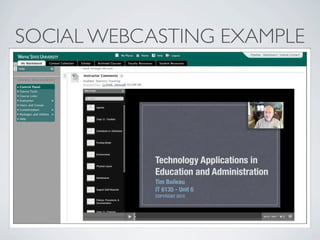
•   Sharing of digital media provides a way to foster interaction and sociability, and
    another way to cultivate communities, using free or inexpensive streaming
    services that can be embedded in LMS pages, web sites, or blog postings
SOCIAL WEBCASTING EXAMPLE
MICRO-BLOGGING
MICRO-BLOGGING

•   Microsharing is the class of social software tools that enables people to update
    one another with short bursts of text, links, and multimedia either through
    standalone applications or as part of larger online communities or social
    networks
MICRO-BLOGGING

• Microsharing is the class of social software tools that enables people to update
  one another with short bursts of text, links, and multimedia either through
  standalone applications or as part of larger online communities or social
  networks
• Messages shared are typically limited to 140 characters. This is the limit that
  mobile devices (SMS) can accept (with an additional 20 characters for
  identifying information)
MICRO-BLOGGING

• Microsharing is the class of social software tools that enables people to update
  one another with short bursts of text, links, and multimedia either through
  standalone applications or as part of larger online communities or social
  networks
• Messages shared are typically limited to 140 characters. This is the limit that
  mobile devices (SMS) can accept (with an additional 20 characters for
  identifying information)
• Microsharing emerges from a trend to make digital content smaller and faster to
  spread. It is eclipsing email (too slow) and texting (too restricted an audience)
MICRO-BLOGGING

• Microsharing is the class of social software tools that enables people to update
  one another with short bursts of text, links, and multimedia either through
  standalone applications or as part of larger online communities or social
  networks
• Messages shared are typically limited to 140 characters. This is the limit that
  mobile devices (SMS) can accept (with an additional 20 characters for
  identifying information)
• Microsharing emerges from a trend to make digital content smaller and faster to
  spread. It is eclipsing email (too slow) and texting (too restricted an audience)
• Conference speakers and educators have begun to recognize a backchannel,
  enabled by microsharing to create and sustain relationships and dialogue around
  sessions and classes
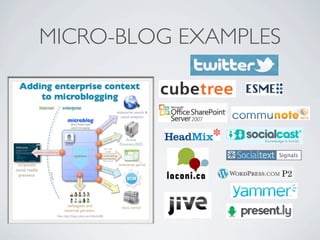
MICRO-BLOG EXAMPLES
WIKIS
WIKIS

•   Wiki represents a transformative culture shift from a “ need to know” to a
    “need to share”. It builds a case that collaboration has an impact on how a
    community evolves and moves forward
WIKIS

• Wiki represents a transformative culture shift from a “ need to know” to a
  “need to share”. It builds a case that collaboration has an impact on how a
  community evolves and moves forward
• Wiki supports knowledge development for the community, relying on
  contributions from people who are personally affected the community, or
  who have additional perspectives
WIKIS

• Wiki represents a transformative culture shift from a “ need to know” to a
  “need to share”. It builds a case that collaboration has an impact on how a
  community evolves and moves forward
• Wiki supports knowledge development for the community, relying on
  contributions from people who are personally affected the community, or
  who have additional perspectives
•   Wiki becomes a place where community members can capture, organize,
    share, and use the community’s emerging and dynamic knowledge
WIKIS

• Wiki represents a transformative culture shift from a “ need to know” to a
  “need to share”. It builds a case that collaboration has an impact on how a
  community evolves and moves forward
• Wiki supports knowledge development for the community, relying on
  contributions from people who are personally affected the community, or
  who have additional perspectives
• Wiki becomes a place where community members can capture, organize,
  share, and use the community’s emerging and dynamic knowledge
• Success of wikis should be measured not by how many people use them
  but by a finer outcome: developing something broader, deeper, or more
  innovative than individuals could create on their own
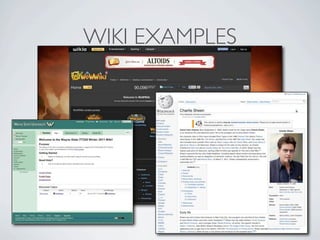
WIKI EXAMPLES
VIRTUAL WORLDS
VIRTUAL WORLDS

• Virtual  environments provide places (i.e., rooms, buildings,
 cities, islands, etc.) that are ‘built’ to deliver an authentic user
 experience by integrating other social learning tools; or may
 aggregate online communities and media sharing sites, by
 adding an immersive and engaging visual wrapper
VIRTUAL WORLDS

• Virtual  environments provide places (i.e., rooms, buildings,
 cities, islands, etc.) that are ‘built’ to deliver an authentic user
 experience by integrating other social learning tools; or may
 aggregate online communities and media sharing sites, by
 adding an immersive and engaging visual wrapper

• Virtualenvironments may be experienced from a first person
 point of view, by manipulating an avatar inside of the virtual
 world (i.e., Second Life) or from a third person point of view
 interacting with content and program generated characters
VIRTUAL WORLD EXAMPLE
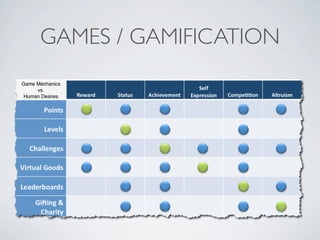
GAMES / GAMIFICATION
PLAYGROUND RULES

1. No loitering in the playground areas. The value is in participation and engagement.
2. The playground is for people of all ages and work groups.
3. Only people interested in having influence are allowed on the premises.
4. Abusive, spammy, or intolerant behavior is not tolerated. Sarcasm, debate, and
   challenging and calling out bull are welcome, though.
5. If you feed pigeons, be warned they may poop on you.
6. Keep excessive cussing, name calling, and partisan politics away from the pool.
7. Enjoy life offline to stay interesting online.
8. The right to be heard does not include the right to be taken seriously
9. Be patient, above all, with yourself.
    Failure to obey these rules can result in missing an unprecedented opportunity to
    learn with smart, interesting people across the globe.
REFERENCES
 THE NEW SOCIAL LEARNING


• Bingham, T., &Conner, M. (2010) The new social learning. A guide
 to transforming organizations through social media. San
 Francisco: Berrett-Koehler

• http://thenewsociallearning.com

Social Learning

  • 1.
    SOCIAL MEDIA AND SOCIALLEARNING: BUSINESS MI-AECT – March 31, 2011 Copyright Tim Boileau
  • 2.
  • 3.
    KEY PREMISE • Sociallearningis a fundamental shift in how people work-- leveraging how we have always worked, but now with new tools to accelerate and broaden individual and organizational reach.
  • 4.
    KEY PREMISE • Sociallearningis a fundamental shift in how people work-- leveraging how we have always worked, but now with new tools to accelerate and broaden individual and organizational reach. • Focus on connecting with the people, and the tools will all make sense.
  • 5.
  • 6.
    SOME DEFINITIONS • Social Networks – virtual communities enabled by Web 2.0 technologies e.g., Facebook, LinkedIn, Google Buzz, Orkut, Bebo, Ning, MySpace, et al.
  • 7.
    SOME DEFINITIONS • SocialNetworks – virtual communities enabled by Web 2.0 technologies e.g., Facebook, LinkedIn, Google Buzz, Orkut, Bebo, Ning, MySpace, et al. • Social Media – set of Internet-based technologies designed to be used by three or more people for publishing and consuming rich media content e.g., YouTube, Flickr, Slideshare, Delicious, Digg, Picasa Yelp, et al.
  • 8.
    SOME DEFINITIONS • SocialNetworks – virtual communities enabled by Web 2.0 technologies e.g., Facebook, LinkedIn, Google Buzz, Orkut, Bebo, Ning, MySpace, et al. • Social Media – set of Internet-based technologies designed to be used by three or more people for publishing and consuming rich media content e.g., YouTube, Flickr, Slideshare, Delicious, Digg, Picasa Yelp, et al. • Social Learning – learning with and from others; participating with others to make sense of new ideas or realities [70/20/10]
  • 9.
    WHY IS SOCIALLEARNING RELEVANT NOW? The convergence of three workforce trends has accelerated the need for social learning:
  • 10.
    WHY IS SOCIALLEARNING RELEVANT NOW? The convergence of three workforce trends has accelerated the need for social learning: • Expanding opportunities for personal connection
  • 11.
    WHY IS SOCIALLEARNING RELEVANT NOW? The convergence of three workforce trends has accelerated the need for social learning: • Expanding opportunities for personal connection • Emerging expectations from shifting workforce demographics
  • 12.
    WHY IS SOCIALLEARNING RELEVANT NOW? The convergence of three workforce trends has accelerated the need for social learning: • Expanding opportunities for personal connection • Emerging expectations from shifting workforce demographics • Increasing reach of customized technologies • Role mashups • Workgroup mashups • Content mashups • Management mashups
  • 13.
    BUILDING SOCIAL LEARNING COMMUNITIES • Social Webcasting – Digital Storytelling • Micro-Blogging for Healthy Culture • Wikis – Growing Collective Intelligence • Virtual Worlds • Games / Gamification
  • 14.
  • 15.
    SOCIAL WEBCASTING • People are tied together by anecdotes, impressions, observations, and narratives, which together map the shape and substance of their world
  • 16.
    SOCIAL WEBCASTING • Peopleare tied together by anecdotes, impressions, observations, and narratives, which together map the shape and substance of their world • The more deeply people know the stories, the more deeply they are invested in the culture, and the more deeply people know the community
  • 17.
    SOCIAL WEBCASTING • Peopleare tied together by anecdotes, impressions, observations, and narratives, which together map the shape and substance of their world • The more deeply people know the stories, the more deeply they are invested in the culture, and the more deeply people know the community • Recording and sharing stories is easier than ever using a webcam, Flip video cameras, smartphones, or tablets (iPad 2) to capture HD video (and audio)
  • 18.
    SOCIAL WEBCASTING • Peopleare tied together by anecdotes, impressions, observations, and narratives, which together map the shape and substance of their world • The more deeply people know the stories, the more deeply they are invested in the culture, and the more deeply people know the community • Recording and sharing stories is easier than ever using a webcam, Flip video cameras, smartphones, or tablets (iPad 2) to capture HD video (and audio) • Inexpensive software like Camtasia allow for simultaneous capture of screen content, webcam video, and audio which can be integrated with other digital content to build and share knowledge in short sequences or learning nuggets
  • 19.
    SOCIAL WEBCASTING • People are tied together by anecdotes, impressions, observations, and narratives, which together map the shape and substance of their world • The more deeply people know the stories, the more deeply they are invested in the culture, and the more deeply people know the community • Recording and sharing stories is easier than ever using a webcam, Flip video cameras, smartphones, or tablets (iPad 2) to capture HD video (and audio) • Inexpensive software like Camtasia allow for simultaneous capture of screen content, webcam video, and audio which can be integrated with other digital content to build and share knowledge in short sequences or learning nuggets • Sharing of digital media provides a way to foster interaction and sociability, and another way to cultivate communities, using free or inexpensive streaming services that can be embedded in LMS pages, web sites, or blog postings
  • 20.
  • 21.
  • 22.
    MICRO-BLOGGING • Microsharing is the class of social software tools that enables people to update one another with short bursts of text, links, and multimedia either through standalone applications or as part of larger online communities or social networks
  • 23.
    MICRO-BLOGGING • Microsharing isthe class of social software tools that enables people to update one another with short bursts of text, links, and multimedia either through standalone applications or as part of larger online communities or social networks • Messages shared are typically limited to 140 characters. This is the limit that mobile devices (SMS) can accept (with an additional 20 characters for identifying information)
  • 24.
    MICRO-BLOGGING • Microsharing isthe class of social software tools that enables people to update one another with short bursts of text, links, and multimedia either through standalone applications or as part of larger online communities or social networks • Messages shared are typically limited to 140 characters. This is the limit that mobile devices (SMS) can accept (with an additional 20 characters for identifying information) • Microsharing emerges from a trend to make digital content smaller and faster to spread. It is eclipsing email (too slow) and texting (too restricted an audience)
  • 25.
    MICRO-BLOGGING • Microsharing isthe class of social software tools that enables people to update one another with short bursts of text, links, and multimedia either through standalone applications or as part of larger online communities or social networks • Messages shared are typically limited to 140 characters. This is the limit that mobile devices (SMS) can accept (with an additional 20 characters for identifying information) • Microsharing emerges from a trend to make digital content smaller and faster to spread. It is eclipsing email (too slow) and texting (too restricted an audience) • Conference speakers and educators have begun to recognize a backchannel, enabled by microsharing to create and sustain relationships and dialogue around sessions and classes
  • 26.
  • 27.
  • 28.
    WIKIS • Wiki represents a transformative culture shift from a “ need to know” to a “need to share”. It builds a case that collaboration has an impact on how a community evolves and moves forward
  • 29.
    WIKIS • Wiki representsa transformative culture shift from a “ need to know” to a “need to share”. It builds a case that collaboration has an impact on how a community evolves and moves forward • Wiki supports knowledge development for the community, relying on contributions from people who are personally affected the community, or who have additional perspectives
  • 30.
    WIKIS • Wiki representsa transformative culture shift from a “ need to know” to a “need to share”. It builds a case that collaboration has an impact on how a community evolves and moves forward • Wiki supports knowledge development for the community, relying on contributions from people who are personally affected the community, or who have additional perspectives • Wiki becomes a place where community members can capture, organize, share, and use the community’s emerging and dynamic knowledge
  • 31.
    WIKIS • Wiki representsa transformative culture shift from a “ need to know” to a “need to share”. It builds a case that collaboration has an impact on how a community evolves and moves forward • Wiki supports knowledge development for the community, relying on contributions from people who are personally affected the community, or who have additional perspectives • Wiki becomes a place where community members can capture, organize, share, and use the community’s emerging and dynamic knowledge • Success of wikis should be measured not by how many people use them but by a finer outcome: developing something broader, deeper, or more innovative than individuals could create on their own
  • 32.
  • 33.
  • 34.
    VIRTUAL WORLDS • Virtual environments provide places (i.e., rooms, buildings, cities, islands, etc.) that are ‘built’ to deliver an authentic user experience by integrating other social learning tools; or may aggregate online communities and media sharing sites, by adding an immersive and engaging visual wrapper
  • 35.
    VIRTUAL WORLDS • Virtual environments provide places (i.e., rooms, buildings, cities, islands, etc.) that are ‘built’ to deliver an authentic user experience by integrating other social learning tools; or may aggregate online communities and media sharing sites, by adding an immersive and engaging visual wrapper • Virtualenvironments may be experienced from a first person point of view, by manipulating an avatar inside of the virtual world (i.e., Second Life) or from a third person point of view interacting with content and program generated characters
  • 36.
  • 37.
  • 38.
    PLAYGROUND RULES 1. Noloitering in the playground areas. The value is in participation and engagement. 2. The playground is for people of all ages and work groups. 3. Only people interested in having influence are allowed on the premises. 4. Abusive, spammy, or intolerant behavior is not tolerated. Sarcasm, debate, and challenging and calling out bull are welcome, though. 5. If you feed pigeons, be warned they may poop on you. 6. Keep excessive cussing, name calling, and partisan politics away from the pool. 7. Enjoy life offline to stay interesting online. 8. The right to be heard does not include the right to be taken seriously 9. Be patient, above all, with yourself. Failure to obey these rules can result in missing an unprecedented opportunity to learn with smart, interesting people across the globe.
  • 39.
    REFERENCES THE NEWSOCIAL LEARNING • Bingham, T., &Conner, M. (2010) The new social learning. A guide to transforming organizations through social media. San Francisco: Berrett-Koehler • http://thenewsociallearning.com

Editor's Notes

  • #2 \n
  • #3 \n
  • #4 \n
  • #5 Social learning reframes social media from a marketing strategy to a strategy that encourages knowledge transfer and connects people in a way consistent with how we naturally interact. It is not a delivery system analogous to classroom training, mobile learning, or e-learning. Rather, it’s a powerful approach to sharing and discovering a whole array of options--some of which we may not even know we need--leading to more informed decision making and a more intimate, expansive, and dynamic understanding of the culture and context in which we work.\n
  • #6 Social learning reframes social media from a marketing strategy to a strategy that encourages knowledge transfer and connects people in a way consistent with how we naturally interact. It is not a delivery system analogous to classroom training, mobile learning, or e-learning. Rather, it’s a powerful approach to sharing and discovering a whole array of options--some of which we may not even know we need--leading to more informed decision making and a more intimate, expansive, and dynamic understanding of the culture and context in which we work.\n
  • #7 Social learning reframes social media from a marketing strategy to a strategy that encourages knowledge transfer and connects people in a way consistent with how we naturally interact. It is not a delivery system analogous to classroom training, mobile learning, or e-learning. Rather, it’s a powerful approach to sharing and discovering a whole array of options--some of which we may not even know we need--leading to more informed decision making and a more intimate, expansive, and dynamic understanding of the culture and context in which we work.\n
  • #8 Another way to consider these trends is:\na.More information sources\nb.More dissemination points\nc.An open approach to a wide network of communicators and collaborators who can help the work flow\n
  • #9 Another way to consider these trends is:\na.More information sources\nb.More dissemination points\nc.An open approach to a wide network of communicators and collaborators who can help the work flow\n
  • #10 Another way to consider these trends is:\na.More information sources\nb.More dissemination points\nc.An open approach to a wide network of communicators and collaborators who can help the work flow\n
  • #11 I’m going to talk about five different interventions to enable social learning. These can be used individually though more often are used in combination for building sustainable learning communities.\n
  • #12 Examples of this abound: Video and audio podcasts embedded in Blackboard; video channel on YouTube; iTunes University; and Screencast.com\n
  • #13 Examples of this abound: Video and audio podcasts embedded in Blackboard; video channel on YouTube; iTunes University; and Screencast.com\n
  • #14 Examples of this abound: Video and audio podcasts embedded in Blackboard; video channel on YouTube; iTunes University; and Screencast.com\n
  • #15 Examples of this abound: Video and audio podcasts embedded in Blackboard; video channel on YouTube; iTunes University; and Screencast.com\n
  • #16 Examples of this abound: Video and audio podcasts embedded in Blackboard; video channel on YouTube; iTunes University; and Screencast.com\n
  • #17 Storytelling with an educational focus...\n
  • #18 Twitter is perhaps the most well known microsharing sharing tool. Hashtags make it possible to follow broad reaching topics across multiple communities by creating discussion threads. Use of groups and judicious discrimination of who you choose to follow, enables personal learning communities. Some people create different accounts to enable participation in different communities.\n
  • #19 Twitter is perhaps the most well known microsharing sharing tool. Hashtags make it possible to follow broad reaching topics across multiple communities by creating discussion threads. Use of groups and judicious discrimination of who you choose to follow, enables personal learning communities. Some people create different accounts to enable participation in different communities.\n
  • #20 Twitter is perhaps the most well known microsharing sharing tool. Hashtags make it possible to follow broad reaching topics across multiple communities by creating discussion threads. Use of groups and judicious discrimination of who you choose to follow, enables personal learning communities. Some people create different accounts to enable participation in different communities.\n
  • #21 Twitter is perhaps the most well known microsharing sharing tool. Hashtags make it possible to follow broad reaching topics across multiple communities by creating discussion threads. Use of groups and judicious discrimination of who you choose to follow, enables personal learning communities. Some people create different accounts to enable participation in different communities.\n
  • #22 \n
  • #23 \n
  • #24 \n
  • #25 \n
  • #26 \n
  • #27 \n
  • #28 \n
  • #29 \n
  • #30 \n
  • #31 \n
  • #32 \n
  • #33 \n