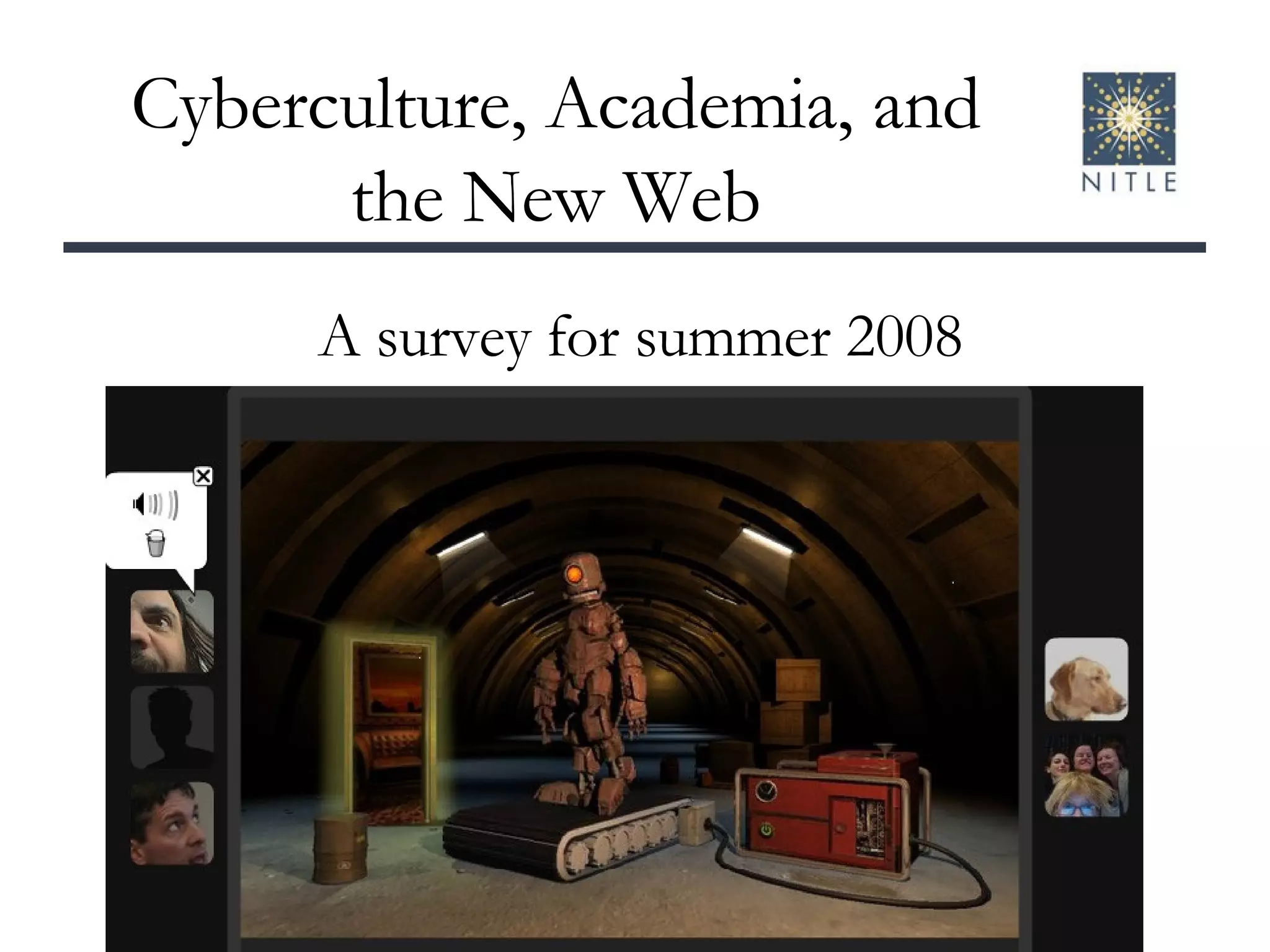
Cyberculture, Academia, and the New Web A survey for summer 2008
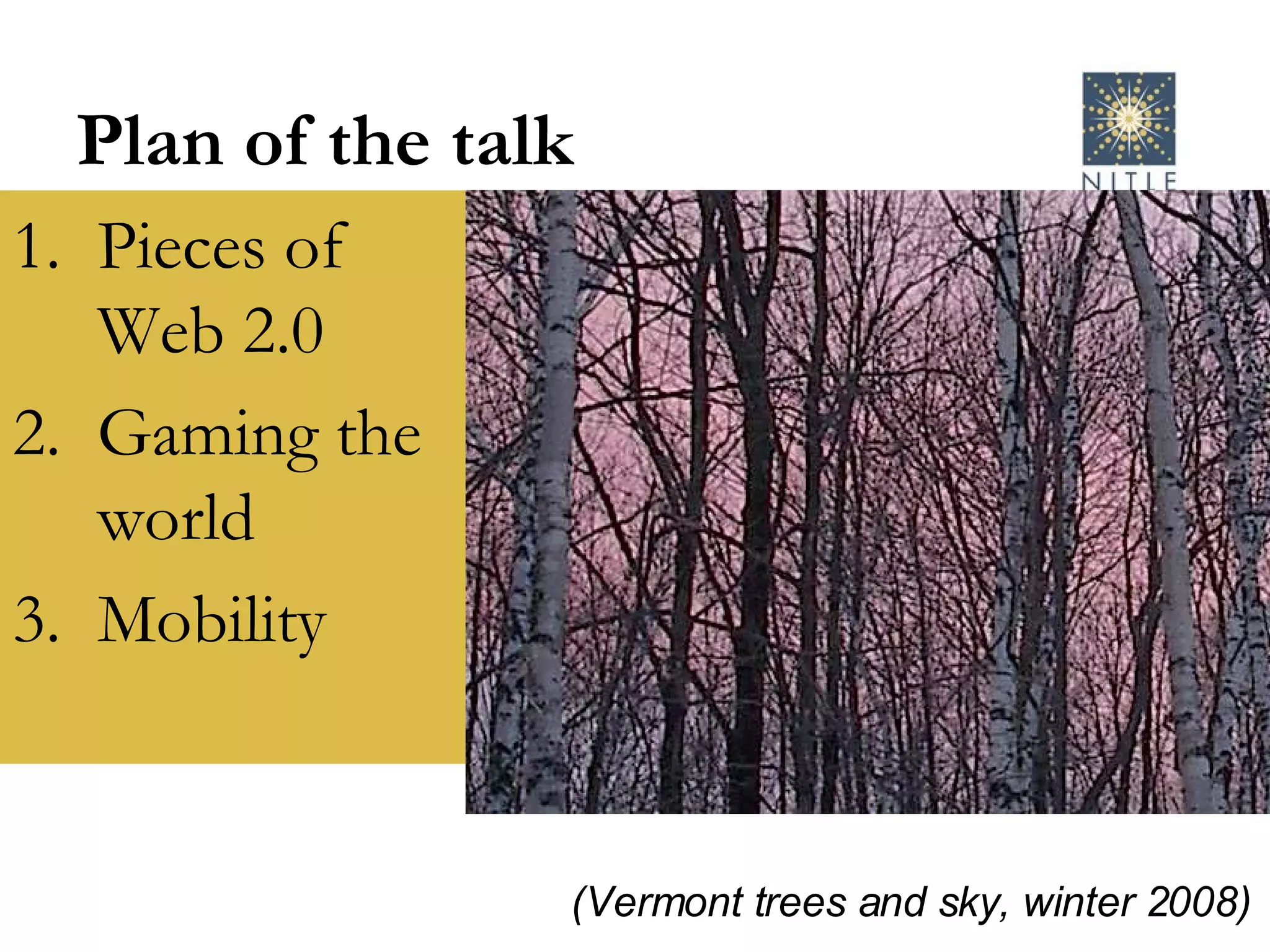
Plan of the talk Pieces of Web 2.0 Gaming the world Mobility (Vermont trees and sky, winter 2008)
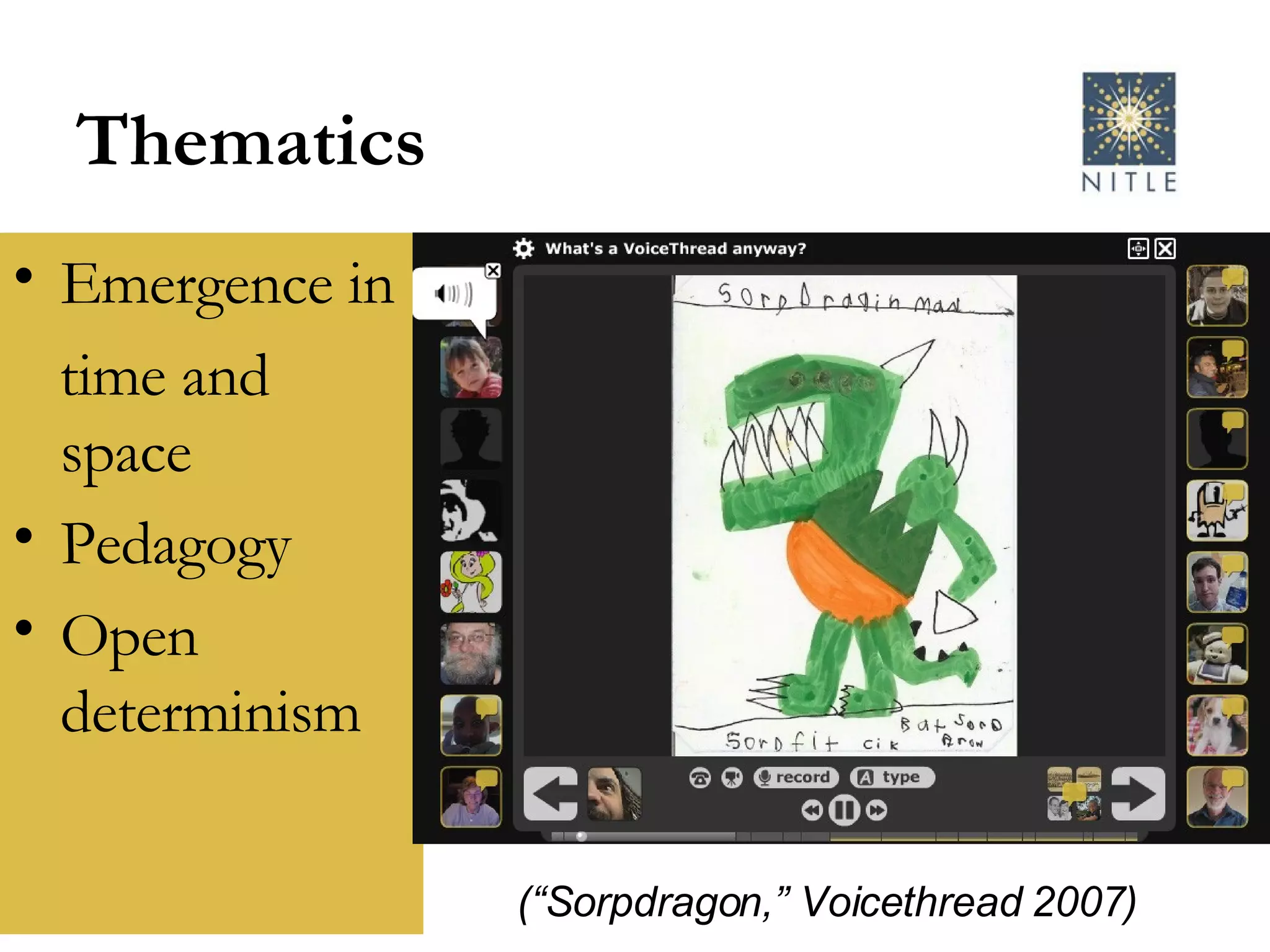
Thematics Emergence in time and space Pedagogy Open determinism (“Sorpdragon,” Voicethread 2007)
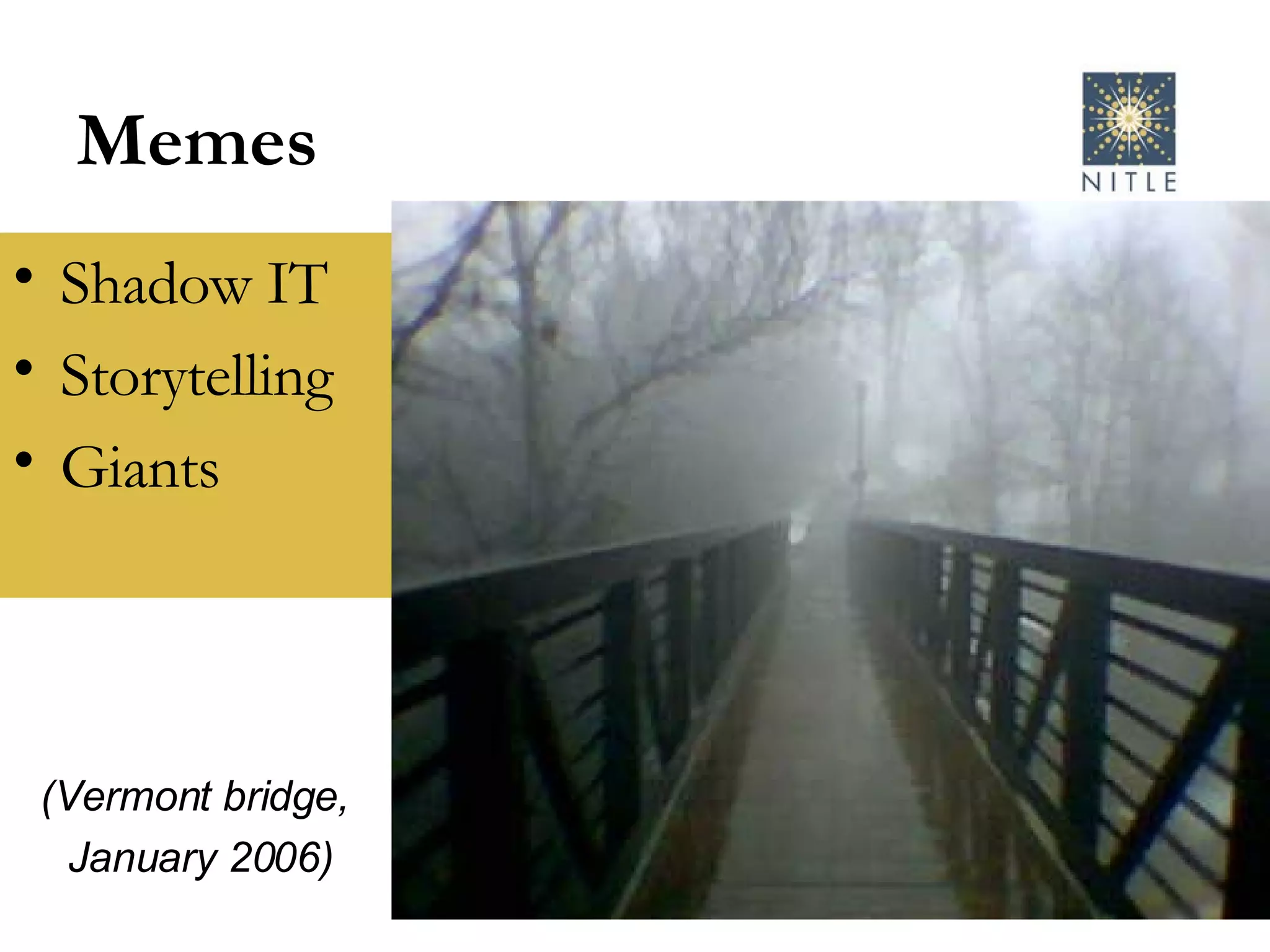
Memes Shadow IT Storytelling Giants (Vermont bridge, January 2006)
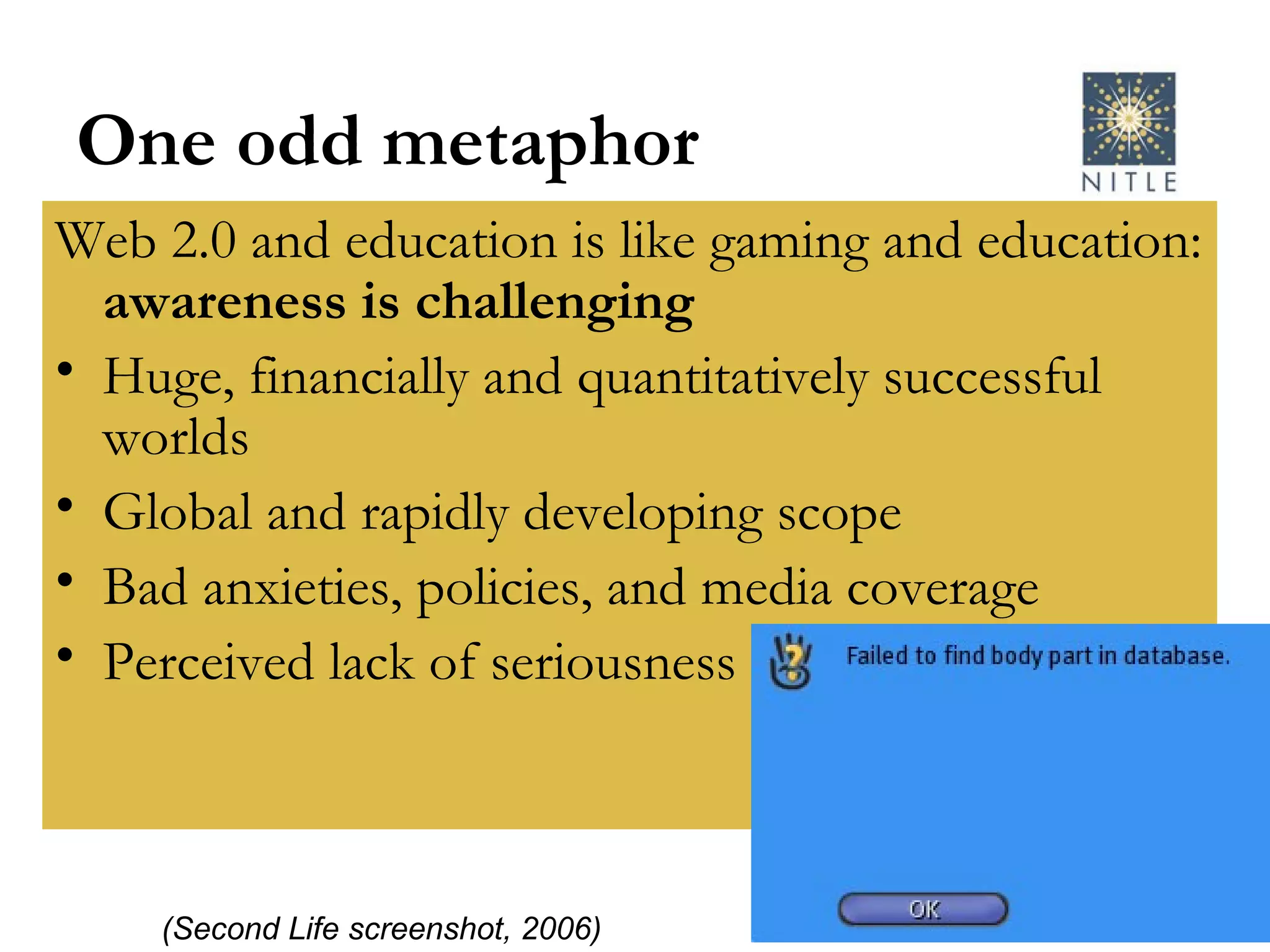
One odd metaphor Web 2.0 and education is like gaming and education:  awareness is challenging Huge, financially and quantitatively successful worlds Global and rapidly developing scope Bad anxieties, policies, and media coverage Perceived lack of seriousness (Second Life screenshot, 2006)
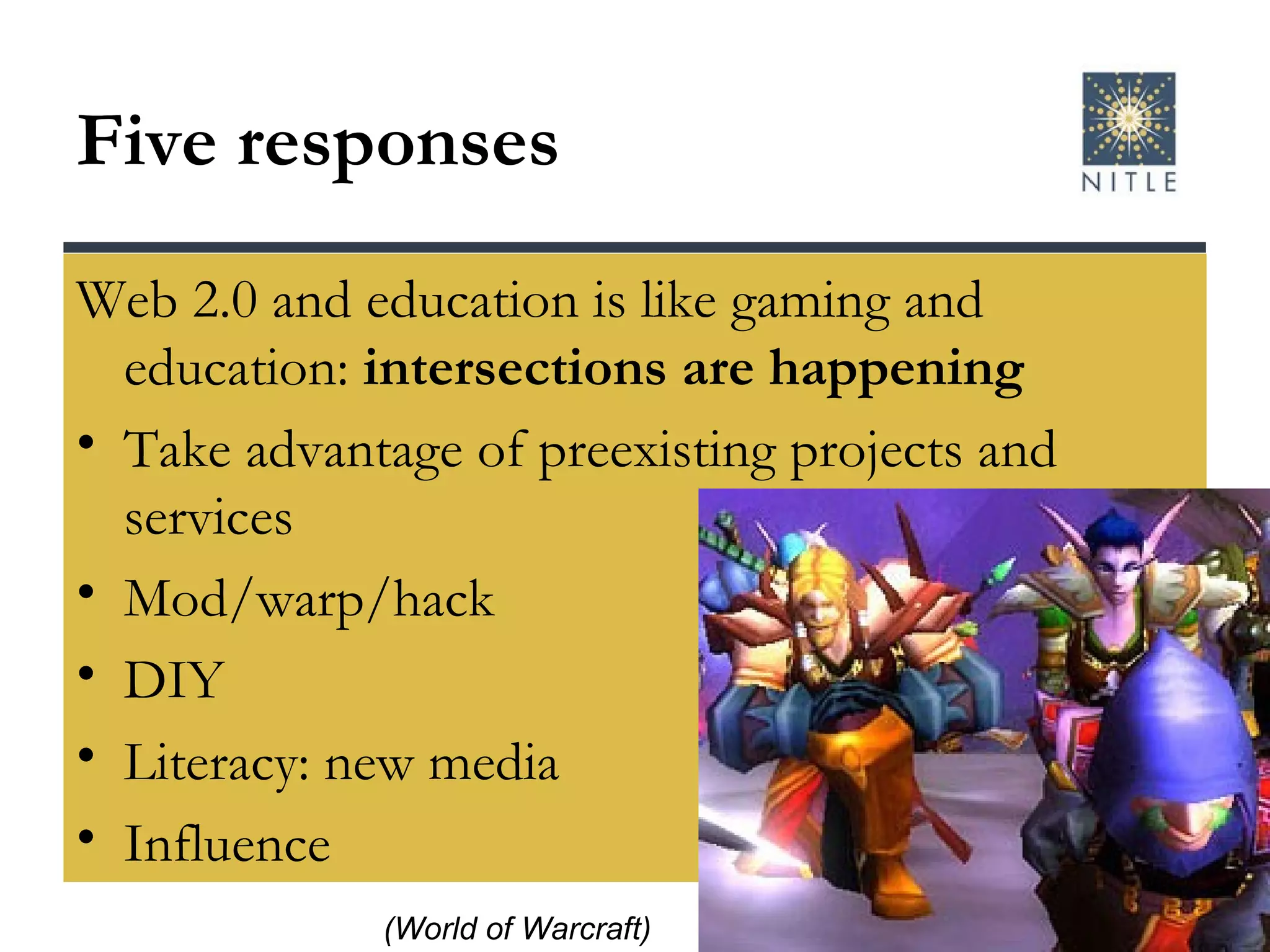
Five responses Web 2.0 and education is like gaming and education:  intersections are happening Take advantage of preexisting projects and services Mod/warp/hack  DIY Literacy: new media Influence (World of Warcraft)
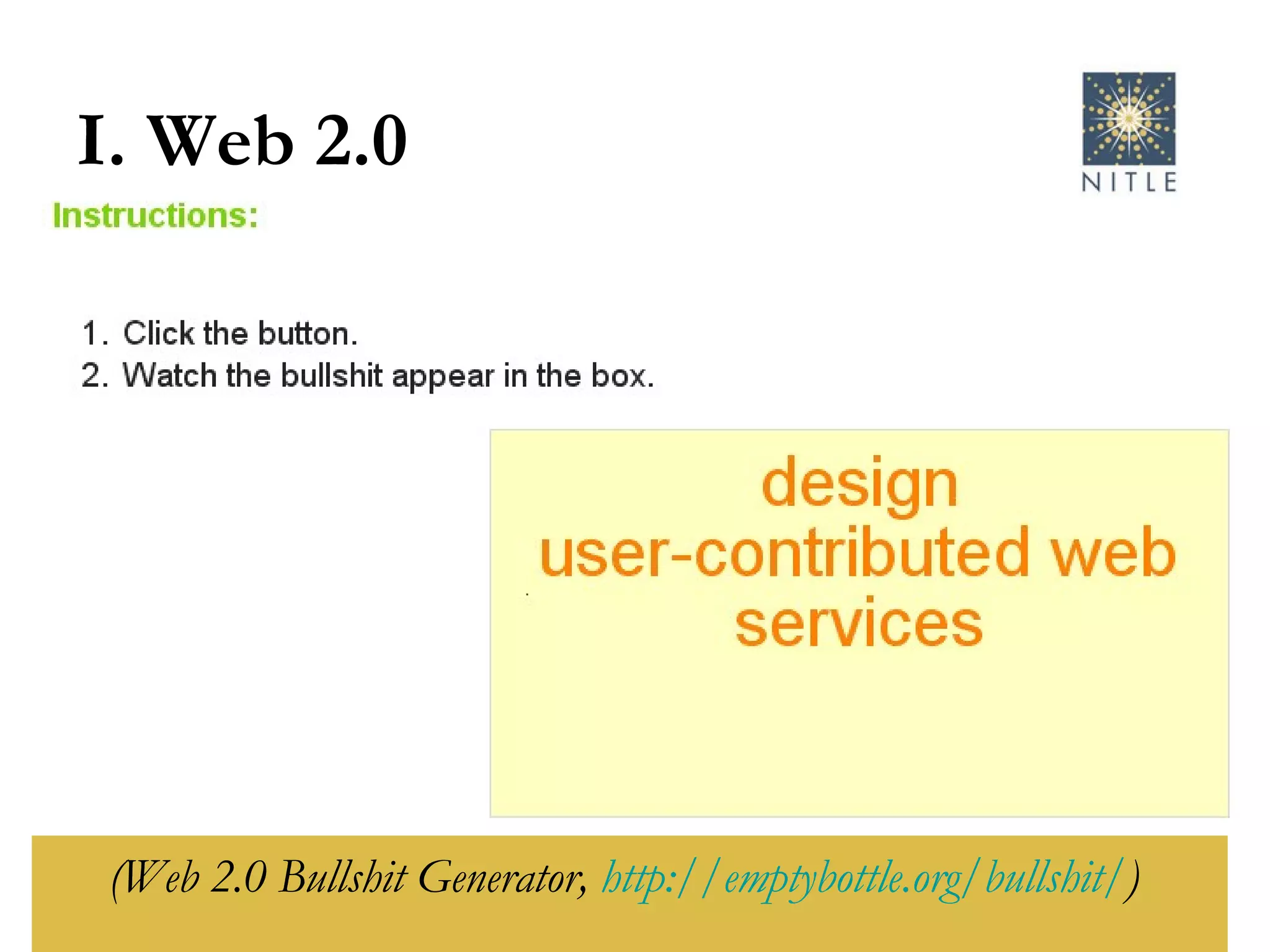
I. Web 2.0 (Web 2.0 Bullshit Generator,  http://emptybottle.org/bullshit/ )
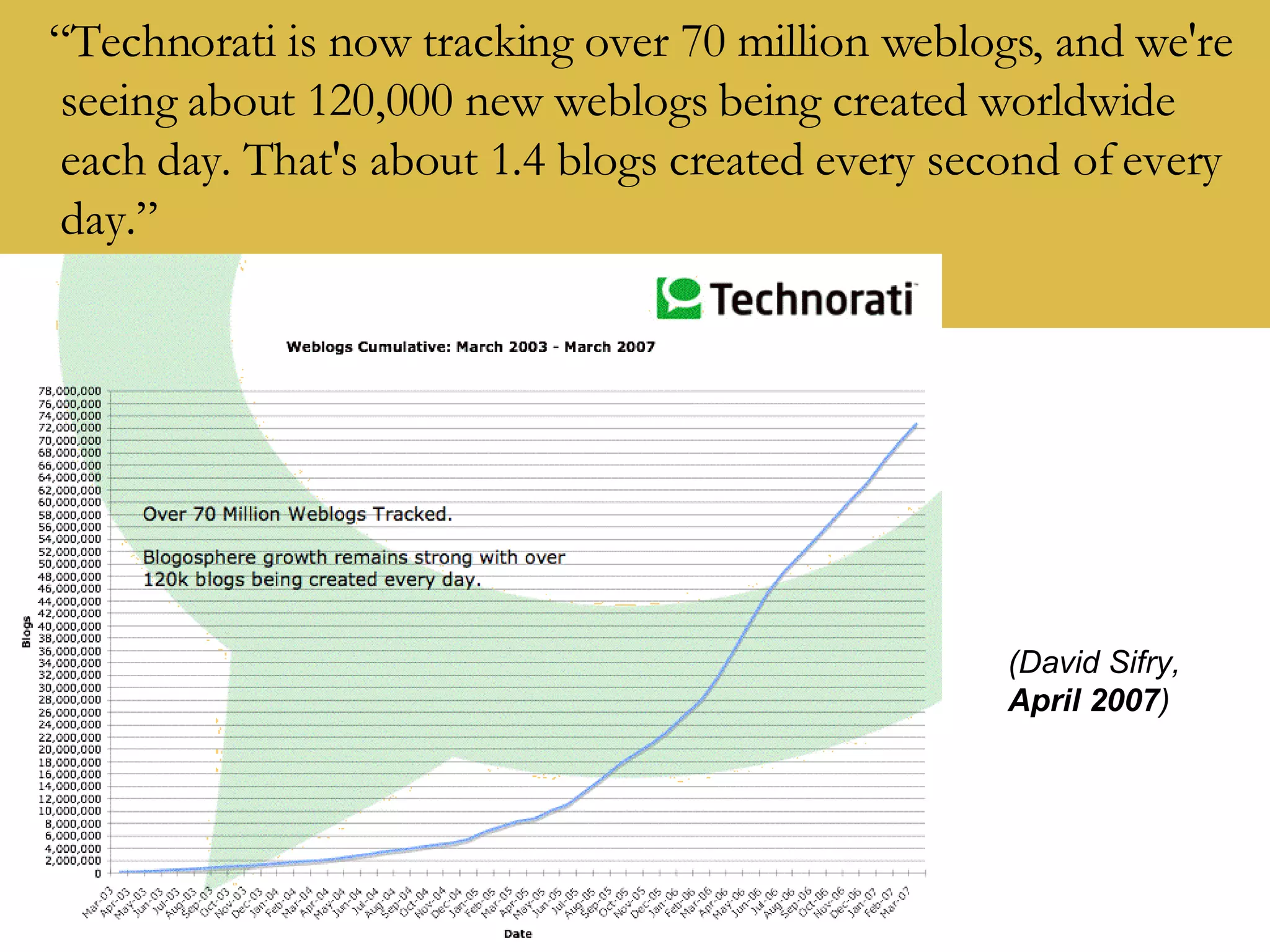
“ Technorati is now tracking over 70 million weblogs, and we're seeing about 120,000 new weblogs being created worldwide each day. That's about 1.4 blogs created every second of every day.” (David Sifry, April 2007 )
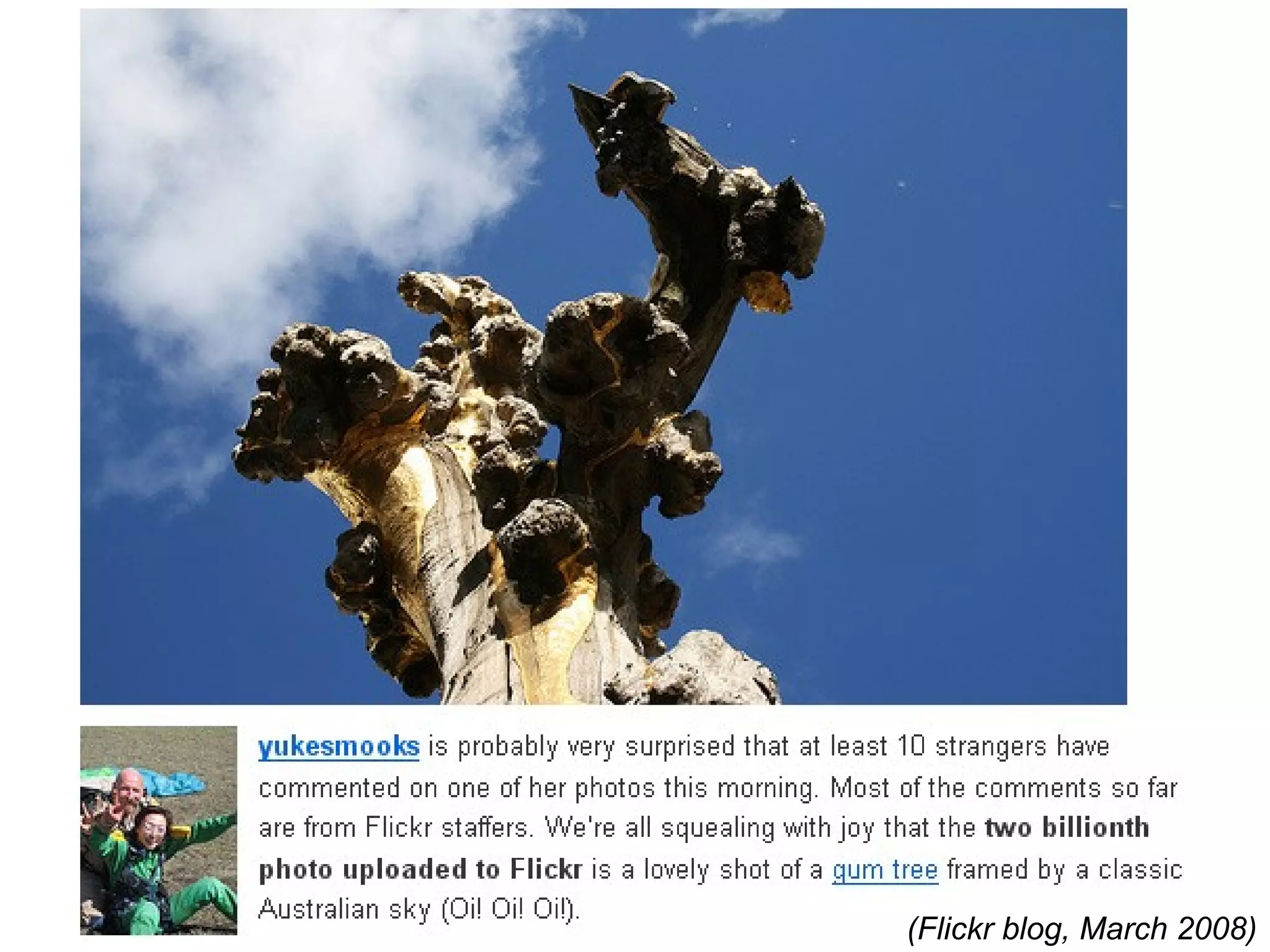
(Flickr blog, March 2008)
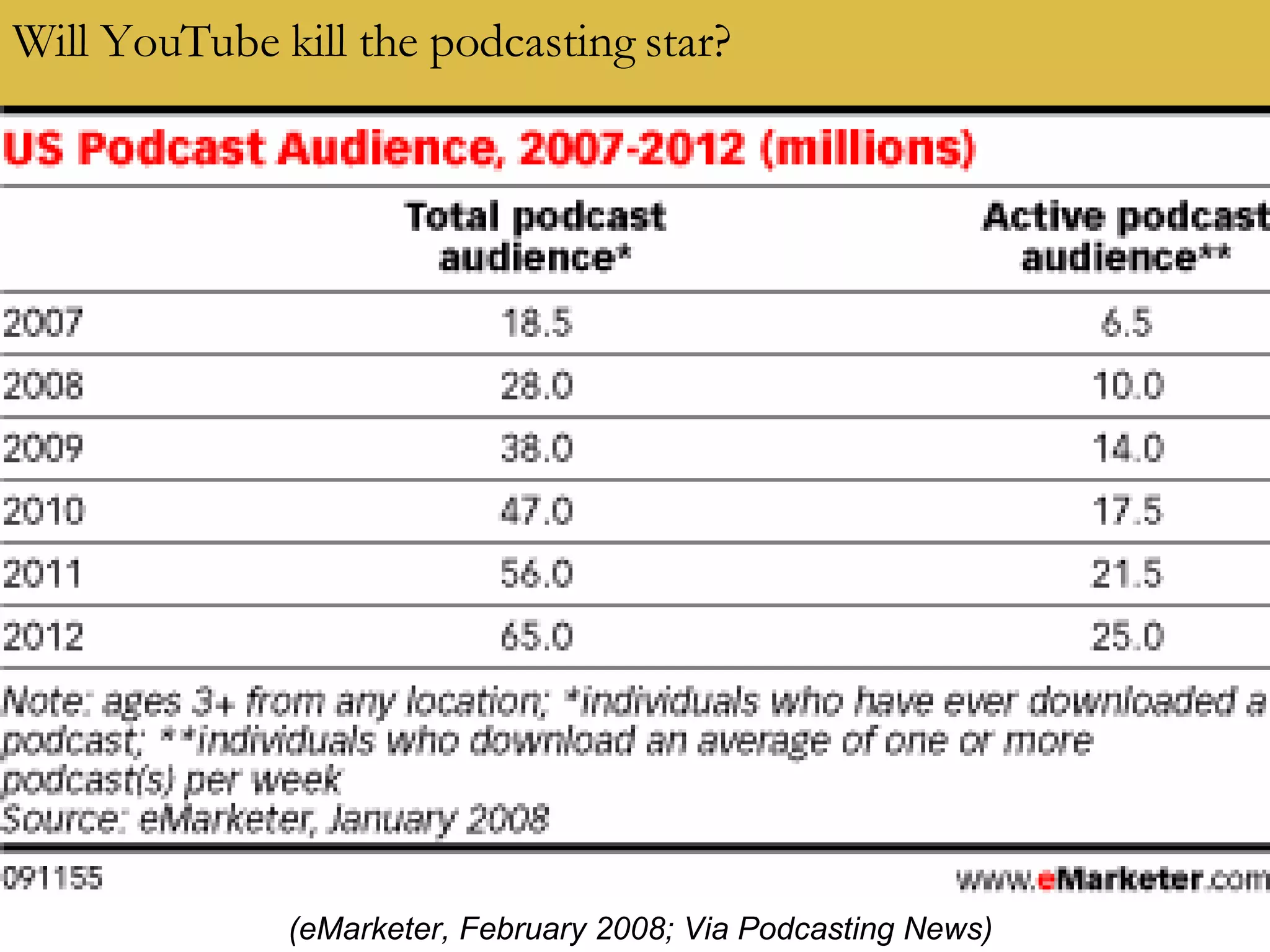
Will YouTube kill the podcasting star? (eMarketer, February 2008; Via Podcasting News)
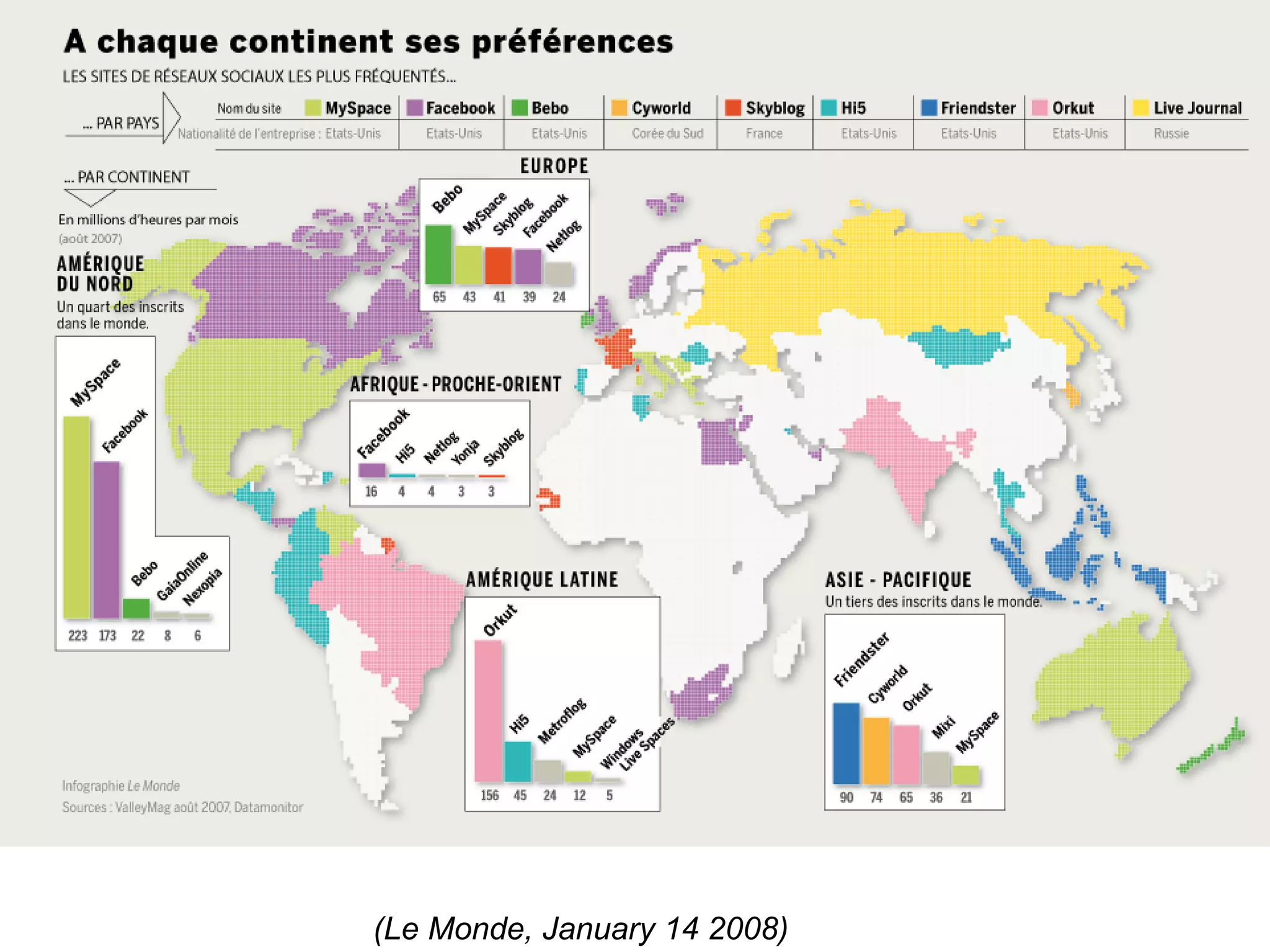
(Le Monde, January 14 2008)
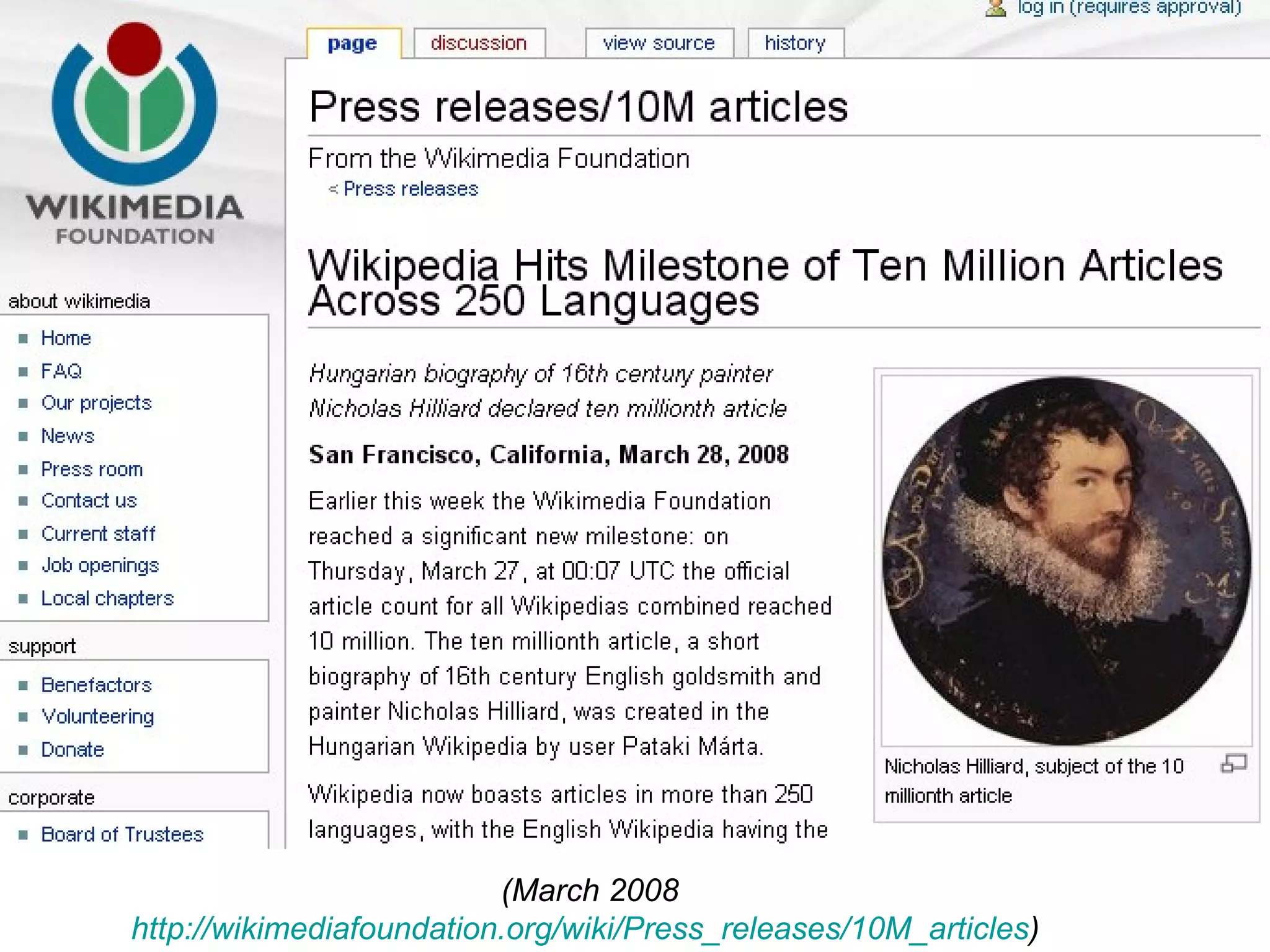
(March 2008 http://wikimediafoundation.org/wiki/Press_releases/10M_articles )
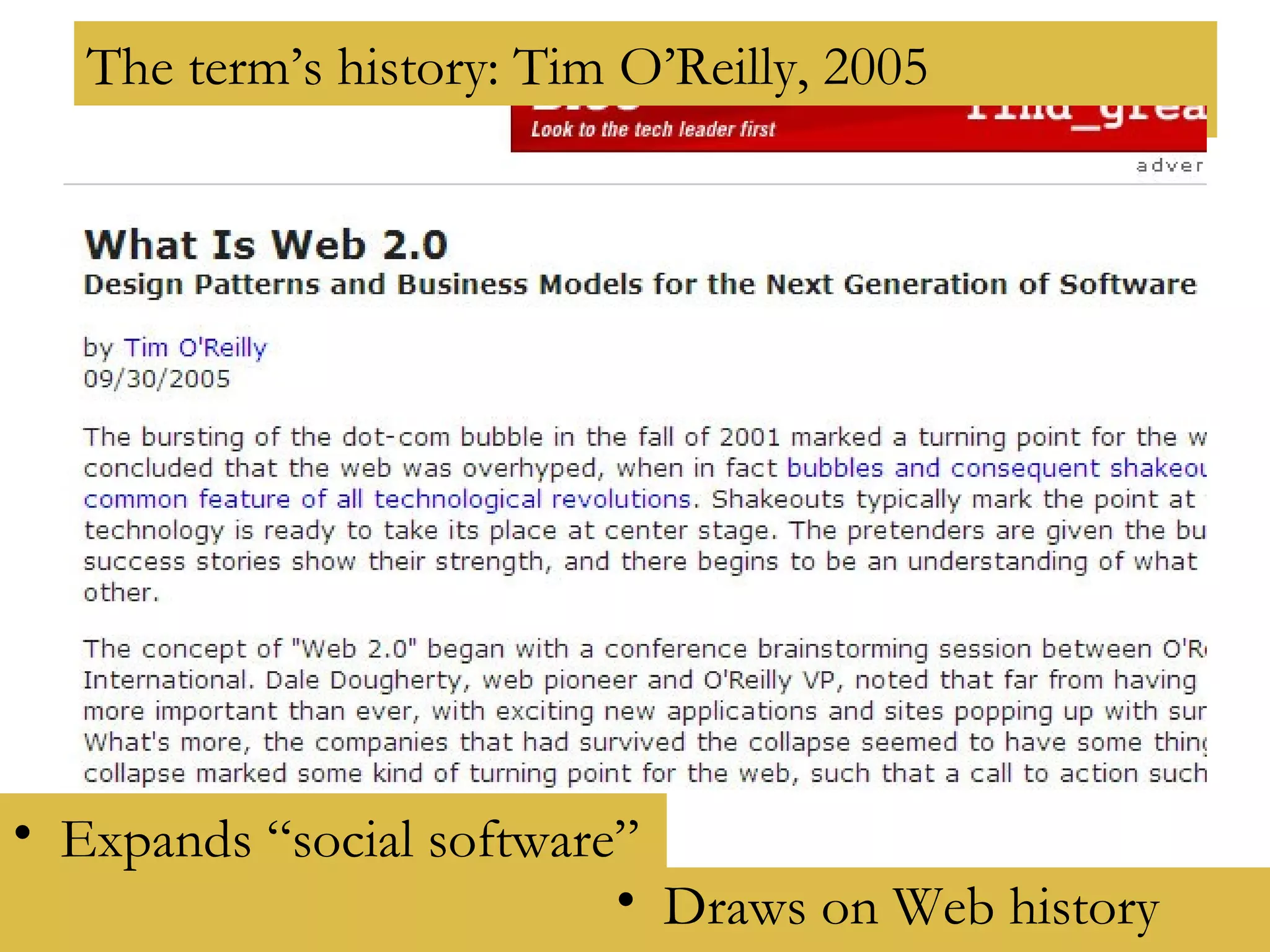
The term’s history: Tim O’Reilly, 2005 Expands “social software” Draws on Web history
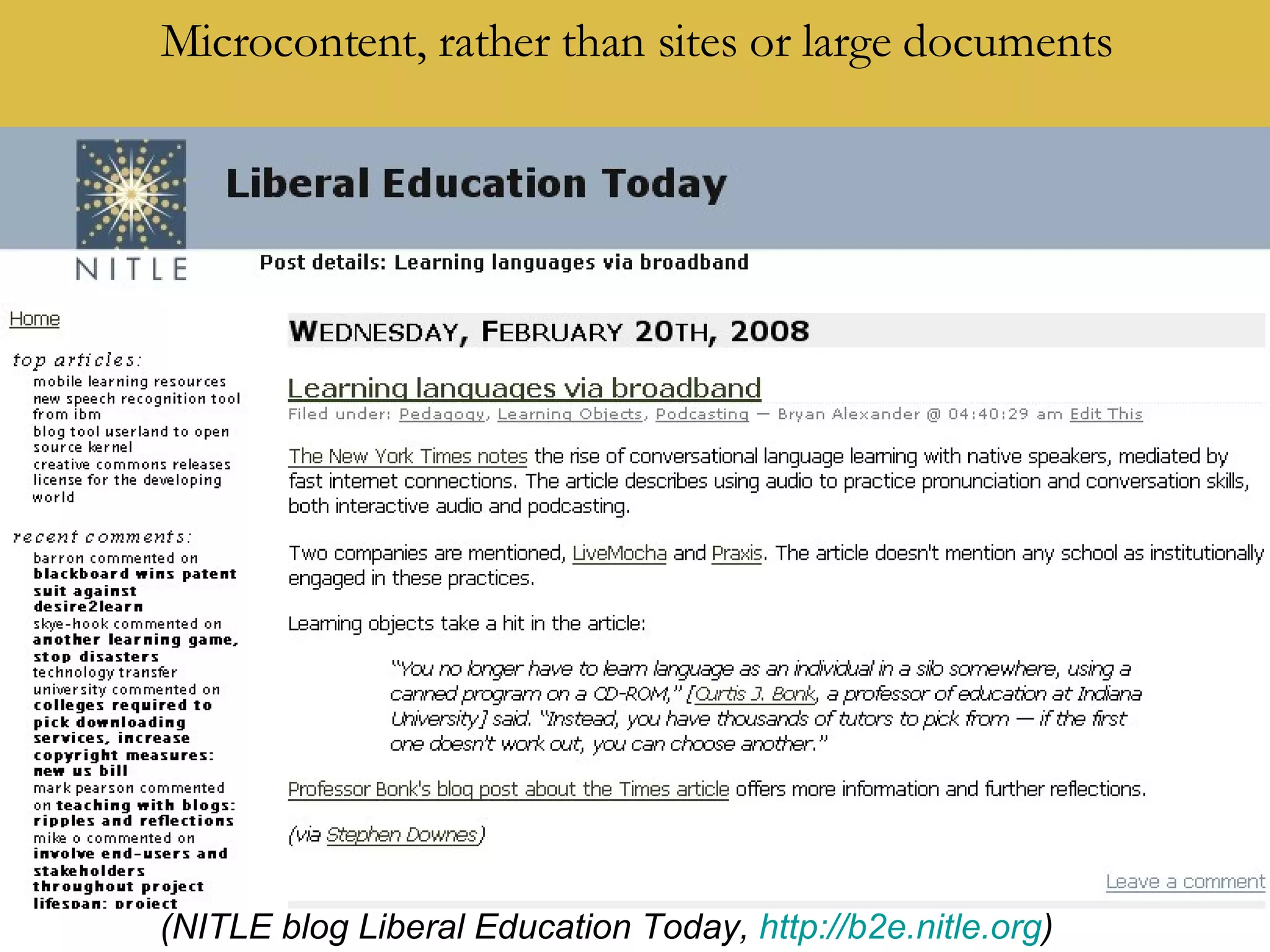
Microcontent, rather than sites or large documents (NITLE blog Liberal Education Today,  http://b2e.nitle.org )
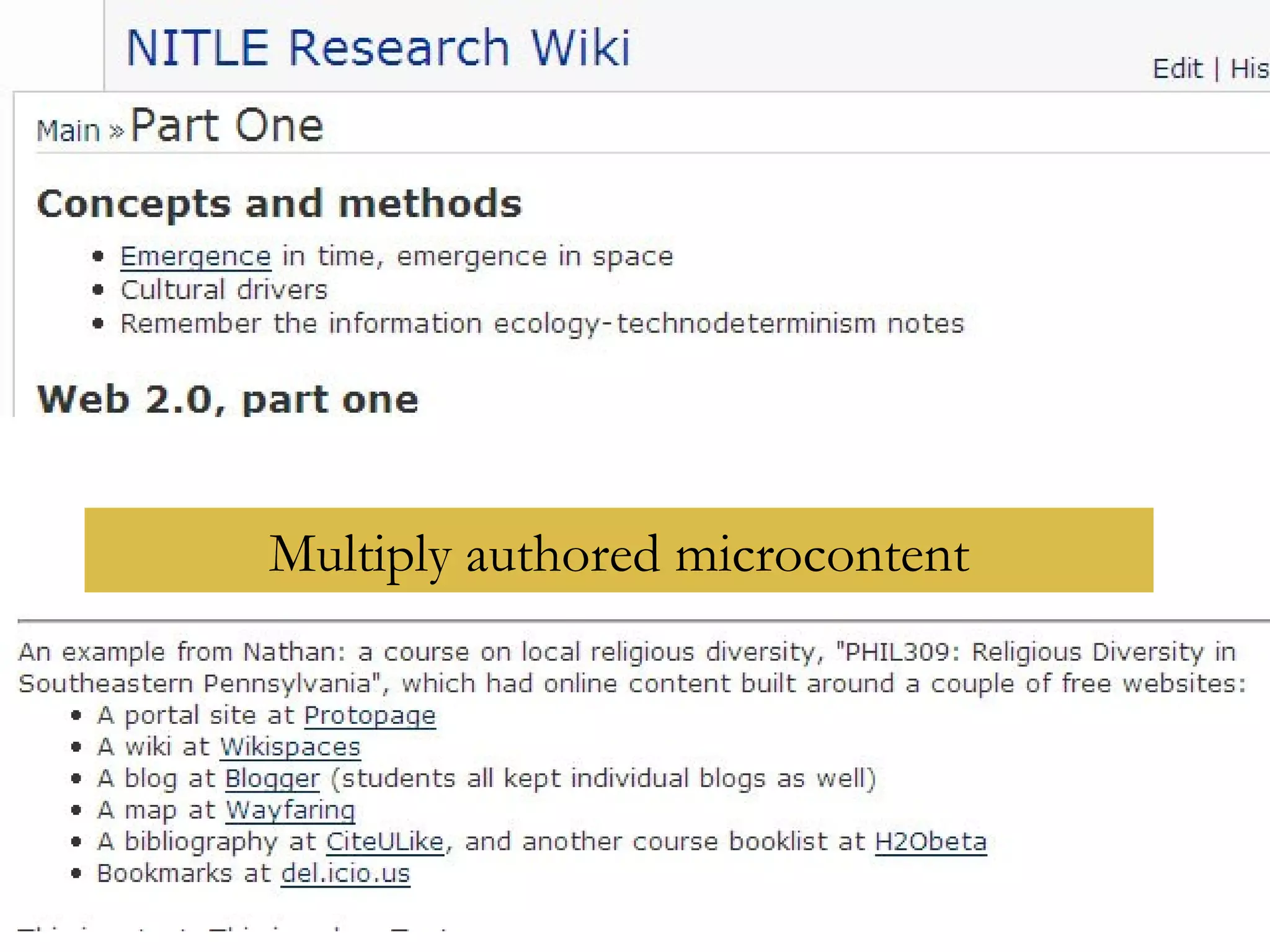
I. Web 2.0 Multiply authored microcontent
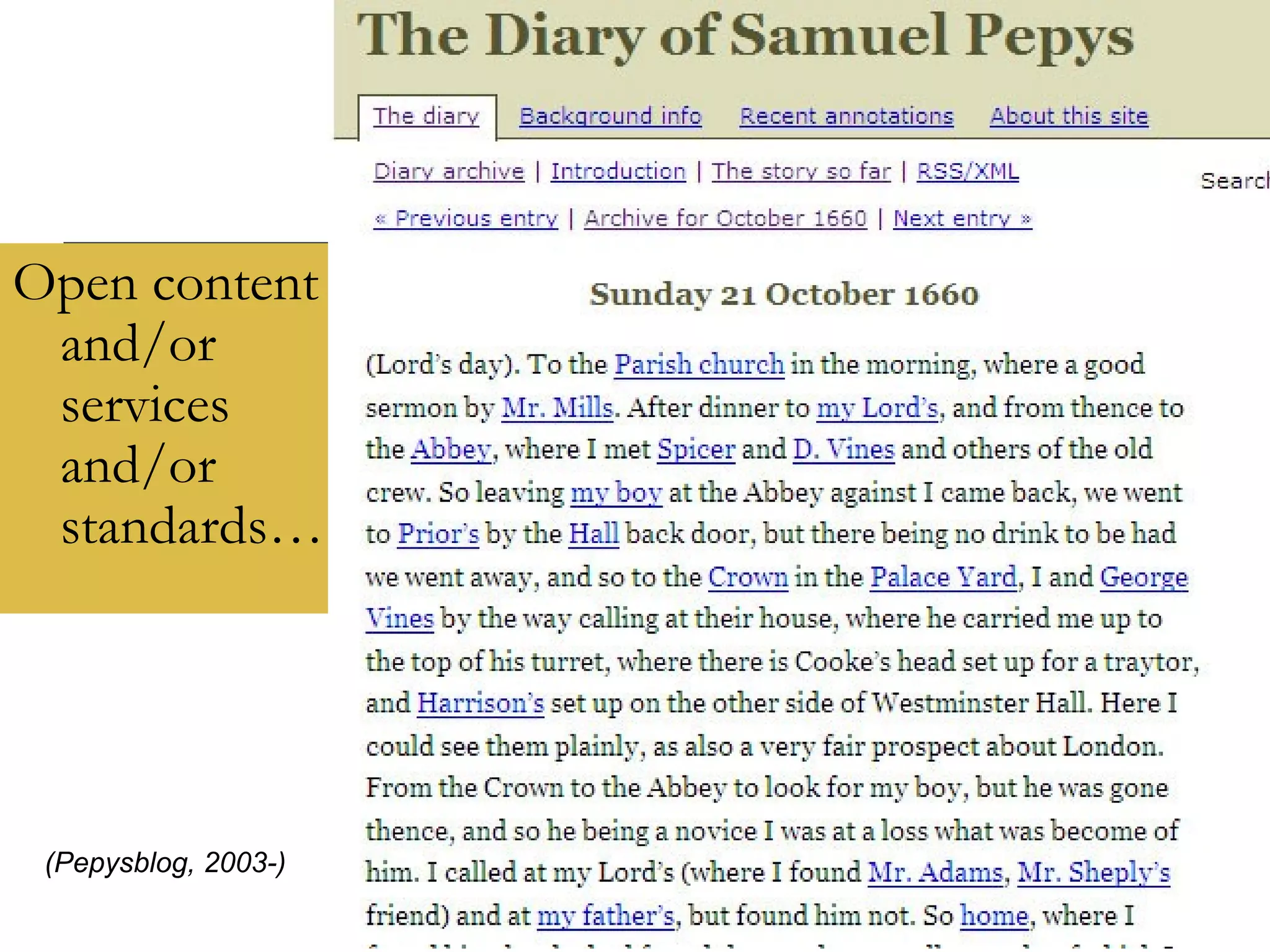
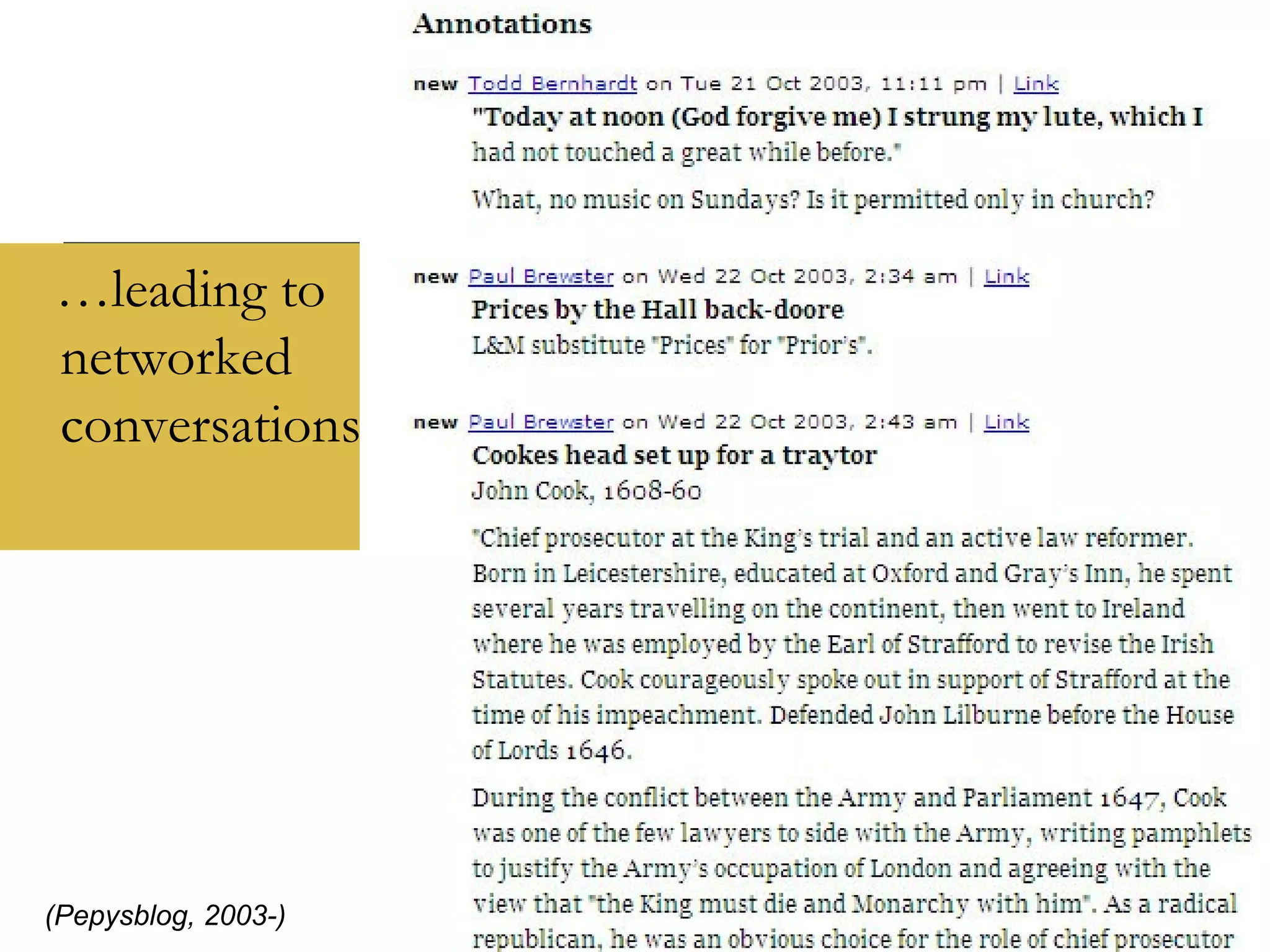
Open content and/or services and/or standards… (Pepysblog, 2003-)
… leading to networked conversations (Pepysblog, 2003-)
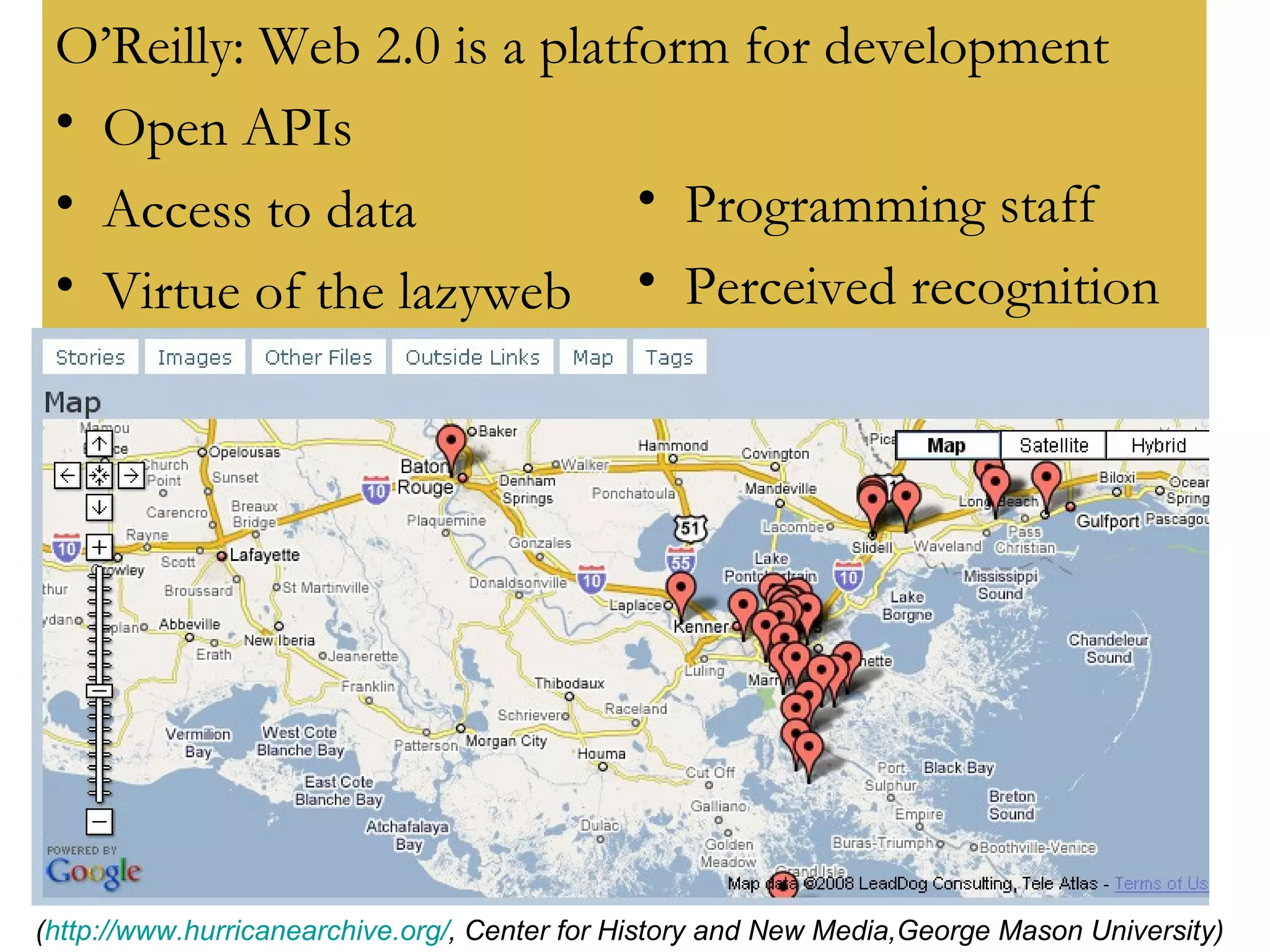
O’Reilly: Web 2.0 is a platform for development Open APIs Access to data Virtue of the lazyweb ( http://www.hurricanearchive.org/ , Center for History and New Media,George Mason University) Programming staff Perceived recognition
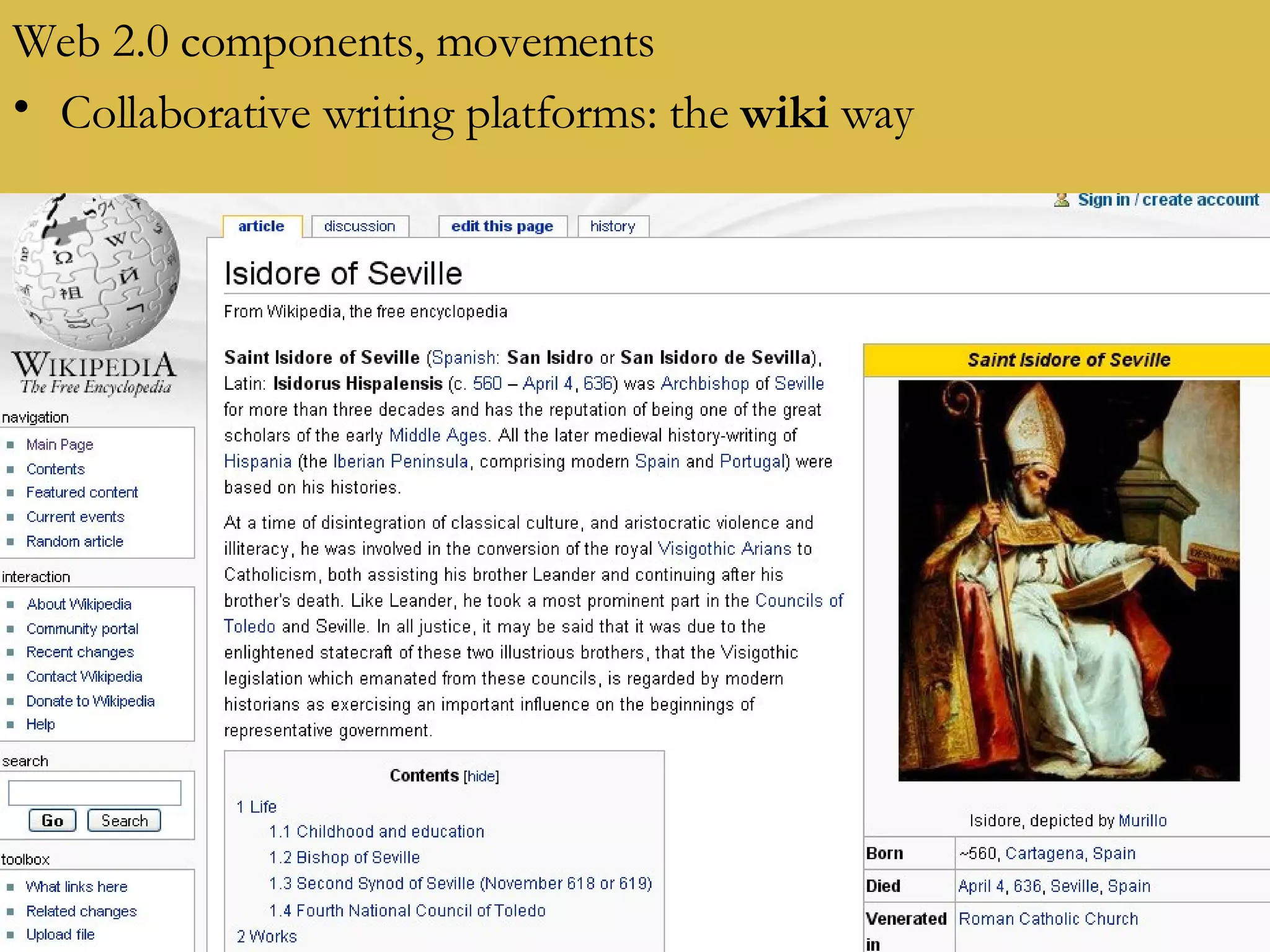
Web 2.0 components, movements Collaborative writing platforms: the  wiki  way
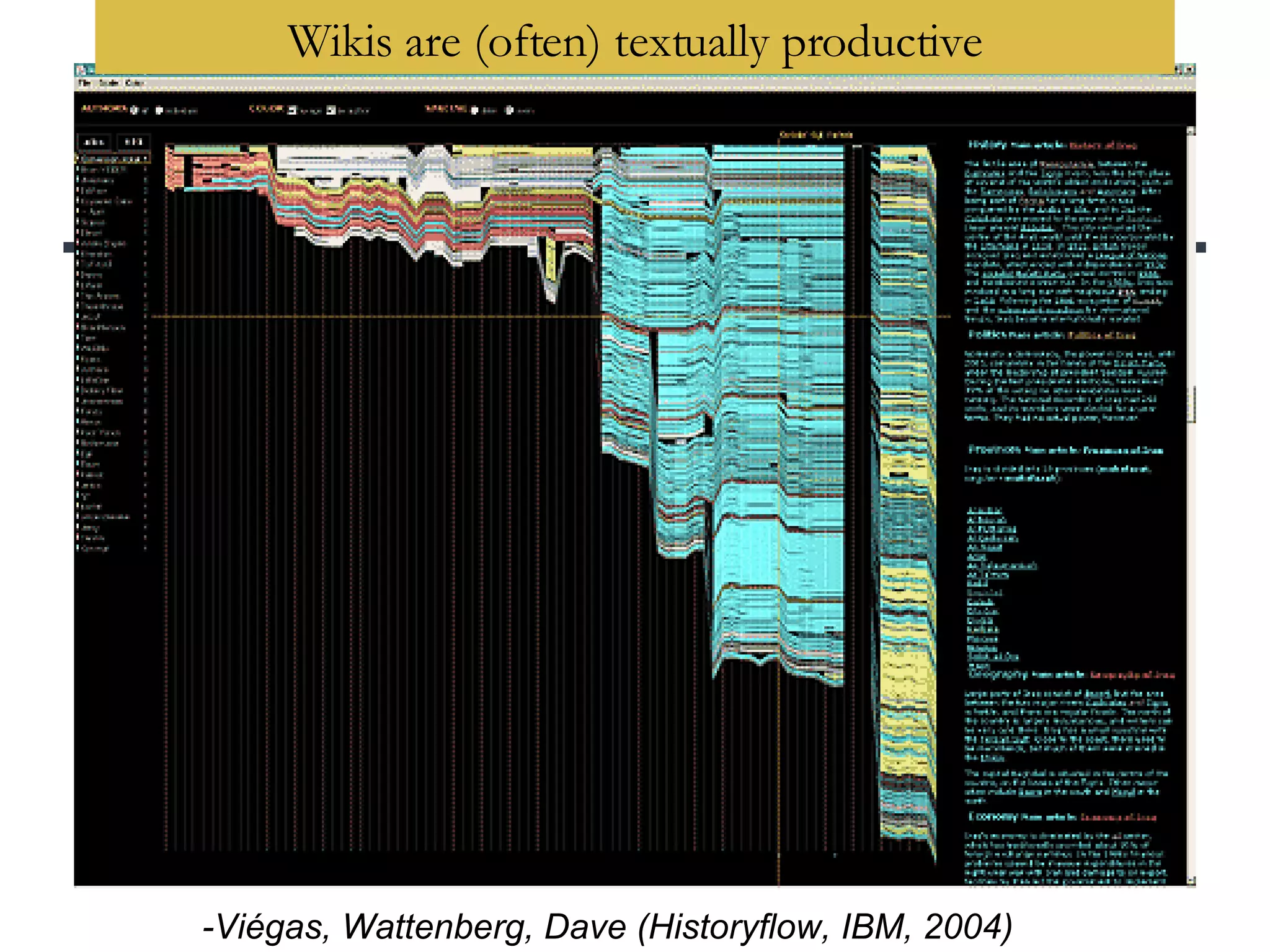
-Viégas, Wattenberg, Dave (Historyflow, IBM, 2004) Wikis are (often) textually productive
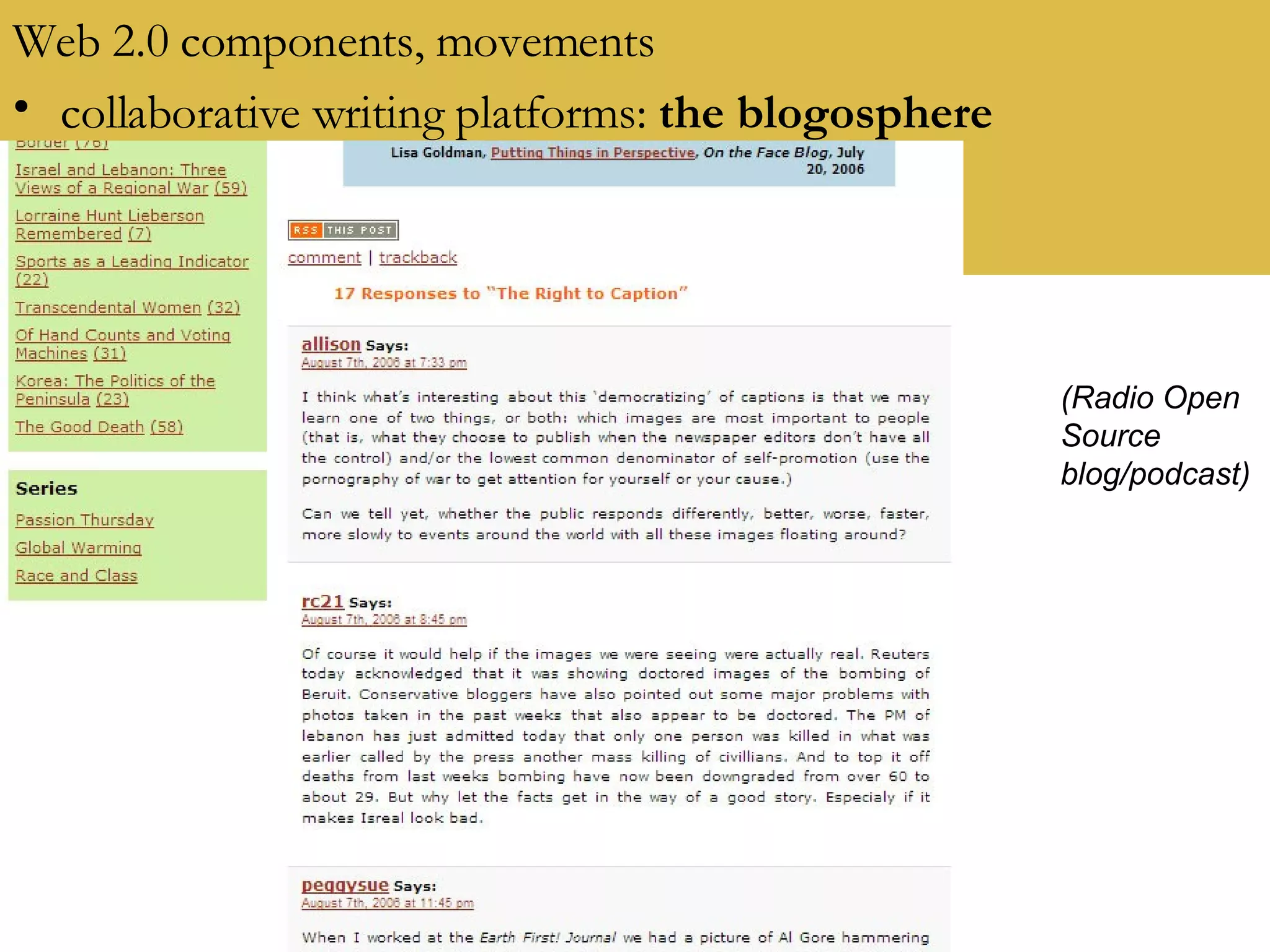
Web 2.0 components, movements collaborative writing platforms:  the blogosphere (Radio Open Source blog/podcast)
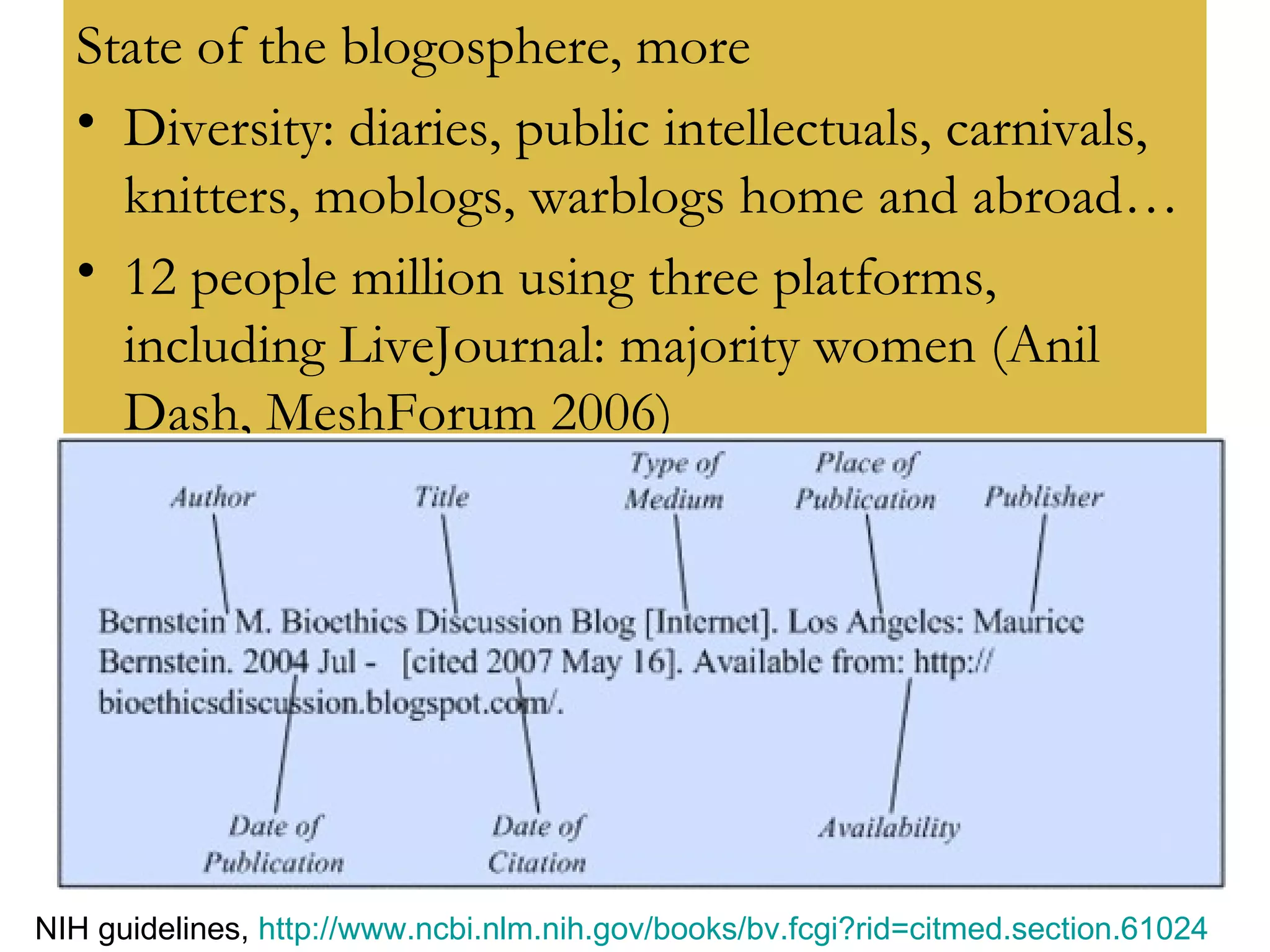
State of the blogosphere, more Diversity: diaries, public intellectuals, carnivals, knitters, moblogs, warblogs home and abroad… 12 people million using three platforms, including LiveJournal: majority women (Anil Dash, MeshForum 2006) NIH guidelines,  http://www.ncbi.nlm.nih.gov/books/bv.fcgi?rid=citmed.section.61024
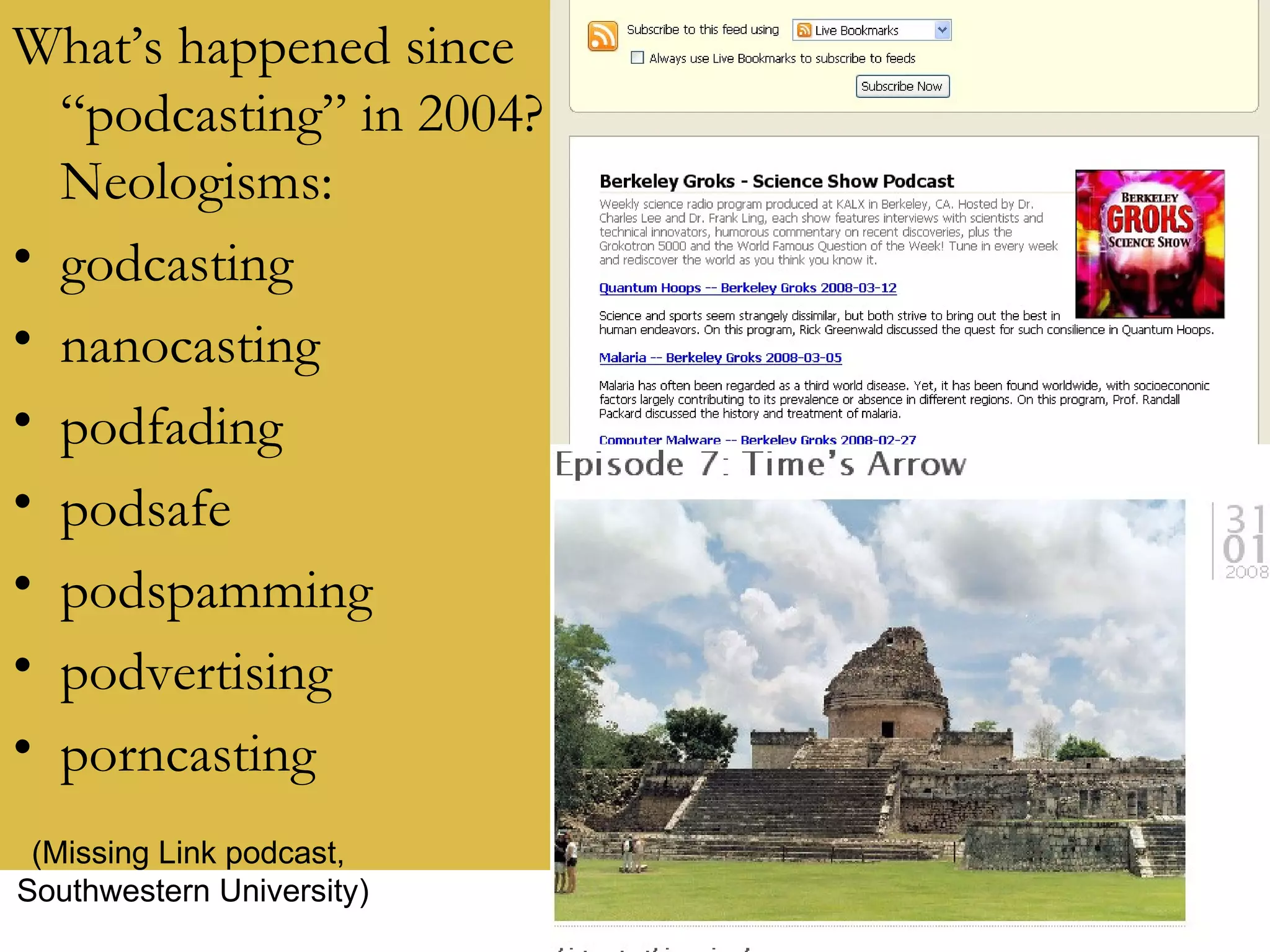
What’s happened since “podcasting” in 2004? Neologisms: godcasting nanocasting podfading podsafe podspamming podvertising porncasting (Missing Link podcast, Southwestern University)
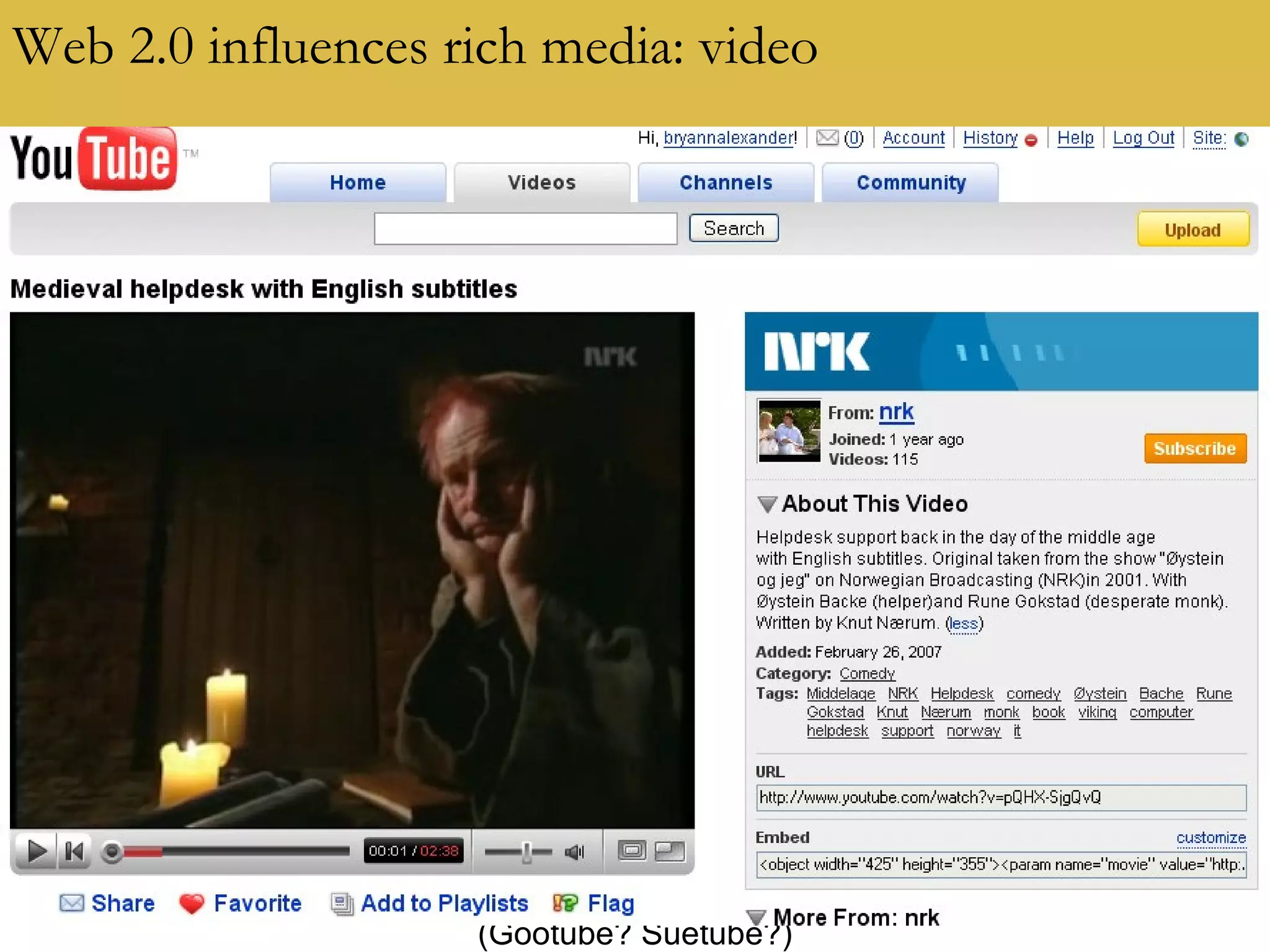
Web 2.0 influences rich media: video (Gootube? Suetube?)
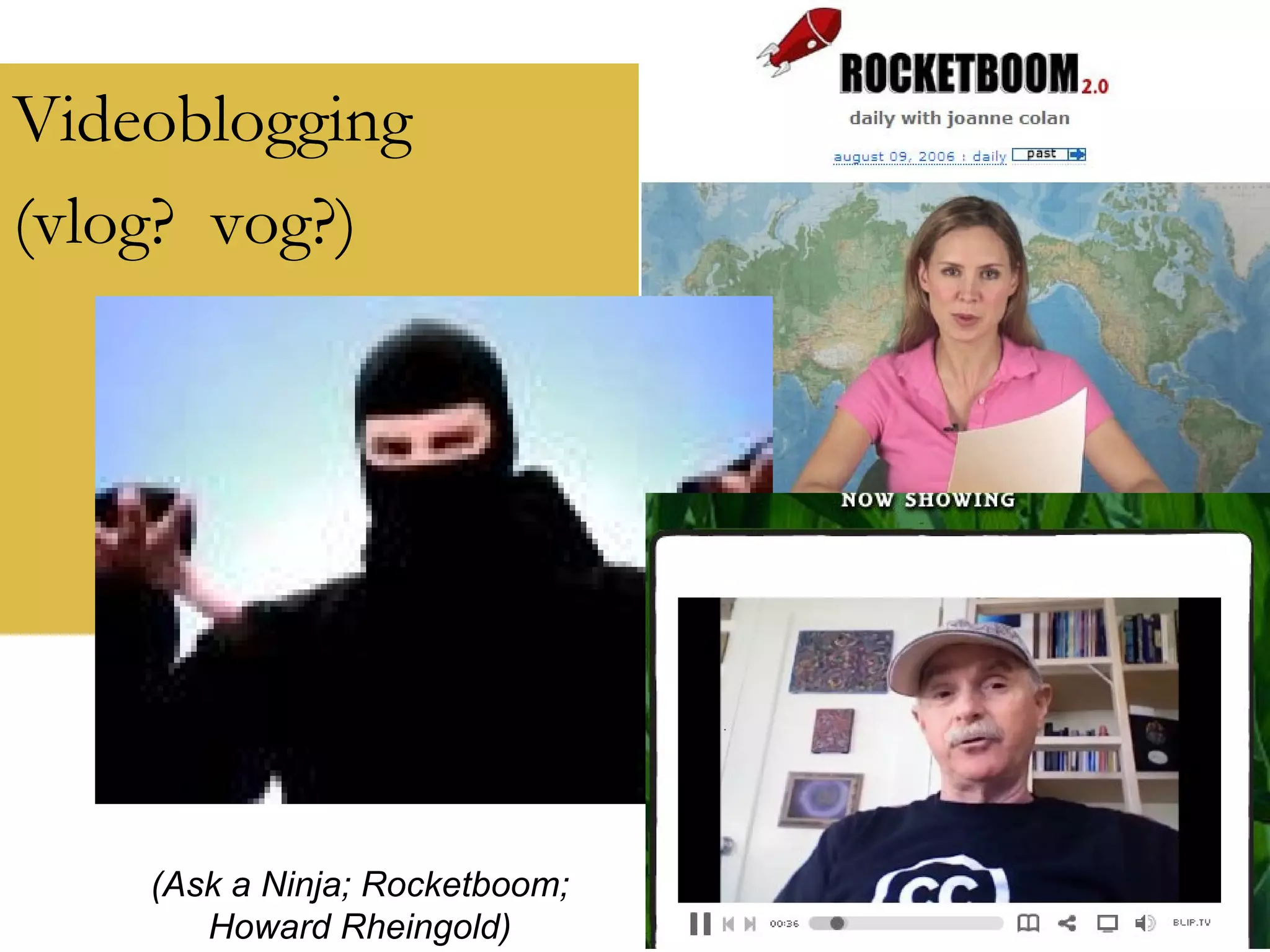
Videoblogging (vlog?  vog?) (Ask a Ninja; Rocketboom; Howard Rheingold)
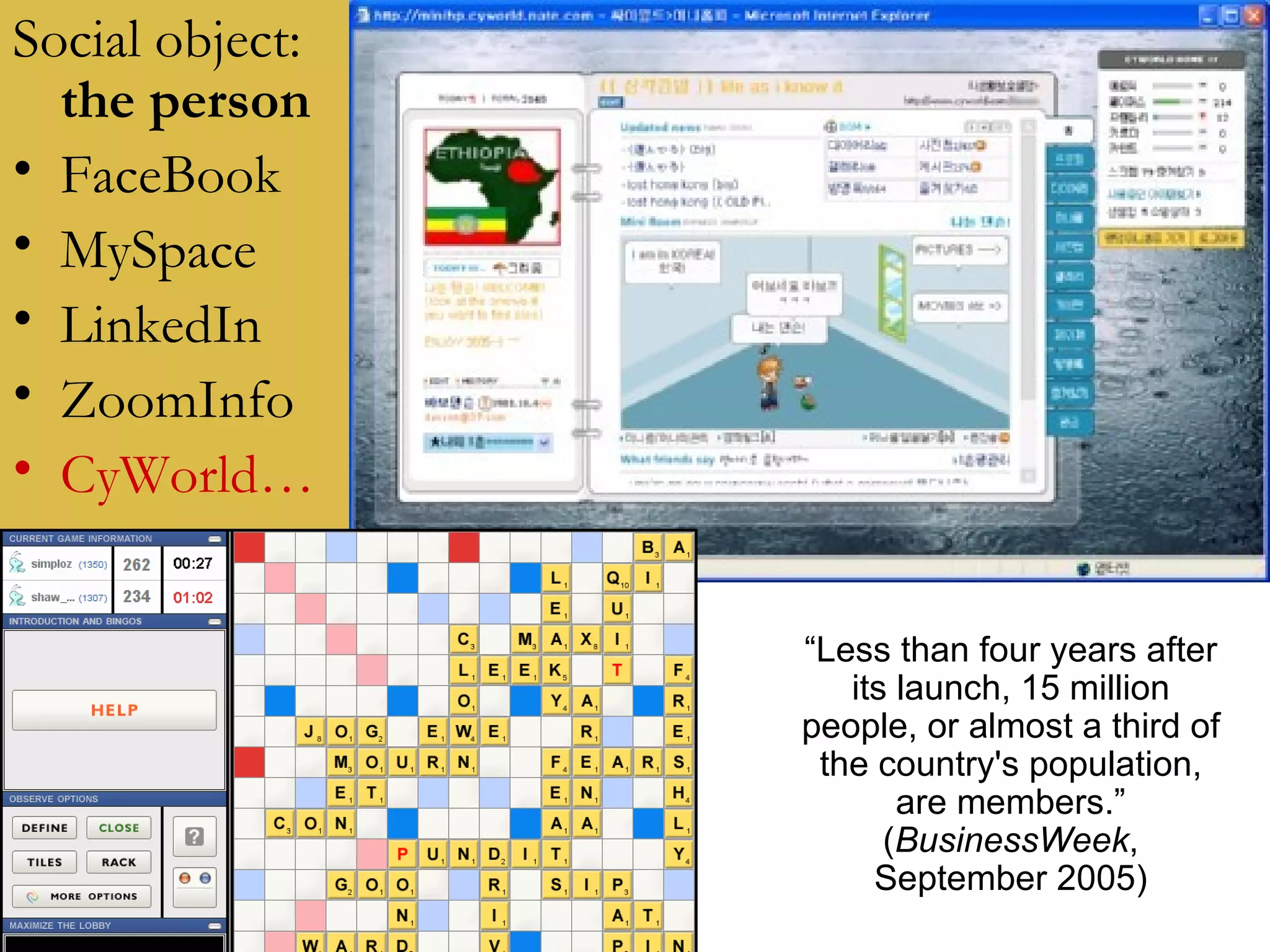
Social object:  the person FaceBook MySpace LinkedIn ZoomInfo CyWorld… “ Less than four years after its launch, 15 million people, or almost a third of the country's population, are members.” ( BusinessWeek , September 2005)
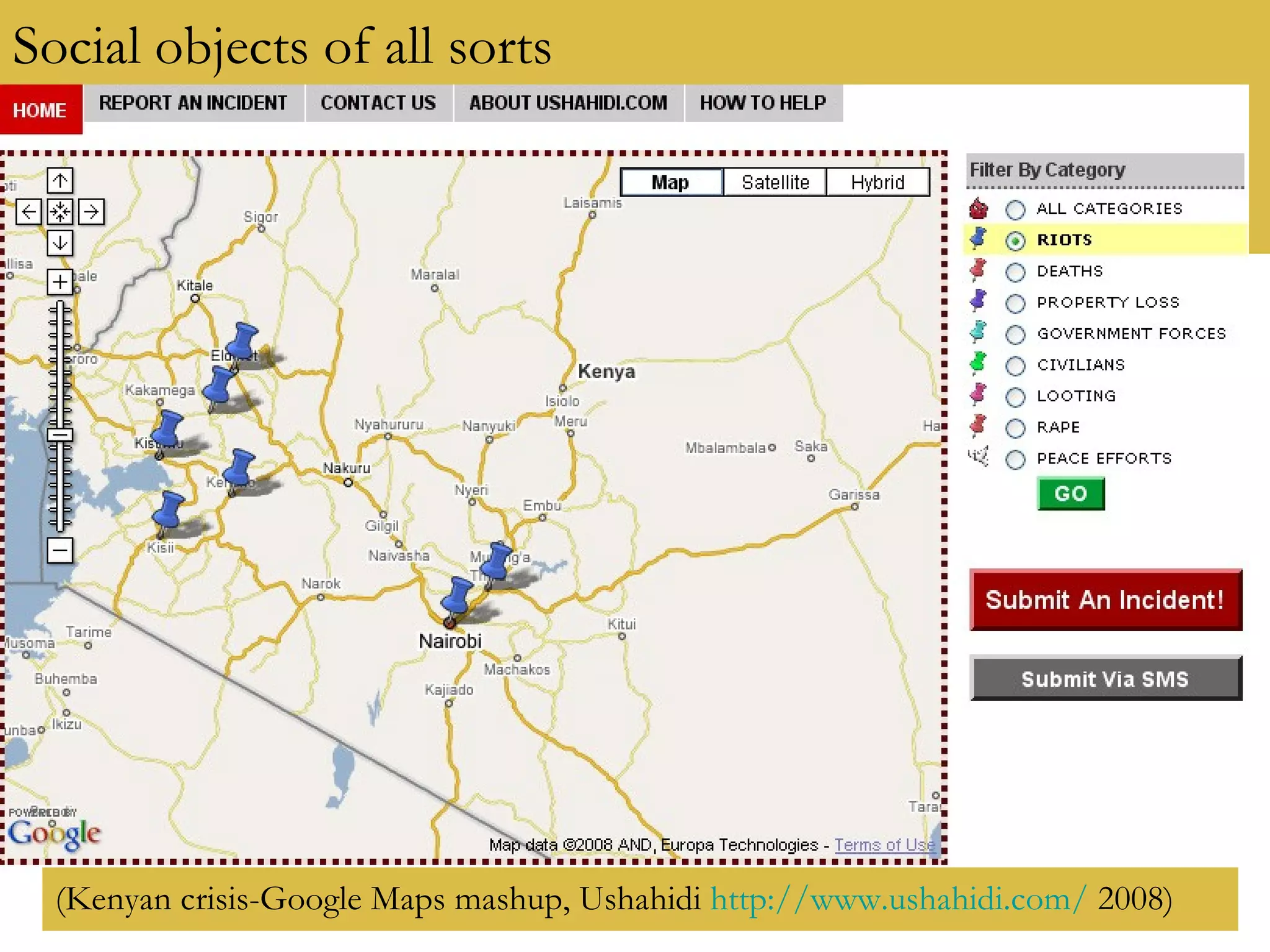
Social objects of all sorts (Kenyan crisis-Google Maps mashup, Ushahidi  http://www.ushahidi.com/  2008)
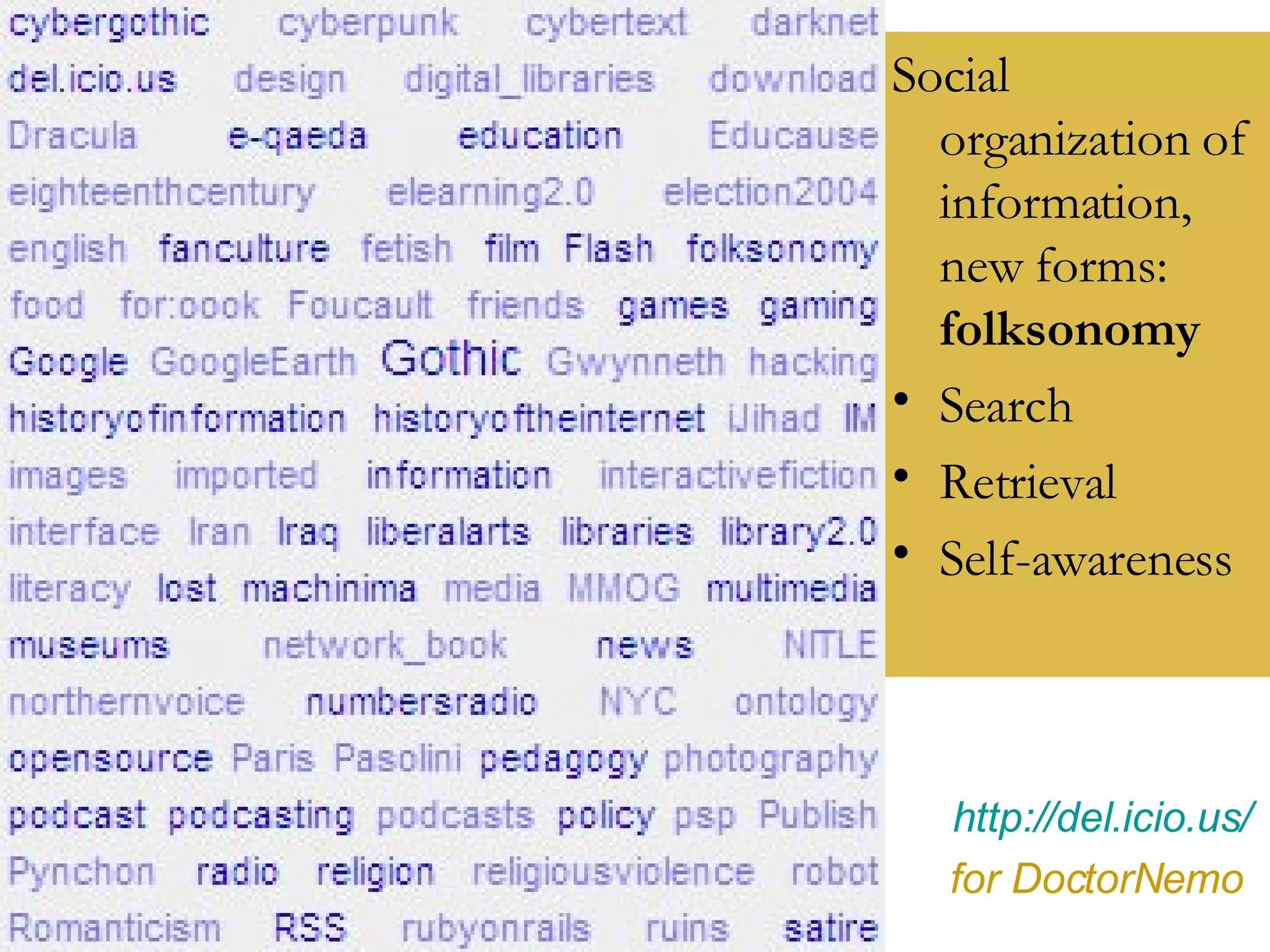
Social organization of information, new forms:  folksonomy  Search Retrieval Self-awareness http://del.icio.us/ for DoctorNemo
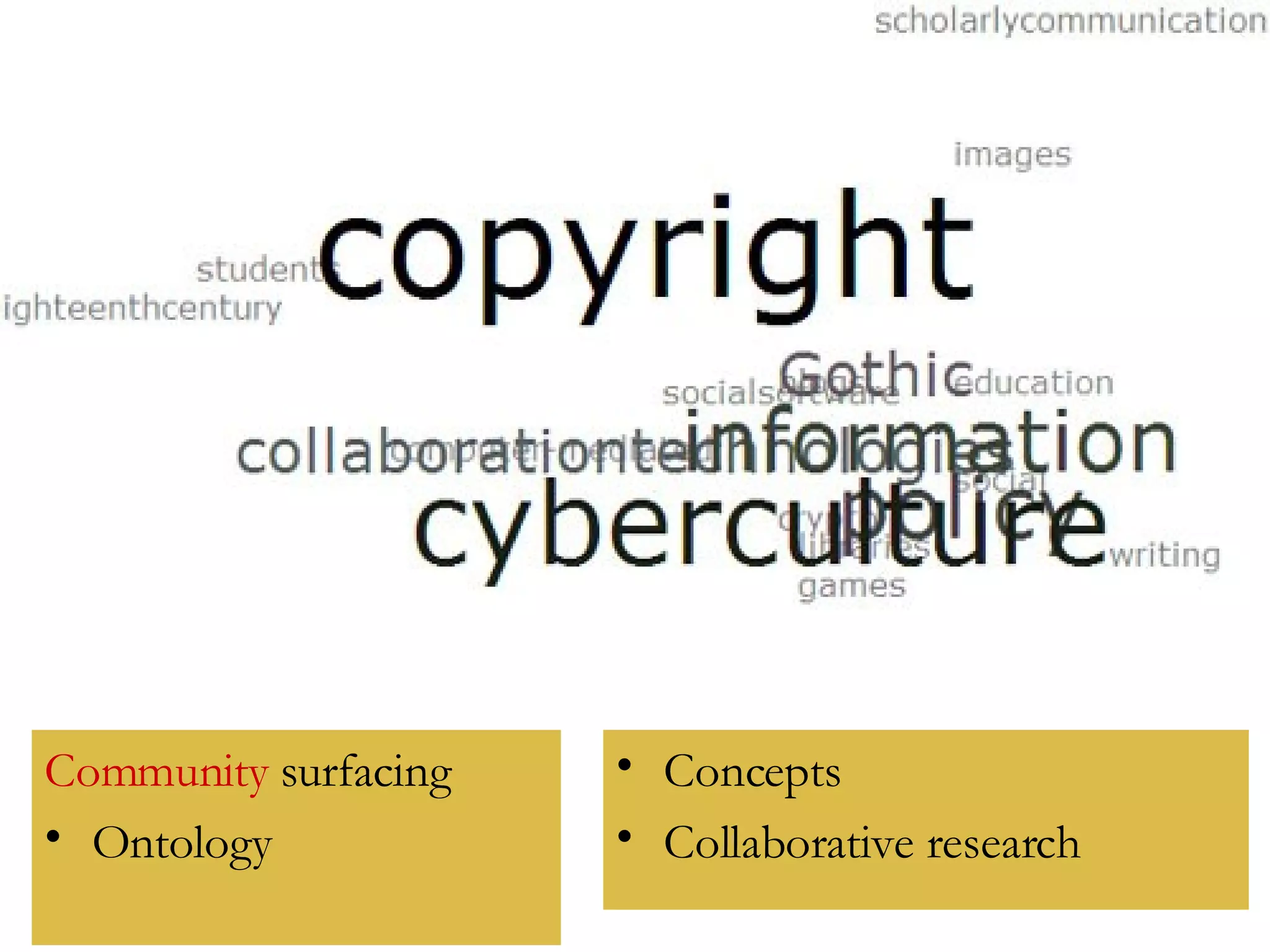
Community  surfacing Ontology Concepts  Collaborative research
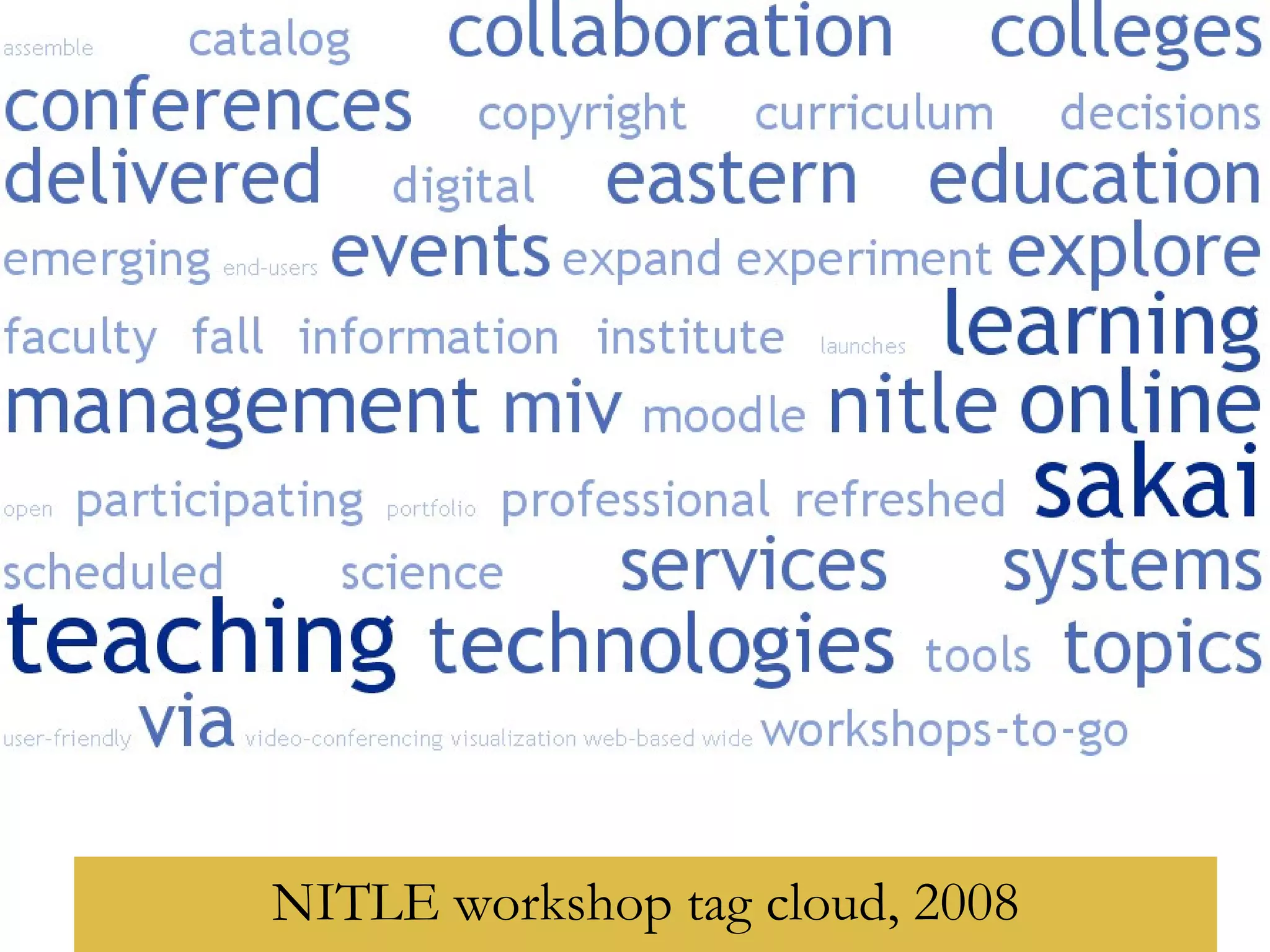
Keeping up NITLE workshop tag cloud, 2008
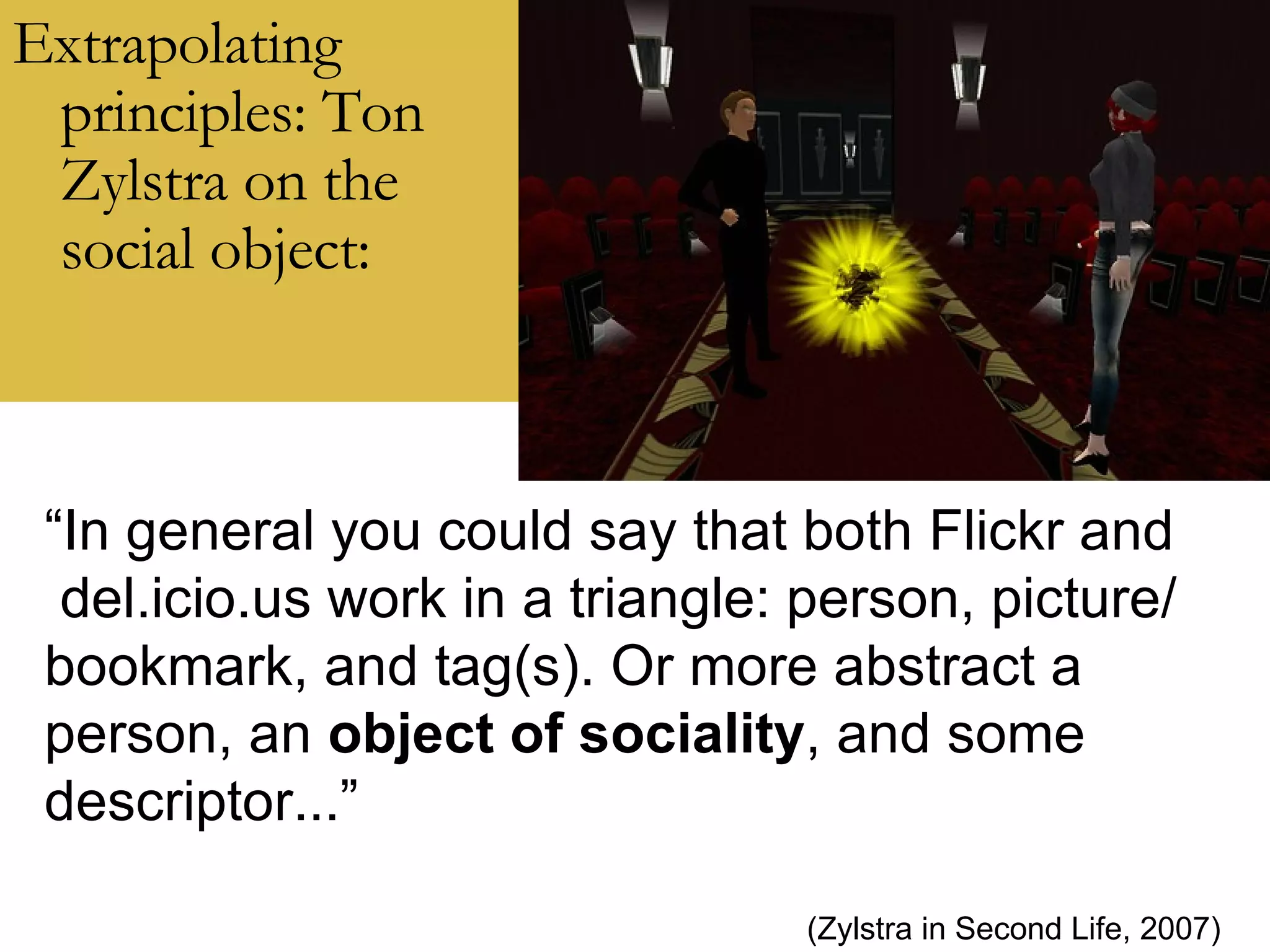
Extrapolating principles: Ton Zylstra on the social object: “ In general you could say that both Flickr and del.icio.us work in a triangle: person, picture/ bookmark, and tag(s). Or more abstract a person, an  object of sociality , and some descriptor...” (Zylstra in Second Life, 2007)
“… In every triangle there always needs to be a person and  an object of sociality . The third point of the triangle is free to define[,] as it were.” - http://www.zylstra.org , 2006 (emphases added)
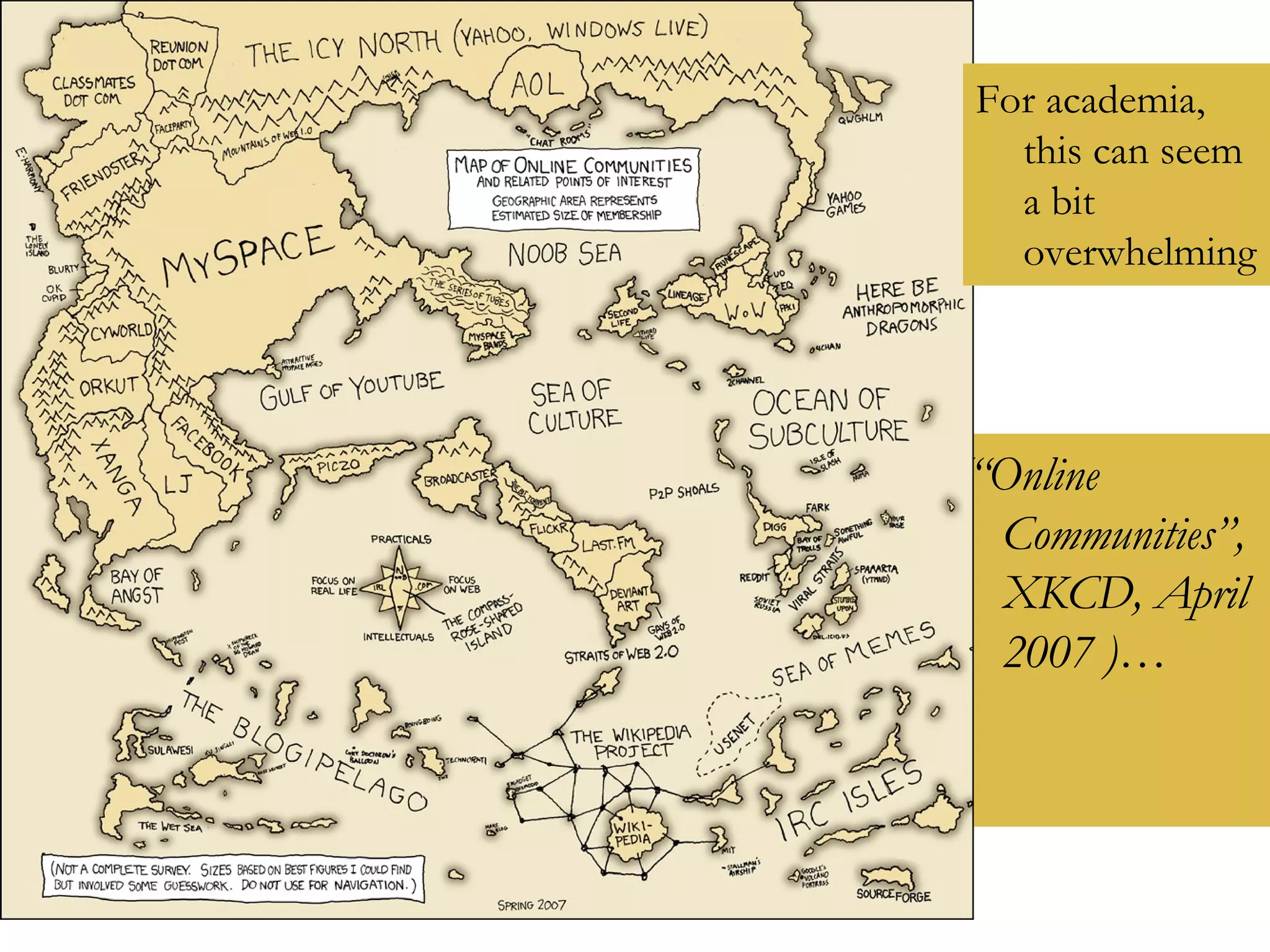
(“Online Communities”, XKCD, April 2007 )… For academia, this can seem a bit overwhelming
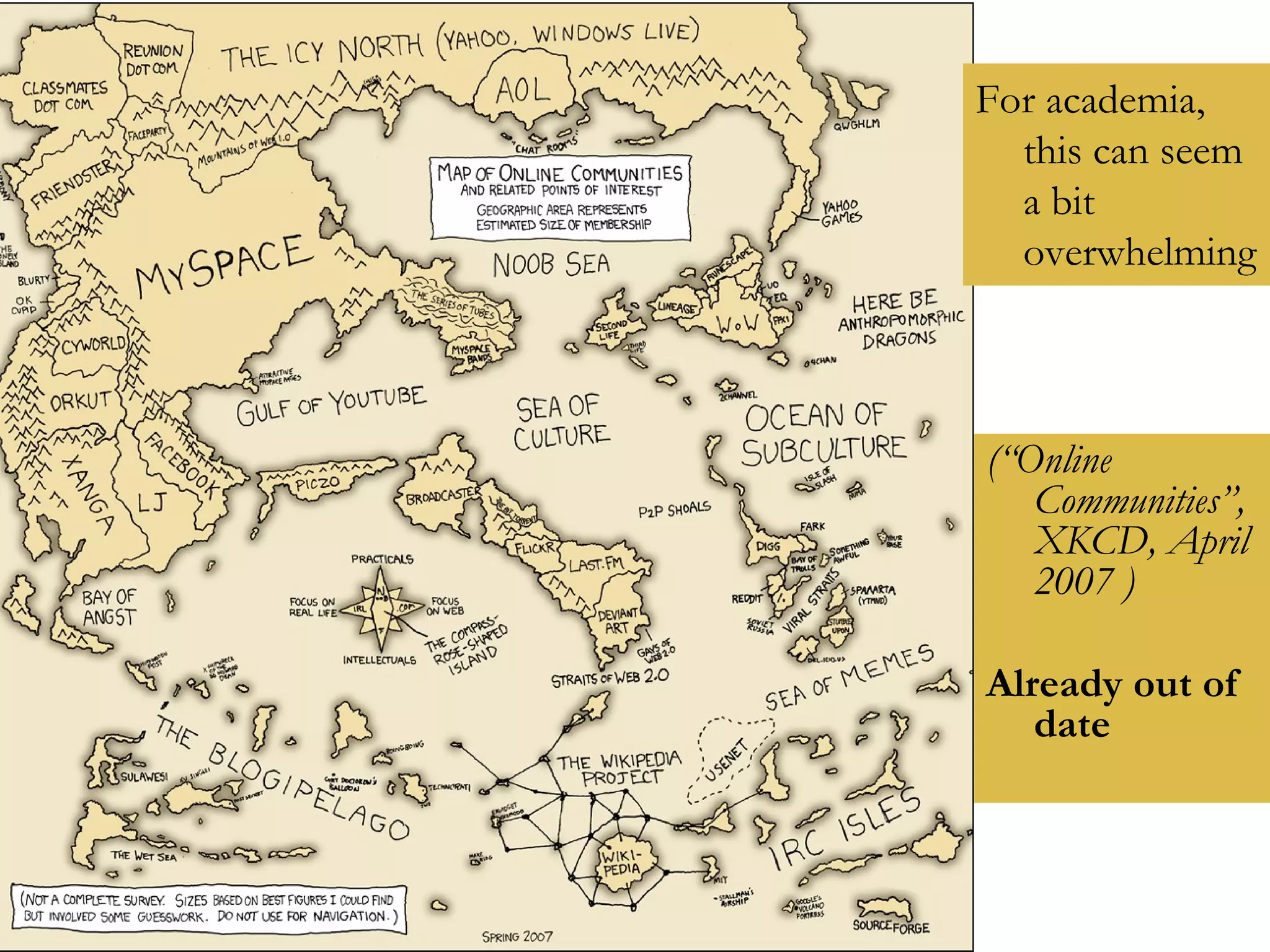
(“Online Communities”, XKCD, April 2007 ) Already out of date For academia, this can seem a bit overwhelming
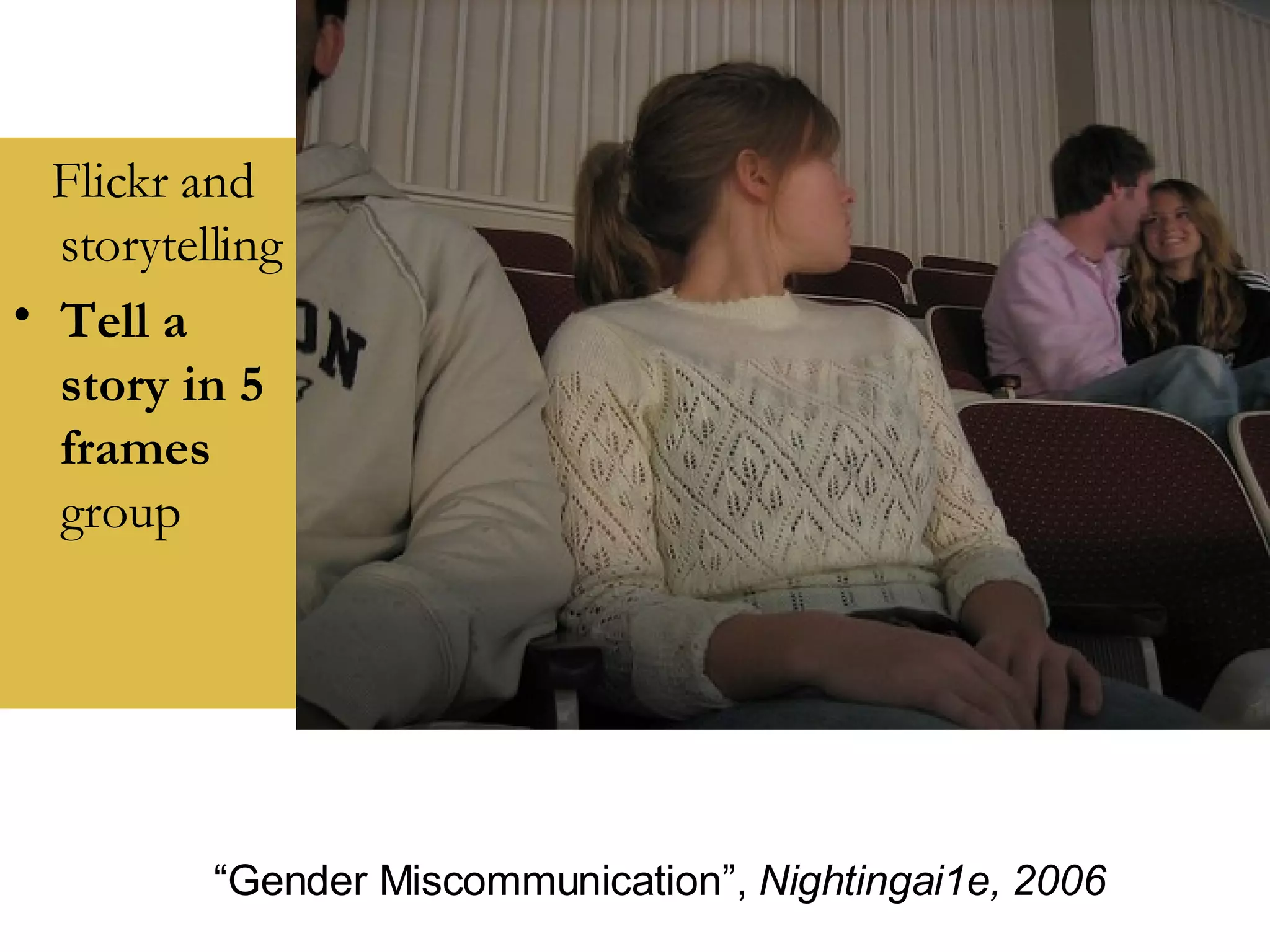
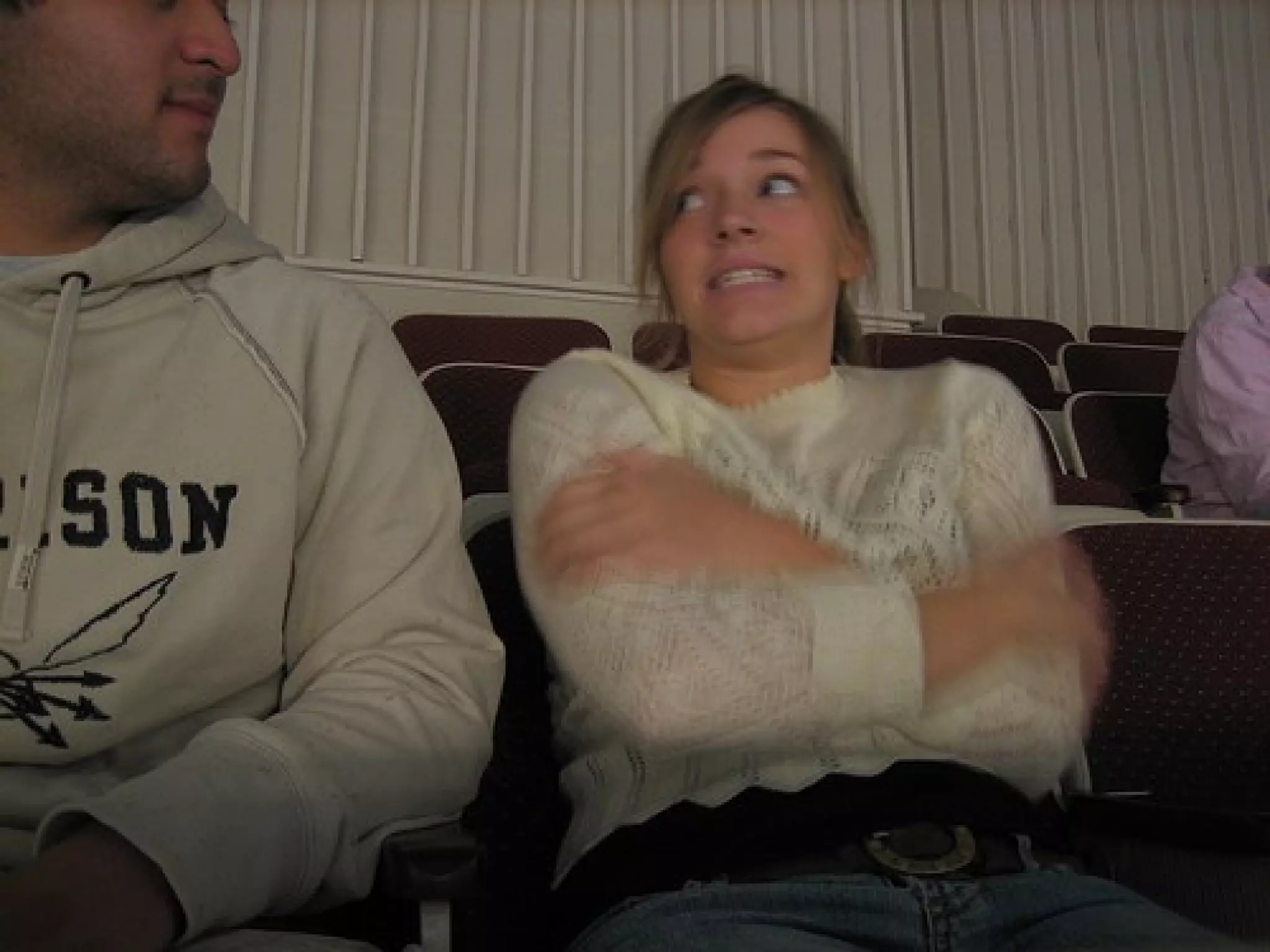
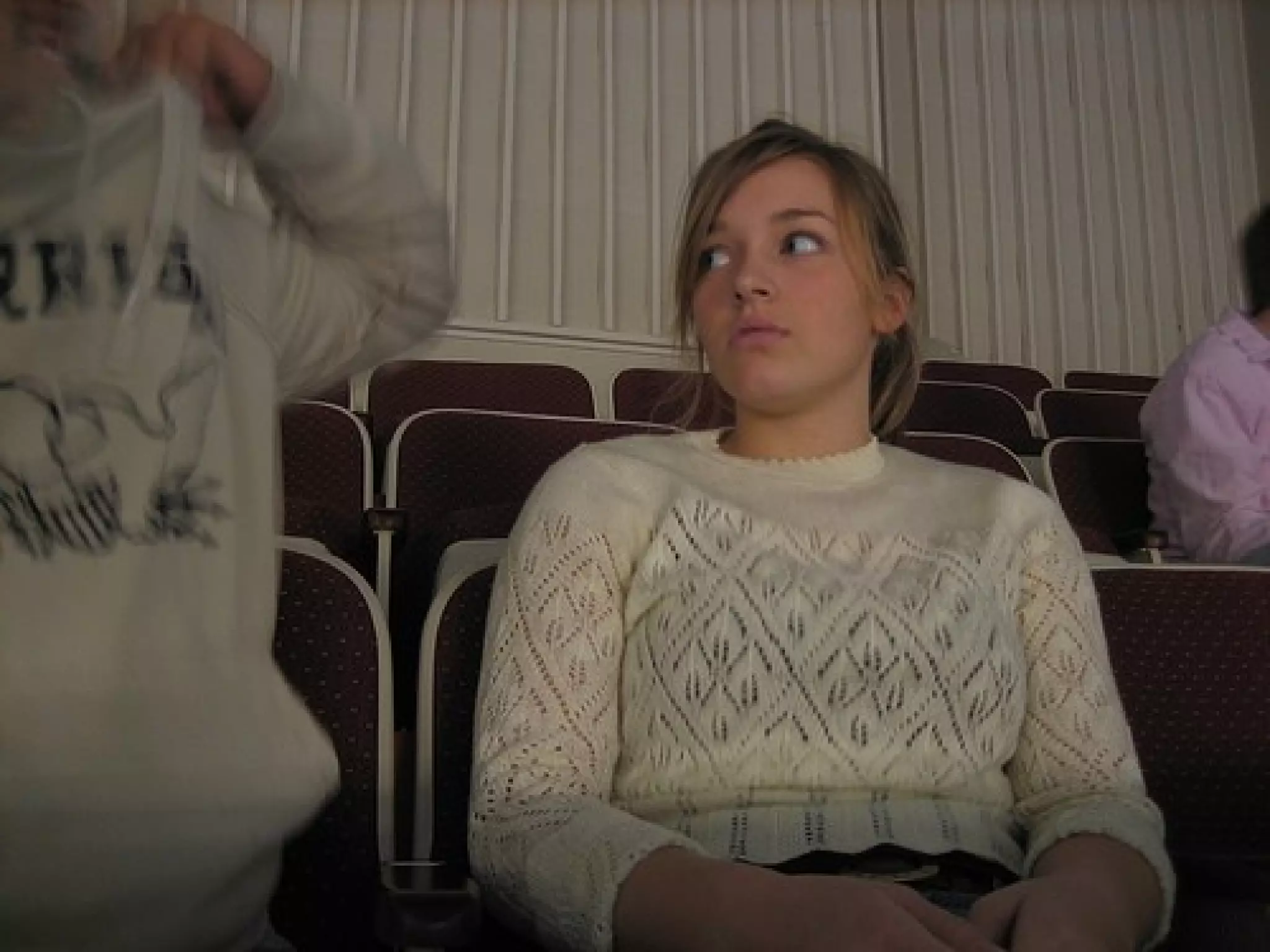
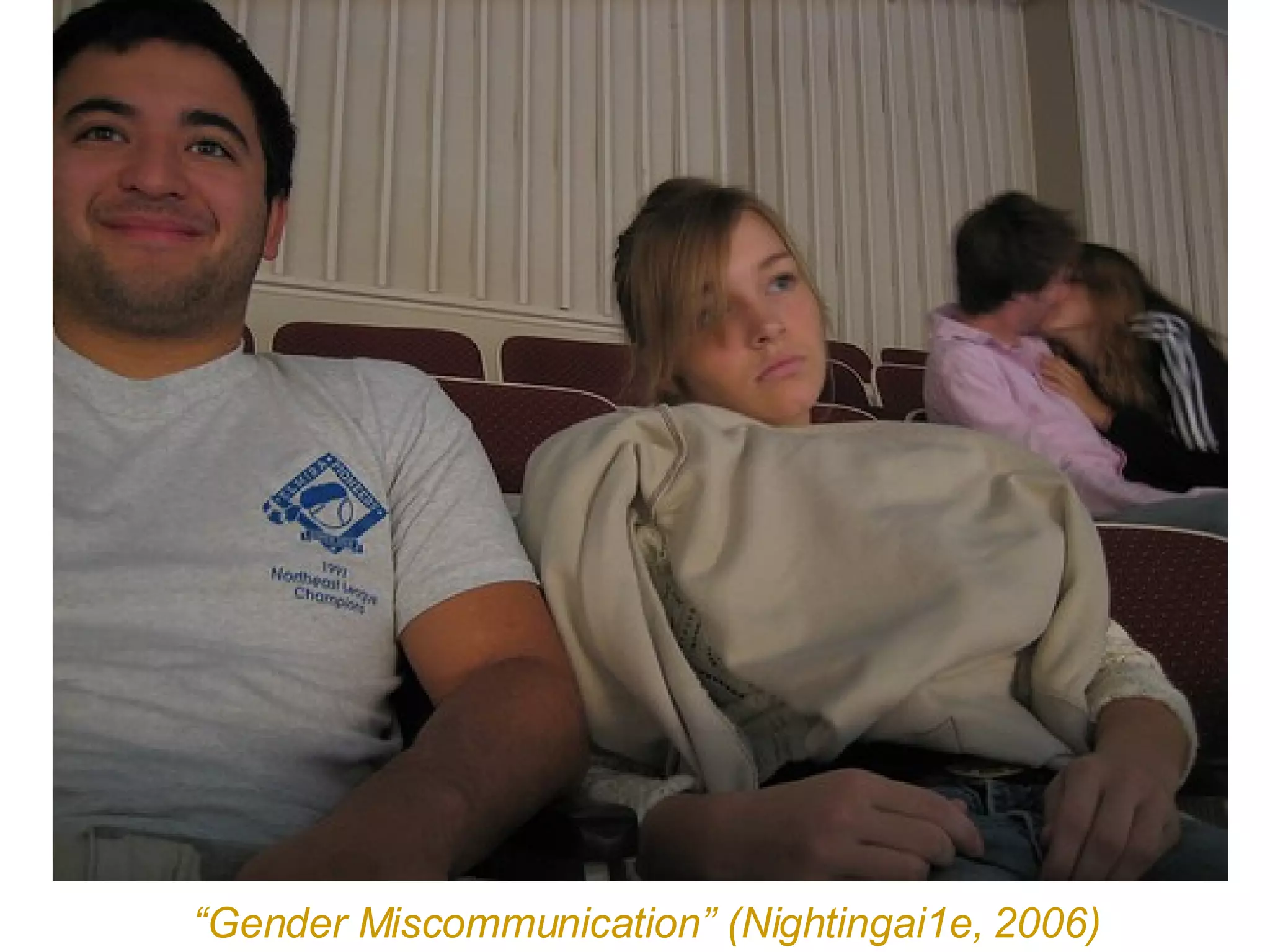
Flickr and storytelling Tell a story in 5 frames  group “ Gender Miscommunication”,  Nightingai1e, 2006


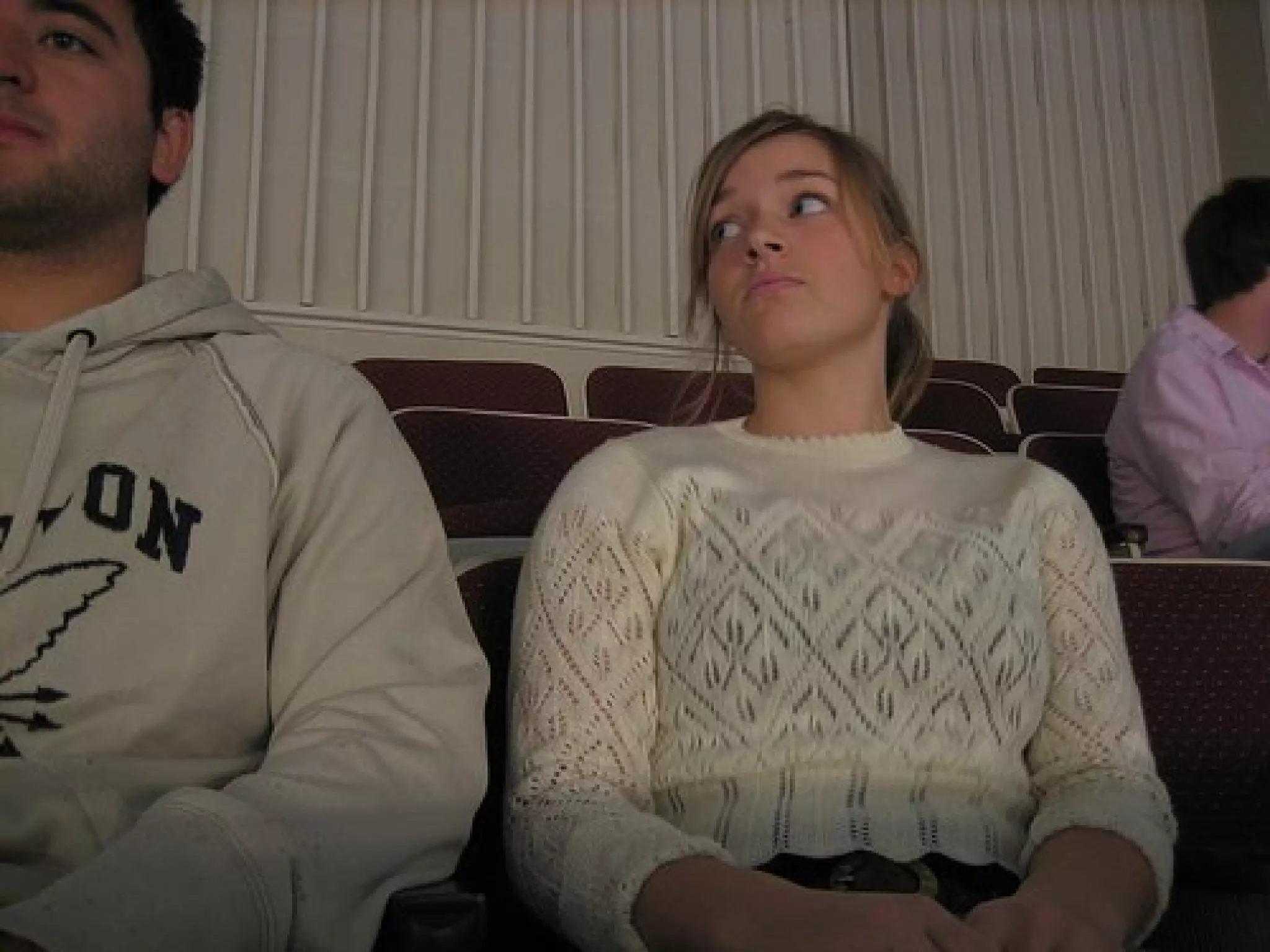
“ Gender Miscommunication” (Nightingai1e, 2006)
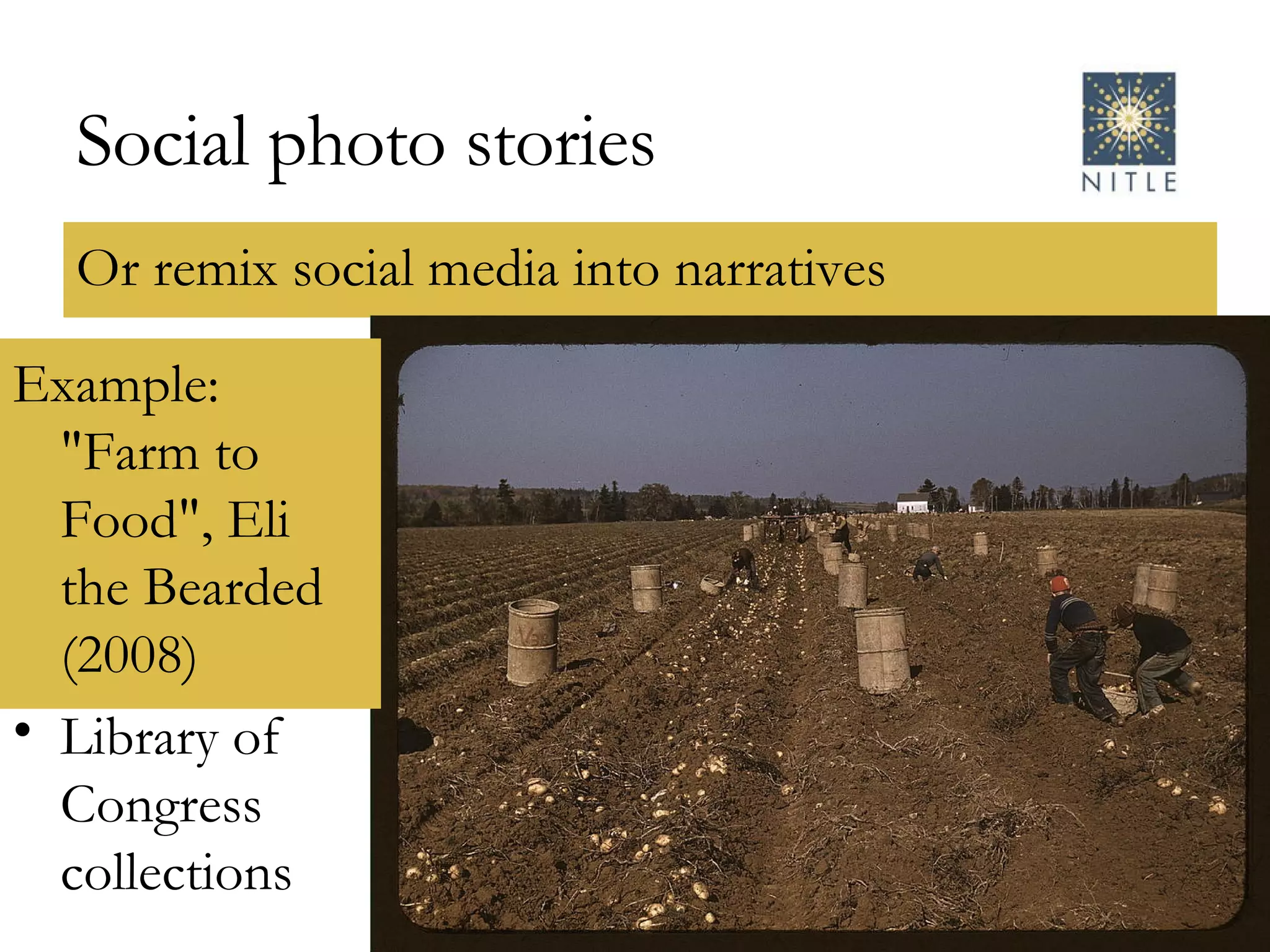
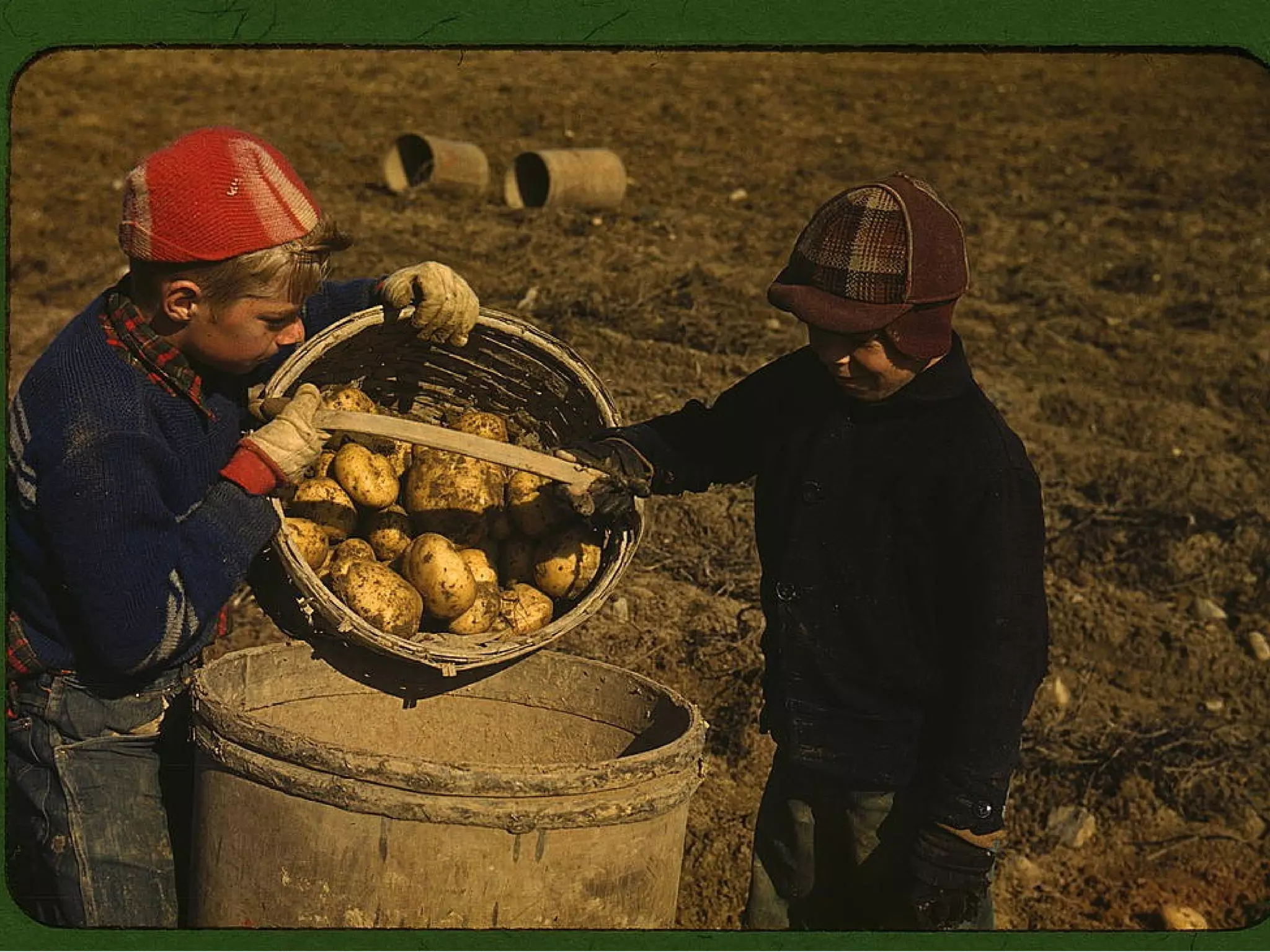
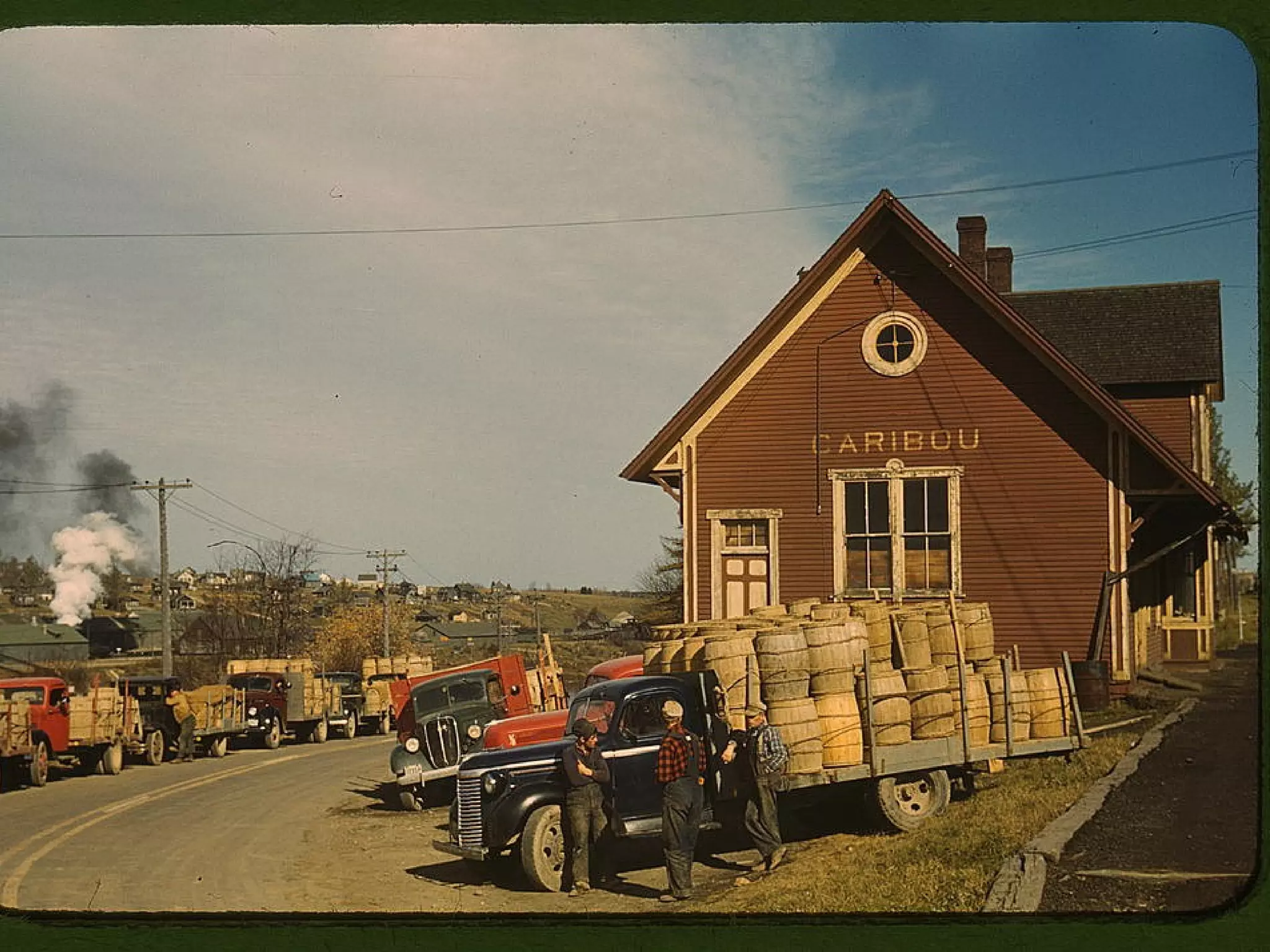
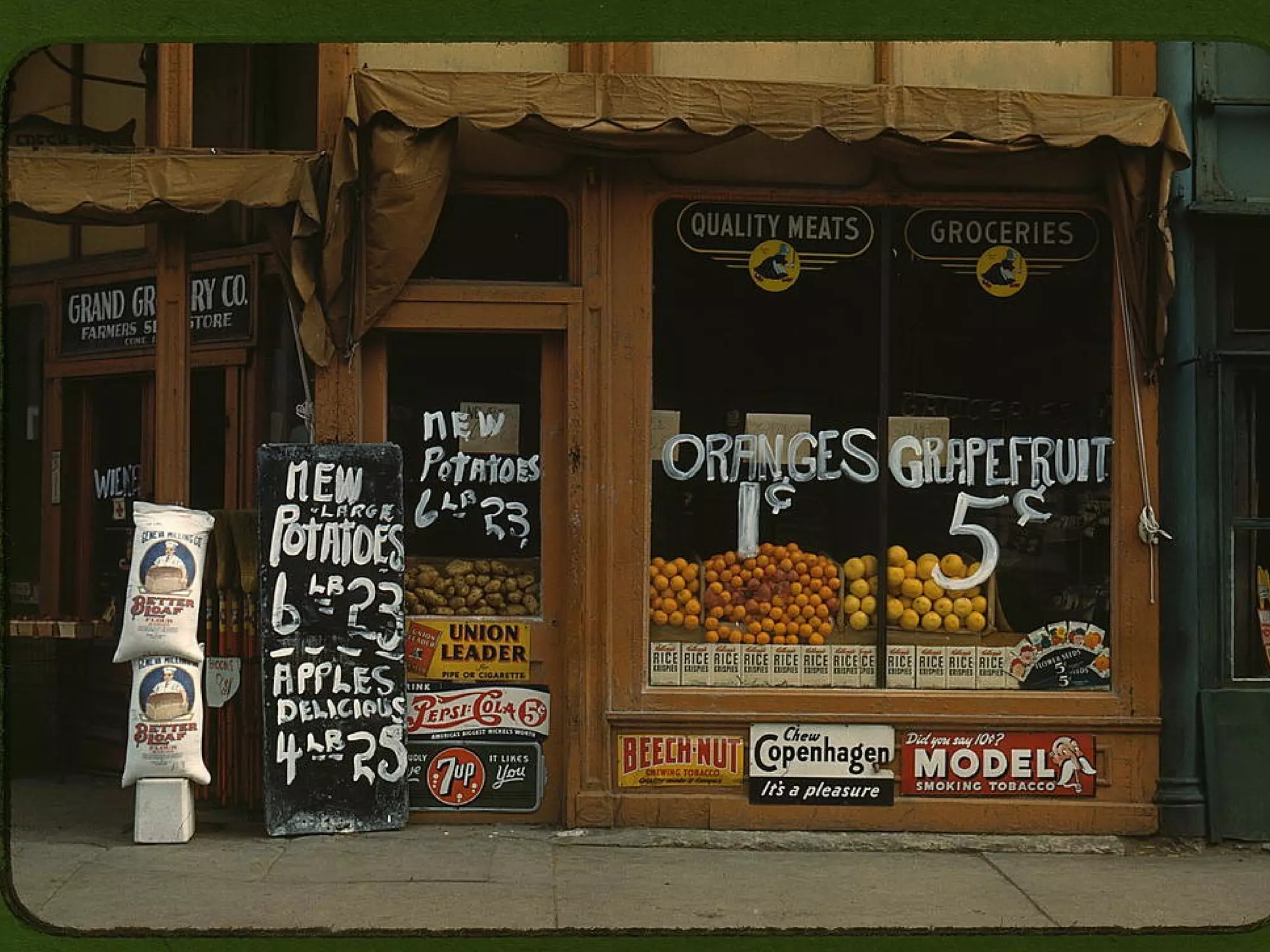
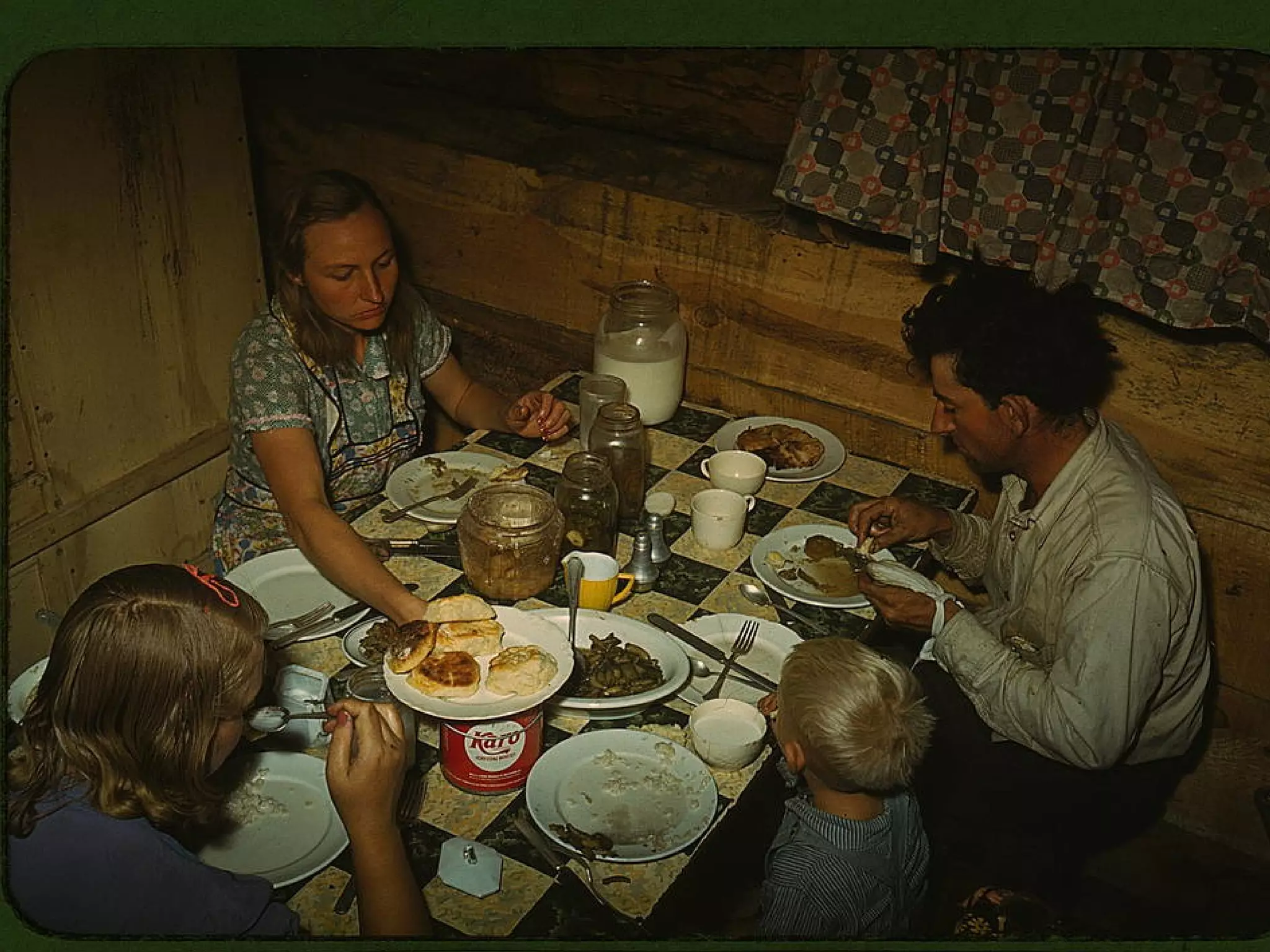
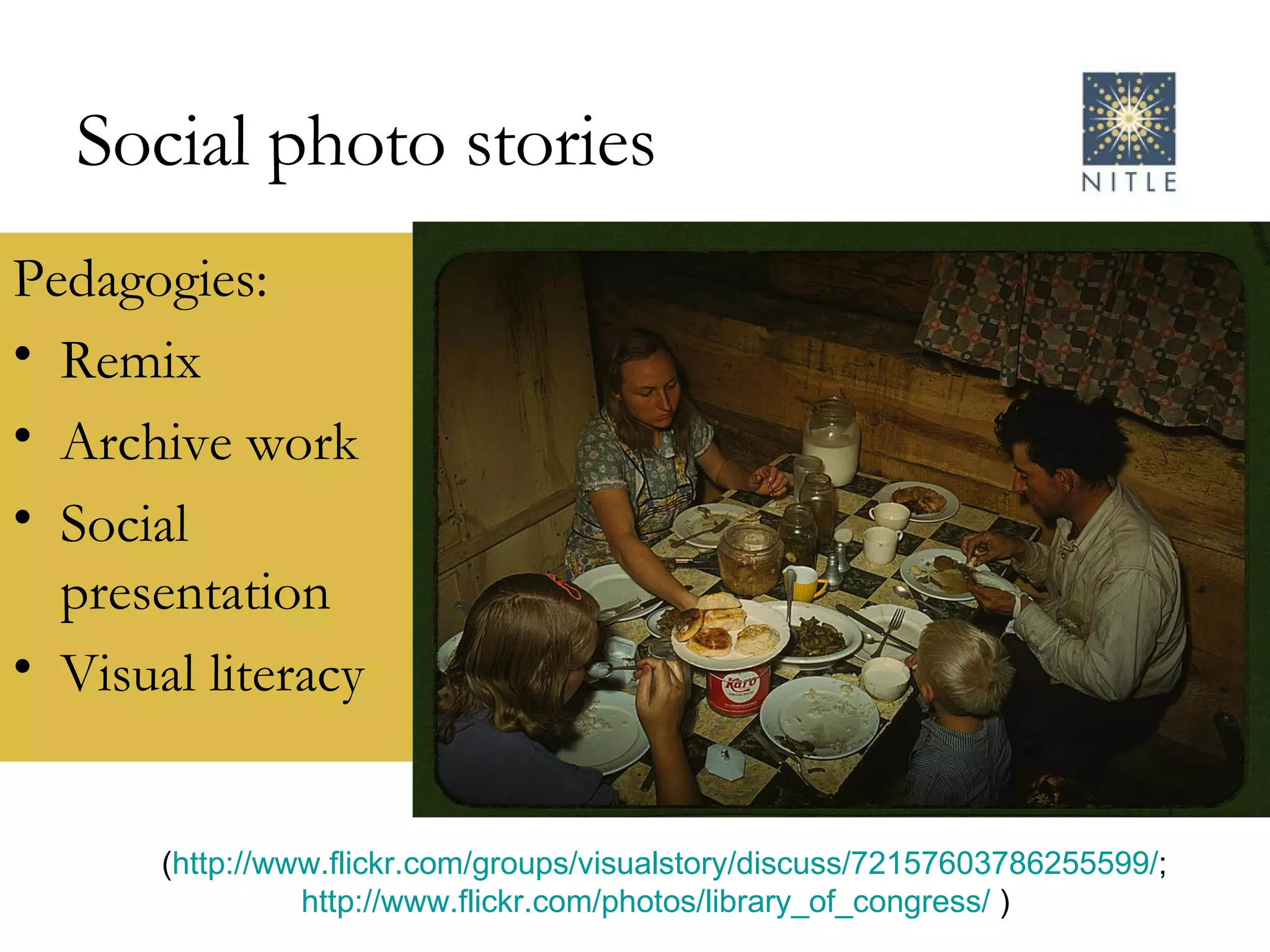
Social photo stories Or remix social media into narratives Example: "Farm to Food", Eli the Bearded (2008) Library of Congress collections
Social photo stories
Social photo stories Flickr, Tell A Story in Five Frames group ( http://www.flickr.com/groups/visualstory/ ) Example: "Food to Farm", Eli the Bearded (2008)
Social photo stories Example: "Food to Farm", Eli the Bearded (2008)
Social photo stories Pedagogies: Remix Archive work Social presentation Visual literacy ( http://www.flickr.com/groups/visualstory/discuss/72157603786255599/ ; http://www.flickr.com/photos/library_of_congress/  )
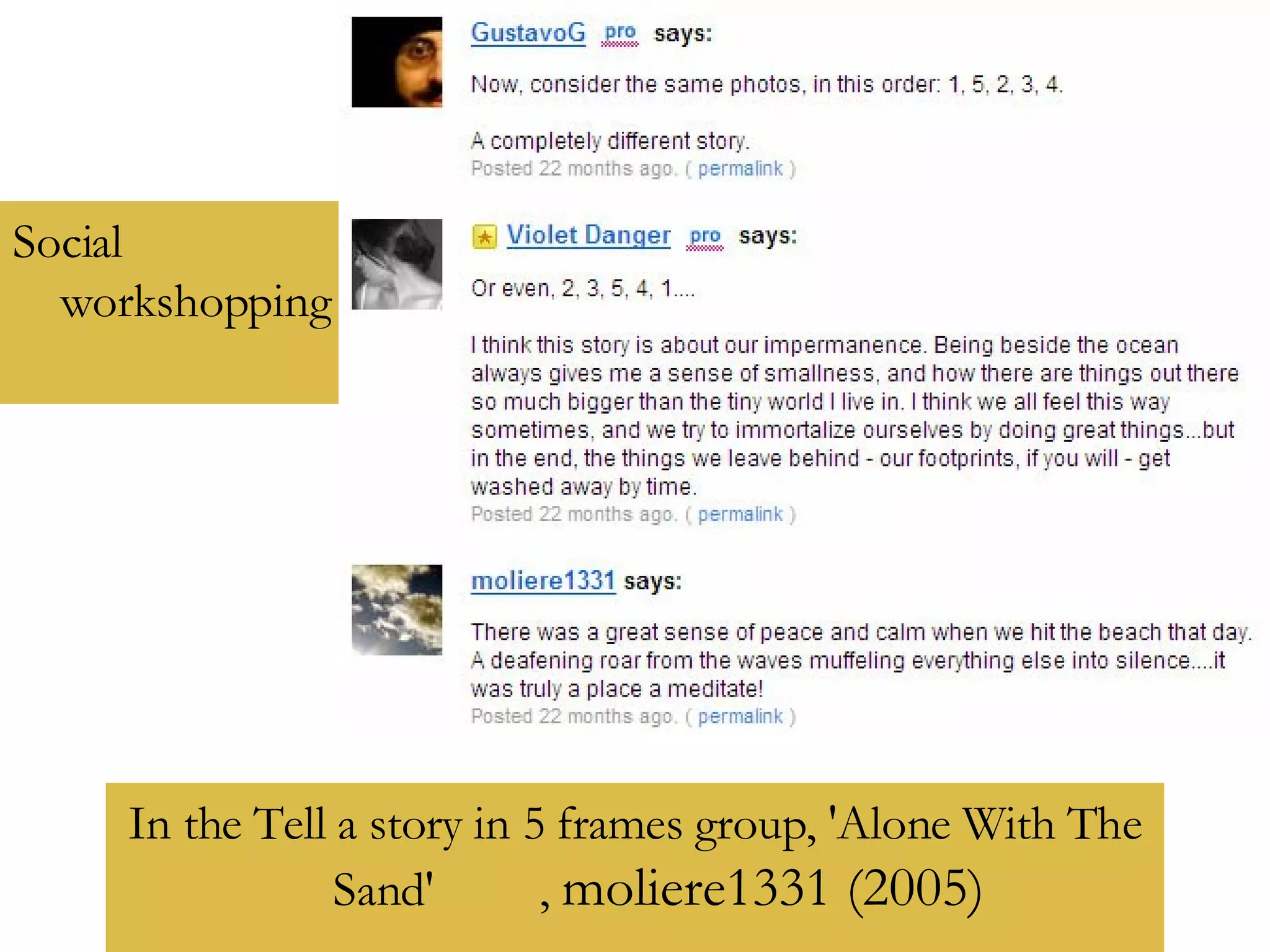
Social workshopping In the Tell a story in 5 frames group, 'Alone With The Sand' ,  moliere1331 (2005)
Pedagogies and publications Teaching with Web 2.0: it’s not all new - Web 1.0, internet pedagogies Hypertext Web audience Discussion fora  Collaborative document authoring Groupware
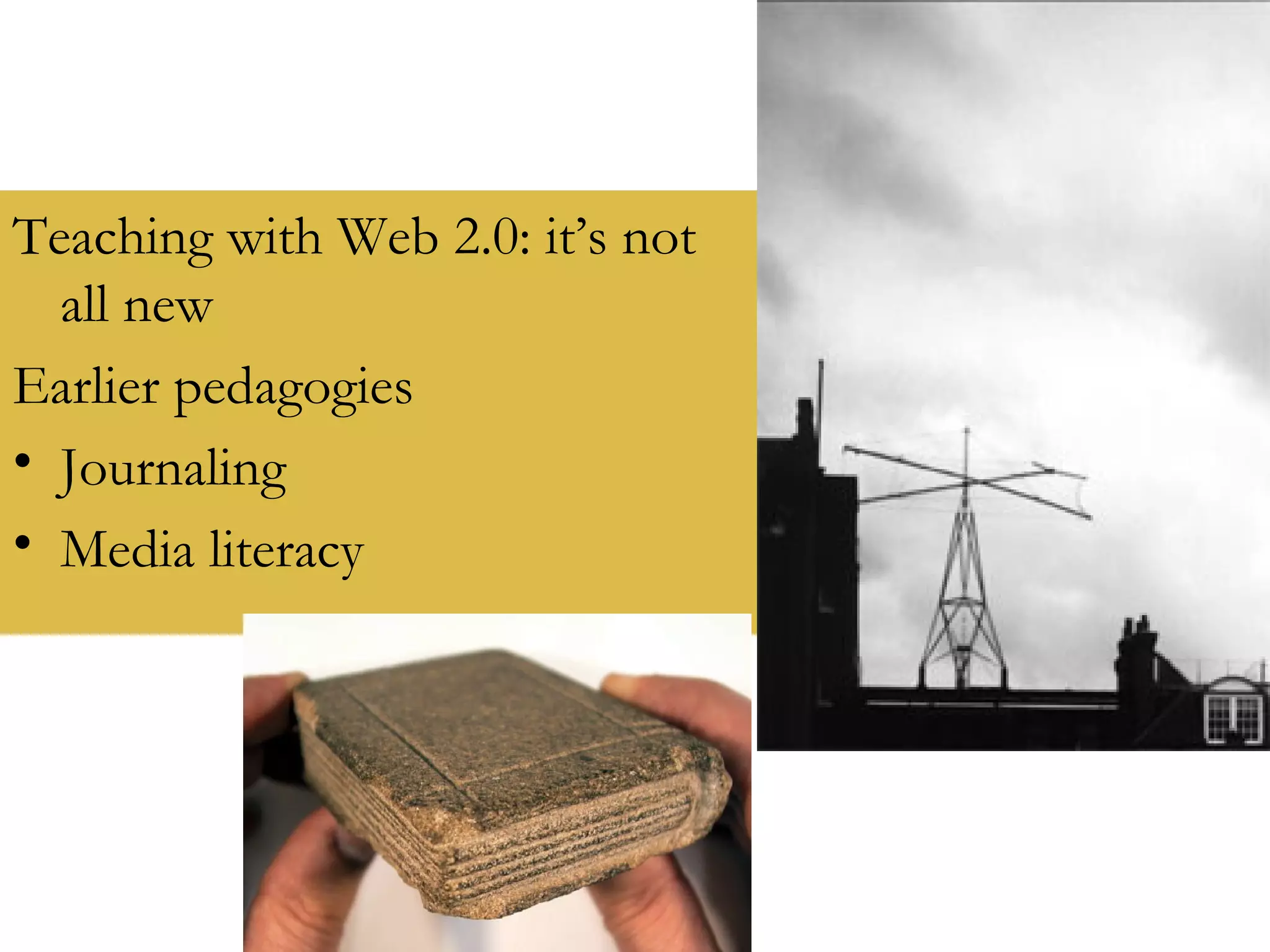
Teaching with Web 2.0: it’s not all new Earlier pedagogies Journaling Media literacy
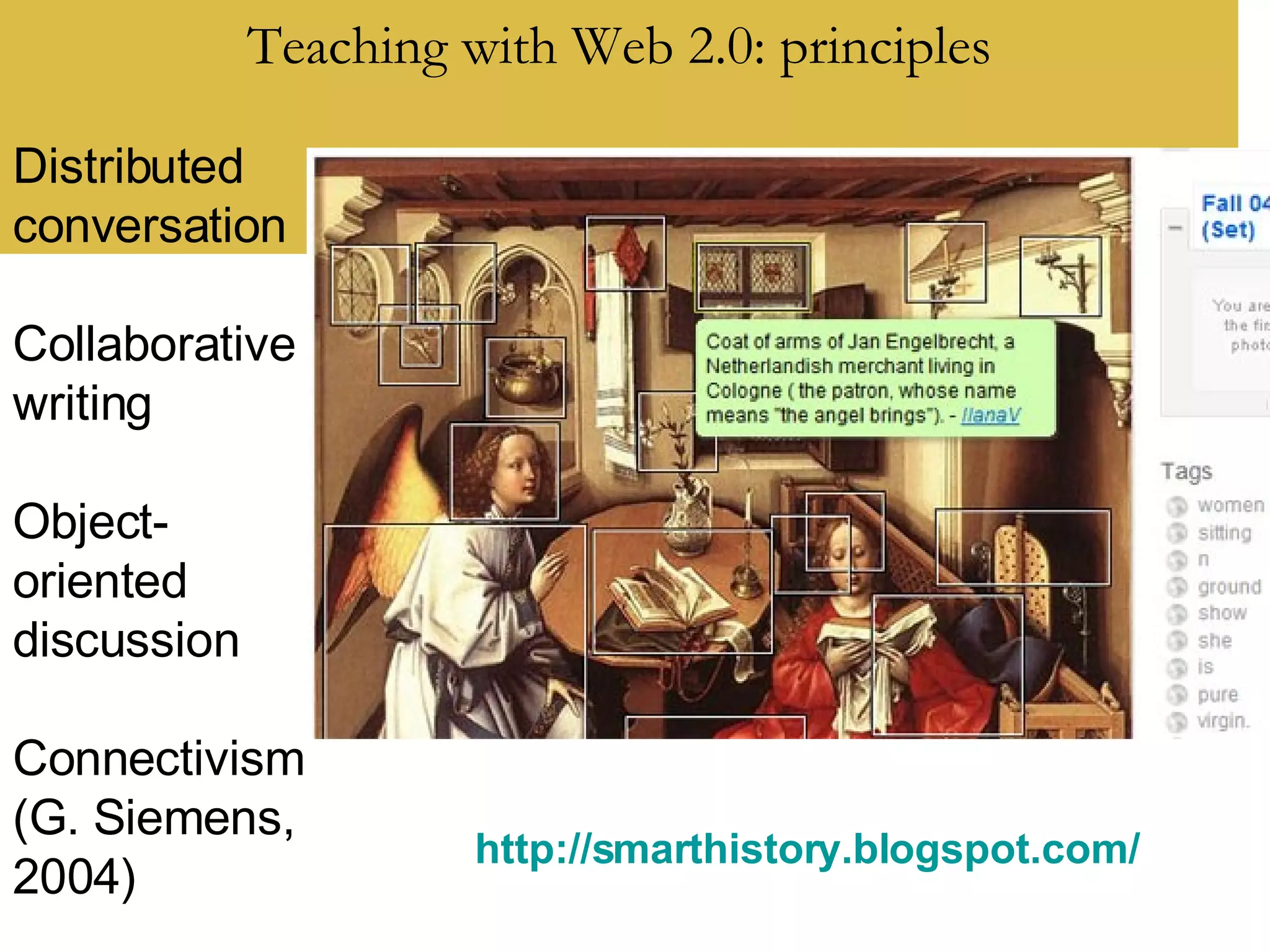
Teaching with Web 2.0: principles http://smarthistory.blogspot.com/   Distributed conversation Collaborative writing Object-oriented discussion Connectivism (G. Siemens, 2004)
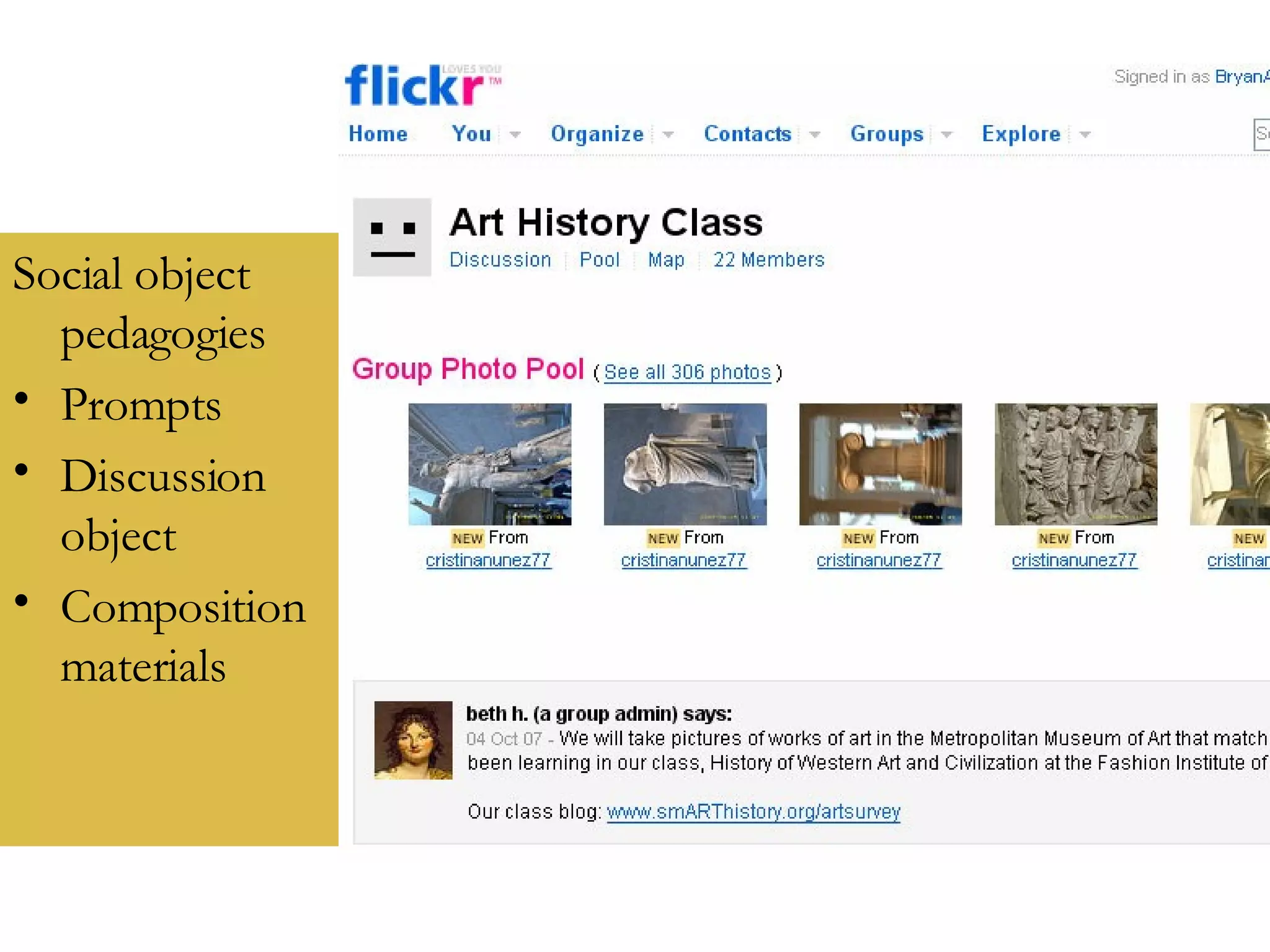
Social object pedagogies Prompts Discussion object Composition materials
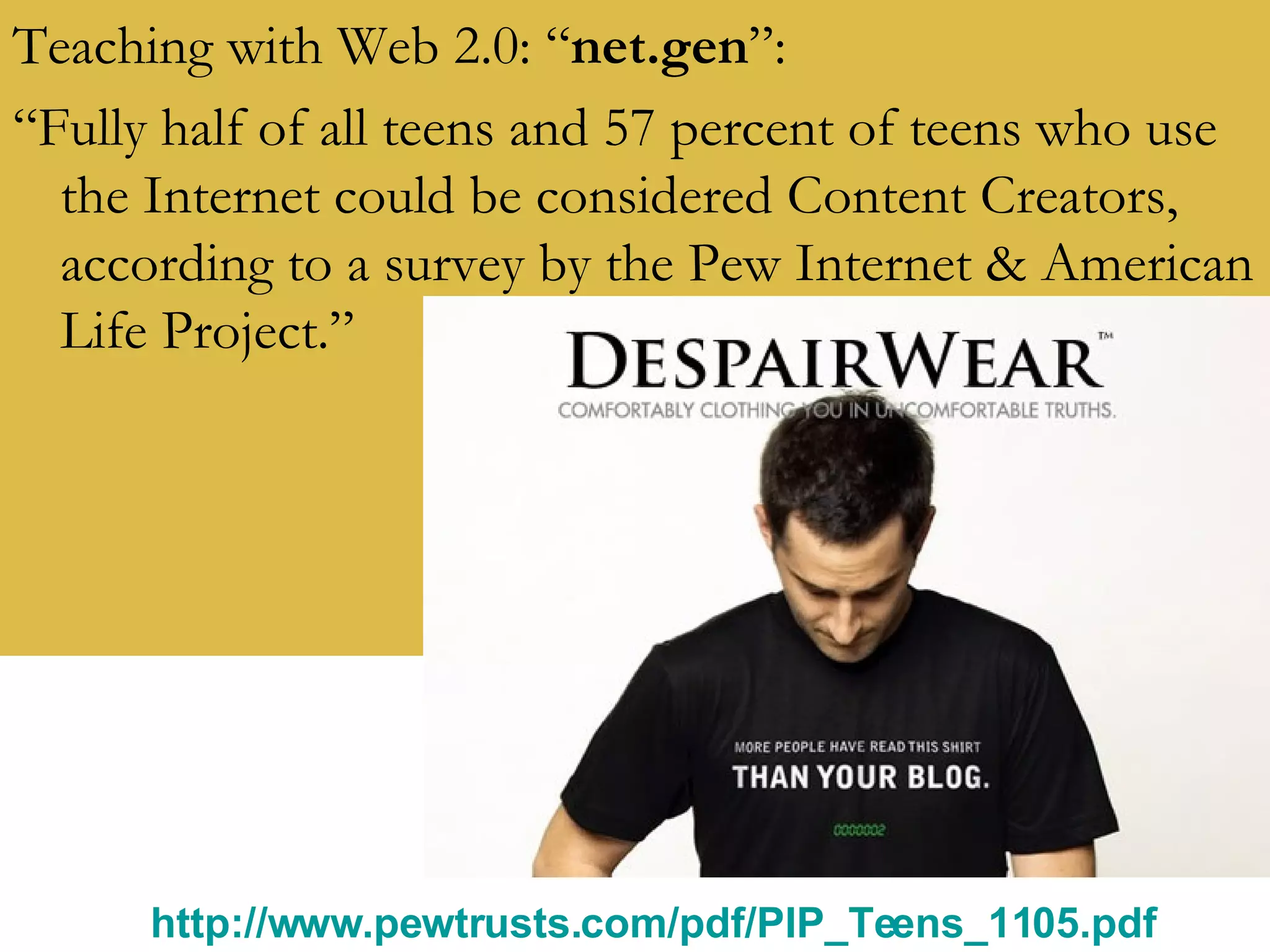
Teaching with Web 2.0: “ net.gen ”: “ Fully half of all teens and 57 percent of teens who use the Internet could be considered Content Creators, according to a survey by the Pew Internet & American Life Project.” http://www.pewtrusts.com/pdf/PIP_Teens_1105.pdf
“ [S]tudents… write words on paper, yes— but… also compose words and images and create audio files on Web logs (blogs), in word processors, with video editors and Web editors and in e-mail and on presentation software and in instant messaging and on listservs and on bulletin boards—and no doubt in whatever genre will emerge in the next ten minutes. Note that no one is making anyone do any of this writing .” Kathleen Blake Yancey, "Made Not Only in Words: Composition in a New Key."  CCC  56.2 (2004):297-328. Emphasis added.
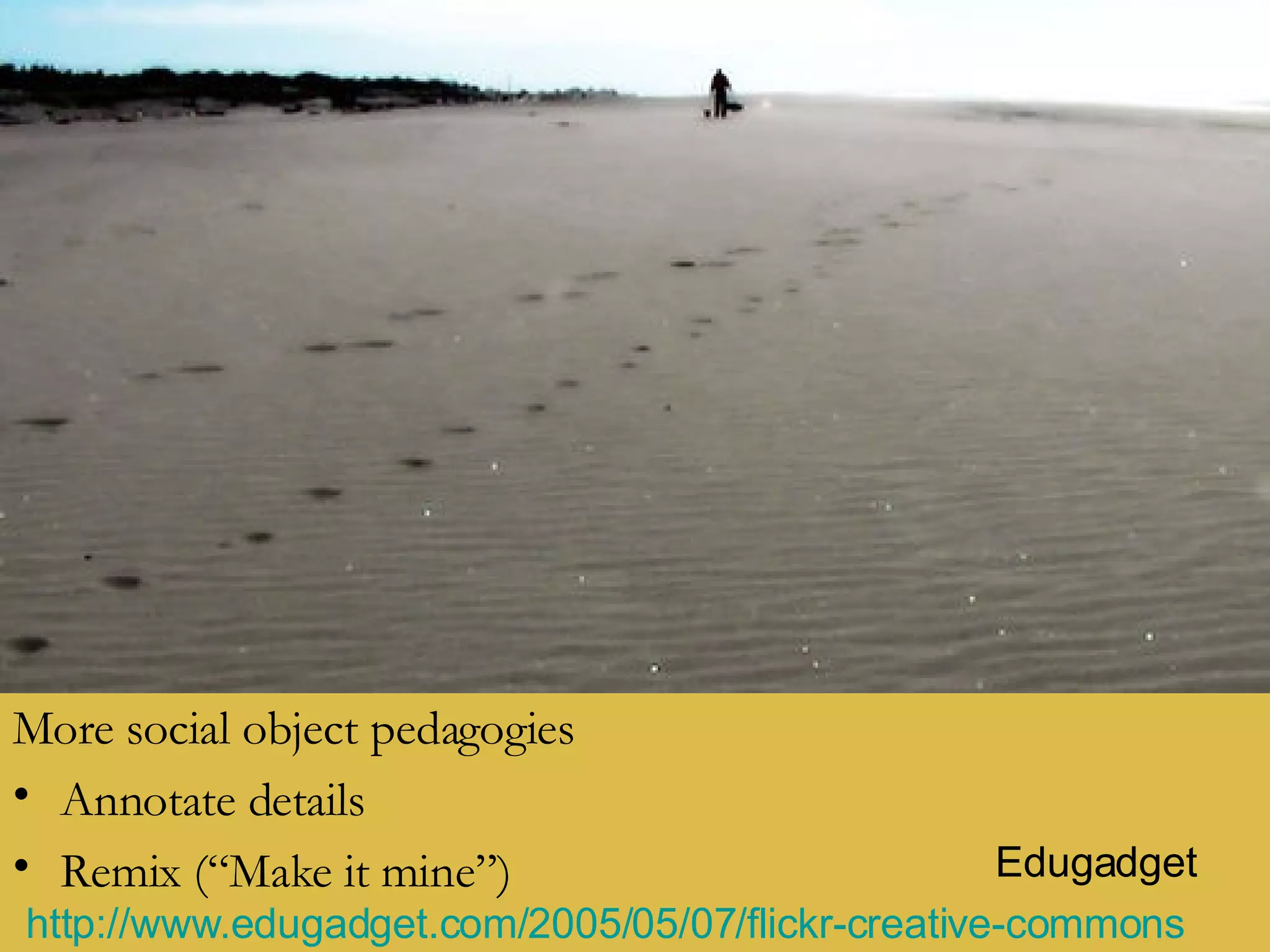
More social object pedagogies Annotate details Remix (“Make it mine”) Edugadget http://www.edugadget.com/2005/05/07/flickr-creative-commons
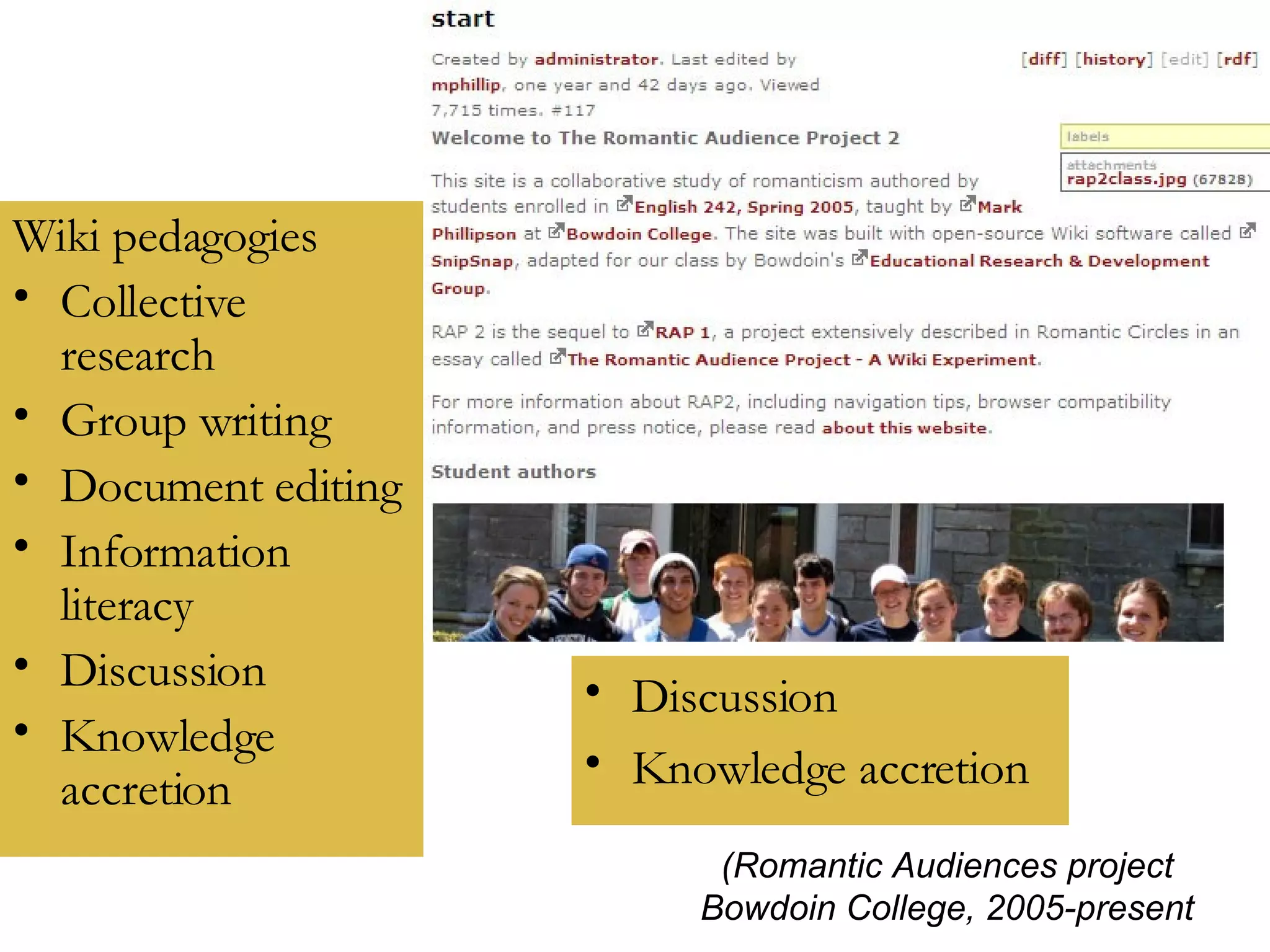
Wiki pedagogies Collective research Group writing Document editing Information literacy Discussion Knowledge accretion (Romantic Audiences project Bowdoin College, 2005-present Discussion Knowledge accretion
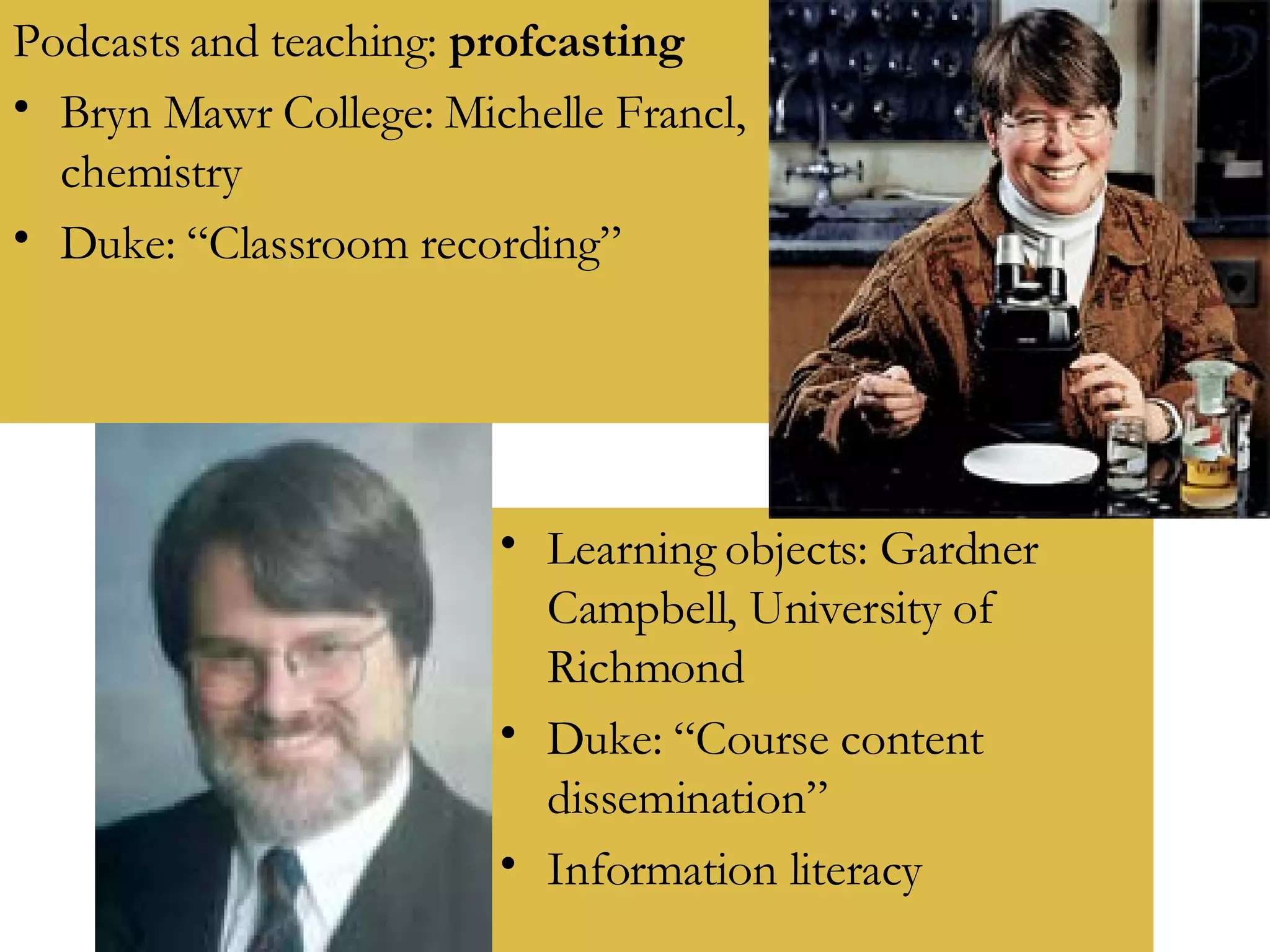
Podcasts and teaching:  profcasting Bryn Mawr College: Michelle Francl, chemistry Duke: “Classroom recording” Learning objects: Gardner Campbell, University of Richmond Duke: “Course content dissemination” Information literacy
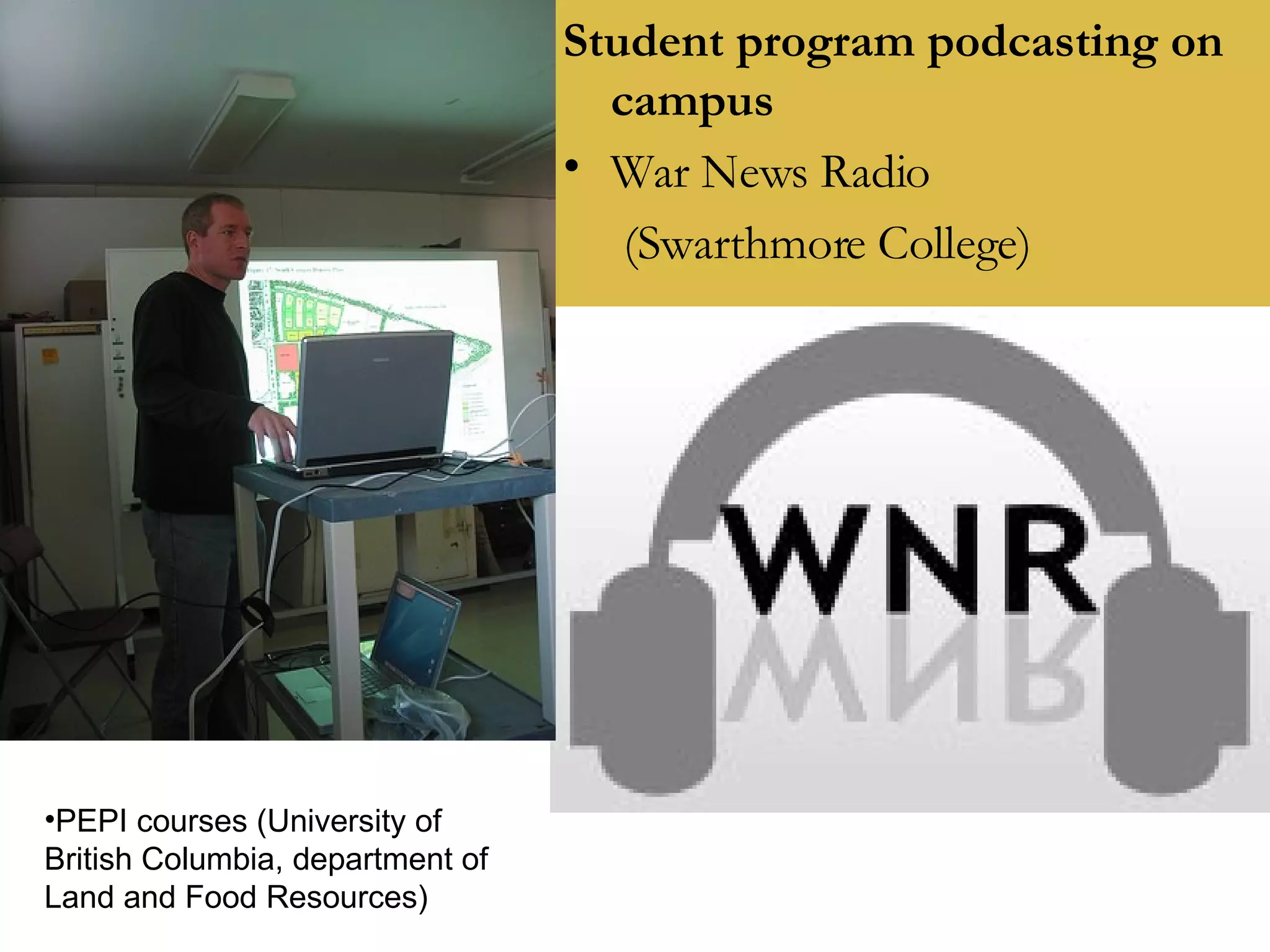
Student program podcasting on campus War News Radio  (Swarthmore College) PEPI courses (University of British Columbia, department of Land and Food Resources)
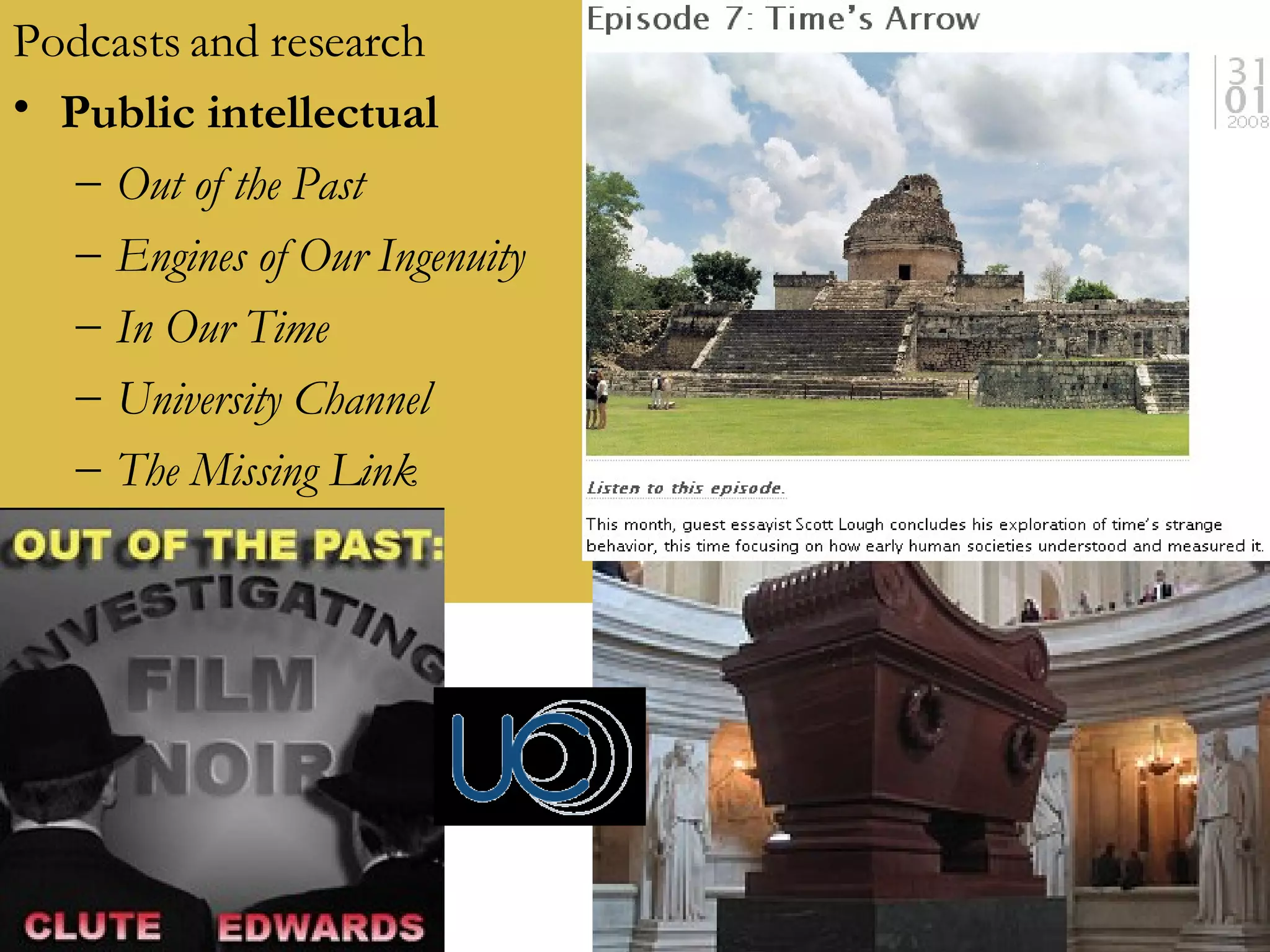
Podcasts and research Public intellectual Out of the Past Engines of Our Ingenuity  In Our Time University Channel The Missing Link
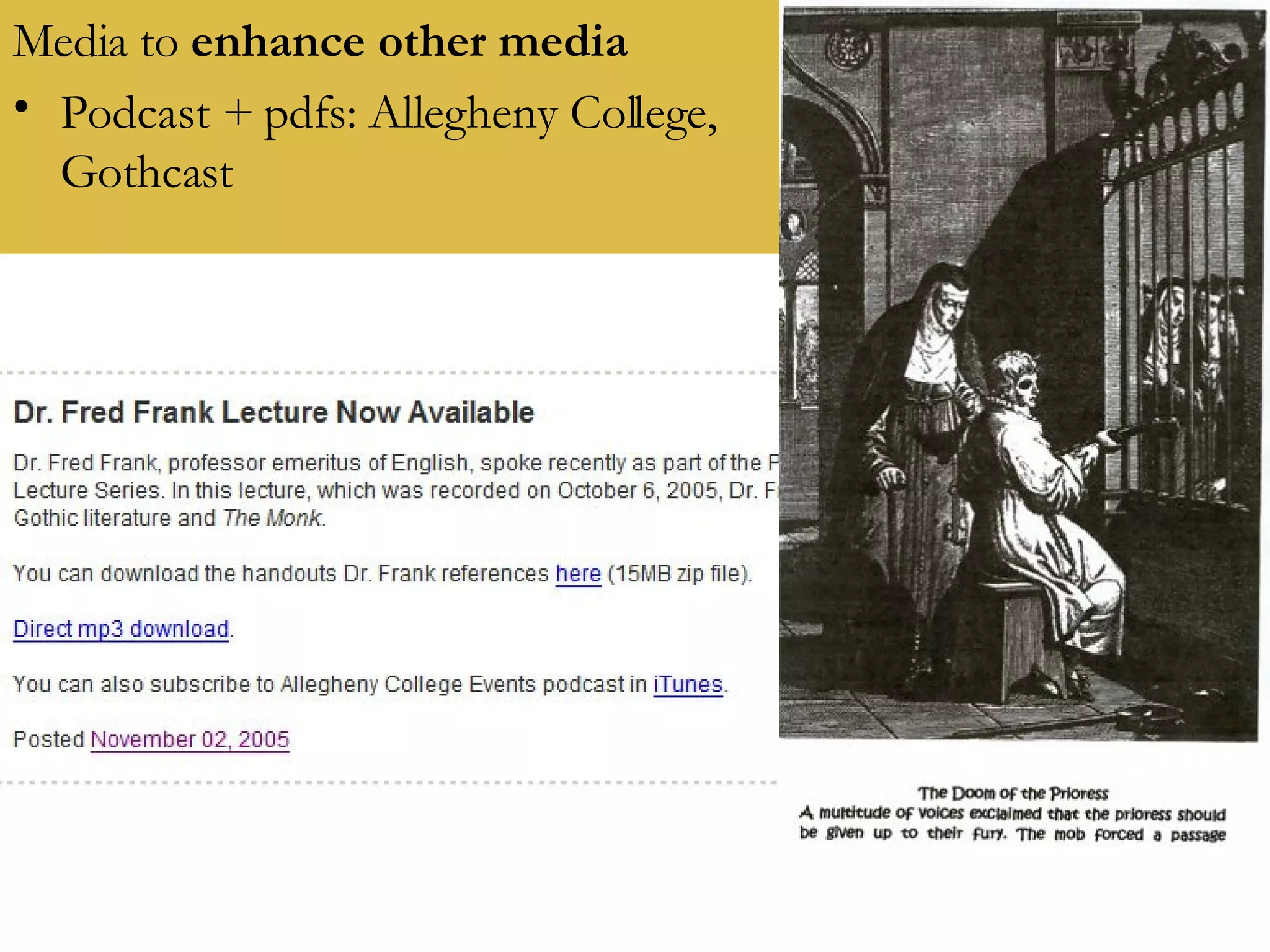
Media to  enhance other media Podcast + pdfs: Allegheny College, Gothcast
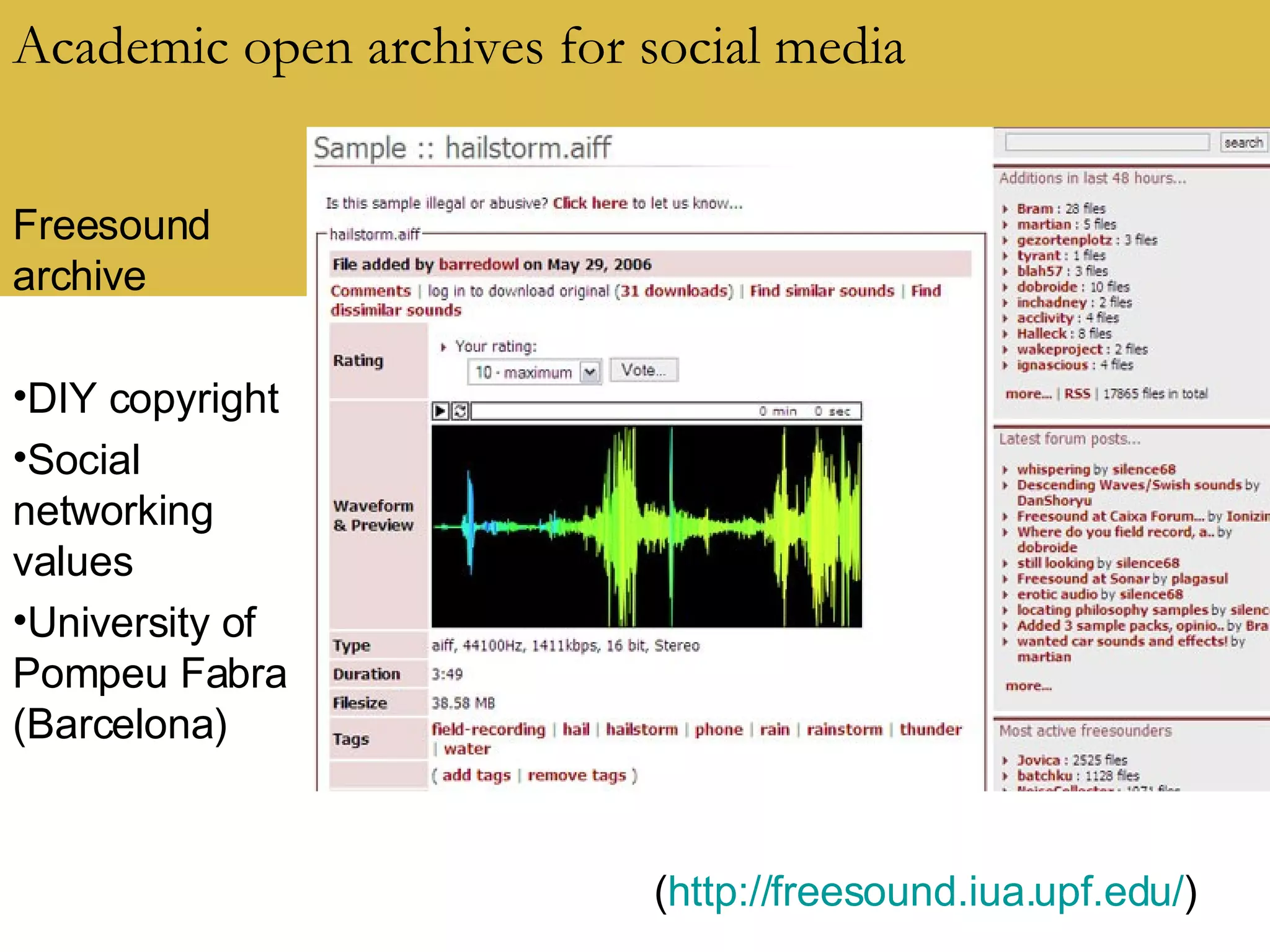
Academic open archives for social media Freesound archive DIY copyright Social networking values University of Pompeu Fabra (Barcelona) ( http://freesound.iua.upf.edu/ )
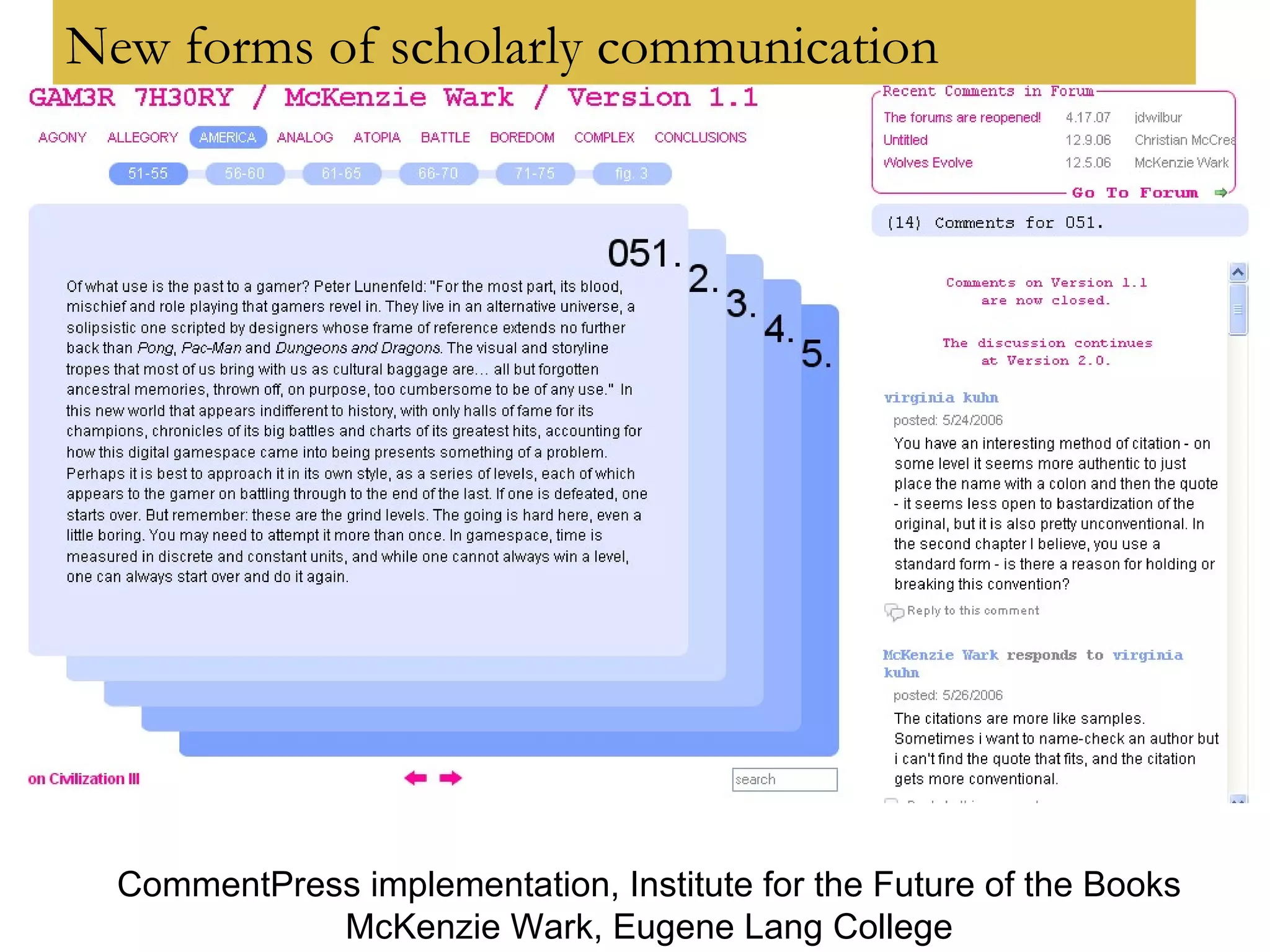
New forms of scholarly communication CommentPress implementation, Institute for the Future of the Books McKenzie Wark, Eugene Lang College
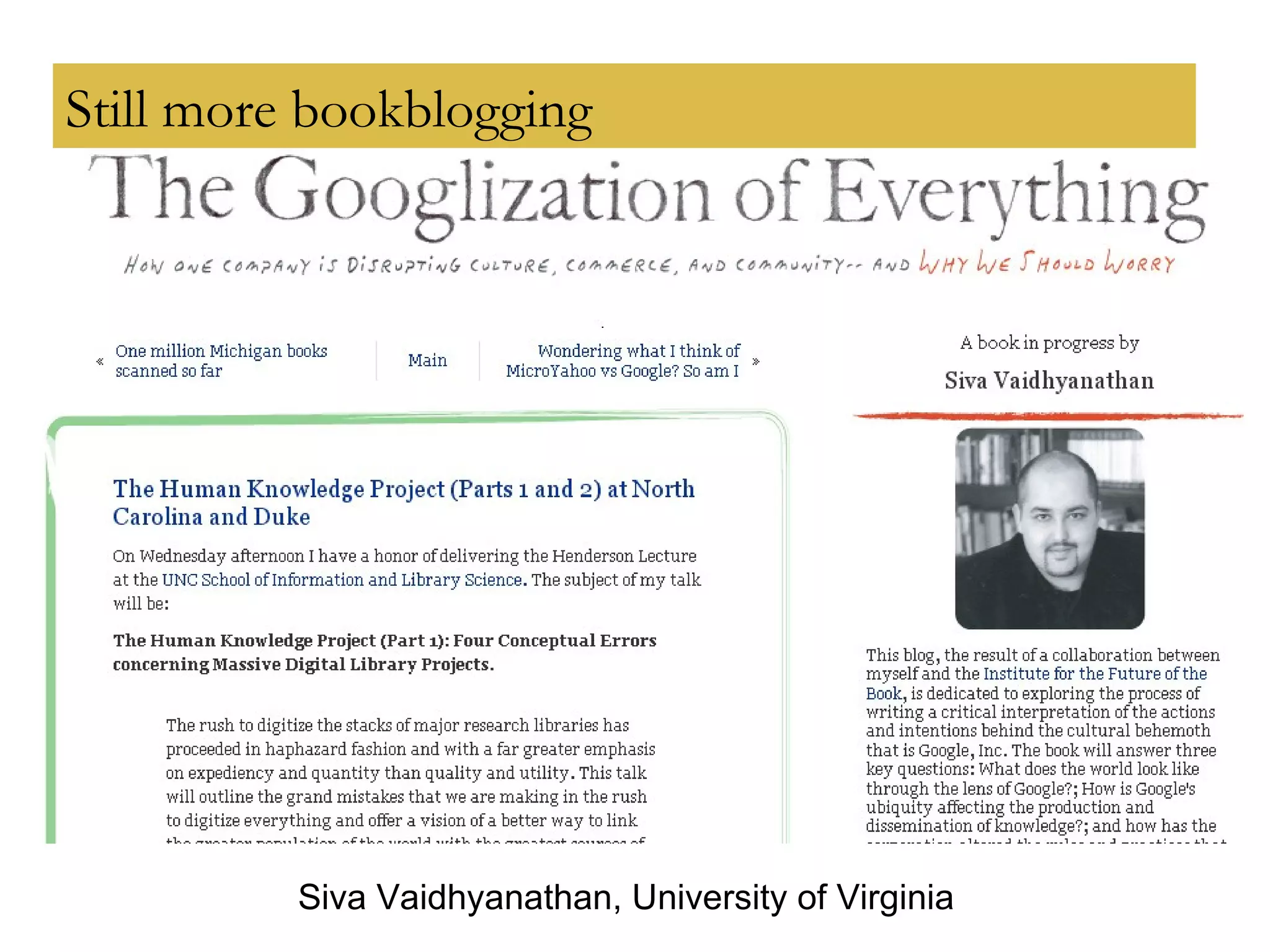
Still more bookblogging Siva Vaidhyanathan, University of Virginia
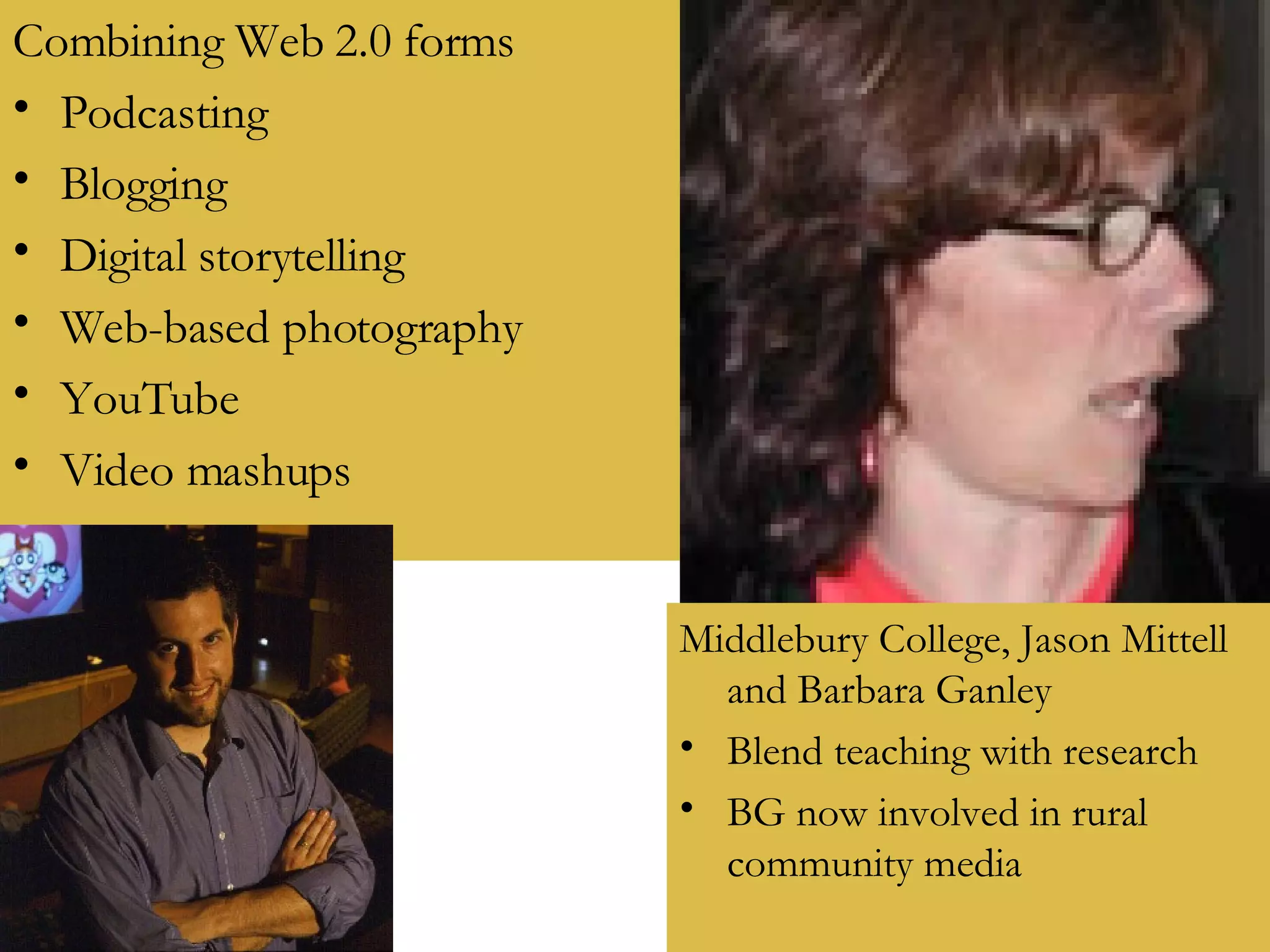
Combining Web 2.0 forms Podcasting Blogging Digital storytelling Web-based photography YouTube Video mashups Middlebury College, Jason Mittell and Barbara Ganley Blend teaching with research BG now involved in rural community media
II. Gaming Long history of gaming Predigital Chess, go, Senet, mancala, backgammon, dice, cards Kriegspiel Cold War games Digital Spacewar Zork to IF boom (1980s) 1990s rebirth
Gaming in 2008 Physical platforms Console Cell phone PSP Extended forms (DDR) New forms: Wii PC CD, DVD Browser Downloadable  … And these can be combined
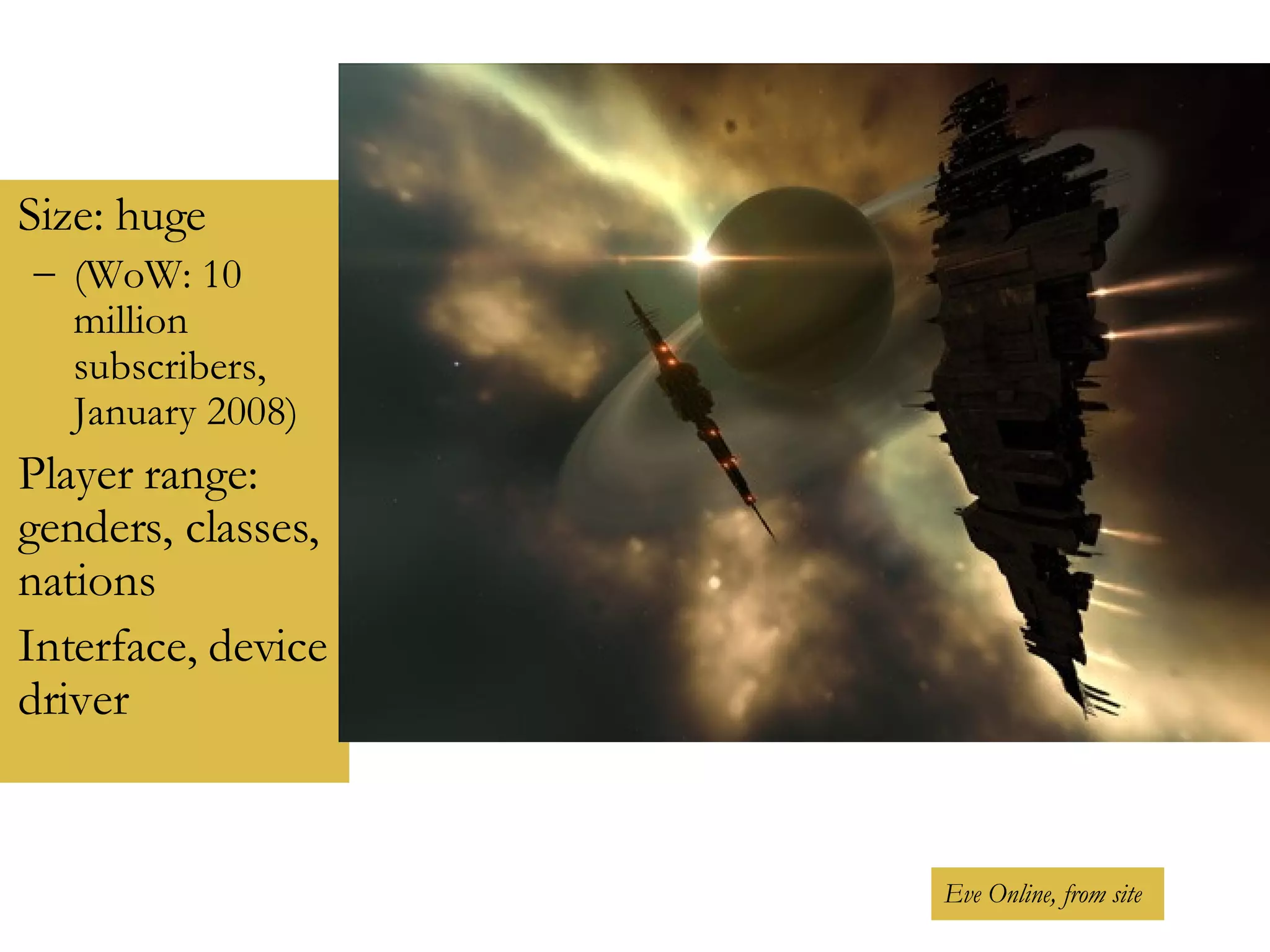
Size: huge  (WoW: 10 million subscribers,  January 2008) Player range: genders, classes, nations Interface, device driver Eve Online, from site
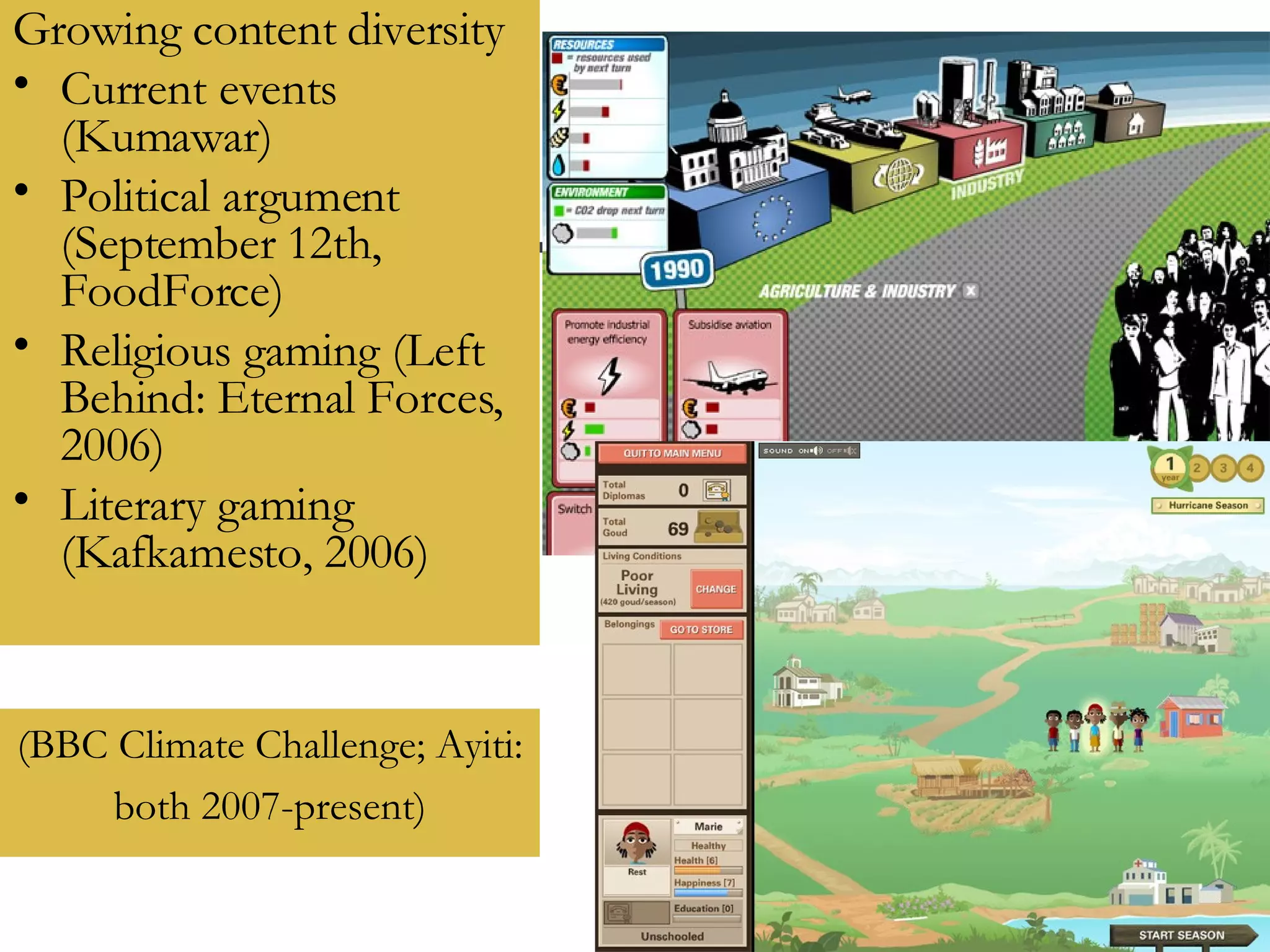
Growing content diversity Current events (Kumawar) Political argument (September 12th, FoodForce) Religious gaming (Left Behind: Eternal Forces, 2006) Literary gaming (Kafkamesto, 2006)  (BBC Climate Challenge; Ayiti:  both 2007-present)
Genres First-person shooter Puzzle  Platform jumper Strategy “ Adventure” Sports  Minigame (Koster fractals) New forms Katamari Portal Augmented reality games
Economics of games Who creates games? Businesses Governments Nonprofits Amateurs  Scales Large games $millions EA, Microsoft Modding Back to Doom, hacking, View Source Neverwinter Nights Casual games Other economics Gambling Gold farming Currency trading
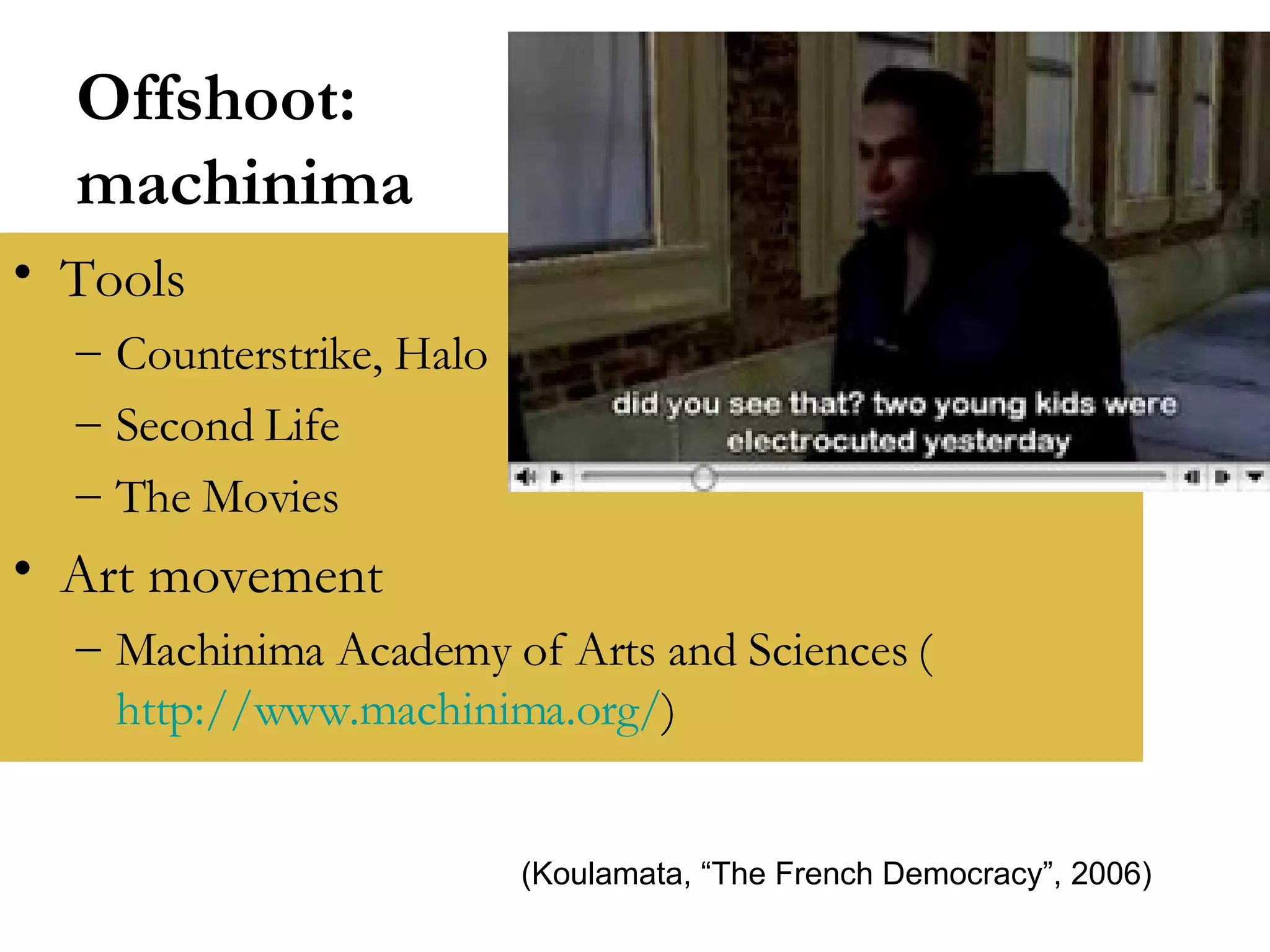
Offshoot: machinima Tools Counterstrike, Halo Second Life The Movies  Art movement Machinima Academy of Arts and Sciences ( http://www.machinima.org/ )  (Koulamata, “The French Democracy”, 2006)
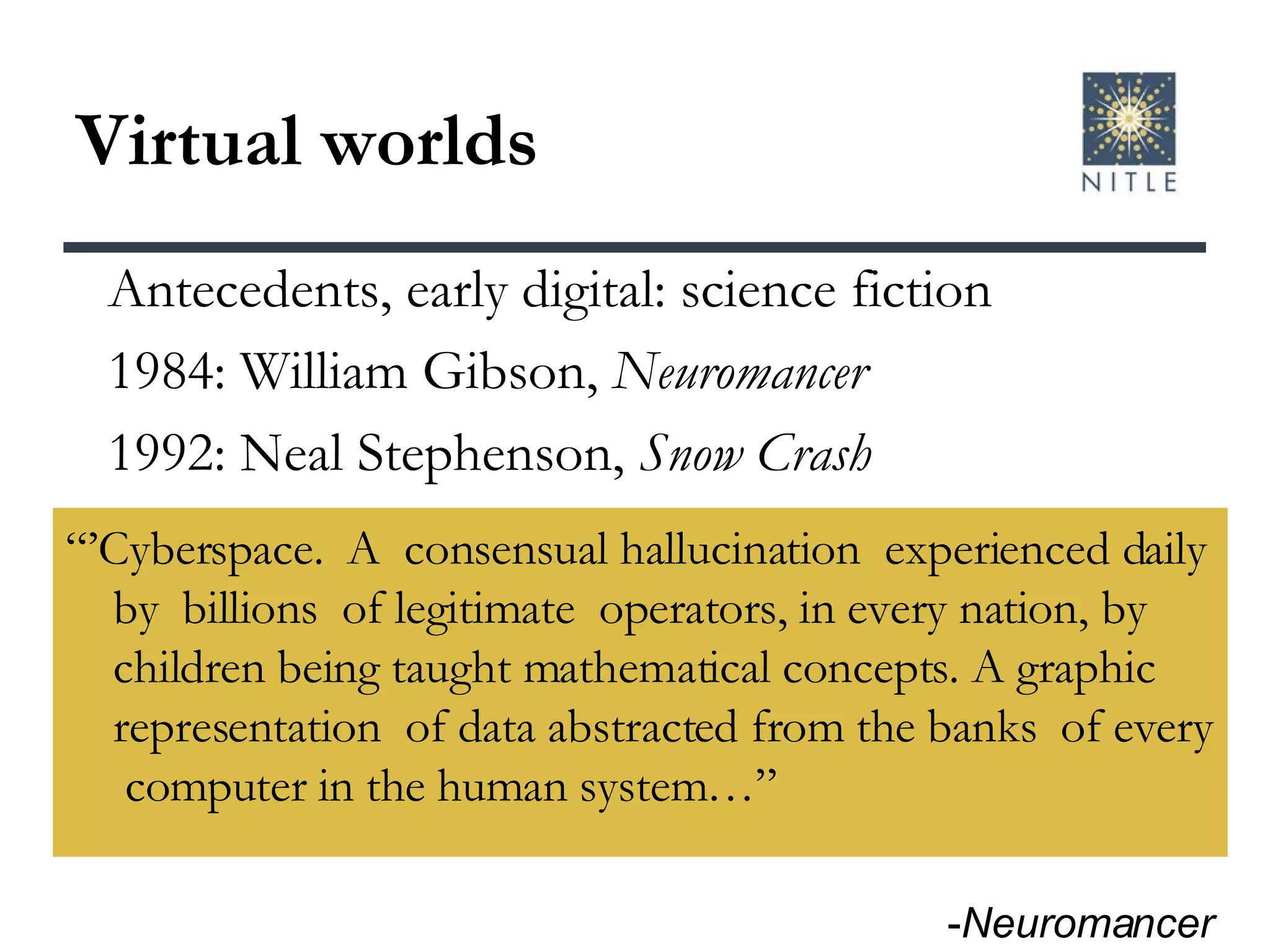
Virtual worlds “’ Cyberspace.  A  consensual hallucination  experienced daily by  billions  of legitimate  operators, in every nation, by children being taught mathematical concepts. A graphic representation  of data abstracted from the banks  of every  computer in the human system…” Antecedents, early digital: science fiction 1984: William Gibson,  Neuromancer 1992: Neal Stephenson,  Snow Crash - Neuromancer
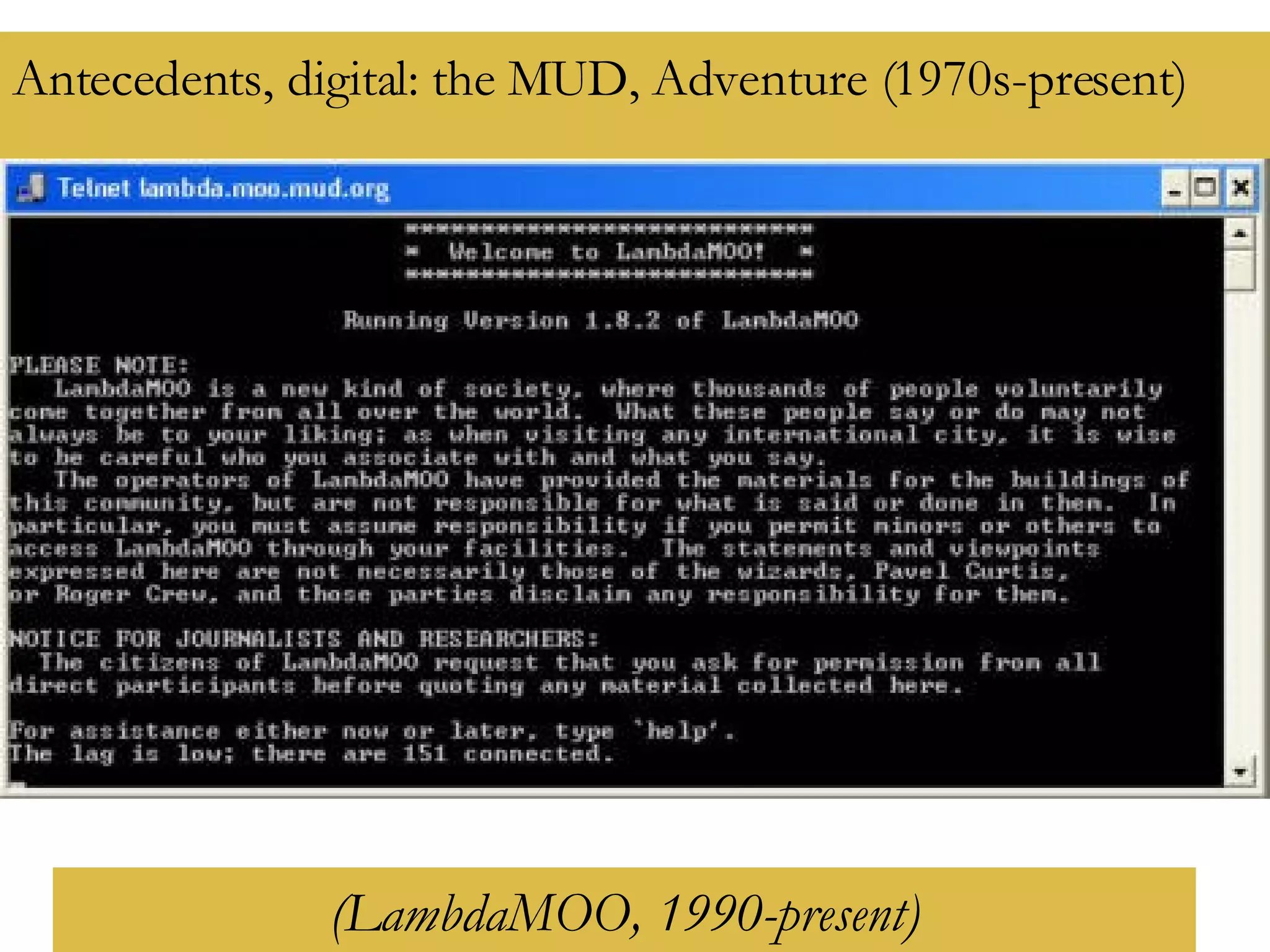
Antecedents, digital: the MUD, Adventure (1970s-present)   (LambdaMOO, 1990-present)
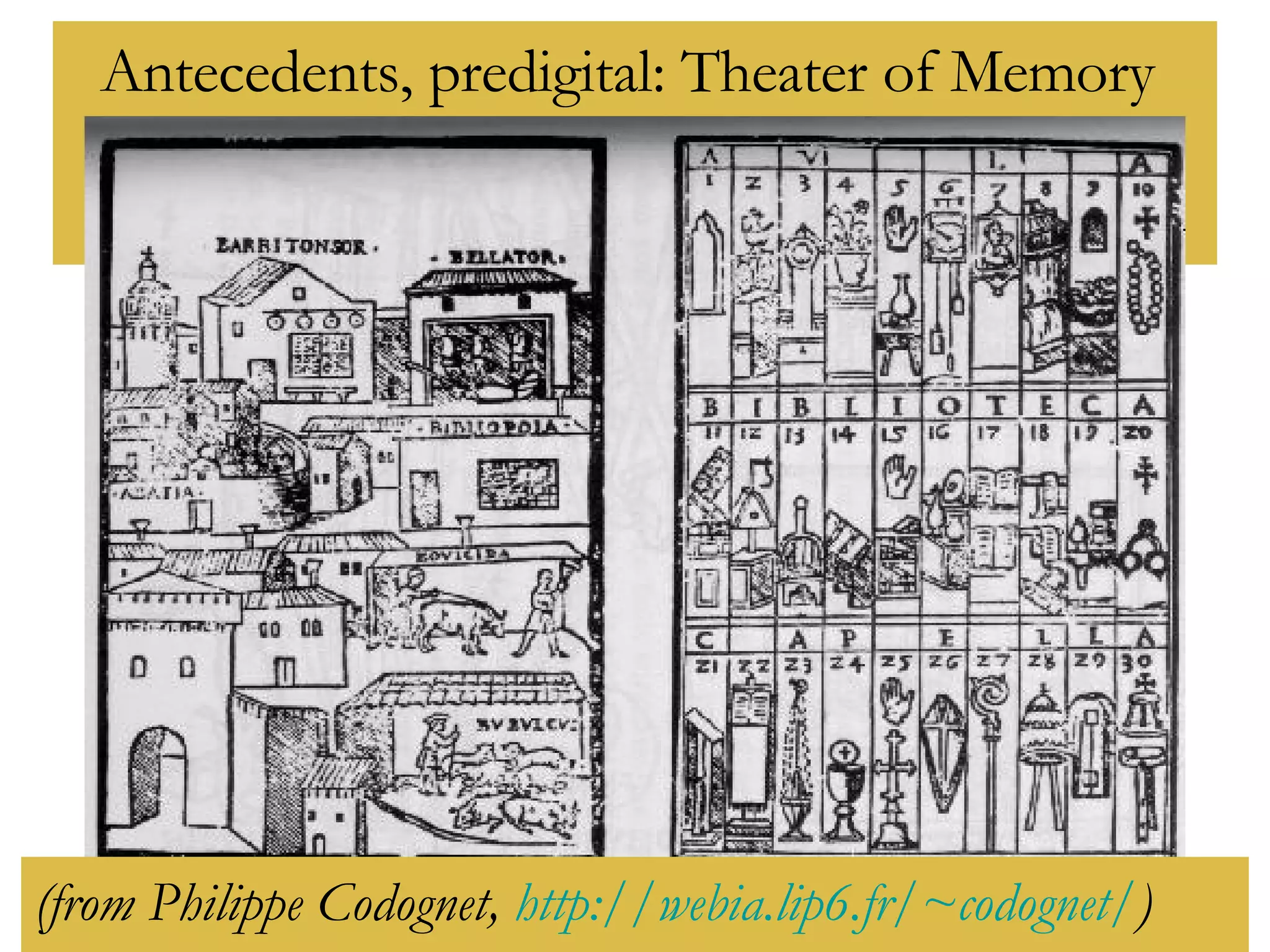
Antecedents, predigital: Theater of Memory  (from Philippe Codognet,  http://webia.lip6.fr/~codognet/ )
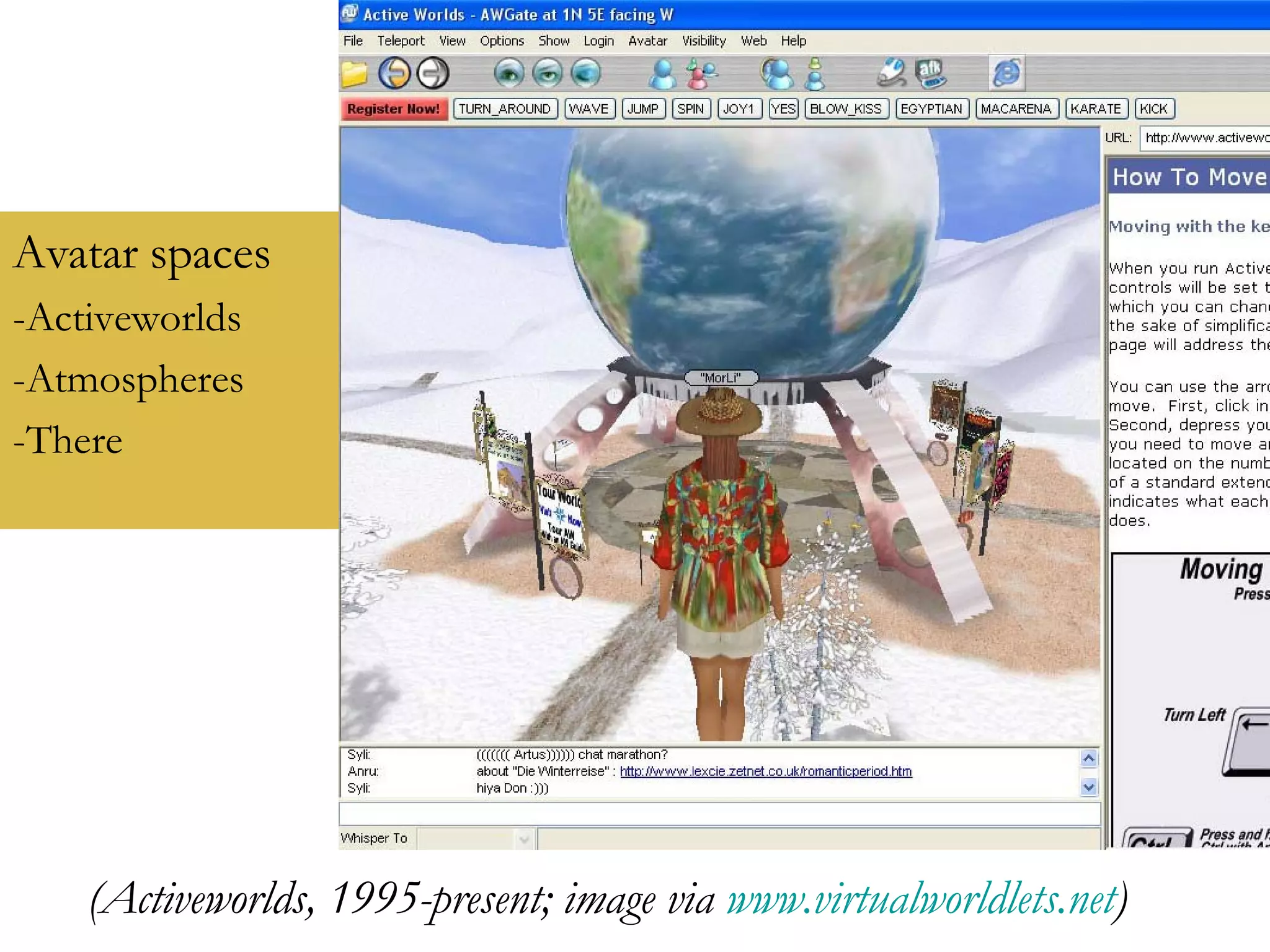
Avatar spaces -Activeworlds -Atmospheres -There (Activeworlds, 1995-present; image via  www.virtualworldlets.net )
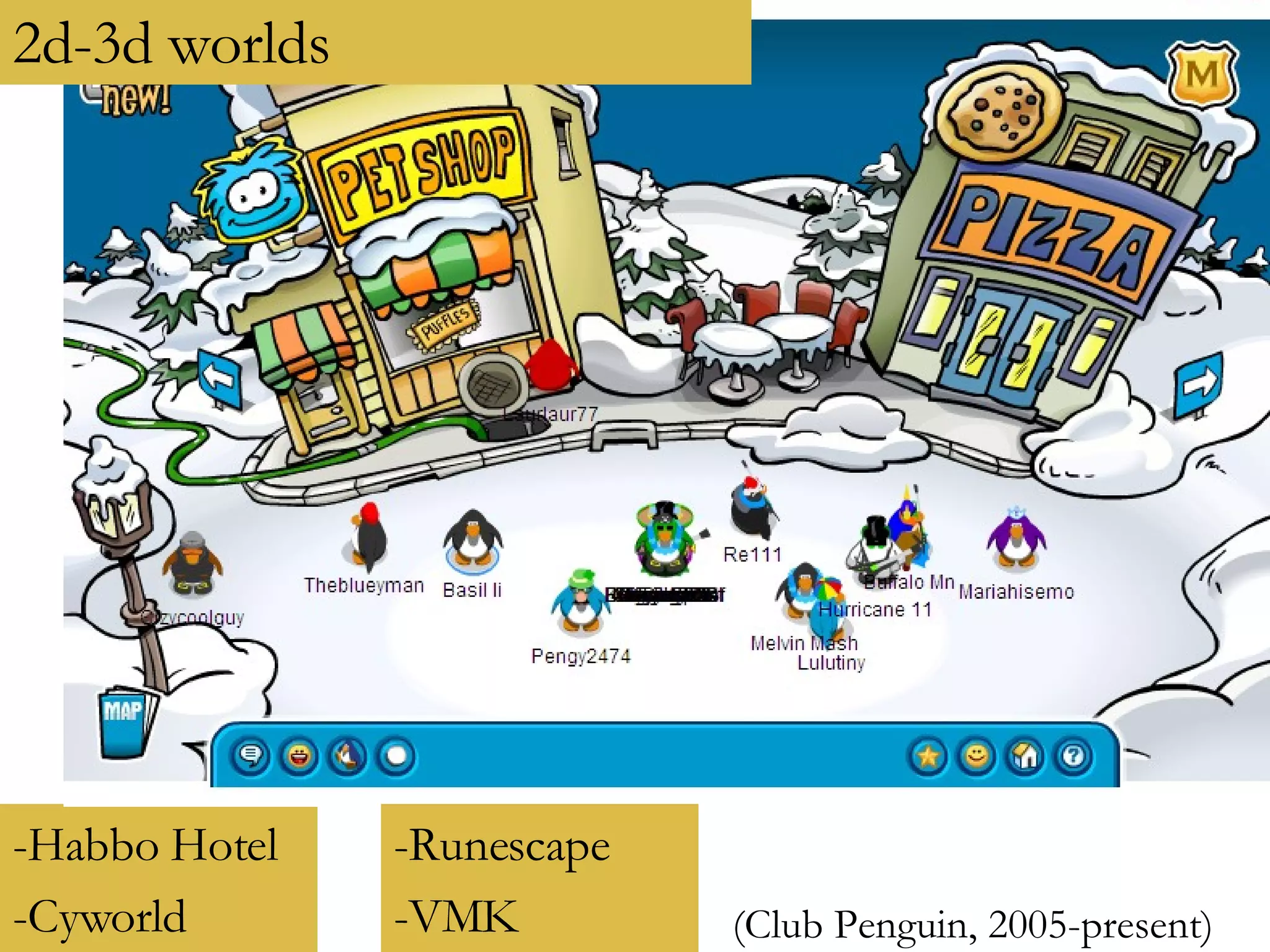
-Habbo Hotel -Cyworld (Club Penguin, 2005-present) 2d-3d worlds   -Runescape -VMK
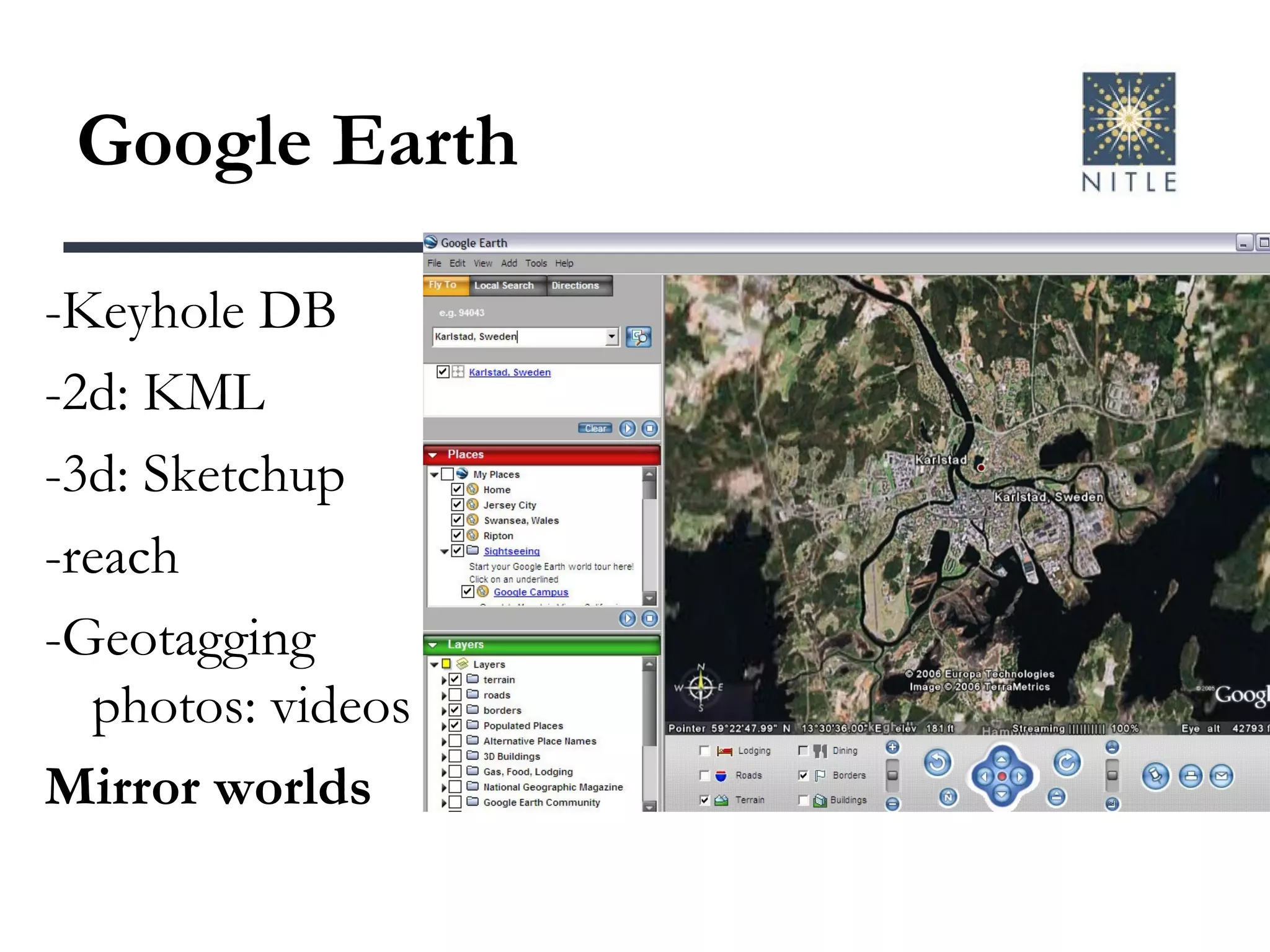
Google Earth -Keyhole DB -2d: KML -3d: Sketchup -reach -Geotagging photos: videos Mirror worlds
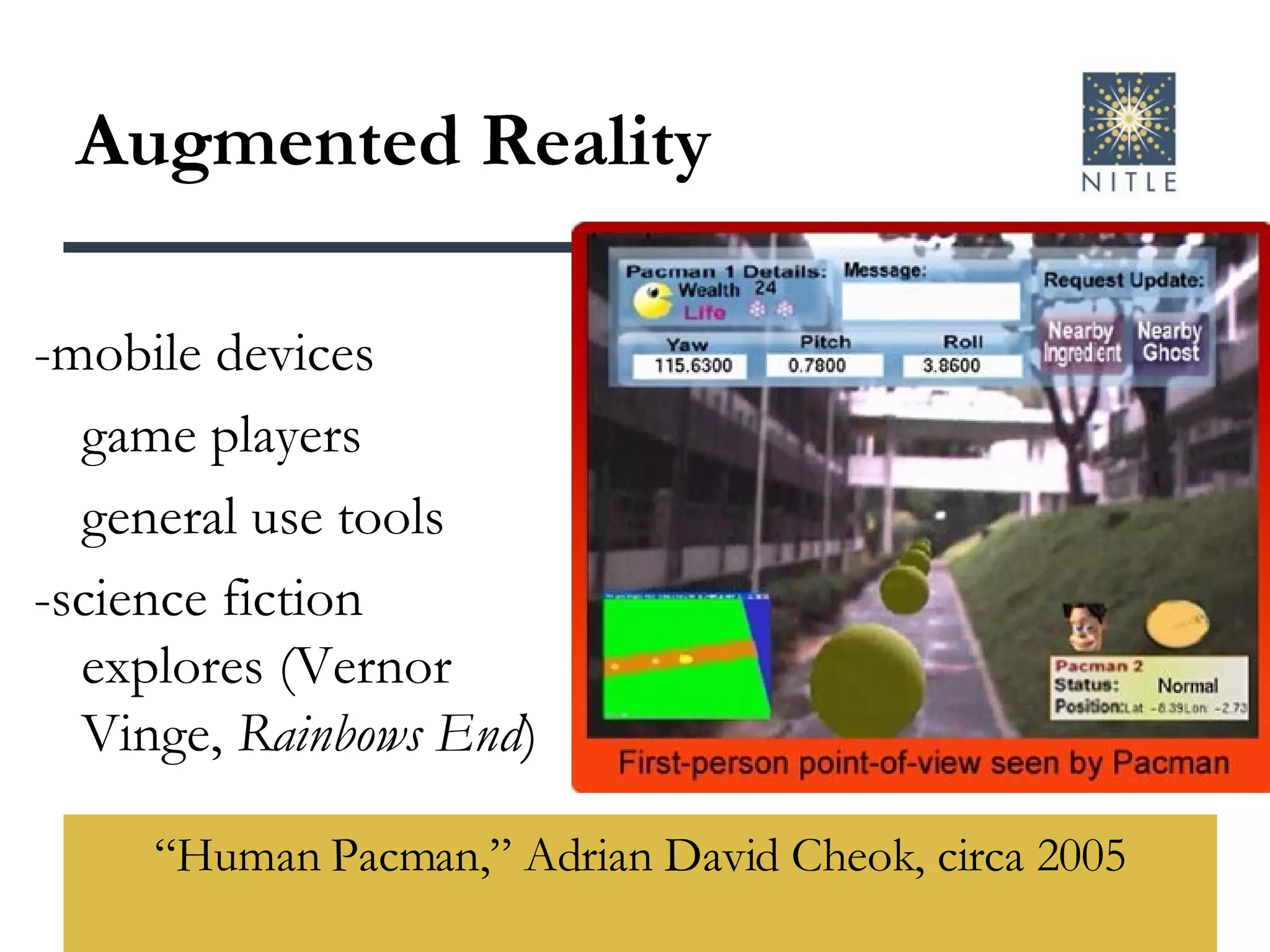
Augmented Reality “ Human Pacman,” Adrian David Cheok, circa 2005 -mobile devices game players general use tools -science fiction explores (Vernor Vinge,  Rainbows End )
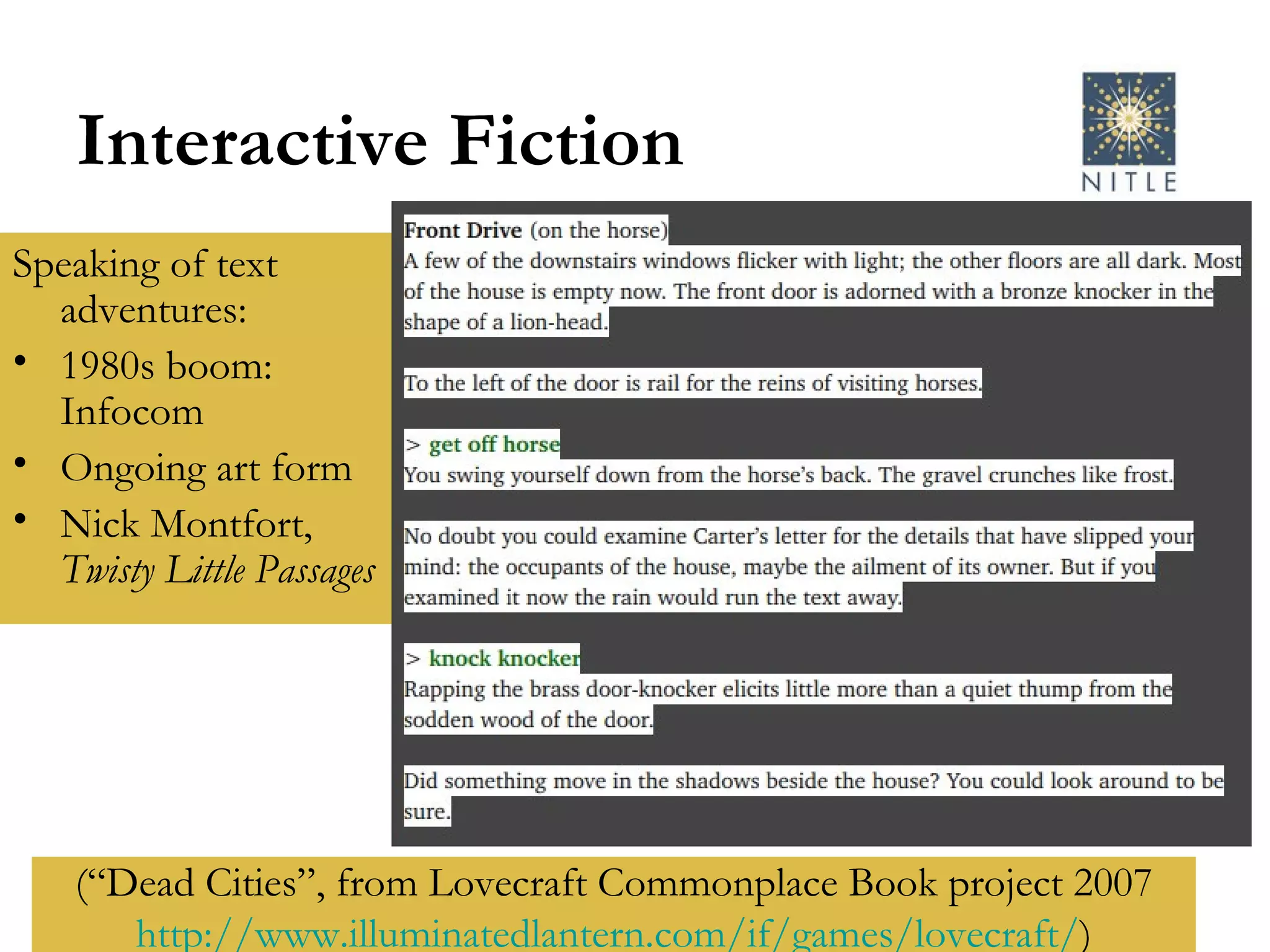
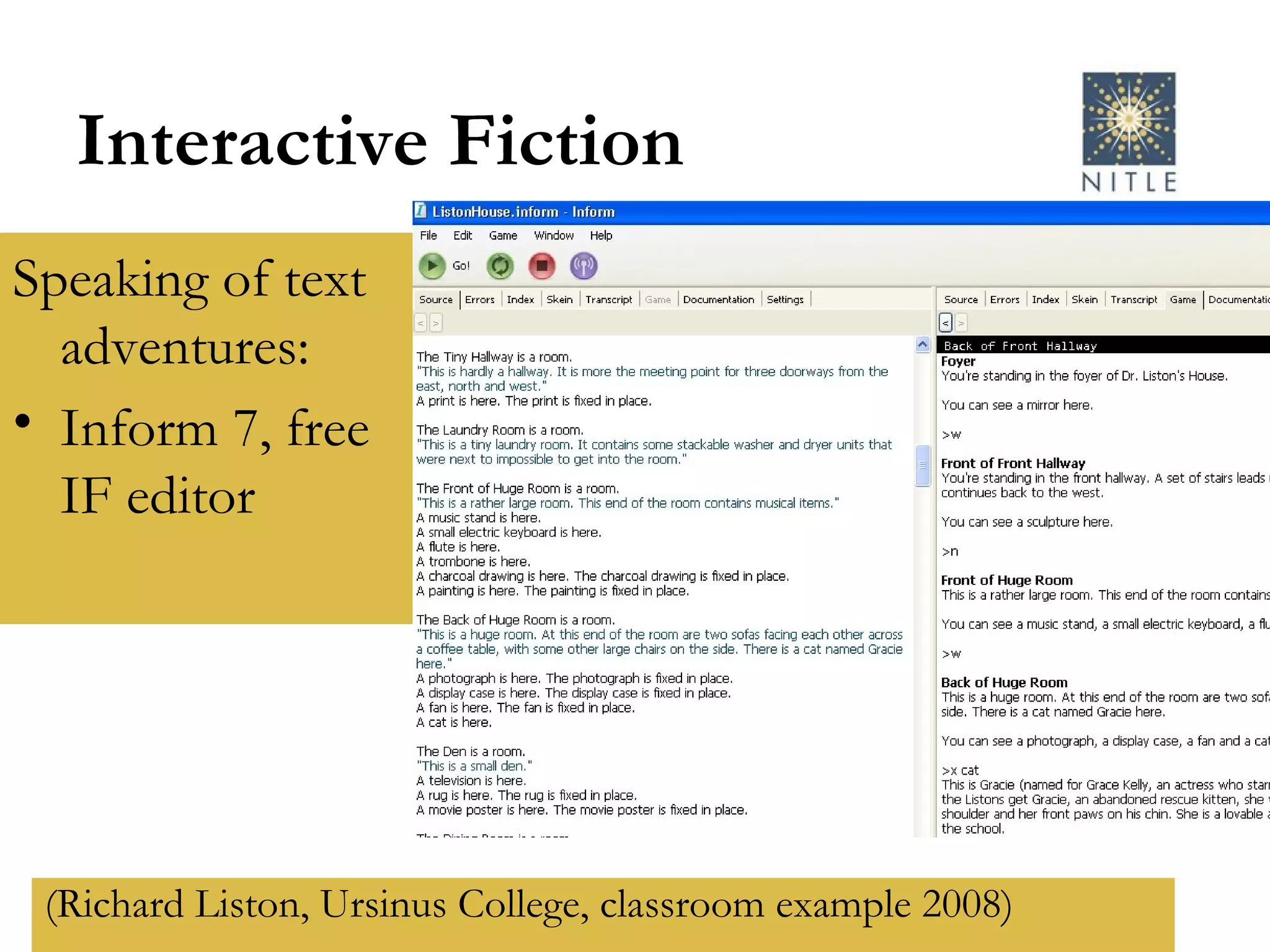
Interactive Fiction Speaking of text adventures: 1980s boom: Infocom Ongoing art form Nick Montfort,  Twisty Little Passages (“Dead Cities”, from Lovecraft Commonplace Book project 2007 http:// www.illuminatedlantern.com/if/games/lovecraft / )
Interactive Fiction Speaking of text adventures: Inform 7, free IF editor (Richard Liston, Ursinus College, classroom example 2008)
Narrative Where is storytelling in a game? Sequence of activities Cut-scene or cinematic Writerly player Encyclopedia world (Murray, Manovich) Ludology vs. narratology Linearity? Game on rails Branching outcomes Multilinear Open-ended
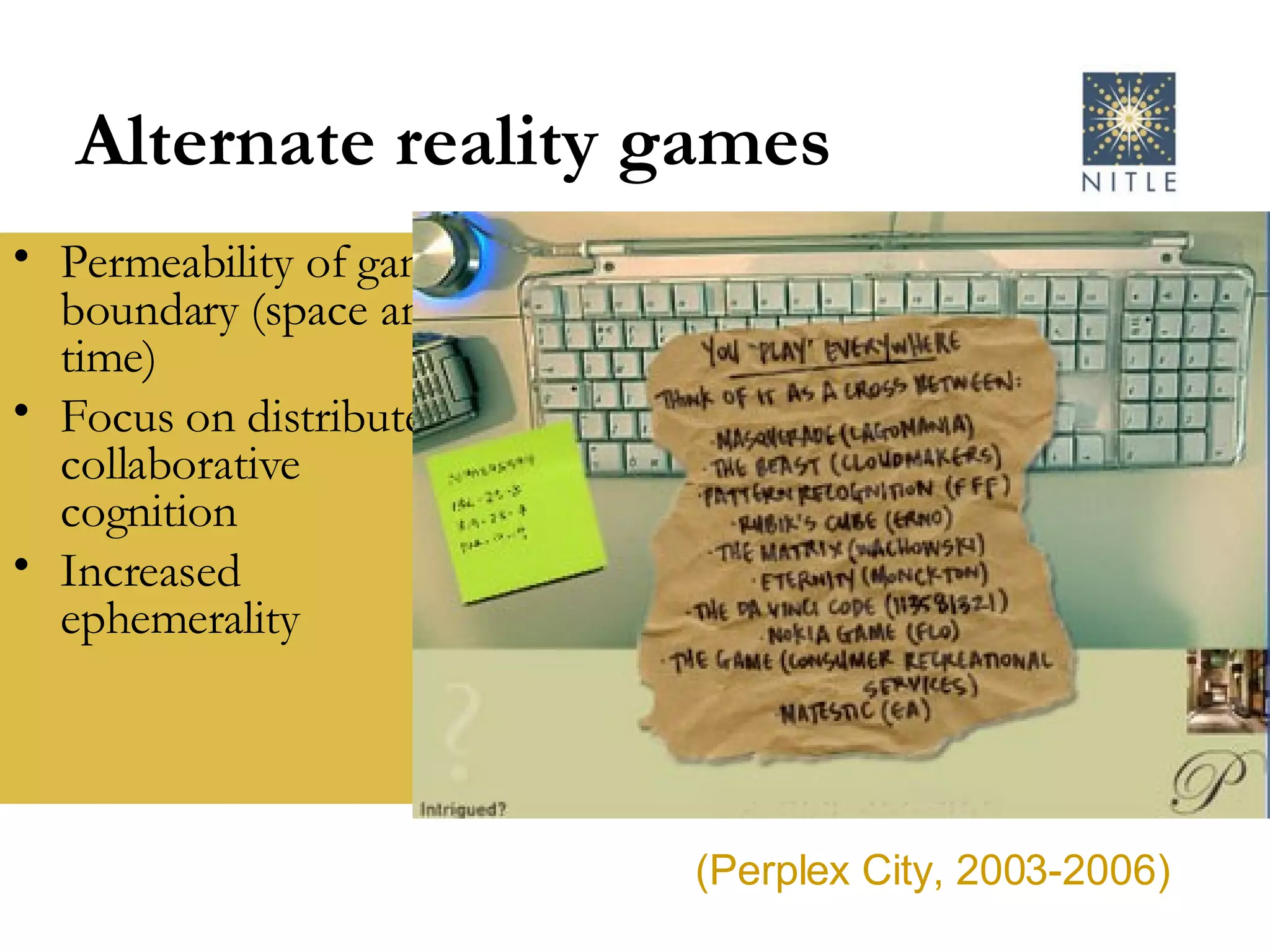
Alternate reality games Permeability of game boundary (space and time) Focus on distributed, collaborative cognition Increased ephemerality  (Perplex City, 2003-2006)
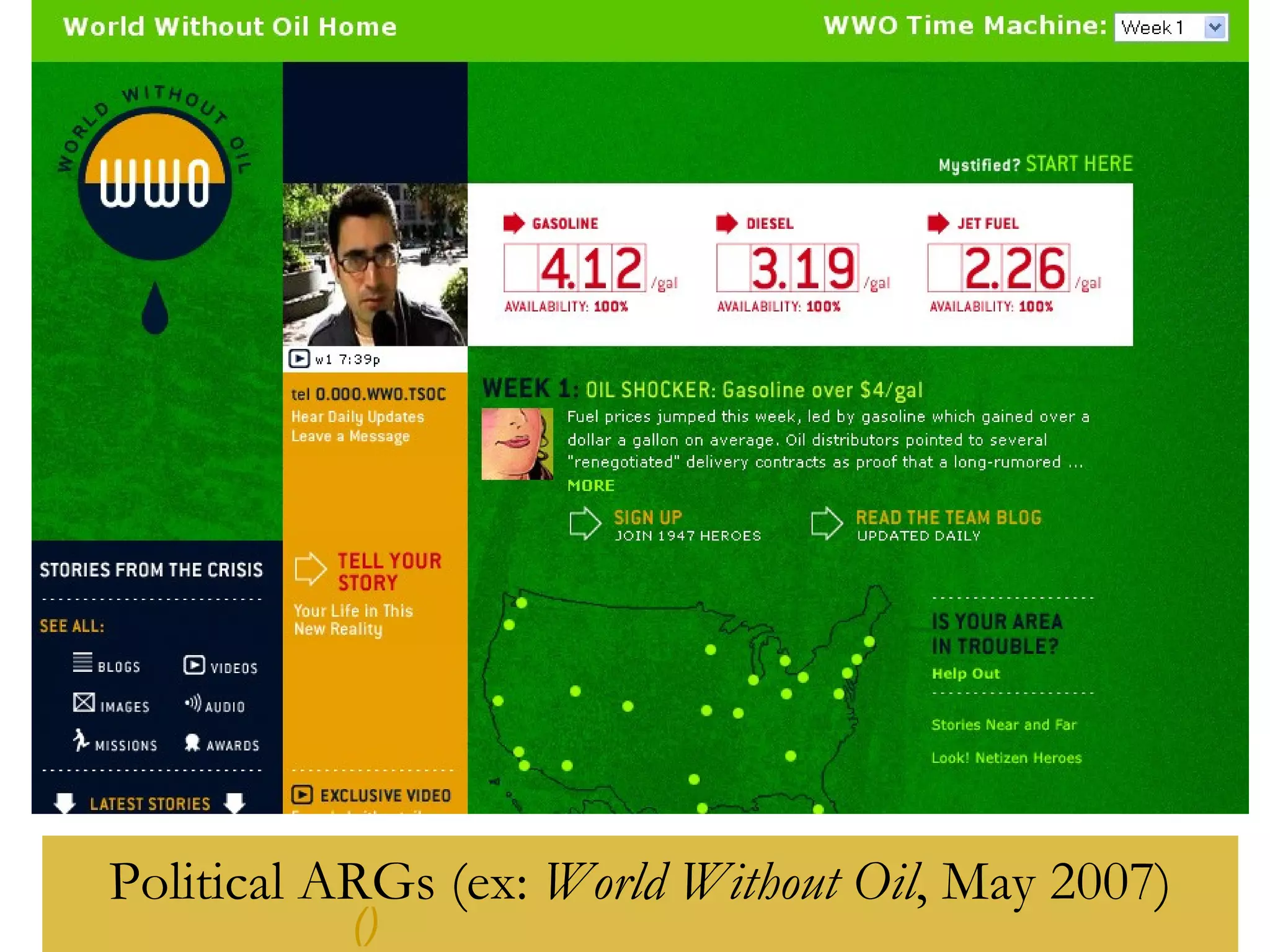
Political ARGs (ex:  World Without Oil , May 2007) ()
Gaming and education “Video games… situate meaning in a multimodal space through embodied experiences to solve problems and reflect on the intricacies of the design of imagined worlds and the design of both real and imagined social relationships and identities in the modern world.”
21-century boom James Paul Gee (author of preceding quote) Marc Presnsky Henry Jenkins John Seely Brown Mia Consalvo Constance Steinkuehler Kurt Squire
James Paul Gee’s argument Semiotic domains; tranference Embodied action and feedback Projective identity Edging the regime of competence (Vygotsky) Probe-reprobe cycle Social learning (roles; consumption-production)
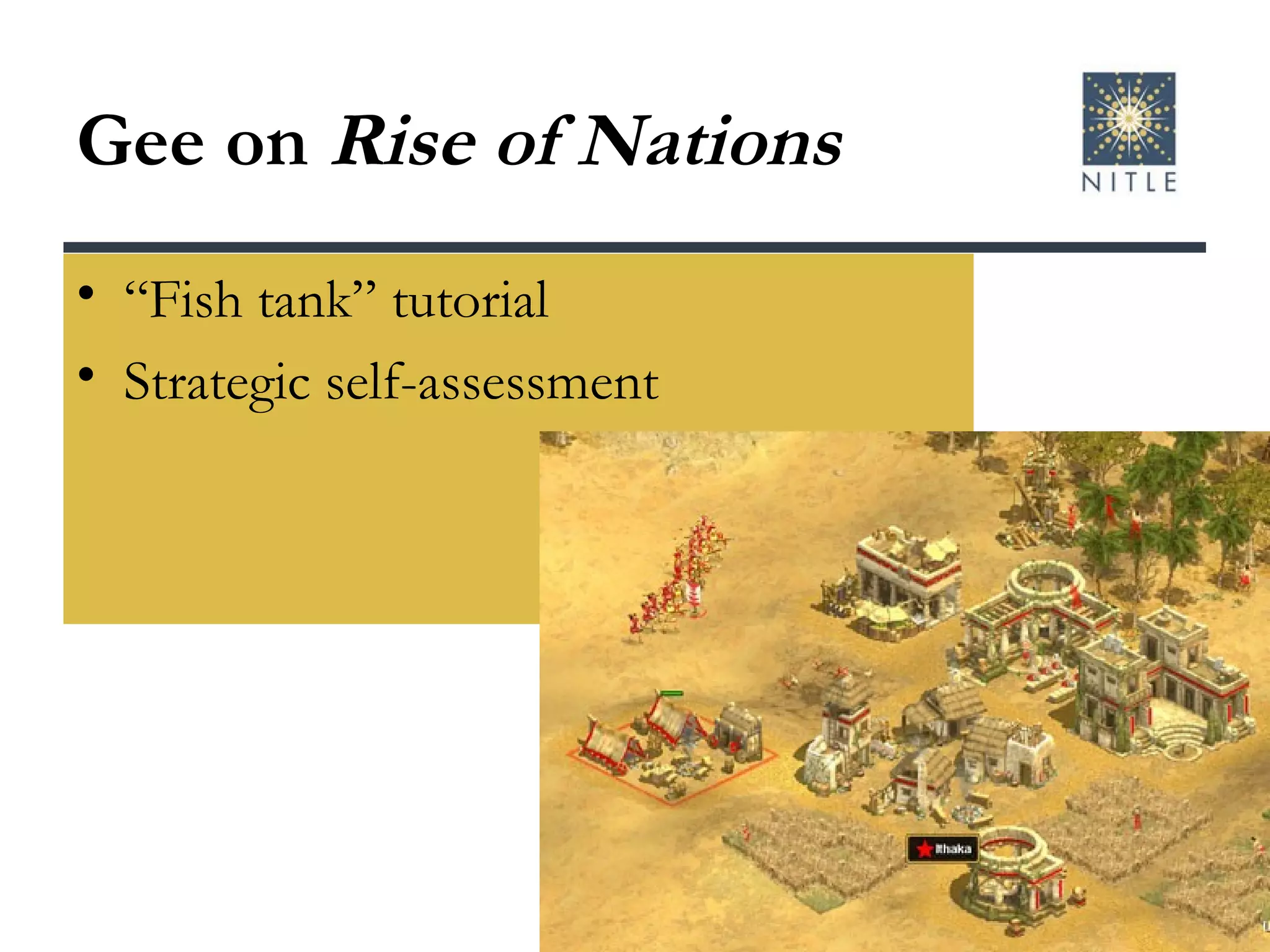
Gee on  Rise of Nations “Fish tank” tutorial Strategic self-assessment
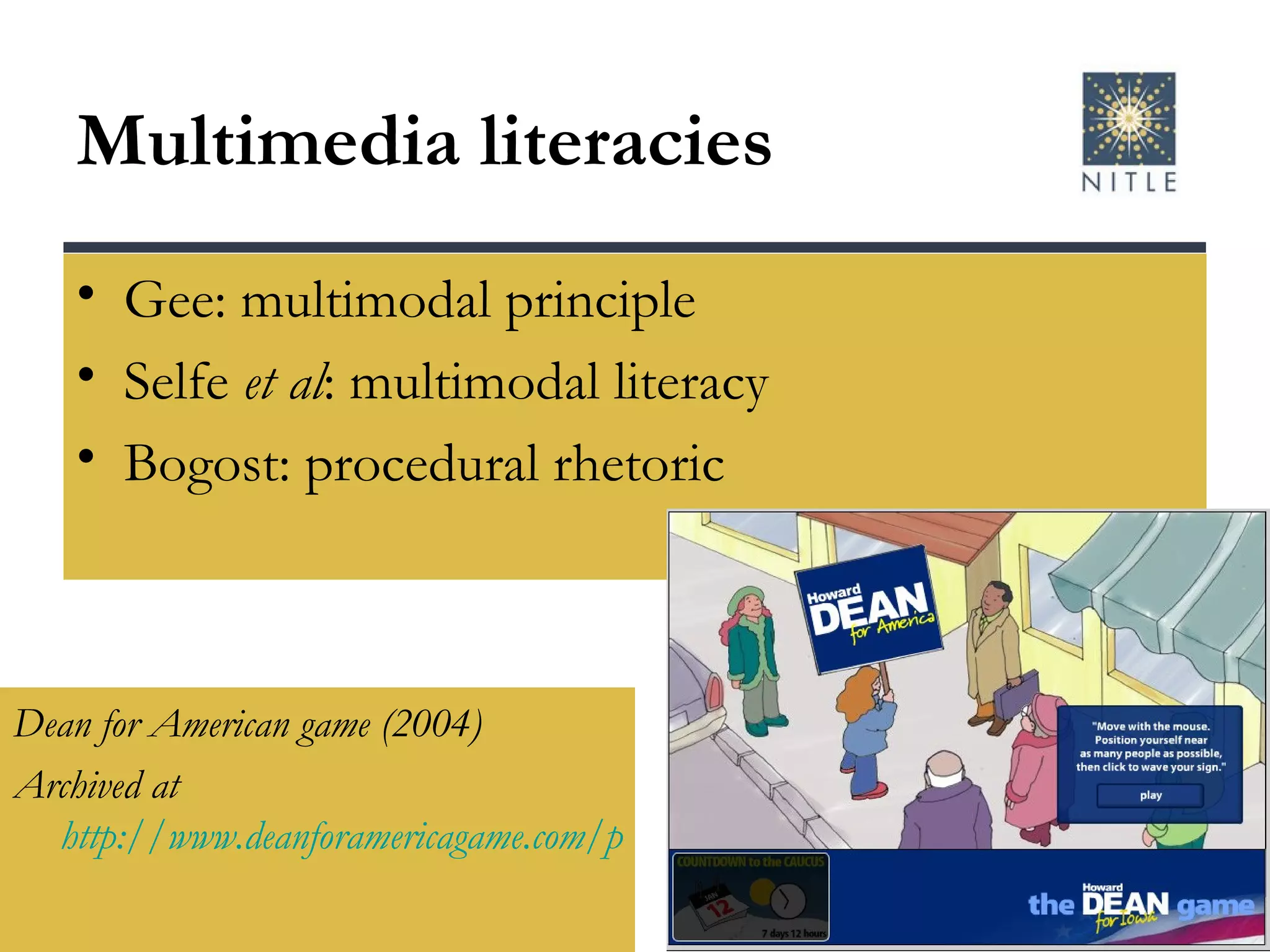
Multimedia literacies Gee: multimodal principle Selfe  et al : multimodal literacy Bogost: procedural rhetoric Dean for American game (2004) Archived at  http://www.deanforamericagame.com/play.html
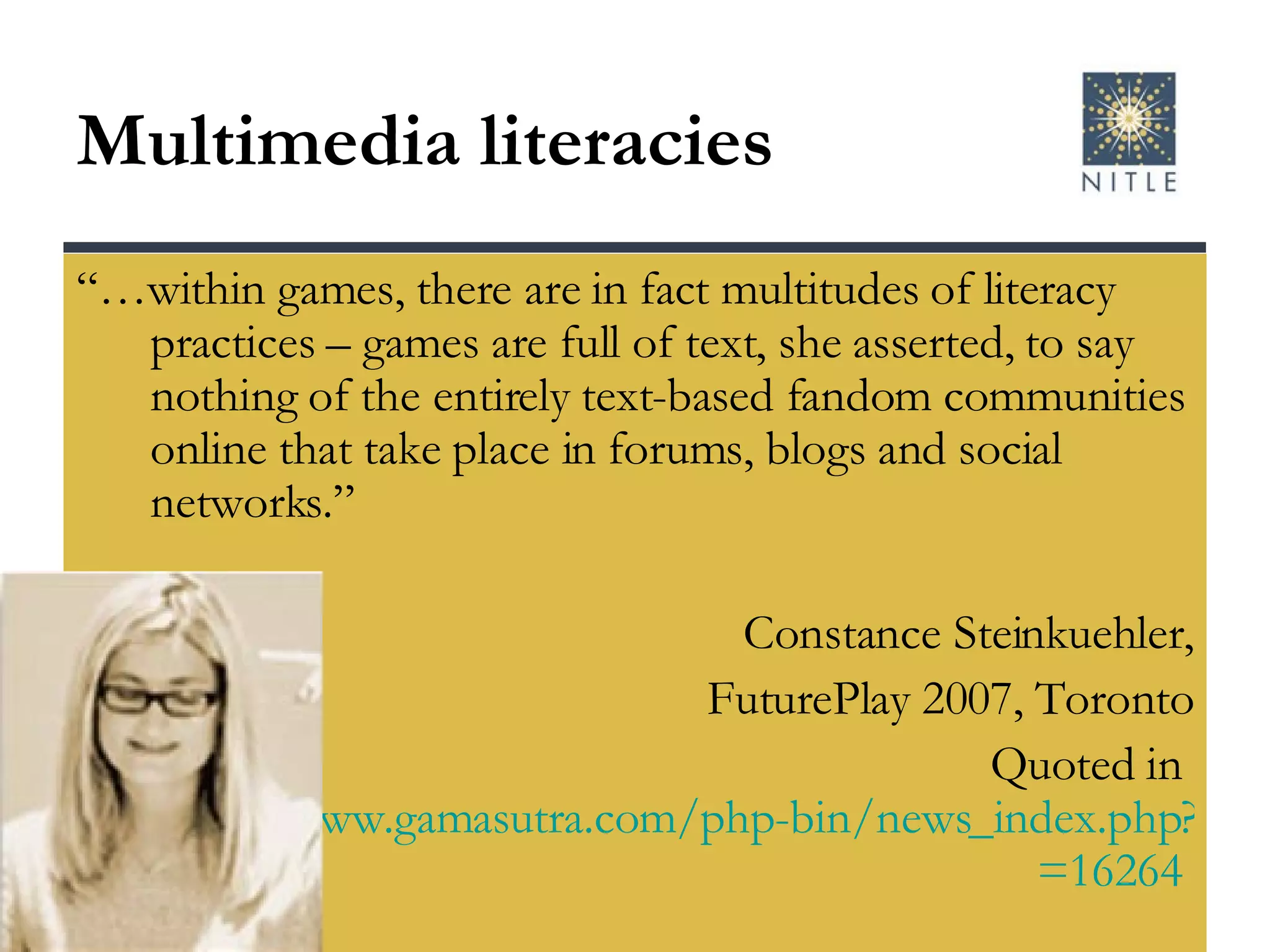
Multimedia literacies “… within games, there are in fact multitudes of literacy practices – games are full of text, she asserted, to say nothing of the entirely text-based fandom communities online that take place in forums, blogs and social networks.” Constance Steinkuehler, FuturePlay 2007, Toronto Quoted in  http://www.gamasutra.com/php-bin/news_index.php?story =16264
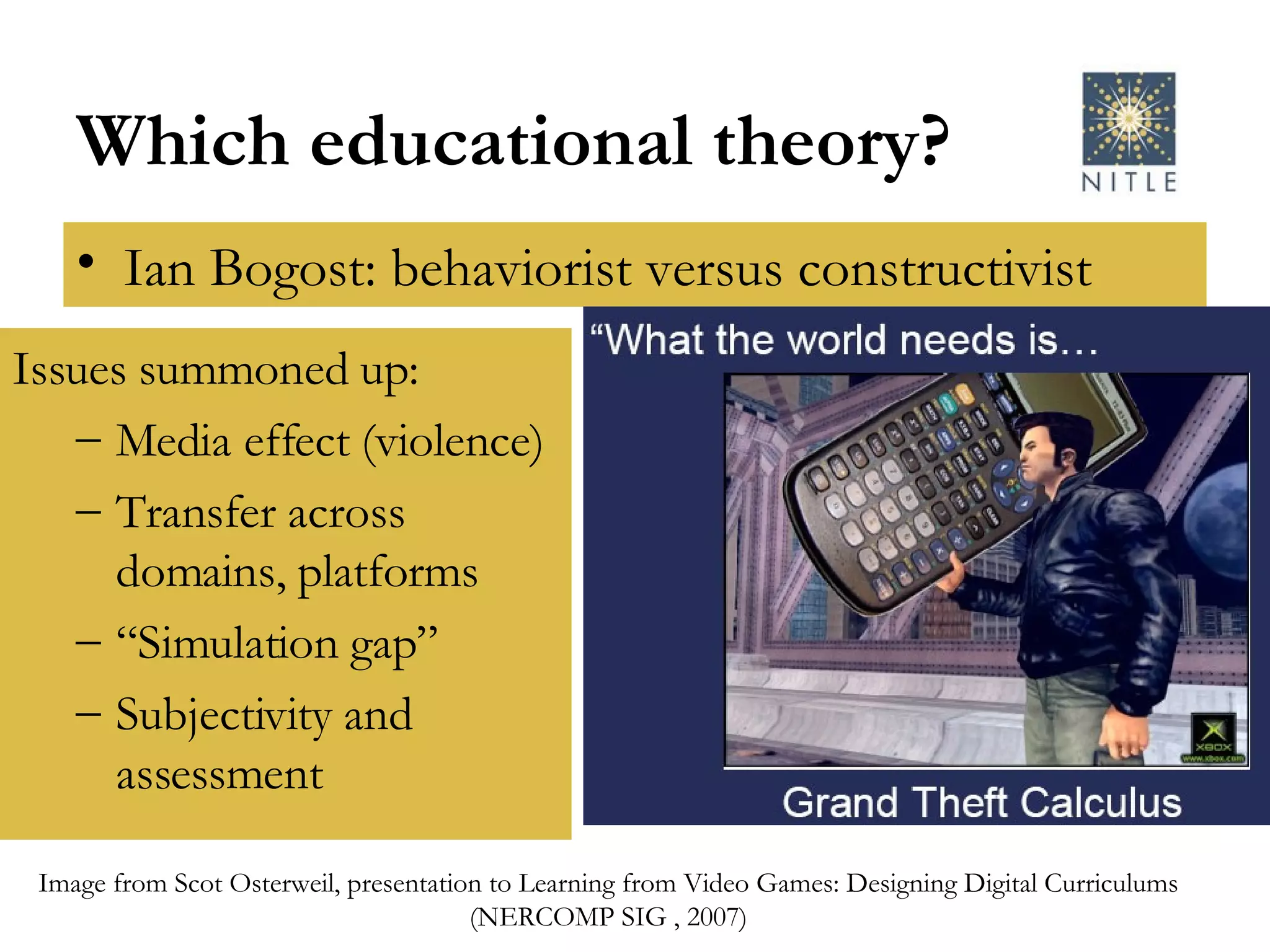
Which educational theory? Ian Bogost: behaviorist versus constructivist Issues summoned up: Media effect (violence) Transfer across domains, platforms “ Simulation gap” Subjectivity and assessment Image from Scot Osterweil, presentation to Learning from Video Games: Designing Digital Curriculums (NERCOMP SIG , 2007)
Pedagogical functions Jason Mittell, Middlebury college: Skills  Simulations Politics (criticism, activism) Media studies (psych, cultural studies, media) NITLE brownbag, January 2008
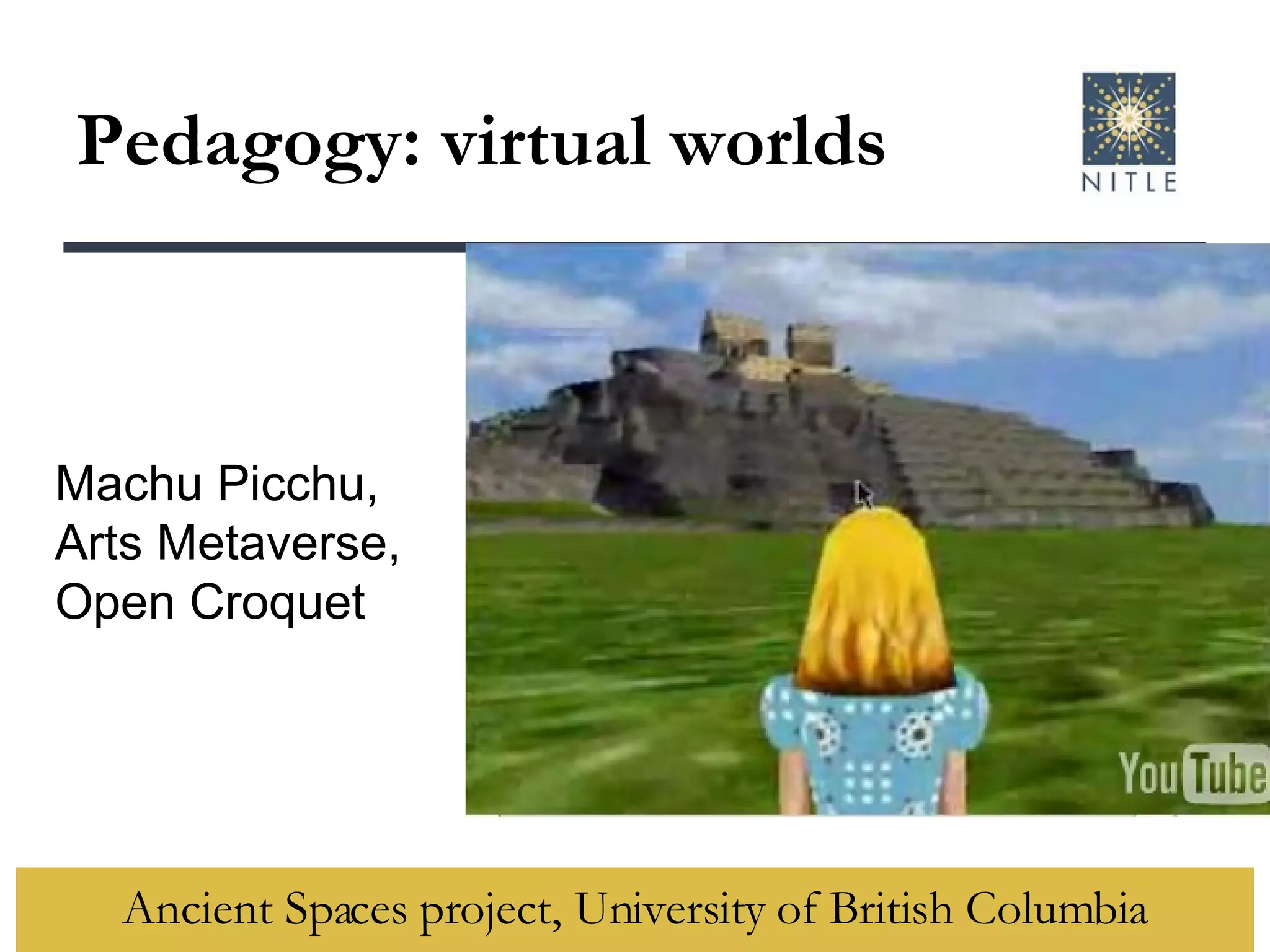
Pedagogy: virtual worlds Ancient Spaces project, University of British Columbia Machu Picchu, Arts Metaverse, Open Croquet
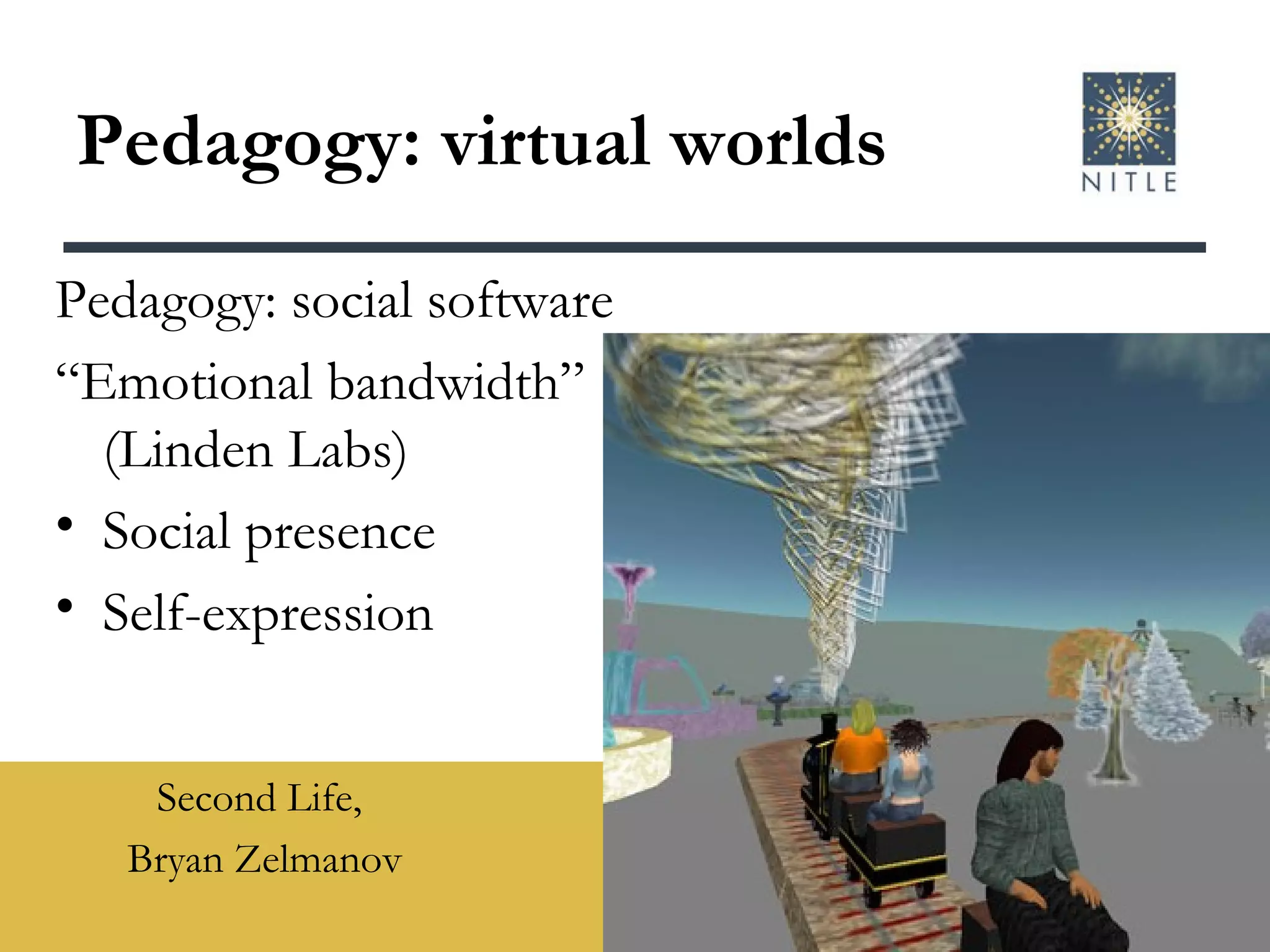
Pedagogy: virtual worlds Second Life,  Bryan Zelmanov Pedagogy: social software “ Emotional bandwidth” (Linden Labs) Social presence Self-expression
Game studies Serious Games Conferences Scholarly articles and books (MIT Press) Games Learning Society conference,  http://www.glsconference.org/2008/index.html
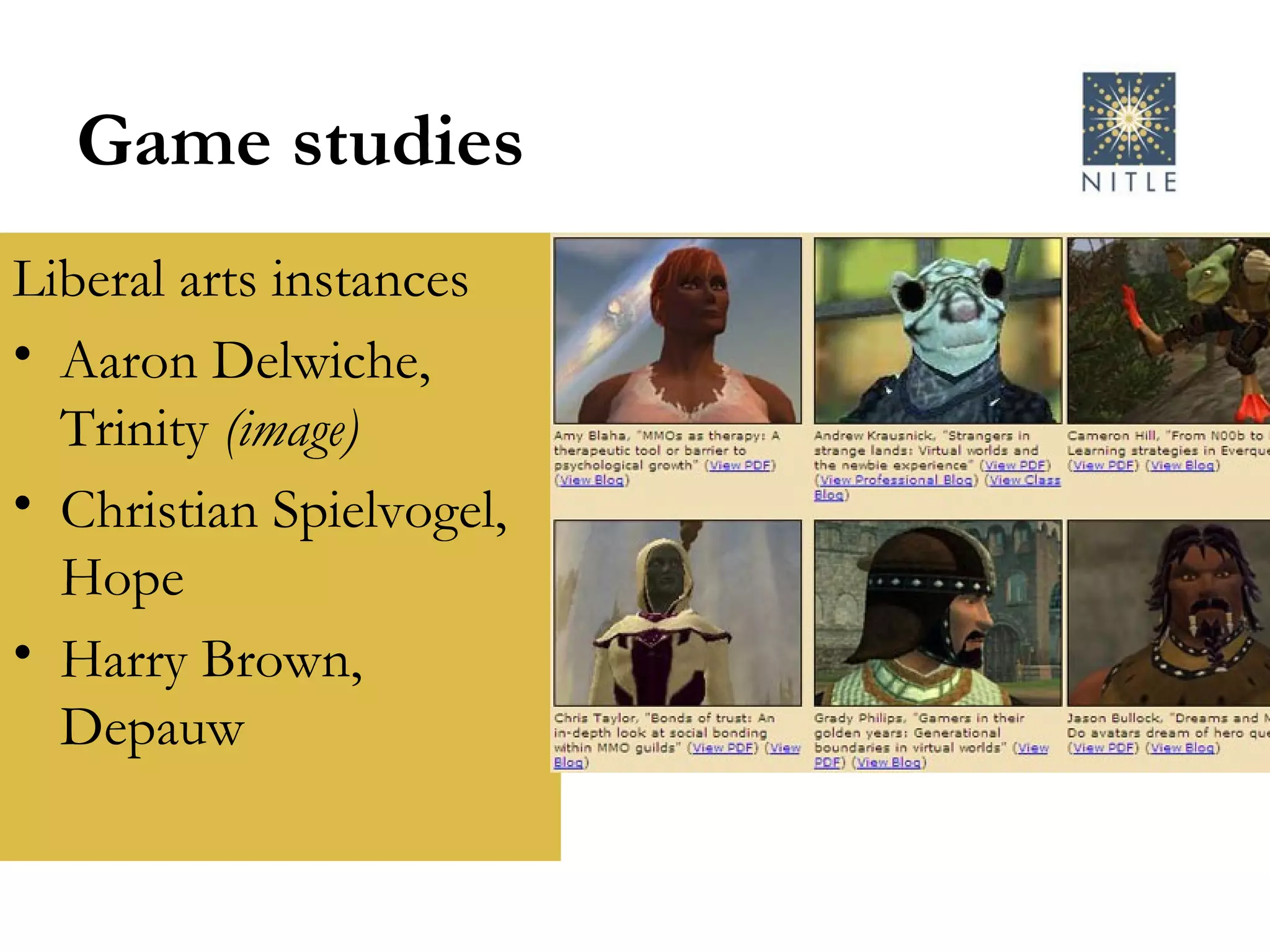
Game studies Liberal arts instances Aaron Delwiche, Trinity  (image) Christian Spielvogel, Hope Harry Brown, Depauw
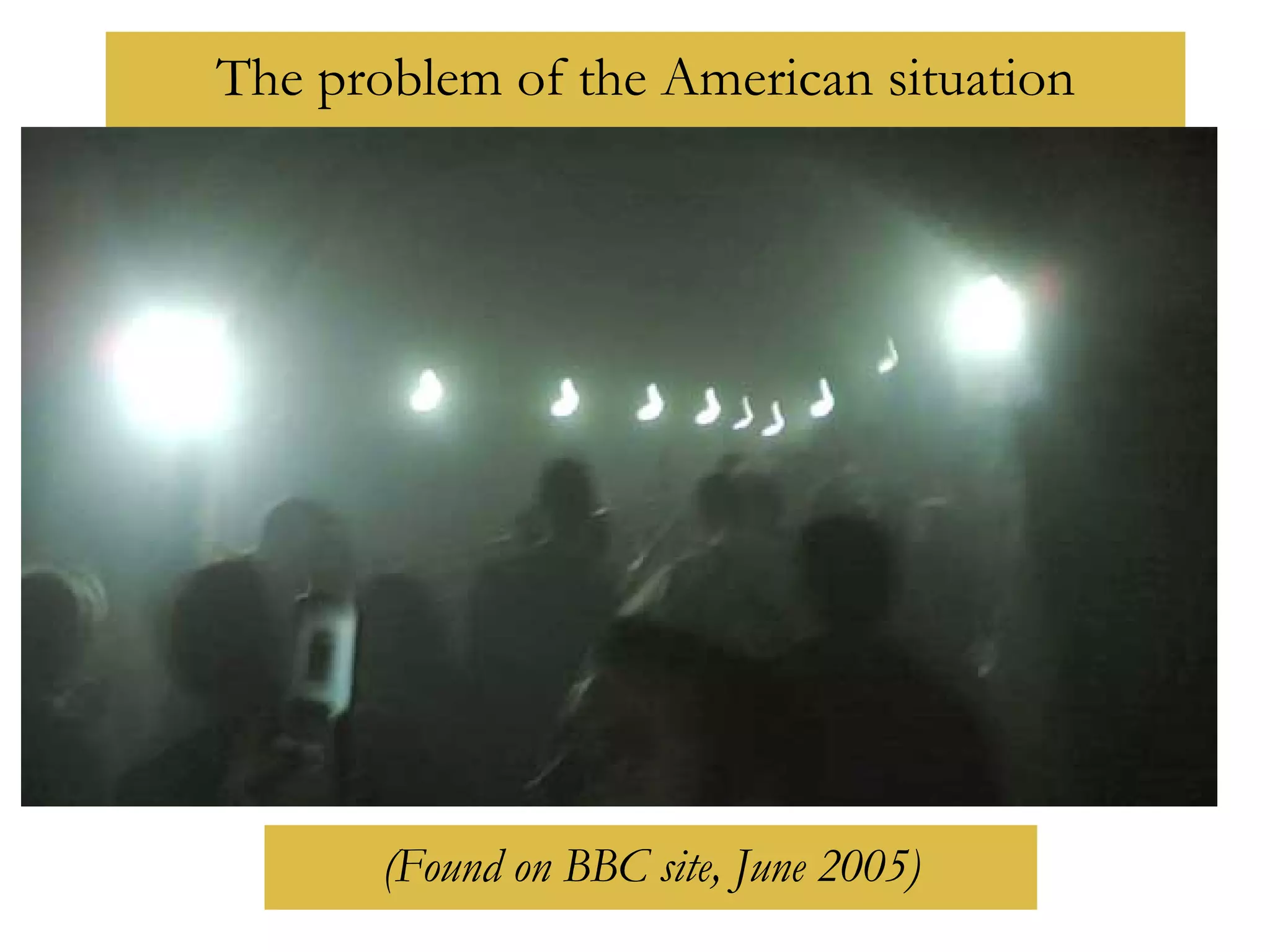
III. Mobile  All of Web 2.0, just more so Ambient Accelerating  Annotating http://www.phonebashing.com/
(Found on BBC site, June 2005) The problem of the American situation
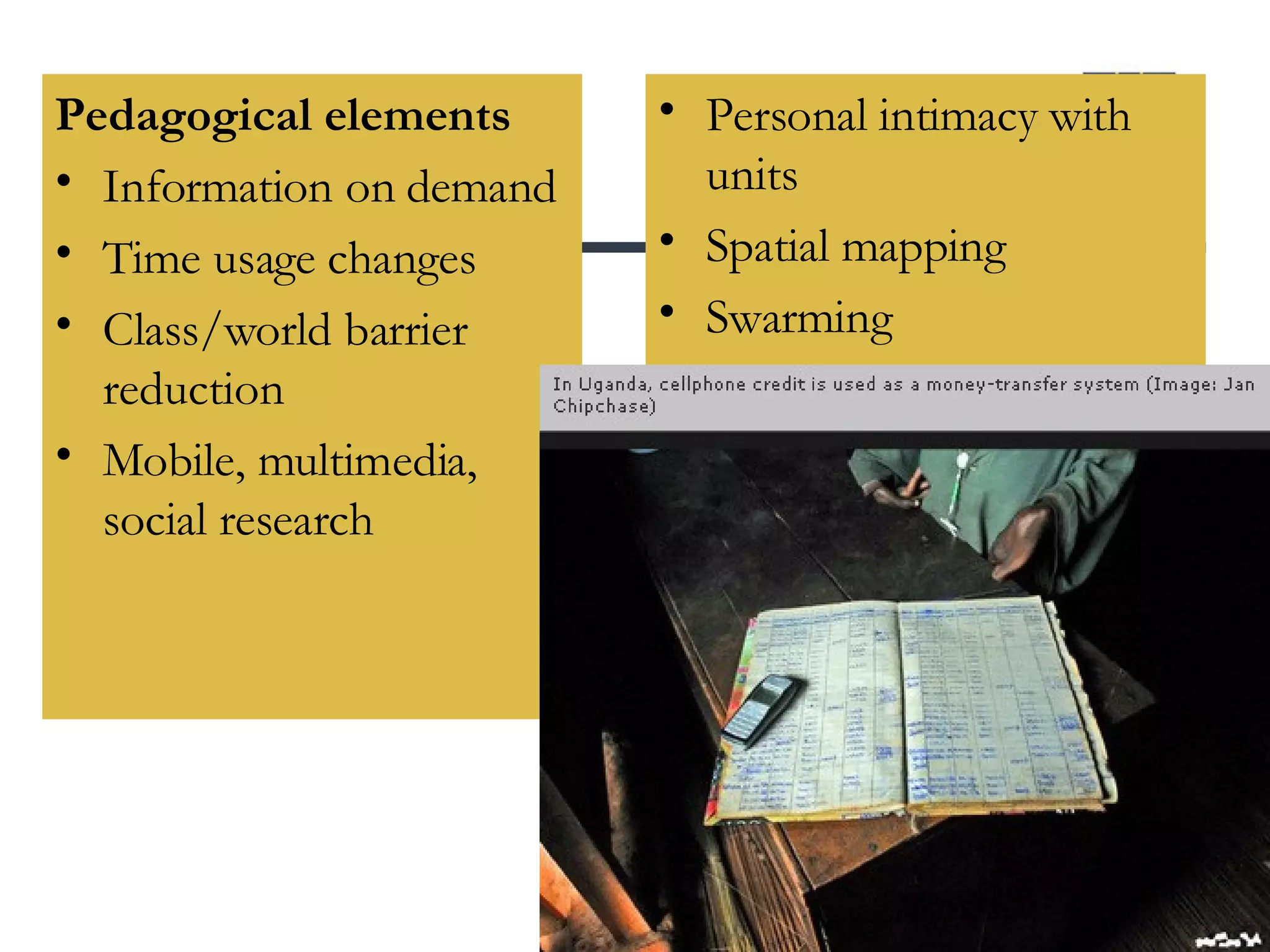
Pedagogical elements Information on demand Time usage changes Class/world barrier reduction Mobile, multimedia, social research  Personal intimacy with units Spatial mapping  Swarming
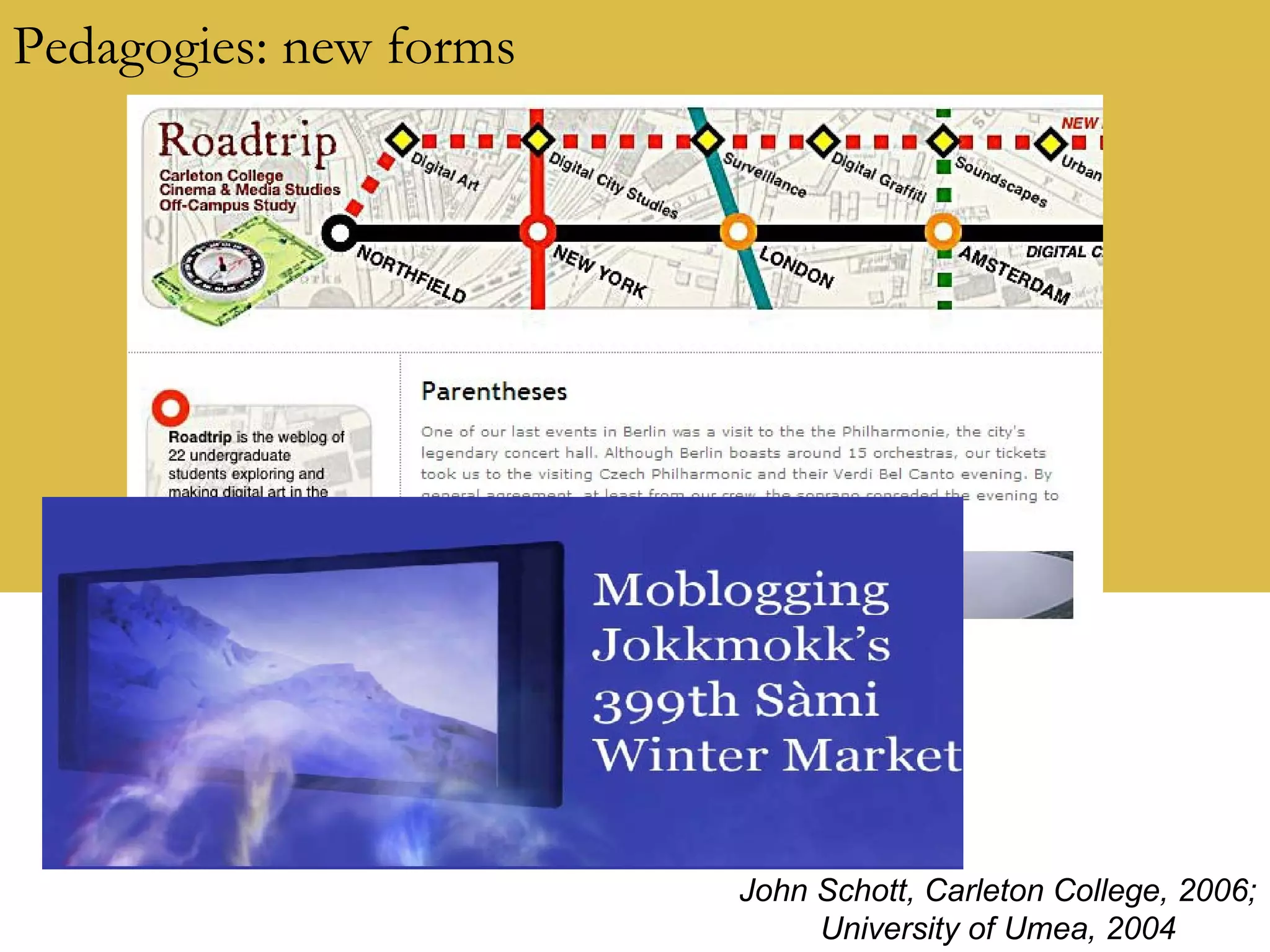
Pedagogies: new forms John Schott, Carleton College, 2006; University of Umea, 2004
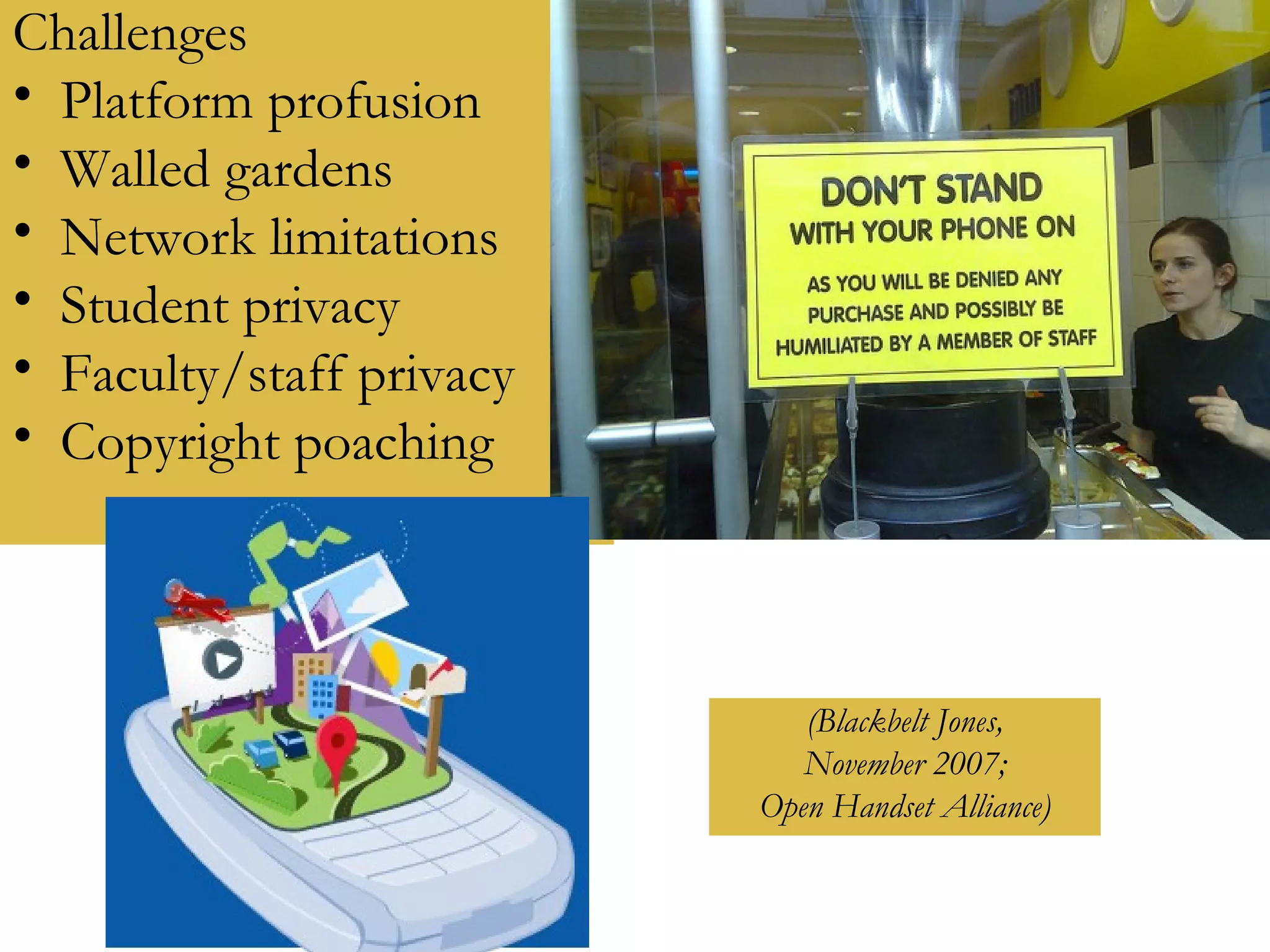
Challenges Platform profusion Walled gardens Network limitations Student privacy Faculty/staff privacy Copyright poaching (Blackbelt Jones, November 2007; Open Handset Alliance)
National Institute for Technology and Liberal Education (NITLE)  http://nitle.org Liberal Education Today blog  http://b2e.nitle.org

Emerging tech for teaching and learning: heading into fall 2008

  • 1.
    Cyberculture, Academia, andthe New Web A survey for summer 2008
  • 2.
    Plan of thetalk Pieces of Web 2.0 Gaming the world Mobility (Vermont trees and sky, winter 2008)
  • 3.
    Thematics Emergence intime and space Pedagogy Open determinism (“Sorpdragon,” Voicethread 2007)
  • 4.
    Memes Shadow ITStorytelling Giants (Vermont bridge, January 2006)
  • 5.
    One odd metaphorWeb 2.0 and education is like gaming and education: awareness is challenging Huge, financially and quantitatively successful worlds Global and rapidly developing scope Bad anxieties, policies, and media coverage Perceived lack of seriousness (Second Life screenshot, 2006)
  • 6.
    Five responses Web2.0 and education is like gaming and education: intersections are happening Take advantage of preexisting projects and services Mod/warp/hack DIY Literacy: new media Influence (World of Warcraft)
  • 7.
    I. Web 2.0(Web 2.0 Bullshit Generator, http://emptybottle.org/bullshit/ )
  • 8.
    “ Technorati isnow tracking over 70 million weblogs, and we're seeing about 120,000 new weblogs being created worldwide each day. That's about 1.4 blogs created every second of every day.” (David Sifry, April 2007 )
  • 9.
  • 10.
    Will YouTube killthe podcasting star? (eMarketer, February 2008; Via Podcasting News)
  • 11.
  • 12.
  • 13.
    The term’s history:Tim O’Reilly, 2005 Expands “social software” Draws on Web history
  • 14.
    Microcontent, rather thansites or large documents (NITLE blog Liberal Education Today, http://b2e.nitle.org )
  • 15.
    I. Web 2.0Multiply authored microcontent
  • 16.
    Open content and/orservices and/or standards… (Pepysblog, 2003-)
  • 17.
    … leading tonetworked conversations (Pepysblog, 2003-)
  • 18.
    O’Reilly: Web 2.0is a platform for development Open APIs Access to data Virtue of the lazyweb ( http://www.hurricanearchive.org/ , Center for History and New Media,George Mason University) Programming staff Perceived recognition
  • 19.
    Web 2.0 components,movements Collaborative writing platforms: the wiki way
  • 20.
    -Viégas, Wattenberg, Dave(Historyflow, IBM, 2004) Wikis are (often) textually productive
  • 21.
    Web 2.0 components,movements collaborative writing platforms: the blogosphere (Radio Open Source blog/podcast)
  • 22.
    State of theblogosphere, more Diversity: diaries, public intellectuals, carnivals, knitters, moblogs, warblogs home and abroad… 12 people million using three platforms, including LiveJournal: majority women (Anil Dash, MeshForum 2006) NIH guidelines, http://www.ncbi.nlm.nih.gov/books/bv.fcgi?rid=citmed.section.61024
  • 23.
    What’s happened since“podcasting” in 2004? Neologisms: godcasting nanocasting podfading podsafe podspamming podvertising porncasting (Missing Link podcast, Southwestern University)
  • 24.
    Web 2.0 influencesrich media: video (Gootube? Suetube?)
  • 25.
    Videoblogging (vlog? vog?) (Ask a Ninja; Rocketboom; Howard Rheingold)
  • 26.
    Social object: the person FaceBook MySpace LinkedIn ZoomInfo CyWorld… “ Less than four years after its launch, 15 million people, or almost a third of the country's population, are members.” ( BusinessWeek , September 2005)
  • 27.
    Social objects ofall sorts (Kenyan crisis-Google Maps mashup, Ushahidi http://www.ushahidi.com/ 2008)
  • 28.
    Social organization ofinformation, new forms: folksonomy Search Retrieval Self-awareness http://del.icio.us/ for DoctorNemo
  • 29.
    Community surfacingOntology Concepts Collaborative research
  • 30.
    Keeping up NITLEworkshop tag cloud, 2008
  • 31.
    Extrapolating principles: TonZylstra on the social object: “ In general you could say that both Flickr and del.icio.us work in a triangle: person, picture/ bookmark, and tag(s). Or more abstract a person, an object of sociality , and some descriptor...” (Zylstra in Second Life, 2007)
  • 32.
    “… In everytriangle there always needs to be a person and an object of sociality . The third point of the triangle is free to define[,] as it were.” - http://www.zylstra.org , 2006 (emphases added)
  • 33.
    (“Online Communities”, XKCD,April 2007 )… For academia, this can seem a bit overwhelming
  • 34.
    (“Online Communities”, XKCD,April 2007 ) Already out of date For academia, this can seem a bit overwhelming
  • 35.
    Flickr and storytellingTell a story in 5 frames group “ Gender Miscommunication”, Nightingai1e, 2006
  • 36.
  • 37.
  • 38.
  • 39.
    “ Gender Miscommunication”(Nightingai1e, 2006)
  • 40.
    Social photo storiesOr remix social media into narratives Example: "Farm to Food", Eli the Bearded (2008) Library of Congress collections
  • 41.
  • 42.
  • 43.
    Social photo storiesFlickr, Tell A Story in Five Frames group ( http://www.flickr.com/groups/visualstory/ ) Example: "Food to Farm", Eli the Bearded (2008)
  • 44.
    Social photo storiesExample: "Food to Farm", Eli the Bearded (2008)
  • 45.
    Social photo storiesPedagogies: Remix Archive work Social presentation Visual literacy ( http://www.flickr.com/groups/visualstory/discuss/72157603786255599/ ; http://www.flickr.com/photos/library_of_congress/ )
  • 46.
    Social workshopping Inthe Tell a story in 5 frames group, 'Alone With The Sand' , moliere1331 (2005)
  • 47.
    Pedagogies and publicationsTeaching with Web 2.0: it’s not all new - Web 1.0, internet pedagogies Hypertext Web audience Discussion fora Collaborative document authoring Groupware
  • 48.
    Teaching with Web2.0: it’s not all new Earlier pedagogies Journaling Media literacy
  • 49.
    Teaching with Web2.0: principles http://smarthistory.blogspot.com/ Distributed conversation Collaborative writing Object-oriented discussion Connectivism (G. Siemens, 2004)
  • 50.
    Social object pedagogiesPrompts Discussion object Composition materials
  • 51.
    Teaching with Web2.0: “ net.gen ”: “ Fully half of all teens and 57 percent of teens who use the Internet could be considered Content Creators, according to a survey by the Pew Internet & American Life Project.” http://www.pewtrusts.com/pdf/PIP_Teens_1105.pdf
  • 52.
    “ [S]tudents… writewords on paper, yes— but… also compose words and images and create audio files on Web logs (blogs), in word processors, with video editors and Web editors and in e-mail and on presentation software and in instant messaging and on listservs and on bulletin boards—and no doubt in whatever genre will emerge in the next ten minutes. Note that no one is making anyone do any of this writing .” Kathleen Blake Yancey, "Made Not Only in Words: Composition in a New Key." CCC 56.2 (2004):297-328. Emphasis added.
  • 53.
    More social objectpedagogies Annotate details Remix (“Make it mine”) Edugadget http://www.edugadget.com/2005/05/07/flickr-creative-commons
  • 54.
    Wiki pedagogies Collectiveresearch Group writing Document editing Information literacy Discussion Knowledge accretion (Romantic Audiences project Bowdoin College, 2005-present Discussion Knowledge accretion
  • 55.
    Podcasts and teaching: profcasting Bryn Mawr College: Michelle Francl, chemistry Duke: “Classroom recording” Learning objects: Gardner Campbell, University of Richmond Duke: “Course content dissemination” Information literacy
  • 56.
    Student program podcastingon campus War News Radio (Swarthmore College) PEPI courses (University of British Columbia, department of Land and Food Resources)
  • 57.
    Podcasts and researchPublic intellectual Out of the Past Engines of Our Ingenuity In Our Time University Channel The Missing Link
  • 58.
    Media to enhance other media Podcast + pdfs: Allegheny College, Gothcast
  • 59.
    Academic open archivesfor social media Freesound archive DIY copyright Social networking values University of Pompeu Fabra (Barcelona) ( http://freesound.iua.upf.edu/ )
  • 60.
    New forms ofscholarly communication CommentPress implementation, Institute for the Future of the Books McKenzie Wark, Eugene Lang College
  • 61.
    Still more bookbloggingSiva Vaidhyanathan, University of Virginia
  • 62.
    Combining Web 2.0forms Podcasting Blogging Digital storytelling Web-based photography YouTube Video mashups Middlebury College, Jason Mittell and Barbara Ganley Blend teaching with research BG now involved in rural community media
  • 63.
    II. Gaming Longhistory of gaming Predigital Chess, go, Senet, mancala, backgammon, dice, cards Kriegspiel Cold War games Digital Spacewar Zork to IF boom (1980s) 1990s rebirth
  • 64.
    Gaming in 2008Physical platforms Console Cell phone PSP Extended forms (DDR) New forms: Wii PC CD, DVD Browser Downloadable … And these can be combined
  • 65.
    Size: huge (WoW: 10 million subscribers, January 2008) Player range: genders, classes, nations Interface, device driver Eve Online, from site
  • 66.
    Growing content diversityCurrent events (Kumawar) Political argument (September 12th, FoodForce) Religious gaming (Left Behind: Eternal Forces, 2006) Literary gaming (Kafkamesto, 2006) (BBC Climate Challenge; Ayiti: both 2007-present)
  • 67.
    Genres First-person shooterPuzzle Platform jumper Strategy “ Adventure” Sports Minigame (Koster fractals) New forms Katamari Portal Augmented reality games
  • 68.
    Economics of gamesWho creates games? Businesses Governments Nonprofits Amateurs Scales Large games $millions EA, Microsoft Modding Back to Doom, hacking, View Source Neverwinter Nights Casual games Other economics Gambling Gold farming Currency trading
  • 69.
    Offshoot: machinima ToolsCounterstrike, Halo Second Life The Movies Art movement Machinima Academy of Arts and Sciences ( http://www.machinima.org/ ) (Koulamata, “The French Democracy”, 2006)
  • 70.
    Virtual worlds “’Cyberspace. A consensual hallucination experienced daily by billions of legitimate operators, in every nation, by children being taught mathematical concepts. A graphic representation of data abstracted from the banks of every computer in the human system…” Antecedents, early digital: science fiction 1984: William Gibson, Neuromancer 1992: Neal Stephenson, Snow Crash - Neuromancer
  • 71.
    Antecedents, digital: theMUD, Adventure (1970s-present) (LambdaMOO, 1990-present)
  • 72.
    Antecedents, predigital: Theaterof Memory (from Philippe Codognet, http://webia.lip6.fr/~codognet/ )
  • 73.
    Avatar spaces -Activeworlds-Atmospheres -There (Activeworlds, 1995-present; image via www.virtualworldlets.net )
  • 74.
    -Habbo Hotel -Cyworld(Club Penguin, 2005-present) 2d-3d worlds -Runescape -VMK
  • 75.
    Google Earth -KeyholeDB -2d: KML -3d: Sketchup -reach -Geotagging photos: videos Mirror worlds
  • 76.
    Augmented Reality “Human Pacman,” Adrian David Cheok, circa 2005 -mobile devices game players general use tools -science fiction explores (Vernor Vinge, Rainbows End )
  • 77.
    Interactive Fiction Speakingof text adventures: 1980s boom: Infocom Ongoing art form Nick Montfort, Twisty Little Passages (“Dead Cities”, from Lovecraft Commonplace Book project 2007 http:// www.illuminatedlantern.com/if/games/lovecraft / )
  • 78.
    Interactive Fiction Speakingof text adventures: Inform 7, free IF editor (Richard Liston, Ursinus College, classroom example 2008)
  • 79.
    Narrative Where isstorytelling in a game? Sequence of activities Cut-scene or cinematic Writerly player Encyclopedia world (Murray, Manovich) Ludology vs. narratology Linearity? Game on rails Branching outcomes Multilinear Open-ended
  • 80.
    Alternate reality gamesPermeability of game boundary (space and time) Focus on distributed, collaborative cognition Increased ephemerality (Perplex City, 2003-2006)
  • 81.
    Political ARGs (ex: World Without Oil , May 2007) ()
  • 82.
    Gaming and education“Video games… situate meaning in a multimodal space through embodied experiences to solve problems and reflect on the intricacies of the design of imagined worlds and the design of both real and imagined social relationships and identities in the modern world.”
  • 83.
    21-century boom JamesPaul Gee (author of preceding quote) Marc Presnsky Henry Jenkins John Seely Brown Mia Consalvo Constance Steinkuehler Kurt Squire
  • 84.
    James Paul Gee’sargument Semiotic domains; tranference Embodied action and feedback Projective identity Edging the regime of competence (Vygotsky) Probe-reprobe cycle Social learning (roles; consumption-production)
  • 85.
    Gee on Rise of Nations “Fish tank” tutorial Strategic self-assessment
  • 86.
    Multimedia literacies Gee:multimodal principle Selfe et al : multimodal literacy Bogost: procedural rhetoric Dean for American game (2004) Archived at http://www.deanforamericagame.com/play.html
  • 87.
    Multimedia literacies “…within games, there are in fact multitudes of literacy practices – games are full of text, she asserted, to say nothing of the entirely text-based fandom communities online that take place in forums, blogs and social networks.” Constance Steinkuehler, FuturePlay 2007, Toronto Quoted in http://www.gamasutra.com/php-bin/news_index.php?story =16264
  • 88.
    Which educational theory?Ian Bogost: behaviorist versus constructivist Issues summoned up: Media effect (violence) Transfer across domains, platforms “ Simulation gap” Subjectivity and assessment Image from Scot Osterweil, presentation to Learning from Video Games: Designing Digital Curriculums (NERCOMP SIG , 2007)
  • 89.
    Pedagogical functions JasonMittell, Middlebury college: Skills Simulations Politics (criticism, activism) Media studies (psych, cultural studies, media) NITLE brownbag, January 2008
  • 90.
    Pedagogy: virtual worldsAncient Spaces project, University of British Columbia Machu Picchu, Arts Metaverse, Open Croquet
  • 91.
    Pedagogy: virtual worldsSecond Life, Bryan Zelmanov Pedagogy: social software “ Emotional bandwidth” (Linden Labs) Social presence Self-expression
  • 92.
    Game studies SeriousGames Conferences Scholarly articles and books (MIT Press) Games Learning Society conference, http://www.glsconference.org/2008/index.html
  • 93.
    Game studies Liberalarts instances Aaron Delwiche, Trinity (image) Christian Spielvogel, Hope Harry Brown, Depauw
  • 94.
    III. Mobile All of Web 2.0, just more so Ambient Accelerating Annotating http://www.phonebashing.com/
  • 95.
    (Found on BBCsite, June 2005) The problem of the American situation
  • 96.
    Pedagogical elements Informationon demand Time usage changes Class/world barrier reduction Mobile, multimedia, social research Personal intimacy with units Spatial mapping Swarming
  • 97.
    Pedagogies: new formsJohn Schott, Carleton College, 2006; University of Umea, 2004
  • 98.
    Challenges Platform profusionWalled gardens Network limitations Student privacy Faculty/staff privacy Copyright poaching (Blackbelt Jones, November 2007; Open Handset Alliance)
  • 99.
    National Institute forTechnology and Liberal Education (NITLE) http://nitle.org Liberal Education Today blog http://b2e.nitle.org