Weathering
differentiate mechanical
weathering and chemical
weathering; and
1
At the end
of the
lesson, you
should be
able to:
2
describe how rocks
undergo weathering;
enumerate the factors
that contribute to
weathering.
3
enumerate the factors
affecting soil erosion;
and
4
At the end
of the
lesson, you
should be
able to:
5
explain the process of
soil erosion and its types;
identify measures to
prevent soil erosion.
6
• Weathering is the process of breaking down rocks present
at Earth’s surface.
• Weathering can happens in the presence of the action of
rainwater, variable extreme temperature, and different
biological activities.
Weathering
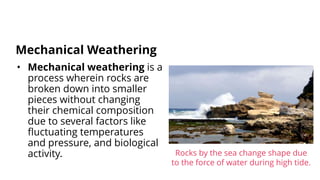
• Mechanical weathering is a
process wherein rocks are
broken down into smaller
pieces without changing
their chemical composition
due to several factors like
fluctuating temperatures
and pressure, and biological
activity.
Mechanical Weathering
Rocks by the sea change shape due
to the force of water during high tide.
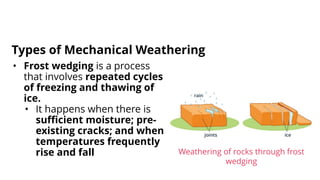
• Frost wedging is a process
that involves repeated cycles
of freezing and thawing of
ice.
• It happens when there is
sufficient moisture; pre-
existing cracks; and when
temperatures frequently
rise and fall
Types of Mechanical Weathering
Weathering of rocks through frost
wedging
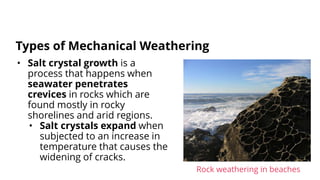
• Salt crystal growth is a
process that happens when
seawater penetrates
crevices in rocks which are
found mostly in rocky
shorelines and arid regions.
• Salt crystals expand when
subjected to an increase in
temperature that causes the
widening of cracks.
Types of Mechanical Weathering
Rock weathering in beaches
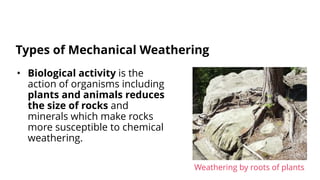
• Biological activity is the
action of organisms including
plants and animals reduces
the size of rocks and
minerals which make rocks
more susceptible to chemical
weathering.
Types of Mechanical Weathering
Weathering by roots of plants
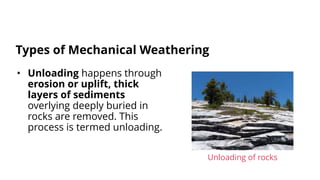
• Unloading happens through
erosion or uplift, thick
layers of sediments
overlying deeply buried in
rocks are removed. This
process is termed unloading.
Types of Mechanical Weathering
Unloading of rocks
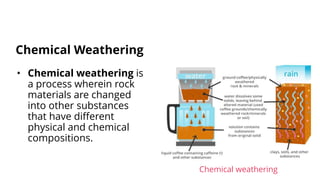
• Chemical weathering is
a process wherein rock
materials are changed
into other substances
that have different
physical and chemical
compositions.
Chemical Weathering
Chemical weathering
• Dissolution is a process wherein a solid (i.e., halite) dissolves
in a liquid (i.e., water).
• Hydrolysis is a process where water reacts with a mineral to
form a new mineral.
• Oxidation is a where chemical combination of oxygen with a
mineral to form an entirely different mineral in which at least
one of the elements has a higher ionic charge.
Types of Chemical Weathering
• Climate mainly includes the amount of moisture in the air
and temperature where weathering takes place.
• The higher the elevation of an area, the more susceptible
it is to weathering since it is more exposed to environmental
factors.
Factors Affecting Weathering of Rocks
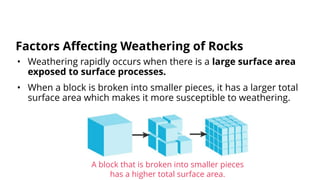
• Weathering rapidly occurs when there is a large surface area
exposed to surface processes.
• When a block is broken into smaller pieces, it has a larger total
surface area which makes it more susceptible to weathering.
Factors Affecting Weathering of Rocks
A block that is broken into smaller pieces
has a higher total surface area.
Erosion
• Erosion is the transportation of weathered rocks.
• Agents like running water or rivers, wind, gravity,
groundwater, wave currents, and glaciers contribute to
erosion.
• Erosion has different types: water erosion, wind erosion,
and glacial erosion.
Erosion
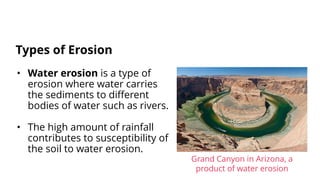
• Water erosion is a type of
erosion where water carries
the sediments to different
bodies of water such as rivers.
• The high amount of rainfall
contributes to susceptibility of
the soil to water erosion.
Types of Erosion
Grand Canyon in Arizona, a
product of water erosion
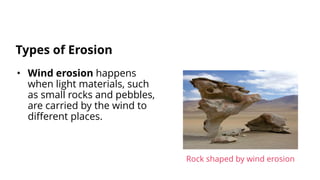
• Wind erosion happens
when light materials, such
as small rocks and pebbles,
are carried by the wind to
different places.
Types of Erosion
Rock shaped by wind erosion
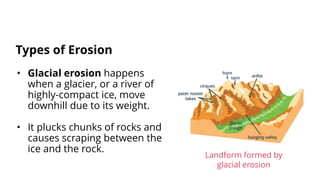
• Glacial erosion happens
when a glacier, or a river of
highly-compact ice, move
downhill due to its weight.
• It plucks chunks of rocks and
causes scraping between the
ice and the rock.
Types of Erosion
Landform formed by
glacial erosion
• Soil erodibility is the vulnerability of soil to erosion caused
by rainfall intensity, soil properties, crop cover, and slope.
• The texture of the soil is the most significant contributing
factor to erodibility although structure, organic matter, and
permeability may also affect it.
Causes of Erosion
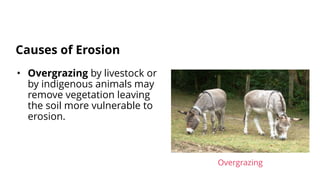
• Overgrazing by livestock or
by indigenous animals may
remove vegetation leaving
the soil more vulnerable to
erosion.
Causes of Erosion
Overgrazing
• Cutting of trees and removal of vegetation to provide
lumber can also result in large amounts of erosion.
• Use of pesticides, herbicides, and fuel oils also pollutes
the soil. Salt can also contaminate soil due to the high
salinity of irrigation water as it passes over croplands.
Causes of Erosion
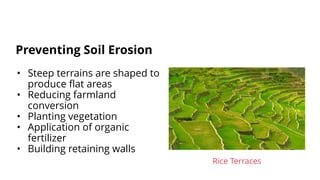
• Steep terrains are shaped to
produce flat areas
• Reducing farmland
conversion
• Planting vegetation
• Application of organic
fertilizer
• Building retaining walls
Preventing Soil Erosion
Rice Terraces
Mass Wasting
describe the different
types of movement of
mass wasting; and
1
At the end
of the
lesson, you
should be
able to:
2
identify the factors that
cause mass wasting;
enumerate different
measures to prevent
mass wasting.
3
enumerate the properties
of sediments; and
4
At the end
of the
lesson, you
should be
able to:
5
describe the process of
sedimentation;
determine the effects of
excessive sedimentation.
6
• Mass wasting is a downslope movement of rock,
regolith/unconsolidated material, and soil under the
influence of gravity.
• It is different from erosion because mass wasting does not
need any transporting medium such as wind, water, or
glacial ice.
Mass Wasting
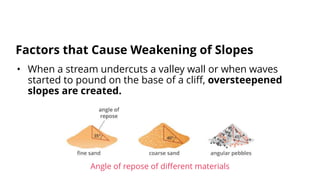
• When a stream undercuts a valley wall or when waves
started to pound on the base of a cliff, oversteepened
slopes are created.
Factors that Cause Weakening of Slopes
Angle of repose of different materials
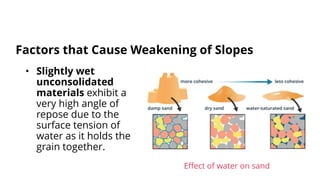
• Slightly wet
unconsolidated
materials exhibit a
very high angle of
repose due to the
surface tension of
water as it holds the
grain together.
Factors that Cause Weakening of Slopes
Effect of water on sand
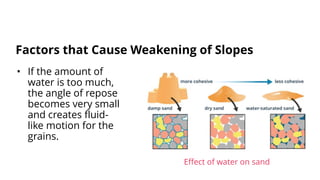
• If the amount of
water is too much,
the angle of repose
becomes very small
and creates fluid-
like motion for the
grains.
Factors that Cause Weakening of Slopes
Effect of water on sand
• Plants have extensive root system which holds the soil
and regolith together, thus preventing mass wasting or
soil erosion.
• Therefore, lack of plants may result in enhanced mass
wasting especially if large amounts of rainfall and steep
slope are present in the area.
Factors that Cause Weakening of Slopes
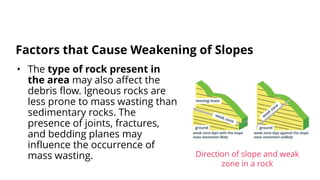
• The type of rock present in
the area may also affect the
debris flow. Igneous rocks are
less prone to mass wasting than
sedimentary rocks. The
presence of joints, fractures,
and bedding planes may
influence the occurrence of
mass wasting.
Factors that Cause Weakening of Slopes
Direction of slope and weak
zone in a rock
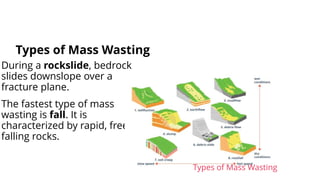
• Creep is the slow, downhill movement of rock or soil under
the influence of gravity.
• A debris flow is composed of a mixture of clay, silt, sand,
and rock fragments in which more than half of the
components are more abundant than sand.
• Mudflow has a consistency of wet concrete due to its high
water content.
Types of Mass Wasting
• An earthflow contains less water and therefore less fluid
than a mudflow.
• Solifluction happens when water-saturated soil moves
downslope.
• A slump occurs when blocks of material move downhill over
a gently curved fracture in rock or regolith.
Types of Mass Wasting
During a rockslide, bedrock
slides downslope over a
fracture plane.
The fastest type of mass
wasting is fall. It is
characterized by rapid, free-
falling rocks.
Types of Mass Wasting
• Hazard maps are used to identify areas susceptible to
landslides.
• Engineering measures are also applied before any hillslope
development.
• Soft mitigating measures such as information and educational
campaigns and monitoring and early warning systems are also
conducted by the local government.
Measures to Prevent Disasters
Sedimentation
• Sediments are loose, unconsolidated, solid particles from
weathering and erosion of pre-existing rocks, precipitation
of minerals dissolved in water, and remains of plants and
animals.
• The process in which solid materials are deposited
horizontally after it is transported by different agents of
sediment transport such as water and wind is called
sedimentation.
Sediments and Sedimentation
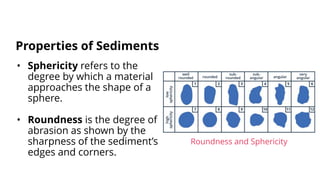
• Sphericity refers to the
degree by which a material
approaches the shape of a
sphere.
• Roundness is the degree of
abrasion as shown by the
sharpness of the sediment’s
edges and corners.
Properties of Sediments
Roundness and Sphericity
• Sorting describes the degree of uniformity of grain sizes of
sediments. Sediments are sorted based on their density
caused by the energy of the transporting medium.
Properties of Sediments
Sorting of sediments
• When the velocity of the transporting medium becomes
low, heavier sediments are left behind and begin to be
deposited.
• Gravel and coarser particles are carried by high energy
current or streams with high competence. Sand and finer
sediments are mostly transported through wind and wave
action.
Properties of Sediments
Earth’s Internal Heat
The learners should be able to:
• describe where the Earth’s internal heat
comes from (S11/12ES-IIb-c23);
• describe how magma is formed.
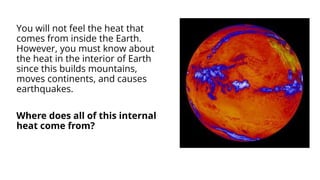
You will not feel the heat that
comes from inside the Earth.
However, you must know about
the heat in the interior of Earth
since this builds mountains,
moves continents, and causes
earthquakes.
Where does all of this internal
heat come from?
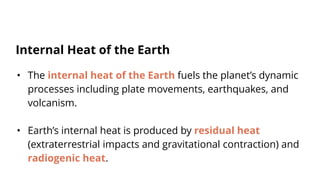
• The internal heat of the Earth fuels the planet’s dynamic
processes including plate movements, earthquakes, and
volcanism.
• Earth’s internal heat is produced by residual heat
(extraterrestrial impacts and gravitational contraction) and
radiogenic heat.
Internal Heat of the Earth
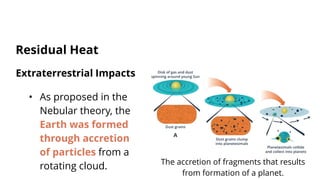
Extraterrestrial Impacts
• As proposed in the
Nebular theory, the
Earth was formed
through accretion
of particles from a
rotating cloud.
Residual Heat
The accretion of fragments that results
from formation of a planet.
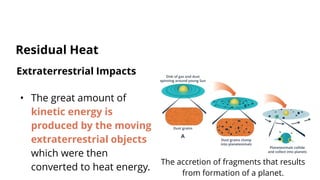
Extraterrestrial Impacts
• The great amount of
kinetic energy is
produced by the moving
extraterrestrial objects
which were then
converted to heat energy.
Residual Heat
The accretion of fragments that results
from formation of a planet.
Gravitational Contraction
• Collapsed clouds occur because accretion of more
materials led to an increase in the gravitational
attraction causing the contraction of the Earth into a
smaller volume which will then enable them to spin faster.
Residual Heat
Gravitational Contraction
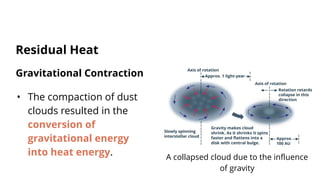
• The compaction of dust
clouds resulted in the
conversion of
gravitational energy
into heat energy.
Residual Heat
A collapsed cloud due to the influence
of gravity
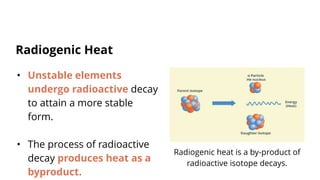
• Unstable elements
undergo radioactive decay
to attain a more stable
form.
• The process of radioactive
decay produces heat as a
byproduct.
Radiogenic Heat
Radiogenic heat is a by-product of
radioactive isotope decays.
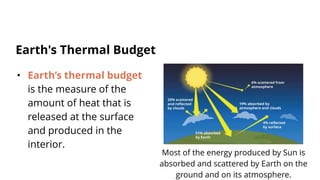
• Earth’s thermal budget
is the measure of the
amount of heat that is
released at the surface
and produced in the
interior.
Earth's Thermal Budget
Most of the energy produced by Sun is
absorbed and scattered by Earth on the
ground and on its atmosphere.
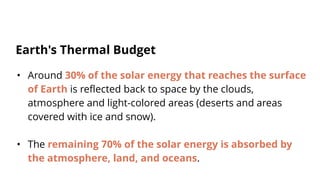
• Around 30% of the solar energy that reaches the surface
of Earth is reflected back to space by the clouds,
atmosphere and light-colored areas (deserts and areas
covered with ice and snow).
• The remaining 70% of the solar energy is absorbed by
the atmosphere, land, and oceans.
Earth's Thermal Budget
Magmatism: How Magma is
Formed
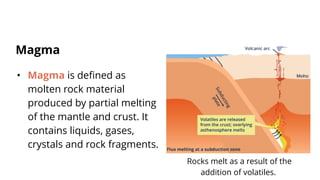
• Magma is defined as
molten rock material
produced by partial melting
of the mantle and crust. It
contains liquids, gases,
crystals and rock fragments.
Magma
Rocks melt as a result of the
addition of volatiles.
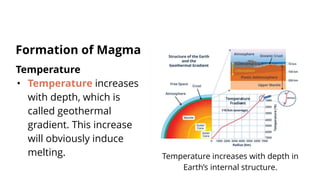
Temperature
• Temperature increases
with depth, which is
called geothermal
gradient. This increase
will obviously induce
melting.
Formation of Magma
Temperature increases with depth in
Earth’s internal structure.
Volatiles
• Volatiles are substances that evaporate easily and can exist
in gaseous form in the surface of Earth.
• Examples of this kind of substances are water and carbon
dioxide. When volatiles mix with hot mantle rock, magma
forms.
Formation of Magma
Volatiles
• When water or carbon dioxide are introduced to rock, flux
melting occurs which cause the rock to melt.
• Flux melting is the process of reducing a substance's melting
point by introducing impurities. When volatiles are added to
rocks, their melting point decreases.
Formation of Magma
• Magmatism occurs along plate boundaries or margins and
sometimes within the plate. Cracks on Earth's crust are the
result of these plate boundaries.
• In effect, hot mantle rock penetrates the crust and
becomes magma.
Magmatism
WEATHERING-EROSION-MASS-WASTING-SEDIMENTATION.pptx

WEATHERING-EROSION-MASS-WASTING-SEDIMENTATION.pptx

  • 2.
  • 3.
    differentiate mechanical weathering andchemical weathering; and 1 At the end of the lesson, you should be able to: 2 describe how rocks undergo weathering; enumerate the factors that contribute to weathering. 3
  • 4.
    enumerate the factors affectingsoil erosion; and 4 At the end of the lesson, you should be able to: 5 explain the process of soil erosion and its types; identify measures to prevent soil erosion. 6
  • 5.
    • Weathering isthe process of breaking down rocks present at Earth’s surface. • Weathering can happens in the presence of the action of rainwater, variable extreme temperature, and different biological activities. Weathering
  • 6.
    • Mechanical weatheringis a process wherein rocks are broken down into smaller pieces without changing their chemical composition due to several factors like fluctuating temperatures and pressure, and biological activity. Mechanical Weathering Rocks by the sea change shape due to the force of water during high tide.
  • 7.
    • Frost wedgingis a process that involves repeated cycles of freezing and thawing of ice. • It happens when there is sufficient moisture; pre- existing cracks; and when temperatures frequently rise and fall Types of Mechanical Weathering Weathering of rocks through frost wedging
  • 8.
    • Salt crystalgrowth is a process that happens when seawater penetrates crevices in rocks which are found mostly in rocky shorelines and arid regions. • Salt crystals expand when subjected to an increase in temperature that causes the widening of cracks. Types of Mechanical Weathering Rock weathering in beaches
  • 9.
    • Biological activityis the action of organisms including plants and animals reduces the size of rocks and minerals which make rocks more susceptible to chemical weathering. Types of Mechanical Weathering Weathering by roots of plants
  • 10.
    • Unloading happensthrough erosion or uplift, thick layers of sediments overlying deeply buried in rocks are removed. This process is termed unloading. Types of Mechanical Weathering Unloading of rocks
  • 11.
    • Chemical weatheringis a process wherein rock materials are changed into other substances that have different physical and chemical compositions. Chemical Weathering Chemical weathering
  • 12.
    • Dissolution isa process wherein a solid (i.e., halite) dissolves in a liquid (i.e., water). • Hydrolysis is a process where water reacts with a mineral to form a new mineral. • Oxidation is a where chemical combination of oxygen with a mineral to form an entirely different mineral in which at least one of the elements has a higher ionic charge. Types of Chemical Weathering
  • 13.
    • Climate mainlyincludes the amount of moisture in the air and temperature where weathering takes place. • The higher the elevation of an area, the more susceptible it is to weathering since it is more exposed to environmental factors. Factors Affecting Weathering of Rocks
  • 14.
    • Weathering rapidlyoccurs when there is a large surface area exposed to surface processes. • When a block is broken into smaller pieces, it has a larger total surface area which makes it more susceptible to weathering. Factors Affecting Weathering of Rocks A block that is broken into smaller pieces has a higher total surface area.
  • 15.
  • 16.
    • Erosion isthe transportation of weathered rocks. • Agents like running water or rivers, wind, gravity, groundwater, wave currents, and glaciers contribute to erosion. • Erosion has different types: water erosion, wind erosion, and glacial erosion. Erosion
  • 17.
    • Water erosionis a type of erosion where water carries the sediments to different bodies of water such as rivers. • The high amount of rainfall contributes to susceptibility of the soil to water erosion. Types of Erosion Grand Canyon in Arizona, a product of water erosion
  • 18.
    • Wind erosionhappens when light materials, such as small rocks and pebbles, are carried by the wind to different places. Types of Erosion Rock shaped by wind erosion
  • 19.
    • Glacial erosionhappens when a glacier, or a river of highly-compact ice, move downhill due to its weight. • It plucks chunks of rocks and causes scraping between the ice and the rock. Types of Erosion Landform formed by glacial erosion
  • 20.
    • Soil erodibilityis the vulnerability of soil to erosion caused by rainfall intensity, soil properties, crop cover, and slope. • The texture of the soil is the most significant contributing factor to erodibility although structure, organic matter, and permeability may also affect it. Causes of Erosion
  • 21.
    • Overgrazing bylivestock or by indigenous animals may remove vegetation leaving the soil more vulnerable to erosion. Causes of Erosion Overgrazing
  • 22.
    • Cutting oftrees and removal of vegetation to provide lumber can also result in large amounts of erosion. • Use of pesticides, herbicides, and fuel oils also pollutes the soil. Salt can also contaminate soil due to the high salinity of irrigation water as it passes over croplands. Causes of Erosion
  • 23.
    • Steep terrainsare shaped to produce flat areas • Reducing farmland conversion • Planting vegetation • Application of organic fertilizer • Building retaining walls Preventing Soil Erosion Rice Terraces
  • 25.
  • 26.
    describe the different typesof movement of mass wasting; and 1 At the end of the lesson, you should be able to: 2 identify the factors that cause mass wasting; enumerate different measures to prevent mass wasting. 3
  • 27.
    enumerate the properties ofsediments; and 4 At the end of the lesson, you should be able to: 5 describe the process of sedimentation; determine the effects of excessive sedimentation. 6
  • 28.
    • Mass wastingis a downslope movement of rock, regolith/unconsolidated material, and soil under the influence of gravity. • It is different from erosion because mass wasting does not need any transporting medium such as wind, water, or glacial ice. Mass Wasting
  • 29.
    • When astream undercuts a valley wall or when waves started to pound on the base of a cliff, oversteepened slopes are created. Factors that Cause Weakening of Slopes Angle of repose of different materials
  • 30.
    • Slightly wet unconsolidated materialsexhibit a very high angle of repose due to the surface tension of water as it holds the grain together. Factors that Cause Weakening of Slopes Effect of water on sand
  • 31.
    • If theamount of water is too much, the angle of repose becomes very small and creates fluid- like motion for the grains. Factors that Cause Weakening of Slopes Effect of water on sand
  • 32.
    • Plants haveextensive root system which holds the soil and regolith together, thus preventing mass wasting or soil erosion. • Therefore, lack of plants may result in enhanced mass wasting especially if large amounts of rainfall and steep slope are present in the area. Factors that Cause Weakening of Slopes
  • 33.
    • The typeof rock present in the area may also affect the debris flow. Igneous rocks are less prone to mass wasting than sedimentary rocks. The presence of joints, fractures, and bedding planes may influence the occurrence of mass wasting. Factors that Cause Weakening of Slopes Direction of slope and weak zone in a rock
  • 34.
    • Creep isthe slow, downhill movement of rock or soil under the influence of gravity. • A debris flow is composed of a mixture of clay, silt, sand, and rock fragments in which more than half of the components are more abundant than sand. • Mudflow has a consistency of wet concrete due to its high water content. Types of Mass Wasting
  • 35.
    • An earthflowcontains less water and therefore less fluid than a mudflow. • Solifluction happens when water-saturated soil moves downslope. • A slump occurs when blocks of material move downhill over a gently curved fracture in rock or regolith. Types of Mass Wasting
  • 37.
    During a rockslide,bedrock slides downslope over a fracture plane. The fastest type of mass wasting is fall. It is characterized by rapid, free- falling rocks. Types of Mass Wasting Types of Mass Wasting
  • 38.
    • Hazard mapsare used to identify areas susceptible to landslides. • Engineering measures are also applied before any hillslope development. • Soft mitigating measures such as information and educational campaigns and monitoring and early warning systems are also conducted by the local government. Measures to Prevent Disasters
  • 39.
  • 40.
    • Sediments areloose, unconsolidated, solid particles from weathering and erosion of pre-existing rocks, precipitation of minerals dissolved in water, and remains of plants and animals. • The process in which solid materials are deposited horizontally after it is transported by different agents of sediment transport such as water and wind is called sedimentation. Sediments and Sedimentation
  • 41.
    • Sphericity refersto the degree by which a material approaches the shape of a sphere. • Roundness is the degree of abrasion as shown by the sharpness of the sediment’s edges and corners. Properties of Sediments Roundness and Sphericity
  • 42.
    • Sorting describesthe degree of uniformity of grain sizes of sediments. Sediments are sorted based on their density caused by the energy of the transporting medium. Properties of Sediments Sorting of sediments
  • 43.
    • When thevelocity of the transporting medium becomes low, heavier sediments are left behind and begin to be deposited. • Gravel and coarser particles are carried by high energy current or streams with high competence. Sand and finer sediments are mostly transported through wind and wave action. Properties of Sediments
  • 44.
  • 45.
    The learners shouldbe able to: • describe where the Earth’s internal heat comes from (S11/12ES-IIb-c23); • describe how magma is formed.
  • 46.
    You will notfeel the heat that comes from inside the Earth. However, you must know about the heat in the interior of Earth since this builds mountains, moves continents, and causes earthquakes. Where does all of this internal heat come from?
  • 47.
    • The internalheat of the Earth fuels the planet’s dynamic processes including plate movements, earthquakes, and volcanism. • Earth’s internal heat is produced by residual heat (extraterrestrial impacts and gravitational contraction) and radiogenic heat. Internal Heat of the Earth
  • 48.
    Extraterrestrial Impacts • Asproposed in the Nebular theory, the Earth was formed through accretion of particles from a rotating cloud. Residual Heat The accretion of fragments that results from formation of a planet.
  • 49.
    Extraterrestrial Impacts • Thegreat amount of kinetic energy is produced by the moving extraterrestrial objects which were then converted to heat energy. Residual Heat The accretion of fragments that results from formation of a planet.
  • 50.
    Gravitational Contraction • Collapsedclouds occur because accretion of more materials led to an increase in the gravitational attraction causing the contraction of the Earth into a smaller volume which will then enable them to spin faster. Residual Heat
  • 51.
    Gravitational Contraction • Thecompaction of dust clouds resulted in the conversion of gravitational energy into heat energy. Residual Heat A collapsed cloud due to the influence of gravity
  • 52.
    • Unstable elements undergoradioactive decay to attain a more stable form. • The process of radioactive decay produces heat as a byproduct. Radiogenic Heat Radiogenic heat is a by-product of radioactive isotope decays.
  • 53.
    • Earth’s thermalbudget is the measure of the amount of heat that is released at the surface and produced in the interior. Earth's Thermal Budget Most of the energy produced by Sun is absorbed and scattered by Earth on the ground and on its atmosphere.
  • 54.
    • Around 30%of the solar energy that reaches the surface of Earth is reflected back to space by the clouds, atmosphere and light-colored areas (deserts and areas covered with ice and snow). • The remaining 70% of the solar energy is absorbed by the atmosphere, land, and oceans. Earth's Thermal Budget
  • 55.
  • 56.
    • Magma isdefined as molten rock material produced by partial melting of the mantle and crust. It contains liquids, gases, crystals and rock fragments. Magma Rocks melt as a result of the addition of volatiles.
  • 57.
    Temperature • Temperature increases withdepth, which is called geothermal gradient. This increase will obviously induce melting. Formation of Magma Temperature increases with depth in Earth’s internal structure.
  • 58.
    Volatiles • Volatiles aresubstances that evaporate easily and can exist in gaseous form in the surface of Earth. • Examples of this kind of substances are water and carbon dioxide. When volatiles mix with hot mantle rock, magma forms. Formation of Magma
  • 59.
    Volatiles • When wateror carbon dioxide are introduced to rock, flux melting occurs which cause the rock to melt. • Flux melting is the process of reducing a substance's melting point by introducing impurities. When volatiles are added to rocks, their melting point decreases. Formation of Magma
  • 60.
    • Magmatism occursalong plate boundaries or margins and sometimes within the plate. Cracks on Earth's crust are the result of these plate boundaries. • In effect, hot mantle rock penetrates the crust and becomes magma. Magmatism