Weathering
 is mainly composed of rocks that differ in terms of sizes,
shapes, and colors. Though rocks seem to be very hard, dense
and indestructible, they still break. Rocks are broken down into
smaller pieces by the effects of weather. These pieces do not
move to a new location, they simply breakdown but remain
next to one another.
 The breaking of rocks into fragments is known as weathering.
Earth
Weathering
 is an important process that helps shape the Earth’s surface. The breaking of
rocks result in the formation of soil and different landforms. This is also the
reason why we have amazing rock formations.
Mechanical weathering – is a physical
wearing away of rocks without any
change in their chemical nature.
Chemical weathering – involves a change in
the composition of rocks that allows them to
break down into pieces.
AGENTS OF WEATHERING
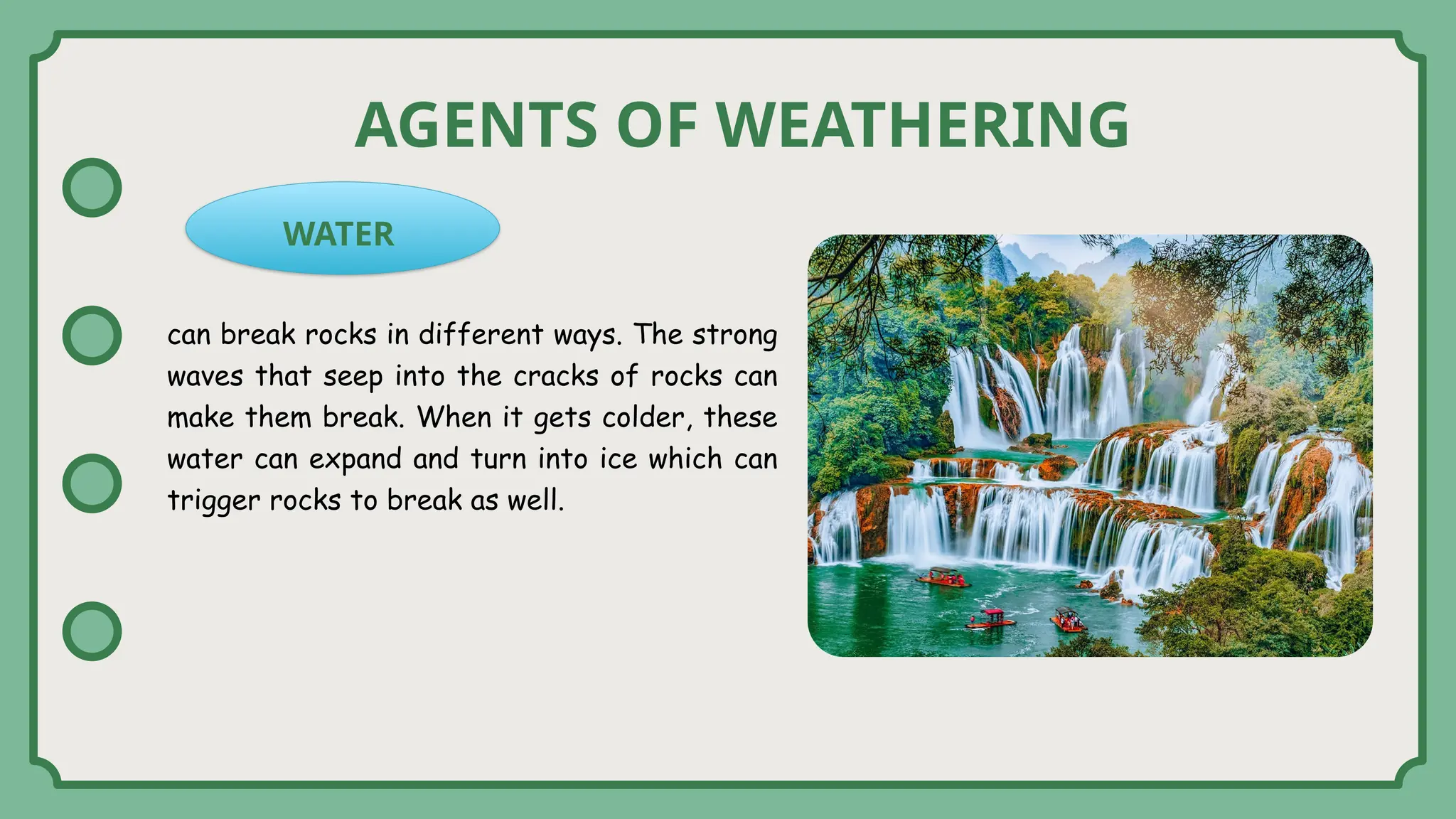
WATER
can break rocks in different ways. The strong
waves that seep into the cracks of rocks can
make them break. When it gets colder, these
water can expand and turn into ice which can
trigger rocks to break as well.
WIND
causes beautiful formations like the Mahayaw
Arch in Sabtang Island, Batanes, Philippines.
As the wind blows, it carries sand or small
rock particles that scratch the rocks’
surface. This can bring about mechanical
weathering which can also result to different
rock formations.
When rocks are exposed to varying temperature, it expands.
If rocks are exposed to a low temperature, it contracts. The
repeated expansion and contraction of rocks due to changes in
temperature results in weathering.
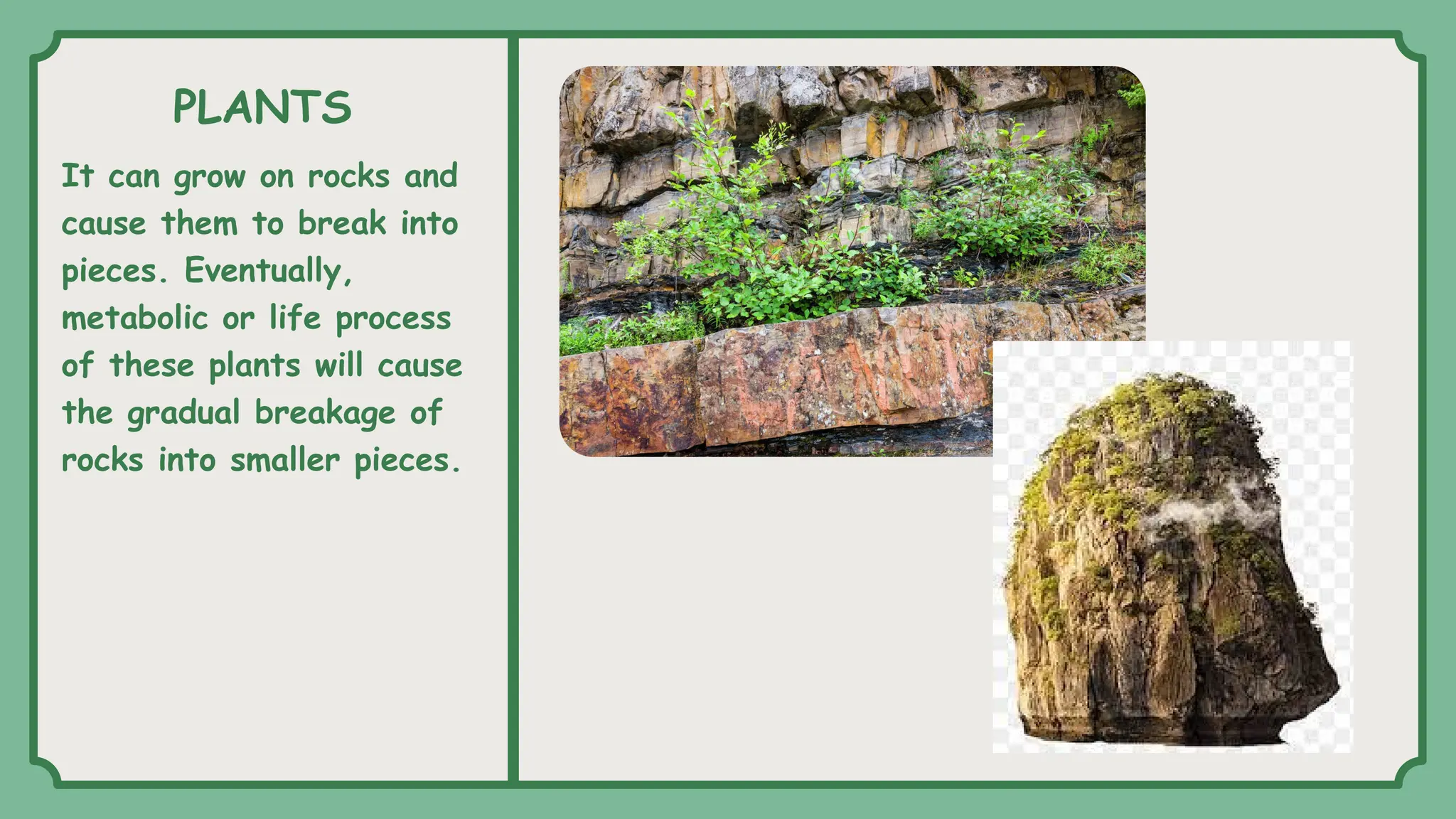
PLANTS
It can grow on rocks and
cause them to break into
pieces. Eventually,
metabolic or life process
of these plants will cause
the gradual breakage of
rocks into smaller pieces.
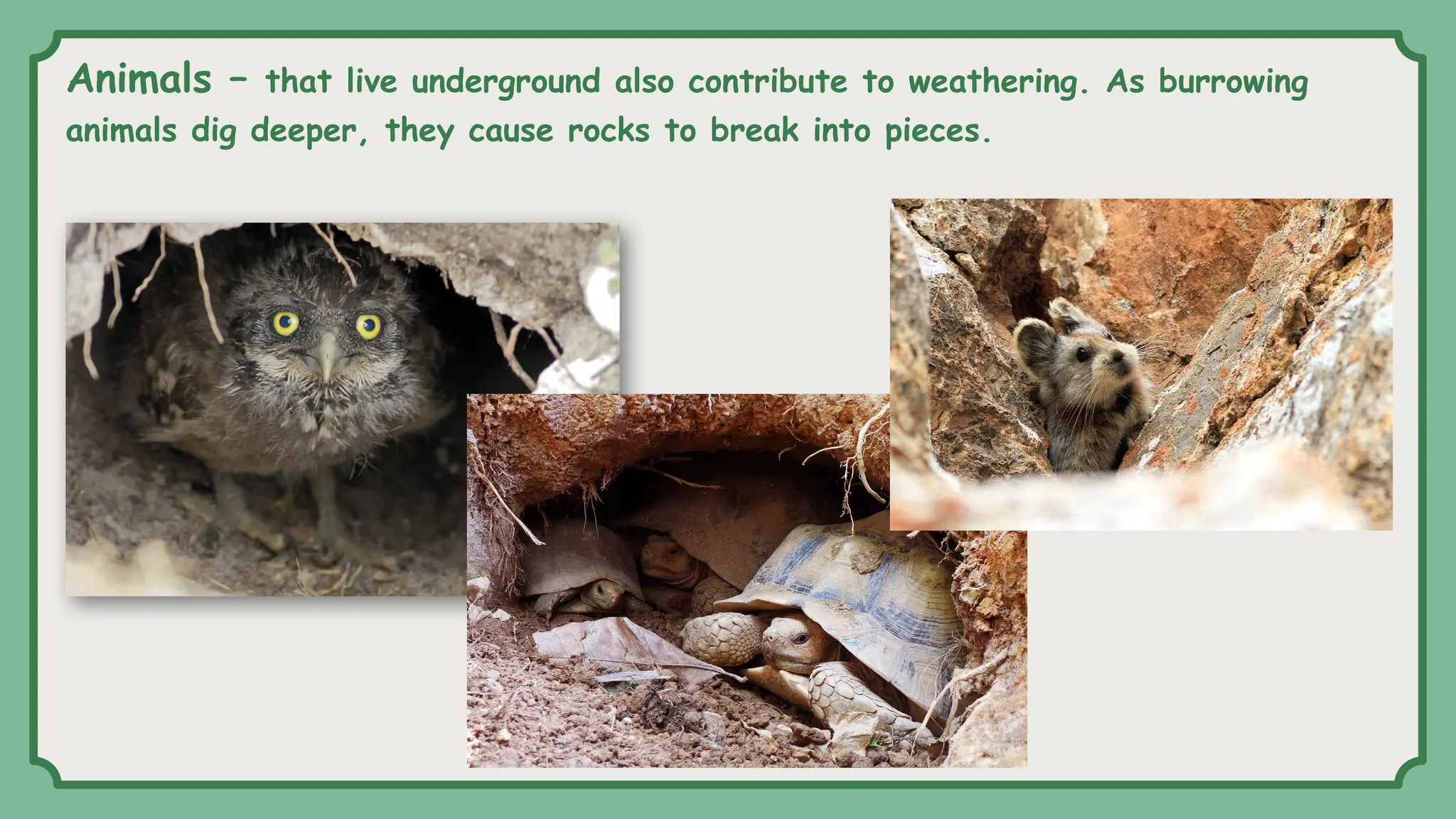
Animals – that live underground also contribute to weathering. As burrowing
animals dig deeper, they cause rocks to break into pieces.
Humans
• subdivision developers use bulldozers to flatten mountains or hills.
• some construction workers use jackhammer to break boulders of
rocks as they repair roads.
• Mining companies extract stones or rocks from a quarry or an open-pit mine.
• Some human miners throw dynamites and other explosives on quarry sites to
get more rocks or stones which can trigger landslides.
Learning Task 1
Use a Venn Diagram to compare and contrast mechanical
and chemical weathering.
Mechanical
weathering is a
physical wearing
away of rocks
without any change
in their chemical
nature
Processes that wear
away rocks into soil
Chemical weathering
involves change in
the composition of
rocks that allows
them to break down
into pieces.
Learning Task 2
Identify the change happening in each situation. Draw a heart
eyes emoji if the change is an example of mechanical
weathering and wow emoji if it is an example of chemical
weathering.
1. A boulder of shore is slowly broken apart by the force of
water.
2. Earthworm makes tunnels in the ground which may lead to the
breakdown of stones and rocks.
3. Some plants release chemicals which loosen the rocks and
cause them to break.
4. Water inside the rocks freezes and melts again.
5. The chemical composition of rocks changes when acid is
produced by the roots of some plants.
Learning Task 2
Identify the change happening in each situation. Draw a heart eyes
emoji if the change is an example of mechanical weathering and
wow emoji if it is an example of chemical weathering.
6. Minerals in rocks dissolve.
7. Tree roots can grow into cracks and break rock apart.
8. As the wind blows, it carries sand or small rock particles that
scratch the rock’s surface.
9. As the rocks expand, the cracks become deeper and new cracks
are produced.
10. Rocks exposed to the intense heat of the sun crack and crumble
when rain falls or soak in the ground.
Learning Task 3
Read each question carefully. Write the letter of the correct answer.
1. It is the breaking of rocks into fragments.
a. erosion
b. flooding
c. weathering
d. runoff
2. A type of weathering that involves change in the composition of the
rock.
a. chemical
b. mechanical
c. both chemical and mechanical
d. electrical
Learning Task 3
Read each question carefully. Write the letter of the correct answer.
3. It is open-pit mine where rocks can be extracted.
a. landfill
b. reservoir
c. open-field
d. quarry
4. Which of the following tends to cause physical or mechanical
weathering?
a. animal that burrow in the ground.
b. root of plants growing into the cracks in the rocks.
c. water that seeps into the pores and cracks of rocks
d. all of these
This presentation template is free for everyone to use thanks to the
following:
• SlidesCarnival for the presentation template
• Pexels for the photos
Happy designing!
Credits
Write a closing statement
or call-to-action here.
Than
k
you
Get In
Touch
Email
hello@reallygreatsite.co
m
Social Media
@reallygreatsite
Call us
123-456-7890
Add a Team Members Page
Elaborate on what you want to discuss.
Name
Title or Position
Name
Title or Position
Name
Title or Position
Name
Title or Position
This presentation template is free for everyone to use thanks to the
following:
• SlidesCarnival for the presentation template
• Pexels for the photos
Happy designing!
Credits
Fonts In this
Presentation
You can find these fonts online too.
This presentation template
uses the following free fonts:
Titles: Sriracha
Headers: Sriracha
Body Copy: Source Sans Pro
Happy
designing!
Add a Timeline Page
Add a main point
Elaborate on what
you want to discuss.
Add a main point
Elaborate on what
you want to discuss.
Add a main point
Elaborate on what
you want to discuss.
Add a main point
Elaborate on what
you want to discuss.
S
STRENGTHS
What are you doing well?
What sets you apart?
What are your good qualities?
W
WEAKNESSES
Where do you need to
improve?
Are resources adequate?
What do others do
better than you?
O
OPPORTUNITIES
What are your goals?
Are demands shifting?
How can it be improved?
T
THREATS
What are the blockers
you're facing?
What are factors outside
of your control?
Item
1
Item
2
Item
3
Item
4
Item
5
50
40
30
20
10
0
Write Your
Topic or Idea
Elaborate on what you want to discuss.
Add a Chart
Page
Name
Title or Position
Name
Title or Position
Name
Title or Position
Name
Title or Position
Name
Title or Position
Name
Title or Position
Name
Title or Position
Use these design resources
in your Canva
Presentation.
Happy designing!
Don't forget to delete this
page before presenting.
Resource
Page
Use these design resources
in your Canva
Presentation.
Happy designing!
Don't forget to delete this
page before presenting.
Resource
Page
Free templates for all your presentation needs
For PowerPoint,
Google Slides, and Canva
100% free for personal
or commercial use
Ready to use,
professional,
and customizable
Blow your audience away
with attractive visuals

Weathering for Grade 5 Learners Science.pptx

  • 1.
  • 2.
     is mainlycomposed of rocks that differ in terms of sizes, shapes, and colors. Though rocks seem to be very hard, dense and indestructible, they still break. Rocks are broken down into smaller pieces by the effects of weather. These pieces do not move to a new location, they simply breakdown but remain next to one another.  The breaking of rocks into fragments is known as weathering. Earth
  • 4.
    Weathering  is animportant process that helps shape the Earth’s surface. The breaking of rocks result in the formation of soil and different landforms. This is also the reason why we have amazing rock formations.
  • 5.
    Mechanical weathering –is a physical wearing away of rocks without any change in their chemical nature.
  • 6.
    Chemical weathering –involves a change in the composition of rocks that allows them to break down into pieces.
  • 7.
    AGENTS OF WEATHERING WATER canbreak rocks in different ways. The strong waves that seep into the cracks of rocks can make them break. When it gets colder, these water can expand and turn into ice which can trigger rocks to break as well.
  • 8.
    WIND causes beautiful formationslike the Mahayaw Arch in Sabtang Island, Batanes, Philippines. As the wind blows, it carries sand or small rock particles that scratch the rocks’ surface. This can bring about mechanical weathering which can also result to different rock formations.
  • 9.
    When rocks areexposed to varying temperature, it expands. If rocks are exposed to a low temperature, it contracts. The repeated expansion and contraction of rocks due to changes in temperature results in weathering.
  • 10.
    PLANTS It can growon rocks and cause them to break into pieces. Eventually, metabolic or life process of these plants will cause the gradual breakage of rocks into smaller pieces.
  • 11.
    Animals – thatlive underground also contribute to weathering. As burrowing animals dig deeper, they cause rocks to break into pieces.
  • 12.
    Humans • subdivision developersuse bulldozers to flatten mountains or hills. • some construction workers use jackhammer to break boulders of rocks as they repair roads. • Mining companies extract stones or rocks from a quarry or an open-pit mine. • Some human miners throw dynamites and other explosives on quarry sites to get more rocks or stones which can trigger landslides.
  • 13.
    Learning Task 1 Usea Venn Diagram to compare and contrast mechanical and chemical weathering. Mechanical weathering is a physical wearing away of rocks without any change in their chemical nature Processes that wear away rocks into soil Chemical weathering involves change in the composition of rocks that allows them to break down into pieces.
  • 14.
    Learning Task 2 Identifythe change happening in each situation. Draw a heart eyes emoji if the change is an example of mechanical weathering and wow emoji if it is an example of chemical weathering. 1. A boulder of shore is slowly broken apart by the force of water. 2. Earthworm makes tunnels in the ground which may lead to the breakdown of stones and rocks. 3. Some plants release chemicals which loosen the rocks and cause them to break. 4. Water inside the rocks freezes and melts again. 5. The chemical composition of rocks changes when acid is produced by the roots of some plants.
  • 15.
    Learning Task 2 Identifythe change happening in each situation. Draw a heart eyes emoji if the change is an example of mechanical weathering and wow emoji if it is an example of chemical weathering. 6. Minerals in rocks dissolve. 7. Tree roots can grow into cracks and break rock apart. 8. As the wind blows, it carries sand or small rock particles that scratch the rock’s surface. 9. As the rocks expand, the cracks become deeper and new cracks are produced. 10. Rocks exposed to the intense heat of the sun crack and crumble when rain falls or soak in the ground.
  • 16.
    Learning Task 3 Readeach question carefully. Write the letter of the correct answer. 1. It is the breaking of rocks into fragments. a. erosion b. flooding c. weathering d. runoff 2. A type of weathering that involves change in the composition of the rock. a. chemical b. mechanical c. both chemical and mechanical d. electrical
  • 17.
    Learning Task 3 Readeach question carefully. Write the letter of the correct answer. 3. It is open-pit mine where rocks can be extracted. a. landfill b. reservoir c. open-field d. quarry 4. Which of the following tends to cause physical or mechanical weathering? a. animal that burrow in the ground. b. root of plants growing into the cracks in the rocks. c. water that seeps into the pores and cracks of rocks d. all of these
  • 18.
    This presentation templateis free for everyone to use thanks to the following: • SlidesCarnival for the presentation template • Pexels for the photos Happy designing! Credits
  • 19.
    Write a closingstatement or call-to-action here. Than k you
  • 20.
  • 21.
    Add a TeamMembers Page Elaborate on what you want to discuss. Name Title or Position Name Title or Position Name Title or Position Name Title or Position
  • 22.
    This presentation templateis free for everyone to use thanks to the following: • SlidesCarnival for the presentation template • Pexels for the photos Happy designing! Credits
  • 23.
    Fonts In this Presentation Youcan find these fonts online too. This presentation template uses the following free fonts: Titles: Sriracha Headers: Sriracha Body Copy: Source Sans Pro Happy designing!
  • 24.
    Add a TimelinePage Add a main point Elaborate on what you want to discuss. Add a main point Elaborate on what you want to discuss. Add a main point Elaborate on what you want to discuss. Add a main point Elaborate on what you want to discuss.
  • 25.
    S STRENGTHS What are youdoing well? What sets you apart? What are your good qualities? W WEAKNESSES Where do you need to improve? Are resources adequate? What do others do better than you? O OPPORTUNITIES What are your goals? Are demands shifting? How can it be improved? T THREATS What are the blockers you're facing? What are factors outside of your control?
  • 26.
  • 27.
    Add a Chart Page Name Titleor Position Name Title or Position Name Title or Position Name Title or Position Name Title or Position Name Title or Position Name Title or Position
  • 28.
    Use these designresources in your Canva Presentation. Happy designing! Don't forget to delete this page before presenting. Resource Page
  • 29.
    Use these designresources in your Canva Presentation. Happy designing! Don't forget to delete this page before presenting. Resource Page
  • 30.
    Free templates forall your presentation needs For PowerPoint, Google Slides, and Canva 100% free for personal or commercial use Ready to use, professional, and customizable Blow your audience away with attractive visuals