Identify Types of motion
Q3 Week 1 Day 1
Source: DepEd Teachers Club
File Created by : Ma’am IRENE A. MANZANERO
PPt created by : PRECILA R. UMALI
Santa Rosa City Laguna
Review
What is energy?
What are the two types of energy?
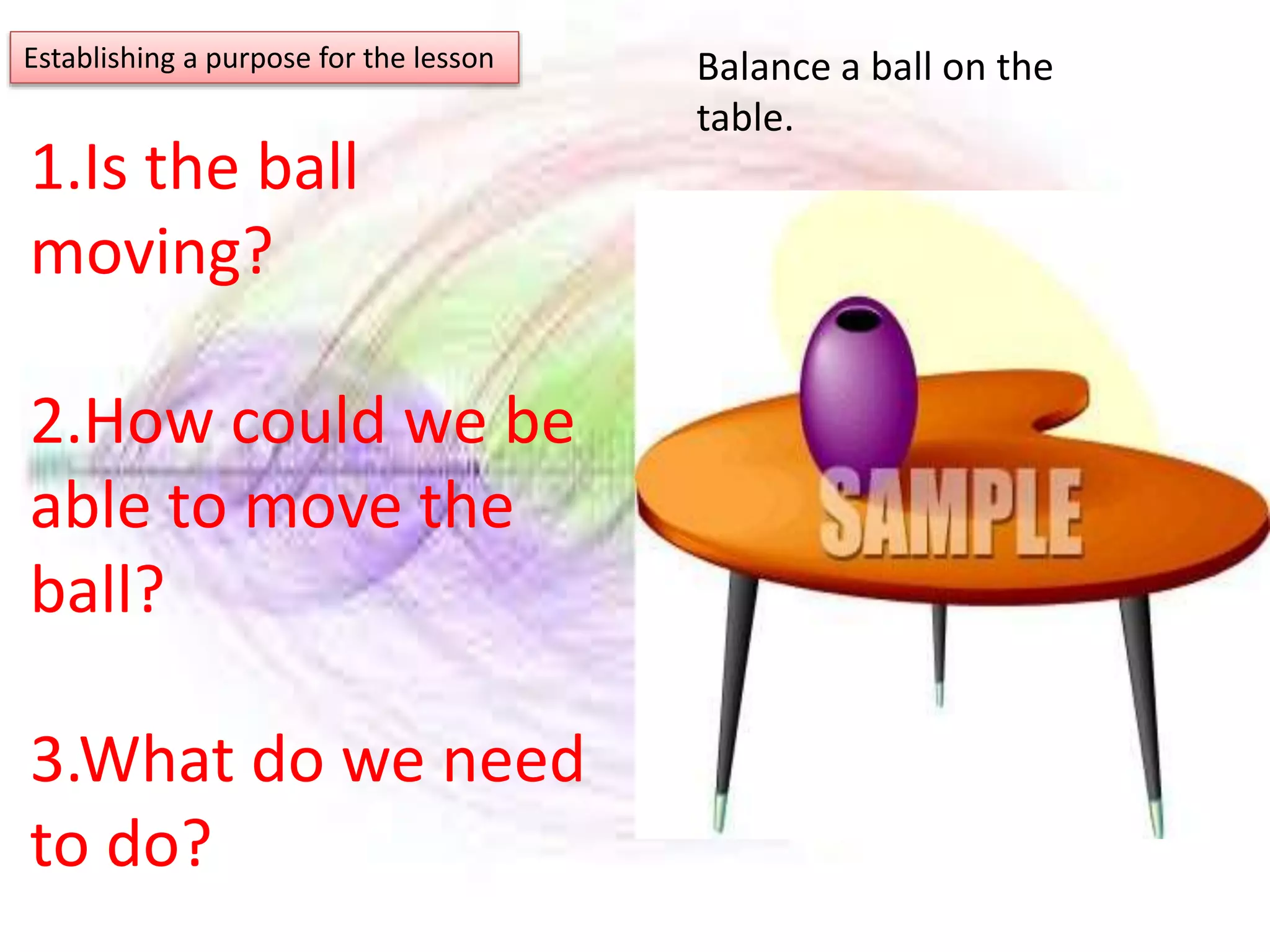
Establishing a purpose for the lesson Balance a ball on the
table.
1.Is the ball
moving?
2.How could we be
able to move the
ball?
3.What do we need
to do?
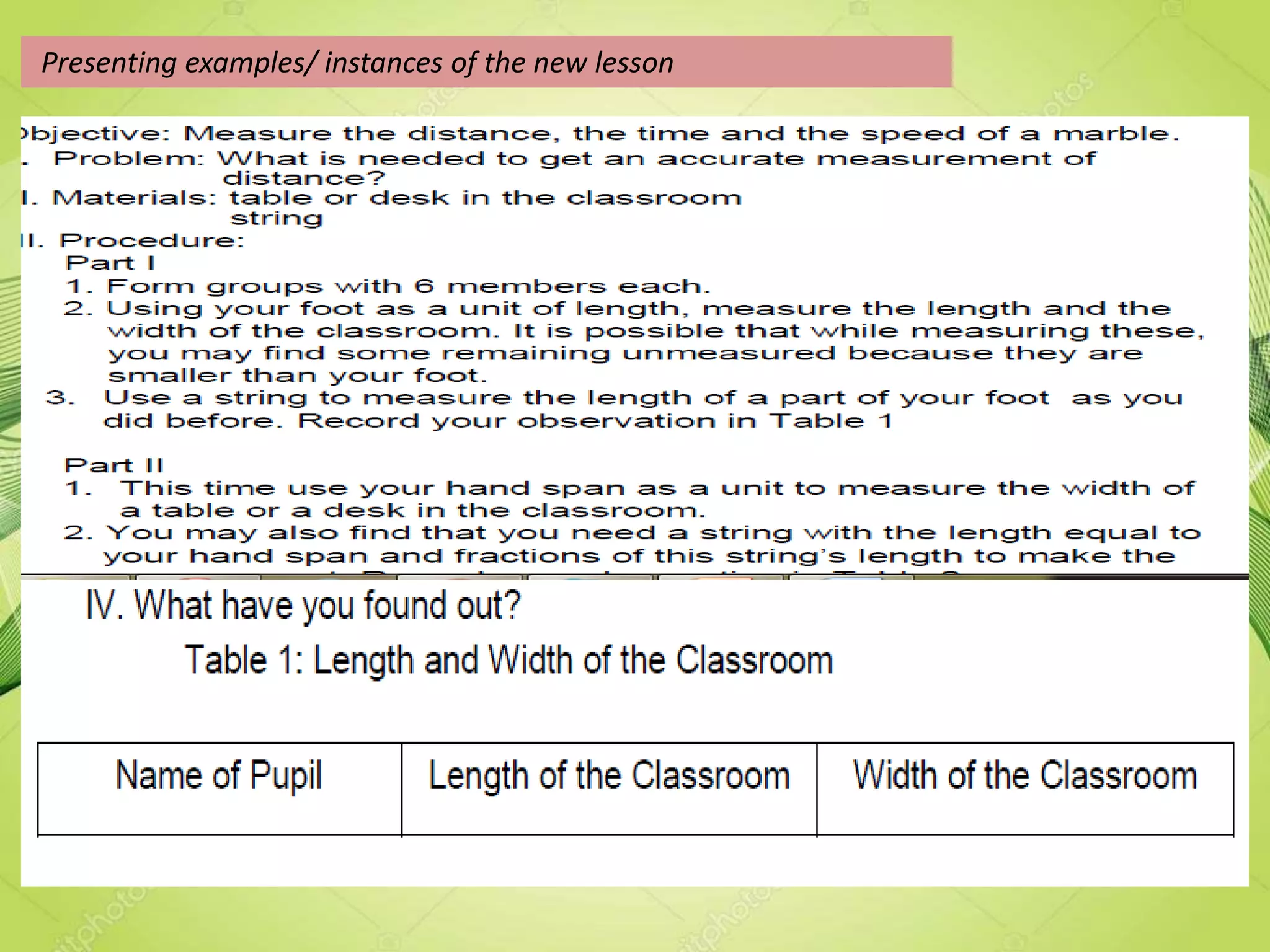
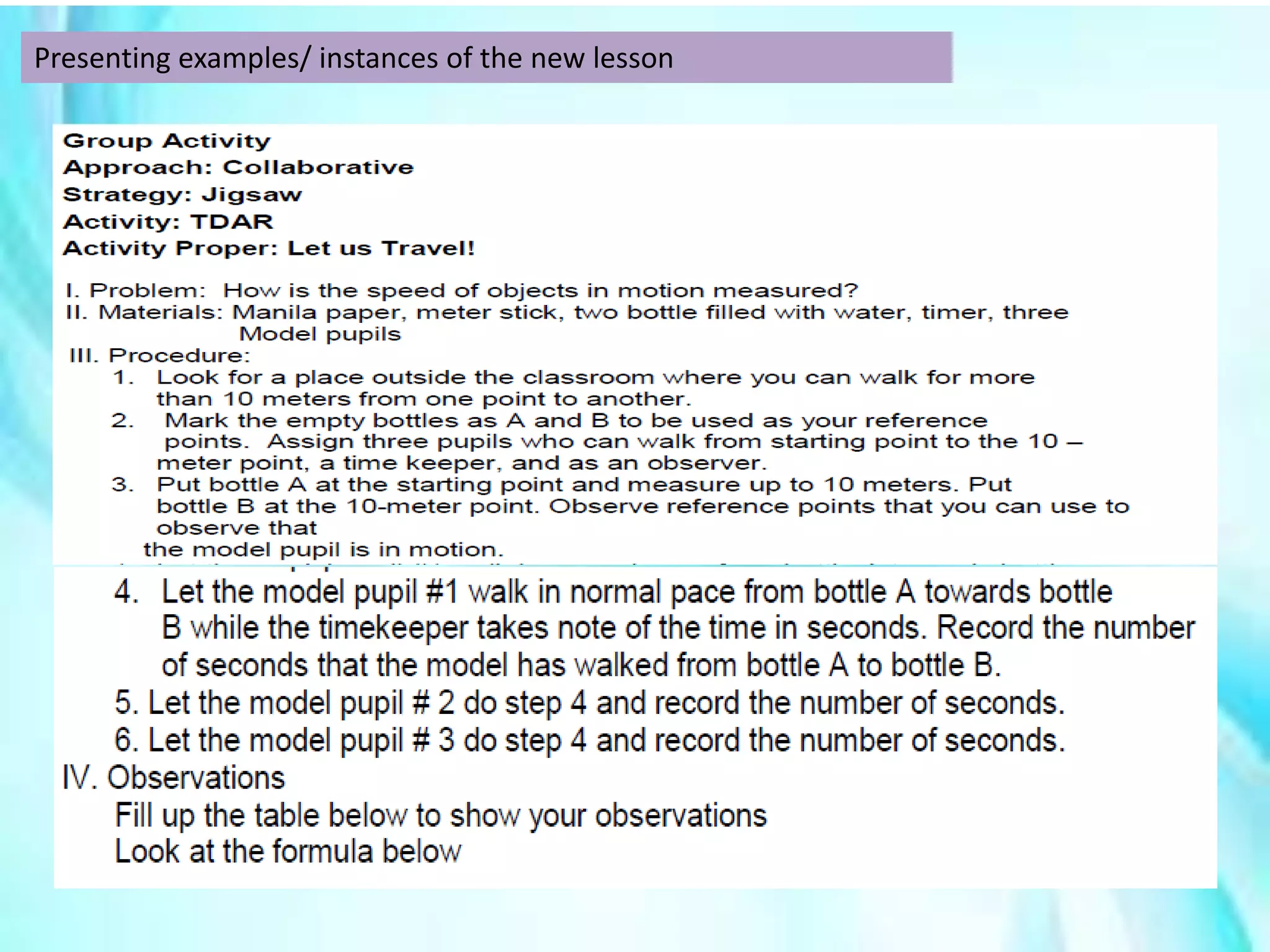
Presenting examples/ instances of the new lesson
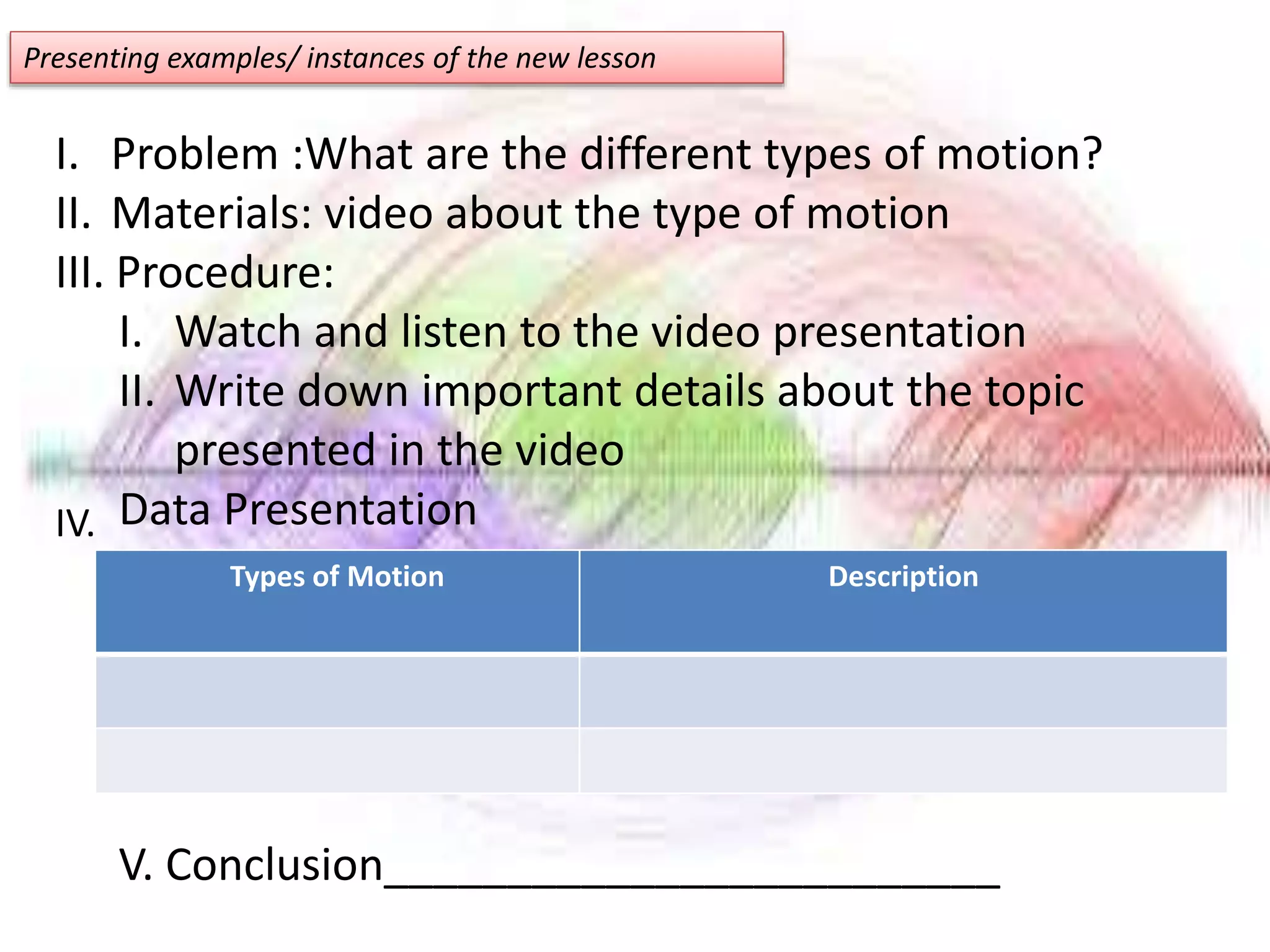
I. Problem :What are the different types of motion?
II. Materials: video about the type of motion
III. Procedure:
I. Watch and listen to the video presentation
II. Write down important details about the topic
presented in the video
Data Presentation
V. Conclusion_________________________
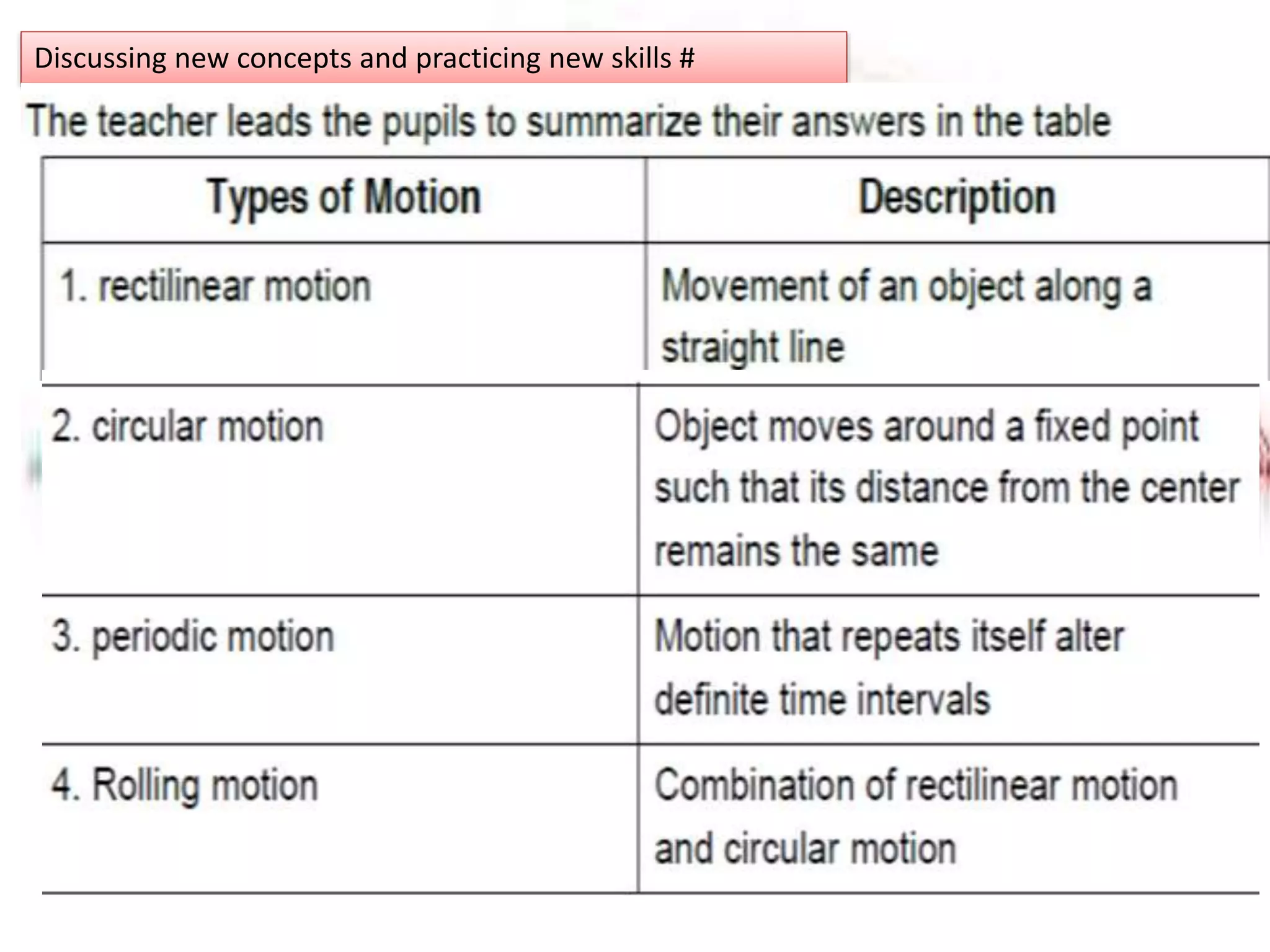
Types of Motion Description
IV.
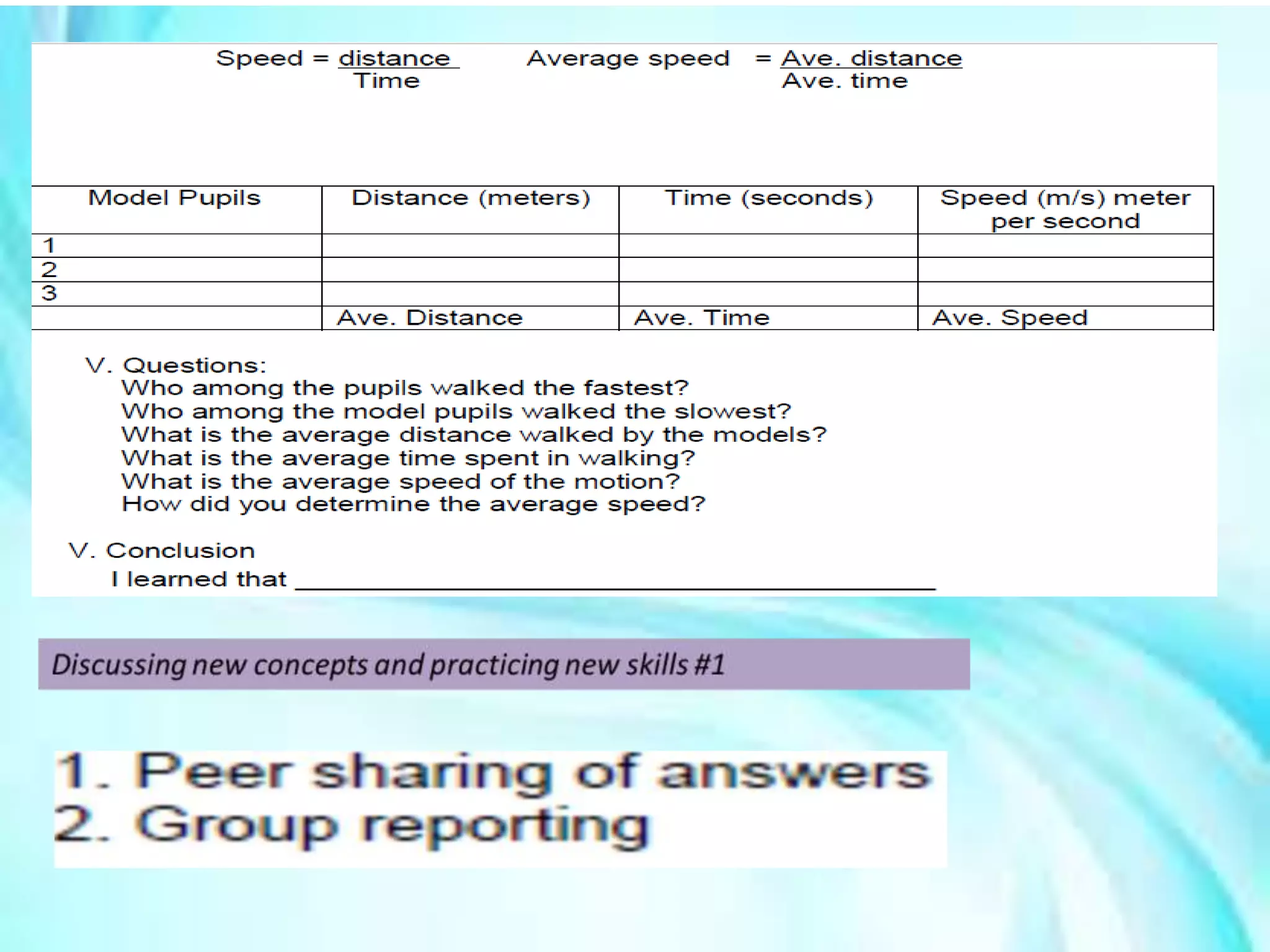
Discussing new concepts and practicing new skills #1
1. Peer sharing
2. Checking of worksheets
3. Verifying the results by replaying the video and
pause in each type of motion.
Discussing new concepts and practicing new skills #
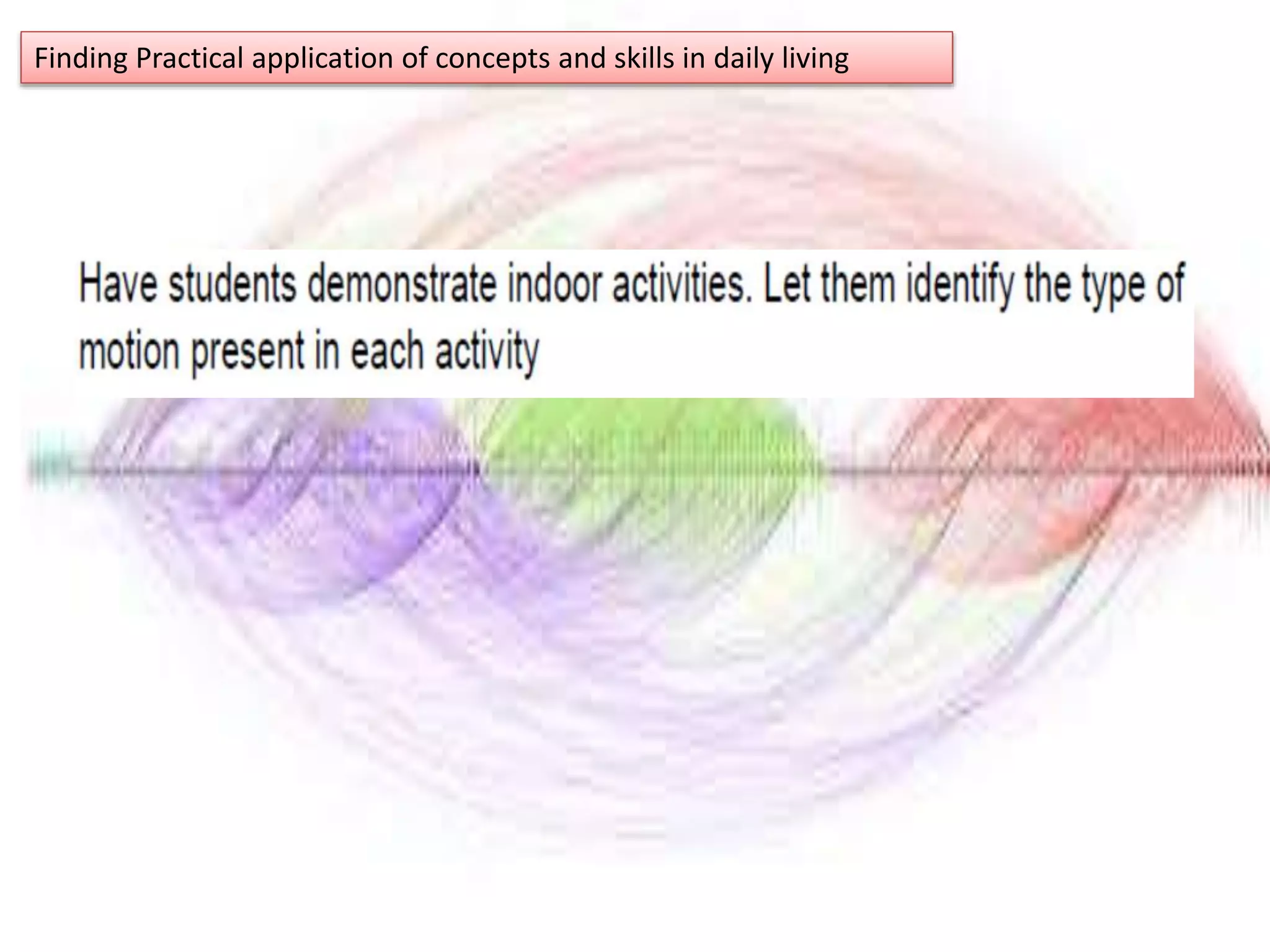
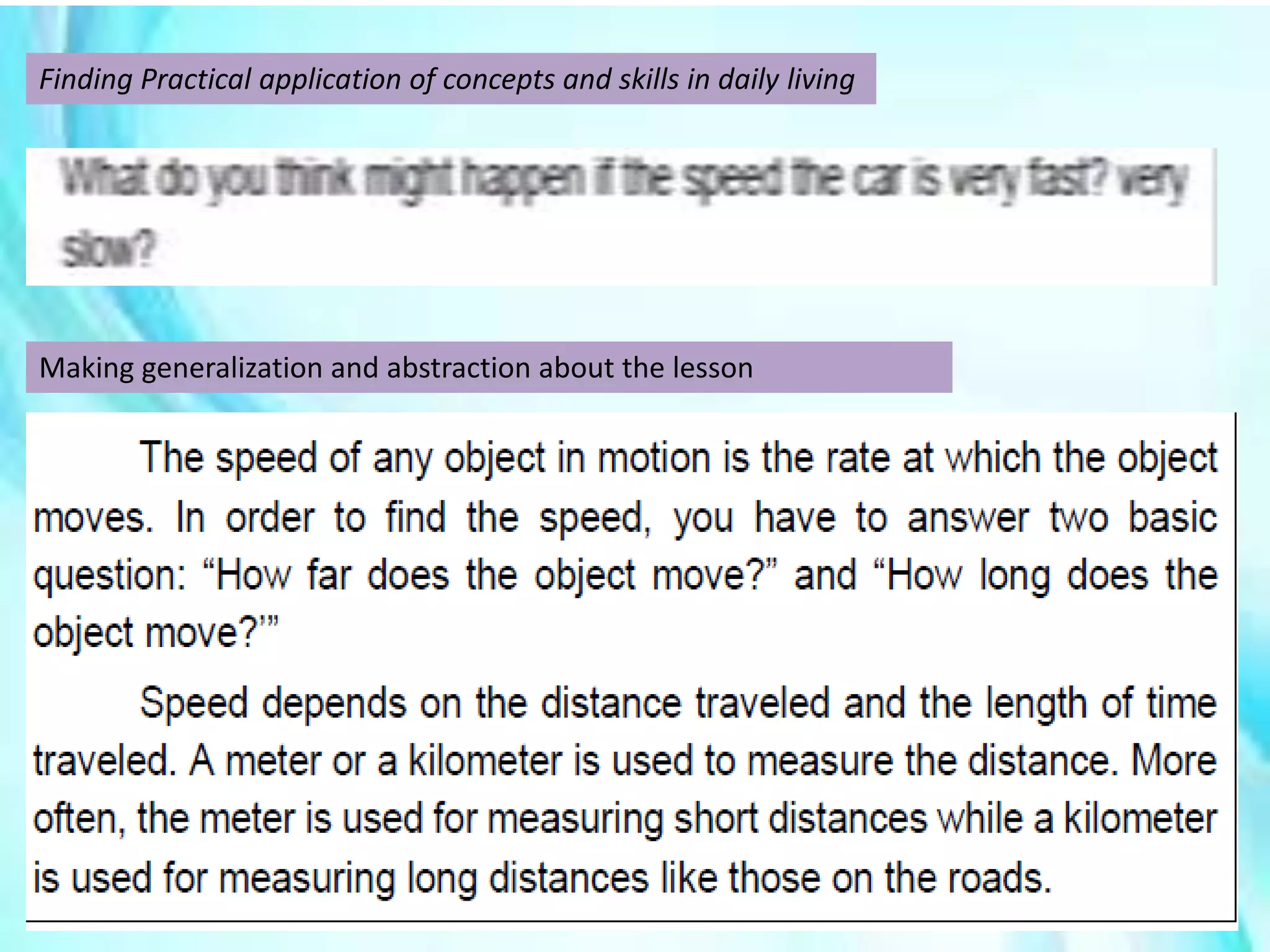
Finding Practical application of concepts and skills in daily living
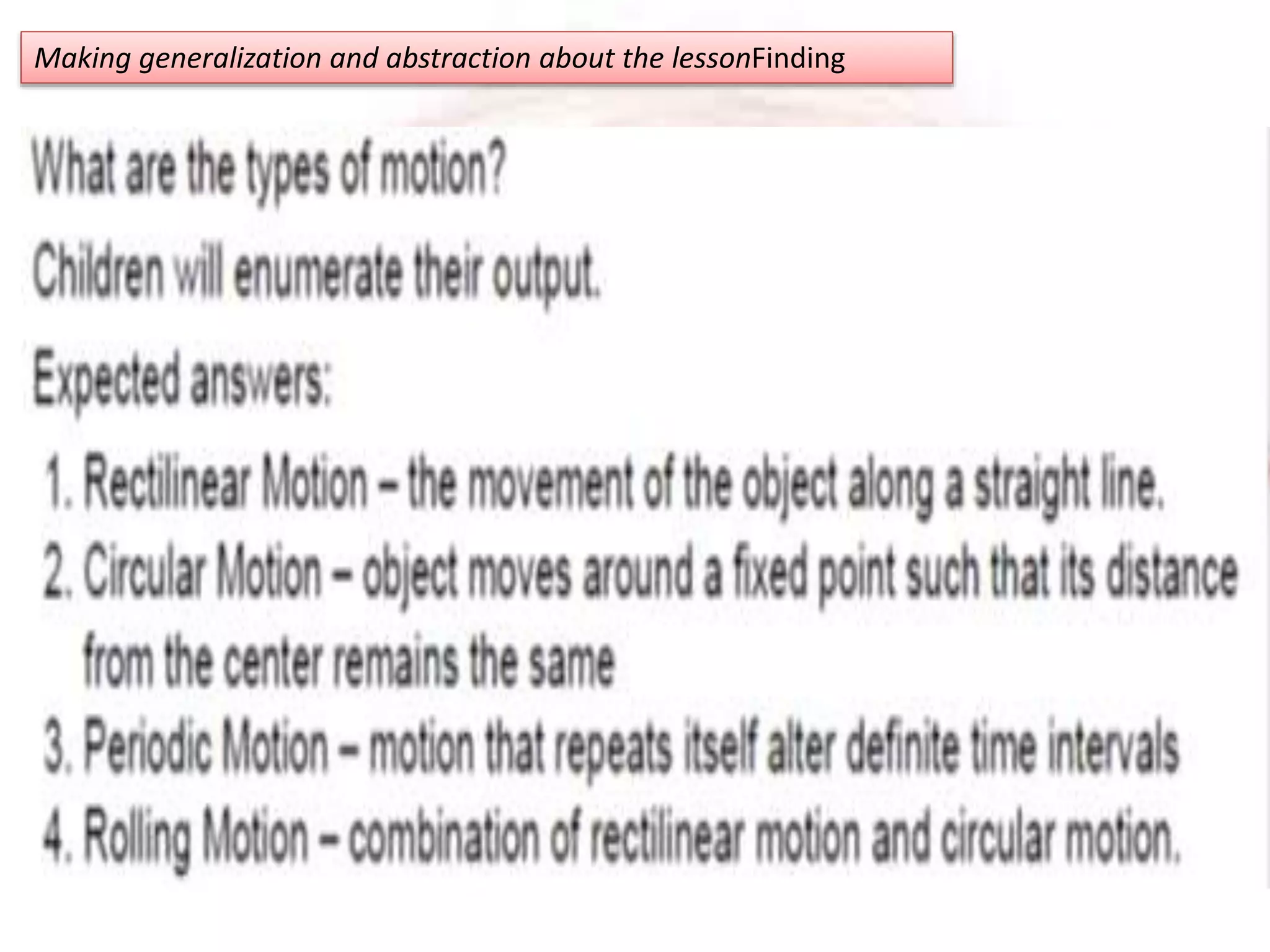
Making generalization and abstraction about the lessonFinding
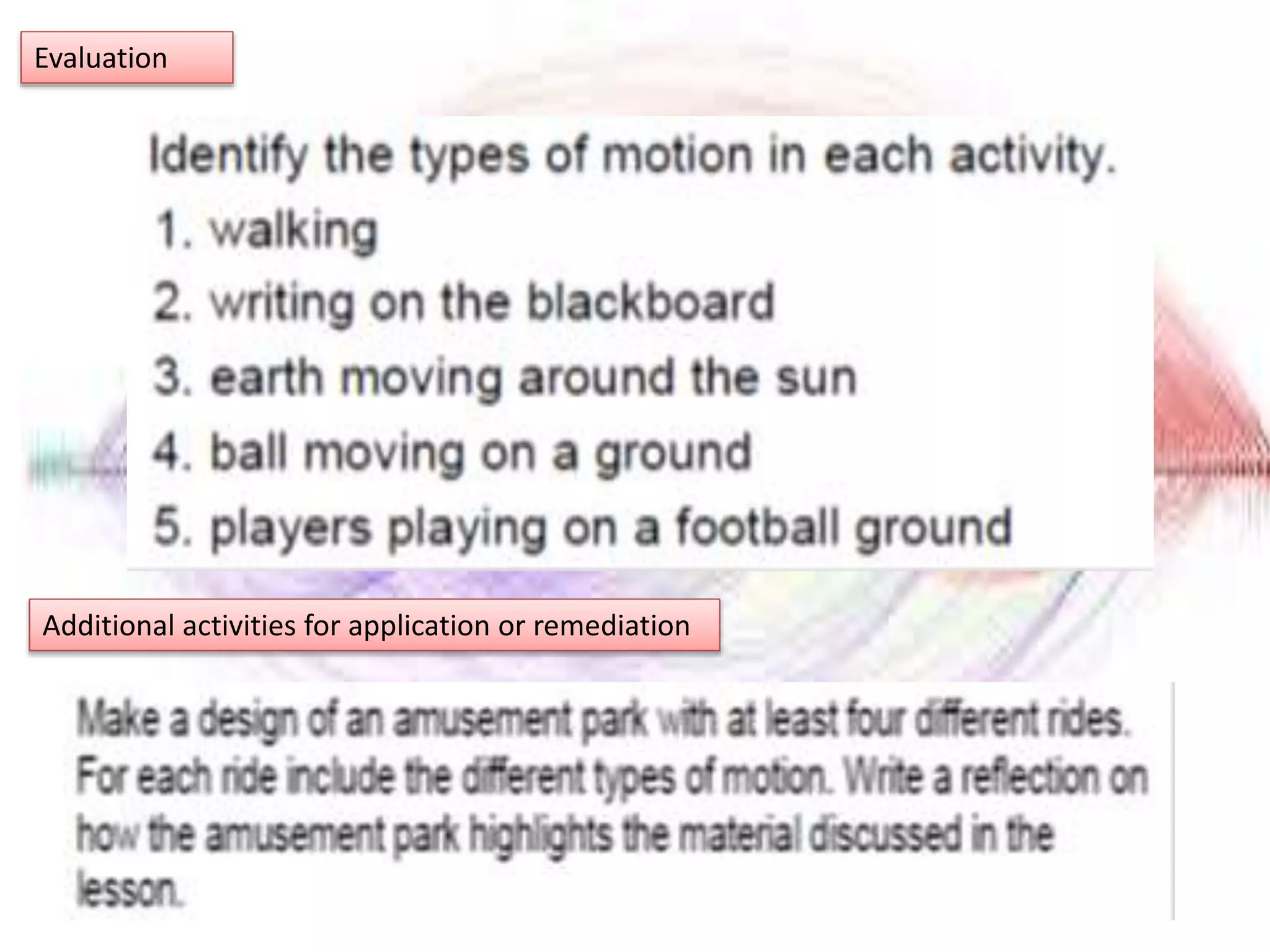
Evaluation
Additional activities for application or remediation
Q3 Week 1 day 2
Enumerate factors affecting motion
Source: DepEd Teachers Club
File Created by : Ma’am IRENE A. MANZANERO
PPt created by : PRECILA R. UMALI
Santa Rosa City Laguna
Review
Establishing a purpose for the lesson
Presenting examples/ instances of the new lesson
Discussing new concepts and practicing new skills #1
Discussing new concepts and practicing new skills
Finding Practical application of concepts and skills in daily living
fric·tion (frĭk′shən) ,noun
1. The rubbing of one object or surface against
another.
2. Conflict, as between persons having dissimilar
ideas or interests; clash.
3. Physics A force that resists the relative motion or
tendency to such motion of two bodies or
substances in contact.
Making generalization and abstraction about the lesson
Evaluation
Q3 Week 1 day 3
Give example of standard units in measuring
time and distance of objects in motion
Source: DepEd Teachers Club
File Created by : Ma’am IRENE A. MANZANERO
PPt created by : PRECILA R. UMALI
Santa Rosa City
Laguna
Review
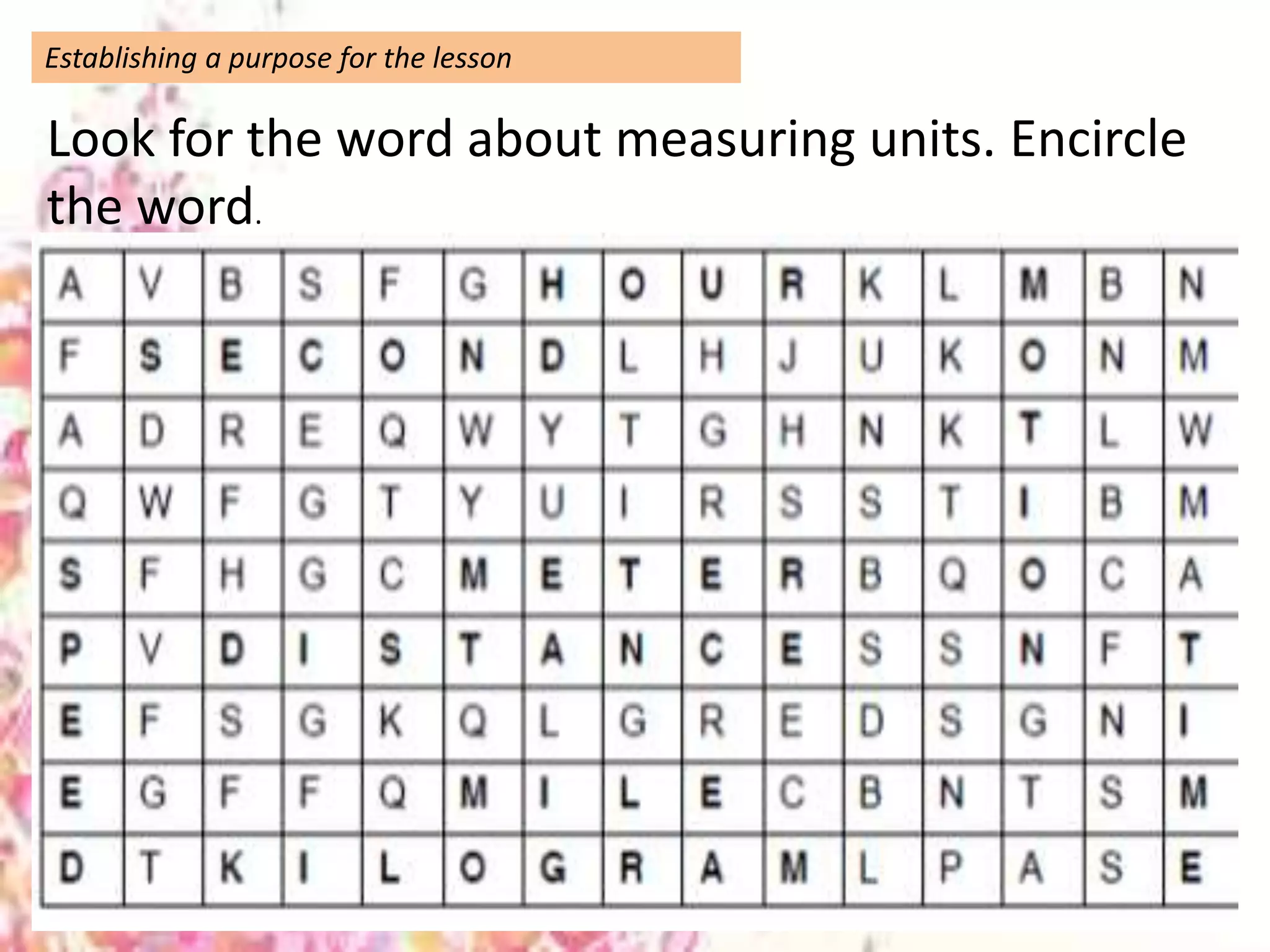
Establishing a purpose for the lesson
Look for the word about measuring units. Encircle
the word.
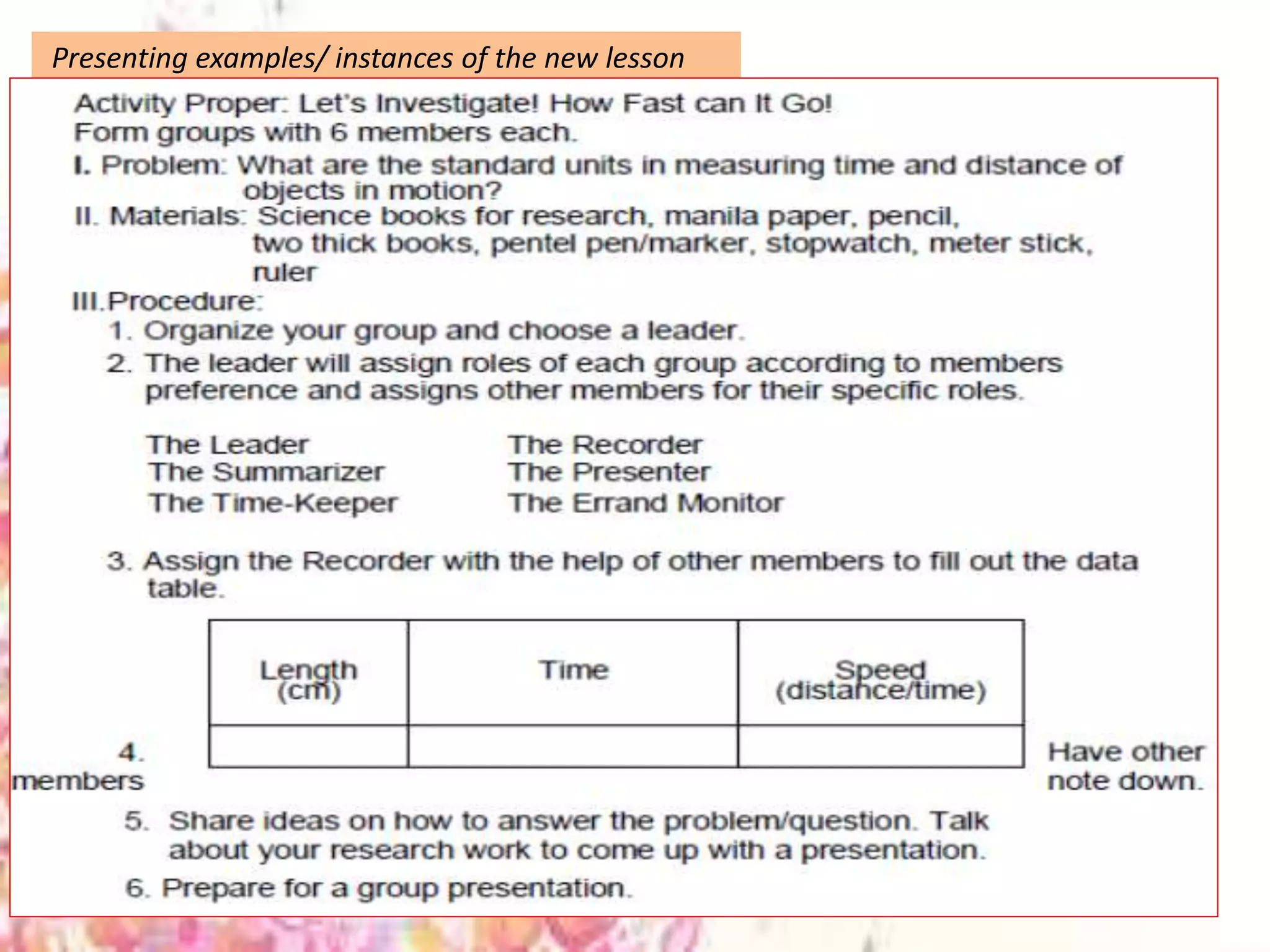
Presenting examples/ instances of the new lesson
Discussing new concepts and practicing new skills #1
Developing Mastery
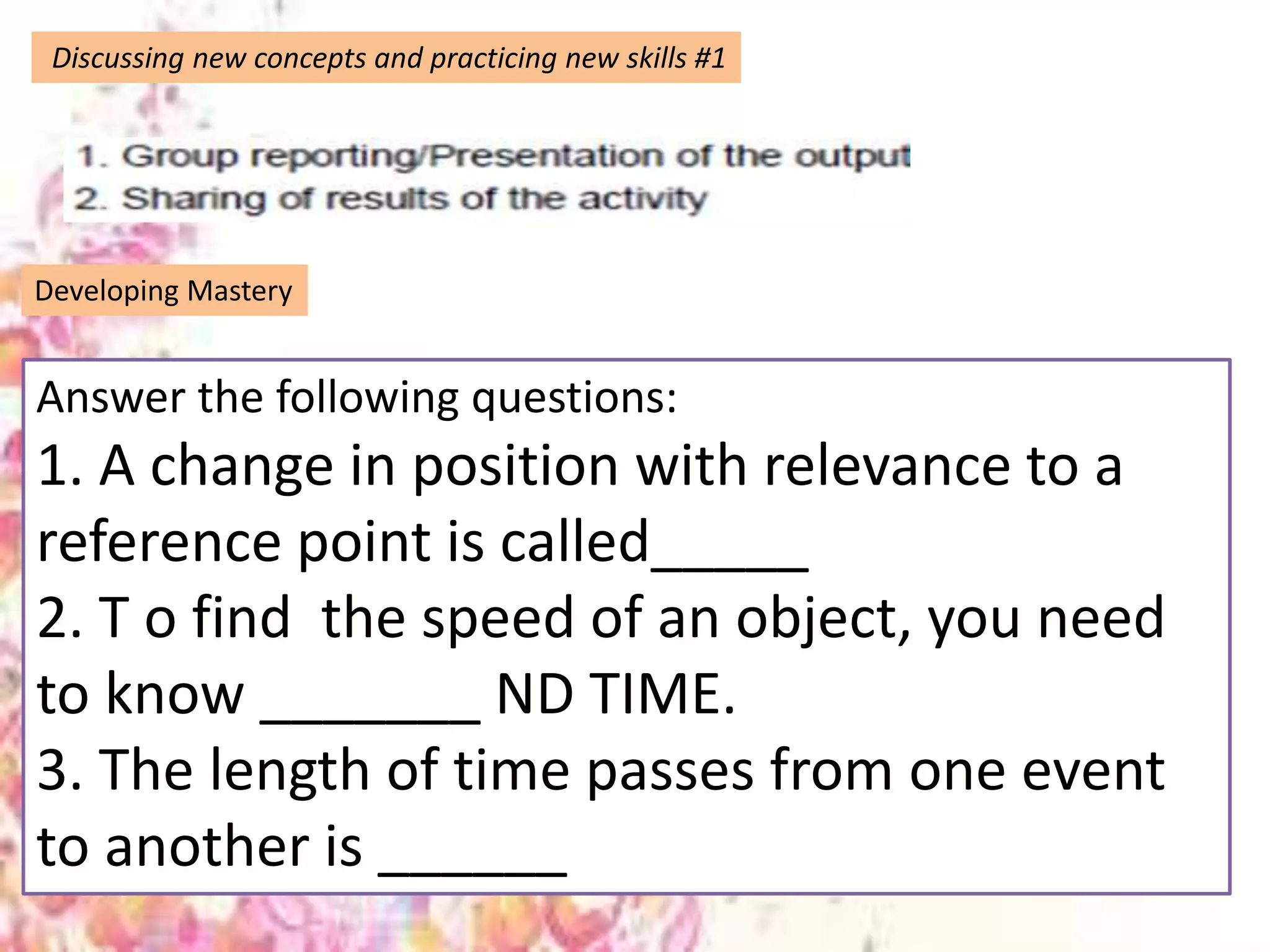
Answer the following questions:
1. A change in position with relevance to a
reference point is called_____
2. T o find the speed of an object, you need
to know _______ ND TIME.
3. The length of time passes from one event
to another is ______
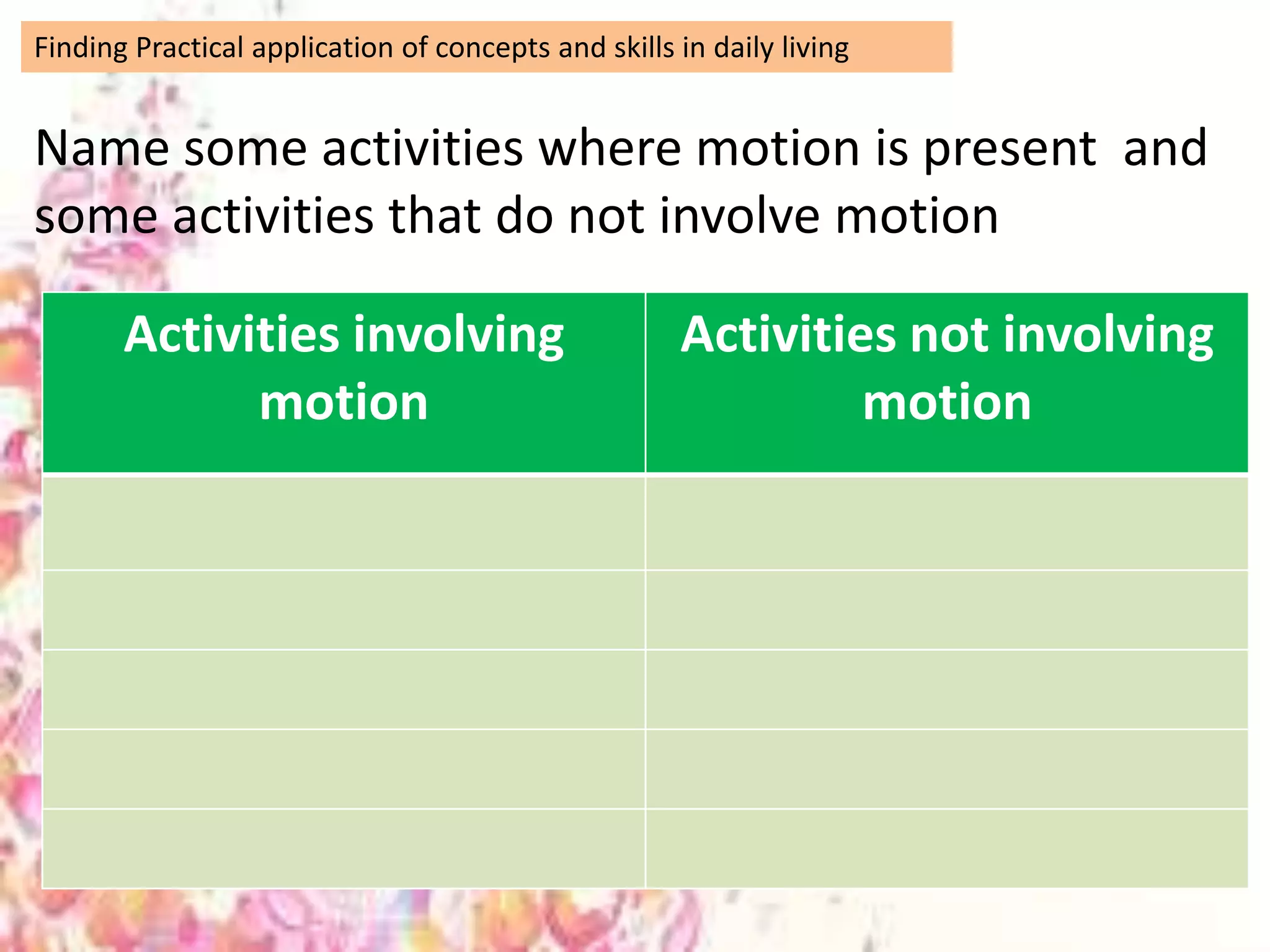
Finding Practical application of concepts and skills in daily living
Name some activities where motion is present and
some activities that do not involve motion
Activities involving
motion
Activities not involving
motion
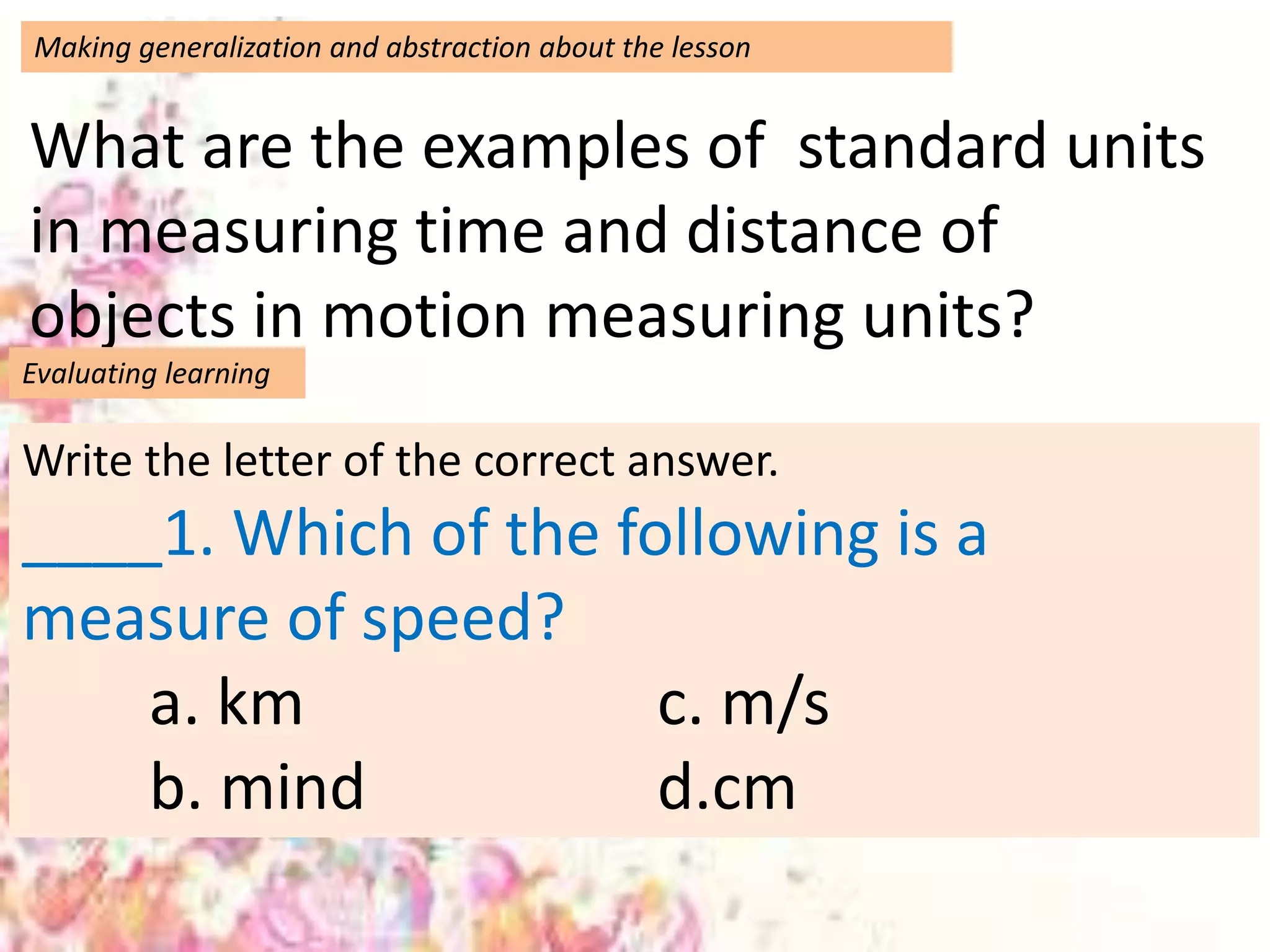
Making generalization and abstraction about the lesson
What are the examples of standard units
in measuring time and distance of
objects in motion measuring units?
Evaluating learning
Write the letter of the correct answer.
____1. Which of the following is a
measure of speed?
a. km c. m/s
b. mind d.cm
___2.Which is an ideal reference point?
a. a colored object
b. a non moving landmark
c. a person running
d. a cloud in the sky
__3. Riza is walking along a sidewalk.
Which of the following sentences is true?
a. Riza is moving with respect to the
building at the corner?
b. Riza is moving with respect to
another person who is walking beside
her.
c. Riza is not moving with respect to
the sidewalk.
d. Riza is not moving with respect to
the sun.
__4. What is elapsed time?
a. It is the time from sun up to sun
down.
b. It is the time between two
specific events.
c. It is the final recorded time.
d. It is the initial recorded time.
__5. A biker covers a distance of 150 km
in five hours. What is the biker’s
speed?
a. 15km/h
b. 30 km/h
c. 45 km/h
d. 60 km/h
Assignment
Q3 Week 1 day 4
Identify appropriate measuring tools
in measuring time and distance of
objects in motion.
Source: DepEd Teachers Club
File Created by : Ma’am IRENE A. MANZANERO
PPt created by : PRECILA R. UMALI
Santa Rosa City Laguna
Review
Establishing a purpose for the lesson
Presenting examples/ instances of the new lesson
Discussing new concepts and practicing new skill 1
Developing Mastery
Finding Practical application of concepts and skills in daily living
Making generalization and abstraction about the lesson
Evaluation
Write T if the statement is True and F if it is False.
__1. Acceleration can’t take place
without a force.
__2. The acceleration is less when the
mass of the object is greater.
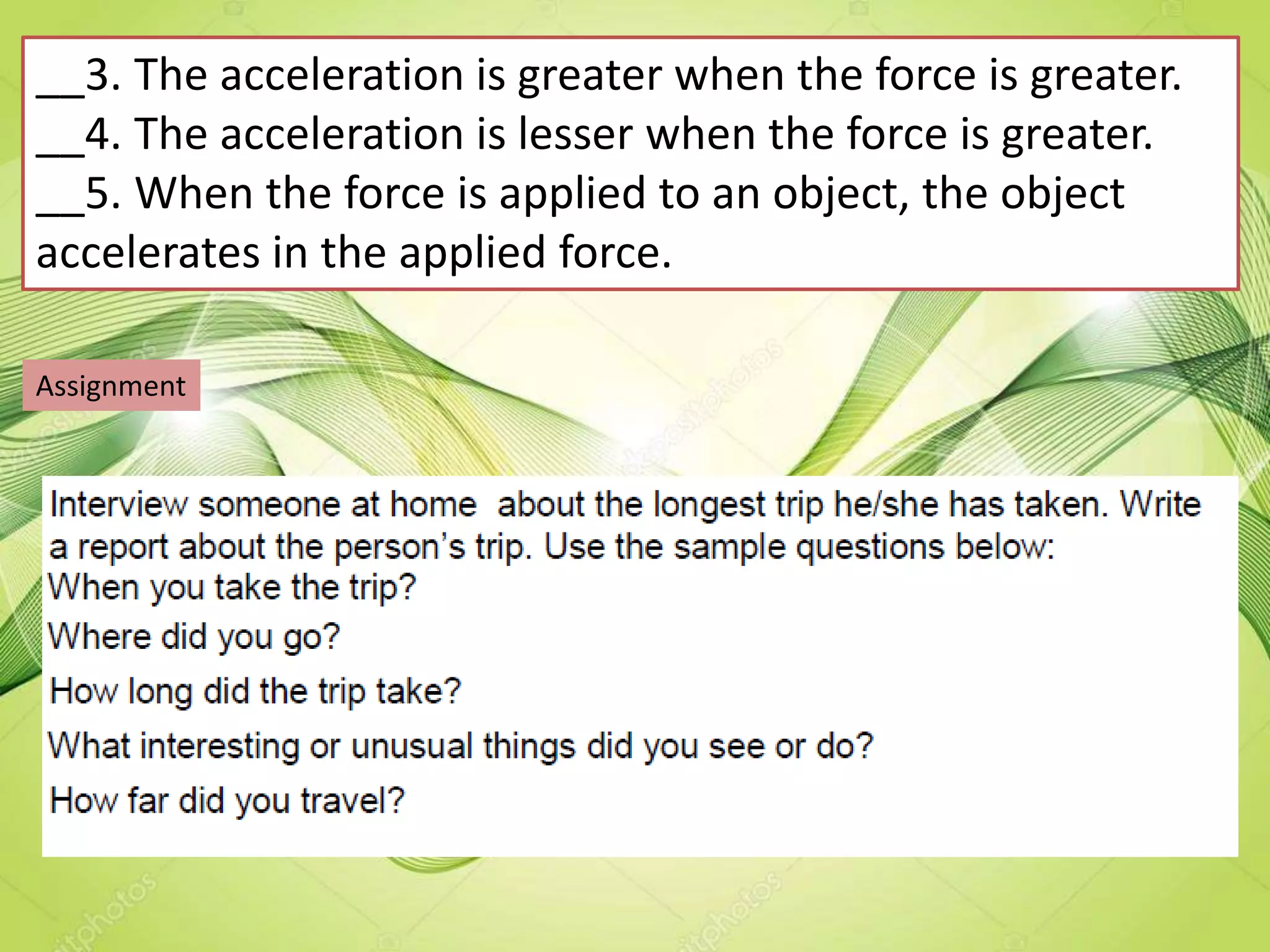
__3. The acceleration is greater when the force is greater.
__4. The acceleration is lesser when the force is greater.
__5. When the force is applied to an object, the object
accelerates in the applied force.
Assignment
Q3 Week 1 day 5
Use different measuring tools and standard
units in measuring time and distance of objects
in motion
Source: DepEd Teachers Club
File Created by : Ma’am IRENE A. MANZANERO
PPt created by : PRECILA R. UMALI
Santa Rosa City Laguna
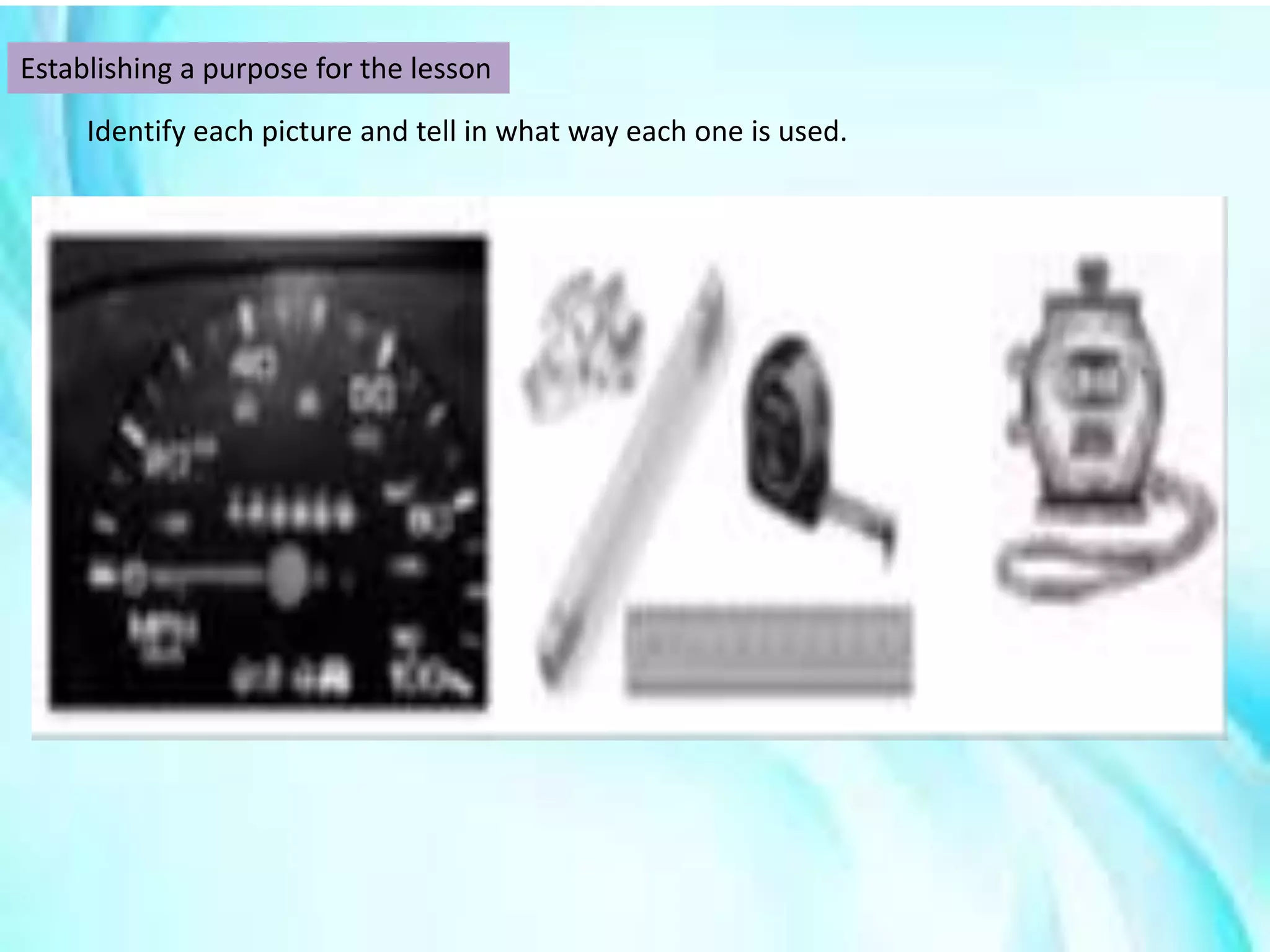
Establishing a purpose for the lesson
Identify each picture and tell in what way each one is used.
Presenting examples/ instances of the new lesson
Discussing new concepts and practicing new skills #2
Finding Practical application of concepts and skills in daily living
Making generalization and abstraction about the lesson
Evaluating learning
Read and analyze each sentence. Write the letter
of the correct answer.
__1. Which of the following shows a
fast speed?
a.5m/s
b. 4 m/s
c. 2 k/h
d. 1km/h
__2. What is the speed of a ball that
moves to about 10 meters in 2
seconds?
a.20 m/s
b. 5 m/s
c. 1 m/s
d. 50 m/s
__3. Which of the following shows
the slowest velocity?
a.20 km/h north
b. 10 km/h south
c.5 km/h north
d.50 km/h south
__4. What is the basic unit for
measuring time?
a. hour c. minute
b. second d. month
__5. What is the basic unit for
measuring distance?
a.hour c. second
b.minute d. month

SCIENCE 5 PPT Q3 W1 Day 1-5 - Types Of Motion, Factors Affecting Motion, Standard Units, Tools In Measuring Time And Distance Of Objects In Motion.pptx

  • 1.
    Identify Types ofmotion Q3 Week 1 Day 1 Source: DepEd Teachers Club File Created by : Ma’am IRENE A. MANZANERO PPt created by : PRECILA R. UMALI Santa Rosa City Laguna
  • 2.
    Review What is energy? Whatare the two types of energy?
  • 3.
    Establishing a purposefor the lesson Balance a ball on the table. 1.Is the ball moving? 2.How could we be able to move the ball? 3.What do we need to do?
  • 4.
    Presenting examples/ instancesof the new lesson I. Problem :What are the different types of motion? II. Materials: video about the type of motion III. Procedure: I. Watch and listen to the video presentation II. Write down important details about the topic presented in the video Data Presentation V. Conclusion_________________________ Types of Motion Description IV.
  • 5.
    Discussing new conceptsand practicing new skills #1 1. Peer sharing 2. Checking of worksheets 3. Verifying the results by replaying the video and pause in each type of motion.
  • 6.
    Discussing new conceptsand practicing new skills #
  • 7.
    Finding Practical applicationof concepts and skills in daily living
  • 8.
    Making generalization andabstraction about the lessonFinding
  • 9.
    Evaluation Additional activities forapplication or remediation
  • 10.
    Q3 Week 1day 2 Enumerate factors affecting motion Source: DepEd Teachers Club File Created by : Ma’am IRENE A. MANZANERO PPt created by : PRECILA R. UMALI Santa Rosa City Laguna
  • 11.
  • 12.
    Establishing a purposefor the lesson
  • 13.
  • 14.
    Discussing new conceptsand practicing new skills #1
  • 15.
    Discussing new conceptsand practicing new skills
  • 16.
    Finding Practical applicationof concepts and skills in daily living fric·tion (frĭk′shən) ,noun 1. The rubbing of one object or surface against another. 2. Conflict, as between persons having dissimilar ideas or interests; clash. 3. Physics A force that resists the relative motion or tendency to such motion of two bodies or substances in contact.
  • 17.
    Making generalization andabstraction about the lesson Evaluation
  • 18.
    Q3 Week 1day 3 Give example of standard units in measuring time and distance of objects in motion Source: DepEd Teachers Club File Created by : Ma’am IRENE A. MANZANERO PPt created by : PRECILA R. UMALI Santa Rosa City Laguna
  • 19.
  • 20.
    Establishing a purposefor the lesson Look for the word about measuring units. Encircle the word.
  • 21.
  • 22.
    Discussing new conceptsand practicing new skills #1 Developing Mastery Answer the following questions: 1. A change in position with relevance to a reference point is called_____ 2. T o find the speed of an object, you need to know _______ ND TIME. 3. The length of time passes from one event to another is ______
  • 24.
    Finding Practical applicationof concepts and skills in daily living Name some activities where motion is present and some activities that do not involve motion Activities involving motion Activities not involving motion
  • 25.
    Making generalization andabstraction about the lesson What are the examples of standard units in measuring time and distance of objects in motion measuring units? Evaluating learning Write the letter of the correct answer. ____1. Which of the following is a measure of speed? a. km c. m/s b. mind d.cm
  • 26.
    ___2.Which is anideal reference point? a. a colored object b. a non moving landmark c. a person running d. a cloud in the sky
  • 27.
    __3. Riza iswalking along a sidewalk. Which of the following sentences is true? a. Riza is moving with respect to the building at the corner? b. Riza is moving with respect to another person who is walking beside her. c. Riza is not moving with respect to the sidewalk. d. Riza is not moving with respect to the sun.
  • 28.
    __4. What iselapsed time? a. It is the time from sun up to sun down. b. It is the time between two specific events. c. It is the final recorded time. d. It is the initial recorded time.
  • 29.
    __5. A bikercovers a distance of 150 km in five hours. What is the biker’s speed? a. 15km/h b. 30 km/h c. 45 km/h d. 60 km/h
  • 30.
  • 31.
    Q3 Week 1day 4 Identify appropriate measuring tools in measuring time and distance of objects in motion. Source: DepEd Teachers Club File Created by : Ma’am IRENE A. MANZANERO PPt created by : PRECILA R. UMALI Santa Rosa City Laguna
  • 32.
  • 33.
  • 34.
    Discussing new conceptsand practicing new skill 1 Developing Mastery Finding Practical application of concepts and skills in daily living
  • 35.
    Making generalization andabstraction about the lesson Evaluation Write T if the statement is True and F if it is False. __1. Acceleration can’t take place without a force. __2. The acceleration is less when the mass of the object is greater.
  • 36.
    __3. The accelerationis greater when the force is greater. __4. The acceleration is lesser when the force is greater. __5. When the force is applied to an object, the object accelerates in the applied force. Assignment
  • 37.
    Q3 Week 1day 5 Use different measuring tools and standard units in measuring time and distance of objects in motion Source: DepEd Teachers Club File Created by : Ma’am IRENE A. MANZANERO PPt created by : PRECILA R. UMALI Santa Rosa City Laguna
  • 38.
    Establishing a purposefor the lesson Identify each picture and tell in what way each one is used.
  • 39.
  • 41.
    Discussing new conceptsand practicing new skills #2
  • 42.
    Finding Practical applicationof concepts and skills in daily living Making generalization and abstraction about the lesson
  • 43.
    Evaluating learning Read andanalyze each sentence. Write the letter of the correct answer. __1. Which of the following shows a fast speed? a.5m/s b. 4 m/s c. 2 k/h d. 1km/h
  • 44.
    __2. What isthe speed of a ball that moves to about 10 meters in 2 seconds? a.20 m/s b. 5 m/s c. 1 m/s d. 50 m/s
  • 45.
    __3. Which ofthe following shows the slowest velocity? a.20 km/h north b. 10 km/h south c.5 km/h north d.50 km/h south
  • 46.
    __4. What isthe basic unit for measuring time? a. hour c. minute b. second d. month __5. What is the basic unit for measuring distance? a.hour c. second b.minute d. month