Copyright  2005 McGraw-Hill Australia Pty Ltd
PPT Slides t/a Economics for Business 3e by Fraser, Gionea and Fraser 11-1
PART 5
WEALTH CREATION
Chapter 11: Wealth creation
Copyright  2005 McGraw-Hill Australia Pty Ltd
PPT Slides t/a Economics for Business 3e by Fraser, Gionea and Fraser 11-2
Lecture Plan
• Definition of wealth and wealth creation
• Brief historical overview on attitudes on wealth
creation
• Financial investment and investment objectives
• Risk factors in financial investment
• Asset classes
• Specific risks associated with different asset
classes
• Risks associated with international investments
(e.g. shares, government securities)
• Tax impact on superannuation
Copyright  2005 McGraw-Hill Australia Pty Ltd
PPT Slides t/a Economics for Business 3e by Fraser, Gionea and Fraser 11-3
Wealth
• An individual, household, business or nation’s
accumulation of assets
• These assets can be
– Physical possessions (e.g. land or buildings)
– Financial assets (bank accounts or securities)
– ‘Human capital’ (people’s skills and talents), or
– Natural resources (mineral deposits)
• Wealth may be accumulated
– By saving out of current income, or
– It may be inherited
• Wealth, in turn, can create income
Copyright  2005 McGraw-Hill Australia Pty Ltd
PPT Slides t/a Economics for Business 3e by Fraser, Gionea and Fraser 11-4
Wealth Creation
• Increasing the value of your assets and protecting
against the effects of both inflation and taxation
• Assets might include land, houses and other forms
of real estate property, shares, bonds, bank and
other forms of deposits, paintings, antiques,
jewellery and superannuation contributions
• If you own your own business then the value of the
assets of the business is part of your wealth
portfolio
Copyright  2005 McGraw-Hill Australia Pty Ltd
PPT Slides t/a Economics for Business 3e by Fraser, Gionea and Fraser 11-5
Brief Historical Overview of Wealth
Creation Attitudes
• Protestant Ethic (16th century AD)
– Accumulation of wealth by hard work—a pathway to
heaven
– This can be contrasted with Christian monks, who took a
vow of poverty
• Communist Manifesto, 1884 (Karl Marx and
Frederick Engels)
– Ideal of communism is a classless society where all
people enjoy equal social and economic status
(cont.)
Copyright  2005 McGraw-Hill Australia Pty Ltd
PPT Slides t/a Economics for Business 3e by Fraser, Gionea and Fraser 11-6
Brief Historical Overview of Wealth
Creation Attitudes (cont.)
• In practice, command economies gave communist-
era bureaucratic elites administrative control and
material privilege, but severely restricted money
income and private wealth
See A.G. Walder, Politics and Property in Transitional Economies: A Theory
of Elite Opportunity, Asia/Pacific Research Centre Institute for International
Studies, Stamford University, Stamford, United States, April 2003.
Copyright  2005 McGraw-Hill Australia Pty Ltd
PPT Slides t/a Economics for Business 3e by Fraser, Gionea and Fraser 11-7
Sources of Income in Australia
For most people:
• Wages and salaries paid in return for their labour
• Profits earned by self-employed small-business
people
• Dividends earned from share holdings
• Rent earned for property
• Interest earned from financial assets
• Income derived from superannuation funds
• Government transfer payments (e.g. pensions)
Copyright  2005 McGraw-Hill Australia Pty Ltd
PPT Slides t/a Economics for Business 3e by Fraser, Gionea and Fraser 11-8
Financial Investment
• Activity conducted by individuals, funded by saving
primarily to increase their individual wealth
– Managed investment: via a financial intermediary
– Direct investment: when individuals execute their own
financial investment strategy
• Investment objectives: the purpose for which you
are saving money. Timeframes:
– 0 to 2 years: new car
– 2 to 5 years: travelling overseas
– More than 5 years: purchasing a house
Copyright  2005 McGraw-Hill Australia Pty Ltd
PPT Slides t/a Economics for Business 3e by Fraser, Gionea and Fraser 11-9
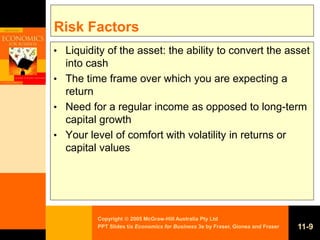
Risk Factors
• Liquidity of the asset: the ability to convert the asset
into cash
• The time frame over which you are expecting a
return
• Need for a regular income as opposed to long-term
capital growth
• Your level of comfort with volatility in returns or
capital values
Copyright  2005 McGraw-Hill Australia Pty Ltd
PPT Slides t/a Economics for Business 3e by Fraser, Gionea and Fraser 11-10
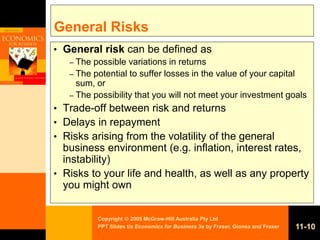
General Risks
• General risk can be defined as
– The possible variations in returns
– The potential to suffer losses in the value of your capital
sum, or
– The possibility that you will not meet your investment goals
• Trade-off between risk and returns
• Delays in repayment
• Risks arising from the volatility of the general
business environment (e.g. inflation, interest rates,
instability)
• Risks to your life and health, as well as any property
you might own
Copyright  2005 McGraw-Hill Australia Pty Ltd
PPT Slides t/a Economics for Business 3e by Fraser, Gionea and Fraser 11-11
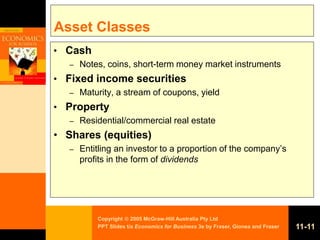
Asset Classes
• Cash
– Notes, coins, short-term money market instruments
• Fixed income securities
– Maturity, a stream of coupons, yield
• Property
– Residential/commercial real estate
• Shares (equities)
– Entitling an investor to a proportion of the company’s
profits in the form of dividends
Copyright  2005 McGraw-Hill Australia Pty Ltd
PPT Slides t/a Economics for Business 3e by Fraser, Gionea and Fraser 11-12
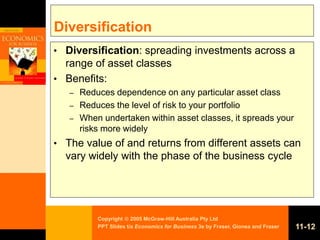
Diversification
• Diversification: spreading investments across a
range of asset classes
• Benefits:
– Reduces dependence on any particular asset class
– Reduces the level of risk to your portfolio
– When undertaken within asset classes, it spreads your
risks more widely
• The value of and returns from different assets can
vary widely with the phase of the business cycle
Copyright  2005 McGraw-Hill Australia Pty Ltd
PPT Slides t/a Economics for Business 3e by Fraser, Gionea and Fraser 11-13
Specific Risks Associated With
Different Asset Classes
• Cash
– Low risk, but no potential for capital growth
• Fixed income investments
– Price will vary with movements in market interest rates and
time to maturity
– Exposed to the credit risk of the issuer
• Property
– Potentially higher risk than fixed income securities but
lower than shares
• Share prices
– Volatile and possible losses over short- to medium-term
– Historical performance no guarantee of future performance
Copyright  2005 McGraw-Hill Australia Pty Ltd
PPT Slides t/a Economics for Business 3e by Fraser, Gionea and Fraser 11-14
Risks Associated With International
Investments (e.g. Shares, Bonds)
• Country differences (e.g. accounting, auditing,
financial reporting, government regulations)
• Foreign markets may have different levels of
liquidity, pricing, availability, settlement and
clearance procedures
• Exchange controls, defaults on government
securities, political and social instability
• Currency risks: international assets usually priced
in the currency of their home country
Copyright  2005 McGraw-Hill Australia Pty Ltd
PPT Slides t/a Economics for Business 3e by Fraser, Gionea and Fraser 11-15
Taxation in Australia
• Investment returns are subject to federal taxes on
income and capital gains
• Purchases of investments are subject to state taxes
such as stamp duties and land taxes
• It is important that you understand how taxes affect
your particular circumstances when making
decisions aimed at wealth creation
Copyright  2005 McGraw-Hill Australia Pty Ltd
PPT Slides t/a Economics for Business 3e by Fraser, Gionea and Fraser 11-16
Superannuation in Australia
• Superannuation is a compulsory form of wealth
creation in Australia, as all working people in
Australia have to have a superannuation fund
• In order to understand the principles of wealth
accumulation underlying superannuation we first
discuss simple and compound interest
(cont.)
Copyright  2005 McGraw-Hill Australia Pty Ltd
PPT Slides t/a Economics for Business 3e by Fraser, Gionea and Fraser 11-17
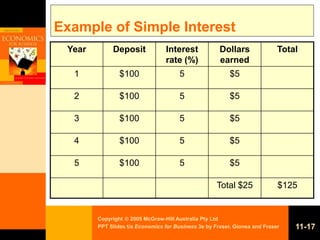
Example of Simple Interest
Year Deposit Interest
rate (%)
Dollars
earned
Total
1 $100 5 $5
2 $100 5 $5
3 $100 5 $5
4 $100 5 $5
5 $100 5 $5
Total $25 $125
Copyright  2005 McGraw-Hill Australia Pty Ltd
PPT Slides t/a Economics for Business 3e by Fraser, Gionea and Fraser 11-18
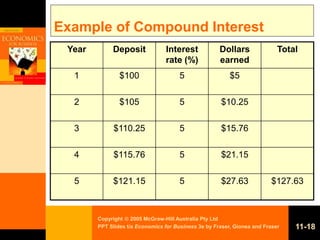
Example of Compound Interest
Year Deposit Interest
rate (%)
Dollars
earned
Total
1 $100 5 $5
2 $105 5 $10.25
3 $110.25 5 $15.76
4 $115.76 5 $21.15
5 $121.15 5 $27.63 $127.63
Copyright  2005 McGraw-Hill Australia Pty Ltd
PPT Slides t/a Economics for Business 3e by Fraser, Gionea and Fraser 11-19
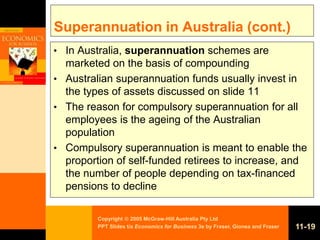
Superannuation in Australia (cont.)
• In Australia, superannuation schemes are
marketed on the basis of compounding
• Australian superannuation funds usually invest in
the types of assets discussed on slide 11
• The reason for compulsory superannuation for all
employees is the ageing of the Australian
population
• Compulsory superannuation is meant to enable the
proportion of self-funded retirees to increase, and
the number of people depending on tax-financed
pensions to decline
Copyright  2005 McGraw-Hill Australia Pty Ltd
PPT Slides t/a Economics for Business 3e by Fraser, Gionea and Fraser 11-20
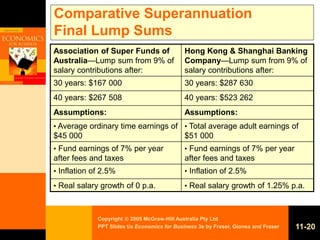
Comparative Superannuation
Final Lump Sums
Association of Super Funds of
Australia—Lump sum from 9% of
salary contributions after:
Hong Kong & Shanghai Banking
Company—Lump sum from 9% of
salary contributions after:
30 years: $167 000 30 years: $287 630
40 years: $267 508 40 years: $523 262
Assumptions: Assumptions:
• Average ordinary time earnings of
$45 000
• Total average adult earnings of
$51 000
• Fund earnings of 7% per year
after fees and taxes
• Fund earnings of 7% per year
after fees and taxes
• Inflation of 2.5% • Inflation of 2.5%
• Real salary growth of 0 p.a. • Real salary growth of 1.25% p.a.
Copyright  2005 McGraw-Hill Australia Pty Ltd
PPT Slides t/a Economics for Business 3e by Fraser, Gionea and Fraser 11-21
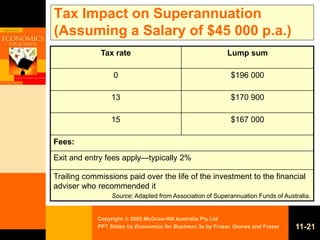
Tax Impact on Superannuation
(Assuming a Salary of $45 000 p.a.)
Tax rate Lump sum
0 $196 000
13 $170 900
15 $167 000
Fees:
Exit and entry fees apply—typically 2%
Trailing commissions paid over the life of the investment to the financial
adviser who recommended it
Source: Adapted from Association of Superannuation Funds of Australia.
Copyright  2005 McGraw-Hill Australia Pty Ltd
PPT Slides t/a Economics for Business 3e by Fraser, Gionea and Fraser 11-22
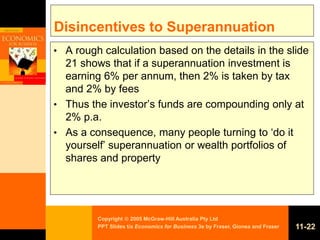
Disincentives to Superannuation
• A rough calculation based on the details in the slide
21 shows that if a superannuation investment is
earning 6% per annum, then 2% is taken by tax
and 2% by fees
• Thus the investor’s funds are compounding only at
2% p.a.
• As a consequence, many people turning to ‘do it
yourself’ superannuation or wealth portfolios of
shares and property

Wealth Creation.ppt

  • 1.
    Copyright  2005McGraw-Hill Australia Pty Ltd PPT Slides t/a Economics for Business 3e by Fraser, Gionea and Fraser 11-1 PART 5 WEALTH CREATION Chapter 11: Wealth creation
  • 2.
    Copyright  2005McGraw-Hill Australia Pty Ltd PPT Slides t/a Economics for Business 3e by Fraser, Gionea and Fraser 11-2 Lecture Plan • Definition of wealth and wealth creation • Brief historical overview on attitudes on wealth creation • Financial investment and investment objectives • Risk factors in financial investment • Asset classes • Specific risks associated with different asset classes • Risks associated with international investments (e.g. shares, government securities) • Tax impact on superannuation
  • 3.
    Copyright  2005McGraw-Hill Australia Pty Ltd PPT Slides t/a Economics for Business 3e by Fraser, Gionea and Fraser 11-3 Wealth • An individual, household, business or nation’s accumulation of assets • These assets can be – Physical possessions (e.g. land or buildings) – Financial assets (bank accounts or securities) – ‘Human capital’ (people’s skills and talents), or – Natural resources (mineral deposits) • Wealth may be accumulated – By saving out of current income, or – It may be inherited • Wealth, in turn, can create income
  • 4.
    Copyright  2005McGraw-Hill Australia Pty Ltd PPT Slides t/a Economics for Business 3e by Fraser, Gionea and Fraser 11-4 Wealth Creation • Increasing the value of your assets and protecting against the effects of both inflation and taxation • Assets might include land, houses and other forms of real estate property, shares, bonds, bank and other forms of deposits, paintings, antiques, jewellery and superannuation contributions • If you own your own business then the value of the assets of the business is part of your wealth portfolio
  • 5.
    Copyright  2005McGraw-Hill Australia Pty Ltd PPT Slides t/a Economics for Business 3e by Fraser, Gionea and Fraser 11-5 Brief Historical Overview of Wealth Creation Attitudes • Protestant Ethic (16th century AD) – Accumulation of wealth by hard work—a pathway to heaven – This can be contrasted with Christian monks, who took a vow of poverty • Communist Manifesto, 1884 (Karl Marx and Frederick Engels) – Ideal of communism is a classless society where all people enjoy equal social and economic status (cont.)
  • 6.
    Copyright  2005McGraw-Hill Australia Pty Ltd PPT Slides t/a Economics for Business 3e by Fraser, Gionea and Fraser 11-6 Brief Historical Overview of Wealth Creation Attitudes (cont.) • In practice, command economies gave communist- era bureaucratic elites administrative control and material privilege, but severely restricted money income and private wealth See A.G. Walder, Politics and Property in Transitional Economies: A Theory of Elite Opportunity, Asia/Pacific Research Centre Institute for International Studies, Stamford University, Stamford, United States, April 2003.
  • 7.
    Copyright  2005McGraw-Hill Australia Pty Ltd PPT Slides t/a Economics for Business 3e by Fraser, Gionea and Fraser 11-7 Sources of Income in Australia For most people: • Wages and salaries paid in return for their labour • Profits earned by self-employed small-business people • Dividends earned from share holdings • Rent earned for property • Interest earned from financial assets • Income derived from superannuation funds • Government transfer payments (e.g. pensions)
  • 8.
    Copyright  2005McGraw-Hill Australia Pty Ltd PPT Slides t/a Economics for Business 3e by Fraser, Gionea and Fraser 11-8 Financial Investment • Activity conducted by individuals, funded by saving primarily to increase their individual wealth – Managed investment: via a financial intermediary – Direct investment: when individuals execute their own financial investment strategy • Investment objectives: the purpose for which you are saving money. Timeframes: – 0 to 2 years: new car – 2 to 5 years: travelling overseas – More than 5 years: purchasing a house
  • 9.
    Copyright  2005McGraw-Hill Australia Pty Ltd PPT Slides t/a Economics for Business 3e by Fraser, Gionea and Fraser 11-9 Risk Factors • Liquidity of the asset: the ability to convert the asset into cash • The time frame over which you are expecting a return • Need for a regular income as opposed to long-term capital growth • Your level of comfort with volatility in returns or capital values
  • 10.
    Copyright  2005McGraw-Hill Australia Pty Ltd PPT Slides t/a Economics for Business 3e by Fraser, Gionea and Fraser 11-10 General Risks • General risk can be defined as – The possible variations in returns – The potential to suffer losses in the value of your capital sum, or – The possibility that you will not meet your investment goals • Trade-off between risk and returns • Delays in repayment • Risks arising from the volatility of the general business environment (e.g. inflation, interest rates, instability) • Risks to your life and health, as well as any property you might own
  • 11.
    Copyright  2005McGraw-Hill Australia Pty Ltd PPT Slides t/a Economics for Business 3e by Fraser, Gionea and Fraser 11-11 Asset Classes • Cash – Notes, coins, short-term money market instruments • Fixed income securities – Maturity, a stream of coupons, yield • Property – Residential/commercial real estate • Shares (equities) – Entitling an investor to a proportion of the company’s profits in the form of dividends
  • 12.
    Copyright  2005McGraw-Hill Australia Pty Ltd PPT Slides t/a Economics for Business 3e by Fraser, Gionea and Fraser 11-12 Diversification • Diversification: spreading investments across a range of asset classes • Benefits: – Reduces dependence on any particular asset class – Reduces the level of risk to your portfolio – When undertaken within asset classes, it spreads your risks more widely • The value of and returns from different assets can vary widely with the phase of the business cycle
  • 13.
    Copyright  2005McGraw-Hill Australia Pty Ltd PPT Slides t/a Economics for Business 3e by Fraser, Gionea and Fraser 11-13 Specific Risks Associated With Different Asset Classes • Cash – Low risk, but no potential for capital growth • Fixed income investments – Price will vary with movements in market interest rates and time to maturity – Exposed to the credit risk of the issuer • Property – Potentially higher risk than fixed income securities but lower than shares • Share prices – Volatile and possible losses over short- to medium-term – Historical performance no guarantee of future performance
  • 14.
    Copyright  2005McGraw-Hill Australia Pty Ltd PPT Slides t/a Economics for Business 3e by Fraser, Gionea and Fraser 11-14 Risks Associated With International Investments (e.g. Shares, Bonds) • Country differences (e.g. accounting, auditing, financial reporting, government regulations) • Foreign markets may have different levels of liquidity, pricing, availability, settlement and clearance procedures • Exchange controls, defaults on government securities, political and social instability • Currency risks: international assets usually priced in the currency of their home country
  • 15.
    Copyright  2005McGraw-Hill Australia Pty Ltd PPT Slides t/a Economics for Business 3e by Fraser, Gionea and Fraser 11-15 Taxation in Australia • Investment returns are subject to federal taxes on income and capital gains • Purchases of investments are subject to state taxes such as stamp duties and land taxes • It is important that you understand how taxes affect your particular circumstances when making decisions aimed at wealth creation
  • 16.
    Copyright  2005McGraw-Hill Australia Pty Ltd PPT Slides t/a Economics for Business 3e by Fraser, Gionea and Fraser 11-16 Superannuation in Australia • Superannuation is a compulsory form of wealth creation in Australia, as all working people in Australia have to have a superannuation fund • In order to understand the principles of wealth accumulation underlying superannuation we first discuss simple and compound interest (cont.)
  • 17.
    Copyright  2005McGraw-Hill Australia Pty Ltd PPT Slides t/a Economics for Business 3e by Fraser, Gionea and Fraser 11-17 Example of Simple Interest Year Deposit Interest rate (%) Dollars earned Total 1 $100 5 $5 2 $100 5 $5 3 $100 5 $5 4 $100 5 $5 5 $100 5 $5 Total $25 $125
  • 18.
    Copyright  2005McGraw-Hill Australia Pty Ltd PPT Slides t/a Economics for Business 3e by Fraser, Gionea and Fraser 11-18 Example of Compound Interest Year Deposit Interest rate (%) Dollars earned Total 1 $100 5 $5 2 $105 5 $10.25 3 $110.25 5 $15.76 4 $115.76 5 $21.15 5 $121.15 5 $27.63 $127.63
  • 19.
    Copyright  2005McGraw-Hill Australia Pty Ltd PPT Slides t/a Economics for Business 3e by Fraser, Gionea and Fraser 11-19 Superannuation in Australia (cont.) • In Australia, superannuation schemes are marketed on the basis of compounding • Australian superannuation funds usually invest in the types of assets discussed on slide 11 • The reason for compulsory superannuation for all employees is the ageing of the Australian population • Compulsory superannuation is meant to enable the proportion of self-funded retirees to increase, and the number of people depending on tax-financed pensions to decline
  • 20.
    Copyright  2005McGraw-Hill Australia Pty Ltd PPT Slides t/a Economics for Business 3e by Fraser, Gionea and Fraser 11-20 Comparative Superannuation Final Lump Sums Association of Super Funds of Australia—Lump sum from 9% of salary contributions after: Hong Kong & Shanghai Banking Company—Lump sum from 9% of salary contributions after: 30 years: $167 000 30 years: $287 630 40 years: $267 508 40 years: $523 262 Assumptions: Assumptions: • Average ordinary time earnings of $45 000 • Total average adult earnings of $51 000 • Fund earnings of 7% per year after fees and taxes • Fund earnings of 7% per year after fees and taxes • Inflation of 2.5% • Inflation of 2.5% • Real salary growth of 0 p.a. • Real salary growth of 1.25% p.a.
  • 21.
    Copyright  2005McGraw-Hill Australia Pty Ltd PPT Slides t/a Economics for Business 3e by Fraser, Gionea and Fraser 11-21 Tax Impact on Superannuation (Assuming a Salary of $45 000 p.a.) Tax rate Lump sum 0 $196 000 13 $170 900 15 $167 000 Fees: Exit and entry fees apply—typically 2% Trailing commissions paid over the life of the investment to the financial adviser who recommended it Source: Adapted from Association of Superannuation Funds of Australia.
  • 22.
    Copyright  2005McGraw-Hill Australia Pty Ltd PPT Slides t/a Economics for Business 3e by Fraser, Gionea and Fraser 11-22 Disincentives to Superannuation • A rough calculation based on the details in the slide 21 shows that if a superannuation investment is earning 6% per annum, then 2% is taken by tax and 2% by fees • Thus the investor’s funds are compounding only at 2% p.a. • As a consequence, many people turning to ‘do it yourself’ superannuation or wealth portfolios of shares and property