E-Marketing
Communication Tools
Chapter 12 Objectives
 After reading Chapter 12, you will be able to:
 Define integrated marketing communication
(IMC) and explain the importance of the
hierarchy of effects model.
 Discuss how marketers use the Internet for
advertising, marketing public relations, sales
promotions, direct marketing, and personal
selling.
 Identify several emerging IMC tools.
 Describe the most effective online IMC tactics.
©2012 PEARSON EDUCATION, INC. PUBLISHING AS PRENTICE HALL 12-2
Will it Blend?
 Blendtec , a supplier of commercial blenders to Starbucks
and others, produced a video in which the CEO blended
unusual products such as a garden rake and a golf club.
 The video, uploaded to YouTube, received 3.9 million
views in an 8-month period.
 The Will It Blend? Campaign illustrates the potential
value of viral marketing and connecting with
consumers online.
 Do you think that such campaigns can build awareness?
Can you think of other examples?
©2012 PEARSON EDUCATION, INC. PUBLISHING AS PRENTICE HALL 12-3
E-MARKETING COMMUNICATION
 Internet marketing is a powerful way to start and
strengthen relationships with customers.
 Users are in control
 Can delete unwanted incoming e-mail
 Can impatiently click away when website don’t quickly
deliver
 The key to success include
 Providing relevant, interesting messages
 Engaging internet users by attracting them
 Marketing communication (MarCom) tools that
 Use technology to build brands
 Important keys to capturing attention and winning long-
term customer relationships
©2012 PEARSON EDUCATION, INC. PUBLISHING AS PRENTICE HALL 12-4
Integrated Marketing Communication (IMC)
 IMC is a cross-functional process for planning, executing, and
monitoring brand communications.
 The goal is to profitably acquire, retain, and grow customers.
 Why IMC is a cross-functional?
 Because every touch point a customer has with a firm or its agents
helps to form brand images
 Profitable customer relationships are key to a firm’s existence
 IMC strategy requires a thorough understanding of target
markets, the brand, its competition, and other internal and
external factors.
 Many IMC experts agree that IMC should
 Be more strategic
 Be more the promotion messages
 Include one & two way communication
©2012 PEARSON EDUCATION, INC. PUBLISHING AS PRENTICE HALL 12-5
Marketing Communication Tools
 MarCom consists of both planned and unplanned (word of
mouth & publicity) messages between firms and customers and
among customers.
 Unplanned messages are
 Difficult to manage
 Unplanned e-mail has spawned rapid growth
 E-marketers can enhance the effectiveness and efficiency of
MarCom by using innovative technologies, such as text and
multimedia messages, databases, blogs, digital receiving
devices, etc.
 Internet MarCom may include advertising, sales promotion,
marketing public relations (MPR), direct marketing, and
personal selling.
©2012 PEARSON EDUCATION, INC. PUBLISHING AS PRENTICE HALL 12-6
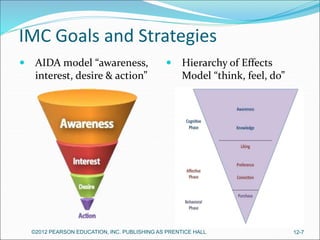
IMC Goals and Strategies
 AIDA model “awareness,
interest, desire & action”
 Hierarchy of Effects
Model “think, feel, do”
©2012 PEARSON EDUCATION, INC. PUBLISHING AS PRENTICE HALL 12-7
IMC Goals and Strategies; Cont.
 The AIDA model and hierarchy of effects model help
guide selection of online and offline MarCom tools to
meet their goals.
 Both models recognize that consumers first become
aware of a product before they develop feelings and
purchase it.
 Aware & learn / think
 Positive or negative attitude / feel
 Purchase the product / do
 The models can help marketers select appropriate
communication objectives and strategies, such as:
 Build brand equity.
 Elicit a direct response.
©2012 PEARSON EDUCATION, INC. PUBLISHING AS PRENTICE HALL 12-8
Branding Versus Direct Response
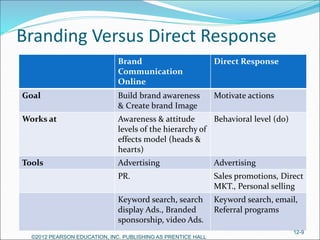
Brand
Communication
Online
Direct Response
Goal Build brand awareness
& Create brand Image
Motivate actions
Works at Awareness & attitude
levels of the hierarchy of
effects model (heads &
hearts)
Behavioral level (do)
Tools Advertising Advertising
PR. Sales promotions, Direct
MKT., Personal selling
Keyword search, search
display Ads., Branded
sponsorship, video Ads.
Keyword search, email,
Referral programs
©2012 PEARSON EDUCATION, INC. PUBLISHING AS PRENTICE HALL
12-9
INTERNET ADVERTISING
 Advertising is nonpersonal communication of
information through various media, usually
persuasive, about products or ideas and usually
paid for by an identified sponsor.
 All paid space on a website or in an e-mail is
considered advertising.
 Internet advertising parallels traditional media
advertising, in which companies create content
draw an audience and then sell space to outside
advertisers.
©2012 PEARSON EDUCATION, INC. PUBLISHING AS PRENTICE HALL 12-10
Trends in Internet Advertising
 Online advertising reached $23.5 billion in 2008,
$22.7 billion in 2009.
 In 2009, 14.3% of ad dollars were spent online.
 Most spending came from:
 Retail
 Telecom
 Financial services
 Automotive
 Computing
©2012 PEARSON EDUCATION, INC. PUBLISHING AS PRENTICE HALL 12-11
Internet Advertising Formats & Types
 Keyword search is the fastest growing and most
important technique.
 Keyword search is part of a larger strategy called
search marketing.
 Search Marketing is the act of marketing a web site
via search engines weather to:
 Improve rank in listings
 Or Purchase paid listings
 Or combine the previous with other search engine
– related activities
©2012 PEARSON EDUCATION, INC. PUBLISHING AS PRENTICE HALL 12-12
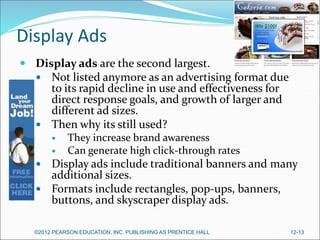
Display Ads
 Display ads are the second largest.
 Not listed anymore as an advertising format due
to its rapid decline in use and effectiveness for
direct response goals, and growth of larger and
different ad sizes.
 Then why its still used?
 They increase brand awareness
 Can generate high click-through rates
 Display ads include traditional banners and many
additional sizes.
 Formats include rectangles, pop-ups, banners,
buttons, and skyscraper display ads.
©2012 PEARSON EDUCATION, INC. PUBLISHING AS PRENTICE HALL 12-13
Rich Media Ads
 Rich media ads are interactive, at least offering
click-through.
 Rich media ads often use Flash animation to
attract attention.
 Many formats can be rich media, including:
 Banner ads.
 Interstitial ads.
 Floating ads.
 Expanding ads.
 Polite ads.
©2012 PEARSON EDUCATION, INC. PUBLISHING AS PRENTICE HALL 12-14
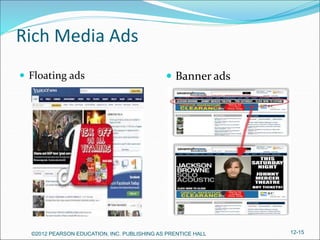
Rich Media Ads
 Floating ads
©2012 PEARSON EDUCATION, INC. PUBLISHING AS PRENTICE HALL 12-15
 Banner ads
Contextual Ads
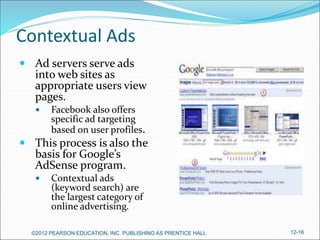
 Ad servers serve ads
into web sites as
appropriate users view
pages.
 Facebook also offers
specific ad targeting
based on user profiles.
 This process is also the
basis for Google’s
AdSense program.
 Contextual ads
(keyword search) are
the largest category of
online advertising.
©2012 PEARSON EDUCATION, INC. PUBLISHING AS PRENTICE HALL 12-16
E-Mail Advertising
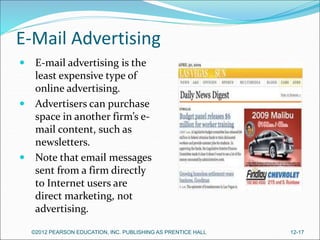
 E-mail advertising is the
least expensive type of
online advertising.
 Advertisers can purchase
space in another firm’s e-
mail content, such as
newsletters.
 Note that email messages
sent from a firm directly
to Internet users are
direct marketing, not
advertising.
©2012 PEARSON EDUCATION, INC. PUBLISHING AS PRENTICE HALL 12-17
Sponsorships
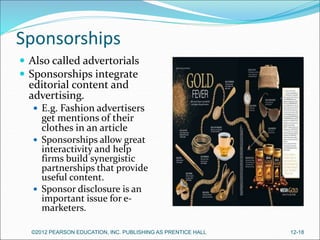
 Also called advertorials
 Sponsorships integrate
editorial content and
advertising.
 E.g. Fashion advertisers
get mentions of their
clothes in an article
 Sponsorships allow great
interactivity and help
firms build synergistic
partnerships that provide
useful content.
 Sponsor disclosure is an
important issue for e-
marketers.
©2012 PEARSON EDUCATION, INC. PUBLISHING AS PRENTICE HALL 12-18
Mobile Advertising
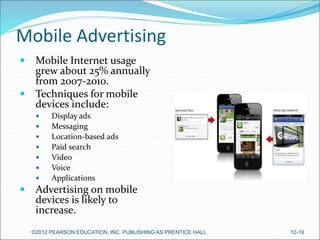
 Mobile Internet usage
grew about 25% annually
from 2007-2010.
 Techniques for mobile
devices include:
 Display ads
 Messaging
 Location-based ads
 Paid search
 Video
 Voice
 Applications
 Advertising on mobile
devices is likely to
increase.
©2012 PEARSON EDUCATION, INC. PUBLISHING AS PRENTICE HALL 12-19
Marketing Public Relations (MPR)
 Public relations includes activities that influence public
opinion and create goodwill.
 MPR includes brand-related activities and nonpaid,
third-party media coverage to positively influence target
markets.
 MRP is the portion of PR directed to the firm’s customer
and prospects in order to build awareness and positive
attitudes about its brands.
 MPR Activities using internet activities include:
 Website
 Online events
 Podcasts.
 Build a Buzz online.
©2012 PEARSON EDUCATION, INC. PUBLISHING AS PRENTICE HALL
12-20
Marketing Public Relations (MPR), Cont.
 A website
 Can serve as an electronic brochure
 May include
 product or service information,
 press releases,
 company information,
 career opportunities and
 investor relations’ information
 order status
 Advantages of using the Web for publishing product
information
 low-cost alternative to paper brochures
 product information are always updated
 reach new prospects
©2012 PEARSON EDUCATION, INC. PUBLISHING AS PRENTICE HALL
12-21
Marketing Public Relations (MPR), Cont.
 Online events
 Designed to generate user interest
 Can draw traffic to a site
 May include
 online fashion shows,
 seminars,
 workshops and
 talk shows
 Users can download video podcasts
 Podcasts “A digital media file that is distributed over
the Internet using syndication modeling to maximize
exposure”
 Replaced by online video
 Online video and video podcasting are very similar
©2012 PEARSON EDUCATION, INC. PUBLISHING AS PRENTICE HALL
12-22
Marketing Public Relations (MPR), Cont.
 Viral marketing can create buzz online
 Online viewers are more plentiful, but less loyal
 Social networking sites offer instant exposure to
millions of potential customers.
 Suggestions for building a buzz online using MPR
 provide engaging and fresh content
 offer RSS feeds
 use online newswires
 use social media press releases
 find influential bloggers to assist
©2012 PEARSON EDUCATION, INC. PUBLISHING AS PRENTICE HALL
12-23
Sales Promotion Offers
 Sales promotions are short-term incentives of gifts or
money that facilitate the movement of products to the end
user.
 Sales promotions activities include
 Coupons
 Rebates
 Samples
 Contests, sweepstakes, and games
 2010 usage estimates are 6%-75% of Internet users.
 Online sales promotions works especially to entice
consumers to change their behavior in the short term.
 3-5 higher rates with online promotions than with direct
postal mail.
 Sales promotions do not help build customer relationships
in the long term.
©2012 PEARSON EDUCATION, INC. PUBLISHING AS PRENTICE HALL 12-24
Sales Promotion Offers, Cont.
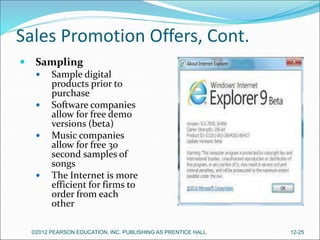
 Sampling
 Sample digital
products prior to
purchase
 Software companies
allow for free demo
versions (beta)
 Music companies
allow for free 30
second samples of
songs
 The Internet is more
efficient for firms to
order from each
other
©2012 PEARSON EDUCATION, INC. PUBLISHING AS PRENTICE HALL 12-25
Sales Promotion Offers, Cont.
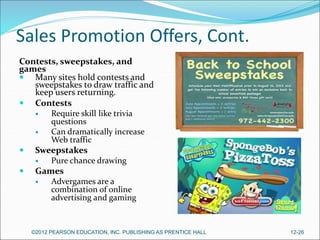
Contests, sweepstakes, and
games
 Many sites hold contests and
sweepstakes to draw traffic and
keep users returning.
 Contests
 Require skill like trivia
questions
 Can dramatically increase
Web traffic
 Sweepstakes
 Pure chance drawing
 Games
 Advergames are a
combination of online
advertising and gaming
©2012 PEARSON EDUCATION, INC. PUBLISHING AS PRENTICE HALL 12-26
Sales Promotion Offers, Cont.
 Sales Promotions Metrics
 Marketers need to know how sales promotions
contribute to the overall communication goals
 Selected metrics depend on campaign goals
 By measuring how customers use and link from their
promotions, e-marketers can measure what is working
most efficiently.
 Must plan to collect information prior to starting the
sales promotion
©2012 PEARSON EDUCATION, INC. PUBLISHING AS PRENTICE HALL 12-27
Direct Marketing
 Direct Marketing is any direct communication to a
consumer or business recipient that is designed to
generate a response in the form of
 an order (direct order),
 a request for further information (lead generation),
and/or
 a visit to a store or other place of business for purchase of
specific product or service (traffic generation).
 Online techniques include:
 Outgoing e-mail.
 Targeted online ads that solicit a direct response.
 Text messages or Short Message Services (SMS).
 Multimedia and instant messages.
©2012 PEARSON EDUCATION, INC. PUBLISHING AS PRENTICE HALL
12-28
E-Mail
 E-mail, used by 89% of Internet users, is the Internet’s
killer application.
 75% of marketers invest in e-mail campaigns.
 E-mail has advantages over postal direct mail marketing.
 No postage or printing costs.
 Immediacy and convenience.
 E-mails can be automatically individualized.
 Faster than postal mail.
 E-mail also has disadvantages.
 Spam
 Addresses can be blocked
 E-mail lists are hard to obtain
 Difficult to match e-mail and postal mailing addresses (how to
build lists)
©2012 PEARSON EDUCATION, INC. PUBLISHING AS PRENTICE HALL 12-29
E-Mail, Cont.
 A new technique is through e-mail newsletters.
 Many firms send out periodic e-mail newsletters
 An excellent tool for communicating with clients
 Benefits are
 Regularly and legitimately promoting the company
name to clients
 Personalizing the communication with tailored
content
 Positioning the company as an expert in a subject
 Pointing recipients back to the company website
 Being easy for clients to pass long to others
 Paying for themselves by carrying small
advertisements
©2012 PEARSON EDUCATION, INC. PUBLISHING AS PRENTICE HALL 12-30
Permission Marketing: Opt-in, Opt-out
 When consumers opt-in, they are giving
permission to receive commercial e-mail.
 Marketers should obtain lists that are guaranteed
to be 90% opt-in.
 Opt-in techniques are part of a bigger marketing
strategy called permission marketing or “turning
strangers into customers.”
 Opt-out is when users have to uncheck the box on
a web page to prevent being put on the e-mail list.
©2012 PEARSON EDUCATION, INC. PUBLISHING AS PRENTICE HALL
12-31
Rules for Successful E-mail Marketing Campaigns
 Use opt-in for being more customer oriented
 Check E-mail (Blacklists) reputation through ISP filters
 Use a professional email address, company based email
 Not Yahoo Gmail or Hotmail
 Make it easy to unsubscribe
 Use micro-segmentation
 Smaller lists of relevant customers
 Personalize email
 Reputation is at risk
 Use creative layouts
 Offer various opportunities to interact with offer
 Use metrics to track success rates
©2012 PEARSON EDUCATION, INC. PUBLISHING AS PRENTICE HALL 12-32
Viral Marketing
 Also known as word of mouse.
 Occurs when users forward e-mails containing
commercial information
 Viral marketing is the online equivalent of “word of
mouth” marketing.
 Success stories include
 Will it Blend?
 Hotmail
 Movies such as Blair Witch Project and American Psycho
were promoted using viral marketing techniques.
 Burger King’s Subservient Chicken campaign drew 14
million visitors in the first year.
©2012 PEARSON EDUCATION, INC. PUBLISHING AS PRENTICE HALL
12-33
Text Messaging
 Messaging may include SMS (short messaging services)
or IM (instant messaging).
 Short Message Services (SMS) are up to 160 characters of text
sent over the Internet with a Personal Digital Assistant (PDA),
cell phone or smartphone (Twitter).
 Instant Messaging
 Short messages sent to and from online users
 Not commonly used for PDA or handheld customers
 Multimedia message service (MMS) is not commonly in
use yet because of handheld capability
 SMS differs from e-mail
 Marketers can build relationships by sending permission-
based information where consumers want to receive it.
 SMS use continues to grow in all industrialized nations.
©2012 PEARSON EDUCATION, INC. PUBLISHING AS PRENTICE HALL 12-34
Location-Based Marketing
 Location-based marketing includes promotional
offers pushed to mobile devices and based on the
user’s physical location.
 Must be used in conjunction with either a global
positioning system (GPS) in handheld device or
automobile (telematics)
 Google is on the leading edge with its local
search.
©2012 PEARSON EDUCATION, INC. PUBLISHING AS PRENTICE HALL 12-35
Direct Marketing Metrics
 Response rate and ROI are the most appropriate
metrics for direct marketing campaigns.
 E-mail receives a widely varied and generally low
click through rate, but the highest ROI of any
direct media.
 Many firms use this information to devise tactics
to build databases and measure success in terms
of record growth.
 In a study of SMS campaigns, 94% of messages were
read by recipients and 23% showed or forwarded
messages to a friend.
©2012 PEARSON EDUCATION, INC. PUBLISHING AS PRENTICE HALL 12-36
Spam
 Spam is unsolicited e-mail.
 The CAN-SPAM Act appears to have little ability
to stop spam.
 Spammers routinely harvest e-mail addresses
from newsgroup postings (or from universities
and colleges public directories) and then spam
the members.
©2012 PEARSON EDUCATION, INC. PUBLISHING AS PRENTICE HALL 12-37
Privacy
 Users will give information if that information is not
likely to be shared and will provide value
 Users don’t mind their tendencies and behaviors
being tracked if they are for specific purposes
©2012 PEARSON EDUCATION, INC. PUBLISHING AS PRENTICE HALL 12-38
Personal Selling
 Personal selling involves real time conversation
between a salesperson and customer, face-to-face, by
telephone, or by computer.
 Some companies provide real time sales assistance
online.
 Name a company has a live chat feature.
 The Internet can offer technology to complete the
sales transaction, or to simply provide sales leads
(asking contact information when downloading a
pdf. file such as whitepaper).
©2012 PEARSON EDUCATION, INC. PUBLISHING AS PRENTICE HALL 12-39
IMC Metrics
 Set specific objectives for IMC campaigns and
then track progress toward those goals by
monitoring appropriate metrics.
 The most important metrics are number and
dollar amount of sales, and all the rest help
improve those numbers in either the short or
long term.
©2012 PEARSON EDUCATION, INC. PUBLISHING AS PRENTICE HALL 12-40
Effectiveness Evidence
 Display ads are generally ineffective. Only 0.2% of all
users click on them.
 Display ads can be successful at increasing brand
awareness
 Online ads that were bigger or contained rich media
delivered greater impact.
 Banner ads are generally ineffective
 Click through results vary greatly
 There is increasing evidence that online and offline
advertising work well together.
©2012 PEARSON EDUCATION, INC. PUBLISHING AS PRENTICE HALL 12-41
12-42
All rights reserved. No part of this publication may be reproduced, stored in a retrieval
system, or transmitted, in any form or by any means, electronic, mechanical,
photocopying, recording, or otherwise, without the prior written permission of the
publisher. Printed in the United States of America.
Copyright © 2012 Pearson Education, Inc.
Publishing as Prentice Hall
©2012 PEARSON EDUCATION, INC.
PUBLISHING AS PRENTICE HALL

E Marketing.ppt

  • 1.
  • 2.
    Chapter 12 Objectives After reading Chapter 12, you will be able to:  Define integrated marketing communication (IMC) and explain the importance of the hierarchy of effects model.  Discuss how marketers use the Internet for advertising, marketing public relations, sales promotions, direct marketing, and personal selling.  Identify several emerging IMC tools.  Describe the most effective online IMC tactics. ©2012 PEARSON EDUCATION, INC. PUBLISHING AS PRENTICE HALL 12-2
  • 3.
    Will it Blend? Blendtec , a supplier of commercial blenders to Starbucks and others, produced a video in which the CEO blended unusual products such as a garden rake and a golf club.  The video, uploaded to YouTube, received 3.9 million views in an 8-month period.  The Will It Blend? Campaign illustrates the potential value of viral marketing and connecting with consumers online.  Do you think that such campaigns can build awareness? Can you think of other examples? ©2012 PEARSON EDUCATION, INC. PUBLISHING AS PRENTICE HALL 12-3
  • 4.
    E-MARKETING COMMUNICATION  Internetmarketing is a powerful way to start and strengthen relationships with customers.  Users are in control  Can delete unwanted incoming e-mail  Can impatiently click away when website don’t quickly deliver  The key to success include  Providing relevant, interesting messages  Engaging internet users by attracting them  Marketing communication (MarCom) tools that  Use technology to build brands  Important keys to capturing attention and winning long- term customer relationships ©2012 PEARSON EDUCATION, INC. PUBLISHING AS PRENTICE HALL 12-4
  • 5.
    Integrated Marketing Communication(IMC)  IMC is a cross-functional process for planning, executing, and monitoring brand communications.  The goal is to profitably acquire, retain, and grow customers.  Why IMC is a cross-functional?  Because every touch point a customer has with a firm or its agents helps to form brand images  Profitable customer relationships are key to a firm’s existence  IMC strategy requires a thorough understanding of target markets, the brand, its competition, and other internal and external factors.  Many IMC experts agree that IMC should  Be more strategic  Be more the promotion messages  Include one & two way communication ©2012 PEARSON EDUCATION, INC. PUBLISHING AS PRENTICE HALL 12-5
  • 6.
    Marketing Communication Tools MarCom consists of both planned and unplanned (word of mouth & publicity) messages between firms and customers and among customers.  Unplanned messages are  Difficult to manage  Unplanned e-mail has spawned rapid growth  E-marketers can enhance the effectiveness and efficiency of MarCom by using innovative technologies, such as text and multimedia messages, databases, blogs, digital receiving devices, etc.  Internet MarCom may include advertising, sales promotion, marketing public relations (MPR), direct marketing, and personal selling. ©2012 PEARSON EDUCATION, INC. PUBLISHING AS PRENTICE HALL 12-6
  • 7.
    IMC Goals andStrategies  AIDA model “awareness, interest, desire & action”  Hierarchy of Effects Model “think, feel, do” ©2012 PEARSON EDUCATION, INC. PUBLISHING AS PRENTICE HALL 12-7
  • 8.
    IMC Goals andStrategies; Cont.  The AIDA model and hierarchy of effects model help guide selection of online and offline MarCom tools to meet their goals.  Both models recognize that consumers first become aware of a product before they develop feelings and purchase it.  Aware & learn / think  Positive or negative attitude / feel  Purchase the product / do  The models can help marketers select appropriate communication objectives and strategies, such as:  Build brand equity.  Elicit a direct response. ©2012 PEARSON EDUCATION, INC. PUBLISHING AS PRENTICE HALL 12-8
  • 9.
    Branding Versus DirectResponse Brand Communication Online Direct Response Goal Build brand awareness & Create brand Image Motivate actions Works at Awareness & attitude levels of the hierarchy of effects model (heads & hearts) Behavioral level (do) Tools Advertising Advertising PR. Sales promotions, Direct MKT., Personal selling Keyword search, search display Ads., Branded sponsorship, video Ads. Keyword search, email, Referral programs ©2012 PEARSON EDUCATION, INC. PUBLISHING AS PRENTICE HALL 12-9
  • 10.
    INTERNET ADVERTISING  Advertisingis nonpersonal communication of information through various media, usually persuasive, about products or ideas and usually paid for by an identified sponsor.  All paid space on a website or in an e-mail is considered advertising.  Internet advertising parallels traditional media advertising, in which companies create content draw an audience and then sell space to outside advertisers. ©2012 PEARSON EDUCATION, INC. PUBLISHING AS PRENTICE HALL 12-10
  • 11.
    Trends in InternetAdvertising  Online advertising reached $23.5 billion in 2008, $22.7 billion in 2009.  In 2009, 14.3% of ad dollars were spent online.  Most spending came from:  Retail  Telecom  Financial services  Automotive  Computing ©2012 PEARSON EDUCATION, INC. PUBLISHING AS PRENTICE HALL 12-11
  • 12.
    Internet Advertising Formats& Types  Keyword search is the fastest growing and most important technique.  Keyword search is part of a larger strategy called search marketing.  Search Marketing is the act of marketing a web site via search engines weather to:  Improve rank in listings  Or Purchase paid listings  Or combine the previous with other search engine – related activities ©2012 PEARSON EDUCATION, INC. PUBLISHING AS PRENTICE HALL 12-12
  • 13.
    Display Ads  Displayads are the second largest.  Not listed anymore as an advertising format due to its rapid decline in use and effectiveness for direct response goals, and growth of larger and different ad sizes.  Then why its still used?  They increase brand awareness  Can generate high click-through rates  Display ads include traditional banners and many additional sizes.  Formats include rectangles, pop-ups, banners, buttons, and skyscraper display ads. ©2012 PEARSON EDUCATION, INC. PUBLISHING AS PRENTICE HALL 12-13
  • 14.
    Rich Media Ads Rich media ads are interactive, at least offering click-through.  Rich media ads often use Flash animation to attract attention.  Many formats can be rich media, including:  Banner ads.  Interstitial ads.  Floating ads.  Expanding ads.  Polite ads. ©2012 PEARSON EDUCATION, INC. PUBLISHING AS PRENTICE HALL 12-14
  • 15.
    Rich Media Ads Floating ads ©2012 PEARSON EDUCATION, INC. PUBLISHING AS PRENTICE HALL 12-15  Banner ads
  • 16.
    Contextual Ads  Adservers serve ads into web sites as appropriate users view pages.  Facebook also offers specific ad targeting based on user profiles.  This process is also the basis for Google’s AdSense program.  Contextual ads (keyword search) are the largest category of online advertising. ©2012 PEARSON EDUCATION, INC. PUBLISHING AS PRENTICE HALL 12-16
  • 17.
    E-Mail Advertising  E-mailadvertising is the least expensive type of online advertising.  Advertisers can purchase space in another firm’s e- mail content, such as newsletters.  Note that email messages sent from a firm directly to Internet users are direct marketing, not advertising. ©2012 PEARSON EDUCATION, INC. PUBLISHING AS PRENTICE HALL 12-17
  • 18.
    Sponsorships  Also calledadvertorials  Sponsorships integrate editorial content and advertising.  E.g. Fashion advertisers get mentions of their clothes in an article  Sponsorships allow great interactivity and help firms build synergistic partnerships that provide useful content.  Sponsor disclosure is an important issue for e- marketers. ©2012 PEARSON EDUCATION, INC. PUBLISHING AS PRENTICE HALL 12-18
  • 19.
    Mobile Advertising  MobileInternet usage grew about 25% annually from 2007-2010.  Techniques for mobile devices include:  Display ads  Messaging  Location-based ads  Paid search  Video  Voice  Applications  Advertising on mobile devices is likely to increase. ©2012 PEARSON EDUCATION, INC. PUBLISHING AS PRENTICE HALL 12-19
  • 20.
    Marketing Public Relations(MPR)  Public relations includes activities that influence public opinion and create goodwill.  MPR includes brand-related activities and nonpaid, third-party media coverage to positively influence target markets.  MRP is the portion of PR directed to the firm’s customer and prospects in order to build awareness and positive attitudes about its brands.  MPR Activities using internet activities include:  Website  Online events  Podcasts.  Build a Buzz online. ©2012 PEARSON EDUCATION, INC. PUBLISHING AS PRENTICE HALL 12-20
  • 21.
    Marketing Public Relations(MPR), Cont.  A website  Can serve as an electronic brochure  May include  product or service information,  press releases,  company information,  career opportunities and  investor relations’ information  order status  Advantages of using the Web for publishing product information  low-cost alternative to paper brochures  product information are always updated  reach new prospects ©2012 PEARSON EDUCATION, INC. PUBLISHING AS PRENTICE HALL 12-21
  • 22.
    Marketing Public Relations(MPR), Cont.  Online events  Designed to generate user interest  Can draw traffic to a site  May include  online fashion shows,  seminars,  workshops and  talk shows  Users can download video podcasts  Podcasts “A digital media file that is distributed over the Internet using syndication modeling to maximize exposure”  Replaced by online video  Online video and video podcasting are very similar ©2012 PEARSON EDUCATION, INC. PUBLISHING AS PRENTICE HALL 12-22
  • 23.
    Marketing Public Relations(MPR), Cont.  Viral marketing can create buzz online  Online viewers are more plentiful, but less loyal  Social networking sites offer instant exposure to millions of potential customers.  Suggestions for building a buzz online using MPR  provide engaging and fresh content  offer RSS feeds  use online newswires  use social media press releases  find influential bloggers to assist ©2012 PEARSON EDUCATION, INC. PUBLISHING AS PRENTICE HALL 12-23
  • 24.
    Sales Promotion Offers Sales promotions are short-term incentives of gifts or money that facilitate the movement of products to the end user.  Sales promotions activities include  Coupons  Rebates  Samples  Contests, sweepstakes, and games  2010 usage estimates are 6%-75% of Internet users.  Online sales promotions works especially to entice consumers to change their behavior in the short term.  3-5 higher rates with online promotions than with direct postal mail.  Sales promotions do not help build customer relationships in the long term. ©2012 PEARSON EDUCATION, INC. PUBLISHING AS PRENTICE HALL 12-24
  • 25.
    Sales Promotion Offers,Cont.  Sampling  Sample digital products prior to purchase  Software companies allow for free demo versions (beta)  Music companies allow for free 30 second samples of songs  The Internet is more efficient for firms to order from each other ©2012 PEARSON EDUCATION, INC. PUBLISHING AS PRENTICE HALL 12-25
  • 26.
    Sales Promotion Offers,Cont. Contests, sweepstakes, and games  Many sites hold contests and sweepstakes to draw traffic and keep users returning.  Contests  Require skill like trivia questions  Can dramatically increase Web traffic  Sweepstakes  Pure chance drawing  Games  Advergames are a combination of online advertising and gaming ©2012 PEARSON EDUCATION, INC. PUBLISHING AS PRENTICE HALL 12-26
  • 27.
    Sales Promotion Offers,Cont.  Sales Promotions Metrics  Marketers need to know how sales promotions contribute to the overall communication goals  Selected metrics depend on campaign goals  By measuring how customers use and link from their promotions, e-marketers can measure what is working most efficiently.  Must plan to collect information prior to starting the sales promotion ©2012 PEARSON EDUCATION, INC. PUBLISHING AS PRENTICE HALL 12-27
  • 28.
    Direct Marketing  DirectMarketing is any direct communication to a consumer or business recipient that is designed to generate a response in the form of  an order (direct order),  a request for further information (lead generation), and/or  a visit to a store or other place of business for purchase of specific product or service (traffic generation).  Online techniques include:  Outgoing e-mail.  Targeted online ads that solicit a direct response.  Text messages or Short Message Services (SMS).  Multimedia and instant messages. ©2012 PEARSON EDUCATION, INC. PUBLISHING AS PRENTICE HALL 12-28
  • 29.
    E-Mail  E-mail, usedby 89% of Internet users, is the Internet’s killer application.  75% of marketers invest in e-mail campaigns.  E-mail has advantages over postal direct mail marketing.  No postage or printing costs.  Immediacy and convenience.  E-mails can be automatically individualized.  Faster than postal mail.  E-mail also has disadvantages.  Spam  Addresses can be blocked  E-mail lists are hard to obtain  Difficult to match e-mail and postal mailing addresses (how to build lists) ©2012 PEARSON EDUCATION, INC. PUBLISHING AS PRENTICE HALL 12-29
  • 30.
    E-Mail, Cont.  Anew technique is through e-mail newsletters.  Many firms send out periodic e-mail newsletters  An excellent tool for communicating with clients  Benefits are  Regularly and legitimately promoting the company name to clients  Personalizing the communication with tailored content  Positioning the company as an expert in a subject  Pointing recipients back to the company website  Being easy for clients to pass long to others  Paying for themselves by carrying small advertisements ©2012 PEARSON EDUCATION, INC. PUBLISHING AS PRENTICE HALL 12-30
  • 31.
    Permission Marketing: Opt-in,Opt-out  When consumers opt-in, they are giving permission to receive commercial e-mail.  Marketers should obtain lists that are guaranteed to be 90% opt-in.  Opt-in techniques are part of a bigger marketing strategy called permission marketing or “turning strangers into customers.”  Opt-out is when users have to uncheck the box on a web page to prevent being put on the e-mail list. ©2012 PEARSON EDUCATION, INC. PUBLISHING AS PRENTICE HALL 12-31
  • 32.
    Rules for SuccessfulE-mail Marketing Campaigns  Use opt-in for being more customer oriented  Check E-mail (Blacklists) reputation through ISP filters  Use a professional email address, company based email  Not Yahoo Gmail or Hotmail  Make it easy to unsubscribe  Use micro-segmentation  Smaller lists of relevant customers  Personalize email  Reputation is at risk  Use creative layouts  Offer various opportunities to interact with offer  Use metrics to track success rates ©2012 PEARSON EDUCATION, INC. PUBLISHING AS PRENTICE HALL 12-32
  • 33.
    Viral Marketing  Alsoknown as word of mouse.  Occurs when users forward e-mails containing commercial information  Viral marketing is the online equivalent of “word of mouth” marketing.  Success stories include  Will it Blend?  Hotmail  Movies such as Blair Witch Project and American Psycho were promoted using viral marketing techniques.  Burger King’s Subservient Chicken campaign drew 14 million visitors in the first year. ©2012 PEARSON EDUCATION, INC. PUBLISHING AS PRENTICE HALL 12-33
  • 34.
    Text Messaging  Messagingmay include SMS (short messaging services) or IM (instant messaging).  Short Message Services (SMS) are up to 160 characters of text sent over the Internet with a Personal Digital Assistant (PDA), cell phone or smartphone (Twitter).  Instant Messaging  Short messages sent to and from online users  Not commonly used for PDA or handheld customers  Multimedia message service (MMS) is not commonly in use yet because of handheld capability  SMS differs from e-mail  Marketers can build relationships by sending permission- based information where consumers want to receive it.  SMS use continues to grow in all industrialized nations. ©2012 PEARSON EDUCATION, INC. PUBLISHING AS PRENTICE HALL 12-34
  • 35.
    Location-Based Marketing  Location-basedmarketing includes promotional offers pushed to mobile devices and based on the user’s physical location.  Must be used in conjunction with either a global positioning system (GPS) in handheld device or automobile (telematics)  Google is on the leading edge with its local search. ©2012 PEARSON EDUCATION, INC. PUBLISHING AS PRENTICE HALL 12-35
  • 36.
    Direct Marketing Metrics Response rate and ROI are the most appropriate metrics for direct marketing campaigns.  E-mail receives a widely varied and generally low click through rate, but the highest ROI of any direct media.  Many firms use this information to devise tactics to build databases and measure success in terms of record growth.  In a study of SMS campaigns, 94% of messages were read by recipients and 23% showed or forwarded messages to a friend. ©2012 PEARSON EDUCATION, INC. PUBLISHING AS PRENTICE HALL 12-36
  • 37.
    Spam  Spam isunsolicited e-mail.  The CAN-SPAM Act appears to have little ability to stop spam.  Spammers routinely harvest e-mail addresses from newsgroup postings (or from universities and colleges public directories) and then spam the members. ©2012 PEARSON EDUCATION, INC. PUBLISHING AS PRENTICE HALL 12-37
  • 38.
    Privacy  Users willgive information if that information is not likely to be shared and will provide value  Users don’t mind their tendencies and behaviors being tracked if they are for specific purposes ©2012 PEARSON EDUCATION, INC. PUBLISHING AS PRENTICE HALL 12-38
  • 39.
    Personal Selling  Personalselling involves real time conversation between a salesperson and customer, face-to-face, by telephone, or by computer.  Some companies provide real time sales assistance online.  Name a company has a live chat feature.  The Internet can offer technology to complete the sales transaction, or to simply provide sales leads (asking contact information when downloading a pdf. file such as whitepaper). ©2012 PEARSON EDUCATION, INC. PUBLISHING AS PRENTICE HALL 12-39
  • 40.
    IMC Metrics  Setspecific objectives for IMC campaigns and then track progress toward those goals by monitoring appropriate metrics.  The most important metrics are number and dollar amount of sales, and all the rest help improve those numbers in either the short or long term. ©2012 PEARSON EDUCATION, INC. PUBLISHING AS PRENTICE HALL 12-40
  • 41.
    Effectiveness Evidence  Displayads are generally ineffective. Only 0.2% of all users click on them.  Display ads can be successful at increasing brand awareness  Online ads that were bigger or contained rich media delivered greater impact.  Banner ads are generally ineffective  Click through results vary greatly  There is increasing evidence that online and offline advertising work well together. ©2012 PEARSON EDUCATION, INC. PUBLISHING AS PRENTICE HALL 12-41
  • 42.
    12-42 All rights reserved.No part of this publication may be reproduced, stored in a retrieval system, or transmitted, in any form or by any means, electronic, mechanical, photocopying, recording, or otherwise, without the prior written permission of the publisher. Printed in the United States of America. Copyright © 2012 Pearson Education, Inc. Publishing as Prentice Hall ©2012 PEARSON EDUCATION, INC. PUBLISHING AS PRENTICE HALL

Editor's Notes

  • #6 Define integrated marketing communication (IMC) and explain the importance of the hierarchy of effects model.