Understanding Investment
Group I
Akshit Gupta
Sajal Agarwal
Aashi Dutt
Hema Gupta
Kaustubh Kohli
Himadri Daga
Bcom(H)
Sec B
Sem VI
Index--
SNO. Topics
1. What is Investment? Why there is a need of investment?
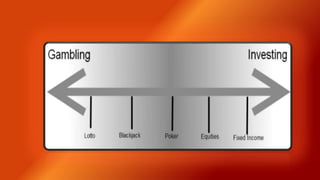
2. Speculation , Investment and Gambling
3. Factors of investment
4. Types of investment
5. Risk and Return
6. Manoeuvring with investment and conclusion..
What is Investment?
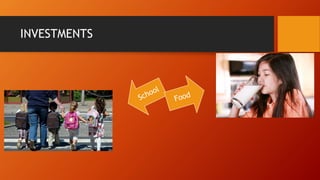
INVESTMENTS
What he is
talking about?
Investment means----------
•The Process of laying
out money now in the
expectation of receiving
more money in the
future.
INVESTMENT
The term investment refers to exchange of money
wealth into some tangible wealth. The money
wealth refers to the savings of the investor and the
tangible wealth refers to the asset an investor get
by sacrificing the money wealth. Future returns can
be in terms of interest(dividends on shares) or
capital gains(increase of price of the land or gold).
Why there is a need for
investments?
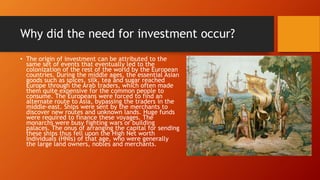
Why did the need for investment occur?
• The origin of investment can be attributed to the
same set of events that eventually led to the
colonization of the rest of the world by the European
countries. During the middle ages, the essential Asian
goods such as spices, silk, tea and sugar reached
Europe through the Arab traders, which often made
them quite expensive for the common people to
consume. The Europeans were forced to find an
alternate route to Asia, bypassing the traders in the
middle-east. Ships were sent by the merchants to
discover new routes and unknown lands. Huge funds
were required to finance these voyages. The
monarchs were busy fighting wars or building
palaces. The onus of arranging the capital for sending
these ships thus fell upon the High Net worth
Individuals (HNIs) of that age, who were generally
the large land owners, nobles and merchants.
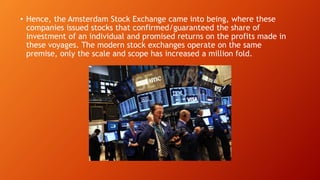
• Hence, the Amsterdam Stock Exchange came into being, where these
companies issued stocks that confirmed/guaranteed the share of
investment of an individual and promised returns on the profits made in
these voyages. The modern stock exchanges operate on the same
premise, only the scale and scope has increased a million fold.
Why we need to invest?
• Let’s say you have Rs.10,000. There’s
no rule that says you have to invest
it.
• In fact, many people would spend it!
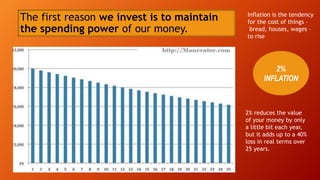
Inflation is the tendency
for the cost of things –
bread, houses, wages –
to rise
2%
INFLATION
2% reduces the value
of your money by only
a little bit each year,
but it adds up to a 40%
loss in real terms over
25 years.
The first reason we invest is to maintain
the spending power of our money.
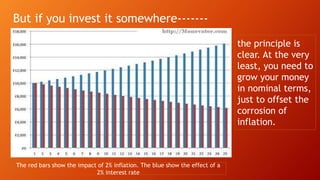
But if you invest it somewhere-------
the principle is
clear. At the very
least, you need to
grow your money
in nominal terms,
just to offset the
corrosion of
inflation.
The red bars show the impact of 2% inflation. The blue show the effect of a
2% interest rate
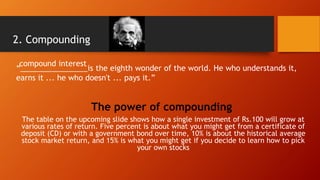
2. Compounding
compound interest
The power of compounding
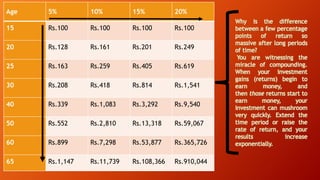
The table on the upcoming slide shows how a single investment of Rs.100 will grow at
various rates of return. Five percent is about what you might get from a certificate of
deposit (CD) or with a government bond over time, 10% is about the historical average
stock market return, and 15% is what you might get if you decide to learn how to pick
your own stocks
“________________is the eighth wonder of the world. He who understands it,
earns it ... he who doesn't ... pays it.”
Age 5% 10% 15% 20%
15 Rs.100 Rs.100 Rs.100 Rs.100
20 Rs.128 Rs.161 Rs.201 Rs.249
25 Rs.163 Rs.259 Rs.405 Rs.619
30 Rs.208 Rs.418 Rs.814 Rs.1,541
40 Rs.339 Rs.1,083 Rs.3,292 Rs.9,540
50 Rs.552 Rs.2,810 Rs.13,318 Rs.59,067
60 Rs.899 Rs.7,298 Rs.53,877 Rs.365,726
65 Rs.1,147 Rs.11,739 Rs.108,366 Rs.910,044
If you keep your money in your back
pocket instead of investing it, your
money doesn't work for you and you will
never have more money than what you
save. By investing your money, you are
getting your money to generate more
money by earning interest on what you
put away or by buying and selling assets
that increase in value.
As they say, "Money isn't everything, but
happiness alone can't keep out the rain."
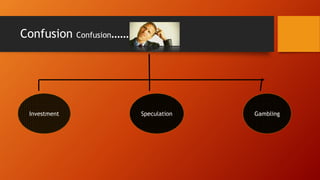
Confusion Confusion……..
Investment Speculation Gambling
Definition of speculation:
• Speculation is a trading activity that involves engaging
in a risky financial transaction, in expectation of making
enormous profits, from fluctuations in the market value
of financial assets. In speculation, there is a high risk of
losing maximum or all initial outlay, but it is offset by
the probability of significant profit. Although, the risk is
taken by speculators is properly analysed and
calculated.
• Speculation ca be seen in markets where the high
fluctuations in the price of securities such as the market
for stocks, bonds, derivatives, currency, commodity
futures, etc.
Does anyone know this guy???????
Definition of investment:
• An investment is an asset or item that is purchased with the hope
that it will generate income or will appreciate in the future.
• In an economic sense, an investment is the purchase of goods that
are not consumed today but are used in the future to create
wealth.
• In finance, an investment is a monetary asset purchased with the
idea that the asset will provide income in the future or will be
sold at a higher price for a profit.
Definition of Gambling:
• Gambling is the wagering of money or something
of value (referred to as "the stakes") on an event with an
uncertain outcome with the primary intent of winning
money or material goods.
• Gambling thus requires three elements be
present: consideration, chance and prize. The outcome of
the wager is often immediate, such as a single roll of dice,
a spin of a roulette wheel, or a horse crossing the finish
line, but longer time frames are also common, allowing
wagers on the outcome of a future sports contest or even
an entire sports season.
Factors of
investments
Factors of Investment
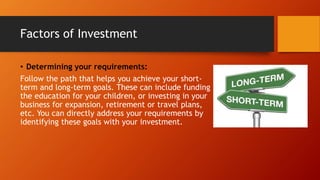
• Determining your requirements:
Follow the path that helps you achieve your short-
term and long-term goals. These can include funding
the education for your children, or investing in your
business for expansion, retirement or travel plans,
etc. You can directly address your requirements by
identifying these goals with your investment.
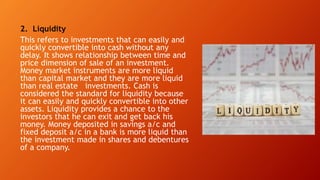
2. Liquidity
This refers to investments that can easily and
quickly convertible into cash without any
delay. It shows relationship between time and
price dimension of sale of an investment.
Money market instruments are more liquid
than capital market and they are more liquid
than real estate investments. Cash is
considered the standard for liquidity because
it can easily and quickly convertible into other
assets. Liquidity provides a chance to the
investors that he can exit and get back his
money. Money deposited in savings a/c and
fixed deposit a/c in a bank is more liquid than
the investment made in shares and debentures
of a company.
RISK OF AN INVESTMENT
• SAFETY OF PRINCIPAL
An investor should take care that the amount of investment should be safe. The safety of an
investment depends upon several factor such as economic conditions , organization where
investment is made , earnings of that organization . Investment in preference shares is still
safer than that in the equity shares of the same company . As in case of liquidation of the
company , order of payment is debenture holders, preference shareholders , and then the
equity shareholders.It may be noted that the safety of investment and the expected return
from that are interrelated .For eg: bonds issued by the RBI are completely safe investments as
compared to bonds of a private company.
• STABILITY OF RETURN
An investment is considered to be best if it offers stable returns . Prime objective of investing
is to earn stable return. If returns are not stable , then investment is considered risky . For eg
: Return from Savings A/c , Fixed Deposit A/c , Bonds and Debentures are stable but the
expected dividends from equity shares are not stable . The rate of return of equity share may
fluctuate depending upon the earnings of the organization .
• CAPITAL APPRECIATION
Capital appreciation is a rise in the value of an asset
based on a rise in market price. It occurs when the
asset invested commands a higher price in the
market than an investor originally paid for the
asset. The capital appreciation portion of the
investment includes all of the market
value exceeding the original investment or cost
basis. Investors need to understand that there is
generally a trade-off between the revenue income
and capital appreciation opportunities . Finding
both in one type of asset is unlikely.
5. TAX ASPECTS OF INVESTMENTS
Investment differ with respect to tax treatment of initial
investment , return from investment and redemption
proceeds. For eg, investment in public provident fund
has tax benefits in respect of all the three
characteristics noted above . however , investment in
shares entails exemption from taxability of dividend
income but the transactions of sale and purchase are
subject to securities transaction tax or tax on capital
gains . Sometimes, the tax treatment depends upon the
type of the investor. tax consequences are of prime
relevance to investment decisions. The performance of
any investment decision should be measured by its after
tax rate of return . for eg, between 8.5% public
provident fund and 8.5% debentures , former should be
preferred as it is exempt from tax while the latter is
subject to tax in the hands of the investor .
6. INVESTMENT HORIZON
Investment horizon refers to the planned liquidation date of the
investment. investment horizon must be considered by investors while
choosing and selecting investments. the maturity period of an investment
(say, bonds) makes it more attractive if it coincides with the date when
funds would be needed.
•Types of Investing &
Investments.
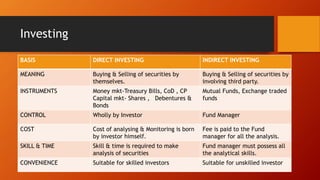
Investing
BASIS DIRECT INVESTING INDIRECT INVESTING
MEANING Buying & Selling of securities by
themselves.
Buying & Selling of securities by
involving third party.
INSTRUMENTS Money mkt-Treasury Bills, CoD , CP
Capital mkt- Shares , Debentures &
Bonds
Mutual Funds, Exchange traded
funds
CONTROL Wholly by Investor Fund Manager
COST Cost of analysing & Monitoring is born
by investor himself.
Fee is paid to the Fund
manager for all the analysis.
SKILL & TIME Skill & time is required to make
analysis of securities
Fund manager must possess all
the analytical skills.
CONVENIENCE Suitable for skilled investors Suitable for unskilled investor
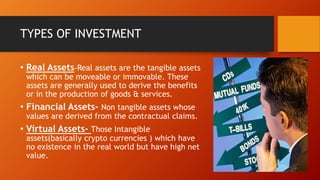
TYPES OF INVESTMENT
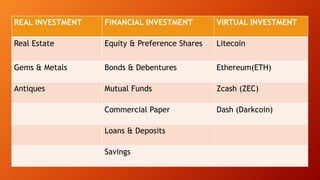
• Real Assets-Real assets are the tangible assets
which can be moveable or immovable. These
assets are generally used to derive the benefits
or in the production of goods & services.
• Financial Assets- Non tangible assets whose
values are derived from the contractual claims.
• Virtual Assets- Those Intangible
assets(basically crypto currencies ) which have
no existence in the real world but have high net
value.
REAL INVESTMENT FINANCIAL INVESTMENT VIRTUAL INVESTMENT
Real Estate Equity & Preference Shares Litecoin
Gems & Metals Bonds & Debentures Ethereum(ETH)
Antiques Mutual Funds Zcash (ZEC)
Commercial Paper Dash (Darkcoin)
Loans & Deposits
Savings
Risk
and
Return
Return
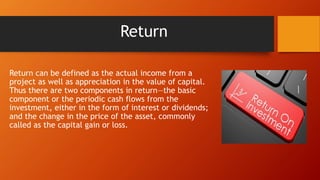
Return can be defined as the actual income from a
project as well as appreciation in the value of capital.
Thus there are two components in return—the basic
component or the periodic cash flows from the
investment, either in the form of interest or dividends;
and the change in the price of the asset, commonly
called as the capital gain or loss.
TYPES OF RETURN
• Expected Return -
It refers to the anticipated return for some future period. The expected
return is estimated on the basis of actual returns in the past periods.
• Realised Return –
It is net actual return earned by the invester over the holiding period. It
refers to the actual return over some past period. The actual return may
be more or less than expected return. The difference between the
expected and the realized return give rise to the RISK attacted with the
return.
The returns on investment usually come in the
following forms:-
• The safety of the principal amount invested.
• Regular and timely payment of interest or dividend.
• Liquidity of investment. This facilitates premature encashment, loan facilities,
marketability of investment, etc.
• Chances of capital appreciation, where the market price of the investment is
higher, due to issue of bonus shares, right issue at a lower premium, etc.
• Problem-free transactions like easy buying and selling of the investment,
encashment of interest or dividend warrants, etc.
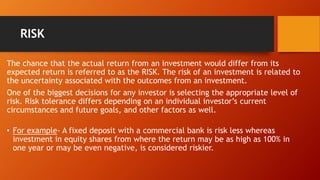
RISK
The chance that the actual return from an investment would differ from its
expected return is referred to as the RISK. The risk of an investment is related to
the uncertainty associated with the outcomes from an investment.
One of the biggest decisions for any investor is selecting the appropriate level of
risk. Risk tolerance differs depending on an individual investor’s current
circumstances and future goals, and other factors as well.
• For example- A fixed deposit with a commercial bank is risk less whereas
investment in equity shares from where the return may be as high as 100% in
one year or may be even negative, is considered riskier.
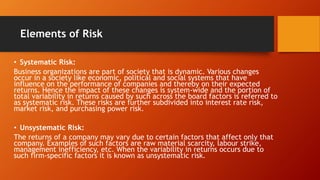
Elements of Risk
• Systematic Risk:
Business organizations are part of society that is dynamic. Various changes
occur in a society like economic, political and social systems that have
influence on the performance of companies and thereby on their expected
returns. Hence the impact of these changes is system-wide and the portion of
total variability in returns caused by such across the board factors is referred to
as systematic risk. These risks are further subdivided into interest rate risk,
market risk, and purchasing power risk.
• Unsystematic Risk:
The returns of a company may vary due to certain factors that affect only that
company. Examples of such factors are raw material scarcity, labour strike,
management inefficiency, etc. When the variability in returns occurs due to
such firm-specific factors it is known as unsystematic risk.
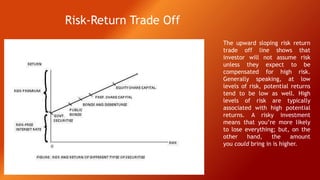
The upward sloping risk return
trade off line shows that
investor will not assume risk
unless they expect to be
compensated for high risk.
Generally speaking, at low
levels of risk, potential returns
tend to be low as well. High
levels of risk are typically
associated with high potential
returns. A risky investment
means that you’re more likely
to lose everything; but, on the
other hand, the amount
you could bring in is higher.
Risk-Return Trade Off
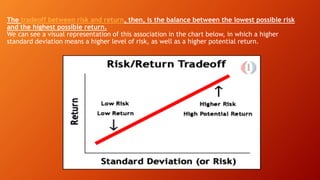
The tradeoff between risk and return, then, is the balance between the lowest possible risk
and the highest possible return.
We can see a visual representation of this association in the chart below, in which a higher
standard deviation means a higher level of risk, as well as a higher potential return.
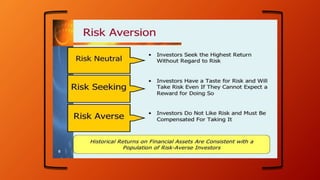
• It’s crucial to keep in mind that higher risk does NOT equal greater
return. The risk/return tradeoff only indicates that higher risk
levels are associated with the possibility of higher returns, but
nothing is guaranteed. At the same time, higher risk also means
higher potential losses on an investment.
• On the safe side of the spectrum, the risk-free rate of return is
represented by the return on U.S. Government Securities, as their
chance of default is essentially zero. Thus, if the risk-free rate is
6% at any given time, for instance, this means that investors can
earn 6% per year on their assets, essentially without risking
anything.
•Maneuvering with
investments
Hedging
• The word hedge is from Old English hecg, originally any fence, living or
artificial. The use of the word as a verb in the sense of "dodge, evade" is
first recorded in the 1590s; that of insure oneself against loss, as in a
bet, is from the 1670s.
• The best way to understand hedging is to think of it as insurance. When
people decide to hedge, they are insuring themselves against a negative
event. This doesn't prevent a negative event from happening, but if it
does happen and you're properly hedged, the impact of the event is
reduced. So, hedging occurs almost everywhere, and we see it everyday.
For example, if you buy house insurance, you are hedging yourself
against fires, break-ins or other unforeseen disasters.
Downside
• Every hedge has a cost, so before you decide to use hedging, you must
ask yourself if the benefits received from it justify the expense.
Remember, the goal of hedging isn't to make money but to protect from
losses. The cost of the hedge – whether it is the cost of an option or lost
profits from being on the wrong side of a futures contract – cannot be
avoided. This is the price you have to pay to avoid uncertainty.
• We've been comparing hedging versus insurance, but we should
emphasize that insurance is far more precise than hedging. With
insurance, you are completely compensated for your loss (usually minus
a deductible). Hedging a portfolio isn't a perfect science and things can
go wrong. Although risk managers are always aiming for the perfect
hedge, it is difficult to achieve in practice.
How to Hedge?
• Let's assume part of your investment portfolio includes 100 shares of Company XYZ, which
manufactures autos. Because the auto industry is cyclical (meaning Company XYZ usually sells
more cars and is more profitable during economic booms and sells fewer cars and is less
profitable during economic slumps), Company XYZ shares will probably be worth less if
the economy starts to deteriorate. How do you protect your investment?
• One way is to buy defensive stocks. These stocks might be from the food, utility, or other
industries that sell products that consumers consider basic necessities. During economic
slumps, these stocks tend to gain or at least hold their value. Thus, these stocks may gain
when your XYZ shares lose.
• Another way to hedge is to purchase a put option contract on the shares (this would
essentially allow you to "lock in" a particular sale price on XYZ, so even if the stock crashed,
you wouldn't suffer much). You could also sell a futures contract, promising to sell your stock
at a set price at a certain point in the future
.
Arbitrage
• Arbitrage is the simultaneous purchase and sale of an asset to
profit from a difference in the price. It is a trade that profits by
exploiting the price differences of identical or similar financial
instruments on different markets or in different forms. Arbitrage
exists as a result of market inefficiencies
• Arbitrage is not simply the act of buying a product in one market
and selling it in another for a higher price at some later time. The
transactions must occur simultaneously to avoid exposure to
market risk, or the risk that prices may change on one market
before both transactions are complete.
Example:
As a simple example of arbitrage, consider the following. The stock
of Company X is trading at $20 on the New York Stock Exchange
(NYSE) while, at the same moment, it is trading for $20.05 on the
London Stock Exchange (LSE). A trader can buy the stock on the
NYSE and immediately sell the same shares on the LSE, earning a
profit of 5 cents per share. The trader could continue to exploit this
arbitrage until the specialists on the NYSE run out of inventory of
Company X's stock, or until the specialists on the NYSE or LSE adjust
their prices to wipe out the opportunity.
Diversification
• Domestic stocks-Stocks represent the most aggressive portion of your portfolio
and provide the opportunity for higher growth over the long term. However, this
greater potential for growth carries a greater risk, particularly in the short term.
Because stocks are generally more volatile than other types of assets, your
investment in a stock could be worth less if and when you decide to sell it.
• International stocks-Stocks issued by non-U.S. companies often perform
differently than their U.S. counterparts, providing exposure to opportunities not
offered by U.S. securities. If you’re searching for investments that offer both
higher potential returns and higher risk, you may want to consider adding some
foreign stocks to your portfolio.
Additional components of a diversified portfolio
• Sector funds-Although these invest in stocks, sector funds, as their name suggests,
focus on a particular segment of the economy. They can be valuable tools for investors
seeking opportunities in different phases of the economic cycle.
• Commodity focused funds-While only the most experienced investors should invest in
commodities, adding equity funds that focus on commodity-intensive industries to your
portfolio—such as oil and gas, mining, and natural resources—can provide a good hedge
against inflation.
• Real estate funds-Real estate funds, including real estate investment trusts (REITs),
can also play a role in diversifying your portfolio and providing some protection against
the risk of inflation.
• Asset allocation funds-For investors who don’t have the time or the expertise to build
a diversified portfolio, asset allocation funds can serve as an effective single-fund
strategy. Fidelity manages a number of different types of these funds, including funds
that are managed to a specific target date, funds that are managed to maintain a
specific asset allocation, funds that are managed to generate income, and funds that
are managed in anticipation of specific outcomes, such as inflation.
What makes a diversified portfolio?
To diversify your portfolio, you need to spread your capital across
different asset classes to reduce your overall investment risk. These
should include a mix of growth and defensive assets:
• Growth assets include investments such as shares or property and
generally provide longer term capital gains, but typically have a
higher level of risk than defensive assets.
• Defensive assets include investments such as cash or fixed interest
and generally provide a lower return over the long term, but also
generally a lower level of risk.
Why diversification?
• Minimising risk of loss – if one investment performs poorly over a certain
period, other investments may perform better over that same period,
reducing the potential losses of your investment portfolio from
concentrating all your capital under one type of investment.
• Preserving capital – not all investors are in the accumulation phase of
life; some who are close to retirement have goals oriented towards
preservation of capital, and diversification can help protect your
savings.
• Generating returns – sometimes investments don’t always perform as
expected, by diversifying you’re not merely relying upon one source for
income.
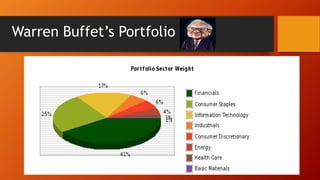
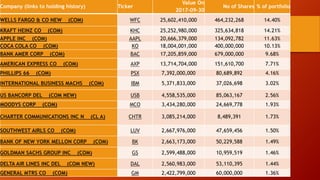
Warren Buffet’s Portfolio
Company (links to holding history) Ticker
Value On
2017-09-30
No of Shares % of portfolio
WELLS FARGO & CO NEW (COM) WFC 25,602,410,000 464,232,268 14.40%
KRAFT HEINZ CO (COM) KHC 25,252,980,000 325,634,818 14.21%
APPLE INC (COM) AAPL 20,666,379,000 134,092,782 11.63%
COCA COLA CO (COM) KO 18,004,001,000 400,000,000 10.13%
BANK AMER CORP (COM) BAC 17,205,859,000 679,000,000 9.68%
AMERICAN EXPRESS CO (COM) AXP 13,714,704,000 151,610,700 7.71%
PHILLIPS 66 (COM) PSX 7,392,000,000 80,689,892 4.16%
INTERNATIONAL BUSINESS MACHS (COM) IBM 5,371,833,000 37,026,698 3.02%
US BANCORP DEL (COM NEW) USB 4,558,535,000 85,063,167 2.56%
MOODYS CORP (COM) MCO 3,434,280,000 24,669,778 1.93%
CHARTER COMMUNICATIONS INC N (CL A) CHTR 3,085,214,000 8,489,391 1.73%
SOUTHWEST AIRLS CO (COM) LUV 2,667,976,000 47,659,456 1.50%
BANK OF NEW YORK MELLON CORP (COM) BK 2,663,173,000 50,229,588 1.49%
GOLDMAN SACHS GROUP INC (COM) GS 2,599,488,000 10,959,519 1.46%
DELTA AIR LINES INC DEL (COM NEW) DAL 2,560,983,000 53,110,395 1.44%
GENERAL MTRS CO (COM) GM 2,422,799,000 60,000,000 1.36%
Conclusion
•Protect your capital.
•Compounding is the eighth wonder of the world.
•The skills required for investing in stock market is
zero.
•Chase GOALS, NOT Returns
Thank You

presentation1-180117144541.pdf

  • 1.
    Understanding Investment Group I AkshitGupta Sajal Agarwal Aashi Dutt Hema Gupta Kaustubh Kohli Himadri Daga Bcom(H) Sec B Sem VI
  • 2.
    Index-- SNO. Topics 1. Whatis Investment? Why there is a need of investment? 2. Speculation , Investment and Gambling 3. Factors of investment 4. Types of investment 5. Risk and Return 6. Manoeuvring with investment and conclusion..
  • 3.
  • 4.
  • 5.
  • 6.
    Investment means---------- •The Processof laying out money now in the expectation of receiving more money in the future.
  • 7.
    INVESTMENT The term investmentrefers to exchange of money wealth into some tangible wealth. The money wealth refers to the savings of the investor and the tangible wealth refers to the asset an investor get by sacrificing the money wealth. Future returns can be in terms of interest(dividends on shares) or capital gains(increase of price of the land or gold).
  • 8.
    Why there isa need for investments?
  • 9.
    Why did theneed for investment occur? • The origin of investment can be attributed to the same set of events that eventually led to the colonization of the rest of the world by the European countries. During the middle ages, the essential Asian goods such as spices, silk, tea and sugar reached Europe through the Arab traders, which often made them quite expensive for the common people to consume. The Europeans were forced to find an alternate route to Asia, bypassing the traders in the middle-east. Ships were sent by the merchants to discover new routes and unknown lands. Huge funds were required to finance these voyages. The monarchs were busy fighting wars or building palaces. The onus of arranging the capital for sending these ships thus fell upon the High Net worth Individuals (HNIs) of that age, who were generally the large land owners, nobles and merchants.
  • 10.
    • Hence, theAmsterdam Stock Exchange came into being, where these companies issued stocks that confirmed/guaranteed the share of investment of an individual and promised returns on the profits made in these voyages. The modern stock exchanges operate on the same premise, only the scale and scope has increased a million fold.
  • 11.
    Why we needto invest? • Let’s say you have Rs.10,000. There’s no rule that says you have to invest it. • In fact, many people would spend it!
  • 12.
    Inflation is thetendency for the cost of things – bread, houses, wages – to rise 2% INFLATION 2% reduces the value of your money by only a little bit each year, but it adds up to a 40% loss in real terms over 25 years. The first reason we invest is to maintain the spending power of our money.
  • 13.
    But if youinvest it somewhere------- the principle is clear. At the very least, you need to grow your money in nominal terms, just to offset the corrosion of inflation. The red bars show the impact of 2% inflation. The blue show the effect of a 2% interest rate
  • 14.
    2. Compounding compound interest Thepower of compounding The table on the upcoming slide shows how a single investment of Rs.100 will grow at various rates of return. Five percent is about what you might get from a certificate of deposit (CD) or with a government bond over time, 10% is about the historical average stock market return, and 15% is what you might get if you decide to learn how to pick your own stocks “________________is the eighth wonder of the world. He who understands it, earns it ... he who doesn't ... pays it.”
  • 15.
    Age 5% 10%15% 20% 15 Rs.100 Rs.100 Rs.100 Rs.100 20 Rs.128 Rs.161 Rs.201 Rs.249 25 Rs.163 Rs.259 Rs.405 Rs.619 30 Rs.208 Rs.418 Rs.814 Rs.1,541 40 Rs.339 Rs.1,083 Rs.3,292 Rs.9,540 50 Rs.552 Rs.2,810 Rs.13,318 Rs.59,067 60 Rs.899 Rs.7,298 Rs.53,877 Rs.365,726 65 Rs.1,147 Rs.11,739 Rs.108,366 Rs.910,044
  • 16.
    If you keepyour money in your back pocket instead of investing it, your money doesn't work for you and you will never have more money than what you save. By investing your money, you are getting your money to generate more money by earning interest on what you put away or by buying and selling assets that increase in value. As they say, "Money isn't everything, but happiness alone can't keep out the rain."
  • 18.
  • 19.
    Definition of speculation: •Speculation is a trading activity that involves engaging in a risky financial transaction, in expectation of making enormous profits, from fluctuations in the market value of financial assets. In speculation, there is a high risk of losing maximum or all initial outlay, but it is offset by the probability of significant profit. Although, the risk is taken by speculators is properly analysed and calculated. • Speculation ca be seen in markets where the high fluctuations in the price of securities such as the market for stocks, bonds, derivatives, currency, commodity futures, etc.
  • 20.
    Does anyone knowthis guy???????
  • 23.
    Definition of investment: •An investment is an asset or item that is purchased with the hope that it will generate income or will appreciate in the future. • In an economic sense, an investment is the purchase of goods that are not consumed today but are used in the future to create wealth. • In finance, an investment is a monetary asset purchased with the idea that the asset will provide income in the future or will be sold at a higher price for a profit.
  • 24.
    Definition of Gambling: •Gambling is the wagering of money or something of value (referred to as "the stakes") on an event with an uncertain outcome with the primary intent of winning money or material goods. • Gambling thus requires three elements be present: consideration, chance and prize. The outcome of the wager is often immediate, such as a single roll of dice, a spin of a roulette wheel, or a horse crossing the finish line, but longer time frames are also common, allowing wagers on the outcome of a future sports contest or even an entire sports season.
  • 25.
  • 26.
    Factors of Investment •Determining your requirements: Follow the path that helps you achieve your short- term and long-term goals. These can include funding the education for your children, or investing in your business for expansion, retirement or travel plans, etc. You can directly address your requirements by identifying these goals with your investment.
  • 27.
    2. Liquidity This refersto investments that can easily and quickly convertible into cash without any delay. It shows relationship between time and price dimension of sale of an investment. Money market instruments are more liquid than capital market and they are more liquid than real estate investments. Cash is considered the standard for liquidity because it can easily and quickly convertible into other assets. Liquidity provides a chance to the investors that he can exit and get back his money. Money deposited in savings a/c and fixed deposit a/c in a bank is more liquid than the investment made in shares and debentures of a company.
  • 28.
    RISK OF ANINVESTMENT • SAFETY OF PRINCIPAL An investor should take care that the amount of investment should be safe. The safety of an investment depends upon several factor such as economic conditions , organization where investment is made , earnings of that organization . Investment in preference shares is still safer than that in the equity shares of the same company . As in case of liquidation of the company , order of payment is debenture holders, preference shareholders , and then the equity shareholders.It may be noted that the safety of investment and the expected return from that are interrelated .For eg: bonds issued by the RBI are completely safe investments as compared to bonds of a private company. • STABILITY OF RETURN An investment is considered to be best if it offers stable returns . Prime objective of investing is to earn stable return. If returns are not stable , then investment is considered risky . For eg : Return from Savings A/c , Fixed Deposit A/c , Bonds and Debentures are stable but the expected dividends from equity shares are not stable . The rate of return of equity share may fluctuate depending upon the earnings of the organization .
  • 29.
    • CAPITAL APPRECIATION Capitalappreciation is a rise in the value of an asset based on a rise in market price. It occurs when the asset invested commands a higher price in the market than an investor originally paid for the asset. The capital appreciation portion of the investment includes all of the market value exceeding the original investment or cost basis. Investors need to understand that there is generally a trade-off between the revenue income and capital appreciation opportunities . Finding both in one type of asset is unlikely.
  • 30.
    5. TAX ASPECTSOF INVESTMENTS Investment differ with respect to tax treatment of initial investment , return from investment and redemption proceeds. For eg, investment in public provident fund has tax benefits in respect of all the three characteristics noted above . however , investment in shares entails exemption from taxability of dividend income but the transactions of sale and purchase are subject to securities transaction tax or tax on capital gains . Sometimes, the tax treatment depends upon the type of the investor. tax consequences are of prime relevance to investment decisions. The performance of any investment decision should be measured by its after tax rate of return . for eg, between 8.5% public provident fund and 8.5% debentures , former should be preferred as it is exempt from tax while the latter is subject to tax in the hands of the investor .
  • 31.
    6. INVESTMENT HORIZON Investmenthorizon refers to the planned liquidation date of the investment. investment horizon must be considered by investors while choosing and selecting investments. the maturity period of an investment (say, bonds) makes it more attractive if it coincides with the date when funds would be needed.
  • 32.
    •Types of Investing& Investments.
  • 33.
    Investing BASIS DIRECT INVESTINGINDIRECT INVESTING MEANING Buying & Selling of securities by themselves. Buying & Selling of securities by involving third party. INSTRUMENTS Money mkt-Treasury Bills, CoD , CP Capital mkt- Shares , Debentures & Bonds Mutual Funds, Exchange traded funds CONTROL Wholly by Investor Fund Manager COST Cost of analysing & Monitoring is born by investor himself. Fee is paid to the Fund manager for all the analysis. SKILL & TIME Skill & time is required to make analysis of securities Fund manager must possess all the analytical skills. CONVENIENCE Suitable for skilled investors Suitable for unskilled investor
  • 34.
    TYPES OF INVESTMENT •Real Assets-Real assets are the tangible assets which can be moveable or immovable. These assets are generally used to derive the benefits or in the production of goods & services. • Financial Assets- Non tangible assets whose values are derived from the contractual claims. • Virtual Assets- Those Intangible assets(basically crypto currencies ) which have no existence in the real world but have high net value.
  • 35.
    REAL INVESTMENT FINANCIALINVESTMENT VIRTUAL INVESTMENT Real Estate Equity & Preference Shares Litecoin Gems & Metals Bonds & Debentures Ethereum(ETH) Antiques Mutual Funds Zcash (ZEC) Commercial Paper Dash (Darkcoin) Loans & Deposits Savings
  • 36.
  • 37.
    Return Return can bedefined as the actual income from a project as well as appreciation in the value of capital. Thus there are two components in return—the basic component or the periodic cash flows from the investment, either in the form of interest or dividends; and the change in the price of the asset, commonly called as the capital gain or loss.
  • 38.
    TYPES OF RETURN •Expected Return - It refers to the anticipated return for some future period. The expected return is estimated on the basis of actual returns in the past periods. • Realised Return – It is net actual return earned by the invester over the holiding period. It refers to the actual return over some past period. The actual return may be more or less than expected return. The difference between the expected and the realized return give rise to the RISK attacted with the return.
  • 39.
    The returns oninvestment usually come in the following forms:- • The safety of the principal amount invested. • Regular and timely payment of interest or dividend. • Liquidity of investment. This facilitates premature encashment, loan facilities, marketability of investment, etc. • Chances of capital appreciation, where the market price of the investment is higher, due to issue of bonus shares, right issue at a lower premium, etc. • Problem-free transactions like easy buying and selling of the investment, encashment of interest or dividend warrants, etc.
  • 40.
    RISK The chance thatthe actual return from an investment would differ from its expected return is referred to as the RISK. The risk of an investment is related to the uncertainty associated with the outcomes from an investment. One of the biggest decisions for any investor is selecting the appropriate level of risk. Risk tolerance differs depending on an individual investor’s current circumstances and future goals, and other factors as well. • For example- A fixed deposit with a commercial bank is risk less whereas investment in equity shares from where the return may be as high as 100% in one year or may be even negative, is considered riskier.
  • 42.
    Elements of Risk •Systematic Risk: Business organizations are part of society that is dynamic. Various changes occur in a society like economic, political and social systems that have influence on the performance of companies and thereby on their expected returns. Hence the impact of these changes is system-wide and the portion of total variability in returns caused by such across the board factors is referred to as systematic risk. These risks are further subdivided into interest rate risk, market risk, and purchasing power risk. • Unsystematic Risk: The returns of a company may vary due to certain factors that affect only that company. Examples of such factors are raw material scarcity, labour strike, management inefficiency, etc. When the variability in returns occurs due to such firm-specific factors it is known as unsystematic risk.
  • 43.
    The upward slopingrisk return trade off line shows that investor will not assume risk unless they expect to be compensated for high risk. Generally speaking, at low levels of risk, potential returns tend to be low as well. High levels of risk are typically associated with high potential returns. A risky investment means that you’re more likely to lose everything; but, on the other hand, the amount you could bring in is higher. Risk-Return Trade Off
  • 44.
    The tradeoff betweenrisk and return, then, is the balance between the lowest possible risk and the highest possible return. We can see a visual representation of this association in the chart below, in which a higher standard deviation means a higher level of risk, as well as a higher potential return.
  • 45.
    • It’s crucialto keep in mind that higher risk does NOT equal greater return. The risk/return tradeoff only indicates that higher risk levels are associated with the possibility of higher returns, but nothing is guaranteed. At the same time, higher risk also means higher potential losses on an investment. • On the safe side of the spectrum, the risk-free rate of return is represented by the return on U.S. Government Securities, as their chance of default is essentially zero. Thus, if the risk-free rate is 6% at any given time, for instance, this means that investors can earn 6% per year on their assets, essentially without risking anything.
  • 46.
  • 47.
    Hedging • The wordhedge is from Old English hecg, originally any fence, living or artificial. The use of the word as a verb in the sense of "dodge, evade" is first recorded in the 1590s; that of insure oneself against loss, as in a bet, is from the 1670s. • The best way to understand hedging is to think of it as insurance. When people decide to hedge, they are insuring themselves against a negative event. This doesn't prevent a negative event from happening, but if it does happen and you're properly hedged, the impact of the event is reduced. So, hedging occurs almost everywhere, and we see it everyday. For example, if you buy house insurance, you are hedging yourself against fires, break-ins or other unforeseen disasters.
  • 48.
    Downside • Every hedgehas a cost, so before you decide to use hedging, you must ask yourself if the benefits received from it justify the expense. Remember, the goal of hedging isn't to make money but to protect from losses. The cost of the hedge – whether it is the cost of an option or lost profits from being on the wrong side of a futures contract – cannot be avoided. This is the price you have to pay to avoid uncertainty. • We've been comparing hedging versus insurance, but we should emphasize that insurance is far more precise than hedging. With insurance, you are completely compensated for your loss (usually minus a deductible). Hedging a portfolio isn't a perfect science and things can go wrong. Although risk managers are always aiming for the perfect hedge, it is difficult to achieve in practice.
  • 49.
    How to Hedge? •Let's assume part of your investment portfolio includes 100 shares of Company XYZ, which manufactures autos. Because the auto industry is cyclical (meaning Company XYZ usually sells more cars and is more profitable during economic booms and sells fewer cars and is less profitable during economic slumps), Company XYZ shares will probably be worth less if the economy starts to deteriorate. How do you protect your investment? • One way is to buy defensive stocks. These stocks might be from the food, utility, or other industries that sell products that consumers consider basic necessities. During economic slumps, these stocks tend to gain or at least hold their value. Thus, these stocks may gain when your XYZ shares lose. • Another way to hedge is to purchase a put option contract on the shares (this would essentially allow you to "lock in" a particular sale price on XYZ, so even if the stock crashed, you wouldn't suffer much). You could also sell a futures contract, promising to sell your stock at a set price at a certain point in the future .
  • 50.
    Arbitrage • Arbitrage isthe simultaneous purchase and sale of an asset to profit from a difference in the price. It is a trade that profits by exploiting the price differences of identical or similar financial instruments on different markets or in different forms. Arbitrage exists as a result of market inefficiencies • Arbitrage is not simply the act of buying a product in one market and selling it in another for a higher price at some later time. The transactions must occur simultaneously to avoid exposure to market risk, or the risk that prices may change on one market before both transactions are complete.
  • 51.
    Example: As a simpleexample of arbitrage, consider the following. The stock of Company X is trading at $20 on the New York Stock Exchange (NYSE) while, at the same moment, it is trading for $20.05 on the London Stock Exchange (LSE). A trader can buy the stock on the NYSE and immediately sell the same shares on the LSE, earning a profit of 5 cents per share. The trader could continue to exploit this arbitrage until the specialists on the NYSE run out of inventory of Company X's stock, or until the specialists on the NYSE or LSE adjust their prices to wipe out the opportunity.
  • 52.
    Diversification • Domestic stocks-Stocksrepresent the most aggressive portion of your portfolio and provide the opportunity for higher growth over the long term. However, this greater potential for growth carries a greater risk, particularly in the short term. Because stocks are generally more volatile than other types of assets, your investment in a stock could be worth less if and when you decide to sell it. • International stocks-Stocks issued by non-U.S. companies often perform differently than their U.S. counterparts, providing exposure to opportunities not offered by U.S. securities. If you’re searching for investments that offer both higher potential returns and higher risk, you may want to consider adding some foreign stocks to your portfolio.
  • 53.
    Additional components ofa diversified portfolio • Sector funds-Although these invest in stocks, sector funds, as their name suggests, focus on a particular segment of the economy. They can be valuable tools for investors seeking opportunities in different phases of the economic cycle. • Commodity focused funds-While only the most experienced investors should invest in commodities, adding equity funds that focus on commodity-intensive industries to your portfolio—such as oil and gas, mining, and natural resources—can provide a good hedge against inflation. • Real estate funds-Real estate funds, including real estate investment trusts (REITs), can also play a role in diversifying your portfolio and providing some protection against the risk of inflation. • Asset allocation funds-For investors who don’t have the time or the expertise to build a diversified portfolio, asset allocation funds can serve as an effective single-fund strategy. Fidelity manages a number of different types of these funds, including funds that are managed to a specific target date, funds that are managed to maintain a specific asset allocation, funds that are managed to generate income, and funds that are managed in anticipation of specific outcomes, such as inflation.
  • 54.
    What makes adiversified portfolio? To diversify your portfolio, you need to spread your capital across different asset classes to reduce your overall investment risk. These should include a mix of growth and defensive assets: • Growth assets include investments such as shares or property and generally provide longer term capital gains, but typically have a higher level of risk than defensive assets. • Defensive assets include investments such as cash or fixed interest and generally provide a lower return over the long term, but also generally a lower level of risk.
  • 55.
    Why diversification? • Minimisingrisk of loss – if one investment performs poorly over a certain period, other investments may perform better over that same period, reducing the potential losses of your investment portfolio from concentrating all your capital under one type of investment. • Preserving capital – not all investors are in the accumulation phase of life; some who are close to retirement have goals oriented towards preservation of capital, and diversification can help protect your savings. • Generating returns – sometimes investments don’t always perform as expected, by diversifying you’re not merely relying upon one source for income.
  • 56.
  • 57.
    Company (links toholding history) Ticker Value On 2017-09-30 No of Shares % of portfolio WELLS FARGO & CO NEW (COM) WFC 25,602,410,000 464,232,268 14.40% KRAFT HEINZ CO (COM) KHC 25,252,980,000 325,634,818 14.21% APPLE INC (COM) AAPL 20,666,379,000 134,092,782 11.63% COCA COLA CO (COM) KO 18,004,001,000 400,000,000 10.13% BANK AMER CORP (COM) BAC 17,205,859,000 679,000,000 9.68% AMERICAN EXPRESS CO (COM) AXP 13,714,704,000 151,610,700 7.71% PHILLIPS 66 (COM) PSX 7,392,000,000 80,689,892 4.16% INTERNATIONAL BUSINESS MACHS (COM) IBM 5,371,833,000 37,026,698 3.02% US BANCORP DEL (COM NEW) USB 4,558,535,000 85,063,167 2.56% MOODYS CORP (COM) MCO 3,434,280,000 24,669,778 1.93% CHARTER COMMUNICATIONS INC N (CL A) CHTR 3,085,214,000 8,489,391 1.73% SOUTHWEST AIRLS CO (COM) LUV 2,667,976,000 47,659,456 1.50% BANK OF NEW YORK MELLON CORP (COM) BK 2,663,173,000 50,229,588 1.49% GOLDMAN SACHS GROUP INC (COM) GS 2,599,488,000 10,959,519 1.46% DELTA AIR LINES INC DEL (COM NEW) DAL 2,560,983,000 53,110,395 1.44% GENERAL MTRS CO (COM) GM 2,422,799,000 60,000,000 1.36%
  • 59.
  • 60.
    •Protect your capital. •Compoundingis the eighth wonder of the world. •The skills required for investing in stock market is zero. •Chase GOALS, NOT Returns
  • 61.