ORGANIZATIONAL BEHAVIOR
S T E P H E N P. R O B B I N S
E L E V E N T H E D I T I O N
W W W . P R E N H A L L . C O M / R O B B I N S
© 2005 Prentice Hall Inc.
All rights reserved.
PowerPoint Presentation
by Charlie Cook
Foundations of
Individual Behavior (OB)
Chapter 2
© 2005 Prentice Hall Inc. All rights reserved. 2–2
Biographical Characteristics
Personal characteristics—such as age, gender, and
marital status—that are objective and easily obtained
from personnel records.
© 2005 Prentice Hall Inc. All rights reserved. 2–3
Ability, Intellect, and Intelligence
Ability
An individual’s capacity to perform the various tasks
in a job.
Intellectual Ability
The capacity to do mental activities.
Multiple Intelligences
Intelligence contains four subparts:
cognitive, social, emotional, and cultural.
© 2005 Prentice Hall Inc. All rights reserved. 2–4
Physical Abilities
Physical Abilities
The capacity to do tasks demanding stamina,
dexterity, strength, and similar characteristics.
© 2005 Prentice Hall Inc. All rights reserved. 2–5
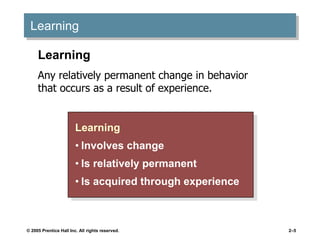
Learning
Learning
• Involves change
• Is relatively permanent
• Is acquired through experience
Learning
Any relatively permanent change in behavior
that occurs as a result of experience.
© 2005 Prentice Hall Inc. All rights reserved. 2–6
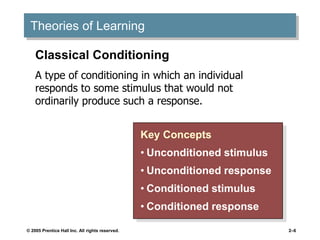
Theories of Learning
Key Concepts
• Unconditioned stimulus
• Unconditioned response
• Conditioned stimulus
• Conditioned response
Classical Conditioning
A type of conditioning in which an individual
responds to some stimulus that would not
ordinarily produce such a response.
© 2005 Prentice Hall Inc. All rights reserved. 2–7
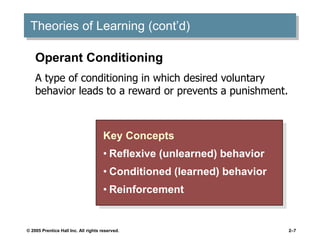
Theories of Learning (cont’d)
Key Concepts
• Reflexive (unlearned) behavior
• Conditioned (learned) behavior
• Reinforcement
Operant Conditioning
A type of conditioning in which desired voluntary
behavior leads to a reward or prevents a punishment.
© 2005 Prentice Hall Inc. All rights reserved. 2–8
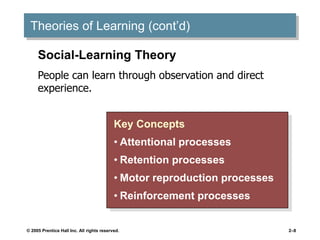
Theories of Learning (cont’d)
Key Concepts
• Attentional processes
• Retention processes
• Motor reproduction processes
• Reinforcement processes
Social-Learning Theory
People can learn through observation and direct
experience.
© 2005 Prentice Hall Inc. All rights reserved. 2–9
Theories of Learning (cont’d)
Key Concepts
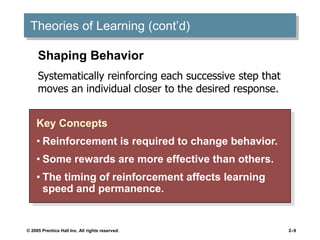
• Reinforcement is required to change behavior.
• Some rewards are more effective than others.
• The timing of reinforcement affects learning
speed and permanence.
Shaping Behavior
Systematically reinforcing each successive step that
moves an individual closer to the desired response.
© 2005 Prentice Hall Inc. All rights reserved. 2–10
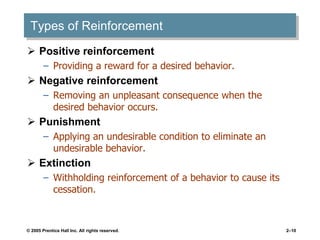
Types of Reinforcement
 Positive reinforcement
– Providing a reward for a desired behavior.
 Negative reinforcement
– Removing an unpleasant consequence when the
desired behavior occurs.
 Punishment
– Applying an undesirable condition to eliminate an
undesirable behavior.
 Extinction
– Withholding reinforcement of a behavior to cause its
cessation.
© 2005 Prentice Hall Inc. All rights reserved. 2–11
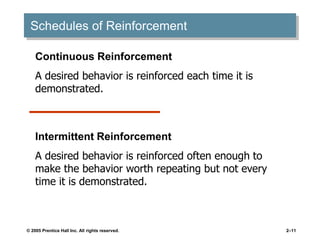
Schedules of Reinforcement
Continuous Reinforcement
A desired behavior is reinforced each time it is
demonstrated.
Intermittent Reinforcement
A desired behavior is reinforced often enough to
make the behavior worth repeating but not every
time it is demonstrated.
© 2005 Prentice Hall Inc. All rights reserved. 2–12
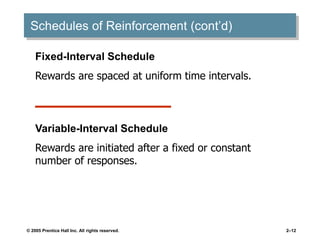
Schedules of Reinforcement (cont’d)
Fixed-Interval Schedule
Rewards are spaced at uniform time intervals.
Variable-Interval Schedule
Rewards are initiated after a fixed or constant
number of responses.
© 2005 Prentice Hall Inc. All rights reserved. 2–13
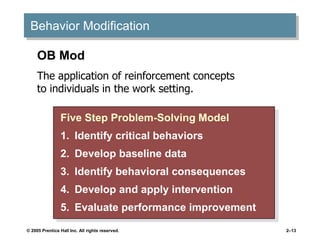
Behavior Modification
Five Step Problem-Solving Model
1. Identify critical behaviors
2. Develop baseline data
3. Identify behavioral consequences
4. Develop and apply intervention
5. Evaluate performance improvement
OB Mod
The application of reinforcement concepts
to individuals in the work setting.
© 2005 Prentice Hall Inc. All rights reserved. 2–14
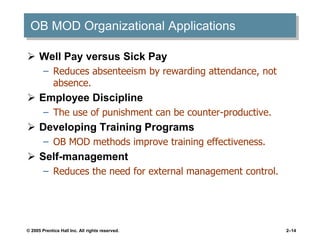
OB MOD Organizational Applications
 Well Pay versus Sick Pay
– Reduces absenteeism by rewarding attendance, not
absence.
 Employee Discipline
– The use of punishment can be counter-productive.
 Developing Training Programs
– OB MOD methods improve training effectiveness.
 Self-management
– Reduces the need for external management control.

Foundations of OB.ppt

  • 1.
    ORGANIZATIONAL BEHAVIOR S TE P H E N P. R O B B I N S E L E V E N T H E D I T I O N W W W . P R E N H A L L . C O M / R O B B I N S © 2005 Prentice Hall Inc. All rights reserved. PowerPoint Presentation by Charlie Cook Foundations of Individual Behavior (OB) Chapter 2
  • 2.
    © 2005 PrenticeHall Inc. All rights reserved. 2–2 Biographical Characteristics Biographical Characteristics Personal characteristics—such as age, gender, and marital status—that are objective and easily obtained from personnel records.
  • 3.
    © 2005 PrenticeHall Inc. All rights reserved. 2–3 Ability, Intellect, and Intelligence Ability An individual’s capacity to perform the various tasks in a job. Intellectual Ability The capacity to do mental activities. Multiple Intelligences Intelligence contains four subparts: cognitive, social, emotional, and cultural.
  • 4.
    © 2005 PrenticeHall Inc. All rights reserved. 2–4 Physical Abilities Physical Abilities The capacity to do tasks demanding stamina, dexterity, strength, and similar characteristics.
  • 5.
    © 2005 PrenticeHall Inc. All rights reserved. 2–5 Learning Learning • Involves change • Is relatively permanent • Is acquired through experience Learning Any relatively permanent change in behavior that occurs as a result of experience.
  • 6.
    © 2005 PrenticeHall Inc. All rights reserved. 2–6 Theories of Learning Key Concepts • Unconditioned stimulus • Unconditioned response • Conditioned stimulus • Conditioned response Classical Conditioning A type of conditioning in which an individual responds to some stimulus that would not ordinarily produce such a response.
  • 7.
    © 2005 PrenticeHall Inc. All rights reserved. 2–7 Theories of Learning (cont’d) Key Concepts • Reflexive (unlearned) behavior • Conditioned (learned) behavior • Reinforcement Operant Conditioning A type of conditioning in which desired voluntary behavior leads to a reward or prevents a punishment.
  • 8.
    © 2005 PrenticeHall Inc. All rights reserved. 2–8 Theories of Learning (cont’d) Key Concepts • Attentional processes • Retention processes • Motor reproduction processes • Reinforcement processes Social-Learning Theory People can learn through observation and direct experience.
  • 9.
    © 2005 PrenticeHall Inc. All rights reserved. 2–9 Theories of Learning (cont’d) Key Concepts • Reinforcement is required to change behavior. • Some rewards are more effective than others. • The timing of reinforcement affects learning speed and permanence. Shaping Behavior Systematically reinforcing each successive step that moves an individual closer to the desired response.
  • 10.
    © 2005 PrenticeHall Inc. All rights reserved. 2–10 Types of Reinforcement  Positive reinforcement – Providing a reward for a desired behavior.  Negative reinforcement – Removing an unpleasant consequence when the desired behavior occurs.  Punishment – Applying an undesirable condition to eliminate an undesirable behavior.  Extinction – Withholding reinforcement of a behavior to cause its cessation.
  • 11.
    © 2005 PrenticeHall Inc. All rights reserved. 2–11 Schedules of Reinforcement Continuous Reinforcement A desired behavior is reinforced each time it is demonstrated. Intermittent Reinforcement A desired behavior is reinforced often enough to make the behavior worth repeating but not every time it is demonstrated.
  • 12.
    © 2005 PrenticeHall Inc. All rights reserved. 2–12 Schedules of Reinforcement (cont’d) Fixed-Interval Schedule Rewards are spaced at uniform time intervals. Variable-Interval Schedule Rewards are initiated after a fixed or constant number of responses.
  • 13.
    © 2005 PrenticeHall Inc. All rights reserved. 2–13 Behavior Modification Five Step Problem-Solving Model 1. Identify critical behaviors 2. Develop baseline data 3. Identify behavioral consequences 4. Develop and apply intervention 5. Evaluate performance improvement OB Mod The application of reinforcement concepts to individuals in the work setting.
  • 14.
    © 2005 PrenticeHall Inc. All rights reserved. 2–14 OB MOD Organizational Applications  Well Pay versus Sick Pay – Reduces absenteeism by rewarding attendance, not absence.  Employee Discipline – The use of punishment can be counter-productive.  Developing Training Programs – OB MOD methods improve training effectiveness.  Self-management – Reduces the need for external management control.