David Rutledge
Investment Advisor
520 17th Street, Suite 200
West Vancouver, BC V7V 3S8
D 604 981 4447
T 604 981 4400
david.rutledge@td.com
davidrutledge.ca
Summer 2016
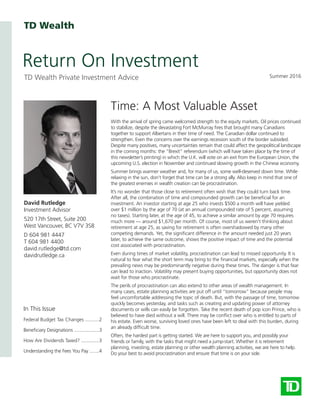
Time: A Most Valuable Asset
In This Issue
Federal Budget Tax Changes ..........2
Beneficiary Designations ..................3
How Are Dividends Taxed? .............3
Understanding the Fees You Pay .......4
With the arrival of spring came welcomed strength to the equity markets. Oil prices continued
to stabilize, despite the devastating Fort McMurray fires that brought many Canadians
together to support Albertans in their time of need. The Canadian dollar continued to
strengthen. Even the concerns over the earnings recession south of the border subsided.
Despite many positives, many uncertainties remain that could affect the geopolitical landscape
in the coming months: the “Brexit” referendum (which will have taken place by the time of
this newsletter’s printing) in which the U.K. will vote on an exit from the European Union, the
upcoming U.S. election in November and continued slowing growth in the Chinese economy.
Summer brings warmer weather and, for many of us, some well-deserved down time. While
relaxing in the sun, don’t forget that time can be a strong ally. Also keep in mind that one of
the greatest enemies in wealth creation can be procrastination.
It’s no wonder that those close to retirement often wish that they could turn back time.
After all, the combination of time and compounded growth can be beneficial for an
investment. An investor starting at age 25 who invests $500 a month will have yielded
over $1 million by the age of 70 (at an annual compounded rate of 5 percent, assuming
no taxes). Starting later, at the age of 45, to achieve a similar amount by age 70 requires
much more — around $1,670 per month. Of course, most of us weren’t thinking about
retirement at age 25, as saving for retirement is often overshadowed by many other
competing demands. Yet, the significant difference in the amount needed just 20 years
later, to achieve the same outcome, shows the positive impact of time and the potential
cost associated with procrastination.
Even during times of market volatility, procrastination can lead to missed opportunity. It is
natural to fear what the short term may bring to the financial markets, especially when the
prevailing news may be predominantly negative during these times. The danger is that fear
can lead to inaction. Volatility may present buying opportunities, but opportunity does not
wait for those who procrastinate.
The perils of procrastination can also extend to other areas of wealth management. In
many cases, estate planning activities are put off until “tomorrow” because people may
feel uncomfortable addressing the topic of death. But, with the passage of time, tomorrow
quickly becomes yesterday, and tasks such as creating and updating power of attorney
documents or wills can easily be forgotten. Take the recent death of pop icon Prince, who is
believed to have died without a will. There may be conflict over who is entitled to parts of
his estate. Even worse, surviving loved ones have been left to deal with this burden, during
an already difficult time.
Often, the hardest part is getting started. We are here to support you, and possibly your
friends or family, with the tasks that might need a jump-start. Whether it is retirement
planning, investing, estate planning or other wealth planning activities, we are here to help.
Do your best to avoid procrastination and ensure that time is on your side.
Return On Investment
TD Wealth Private Investment Advice
Return On Investment 		 2
Tax Changes Are Imminent
Federal Budget 2016: A Recap
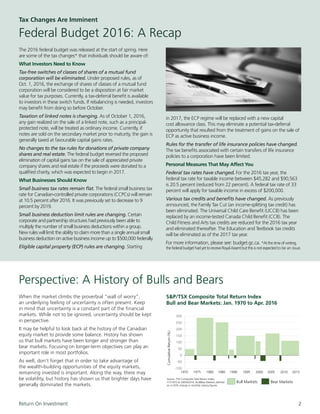
The 2016 federal budget was released at the start of spring. Here
are some of the tax changes* that individuals should be aware of:
What Investors Need to Know
Tax-free switches of classes of shares of a mutual fund
corporation will be eliminated. Under proposed rules, as of
Oct. 1, 2016, the exchange of shares of classes of a mutual fund
corporation will be considered to be a disposition at fair market
value for tax purposes. Currently, a tax-deferral benefit is available
to investors in these switch funds. If rebalancing is needed, investors
may benefit from doing so before October.
Taxation of linked notes is changing. As of October 1, 2016,
any gain realized on the sale of a linked note, such as a principal-
protected note, will be treated as ordinary income. Currently, if
notes are sold on the secondary market prior to maturity, the gain is
generally taxed at favourable capital gains rates.
No changes to the tax rules for donations of private company
shares and real estate. The federal budget reversed the proposed
elimination of capital gains tax on the sale of appreciated private
company shares and real estate if the proceeds were donated to a
qualified charity, which was expected to begin in 2017.
What Businesses Should Know
Small business tax rates remain flat. The federal small business tax
rate for Canadian-controlled private corporations (CCPCs) will remain
at 10.5 percent after 2016. It was previously set to decrease to 9
percent by 2019.
Small business deduction limit rules are changing. Certain
corporate and partnership structures had previously been able to
multiply the number of small business deductions within a group.
New rules will limit the ability to claim more than a single annual small
business deduction on active business income up to $500,000 federally.
Eligible capital property (ECP) rules are changing. Starting
in 2017, the ECP regime will be replaced with a new capital
cost allowance class. This may eliminate a potential tax-deferral
opportunity that resulted from the treatment of gains on the sale of
ECP as active business income.
Rules for the transfer of life insurance policies have changed.
The tax benefits associated with certain transfers of life insurance
policies to a corporation have been limited.
Personal Measures That May Affect You
Federal tax rates have changed. For the 2016 tax year, the
federal tax rate for taxable income between $45,282 and $90,563
is 20.5 percent (reduced from 22 percent). A federal tax rate of 33
percent will apply for taxable income in excess of $200,000.
Various tax credits and benefits have changed. As previously
announced, the Family Tax Cut (an income-splitting tax credit) has
been eliminated. The Universal Child Care Benefit (UCCB) has been
replaced by an income-tested Canada Child Benefit (CCB). The
Child Fitness and Arts tax credits are reduced for the 2016 tax year
and eliminated thereafter. The Education and Textbook tax credits
will be eliminated as of the 2017 tax year.
For more information, please see: budget.gc.ca. *Atthetimeofwriting,
thefederalbudgethadyettoreceiveRoyalAssentbutthisisnotexpectedto be an issue.
Perspective: A History of Bulls and Bears
-100
-50
0
50
100
150
200
250
300
CumulativeReturn(%)
1970 1975 1980 1985 1990 1995 2000 2005 2010 2015
Bull Markets Bear Markets
Source: TSX Composite Total Return Index,
1/1/1970 to 29/04/2016. Bull/Bear Markets defined
as +/-20% change in monthly closing figures.
When the market climbs the proverbial “wall of worry”,
an underlying feeling of uncertainty is often present. Keep
in mind that uncertainty is a constant part of the financial
markets. While not to be ignored, uncertainty should be kept
in perspective.
It may be helpful to look back at the history of the Canadian
equity market to provide some balance. History has shown
us that bull markets have been longer and stronger than
bear markets. Focusing on longer-term objectives can play an
important role in most portfolios.
As well, don’t forget that in order to take advantage of
the wealth-building opportunities of the equity markets,
remaining invested is important. Along the way, there may
be volatility, but history has shown us that brighter days have
generally dominated the markets.
S&P/TSX Composite Total Return Index
Bull and Bear Markets: Jan. 1970 to Apr. 2016
Understanding Taxation
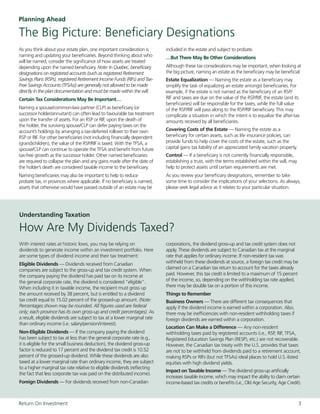
How Are My Dividends Taxed?
With interest rates at historic lows, you may be relying on
dividends to generate income within an investment portfolio. Here
are some types of dividend income and their tax treatment:
Eligible Dividends — Dividends received from Canadian
companies are subject to the gross-up and tax credit system. When
the company paying the dividend has paid tax on its income at
the general corporate rate, the dividend is considered “eligible”.
When including it in taxable income, the recipient must gross up
the amount received by 38 percent, but is entitled to a dividend
tax credit equal to 15.02 percent of the grossed-up amount. (Note:
Percentages shown may be rounded. All figures used are federal
only; each province has its own gross-up and credit percentages). As
a result, eligible dividends are subject to tax at a lower marginal rate
than ordinary income (i.e. salary/pension/interest).
Non-Eligible Dividends — If the company paying the dividend
has been subject to tax at less than the general corporate rate (e.g.,
it is eligible for the small business deduction), the dividend gross-up
factor is reduced to 17 percent and the dividend tax credit is 10.52
percent of the grossed-up dividend. While these dividends are also
taxed at a lower marginal rate than ordinary income, they are subject
to a higher marginal tax rate relative to eligible dividends (reflecting
the fact that less corporate tax was paid on the distributed income).
Foreign Dividends — For dividends received from non-Canadian
Return On Investment 		 3
corporations, the dividend gross-up and tax credit system does not
apply. These dividends are subject to Canadian tax at the marginal
rate that applies for ordinary income. If non-resident tax was
withheld from these dividends at source, a foreign tax credit may be
claimed on a Canadian tax return to account for the taxes already
paid. However, this tax credit is limited to a maximum of 15 percent
of the income, so, depending on the withholding tax rate applied,
there may be double tax on a portion of this income.
Things to Remember
Business Owners — There are different tax consequences that
apply if the dividend income is earned within a corporation. Also,
there may be inefficiencies with non-resident withholding taxes if
foreign dividends are earned within a corporation.
Location Can Make a Difference — Any non-resident
withholding taxes paid by registered accounts (i.e., RSP, RIF, TFSA,
Registered Education Savings Plan (RESP), etc.) are not recoverable.
However, the Canadian tax treaty with the U.S. provides that taxes
are not to be withheld from dividends paid to a retirement account,
making RSPs or RIFs (but not TFSAs) ideal places to hold U.S.-listed
equities with high dividend yields.
Impact on Taxable Income — The dividend gross-up artificially
increases taxable income, which may impact the ability to claim certain
income-based tax credits or benefits (i.e., Old Age Security, Age Credit).
Planning Ahead
The Big Picture: Beneficiary Designations
As you think about your estate plan, one important consideration is
naming and updating your beneficiaries. Beyond thinking about who
will be named, consider the significance of how assets are treated
depending upon the named beneficiary. Note: In Quebec, beneficiary
designations on registered accounts (such as registered Retirement
Savings Plans (RSPs), registered Retirement Income Funds (RIFs) and Tax-
Free Savings Accounts (TFSAs)) are generally not allowed to be made
directly in the plan documentation and must be made within the will.
Certain Tax Considerations May Be Important…
Naming a spouse/common-law partner (CLP) as beneficiary (or
successor holder/annuitant) can often lead to favourable tax treatment
upon the transfer of assets. For an RSP or RIF, upon the death of
the holder, the surviving spouse/CLP can defer paying taxes on the
account’s holdings by arranging a tax-deferred rollover to their own
RSP or RIF. For other beneficiaries (not including financially dependent
(grand)children), the value of the RSP/RIF is taxed. With the TFSA, a
spouse/CLP can continue to operate the TFSA and benefit from future
tax-free growth as the successor holder. Other named beneficiaries
are required to collapse the plan and any gains made after the date of
the holder’s death are considered taxable income to the beneficiary.
Naming beneficiaries may also be important to help to reduce
probate tax, in provinces where applicable. If no beneficiary is named,
assets that otherwise would have passed outside of an estate may be
included in the estate and subject to probate.
…But There May Be Other Considerations
Although these tax considerations may be important, when looking at
the big picture, naming an estate as the beneficiary may be beneficial:
Estate Equalization — Naming the estate as a beneficiary may
simplify the task of equalizing an estate amongst beneficiaries. For
example, if the estate is not named as the beneficiary of an RSP/
RIF and taxes are due on the value of the RSP/RIF, the estate (and its
beneficiaries) will be responsible for the taxes, while the full value
of the RSP/RIF will pass along to the RSP/RIF beneficiary. This may
complicate a situation in which the intent is to equalize the after-tax
amounts received by all beneficiaries.
Covering Costs of the Estate — Naming the estate as a
beneficiary for certain assets, such as life insurance policies, can
provide funds to help cover the costs of the estate, such as the
capital gains tax liability of an appreciated family vacation property.
Control — If a beneficiary is not currently financially responsible,
establishing a trust, with the terms established within the will, may
help to protect assets until certain requirements are met.
As you review your beneficiary designations, remember to take
some time to consider the implications of your selections. As always,
please seek legal advice as it relates to your particular situation.
With the Compliments of:
David Rutledge
Investment Advisor
604 981 4447 david.rutledge@td.com
Dalia Al-Khafaji
Administrative Assistant
604 981 4436 dalia.al-khafaji@td.com
TD Wealth Private Investment Advice
A Division of TD Waterhouse Canada Inc.
520 17th Street, Suite 200
West Vancouver, BC V7V3S8
T: 604 981 4400
F: 604 981 4432
http://davidrutledge.ca
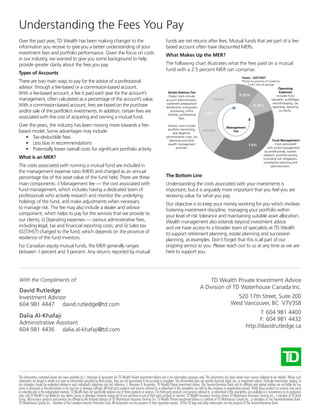
Understanding the Fees You Pay
Over the past year, TD Wealth has been making changes to the
information you receive to give you a better understanding of your
investment fees and portfolio performance. Given the focus on costs
in our industry, we wanted to give you some background to help
provide greater clarity about the fees you pay.
Types of Accounts
There are two main ways to pay for the advice of a professional
advisor: through a fee-based or a commission-based account.
With a fee-based account, a fee is paid each year for the account’s
management, often calculated as a percentage of the account’s value.
With a commission-based account, fees are based on the purchase
and/or sale of the portfolio’s investments. In addition, certain fees are
associated with the cost of acquiring and owning a mutual fund.
Over the years, the industry has been moving more towards a fee-
based model. Some advantages may include:
•	 Tax-deductible fees
•	 Less bias in recommendations
•	 Potentially lower overall costs for significant portfolio activity
What is an MER?
The costs associated with running a mutual fund are included in
the management expense ratio (MER) and charged as an annual
percentage fee of the asset value of the fund held. There are three
main components: i) Management fee — the cost associated with
fund management, which includes having a dedicated team of
professionals who actively research and monitor the underlying
holdings of the fund, and make adjustments when necessary
to manage risk. The fee may also include a dealer and advisor
component, which helps to pay for the services that we provide to
our clients; ii) Operating expenses — various administrative fees,
including legal, tax and financial reporting costs; and iii) Sales tax
(GST/HST) charged to the fund, which depends on the province of
residence of the fund investors.
For Canadian equity mutual funds, the MER generally ranges
between 1 percent and 3 percent. Any returns reported by mutual
funds are net returns after fees. Mutual funds that are part of a fee-
based account often have discounted MERs.
What Makes Up the MER?
The following chart illustrates what the fees paid on a mutual
fund with a 2.5 percent MER can comprise:
The Bottom Line
Understanding the costs associated with your investments is
important, but it is arguably more important that you feel you are
receiving value for what you pay.
Our objective is to keep your money working for you which involves
fostering investment discipline, managing your portfolio within
your level of risk tolerance and maintaining suitable asset allocation.
Wealth management also extends beyond investment advice
and we have access to a broader team of specialists at TD Wealth
to support retirement planning, estate planning and succession
planning, as examples. Don’t forget that this is all part of our
ongoing service to you. Please reach out to us at any time as we are
here to support you.
0.25%
0.25%
1.0%
1.0%
ADVISOR
DEALER
Fund Management
Costs associated
with active management
by professionals, market
research, portfolio activity
(including risk mitigation),
compliance reporting and
administration.
Taxes – GST/HST
*Varies by province of residence.
Chart uses an average.
Operating
Expenses
Includes fund
valuation, audit/legal,
record-keeping, tax
reporting, reporting
to clients.
Dealer/Advisor Fee
Dealer costs include
account administration,
statement preparation/
distribution, transaction
processing, office
facilities, professional
fees.
Advisor costs include
portfolio monitoring,
due diligence,
administrative costs, tax
planning and other
wealth management
activities.
Managem
ent Fee
Management
Fee
The information contained herein has been provided by J. Hirasawa & Associates for TD Wealth Private Investment Advice and is for information purposes only. The information has been drawn from sources believed to be reliable. Where such
statements are based in whole or in part on information provided by third parties, they are not guaranteed to be accurate or complete. The information does not provide financial, legal, tax, or investment advice. Particular investment, trading, or
tax strategies should be evaluated relative to each individual’s objectives and risk tolerance. J. Hirasawa & Associates, TD Wealth Private Investment Advice, The Toronto-Dominion Bank and its affiliates and related entities are not liable for any
errors or omissions in the information or for any loss or damage suffered. All third party products and services referred to or advertised in this newsletter are sold by the company or organization named. While these products or services may serve
as valuable aids to the independent investor, TD Wealth does not specifically endorse any of these products or services. The third party products and services referred to, or advertised in this newsletter, are available as a convenience to its customers
only, and TD Wealth is not liable for any claims, losses or damages however arising out of any purchase or use of third party products or services. TD Wealth Insurance Services means TD Waterhouse Insurance Services Inc., a member of TD Bank
Group. All insurance products and services are offered by life licensed advisors of TD Waterhouse Insurance Services Inc. TD Wealth Private Investment Advice is a division of TD Waterhouse Canada Inc., a subsidiary of The Toronto-Dominion Bank.
TD Waterhouse Canada Inc. - Member of the Canadian Investor Protection Fund. All trademarks are the property of their respective owners. ®The TD logo and other trade-marks are the property of The Toronto-Dominion Bank.

Return On Investment - Summer 2016

  • 1.
    David Rutledge Investment Advisor 52017th Street, Suite 200 West Vancouver, BC V7V 3S8 D 604 981 4447 T 604 981 4400 david.rutledge@td.com davidrutledge.ca Summer 2016 Time: A Most Valuable Asset In This Issue Federal Budget Tax Changes ..........2 Beneficiary Designations ..................3 How Are Dividends Taxed? .............3 Understanding the Fees You Pay .......4 With the arrival of spring came welcomed strength to the equity markets. Oil prices continued to stabilize, despite the devastating Fort McMurray fires that brought many Canadians together to support Albertans in their time of need. The Canadian dollar continued to strengthen. Even the concerns over the earnings recession south of the border subsided. Despite many positives, many uncertainties remain that could affect the geopolitical landscape in the coming months: the “Brexit” referendum (which will have taken place by the time of this newsletter’s printing) in which the U.K. will vote on an exit from the European Union, the upcoming U.S. election in November and continued slowing growth in the Chinese economy. Summer brings warmer weather and, for many of us, some well-deserved down time. While relaxing in the sun, don’t forget that time can be a strong ally. Also keep in mind that one of the greatest enemies in wealth creation can be procrastination. It’s no wonder that those close to retirement often wish that they could turn back time. After all, the combination of time and compounded growth can be beneficial for an investment. An investor starting at age 25 who invests $500 a month will have yielded over $1 million by the age of 70 (at an annual compounded rate of 5 percent, assuming no taxes). Starting later, at the age of 45, to achieve a similar amount by age 70 requires much more — around $1,670 per month. Of course, most of us weren’t thinking about retirement at age 25, as saving for retirement is often overshadowed by many other competing demands. Yet, the significant difference in the amount needed just 20 years later, to achieve the same outcome, shows the positive impact of time and the potential cost associated with procrastination. Even during times of market volatility, procrastination can lead to missed opportunity. It is natural to fear what the short term may bring to the financial markets, especially when the prevailing news may be predominantly negative during these times. The danger is that fear can lead to inaction. Volatility may present buying opportunities, but opportunity does not wait for those who procrastinate. The perils of procrastination can also extend to other areas of wealth management. In many cases, estate planning activities are put off until “tomorrow” because people may feel uncomfortable addressing the topic of death. But, with the passage of time, tomorrow quickly becomes yesterday, and tasks such as creating and updating power of attorney documents or wills can easily be forgotten. Take the recent death of pop icon Prince, who is believed to have died without a will. There may be conflict over who is entitled to parts of his estate. Even worse, surviving loved ones have been left to deal with this burden, during an already difficult time. Often, the hardest part is getting started. We are here to support you, and possibly your friends or family, with the tasks that might need a jump-start. Whether it is retirement planning, investing, estate planning or other wealth planning activities, we are here to help. Do your best to avoid procrastination and ensure that time is on your side. Return On Investment TD Wealth Private Investment Advice
  • 2.
    Return On Investment 2 Tax Changes Are Imminent Federal Budget 2016: A Recap The 2016 federal budget was released at the start of spring. Here are some of the tax changes* that individuals should be aware of: What Investors Need to Know Tax-free switches of classes of shares of a mutual fund corporation will be eliminated. Under proposed rules, as of Oct. 1, 2016, the exchange of shares of classes of a mutual fund corporation will be considered to be a disposition at fair market value for tax purposes. Currently, a tax-deferral benefit is available to investors in these switch funds. If rebalancing is needed, investors may benefit from doing so before October. Taxation of linked notes is changing. As of October 1, 2016, any gain realized on the sale of a linked note, such as a principal- protected note, will be treated as ordinary income. Currently, if notes are sold on the secondary market prior to maturity, the gain is generally taxed at favourable capital gains rates. No changes to the tax rules for donations of private company shares and real estate. The federal budget reversed the proposed elimination of capital gains tax on the sale of appreciated private company shares and real estate if the proceeds were donated to a qualified charity, which was expected to begin in 2017. What Businesses Should Know Small business tax rates remain flat. The federal small business tax rate for Canadian-controlled private corporations (CCPCs) will remain at 10.5 percent after 2016. It was previously set to decrease to 9 percent by 2019. Small business deduction limit rules are changing. Certain corporate and partnership structures had previously been able to multiply the number of small business deductions within a group. New rules will limit the ability to claim more than a single annual small business deduction on active business income up to $500,000 federally. Eligible capital property (ECP) rules are changing. Starting in 2017, the ECP regime will be replaced with a new capital cost allowance class. This may eliminate a potential tax-deferral opportunity that resulted from the treatment of gains on the sale of ECP as active business income. Rules for the transfer of life insurance policies have changed. The tax benefits associated with certain transfers of life insurance policies to a corporation have been limited. Personal Measures That May Affect You Federal tax rates have changed. For the 2016 tax year, the federal tax rate for taxable income between $45,282 and $90,563 is 20.5 percent (reduced from 22 percent). A federal tax rate of 33 percent will apply for taxable income in excess of $200,000. Various tax credits and benefits have changed. As previously announced, the Family Tax Cut (an income-splitting tax credit) has been eliminated. The Universal Child Care Benefit (UCCB) has been replaced by an income-tested Canada Child Benefit (CCB). The Child Fitness and Arts tax credits are reduced for the 2016 tax year and eliminated thereafter. The Education and Textbook tax credits will be eliminated as of the 2017 tax year. For more information, please see: budget.gc.ca. *Atthetimeofwriting, thefederalbudgethadyettoreceiveRoyalAssentbutthisisnotexpectedto be an issue. Perspective: A History of Bulls and Bears -100 -50 0 50 100 150 200 250 300 CumulativeReturn(%) 1970 1975 1980 1985 1990 1995 2000 2005 2010 2015 Bull Markets Bear Markets Source: TSX Composite Total Return Index, 1/1/1970 to 29/04/2016. Bull/Bear Markets defined as +/-20% change in monthly closing figures. When the market climbs the proverbial “wall of worry”, an underlying feeling of uncertainty is often present. Keep in mind that uncertainty is a constant part of the financial markets. While not to be ignored, uncertainty should be kept in perspective. It may be helpful to look back at the history of the Canadian equity market to provide some balance. History has shown us that bull markets have been longer and stronger than bear markets. Focusing on longer-term objectives can play an important role in most portfolios. As well, don’t forget that in order to take advantage of the wealth-building opportunities of the equity markets, remaining invested is important. Along the way, there may be volatility, but history has shown us that brighter days have generally dominated the markets. S&P/TSX Composite Total Return Index Bull and Bear Markets: Jan. 1970 to Apr. 2016
  • 3.
    Understanding Taxation How AreMy Dividends Taxed? With interest rates at historic lows, you may be relying on dividends to generate income within an investment portfolio. Here are some types of dividend income and their tax treatment: Eligible Dividends — Dividends received from Canadian companies are subject to the gross-up and tax credit system. When the company paying the dividend has paid tax on its income at the general corporate rate, the dividend is considered “eligible”. When including it in taxable income, the recipient must gross up the amount received by 38 percent, but is entitled to a dividend tax credit equal to 15.02 percent of the grossed-up amount. (Note: Percentages shown may be rounded. All figures used are federal only; each province has its own gross-up and credit percentages). As a result, eligible dividends are subject to tax at a lower marginal rate than ordinary income (i.e. salary/pension/interest). Non-Eligible Dividends — If the company paying the dividend has been subject to tax at less than the general corporate rate (e.g., it is eligible for the small business deduction), the dividend gross-up factor is reduced to 17 percent and the dividend tax credit is 10.52 percent of the grossed-up dividend. While these dividends are also taxed at a lower marginal rate than ordinary income, they are subject to a higher marginal tax rate relative to eligible dividends (reflecting the fact that less corporate tax was paid on the distributed income). Foreign Dividends — For dividends received from non-Canadian Return On Investment 3 corporations, the dividend gross-up and tax credit system does not apply. These dividends are subject to Canadian tax at the marginal rate that applies for ordinary income. If non-resident tax was withheld from these dividends at source, a foreign tax credit may be claimed on a Canadian tax return to account for the taxes already paid. However, this tax credit is limited to a maximum of 15 percent of the income, so, depending on the withholding tax rate applied, there may be double tax on a portion of this income. Things to Remember Business Owners — There are different tax consequences that apply if the dividend income is earned within a corporation. Also, there may be inefficiencies with non-resident withholding taxes if foreign dividends are earned within a corporation. Location Can Make a Difference — Any non-resident withholding taxes paid by registered accounts (i.e., RSP, RIF, TFSA, Registered Education Savings Plan (RESP), etc.) are not recoverable. However, the Canadian tax treaty with the U.S. provides that taxes are not to be withheld from dividends paid to a retirement account, making RSPs or RIFs (but not TFSAs) ideal places to hold U.S.-listed equities with high dividend yields. Impact on Taxable Income — The dividend gross-up artificially increases taxable income, which may impact the ability to claim certain income-based tax credits or benefits (i.e., Old Age Security, Age Credit). Planning Ahead The Big Picture: Beneficiary Designations As you think about your estate plan, one important consideration is naming and updating your beneficiaries. Beyond thinking about who will be named, consider the significance of how assets are treated depending upon the named beneficiary. Note: In Quebec, beneficiary designations on registered accounts (such as registered Retirement Savings Plans (RSPs), registered Retirement Income Funds (RIFs) and Tax- Free Savings Accounts (TFSAs)) are generally not allowed to be made directly in the plan documentation and must be made within the will. Certain Tax Considerations May Be Important… Naming a spouse/common-law partner (CLP) as beneficiary (or successor holder/annuitant) can often lead to favourable tax treatment upon the transfer of assets. For an RSP or RIF, upon the death of the holder, the surviving spouse/CLP can defer paying taxes on the account’s holdings by arranging a tax-deferred rollover to their own RSP or RIF. For other beneficiaries (not including financially dependent (grand)children), the value of the RSP/RIF is taxed. With the TFSA, a spouse/CLP can continue to operate the TFSA and benefit from future tax-free growth as the successor holder. Other named beneficiaries are required to collapse the plan and any gains made after the date of the holder’s death are considered taxable income to the beneficiary. Naming beneficiaries may also be important to help to reduce probate tax, in provinces where applicable. If no beneficiary is named, assets that otherwise would have passed outside of an estate may be included in the estate and subject to probate. …But There May Be Other Considerations Although these tax considerations may be important, when looking at the big picture, naming an estate as the beneficiary may be beneficial: Estate Equalization — Naming the estate as a beneficiary may simplify the task of equalizing an estate amongst beneficiaries. For example, if the estate is not named as the beneficiary of an RSP/ RIF and taxes are due on the value of the RSP/RIF, the estate (and its beneficiaries) will be responsible for the taxes, while the full value of the RSP/RIF will pass along to the RSP/RIF beneficiary. This may complicate a situation in which the intent is to equalize the after-tax amounts received by all beneficiaries. Covering Costs of the Estate — Naming the estate as a beneficiary for certain assets, such as life insurance policies, can provide funds to help cover the costs of the estate, such as the capital gains tax liability of an appreciated family vacation property. Control — If a beneficiary is not currently financially responsible, establishing a trust, with the terms established within the will, may help to protect assets until certain requirements are met. As you review your beneficiary designations, remember to take some time to consider the implications of your selections. As always, please seek legal advice as it relates to your particular situation.
  • 4.
    With the Complimentsof: David Rutledge Investment Advisor 604 981 4447 david.rutledge@td.com Dalia Al-Khafaji Administrative Assistant 604 981 4436 dalia.al-khafaji@td.com TD Wealth Private Investment Advice A Division of TD Waterhouse Canada Inc. 520 17th Street, Suite 200 West Vancouver, BC V7V3S8 T: 604 981 4400 F: 604 981 4432 http://davidrutledge.ca Understanding the Fees You Pay Over the past year, TD Wealth has been making changes to the information you receive to give you a better understanding of your investment fees and portfolio performance. Given the focus on costs in our industry, we wanted to give you some background to help provide greater clarity about the fees you pay. Types of Accounts There are two main ways to pay for the advice of a professional advisor: through a fee-based or a commission-based account. With a fee-based account, a fee is paid each year for the account’s management, often calculated as a percentage of the account’s value. With a commission-based account, fees are based on the purchase and/or sale of the portfolio’s investments. In addition, certain fees are associated with the cost of acquiring and owning a mutual fund. Over the years, the industry has been moving more towards a fee- based model. Some advantages may include: • Tax-deductible fees • Less bias in recommendations • Potentially lower overall costs for significant portfolio activity What is an MER? The costs associated with running a mutual fund are included in the management expense ratio (MER) and charged as an annual percentage fee of the asset value of the fund held. There are three main components: i) Management fee — the cost associated with fund management, which includes having a dedicated team of professionals who actively research and monitor the underlying holdings of the fund, and make adjustments when necessary to manage risk. The fee may also include a dealer and advisor component, which helps to pay for the services that we provide to our clients; ii) Operating expenses — various administrative fees, including legal, tax and financial reporting costs; and iii) Sales tax (GST/HST) charged to the fund, which depends on the province of residence of the fund investors. For Canadian equity mutual funds, the MER generally ranges between 1 percent and 3 percent. Any returns reported by mutual funds are net returns after fees. Mutual funds that are part of a fee- based account often have discounted MERs. What Makes Up the MER? The following chart illustrates what the fees paid on a mutual fund with a 2.5 percent MER can comprise: The Bottom Line Understanding the costs associated with your investments is important, but it is arguably more important that you feel you are receiving value for what you pay. Our objective is to keep your money working for you which involves fostering investment discipline, managing your portfolio within your level of risk tolerance and maintaining suitable asset allocation. Wealth management also extends beyond investment advice and we have access to a broader team of specialists at TD Wealth to support retirement planning, estate planning and succession planning, as examples. Don’t forget that this is all part of our ongoing service to you. Please reach out to us at any time as we are here to support you. 0.25% 0.25% 1.0% 1.0% ADVISOR DEALER Fund Management Costs associated with active management by professionals, market research, portfolio activity (including risk mitigation), compliance reporting and administration. Taxes – GST/HST *Varies by province of residence. Chart uses an average. Operating Expenses Includes fund valuation, audit/legal, record-keeping, tax reporting, reporting to clients. Dealer/Advisor Fee Dealer costs include account administration, statement preparation/ distribution, transaction processing, office facilities, professional fees. Advisor costs include portfolio monitoring, due diligence, administrative costs, tax planning and other wealth management activities. Managem ent Fee Management Fee The information contained herein has been provided by J. Hirasawa & Associates for TD Wealth Private Investment Advice and is for information purposes only. The information has been drawn from sources believed to be reliable. Where such statements are based in whole or in part on information provided by third parties, they are not guaranteed to be accurate or complete. The information does not provide financial, legal, tax, or investment advice. Particular investment, trading, or tax strategies should be evaluated relative to each individual’s objectives and risk tolerance. J. Hirasawa & Associates, TD Wealth Private Investment Advice, The Toronto-Dominion Bank and its affiliates and related entities are not liable for any errors or omissions in the information or for any loss or damage suffered. All third party products and services referred to or advertised in this newsletter are sold by the company or organization named. While these products or services may serve as valuable aids to the independent investor, TD Wealth does not specifically endorse any of these products or services. The third party products and services referred to, or advertised in this newsletter, are available as a convenience to its customers only, and TD Wealth is not liable for any claims, losses or damages however arising out of any purchase or use of third party products or services. TD Wealth Insurance Services means TD Waterhouse Insurance Services Inc., a member of TD Bank Group. All insurance products and services are offered by life licensed advisors of TD Waterhouse Insurance Services Inc. TD Wealth Private Investment Advice is a division of TD Waterhouse Canada Inc., a subsidiary of The Toronto-Dominion Bank. TD Waterhouse Canada Inc. - Member of the Canadian Investor Protection Fund. All trademarks are the property of their respective owners. ®The TD logo and other trade-marks are the property of The Toronto-Dominion Bank.