Mrs.R.Kohila Devi
Asst. Prof. in Education
Thiagarajar College of Preceptors
Madurai -9
 Student –centered learning is an educational
experience that is driven by its students.
 This can manifest in many different ways.
 Student- centered learning is an project based
learning.
 The core goals are to motivate and interest
students and to foster critical thining skills that
employ active rather than passive engagement
in the classroom.
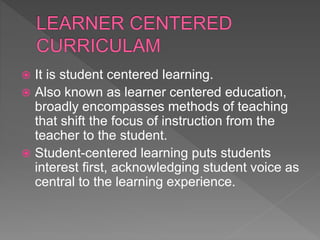
 It is student centered learning.
 Also known as learner centered education,
broadly encompasses methods of teaching
that shift the focus of instruction from the
teacher to the student.
 Student-centered learning puts students
interest first, acknowledging student voice as
central to the learning experience.
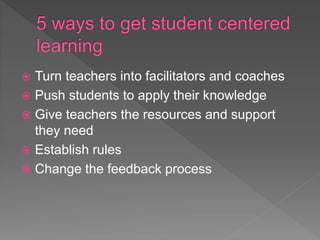
 Turn teachers into facilitators and coaches
 Push students to apply their knowledge
 Give teachers the resources and support
they need
 Establish rules
 Change the feedback process
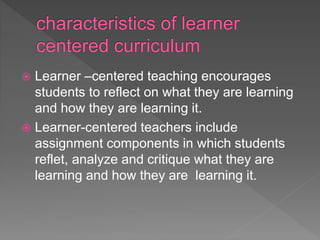
 Learner –centered teaching encourages
students to reflect on what they are learning
and how they are learning it.
 Learner-centered teachers include
assignment components in which students
reflet, analyze and critique what they are
learning and how they are learning it.
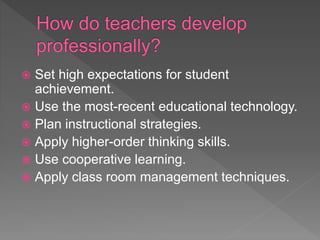
 Set high expectations for student
achievement.
 Use the most-recent educational technology.
 Plan instructional strategies.
 Apply higher-order thinking skills.
 Use cooperative learning.
 Apply class room management techniques.
 The most important person in the curriculum
implementation process is the teacher.
 With their knowledge, experiences and
competencies, teachers are central to any
curriculum development effort.
 The teacher involved in curriculum
organization has may roles and
responsibilities.
 Teachers want to enjoy teaching and
watching their students develop interests
and skills in their interest area.
 Teacher involvement in the process of
curriculum development is important to align
content of curriculum with students needs in
the classroom.
WAYS TO DEVELOP LEARNER CENTERED CURRICULUM

WAYS TO DEVELOP LEARNER CENTERED CURRICULUM

  • 1.
    Mrs.R.Kohila Devi Asst. Prof.in Education Thiagarajar College of Preceptors Madurai -9
  • 3.
     Student –centeredlearning is an educational experience that is driven by its students.  This can manifest in many different ways.  Student- centered learning is an project based learning.  The core goals are to motivate and interest students and to foster critical thining skills that employ active rather than passive engagement in the classroom.
  • 4.
     It isstudent centered learning.  Also known as learner centered education, broadly encompasses methods of teaching that shift the focus of instruction from the teacher to the student.  Student-centered learning puts students interest first, acknowledging student voice as central to the learning experience.
  • 5.
     Turn teachersinto facilitators and coaches  Push students to apply their knowledge  Give teachers the resources and support they need  Establish rules  Change the feedback process
  • 6.
     Learner –centeredteaching encourages students to reflect on what they are learning and how they are learning it.  Learner-centered teachers include assignment components in which students reflet, analyze and critique what they are learning and how they are learning it.
  • 7.
     Set highexpectations for student achievement.  Use the most-recent educational technology.  Plan instructional strategies.  Apply higher-order thinking skills.  Use cooperative learning.  Apply class room management techniques.
  • 8.
     The mostimportant person in the curriculum implementation process is the teacher.  With their knowledge, experiences and competencies, teachers are central to any curriculum development effort.
  • 9.
     The teacherinvolved in curriculum organization has may roles and responsibilities.  Teachers want to enjoy teaching and watching their students develop interests and skills in their interest area.  Teacher involvement in the process of curriculum development is important to align content of curriculum with students needs in the classroom.