Sound
UNIT - V
1
Objectives
2
•The objective of this unit is to present the student the nature of
sound wave, student will have an understanding of
•The nature and propagation of sound wave
•Transverse and longitudinal waves
•Interface of sound waves
•Beats
•Decibel
•Speed of sound in material medium
•Intensity of sound
•Superimposition of the wave
•Doppler effect principle
The nature and
propagation of sound
wave
3
•The nature and propagation of sound wave
•Sound is produced by vibrating objects. The matter or substance through which
sound is transmitted is called a medium. It can be solid, liquid or gas. Sound
moves through a medium from the point of generation to the listener.
•When an object vibrates, it sets the particles of the medium around it vibrating.
The particles do not travel all the way from the vibrating object to the ear. A
particle of the medium in contact with the vibrating object is first displaced from its
equilibrium position. It then exerts a force on the adjacent particle.
•As a result of which the adjacent particle gets displaced from its position of rest.
After displacing the adjacent particle the first particle comes back to its original
position. This process continues in the medium till the sound reaches your ear
•The disturbance created by a source of sound in the medium travels through the
medium and not the particles of the medium
•A wave is a disturbance that moves through a medium when the particles of the
medium set neighbouring particles into motion. They in turn produce similar motion
in others. The particles of the medium do not move forward themselves, but the
disturbance is carried forward. This is what happens during propagation of sound
in a medium, hence sound can be visualised as a wave. Sound waves are
characterised by the motion of particles in the medium and are called mechanical
waves
The nature and
propagation of sound
wave
4
•The nature and propagation of sound wave
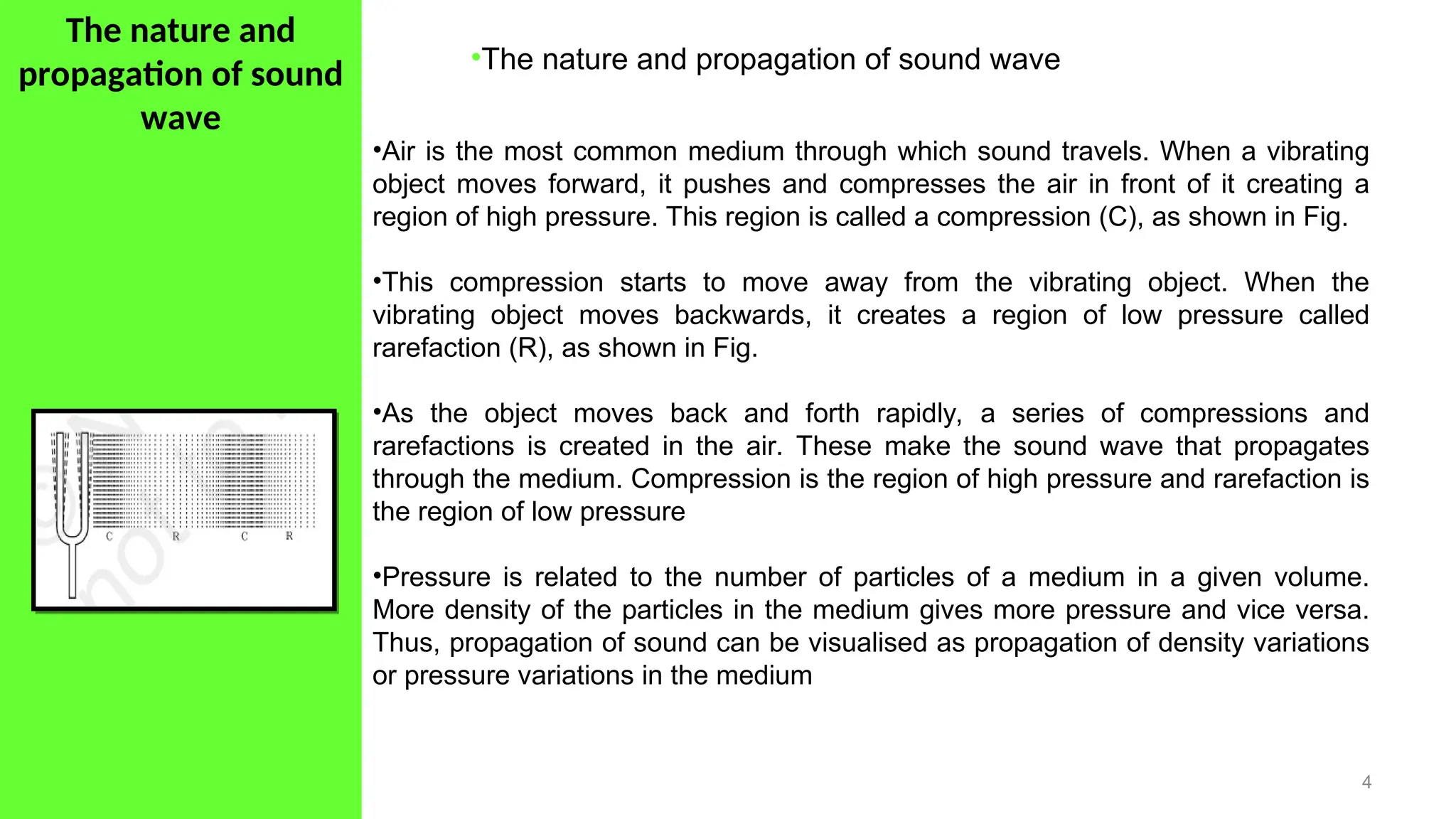
•Air is the most common medium through which sound travels. When a vibrating
object moves forward, it pushes and compresses the air in front of it creating a
region of high pressure. This region is called a compression (C), as shown in Fig.
•This compression starts to move away from the vibrating object. When the
vibrating object moves backwards, it creates a region of low pressure called
rarefaction (R), as shown in Fig.
•As the object moves back and forth rapidly, a series of compressions and
rarefactions is created in the air. These make the sound wave that propagates
through the medium. Compression is the region of high pressure and rarefaction is
the region of low pressure
•Pressure is related to the number of particles of a medium in a given volume.
More density of the particles in the medium gives more pressure and vice versa.
Thus, propagation of sound can be visualised as propagation of density variations
or pressure variations in the medium
•Longitudinal
waves
5
•Longitudinal waves
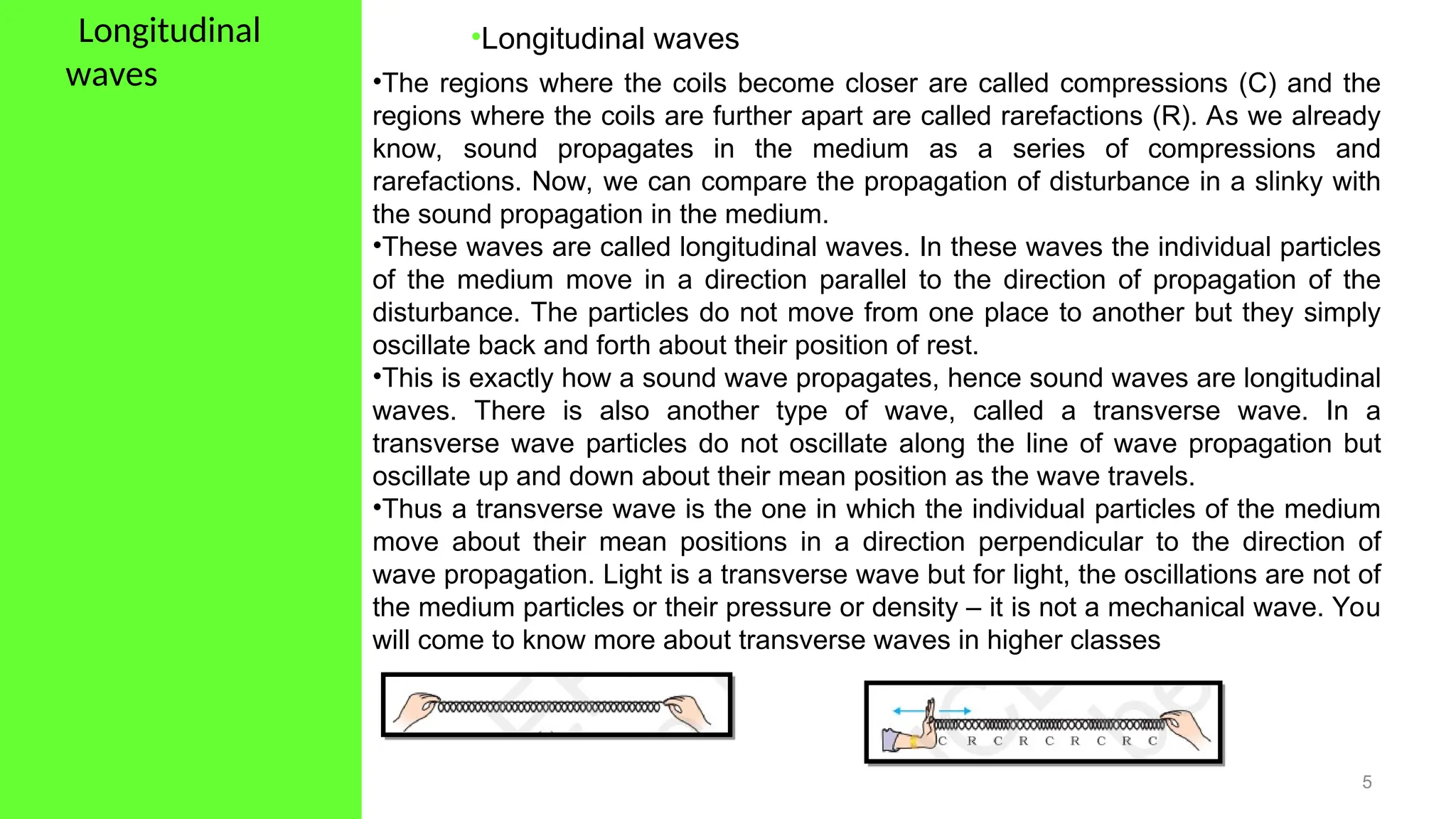
•The regions where the coils become closer are called compressions (C) and the
regions where the coils are further apart are called rarefactions (R). As we already
know, sound propagates in the medium as a series of compressions and
rarefactions. Now, we can compare the propagation of disturbance in a slinky with
the sound propagation in the medium.
•These waves are called longitudinal waves. In these waves the individual particles
of the medium move in a direction parallel to the direction of propagation of the
disturbance. The particles do not move from one place to another but they simply
oscillate back and forth about their position of rest.
•This is exactly how a sound wave propagates, hence sound waves are longitudinal
waves. There is also another type of wave, called a transverse wave. In a
transverse wave particles do not oscillate along the line of wave propagation but
oscillate up and down about their mean position as the wave travels.
•Thus a transverse wave is the one in which the individual particles of the medium
move about their mean positions in a direction perpendicular to the direction of
wave propagation. Light is a transverse wave but for light, the oscillations are not of
the medium particles or their pressure or density – it is not a mechanical wave. You
will come to know more about transverse waves in higher classes
Interference of
sound waves
6
• Interference of sound waves
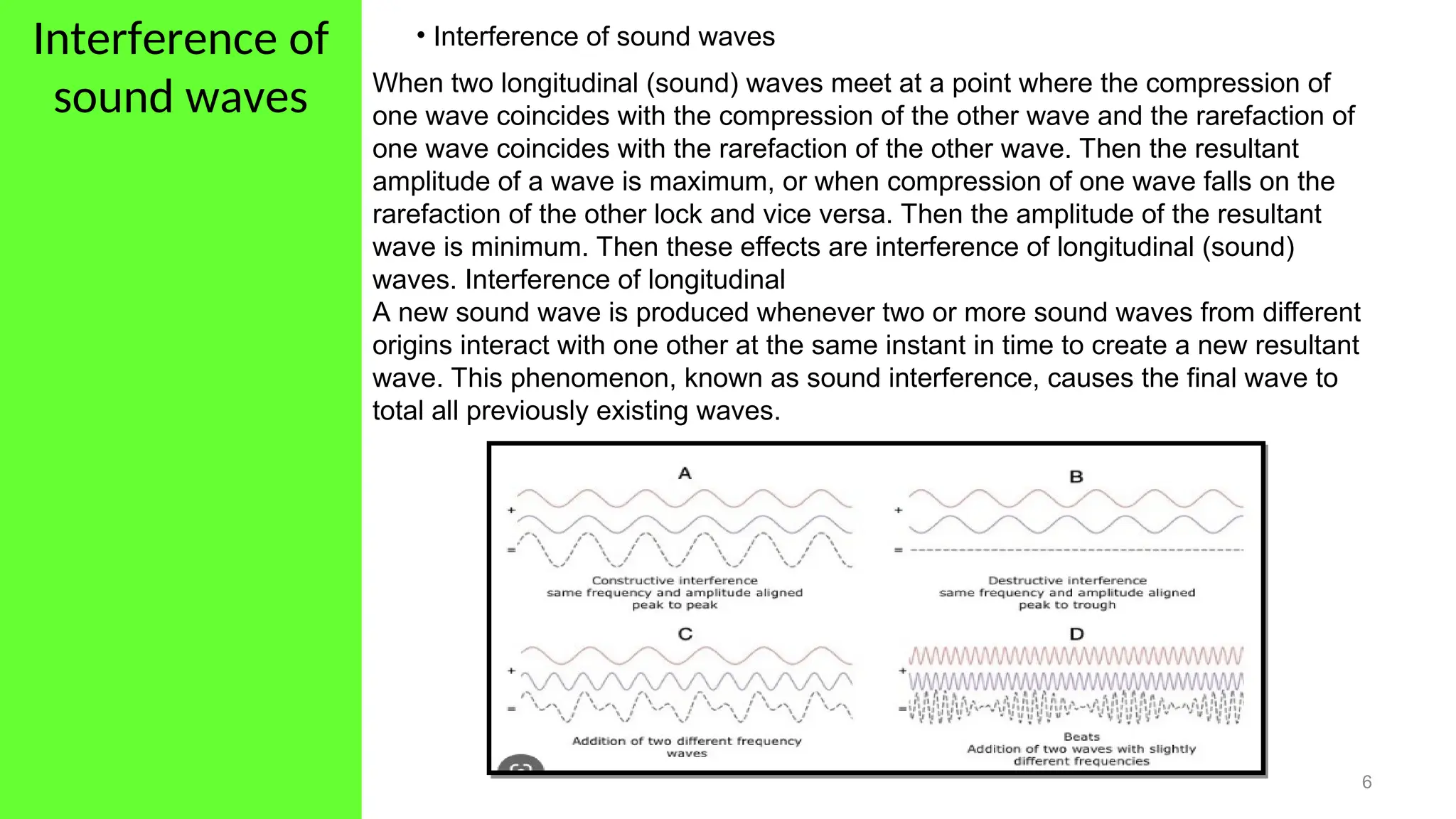
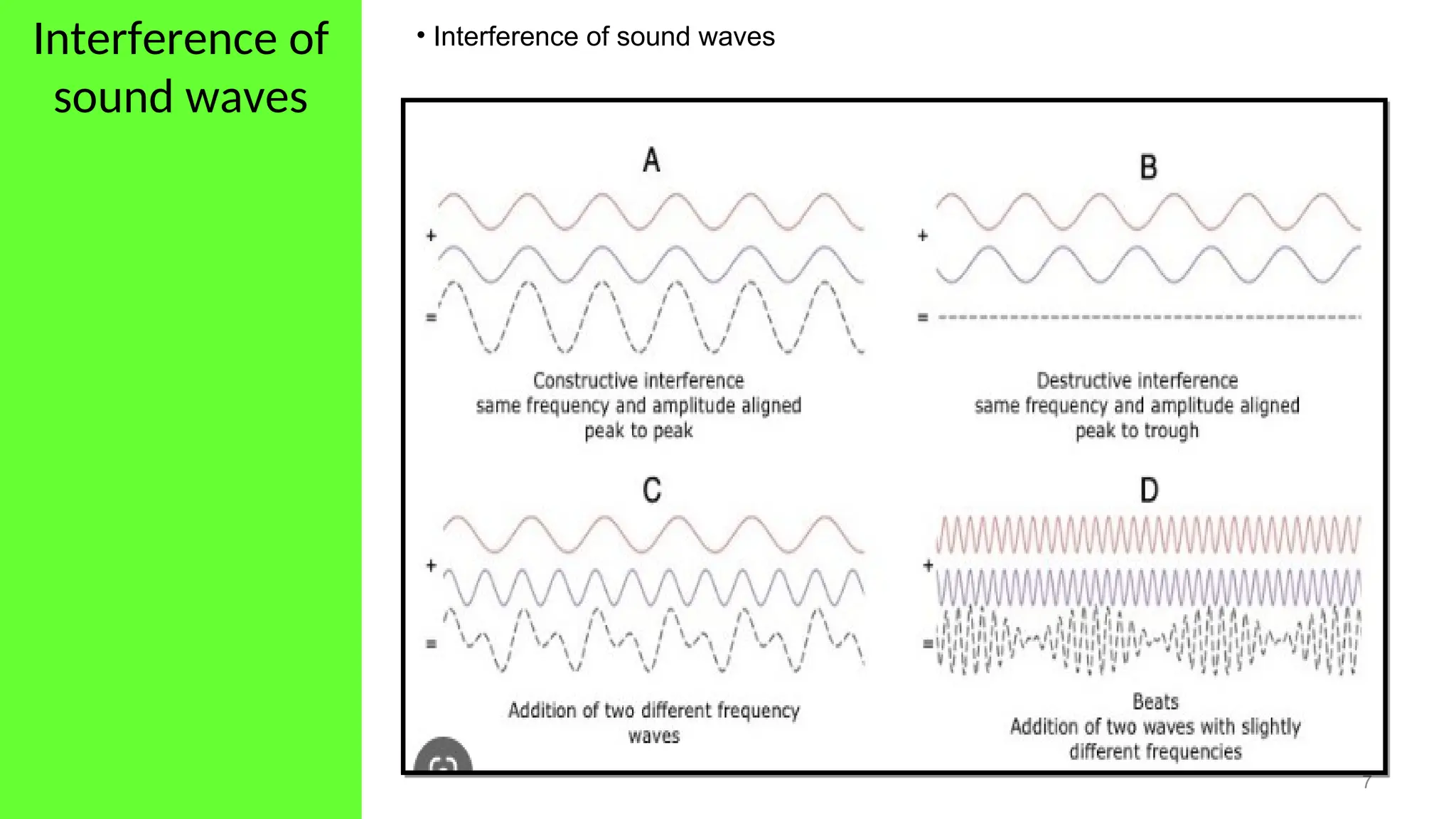
When two longitudinal (sound) waves meet at a point where the compression of
one wave coincides with the compression of the other wave and the rarefaction of
one wave coincides with the rarefaction of the other wave. Then the resultant
amplitude of a wave is maximum, or when compression of one wave falls on the
rarefaction of the other lock and vice versa. Then the amplitude of the resultant
wave is minimum. Then these effects are interference of longitudinal (sound)
waves. Interference of longitudinal
A new sound wave is produced whenever two or more sound waves from different
origins interact with one other at the same instant in time to create a new resultant
wave. This phenomenon, known as sound interference, causes the final wave to
total all previously existing waves.
Interference of
sound waves
7
• Interference of sound waves
Beats
8
•Beats
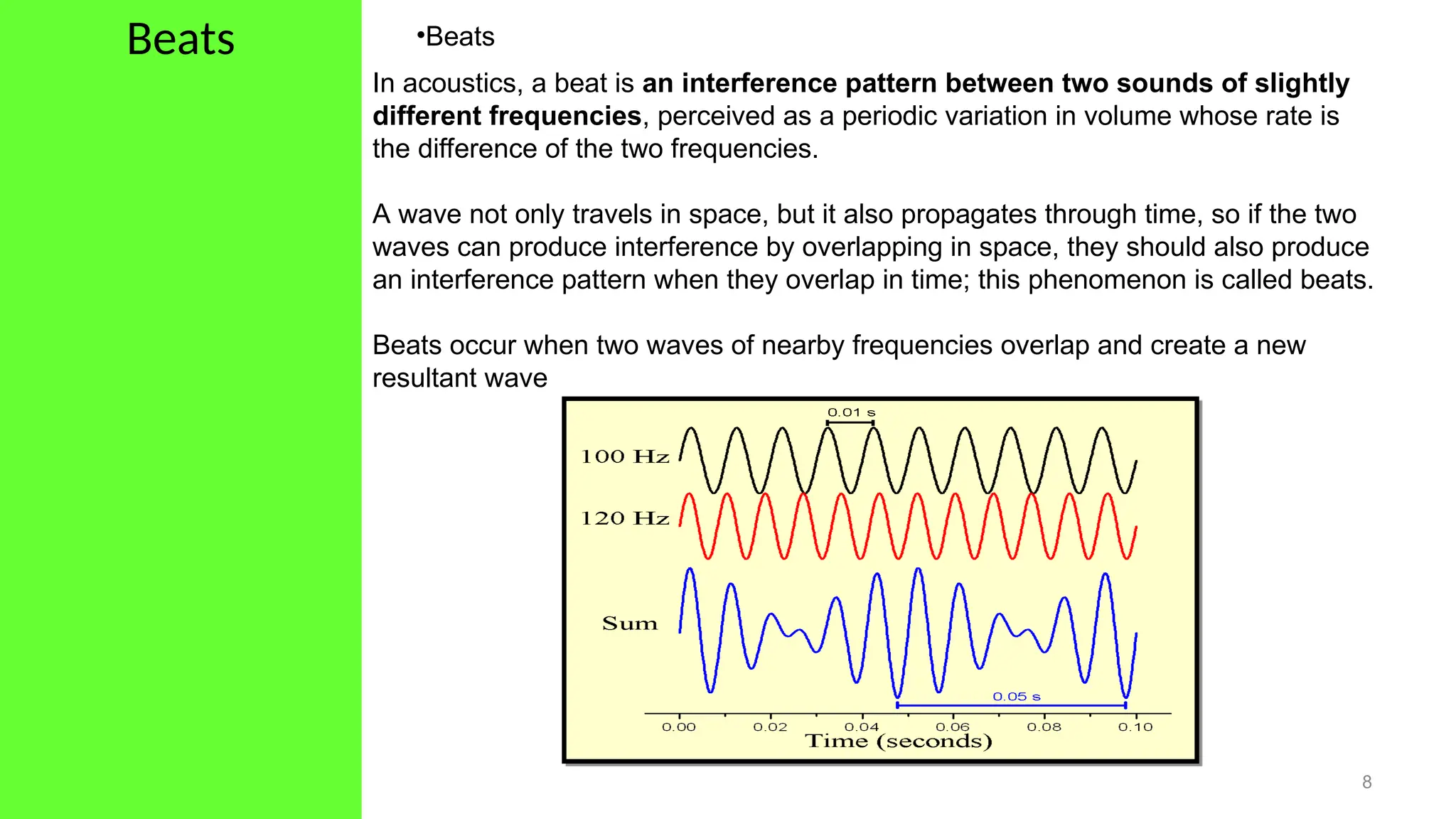
In acoustics, a beat is an interference pattern between two sounds of slightly
different frequencies, perceived as a periodic variation in volume whose rate is
the difference of the two frequencies.
A wave not only travels in space, but it also propagates through time, so if the two
waves can produce interference by overlapping in space, they should also produce
an interference pattern when they overlap in time; this phenomenon is called beats.
Beats occur when two waves of nearby frequencies overlap and create a new
resultant wave
Decibel
9
•Decibel
A decibel (dB) is a unit of measurement for sound. A-weighted decibels,
abbreviated dBA, are an expression of the relative loudness of sounds in air as
perceived by our ears.
A 1 dB change in a sound equates to about a 26% difference in sound
energy (remember that a 3 dB difference is a doubling of energy levels). In terms
of subjective loudness, a 1 dB change yields just over a 7% change. A 3 dB
change yields a 100% increase in sound energy and just over a 23% increase in
loudness
Decibel
10
•Decibel
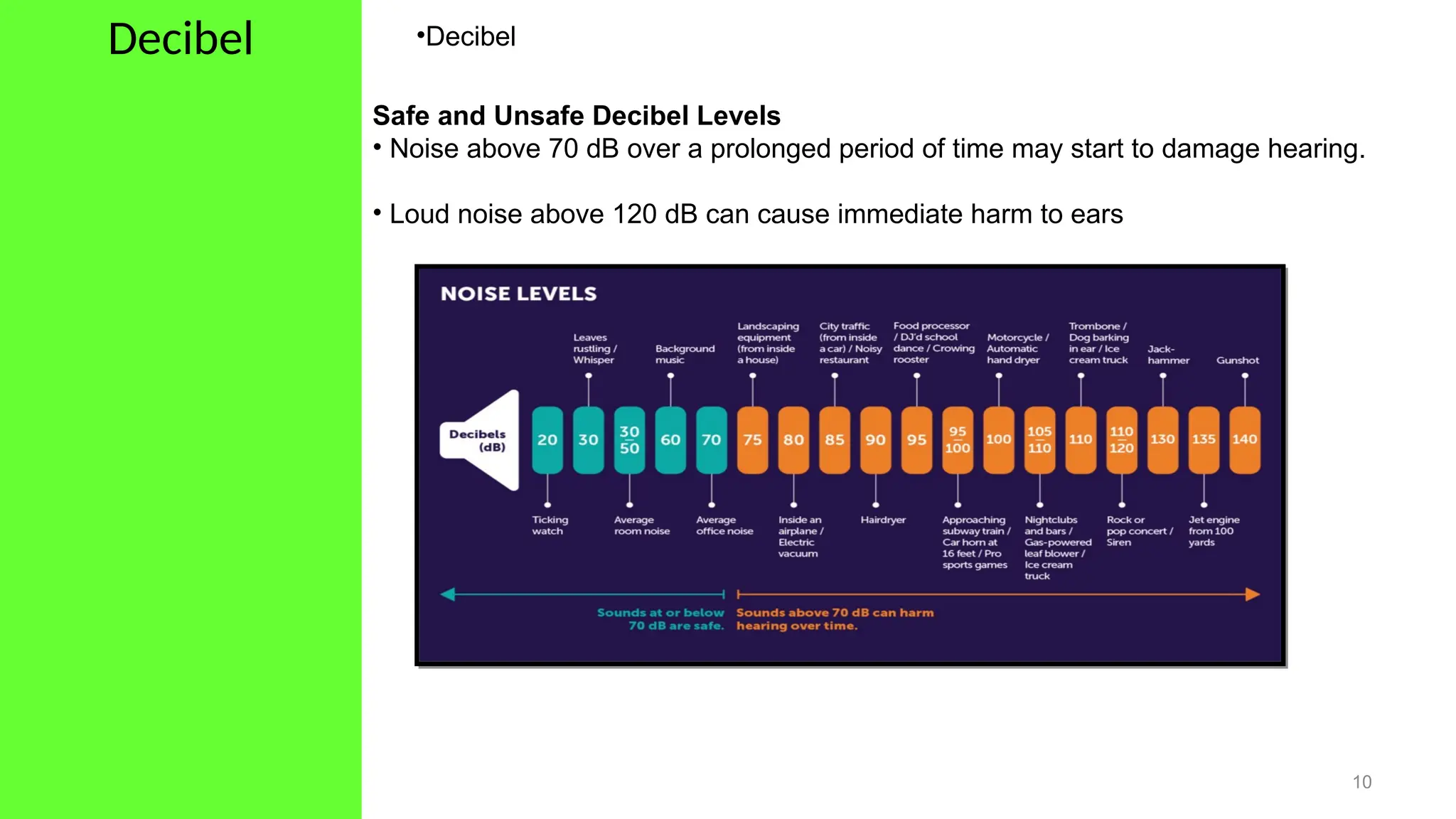
Safe and Unsafe Decibel Levels
• Noise above 70 dB over a prolonged period of time may start to damage hearing.
• Loud noise above 120 dB can cause immediate harm to ears
Speed of sound
11
•Speed of sound
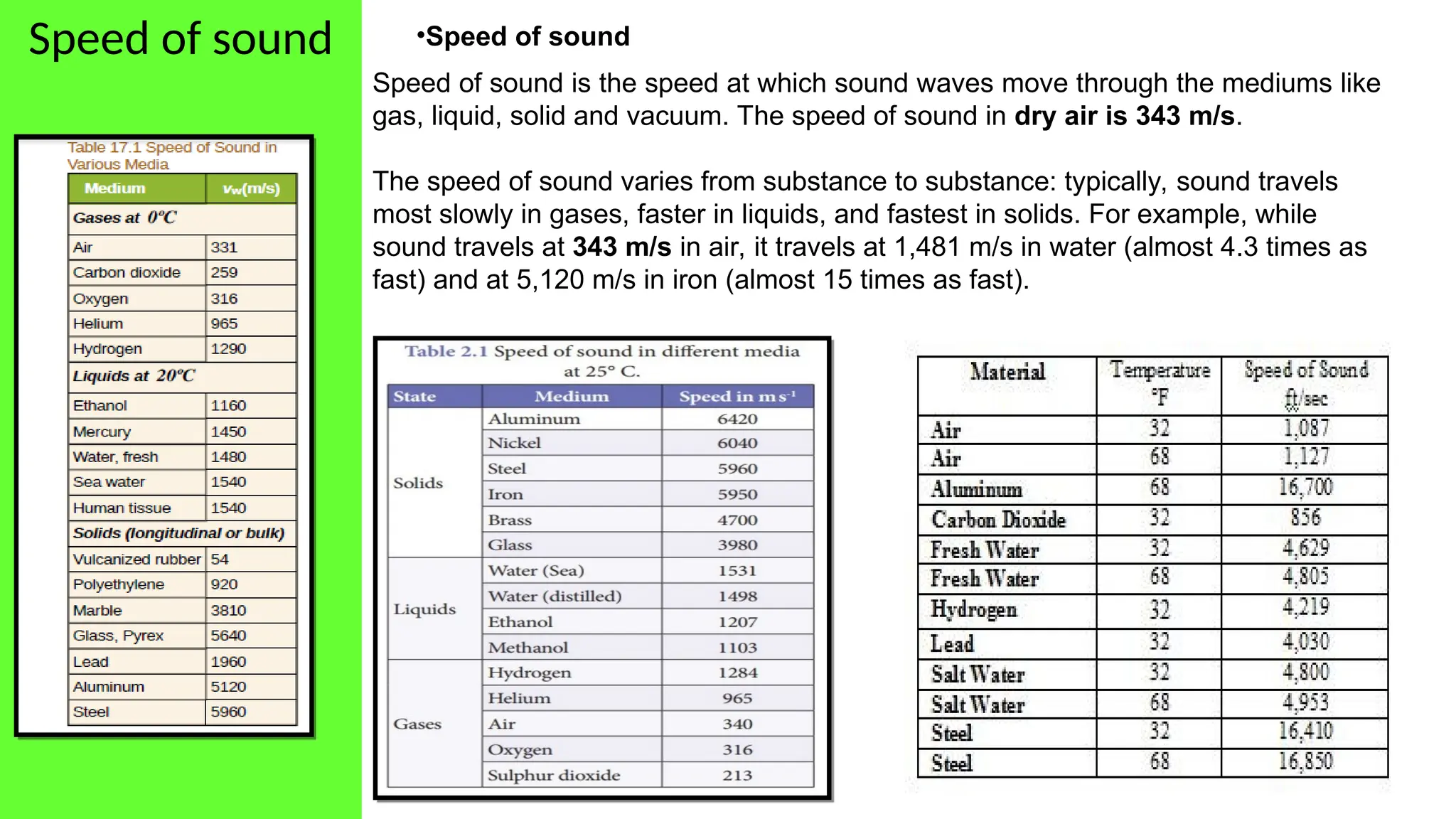
Speed of sound is the speed at which sound waves move through the mediums like
gas, liquid, solid and vacuum. The speed of sound in dry air is 343 m/s.
The speed of sound varies from substance to substance: typically, sound travels
most slowly in gases, faster in liquids, and fastest in solids. For example, while
sound travels at 343 m/s in air, it travels at 1,481 m/s in water (almost 4.3 times as
fast) and at 5,120 m/s in iron (almost 15 times as fast).
Sound Intensity
12
•Sound Intensity
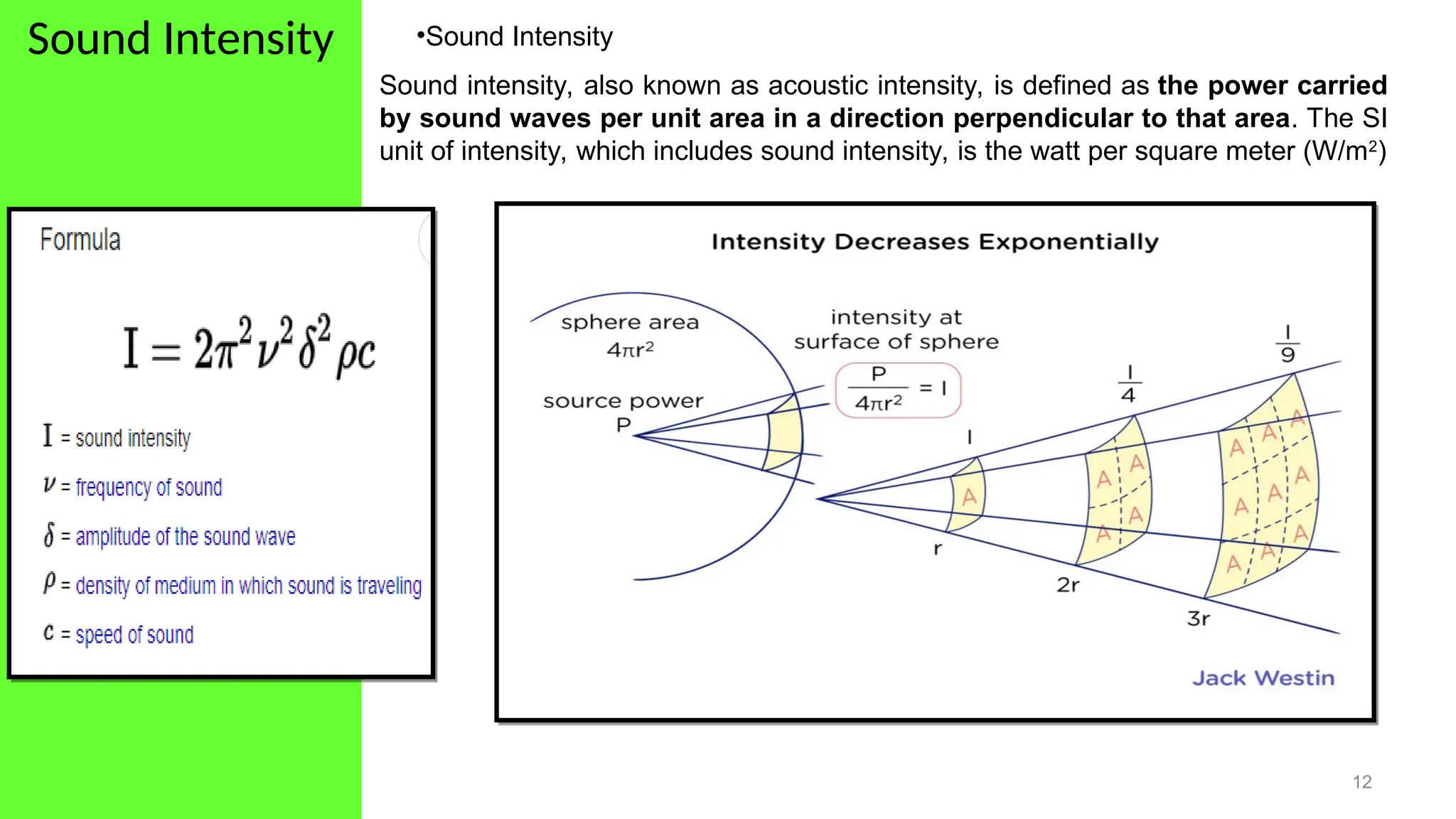
Sound intensity, also known as acoustic intensity, is defined as the power carried
by sound waves per unit area in a direction perpendicular to that area. The SI
unit of intensity, which includes sound intensity, is the watt per square meter (W/m2
)
•Superposition
of the waves
13
•Superposition of the waves
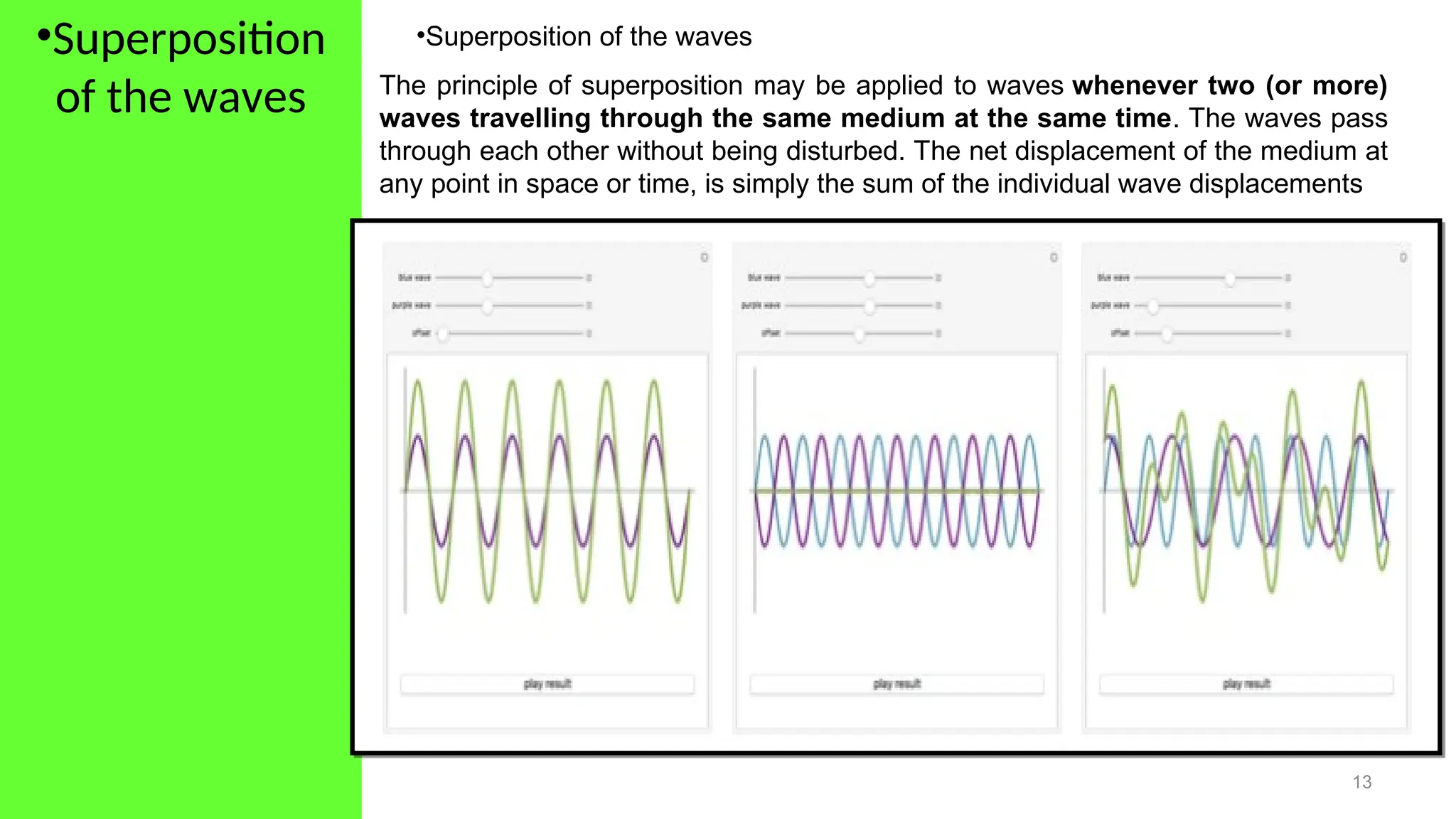
The principle of superposition may be applied to waves whenever two (or more)
waves travelling through the same medium at the same time. The waves pass
through each other without being disturbed. The net displacement of the medium at
any point in space or time, is simply the sum of the individual wave displacements
•Doppler Effect
14
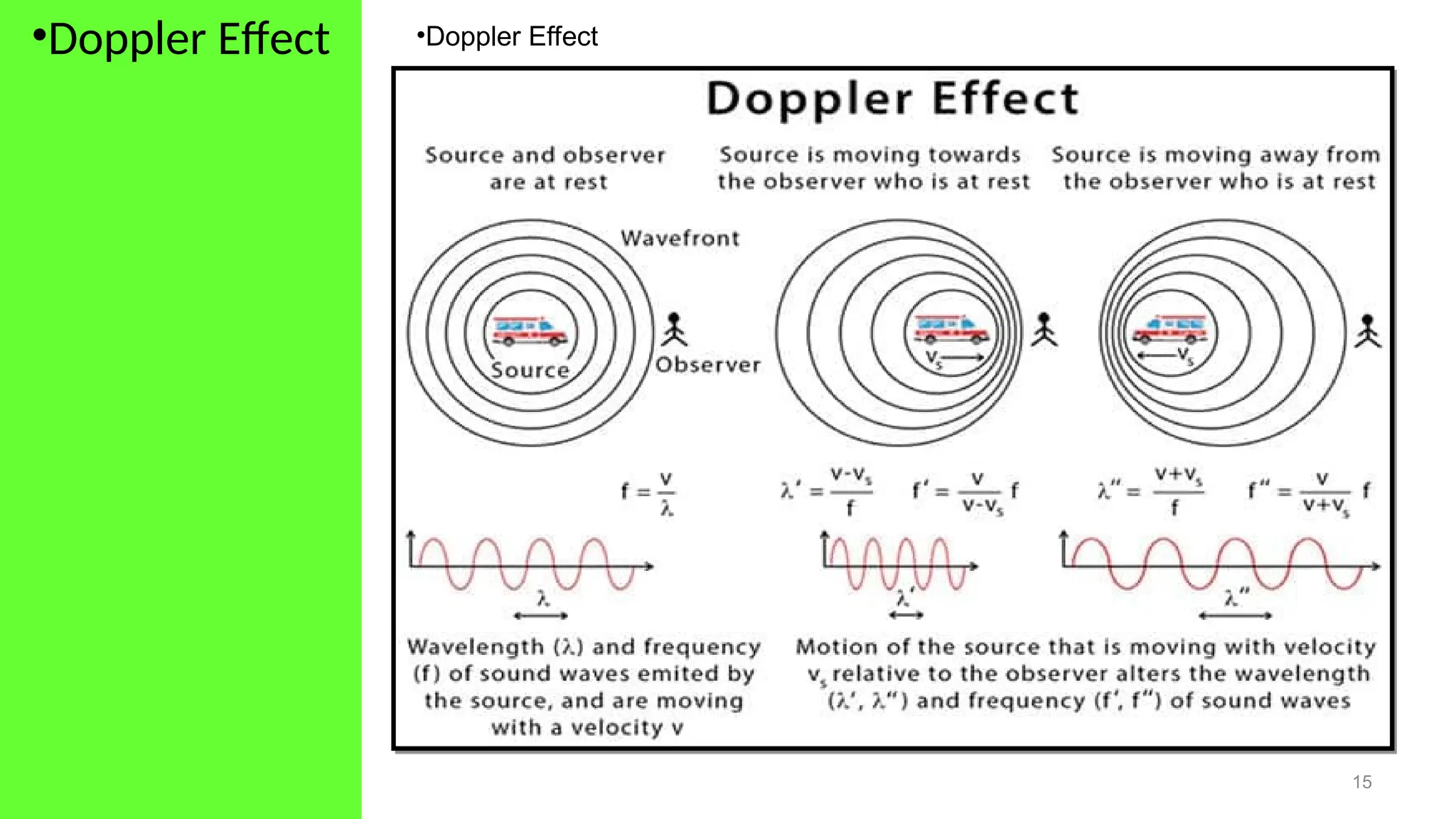
•Doppler Effect
Doppler effect is defined as the increase (or decrease) in the frequency of
sound, light, or other waves as the source and observer move towards (or
away from) each other.
•The Doppler effect is observed whenever the source of waves is moving with
respect to an observer.
•The Doppler effect can be described as the effect produced by a moving source
of waves in which there is an apparent upward shift in frequency for observers
towards whom the source is approaching and an apparent downward shift in
frequency for observers from whom the source is receding.
•It is important to note that the effect does not result because of an actual change in
the frequency of the source
•Doppler Effect
15
•Doppler Effect
•Doppler Effect
16
•Thank you

The objective of this unit is to present the student the nature of sound wave, student will have an understanding of The nature and propagation of sound wave

  • 1.
  • 2.
    Objectives 2 •The objective ofthis unit is to present the student the nature of sound wave, student will have an understanding of •The nature and propagation of sound wave •Transverse and longitudinal waves •Interface of sound waves •Beats •Decibel •Speed of sound in material medium •Intensity of sound •Superimposition of the wave •Doppler effect principle
  • 3.
    The nature and propagationof sound wave 3 •The nature and propagation of sound wave •Sound is produced by vibrating objects. The matter or substance through which sound is transmitted is called a medium. It can be solid, liquid or gas. Sound moves through a medium from the point of generation to the listener. •When an object vibrates, it sets the particles of the medium around it vibrating. The particles do not travel all the way from the vibrating object to the ear. A particle of the medium in contact with the vibrating object is first displaced from its equilibrium position. It then exerts a force on the adjacent particle. •As a result of which the adjacent particle gets displaced from its position of rest. After displacing the adjacent particle the first particle comes back to its original position. This process continues in the medium till the sound reaches your ear •The disturbance created by a source of sound in the medium travels through the medium and not the particles of the medium •A wave is a disturbance that moves through a medium when the particles of the medium set neighbouring particles into motion. They in turn produce similar motion in others. The particles of the medium do not move forward themselves, but the disturbance is carried forward. This is what happens during propagation of sound in a medium, hence sound can be visualised as a wave. Sound waves are characterised by the motion of particles in the medium and are called mechanical waves
  • 4.
    The nature and propagationof sound wave 4 •The nature and propagation of sound wave •Air is the most common medium through which sound travels. When a vibrating object moves forward, it pushes and compresses the air in front of it creating a region of high pressure. This region is called a compression (C), as shown in Fig. •This compression starts to move away from the vibrating object. When the vibrating object moves backwards, it creates a region of low pressure called rarefaction (R), as shown in Fig. •As the object moves back and forth rapidly, a series of compressions and rarefactions is created in the air. These make the sound wave that propagates through the medium. Compression is the region of high pressure and rarefaction is the region of low pressure •Pressure is related to the number of particles of a medium in a given volume. More density of the particles in the medium gives more pressure and vice versa. Thus, propagation of sound can be visualised as propagation of density variations or pressure variations in the medium
  • 5.
    •Longitudinal waves 5 •Longitudinal waves •The regionswhere the coils become closer are called compressions (C) and the regions where the coils are further apart are called rarefactions (R). As we already know, sound propagates in the medium as a series of compressions and rarefactions. Now, we can compare the propagation of disturbance in a slinky with the sound propagation in the medium. •These waves are called longitudinal waves. In these waves the individual particles of the medium move in a direction parallel to the direction of propagation of the disturbance. The particles do not move from one place to another but they simply oscillate back and forth about their position of rest. •This is exactly how a sound wave propagates, hence sound waves are longitudinal waves. There is also another type of wave, called a transverse wave. In a transverse wave particles do not oscillate along the line of wave propagation but oscillate up and down about their mean position as the wave travels. •Thus a transverse wave is the one in which the individual particles of the medium move about their mean positions in a direction perpendicular to the direction of wave propagation. Light is a transverse wave but for light, the oscillations are not of the medium particles or their pressure or density – it is not a mechanical wave. You will come to know more about transverse waves in higher classes
  • 6.
    Interference of sound waves 6 •Interference of sound waves When two longitudinal (sound) waves meet at a point where the compression of one wave coincides with the compression of the other wave and the rarefaction of one wave coincides with the rarefaction of the other wave. Then the resultant amplitude of a wave is maximum, or when compression of one wave falls on the rarefaction of the other lock and vice versa. Then the amplitude of the resultant wave is minimum. Then these effects are interference of longitudinal (sound) waves. Interference of longitudinal A new sound wave is produced whenever two or more sound waves from different origins interact with one other at the same instant in time to create a new resultant wave. This phenomenon, known as sound interference, causes the final wave to total all previously existing waves.
  • 7.
    Interference of sound waves 7 •Interference of sound waves
  • 8.
    Beats 8 •Beats In acoustics, abeat is an interference pattern between two sounds of slightly different frequencies, perceived as a periodic variation in volume whose rate is the difference of the two frequencies. A wave not only travels in space, but it also propagates through time, so if the two waves can produce interference by overlapping in space, they should also produce an interference pattern when they overlap in time; this phenomenon is called beats. Beats occur when two waves of nearby frequencies overlap and create a new resultant wave
  • 9.
    Decibel 9 •Decibel A decibel (dB)is a unit of measurement for sound. A-weighted decibels, abbreviated dBA, are an expression of the relative loudness of sounds in air as perceived by our ears. A 1 dB change in a sound equates to about a 26% difference in sound energy (remember that a 3 dB difference is a doubling of energy levels). In terms of subjective loudness, a 1 dB change yields just over a 7% change. A 3 dB change yields a 100% increase in sound energy and just over a 23% increase in loudness
  • 10.
    Decibel 10 •Decibel Safe and UnsafeDecibel Levels • Noise above 70 dB over a prolonged period of time may start to damage hearing. • Loud noise above 120 dB can cause immediate harm to ears
  • 11.
    Speed of sound 11 •Speedof sound Speed of sound is the speed at which sound waves move through the mediums like gas, liquid, solid and vacuum. The speed of sound in dry air is 343 m/s. The speed of sound varies from substance to substance: typically, sound travels most slowly in gases, faster in liquids, and fastest in solids. For example, while sound travels at 343 m/s in air, it travels at 1,481 m/s in water (almost 4.3 times as fast) and at 5,120 m/s in iron (almost 15 times as fast).
  • 12.
    Sound Intensity 12 •Sound Intensity Soundintensity, also known as acoustic intensity, is defined as the power carried by sound waves per unit area in a direction perpendicular to that area. The SI unit of intensity, which includes sound intensity, is the watt per square meter (W/m2 )
  • 13.
    •Superposition of the waves 13 •Superpositionof the waves The principle of superposition may be applied to waves whenever two (or more) waves travelling through the same medium at the same time. The waves pass through each other without being disturbed. The net displacement of the medium at any point in space or time, is simply the sum of the individual wave displacements
  • 14.
    •Doppler Effect 14 •Doppler Effect Dopplereffect is defined as the increase (or decrease) in the frequency of sound, light, or other waves as the source and observer move towards (or away from) each other. •The Doppler effect is observed whenever the source of waves is moving with respect to an observer. •The Doppler effect can be described as the effect produced by a moving source of waves in which there is an apparent upward shift in frequency for observers towards whom the source is approaching and an apparent downward shift in frequency for observers from whom the source is receding. •It is important to note that the effect does not result because of an actual change in the frequency of the source
  • 15.
  • 16.