This document summarizes a study that uses a wavelet-neural network (WLNN) conjunction model for river flow forecasting of the Brahmaputra River in India. The model decomposes river discharge time series data into multiresolution time series using discrete wavelet transforms. These decomposed time series are then used as inputs to an artificial neural network (ANN) to forecast river flows at different lead times. The results of the WLNN model are compared to those of a single ANN model. The WLNN model is found to provide more accurate and consistent predictions than the ANN model alone due to its use of multiresolution time series data as inputs.
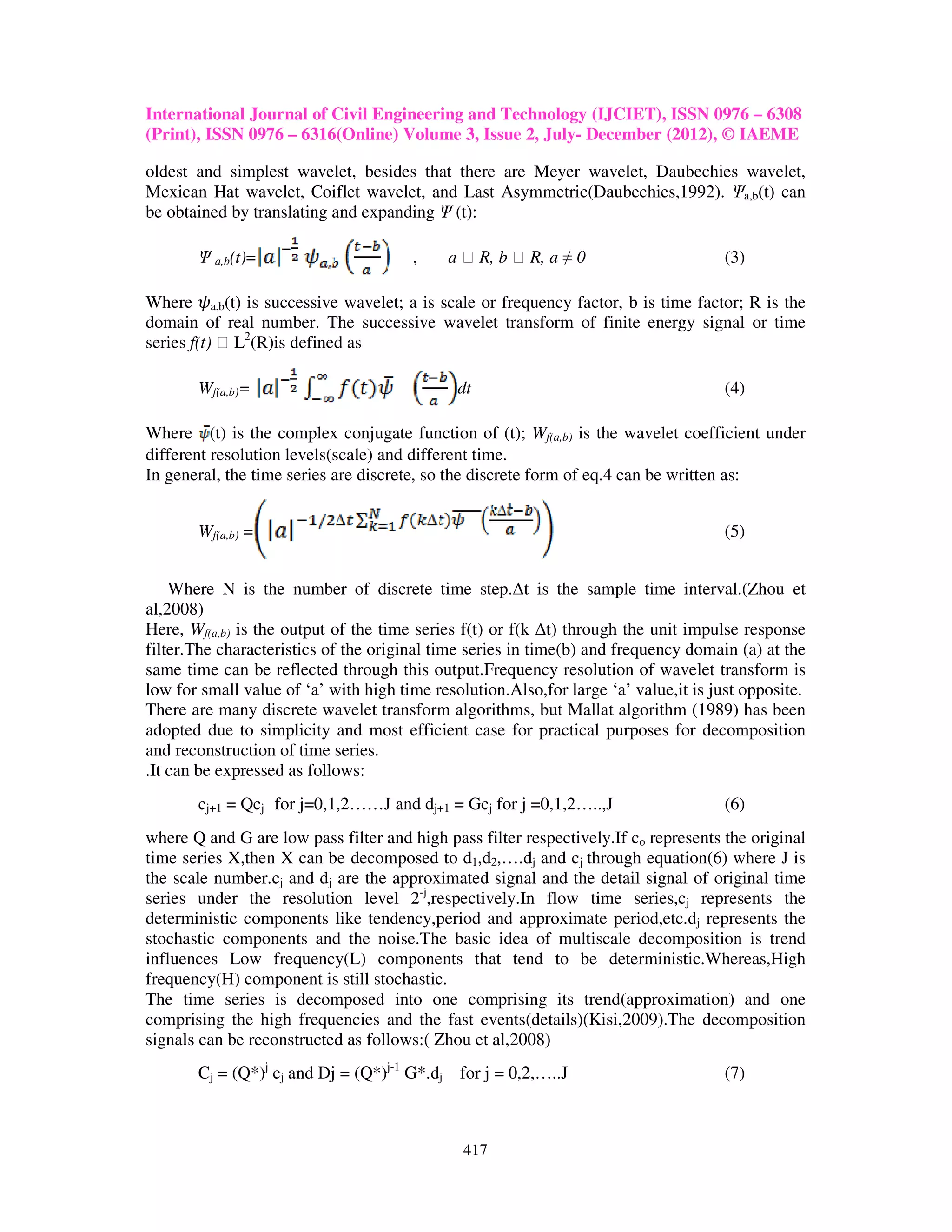
![International Journal of Civil Engineering and Technology (IJCIET), ISSN 0976 – 6308
(Print), ISSN 0976 – 6316(Online) Volume 3, Issue 2, July- December (2012), © IAEME
Where Q* and G* are dual operators of Q and G respectively.The reconstruction of
decomposition signals will increase the number of signals.The wavelet transform series
{D1,D2,…DJ,CJ},obtained by reconstructing d1,d2,…dj and cj,has the same length with the
original time series X and X = D1+D2+…DJ+CJ.
3. STUDY AREA
The study area is located in the international river Brahmaputra main stream within
India. The two consecutive discharge gauging sites namely Pandu(u/s) and Pancharatna(d/s)
are selected for the study as these two stations recorded heavy discharge flows in the main-
stream of the Brahmaputra river causing frequent floods to the downstream area.
The Brahmaputra originates in Tibet region in China is the fourth largest river in the
world in terms of average discharge at mouth, with a flow of 19,830 cumecs
(Goswami,1985). The hydrologic regime of the river responds to the seasonal rhythm of the
monsoons and to the freeze-thaw cycle of the Himalayan snow. The discharge is highly
fluctuating in nature. Discharge per unit drainage area in the Brahmaputra Basin River is
among the highest of major rivers of the world. The basin lies between latitudes 24013´ and
31030´9 North and longitudes 820 and 96049´ East. The catchment area upto pandu
station(u/s) is 500,000 sqkm and upto Pancharatna(d/s) is 532,000 sqkm. The location of the
two discharge gauging stations namely Pandu and Pancharatna are shown in the figure 1
below.
Figure.1: Location of the study area
4. METHODOLOGY
Here, considering the dominance of persistence in the flow time series, future river
flow to be forecasted from the past/previous flow data. River flow upto previous four time
steps were taken as predictor variables.The input scenarios formed by various predictor
configurations are;
[ 1] Q(t) [2] Q(t),Q(t-1) [3] Q(t),Q(t-1),Q(t-2) [4] Q(t),Q(t-1),Q(t-2),Q(t-3).
Where Q(t)—current discharge .Also Q(t-1),Q(t-2),Q(t-3) are onetime step,two time step and
three time step past discharge respectively. The predictand is Q (t+n) where n is the lead time.
These input and output scenarios are same for both ANN and WLNN model.Here, wavelet
418](https://image.slidesharecdn.com/wavelet-neuralnetworkconjunctionmodelinflowforecastingofsubhimalayanriverbrahmaputra-130116092141-phpapp01/75/Wavelet-neural-network-conjunction-model-in-flow-forecasting-of-subhimalayan-river-brahmaputra-4-2048.jpg)
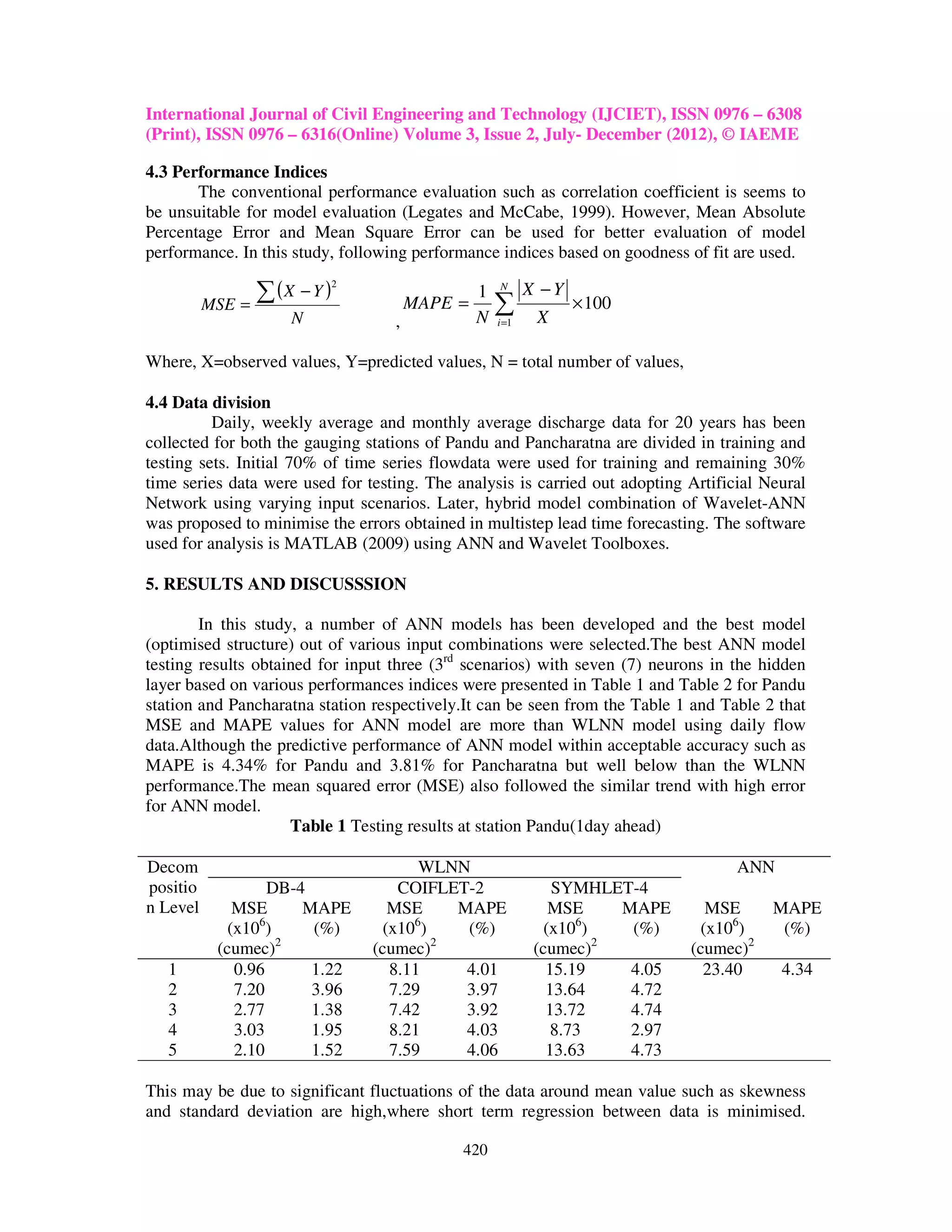
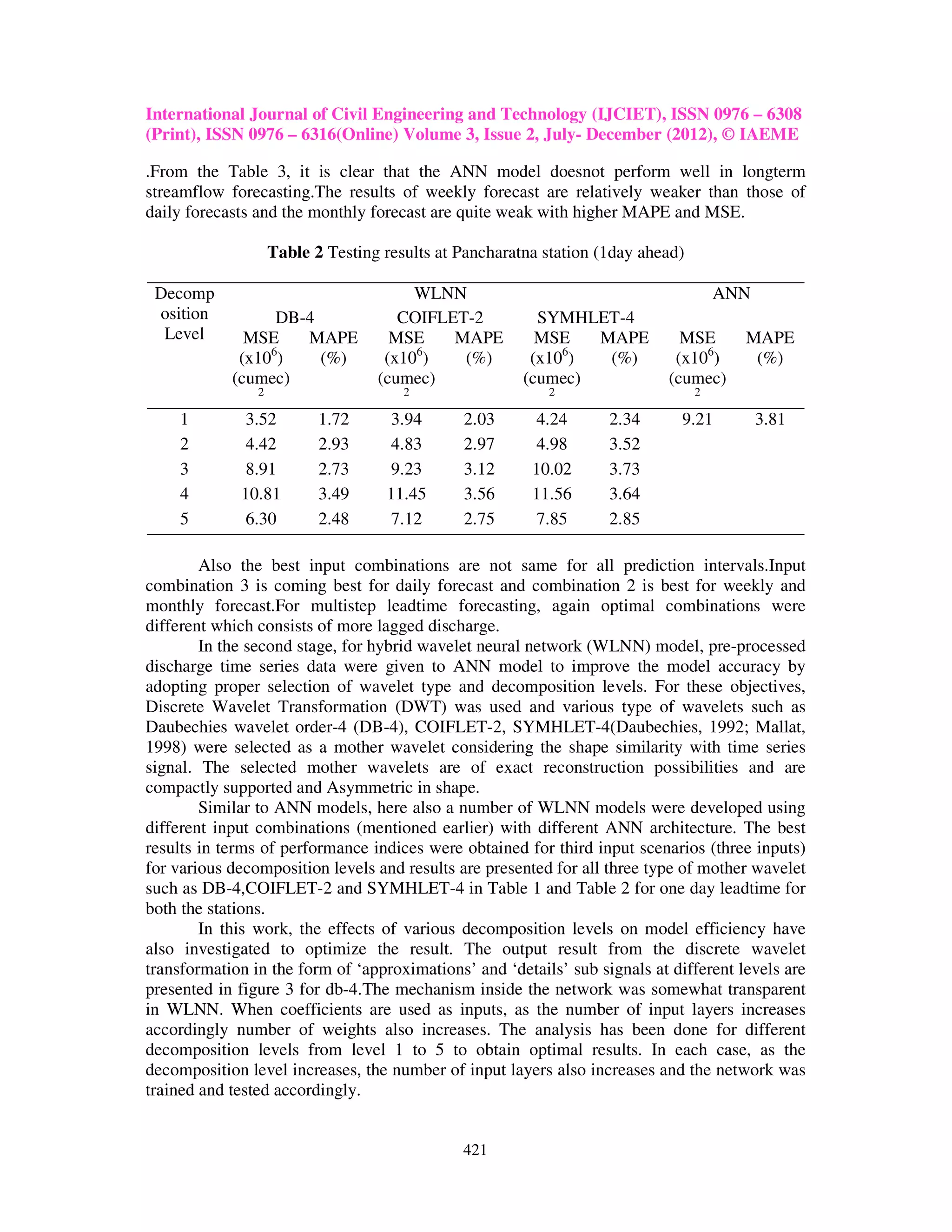
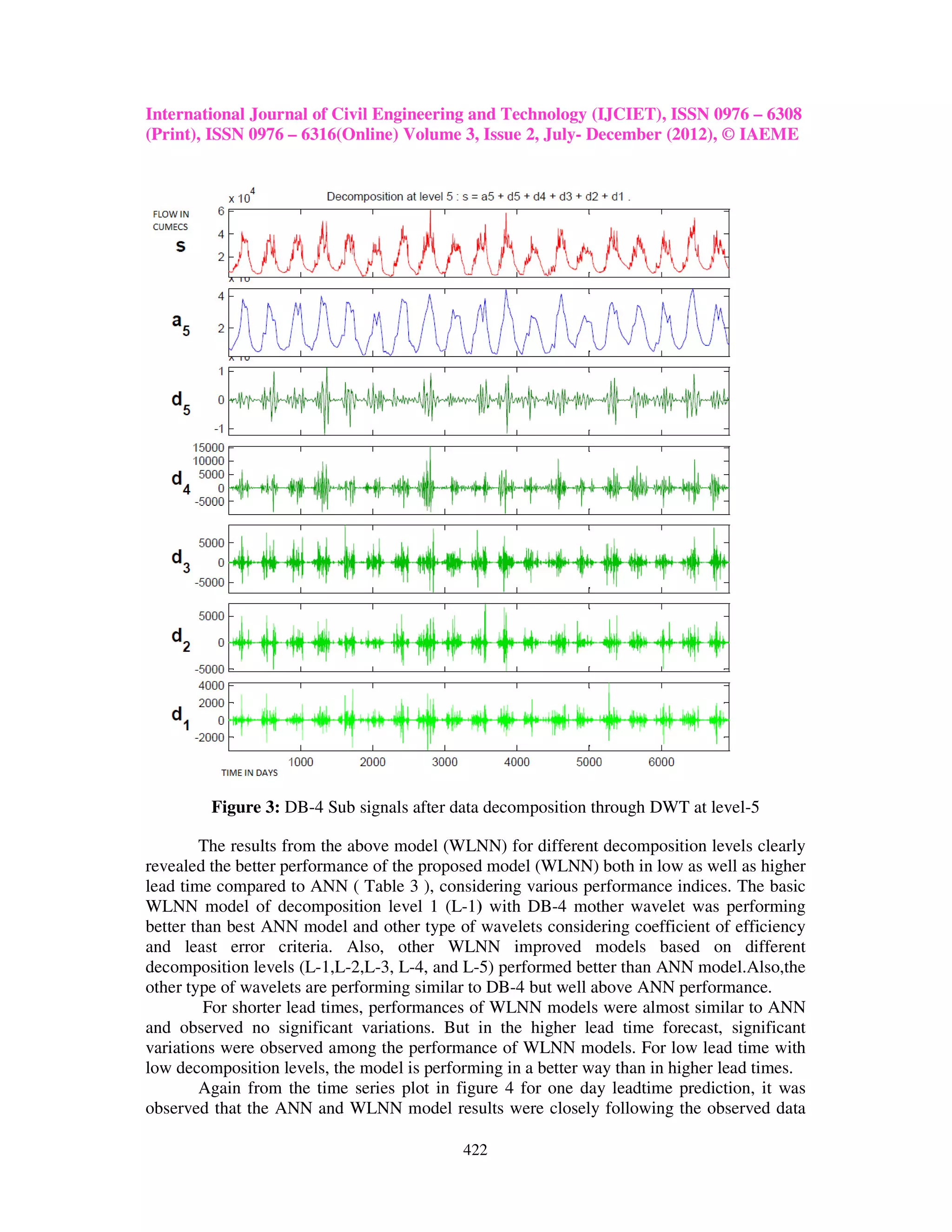
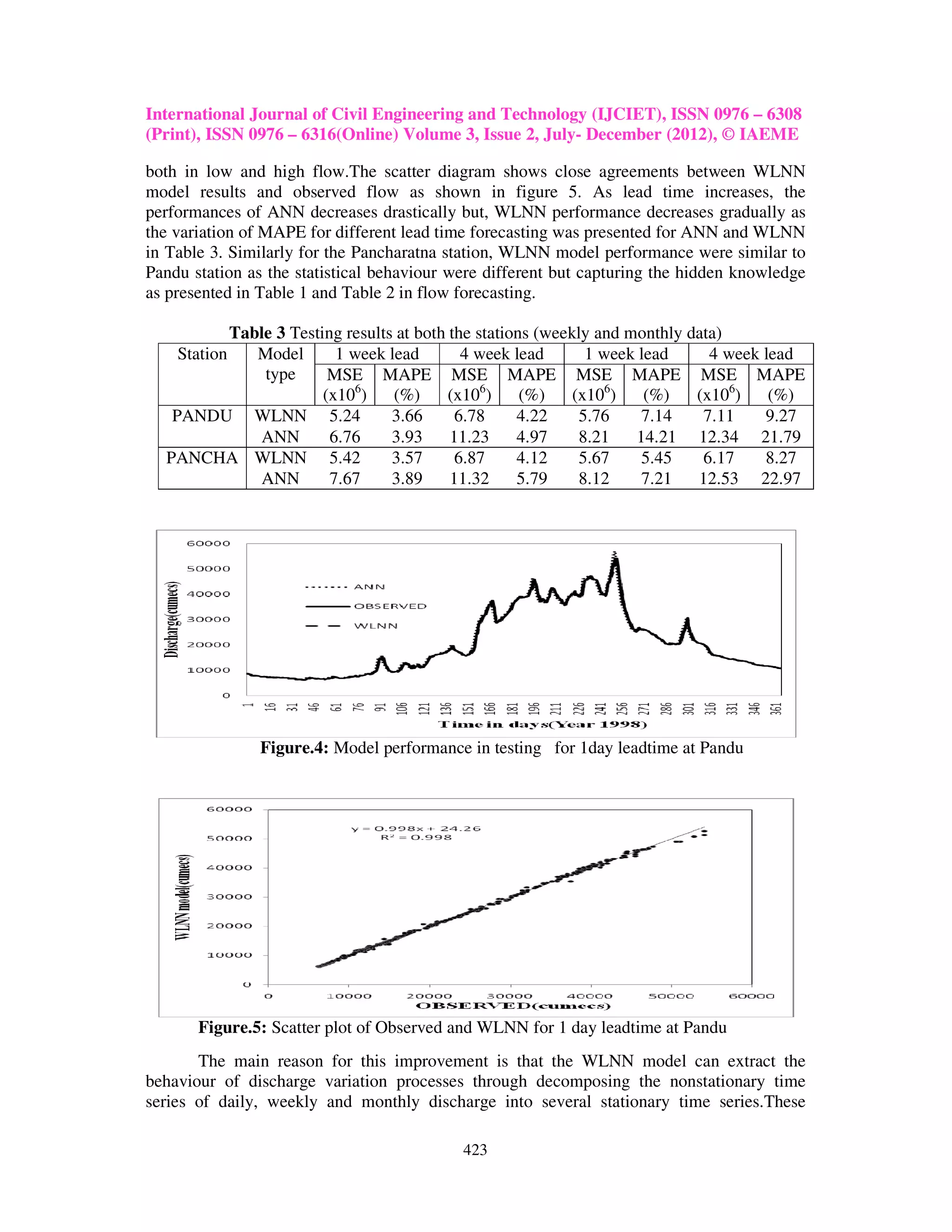
![International Journal of Civil Engineering and Technology (IJCIET), ISSN 0976 – 6308
(Print), ISSN 0976 – 6316(Online) Volume 3, Issue 2, July- December (2012), © IAEME
REFERENCES
[1] Coulibaly,P.,and Burn,H.D.2004.“Wavelet analysis of variability in annual Canadian
streamflows.Water Resources Research, 40(3), 1-14.
[2] Cannas, B., Fanni, A, Sias, G, Tronchi, S, Zedda, M.K. 2005. “River flow forecasting
using Neural Networks and Wavelet Analysis.” EUG (2005), European Geosciences Union,
Vienna, Ausrtia, vol.7, 24-29.
[3] Deka,P.C. and R.Prahlada.2012. “Discrete Wavelet Neural Network approach in
significant wave height forecasting for multistep lead time.”Ocean Engineering
journal(ISSN-0029-8018)April, Vol-43pp..32-42
[4] Daubechies,I.,1992. “Ten lectures on wavelets.Society for Industrial and Applied
Mathematics”,Philadelphia,PA.
[5] Goswami, D.C.1985.“Brahmaputra river, Assam, India; Physiographic, basin denudation
and channel aggradation”.Water Resources Research, 21,959-978.
[6] Lu,R.Y.2002. “Decomposition of interdecadal and interannual components for North
China rainfall in rainy season”,Chin.J.Atmosp.,26,611-624.
[7] Labat,D.2005.“Recent advances in wavelet analysis:PartI.A review of concepts”,J.of
Hydrology,314(1-4),289-311.
[8] Legates, D. R.; McCabe, Jr., 1999. “Evaluating the use of goodness-of-fit measures in
hydrologic and hydroclimatic model validation”. Water Resour. Res., 35 (1), 233-241.
[9] Mallat S.G. 1989. “A theory for multiresolution signal decomposition: The wavelet
representation.”IEEE Trans. Pattern Anal. Mach. Intell., 11(7), 674-693.
[10] Mallat S G.1998. “A wavelet tour of signal processing”Academic,San Diego
[11] Nourani, V.,Kisi,O.,Komasi.M. 2011. “Two hybrid artificial intelligence approaches for
modeling rainfall – runoff process.” Journal of Hydrology, 402, 41-49.
[12] Partal,T., and Kucuk,M.2006 “Flow forecasting for a Hawaii stream using rating curves
and neural networks”.J.Hydrology,317,63-80.
[13] Percival,D.B and Walden,A.T.2000. “Wavelet methods for time series analysis”.
Cambridge University Press,Cambridge.
[14] Rao,Y.R. Satyaji and B. Krishna 2009, “Modelling Hydrological Time Series data using
Wavelet Neural Network Analysis”, IAHS Publication -333,101-110.
[15] Smith,L.C.,Turcotte,D.L.,Isacks,B.1998 “Streamflow characterization and feature
detection using a Discrete wavelet transform”.Hydrological Process.,12,233-249.
[16] Shiri, J., and Kisi, O. 2010. “Short term and long term stream flow forecasting using a
wavelet and neuro-fuzzy conjunction model.” Journal of Hydrology, 394, 486-493.
[17] Wang.W.,Hu.S.,Li. Y.2011. “Wavelet transform method for synthetic generation of
daily streamflow”.Water Resources Management, 25:41-57.
[18] Wang . W and Ding.J, 2003. “Wavelet network model and its application to the
prediction of hydrology.” Nature and Science, 1(1) ,67-71.
[19] Xingang,D.,Ping,W.,and Jifan,C.2003. “Multiscale characteristics of the rainy season
rainfall and interdecadal decaying of summer monsoon in North China”. Chin.Sci.Bull.,
48,2730-2734.
[20] Zhou H.C,Peng Y,Liang G.H.,2008 “.The research of monthly discharge predictor-
corrector model based on wavelet decomposition.”Water Resources Management 22:217-
227.
425](https://image.slidesharecdn.com/wavelet-neuralnetworkconjunctionmodelinflowforecastingofsubhimalayanriverbrahmaputra-130116092141-phpapp01/75/Wavelet-neural-network-conjunction-model-in-flow-forecasting-of-subhimalayan-river-brahmaputra-11-2048.jpg)


