Daljeet Kaur Khanduja & M.Y.Gokhale
Signal Processing-An International Journal (SPIJ), Volume (4): Issue (3) 161
Time Domain Signal Analysis Using Modified Haar and
Modified Daubechies Wavelet Transform
Daljeet Kaur Khanduja dkdkhalsa@gmail.com
Professor, Department of Mathematics,
Sinhgad Academy of Engineering, Kondhwa,
Pune 48, India
M.Y.Gokhale
Professor and Head of Department of Mathematics,
Maharashtra Institute of Technology, Kothrud,
Pune 38, India
Abstract
In this paper, time signal analysis and synthesis based on modified Haar and
modified Daubechies wavelet transform is proposed. The optimal results for
both analysis and synthesis for time domain signals were obtained with the
use of the modified Haar and modified Daubechies wavelet transforms. This
paper evaluates the quality of filtering using the modified Haar and modified
Daubechies wavelet transform. Analysis and synthesis of the time signals is
performed for 10 samples and the signal to noise ratio (SNR) of around 25-40
dB is obtained for modified Haar and 24-32 dB for modified Daubechies
wavelet. We have observed that as compared to standard Haar and standard
Daubechies mother wavelet our proposed method gives better signal quality,
which is good for time varying signals.
Keywords: Modified haar, Modified daubechies, Analysis, Synthesis.
1. INTRODUCTION
Wavelet analysis is a mathematical technique used to represent data or functions. The
wavelets used in the analysis are functions that possess certain mathematical properties, and
break the data down into different scales or resolutions [1]. Wavelets are better able to
handle spikes and discontinuities than traditional Fourier analysis making them a perfect tool
to de-noise noisy data. Therefore, the wavelet transform is anticipated to provide economical
and informative mathematical representation of many objects of interest [2]. In this paper,
signal data refer to data with some type of time or spatial relationship. The majority of signal
data we encounter in practical situations are a combination of low and high frequency
components. The low frequency component is somewhat stationary over the length of the
signal data. Wavelet analysis employs two functions, often referred to as the father and
mother wavelets, to generate a family of functions that break up and reconstruct a signal. The
father wavelet is similar in concept to a moving average function, while the mother wavelet
quantifies the differences between the original signal and the average generated by the father
wavelet. The combination of the two functions allows wavelet analysis to analyze both the low
and high frequency components in a signal simultaneously.
The wavelet transform is an emerging signal processing technique that can be used to
represent real-life nonstationary signals with high efficiency [3]. Indeed, the wavelet transform
Daljeet Kaur Khanduja & M.Y.Gokhale
Signal Processing-An International Journal (SPIJ), Volume (4): Issue (3) 162
is gaining momentum to become an alternative tool to traditional time-frequency
representation techniques such as the discrete Fourier transform and the discrete cosine
transform. By virtue of its multi-resolution representation capability, the wavelet transform has
been used effectively in vital applications such as transient signal analysis [4], numerical
analysis [5], computer vision [6], and image compression [7], among many other audiovisual
applications. Wavelets (literally “small waves”) are a relatively recent instrument in modern
mathematics. Introduced about 20 years ago, wavelets have made a revolution in theory and
practice of non-stationary signal analysis [8][9]. Wavelets have been first found in the
literature in works of Grossmann and Morlet [10].Some ideas of wavelets partly existed long
time ago. In 1910 Haar published a work about a system of locally-defined basis functions.
Now these functions are called Haar wavelets. Nowadays wavelets are widely used in
various signal analysis, ranging from image processing, analysis and synthesis of speech,
medical data and music [11][12].
In this paper we use modified Haar and modified Daubechies wavelet by considering odd
number of coefficients and implement it in time signal analysis and synthesis. The two sets of
coefficients (low pass and high pass filter coefficients) obtained that define the refinement
relation act as signal filters. A set of simultaneous equations are formulated and solved to
obtain numerical values for the coefficients. The quality of filtering using the modified Haar
and modified Daubechies wavelet transform is evaluated by calculating the SNR for 10
samples.
The organization of this paper is as follows: In section 2, the standard Haar and Daubechies
mother wavelets is discussed. Section 3 explains the mathematical analysis, in section 4
results for modified Haar and modified Daubechies mother wavelets are presented. In
Section 5 the results are discussed, Section 6 gives the observations and in Section 7
conclusions of this work are summarized.
2 STANDARD HAAR AND STANDARD DAUBECHIES WAVELETS
The key idea to find the wavelets is self-similarity. We start with a function  t that is made
up of a smaller version of itself. This is the refinement (or 2-scale, dilation) equation given by
       ktcktkht
N
k
k
N
k
 




222
1
0
1
0
 (1)
where   2khck  . We call kc as un-normalized coefficients and  kh as the normalized
coefficients.
       ktcktkt
N
k
k
N
k
 




2'22g
1
0
1
0
 (2)
where
  2' kgck 
First, the scaling function is chosen to preserve its area under each iteration,
so   1


dtt . (3)
The scaling relation then imposes a condition on the filter coefficients.
Daljeet Kaur Khanduja & M.Y.Gokhale
Signal Processing-An International Journal (SPIJ), Volume (4): Issue (3) 163
   dtktcdtt
N
k
k 







1
0
2
=  dtktc
N
k
k 2
1
0
 



=  dyyck
2
1
 
Since    dyydtt    , we obtain
2
1
0



N
k
kc (4)
Utilizing the relation   2khck  , we get the relation in terms of normalized coefficient as:
  2
2
21
0



N
k
kh . (5)
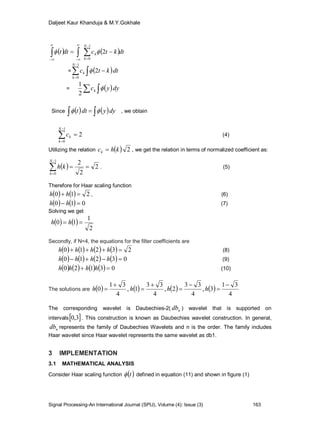
Therefore for Haar scaling function
    210  hh , (6)
    010  hh (7)
Solving we get
   
2
1
10  hh
Secondly, if N=4, the equations for the filter coefficients are
        23210  hhhh (8)
        03210  hhhh (9)
        03120  hhhh (10)
The solutions are        
4
31
3,
4
33
2,
4
33
1,
4
31
0







 hhhh
The corresponding wavelet is Daubechies-2( ndb ) wavelet that is supported on
intervals 3,0 . This construction is known as Daubechies wavelet construction. In general,
ndb represents the family of Daubechies Wavelets and n is the order. The family includes
Haar wavelet since Haar wavelet represents the same wavelet as db1.
3 IMPLEMENTATION
3.1 MATHEMATICAL ANALYSIS
Consider Haar scaling function  t defined in equation (11) and shown in figure (1)
Daljeet Kaur Khanduja & M.Y.Gokhale
Signal Processing-An International Journal (SPIJ), Volume (4): Issue (3) 164
 
whereelse
tt
0
101 
(11)
 t
1
0 1 t
FIGURE 1: Haar Scaling Function
Consider functions of the type      1,2,1  ttt  or in general  kt  .These
functions are called as translates of  t . In function  t , the function exists practically for
values of t in the range 1,0 . Beyond this range, function value is zero.
 t
1  2t  kt 
0 1 2 3 k 1k
t
FIGURE 2: Translations Of Haar Scaling Function  t
The domain of the function is [0, 1].Note that the function is time limited and have finite
energy. That is   dttf
2



exists and is finite.
Consider a set of orthonormal functions       ....1,,1......  ttt  , which are translates of
a single function  t .
Let 0V be the space spanned by the set of bases       ....1,,1......  ttt  .We denote
this as
Daljeet Kaur Khanduja & M.Y.Gokhale
Signal Processing-An International Journal (SPIJ), Volume (4): Issue (3) 165
  ktSpanV  0 (12)
Consider a function    ktatf
k
k  


 where sak ' are real numbers (scalars) which we
call as coefficients of   skt ' . For one set of sak ' , we have one particular signal. But
assume that we are continuously changing sak ' to generate continuously new functions or
signals. The set of all such signals constitute the function space 0V .
3.2 FINER HAAR SCALING FUNCTIONS
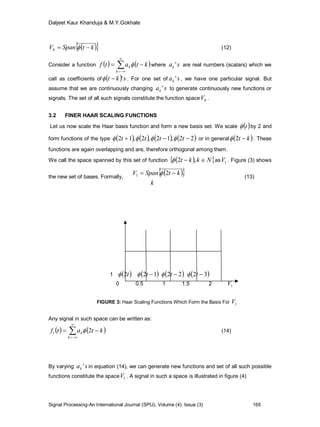
Let us now scale the Haar basis function and form a new basis set. We scale  t by 2 and
form functions of the type        22,12,2,12  tttt  or in general  kt 2 . These
functions are again overlapping and are, therefore orthogonal among them.
We call the space spanned by this set of function   Nkkt  ,2 as 1V . Figure (3) shows
the new set of bases. Formally,
  
k
ktSpanV 21  
(13)
1  t2  12 t  22 t  32 t
0 0.5 1 1.5 2 1V
FIGURE 3: Haar Scaling Functions Which Form the Basis For 1V
Any signal in such space can be written as:
   ktatf
k
k  


21  (14)
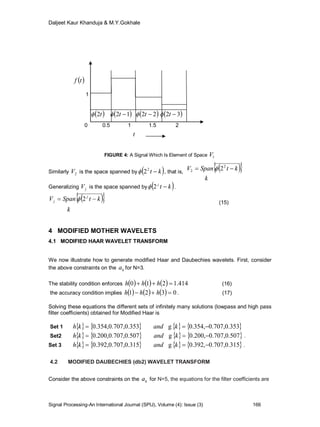
By varying sak ' in equation (14), we can generate new functions and set of all such possible
functions constitute the space 1V . A signal in such a space is illustrated in figure (4)
Daljeet Kaur Khanduja & M.Y.Gokhale
Signal Processing-An International Journal (SPIJ), Volume (4): Issue (3) 166
 tf
1
 t2  12 t  22 t  32 t
0 0.5 1 1.5 2
t
FIGURE 4: A Signal Which Is Element of Space 1V
Similarly 2V is the space spanned by  kt 2
2 , that is,
  
k
ktSpanV 22
2  
Generalizing jV is the space spanned by  ktj
2 .
  
k
ktSpanV j
j 2  
(15)
4 MODIFIED MOTHER WAVELETS
4.1 MODIFIED HAAR WAVELET TRANSFORM
We now illustrate how to generate modified Haar and Daubechies wavelets. First, consider
the above constraints on the ka for N=3.
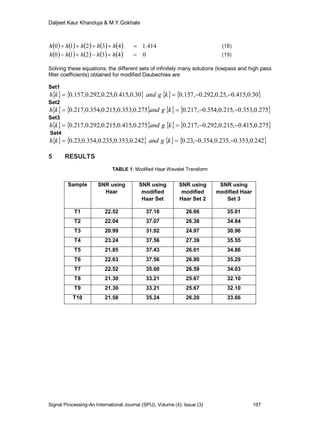
The stability condition enforces       414.1210  hhh (16)
the accuracy condition implies       0321  hhh . (17)
Solving these equations the different sets of infinitely many solutions (lowpass and high pass
filter coefficients) obtained for Modified Haar is
Set 1        353.0,707.0,354.0g353.0,707.0,354.0  kandkh
Set2        507.0,707.0,200.0g507.0,707.0,200.0  kandkh .
Set 3        315.0,707.0,392.0g315.0,707.0,392.0  kandkh .
4.2 MODIFIED DAUBECHIES (db2) WAVELET TRANSFORM
Consider the above constraints on the ka for N=5, the equations for the filter coefficients are
Daljeet Kaur Khanduja & M.Y.Gokhale
Signal Processing-An International Journal (SPIJ), Volume (4): Issue (3) 167
          414.143210  hhhhh (18)
          043210  hhhhh (19)
Solving these equations, the different sets of infinitely many solutions (lowpass and high pass
filter coefficients) obtained for modified Daubechies are
Set1
       30.0,415.0,25.0,292.0,157.030.0,415.0,25.0,292.0,157.0  kgandkh
Set2
       275.0,353.0,215.0,354.0,217.0275.0,353.0,215.0,354.0,217.0  kgandkh
Set3
       275.0,415.0,215.0,292.0,217.0275.0,415.0,215.0,292.0,217.0  kgandkh
Set4
       242.0,353.0,235.0,354.0,23.0242.0,353.0,235.0,354.0,23.0  kgandkh
5 RESULTS
TABLE 1: Modified Haar Wavelet Transform
Sample SNR using
Haar
SNR using
modified
Haar Set
SNR using
modified
Haar Set 2
SNR using
modified Haar
Set 3
T1 22.52 37.16 26.66 35.01
T2 22.04 37.07 26.38 34.84
T3 20.99 31.92 24.97 30.96
T4 23.24 37.56 27.39 35.55
T5 21.85 37.43 26.01 34.86
T6 22.63 37.56 26.80 35.29
T7 22.52 35.60 26.59 34.03
T8 21.30 33.21 25.67 32.10
T9 21.30 33.21 25.67 32.10
T10 21.58 35.24 26.20 33.66
Daljeet Kaur Khanduja & M.Y.Gokhale
Signal Processing-An International Journal (SPIJ), Volume (4): Issue (3) 168
0
10
20
30
40
50
T1 T2 T3 T4 T5 T6 T7 T8 T9 T10
SNR
Samples
SNR
using
Haar
SNR
using
modified
Haar
SNR
using
modified
Haar
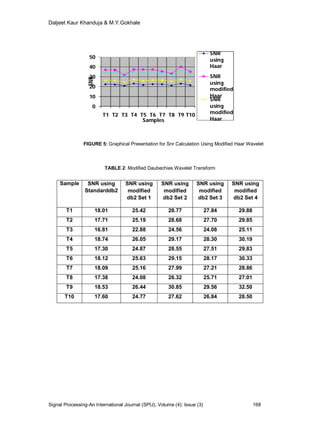
FIGURE 5: Graphical Presentation for Snr Calculation Using Modified Haar Wavelet
TABLE 2: Modified Daubechies Wavelet Transform
Sample SNR using
Standarddb2
SNR using
modified
db2 Set 1
SNR using
modified
db2 Set 2
SNR using
modified
db2 Set 3
SNR using
modified
db2 Set 4
T1 18.01 25.42 28.77 27.84 29.88
T2 17.71 25.19 28.68 27.70 29.85
T3 16.81 22.88 24.56 24.08 25.11
T4 18.74 26.05 29.17 28.30 30.19
T5 17.30 24.87 28.55 27.51 29.83
T6 18.12 25.63 29.15 28.17 30.33
T7 18.09 25.16 27.99 27.21 28.86
T8 17.38 24.08 26.32 25.71 27.01
T9 18.53 26.44 30.85 29.56 32.50
T10 17.60 24.77 27.62 26.84 28.50
Daljeet Kaur Khanduja & M.Y.Gokhale
Signal Processing-An International Journal (SPIJ), Volume (4): Issue (3) 169
0
5
10
15
20
25
30
35
T1 T2 T3 T4 T5 T6 T7 T8 T9 T10
SNR
Samples
SNR
using
db2
SNR
using
modified
db2
SNR
using
modified
db2
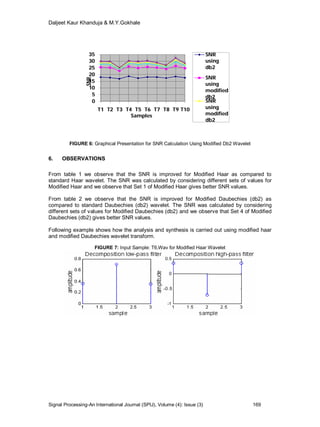
FIGURE 6: Graphical Presentation for SNR Calculation Using Modified Db2 Wavelet
6. OBSERVATIONS
From table 1 we observe that the SNR is improved for Modified Haar as compared to
standard Haar wavelet. The SNR was calculated by considering different sets of values for
Modified Haar and we observe that Set 1 of Modified Haar gives better SNR values.
From table 2 we observe that the SNR is improved for Modified Daubechies (db2) as
compared to standard Daubechies (db2) wavelet. The SNR was calculated by considering
different sets of values for Modified Daubechies (db2) and we observe that Set 4 of Modified
Daubechies (db2) gives better SNR values.
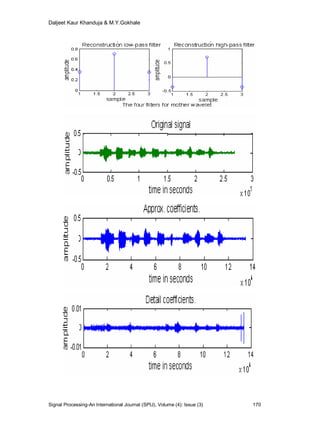
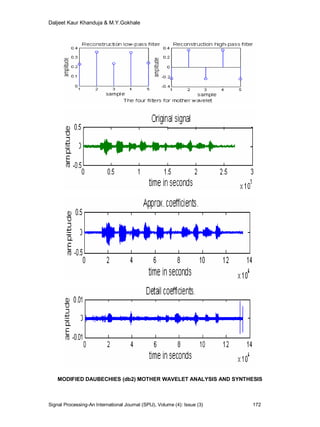
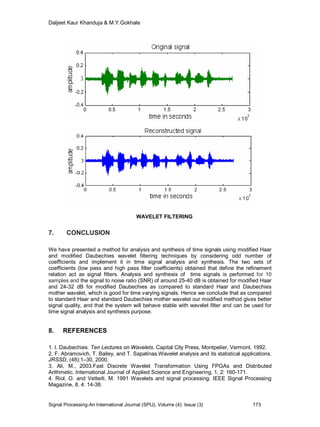
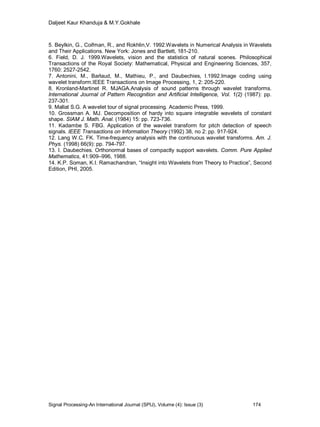
Following example shows how the analysis and synthesis is carried out using modified haar
and modified Daubechies wavelet transform.
FIGURE 7: Input Sample: T6.Wav for Modified Haar Wavelet
Daljeet Kaur Khanduja & M.Y.Gokhale
Signal Processing-An International Journal (SPIJ), Volume (4): Issue (3) 170
Daljeet Kaur Khanduja & M.Y.Gokhale
Signal Processing-An International Journal (SPIJ), Volume (4): Issue (3) 171
MODIFIED HAAR MOTHER WAVELET ANALYSIS AND SYNTHESIS
WAVELET FILTERING
FIGURE 8: Input Sample: T6.Wav for Modified Daubechies (Db2) Mother Wavelet
Daljeet Kaur Khanduja & M.Y.Gokhale
Signal Processing-An International Journal (SPIJ), Volume (4): Issue (3) 172
MODIFIED DAUBECHIES (db2) MOTHER WAVELET ANALYSIS AND SYNTHESIS
Daljeet Kaur Khanduja & M.Y.Gokhale
Signal Processing-An International Journal (SPIJ), Volume (4): Issue (3) 173
WAVELET FILTERING
7. CONCLUSION
We have presented a method for analysis and synthesis of time signals using modified Haar
and modified Daubechies wavelet filtering techniques by considering odd number of
coefficients and implement it in time signal analysis and synthesis. The two sets of
coefficients (low pass and high pass filter coefficients) obtained that define the refinement
relation act as signal filters. Analysis and synthesis of time signals is performed for 10
samples and the signal to noise ratio (SNR) of around 25-40 dB is obtained for modified Haar
and 24-32 dB for modified Daubechies as compared to standard Haar and Daubechies
mother wavelet, which is good for time varying signals. Hence we conclude that as compared
to standard Haar and standard Daubechies mother wavelet our modified method gives better
signal quality, and that the system will behave stable with wavelet filter and can be used for
time signal analysis and synthesis purpose.
8. REFERENCES
1. I. Daubechies. Ten Lectures on Wavelets. Capital City Press, Montpelier, Vermont, 1992.
2. F. Abramovich, T. Bailey, and T. Sapatinas.Wavelet analysis and its statistical applications.
JRSSD, (48):1–30, 2000.
3. Ali, M., 2003.Fast Discrete Wavelet Transformation Using FPGAs and Distributed
Arithmetic. International Journal of Applied Science and Engineering, 1, 2: 160-171.
4. Riol, O. and Vetterli, M. 1991 Wavelets and signal processing. IEEE Signal Processing
Magazine, 8, 4: 14-38.
Daljeet Kaur Khanduja & M.Y.Gokhale
Signal Processing-An International Journal (SPIJ), Volume (4): Issue (3) 174
5. Beylkin, G., Coifman, R., and Rokhlin,V. 1992.Wavelets in Numerical Analysis in Wavelets
and Their Applications. New York: Jones and Bartlett, 181-210.
6. Field, D. J. 1999.Wavelets, vision and the statistics of natural scenes. Philosophical
Transactions of the Royal Society: Mathematical, Physical and Engineering Sciences, 357,
1760: 2527-2542.
7. Antonini, M., Barlaud, M., Mathieu, P., and Daubechies, I.1992.Image coding using
wavelet transform.IEEE Transactions on Image Processing, 1, 2: 205-220.
8. Kronland-Martinet R. MJAGA.Analysis of sound patterns through wavelet transforms.
International Journal of Pattern Recognition and Artificial Intelligence, Vol. 1(2) (1987): pp.
237-301.
9. Mallat S.G. A wavelet tour of signal processing. Academic Press, 1999.
10. Grossman A. MJ. Decomposition of hardy into square integrable wavelets of constant
shape. SIAM J. Math. Anal. (1984) 15: pp. 723-736.
11. Kadambe S. FBG. Application of the wavelet transform for pitch detection of speech
signals. IEEE Transactions on Information Theory (1992) 38, no 2: pp. 917-924.
12. Lang W.C. FK. Time-frequency analysis with the continuous wavelet transforms. Am. J.
Phys. (1998) 66(9): pp. 794-797.
13. I. Daubechies. Orthonormal bases of compactly support wavelets. Comm. Pure Applied
Mathematics, 41:909–996, 1988.
14. K.P. Soman, K.I. Ramachandran, “Insight into Wavelets from Theory to Practice”, Second
Edition, PHI, 2005.

Time Domain Signal Analysis Using Modified Haar and Modified Daubechies Wavelet Transform

  • 1.
    Daljeet Kaur Khanduja& M.Y.Gokhale Signal Processing-An International Journal (SPIJ), Volume (4): Issue (3) 161 Time Domain Signal Analysis Using Modified Haar and Modified Daubechies Wavelet Transform Daljeet Kaur Khanduja dkdkhalsa@gmail.com Professor, Department of Mathematics, Sinhgad Academy of Engineering, Kondhwa, Pune 48, India M.Y.Gokhale Professor and Head of Department of Mathematics, Maharashtra Institute of Technology, Kothrud, Pune 38, India Abstract In this paper, time signal analysis and synthesis based on modified Haar and modified Daubechies wavelet transform is proposed. The optimal results for both analysis and synthesis for time domain signals were obtained with the use of the modified Haar and modified Daubechies wavelet transforms. This paper evaluates the quality of filtering using the modified Haar and modified Daubechies wavelet transform. Analysis and synthesis of the time signals is performed for 10 samples and the signal to noise ratio (SNR) of around 25-40 dB is obtained for modified Haar and 24-32 dB for modified Daubechies wavelet. We have observed that as compared to standard Haar and standard Daubechies mother wavelet our proposed method gives better signal quality, which is good for time varying signals. Keywords: Modified haar, Modified daubechies, Analysis, Synthesis. 1. INTRODUCTION Wavelet analysis is a mathematical technique used to represent data or functions. The wavelets used in the analysis are functions that possess certain mathematical properties, and break the data down into different scales or resolutions [1]. Wavelets are better able to handle spikes and discontinuities than traditional Fourier analysis making them a perfect tool to de-noise noisy data. Therefore, the wavelet transform is anticipated to provide economical and informative mathematical representation of many objects of interest [2]. In this paper, signal data refer to data with some type of time or spatial relationship. The majority of signal data we encounter in practical situations are a combination of low and high frequency components. The low frequency component is somewhat stationary over the length of the signal data. Wavelet analysis employs two functions, often referred to as the father and mother wavelets, to generate a family of functions that break up and reconstruct a signal. The father wavelet is similar in concept to a moving average function, while the mother wavelet quantifies the differences between the original signal and the average generated by the father wavelet. The combination of the two functions allows wavelet analysis to analyze both the low and high frequency components in a signal simultaneously. The wavelet transform is an emerging signal processing technique that can be used to represent real-life nonstationary signals with high efficiency [3]. Indeed, the wavelet transform
  • 2.
    Daljeet Kaur Khanduja& M.Y.Gokhale Signal Processing-An International Journal (SPIJ), Volume (4): Issue (3) 162 is gaining momentum to become an alternative tool to traditional time-frequency representation techniques such as the discrete Fourier transform and the discrete cosine transform. By virtue of its multi-resolution representation capability, the wavelet transform has been used effectively in vital applications such as transient signal analysis [4], numerical analysis [5], computer vision [6], and image compression [7], among many other audiovisual applications. Wavelets (literally “small waves”) are a relatively recent instrument in modern mathematics. Introduced about 20 years ago, wavelets have made a revolution in theory and practice of non-stationary signal analysis [8][9]. Wavelets have been first found in the literature in works of Grossmann and Morlet [10].Some ideas of wavelets partly existed long time ago. In 1910 Haar published a work about a system of locally-defined basis functions. Now these functions are called Haar wavelets. Nowadays wavelets are widely used in various signal analysis, ranging from image processing, analysis and synthesis of speech, medical data and music [11][12]. In this paper we use modified Haar and modified Daubechies wavelet by considering odd number of coefficients and implement it in time signal analysis and synthesis. The two sets of coefficients (low pass and high pass filter coefficients) obtained that define the refinement relation act as signal filters. A set of simultaneous equations are formulated and solved to obtain numerical values for the coefficients. The quality of filtering using the modified Haar and modified Daubechies wavelet transform is evaluated by calculating the SNR for 10 samples. The organization of this paper is as follows: In section 2, the standard Haar and Daubechies mother wavelets is discussed. Section 3 explains the mathematical analysis, in section 4 results for modified Haar and modified Daubechies mother wavelets are presented. In Section 5 the results are discussed, Section 6 gives the observations and in Section 7 conclusions of this work are summarized. 2 STANDARD HAAR AND STANDARD DAUBECHIES WAVELETS The key idea to find the wavelets is self-similarity. We start with a function  t that is made up of a smaller version of itself. This is the refinement (or 2-scale, dilation) equation given by        ktcktkht N k k N k       222 1 0 1 0  (1) where   2khck  . We call kc as un-normalized coefficients and  kh as the normalized coefficients.        ktcktkt N k k N k       2'22g 1 0 1 0  (2) where   2' kgck  First, the scaling function is chosen to preserve its area under each iteration, so   1   dtt . (3) The scaling relation then imposes a condition on the filter coefficients.
  • 3.
    Daljeet Kaur Khanduja& M.Y.Gokhale Signal Processing-An International Journal (SPIJ), Volume (4): Issue (3) 163    dtktcdtt N k k         1 0 2 =  dtktc N k k 2 1 0      =  dyyck 2 1   Since    dyydtt    , we obtain 2 1 0    N k kc (4) Utilizing the relation   2khck  , we get the relation in terms of normalized coefficient as:   2 2 21 0    N k kh . (5) Therefore for Haar scaling function     210  hh , (6)     010  hh (7) Solving we get     2 1 10  hh Secondly, if N=4, the equations for the filter coefficients are         23210  hhhh (8)         03210  hhhh (9)         03120  hhhh (10) The solutions are         4 31 3, 4 33 2, 4 33 1, 4 31 0         hhhh The corresponding wavelet is Daubechies-2( ndb ) wavelet that is supported on intervals 3,0 . This construction is known as Daubechies wavelet construction. In general, ndb represents the family of Daubechies Wavelets and n is the order. The family includes Haar wavelet since Haar wavelet represents the same wavelet as db1. 3 IMPLEMENTATION 3.1 MATHEMATICAL ANALYSIS Consider Haar scaling function  t defined in equation (11) and shown in figure (1)
  • 4.
    Daljeet Kaur Khanduja& M.Y.Gokhale Signal Processing-An International Journal (SPIJ), Volume (4): Issue (3) 164   whereelse tt 0 101  (11)  t 1 0 1 t FIGURE 1: Haar Scaling Function Consider functions of the type      1,2,1  ttt  or in general  kt  .These functions are called as translates of  t . In function  t , the function exists practically for values of t in the range 1,0 . Beyond this range, function value is zero.  t 1  2t  kt  0 1 2 3 k 1k t FIGURE 2: Translations Of Haar Scaling Function  t The domain of the function is [0, 1].Note that the function is time limited and have finite energy. That is   dttf 2    exists and is finite. Consider a set of orthonormal functions       ....1,,1......  ttt  , which are translates of a single function  t . Let 0V be the space spanned by the set of bases       ....1,,1......  ttt  .We denote this as
  • 5.
    Daljeet Kaur Khanduja& M.Y.Gokhale Signal Processing-An International Journal (SPIJ), Volume (4): Issue (3) 165   ktSpanV  0 (12) Consider a function    ktatf k k      where sak ' are real numbers (scalars) which we call as coefficients of   skt ' . For one set of sak ' , we have one particular signal. But assume that we are continuously changing sak ' to generate continuously new functions or signals. The set of all such signals constitute the function space 0V . 3.2 FINER HAAR SCALING FUNCTIONS Let us now scale the Haar basis function and form a new basis set. We scale  t by 2 and form functions of the type        22,12,2,12  tttt  or in general  kt 2 . These functions are again overlapping and are, therefore orthogonal among them. We call the space spanned by this set of function   Nkkt  ,2 as 1V . Figure (3) shows the new set of bases. Formally,    k ktSpanV 21   (13) 1  t2  12 t  22 t  32 t 0 0.5 1 1.5 2 1V FIGURE 3: Haar Scaling Functions Which Form the Basis For 1V Any signal in such space can be written as:    ktatf k k     21  (14) By varying sak ' in equation (14), we can generate new functions and set of all such possible functions constitute the space 1V . A signal in such a space is illustrated in figure (4)
  • 6.
    Daljeet Kaur Khanduja& M.Y.Gokhale Signal Processing-An International Journal (SPIJ), Volume (4): Issue (3) 166  tf 1  t2  12 t  22 t  32 t 0 0.5 1 1.5 2 t FIGURE 4: A Signal Which Is Element of Space 1V Similarly 2V is the space spanned by  kt 2 2 , that is,    k ktSpanV 22 2   Generalizing jV is the space spanned by  ktj 2 .    k ktSpanV j j 2   (15) 4 MODIFIED MOTHER WAVELETS 4.1 MODIFIED HAAR WAVELET TRANSFORM We now illustrate how to generate modified Haar and Daubechies wavelets. First, consider the above constraints on the ka for N=3. The stability condition enforces       414.1210  hhh (16) the accuracy condition implies       0321  hhh . (17) Solving these equations the different sets of infinitely many solutions (lowpass and high pass filter coefficients) obtained for Modified Haar is Set 1        353.0,707.0,354.0g353.0,707.0,354.0  kandkh Set2        507.0,707.0,200.0g507.0,707.0,200.0  kandkh . Set 3        315.0,707.0,392.0g315.0,707.0,392.0  kandkh . 4.2 MODIFIED DAUBECHIES (db2) WAVELET TRANSFORM Consider the above constraints on the ka for N=5, the equations for the filter coefficients are
  • 7.
    Daljeet Kaur Khanduja& M.Y.Gokhale Signal Processing-An International Journal (SPIJ), Volume (4): Issue (3) 167           414.143210  hhhhh (18)           043210  hhhhh (19) Solving these equations, the different sets of infinitely many solutions (lowpass and high pass filter coefficients) obtained for modified Daubechies are Set1        30.0,415.0,25.0,292.0,157.030.0,415.0,25.0,292.0,157.0  kgandkh Set2        275.0,353.0,215.0,354.0,217.0275.0,353.0,215.0,354.0,217.0  kgandkh Set3        275.0,415.0,215.0,292.0,217.0275.0,415.0,215.0,292.0,217.0  kgandkh Set4        242.0,353.0,235.0,354.0,23.0242.0,353.0,235.0,354.0,23.0  kgandkh 5 RESULTS TABLE 1: Modified Haar Wavelet Transform Sample SNR using Haar SNR using modified Haar Set SNR using modified Haar Set 2 SNR using modified Haar Set 3 T1 22.52 37.16 26.66 35.01 T2 22.04 37.07 26.38 34.84 T3 20.99 31.92 24.97 30.96 T4 23.24 37.56 27.39 35.55 T5 21.85 37.43 26.01 34.86 T6 22.63 37.56 26.80 35.29 T7 22.52 35.60 26.59 34.03 T8 21.30 33.21 25.67 32.10 T9 21.30 33.21 25.67 32.10 T10 21.58 35.24 26.20 33.66
  • 8.
    Daljeet Kaur Khanduja& M.Y.Gokhale Signal Processing-An International Journal (SPIJ), Volume (4): Issue (3) 168 0 10 20 30 40 50 T1 T2 T3 T4 T5 T6 T7 T8 T9 T10 SNR Samples SNR using Haar SNR using modified Haar SNR using modified Haar FIGURE 5: Graphical Presentation for Snr Calculation Using Modified Haar Wavelet TABLE 2: Modified Daubechies Wavelet Transform Sample SNR using Standarddb2 SNR using modified db2 Set 1 SNR using modified db2 Set 2 SNR using modified db2 Set 3 SNR using modified db2 Set 4 T1 18.01 25.42 28.77 27.84 29.88 T2 17.71 25.19 28.68 27.70 29.85 T3 16.81 22.88 24.56 24.08 25.11 T4 18.74 26.05 29.17 28.30 30.19 T5 17.30 24.87 28.55 27.51 29.83 T6 18.12 25.63 29.15 28.17 30.33 T7 18.09 25.16 27.99 27.21 28.86 T8 17.38 24.08 26.32 25.71 27.01 T9 18.53 26.44 30.85 29.56 32.50 T10 17.60 24.77 27.62 26.84 28.50
  • 9.
    Daljeet Kaur Khanduja& M.Y.Gokhale Signal Processing-An International Journal (SPIJ), Volume (4): Issue (3) 169 0 5 10 15 20 25 30 35 T1 T2 T3 T4 T5 T6 T7 T8 T9 T10 SNR Samples SNR using db2 SNR using modified db2 SNR using modified db2 FIGURE 6: Graphical Presentation for SNR Calculation Using Modified Db2 Wavelet 6. OBSERVATIONS From table 1 we observe that the SNR is improved for Modified Haar as compared to standard Haar wavelet. The SNR was calculated by considering different sets of values for Modified Haar and we observe that Set 1 of Modified Haar gives better SNR values. From table 2 we observe that the SNR is improved for Modified Daubechies (db2) as compared to standard Daubechies (db2) wavelet. The SNR was calculated by considering different sets of values for Modified Daubechies (db2) and we observe that Set 4 of Modified Daubechies (db2) gives better SNR values. Following example shows how the analysis and synthesis is carried out using modified haar and modified Daubechies wavelet transform. FIGURE 7: Input Sample: T6.Wav for Modified Haar Wavelet
  • 10.
    Daljeet Kaur Khanduja& M.Y.Gokhale Signal Processing-An International Journal (SPIJ), Volume (4): Issue (3) 170
  • 11.
    Daljeet Kaur Khanduja& M.Y.Gokhale Signal Processing-An International Journal (SPIJ), Volume (4): Issue (3) 171 MODIFIED HAAR MOTHER WAVELET ANALYSIS AND SYNTHESIS WAVELET FILTERING FIGURE 8: Input Sample: T6.Wav for Modified Daubechies (Db2) Mother Wavelet
  • 12.
    Daljeet Kaur Khanduja& M.Y.Gokhale Signal Processing-An International Journal (SPIJ), Volume (4): Issue (3) 172 MODIFIED DAUBECHIES (db2) MOTHER WAVELET ANALYSIS AND SYNTHESIS
  • 13.
    Daljeet Kaur Khanduja& M.Y.Gokhale Signal Processing-An International Journal (SPIJ), Volume (4): Issue (3) 173 WAVELET FILTERING 7. CONCLUSION We have presented a method for analysis and synthesis of time signals using modified Haar and modified Daubechies wavelet filtering techniques by considering odd number of coefficients and implement it in time signal analysis and synthesis. The two sets of coefficients (low pass and high pass filter coefficients) obtained that define the refinement relation act as signal filters. Analysis and synthesis of time signals is performed for 10 samples and the signal to noise ratio (SNR) of around 25-40 dB is obtained for modified Haar and 24-32 dB for modified Daubechies as compared to standard Haar and Daubechies mother wavelet, which is good for time varying signals. Hence we conclude that as compared to standard Haar and standard Daubechies mother wavelet our modified method gives better signal quality, and that the system will behave stable with wavelet filter and can be used for time signal analysis and synthesis purpose. 8. REFERENCES 1. I. Daubechies. Ten Lectures on Wavelets. Capital City Press, Montpelier, Vermont, 1992. 2. F. Abramovich, T. Bailey, and T. Sapatinas.Wavelet analysis and its statistical applications. JRSSD, (48):1–30, 2000. 3. Ali, M., 2003.Fast Discrete Wavelet Transformation Using FPGAs and Distributed Arithmetic. International Journal of Applied Science and Engineering, 1, 2: 160-171. 4. Riol, O. and Vetterli, M. 1991 Wavelets and signal processing. IEEE Signal Processing Magazine, 8, 4: 14-38.
  • 14.
    Daljeet Kaur Khanduja& M.Y.Gokhale Signal Processing-An International Journal (SPIJ), Volume (4): Issue (3) 174 5. Beylkin, G., Coifman, R., and Rokhlin,V. 1992.Wavelets in Numerical Analysis in Wavelets and Their Applications. New York: Jones and Bartlett, 181-210. 6. Field, D. J. 1999.Wavelets, vision and the statistics of natural scenes. Philosophical Transactions of the Royal Society: Mathematical, Physical and Engineering Sciences, 357, 1760: 2527-2542. 7. Antonini, M., Barlaud, M., Mathieu, P., and Daubechies, I.1992.Image coding using wavelet transform.IEEE Transactions on Image Processing, 1, 2: 205-220. 8. Kronland-Martinet R. MJAGA.Analysis of sound patterns through wavelet transforms. International Journal of Pattern Recognition and Artificial Intelligence, Vol. 1(2) (1987): pp. 237-301. 9. Mallat S.G. A wavelet tour of signal processing. Academic Press, 1999. 10. Grossman A. MJ. Decomposition of hardy into square integrable wavelets of constant shape. SIAM J. Math. Anal. (1984) 15: pp. 723-736. 11. Kadambe S. FBG. Application of the wavelet transform for pitch detection of speech signals. IEEE Transactions on Information Theory (1992) 38, no 2: pp. 917-924. 12. Lang W.C. FK. Time-frequency analysis with the continuous wavelet transforms. Am. J. Phys. (1998) 66(9): pp. 794-797. 13. I. Daubechies. Orthonormal bases of compactly support wavelets. Comm. Pure Applied Mathematics, 41:909–996, 1988. 14. K.P. Soman, K.I. Ramachandran, “Insight into Wavelets from Theory to Practice”, Second Edition, PHI, 2005.