The shortest distance between any two points is called a "straight line".
Different surfaces and planes form the configuration or shape of any object.
Thus a straight line is the basic conceptual figure using which any object like a
machine component or a structural element is represented.
Thus projection of a straight line is the foundation of Engineering Drawing.
We have studied the projections of given points, Joining the respective
projections of two points therefore gives the projection of the straight line
joining the two points
PROJECTION OF LINES
Objectives- Projection of Lines:
• Define straight line.
• Draw the projections of a straight
line the VP and the HP
.
located at different positions with respect to
• Position of line are arranged in planes.
Orientation of Line in Space:
The position of straight line in space can be described following:
1.Lines
2.Lines
3.Lines
4.Lines
5.Lines
6.Lines
parallel to VP and perpendicular to
perpendicular to VP and parallel to
parallel to both VP and HP
parallel to VP and inclined to HP
inclined to VP and parallel to HP
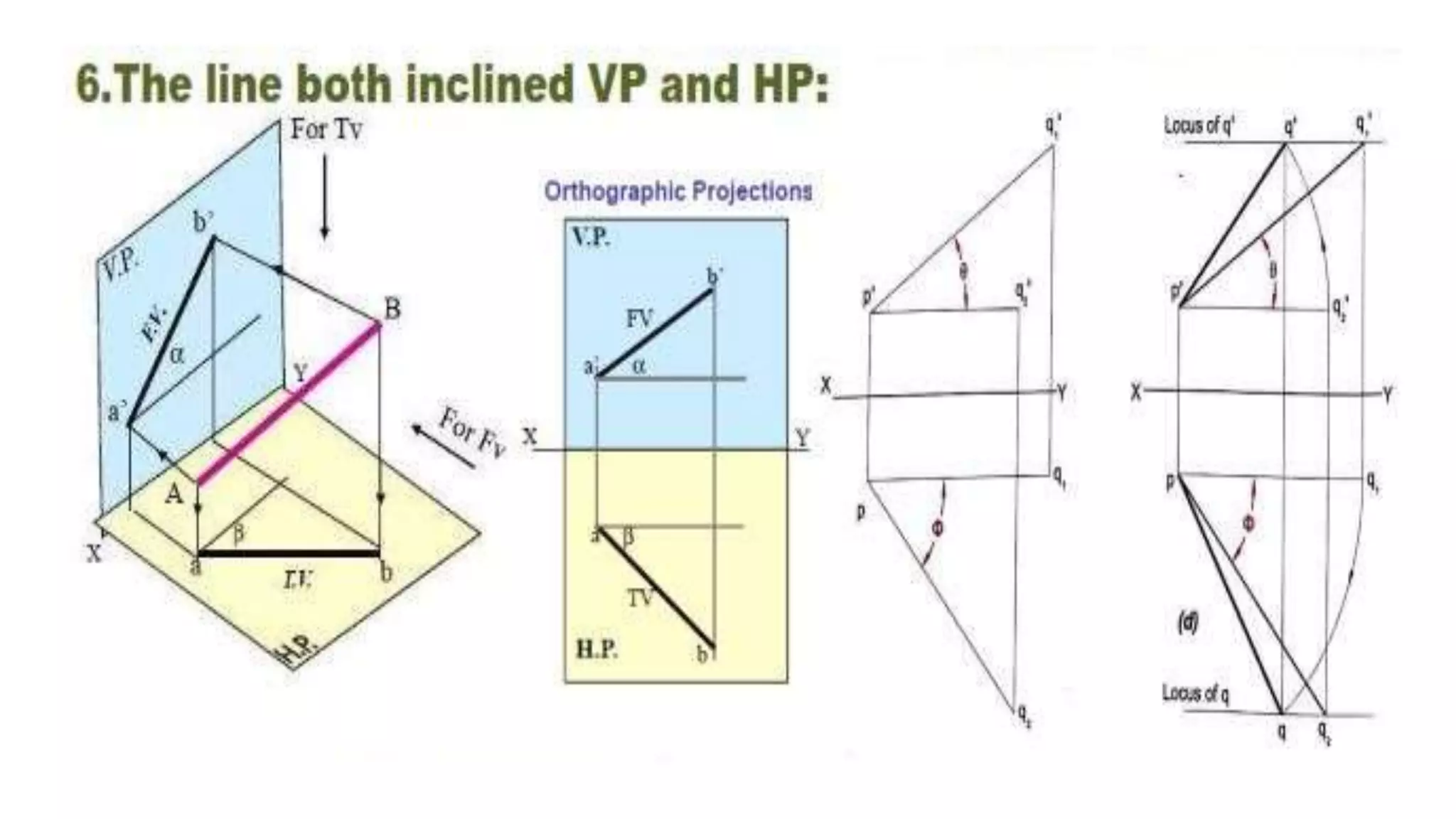
inclined to both VP and HP
HP
HP
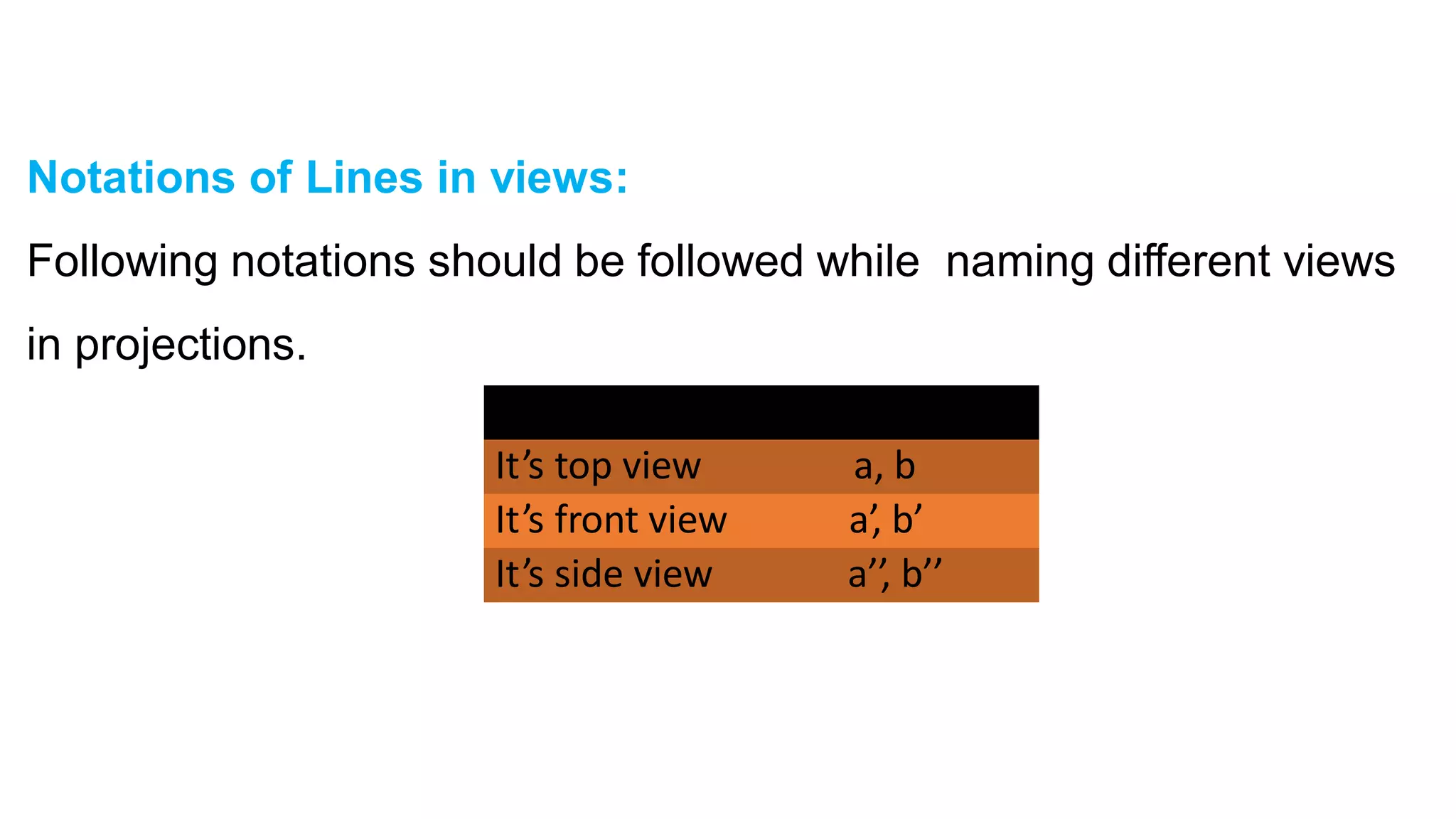
Notations of Lines in views:
Following notations should be followed while naming different views
in projections.
Object Line
It’s top view a, b
It’s front view a’, b’
It’s side view a’’, b’’
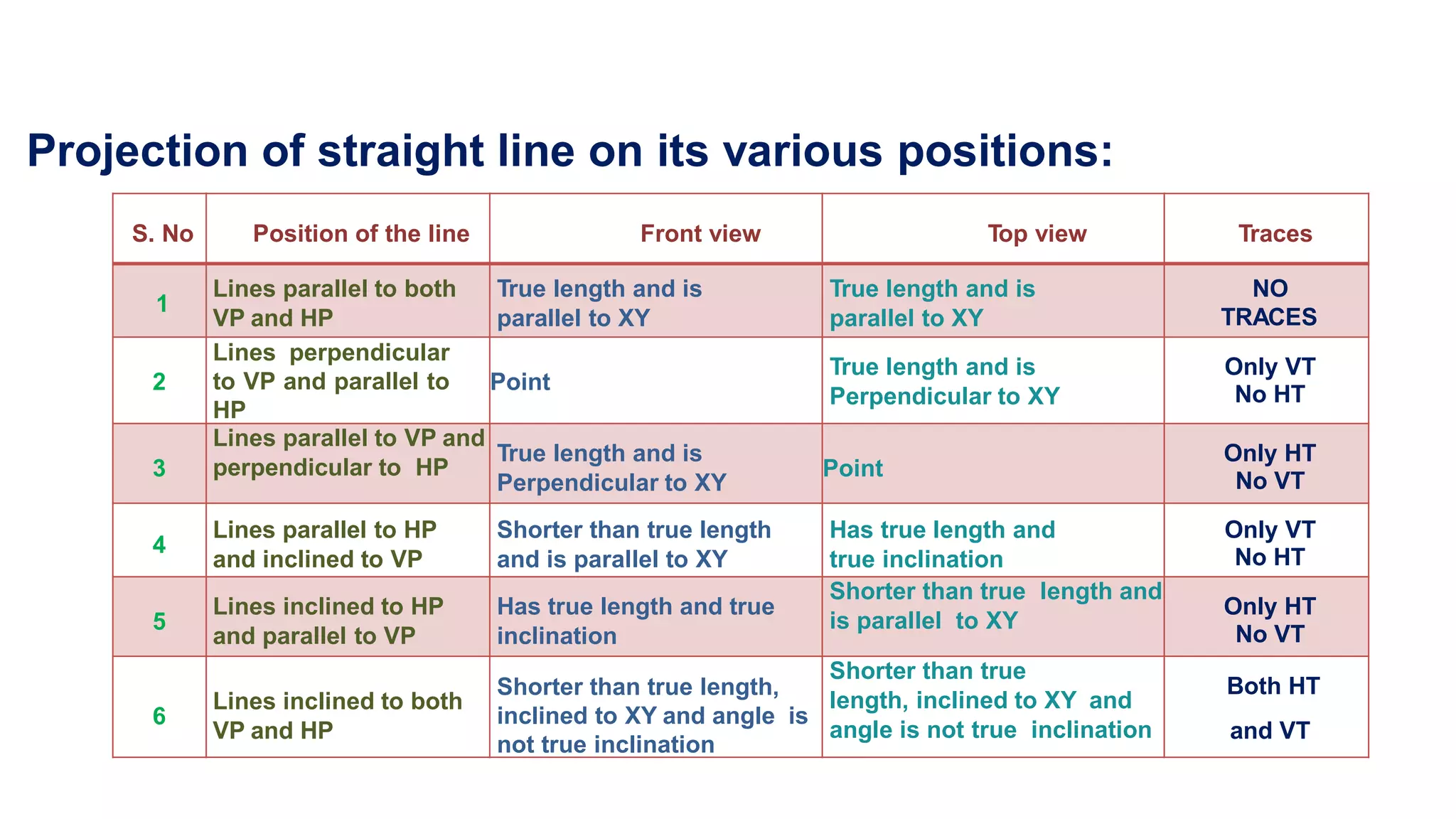
Projection of straight line on its various positions:
TRACES
No HT
No VT
No HT
No VT
S. No Position of the line Front view Top view Traces
1
Lines parallel to both
VP and HP
True length and is
parallel to XY
True length and is
parallel to XY
NO
2
Lines perpendicular
to VP and parallel to
HP
Point
True length and is
Perpendicular to XY
Only VT
3
Lines parallel to VP and
perpendicular to HP
True length and is
Perpendicular to XY
Point
Only HT
4
Lines parallel to HP
and inclined to VP
Shorter than true length
and is parallel to XY
Has true length and
true inclination
Only VT
5
Lines inclined to HP
and parallel to VP
Has true length and true
inclination
Shorter than true length and
is parallel to XY
Only HT
6
Lines inclined to both
VP and HP
Shorter than true length,
inclined to XY and angle is
not true inclination
Shorter than true
length, inclined to XY and
angle is not true inclination
Both HT
and VT
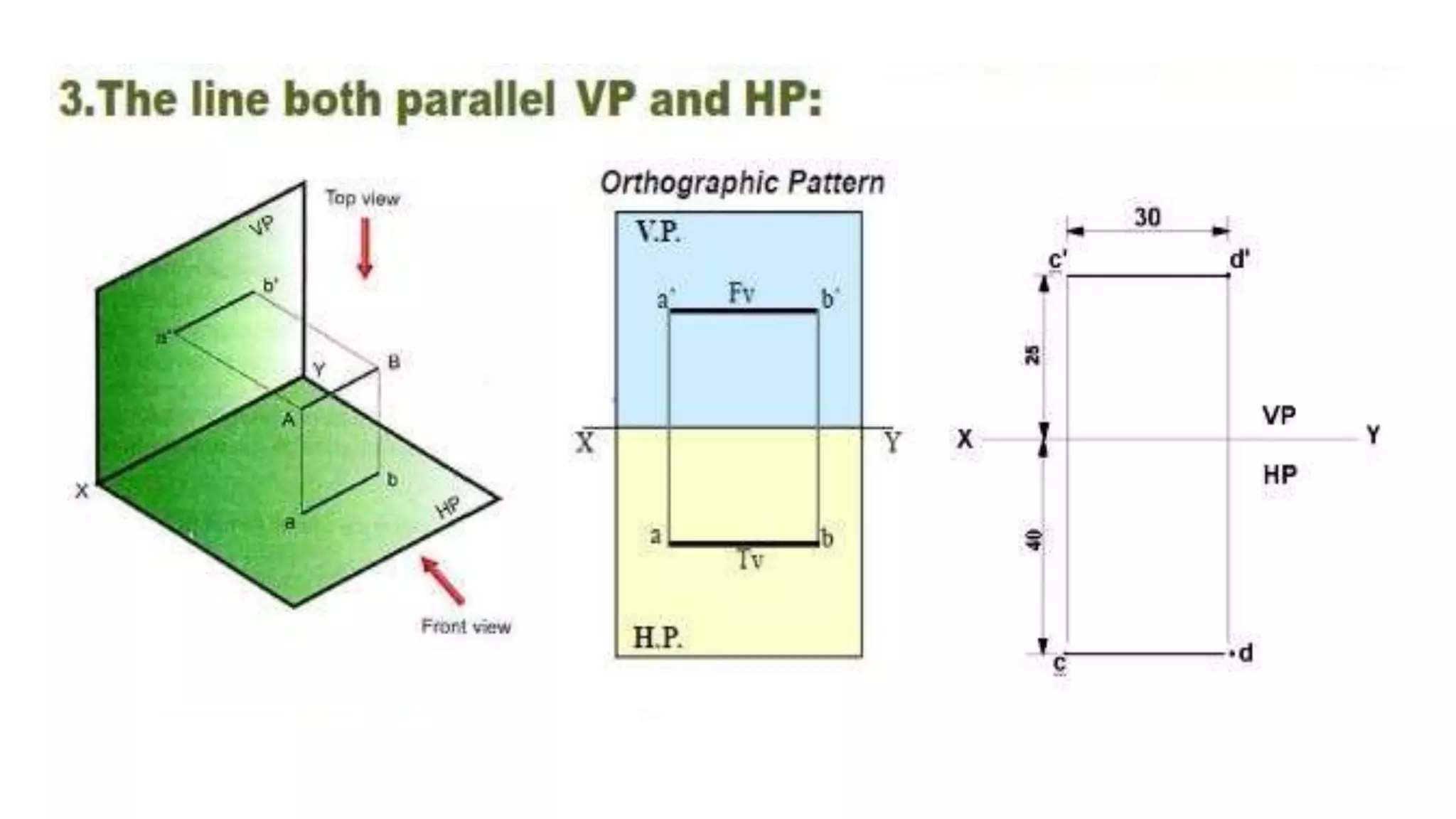
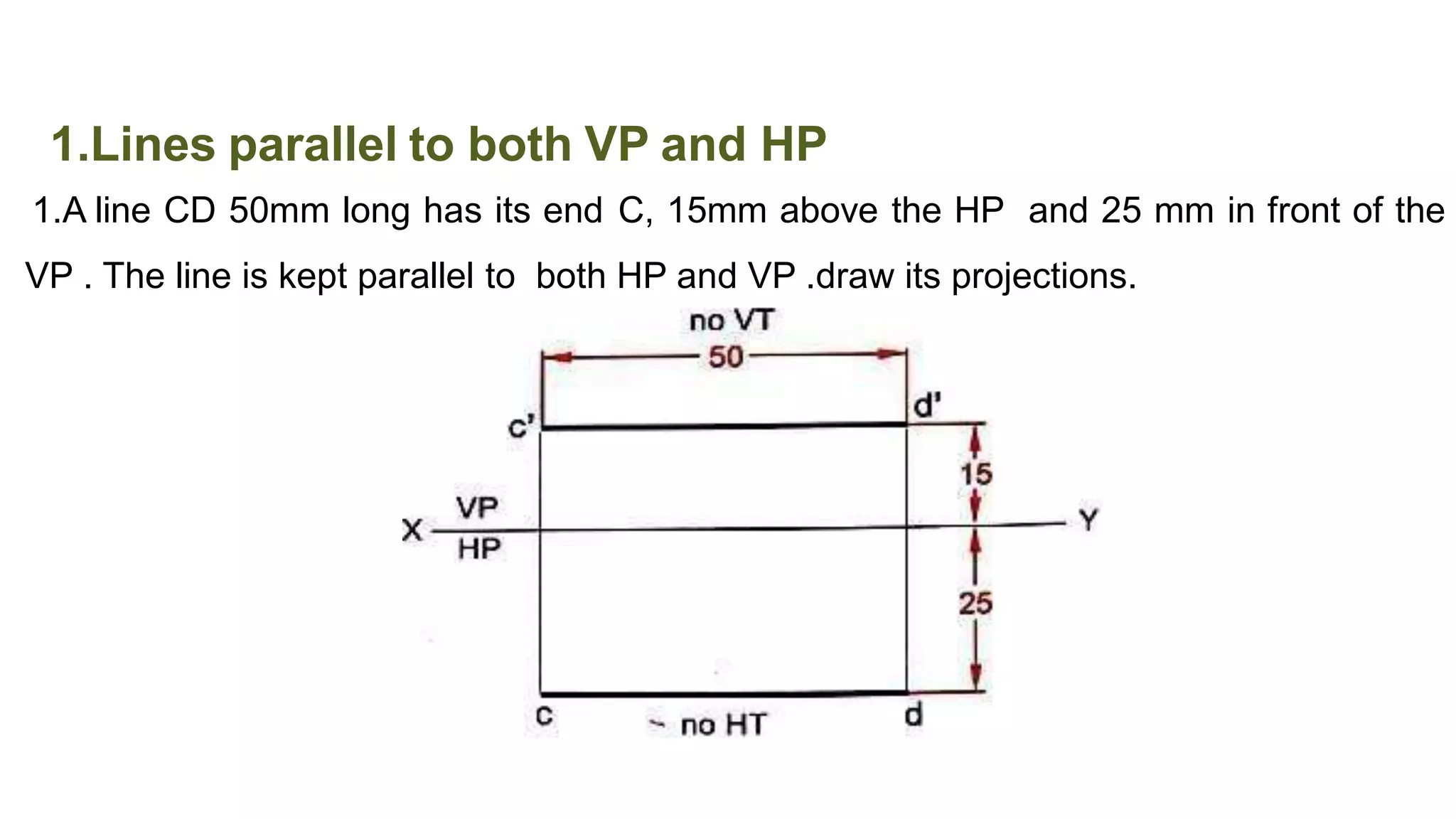
1.Lines parallel to both VP and HP
1.A line CD 50mm long has its end C, 15mm above the HP and 25 mm in front of the
VP . The line is kept parallel to both HP and VP .draw its projections.
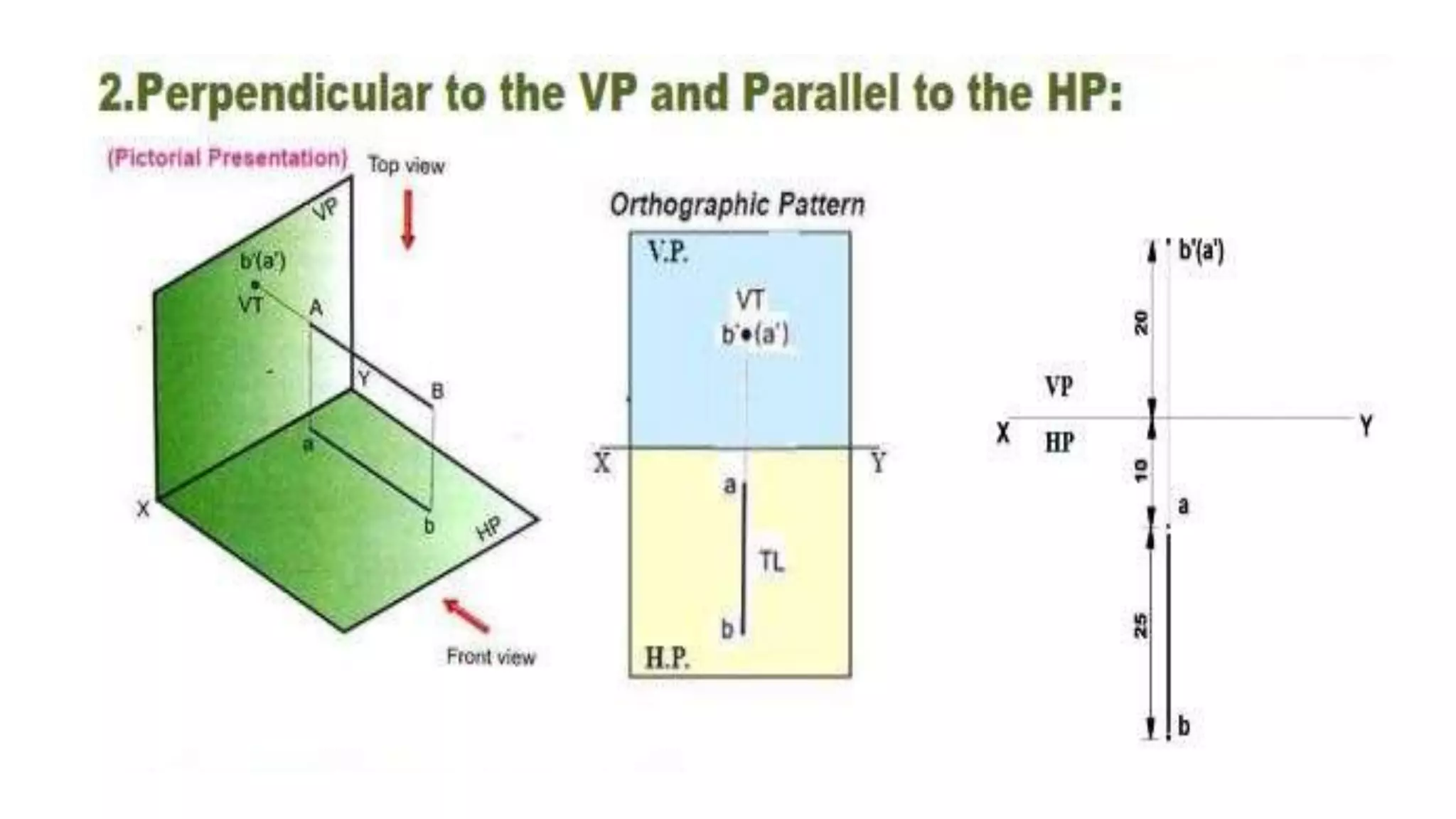
2. Lines perpendicular to one plane
and parallel to another plane
2. A line 55 mm long has its end E 15 mm above
the HP and 25 mm in front of the VP
. The line is
kept perpendicular to HP and parallel to VP
. Draw
its projections.
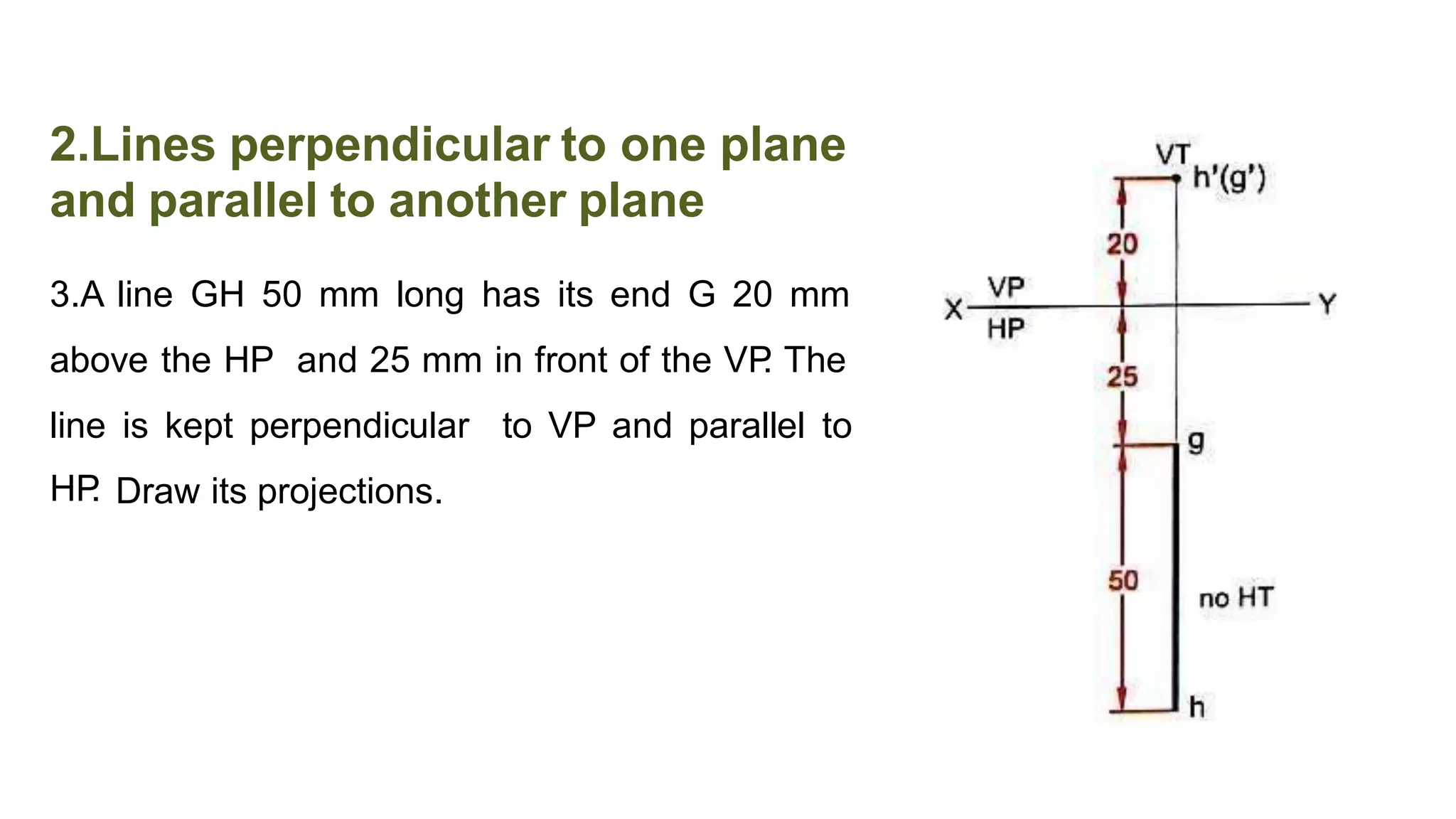
2.Lines perpendicular to one plane
and parallel to another plane
3.A line GH 50 mm long has its end G 20 mm
above the HP and 25 mm in front of the VP
. The
line
HP
.
is kept perpendicular to VP and parallel to
Draw its projections.
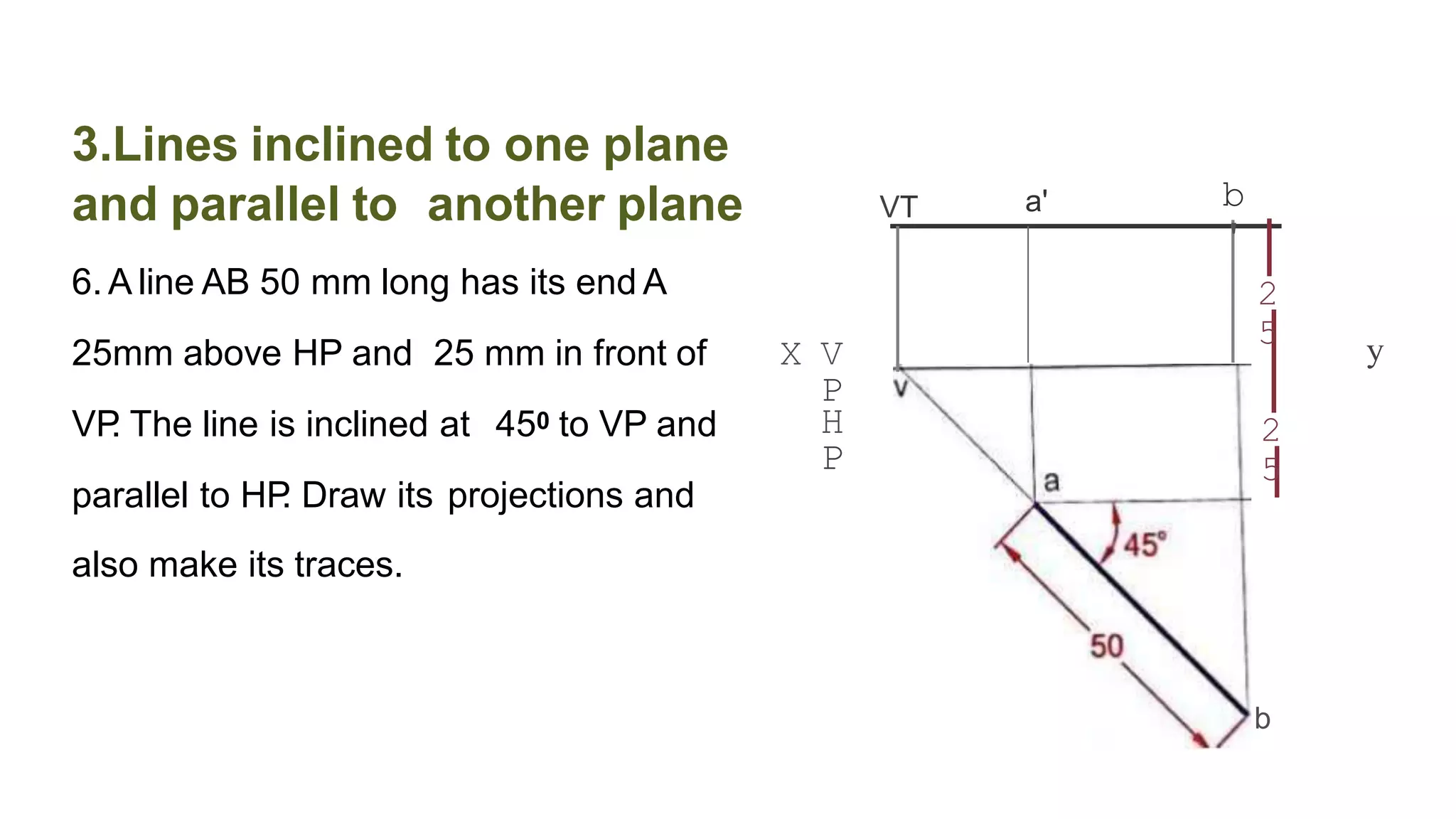
3.Lines inclined to one plane
b
'
and parallel to another plane a'
VT
6. A line AB 50 mm long has its end A 2
5 y
25mm above HP and 25 mm in front of X V
P
H
P
VP
. The line is inclined at 450 to VP and 2
5
parallel to HP
. Draw its
also make its traces.
projections and
b
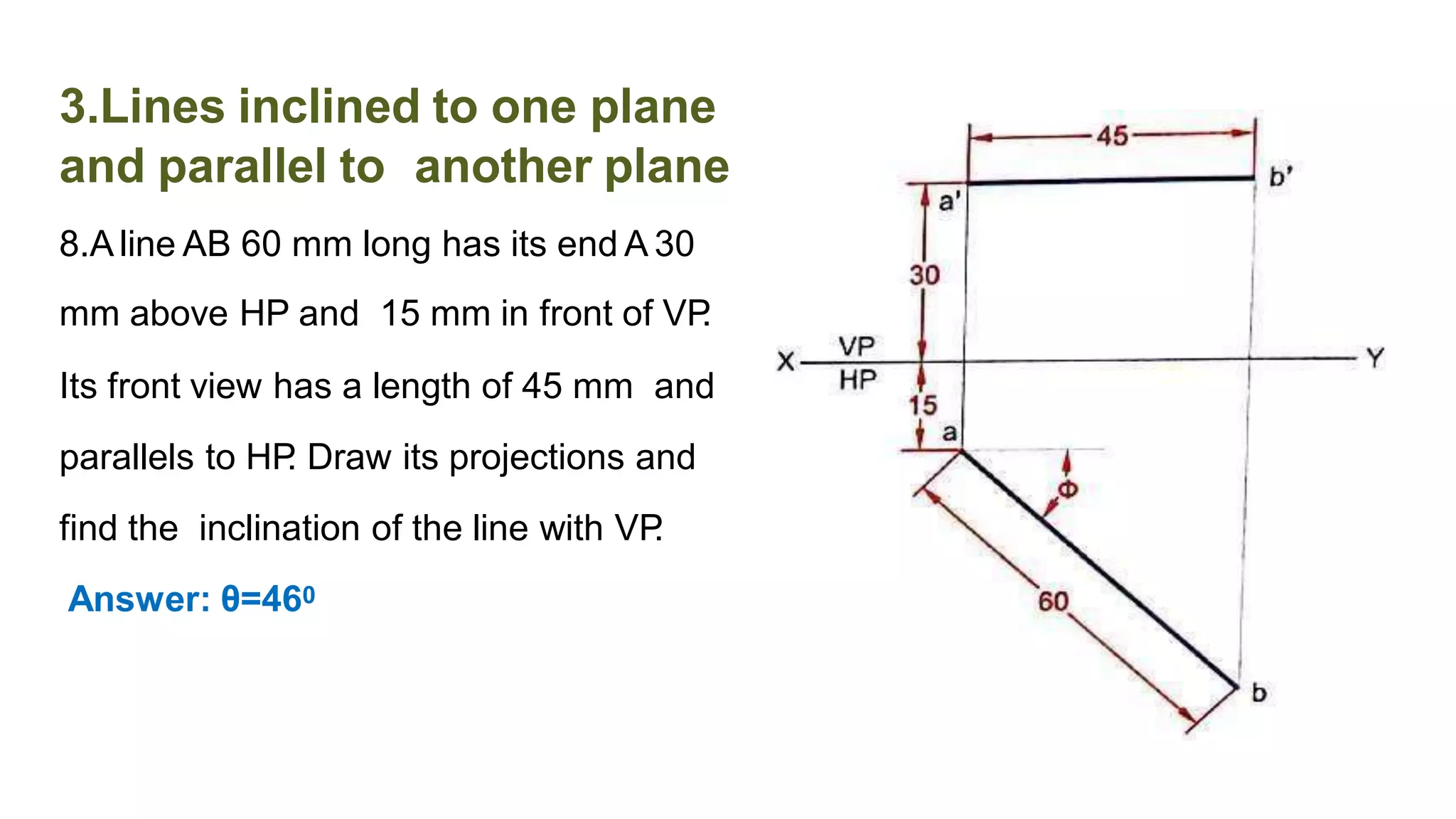
3.Lines inclined to one plane
and parallel to another plane
8.A line AB 60 mm long has its end A 30
mm above HP and 15 mm in front of VP
.
Its front view has a length of 45 mm and
parallels to HP
. Draw its projections and
find the inclination of the line with VP
.
Answer: θ=460
3.Lines inclined to one plane
and parallel to another plane
9. A line AB has its end A 30 mm above HP
and 20 mm in front of VP
. It is inclined at
250to the VP and parallels to HP
. Draw its
projections, if the distance between the
end projectors to be 55 mm. Find the true
length of the line also.
Answer : TL= 60mm.

Projection of Lines.pptx

  • 1.
    The shortest distancebetween any two points is called a "straight line". Different surfaces and planes form the configuration or shape of any object. Thus a straight line is the basic conceptual figure using which any object like a machine component or a structural element is represented. Thus projection of a straight line is the foundation of Engineering Drawing. We have studied the projections of given points, Joining the respective projections of two points therefore gives the projection of the straight line joining the two points PROJECTION OF LINES
  • 2.
    Objectives- Projection ofLines: • Define straight line. • Draw the projections of a straight line the VP and the HP . located at different positions with respect to • Position of line are arranged in planes.
  • 4.
    Orientation of Linein Space: The position of straight line in space can be described following: 1.Lines 2.Lines 3.Lines 4.Lines 5.Lines 6.Lines parallel to VP and perpendicular to perpendicular to VP and parallel to parallel to both VP and HP parallel to VP and inclined to HP inclined to VP and parallel to HP inclined to both VP and HP HP HP
  • 5.
    Notations of Linesin views: Following notations should be followed while naming different views in projections. Object Line It’s top view a, b It’s front view a’, b’ It’s side view a’’, b’’
  • 6.
    Projection of straightline on its various positions: TRACES No HT No VT No HT No VT S. No Position of the line Front view Top view Traces 1 Lines parallel to both VP and HP True length and is parallel to XY True length and is parallel to XY NO 2 Lines perpendicular to VP and parallel to HP Point True length and is Perpendicular to XY Only VT 3 Lines parallel to VP and perpendicular to HP True length and is Perpendicular to XY Point Only HT 4 Lines parallel to HP and inclined to VP Shorter than true length and is parallel to XY Has true length and true inclination Only VT 5 Lines inclined to HP and parallel to VP Has true length and true inclination Shorter than true length and is parallel to XY Only HT 6 Lines inclined to both VP and HP Shorter than true length, inclined to XY and angle is not true inclination Shorter than true length, inclined to XY and angle is not true inclination Both HT and VT
  • 13.
    1.Lines parallel toboth VP and HP 1.A line CD 50mm long has its end C, 15mm above the HP and 25 mm in front of the VP . The line is kept parallel to both HP and VP .draw its projections.
  • 14.
    2. Lines perpendicularto one plane and parallel to another plane 2. A line 55 mm long has its end E 15 mm above the HP and 25 mm in front of the VP . The line is kept perpendicular to HP and parallel to VP . Draw its projections.
  • 15.
    2.Lines perpendicular toone plane and parallel to another plane 3.A line GH 50 mm long has its end G 20 mm above the HP and 25 mm in front of the VP . The line HP . is kept perpendicular to VP and parallel to Draw its projections.
  • 18.
    3.Lines inclined toone plane b ' and parallel to another plane a' VT 6. A line AB 50 mm long has its end A 2 5 y 25mm above HP and 25 mm in front of X V P H P VP . The line is inclined at 450 to VP and 2 5 parallel to HP . Draw its also make its traces. projections and b
  • 20.
    3.Lines inclined toone plane and parallel to another plane 8.A line AB 60 mm long has its end A 30 mm above HP and 15 mm in front of VP . Its front view has a length of 45 mm and parallels to HP . Draw its projections and find the inclination of the line with VP . Answer: θ=460
  • 21.
    3.Lines inclined toone plane and parallel to another plane 9. A line AB has its end A 30 mm above HP and 20 mm in front of VP . It is inclined at 250to the VP and parallels to HP . Draw its projections, if the distance between the end projectors to be 55 mm. Find the true length of the line also. Answer : TL= 60mm.