International Journal of Advance Research In Science And Engineering http://www.ijarse.com
IJARSE, Vol. No.3, Special Issue (01), September 2014 ISSN-2319-8354(E)
281 | P a g e
AN IMPROVED WATERSHED AND MRI
IMAGE SEGMENTATION
SNIGDHA RAI
Department of Electronics and communication, K.E.C, Mohan Nagar (INDIA)
ABSTRACT
Watershed Transformation in mathematical morphology is a powerful tool for image segmentation. Watershed
transformation based segmentation is generally marker controlled segmentation. In the last decade medical
image processing is immerged as one of the major area of research .In medical science, Magnetic Resonance
Imaging(MRI) is a very popular technique used in details.MRI provides good contrast between the different soft
tissues of the body, which makes it especially useful in imaging the different internal organs like brain ,heart,
kidney etc. this paper presents a robust procedure for segmentation and edge detection of MRI images based on
marker controlled watershed algorithm.
KEYWORDS: Image Segmentation, MR Image, Watershed Transform, Image Enhancement,
Marker Controlled Watershed Segmentation, Prewitt's Operator.
I. INTRODUCTION
Image segmentation is an important and, perhaps, the most difficult task in image processing . Segmentation
refers to the grouping of image elements that exhibit ''similar'' characteristics ,i.e. subdividing an image into its
constituent regions or objects. For image unperceiving, analysis and pattern identification, image segmentation
plays a very significant role. The most important role of the segmentation process is to segregate an image into
regions with one or more characteristics like color and object and the segmentation results are mainly for better
analyzing and meaningful understanding images. Several methods and approaches are introduced into area of
segmentation among them a well known method is watershed algorithm or technique. The Watershed transform
is a broadly used technique for image segmentation. The watershed transform can be classified as a region-based
segmentation approach. The intuitive idea underlying this method comes from geography: it is that of a
landscape or topographic relief which is flooded by water, watersheds being the divide lines of the domains of
attraction of rain falling over the region. An alternative approach is to imagine the landscape being immersed in
a lake, with holes pierced in local minima. Basins also called catchment basins will fill up with water starting at
these local minima ,and, at points where water coming from different basins would meet, dams are built.
Medical image segmentation is a very important field for the medical science. Medical images edge detection is
an important work for object recognition of the human organs such as brain, heart, kidney etc. Medical images
such as CT, MRI or X-RAY visualizes the various information's of internal organs which is very important for
doctors diagnoses as well as medical teaching, learning and research. It is a tough job to locate the internal organ
as these pictures contains noise or rough structure of human body organs. Image processing and segmentation
technique plays a vital role for detecting edges of internal body organs for medical sciences and now a days
International Journal of Advance Research In Science And Engineering http://www.ijarse.com
IJARSE, Vol. No.3, Special Issue (01), September 2014 ISSN-2319-8354(E)
282 | P a g e
MRI (magnetic resonance imaging) images are very effective for the doctor's diagnoses. For a better
understanding the following sections will give a better explanation with results, discussions and conclusion.
II. BACKGROUND AND PRELIMINARY
The idea that has been introduced in 1979 by S. Beucher and C.Lantuejoul.It consists in placing a water source
in each regional minimum, to flood the relief from sources, and build barriers when different sources are
meeting. The resulting set of barriers constitutes a watershed by flooding .By taking this concept several works
has been done in various research fields .The main idea behind this in technique is to segmentation of images.
We have tried to use this concept in a new dimension by detecting the human with MRI images. As an example
we have chosen MRI images of human brains. Edge detection of human organs with MRI images is a major
concerning problem in respect of the vision of the computer.
III. THE WATERSHED TRANSFORM
The watershed transform is a morphological based tool for image segmentation. The watershed transform can be
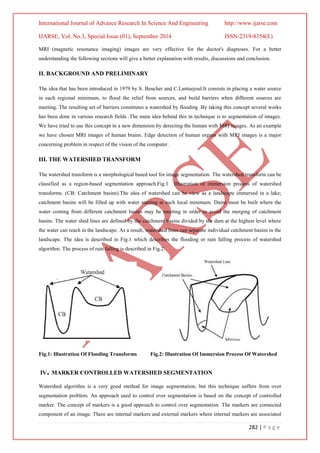
classified as a region-based segmentation approach.Fig.1 Illustration of immersion process of watershed
transforms. (CB: Catchment basins).The idea of watershed can be view as a landscape immersed in a lake;
catchment basins will be filled up with water starting at each local minimum. Dams must be built where the
water coming from different catchment basins may be meeting in order to avoid the merging of catchment
basins. The water shed lines are defined by the catchment basins divided by the dam at the highest level where
the water can reach in the landscape. As a result, watershed lines can separate individual catchment basins in the
landscape. The idea is described in Fig.1 which describes the flooding or rain falling process of watershed
algorithm. The process of rain falling is described in Fig.2.
Fig.1: Illustration Of Flooding Transforms Fig.2: Illustration Of Immersion Process Of Watershed
IV. MARKER CONTROLLED WATERSHED SEGMENTATION
Watershed algorithm is a very good method for image segmentation, but this technique suffers from over
segmentation problem. An approach used to control over segmentation is based on the concept of controlled
marker. The concept of markers is a good approach to control over segmentation. The markers are connected
component of an image. There are internal markers and external markers where internal markers are associated
International Journal of Advance Research In Science And Engineering http://www.ijarse.com
IJARSE, Vol. No.3, Special Issue (01), September 2014 ISSN-2319-8354(E)
283 | P a g e
with object of interest and external markers are associated with the background .This is a very useful technique
for improvisation of watershed transform to overcome the over segmentation problem.
Marker -controlled watershed segmentation follows this basic procedure:
IV.1 : Compute a segmentation function. This is an image whose dark regions are the objects you are trying to
object.
IV.2 : Compute foreground markers. These are connected blobs of pixels within each of the objects.
IV.3 : Compute background markers. These are pixels that are not part of any object.
IV.4 : Modify the segmentation function so that it only has minima at the foreground and background marker
locations.
IV.5 : Compute the watershed transform of the modified segmentation function.
V. PROPOSED TECHNIQUE
The marker controlled watershed transform is mainly for the problems where adjacent objects are there in an
image and we have to separate them using image processing operations. This approach deals with catchment
basins and watershed ridge lines in an image by assuming it as a surface where light pixels are low. In the initial
International Journal of Advance Research In Science And Engineering http://www.ijarse.com
IJARSE, Vol. No.3, Special Issue (01), September 2014 ISSN-2319-8354(E)
284 | P a g e
step we have to convert a 3D color image into gray scale and compute the gradient magnitude as the
segmentation function where gradient is highest at the borders of the object and generally low inside the object.
We will then use the internal marker to distinguish the foreground of adjacent objects. The background of image
will then be segregated from the foreground objects using the external markers. Finally we will aggregate the
computed result of the watershed transform and examine the final image .The detailed algorithm is the
following:
STEP 1: Insert the original image as input.
STEP 2: Convert the image into gray scale.
STEP 3: Find out the gradient magnitude.
STEP 4: Mark the foreground objects.
STEP 5: Mark the background objects.
STEP 6: Estimate the watershed transform.
VI. RESULTS AND DISCUSSIONS
The designed algorithm has been tested on MRI brain images. Results indicate that the segmentation is very
clear for the images where the region of interest where the region of interest is enhanced. An image
segmentation approach based on Marker Controlled Watershed Transform has been discussed .This approach
for segmentation of medical images can help in the proper detection of the region of interest and also can be
very helpful for doctor's diagnoses, medical teaching, learning and research .We have tried to proposed a robust
approach for 3D medical image segmentation with human brain images by using marker-based watershed
segmentation. With this approach we can reduce user interaction and speeds up the entire segmentation process.
In this paper this approach has been applied successfully on medical images where we have chosen MRI brain
images. Furthermore the algorithm should be improved for more demanding tasks as brain, heart, liver or kidney
segmentation with the CT image data in 3D nature.
International Journal of Advance Research In Science And Engineering http://www.ijarse.com
IJARSE, Vol. No.3, Special Issue (01), September 2014 ISSN-2319-8354(E)
285 | P a g e
Fig. Illustrations Using Marker Foreground and Background Methods
REFERENCES
[1] Serra, J., Image analysis and mathematical morphology, Academic Press, New York, 1982.
[2] S.Beucher, F.Meyer,"The Morphological Approach to segmentation: The Watershed transform", in
Mathematical Morphology Image Processing, E.R. Dougherty, Ed. New York Marcel Dekker, vol.12,
pp.433-481, 1993.
[3] Beucher, S. "The Watershed Transform Applied to Image Segmentation", Proceedings of the pfefferkorn
Conference on Signal and Image Processing in Microscopy and Microanalysis, pp. 299-314, September
1991.
[4] Rafael C. Gonzalez, Richard E. Woods, "Digital Image processing:, 2nd edition, Pearson Education, pp.
589-656, 2007.
[5] Malik Khan, "Modified Watershed Algorithm for Segmentation of 2D Images", Journal of Information
Science & Information Technology, 6, No.3, pp.546-552,2009.
[6] S. Beucher,Watershed, hierarchial segmentation and water fall algorithm"' in Mathematical Morphology
and its Application to Image Processing, Dordecht, The Netherlands: Kluwer, pp.69-76,1994.
[7] R.M. Haralick and L.G. Shapiro,"Survey: Image Segmentation Technique", Comput. vis. Graph. Im.
Proc,29 (1985) 100-132.
[8] Rivest, J., Beucher, S., delhomme. J, "Marker-controlled segmentation: an application to electrical borehole
imaging", Journal of Electronic Imaging, April pp.136-142,1992.
[9] MRI image segmentation by Dibyendu Goshal and Pinaki Pratim Acharjya, journal of Emerging
Technology and advanced engineering.
[10] An improved watershed image segmentation by Anju Bala , Journal of Scientific and Engineering Research

1412194747_414ijarse

  • 1.
    International Journal ofAdvance Research In Science And Engineering http://www.ijarse.com IJARSE, Vol. No.3, Special Issue (01), September 2014 ISSN-2319-8354(E) 281 | P a g e AN IMPROVED WATERSHED AND MRI IMAGE SEGMENTATION SNIGDHA RAI Department of Electronics and communication, K.E.C, Mohan Nagar (INDIA) ABSTRACT Watershed Transformation in mathematical morphology is a powerful tool for image segmentation. Watershed transformation based segmentation is generally marker controlled segmentation. In the last decade medical image processing is immerged as one of the major area of research .In medical science, Magnetic Resonance Imaging(MRI) is a very popular technique used in details.MRI provides good contrast between the different soft tissues of the body, which makes it especially useful in imaging the different internal organs like brain ,heart, kidney etc. this paper presents a robust procedure for segmentation and edge detection of MRI images based on marker controlled watershed algorithm. KEYWORDS: Image Segmentation, MR Image, Watershed Transform, Image Enhancement, Marker Controlled Watershed Segmentation, Prewitt's Operator. I. INTRODUCTION Image segmentation is an important and, perhaps, the most difficult task in image processing . Segmentation refers to the grouping of image elements that exhibit ''similar'' characteristics ,i.e. subdividing an image into its constituent regions or objects. For image unperceiving, analysis and pattern identification, image segmentation plays a very significant role. The most important role of the segmentation process is to segregate an image into regions with one or more characteristics like color and object and the segmentation results are mainly for better analyzing and meaningful understanding images. Several methods and approaches are introduced into area of segmentation among them a well known method is watershed algorithm or technique. The Watershed transform is a broadly used technique for image segmentation. The watershed transform can be classified as a region-based segmentation approach. The intuitive idea underlying this method comes from geography: it is that of a landscape or topographic relief which is flooded by water, watersheds being the divide lines of the domains of attraction of rain falling over the region. An alternative approach is to imagine the landscape being immersed in a lake, with holes pierced in local minima. Basins also called catchment basins will fill up with water starting at these local minima ,and, at points where water coming from different basins would meet, dams are built. Medical image segmentation is a very important field for the medical science. Medical images edge detection is an important work for object recognition of the human organs such as brain, heart, kidney etc. Medical images such as CT, MRI or X-RAY visualizes the various information's of internal organs which is very important for doctors diagnoses as well as medical teaching, learning and research. It is a tough job to locate the internal organ as these pictures contains noise or rough structure of human body organs. Image processing and segmentation technique plays a vital role for detecting edges of internal body organs for medical sciences and now a days
  • 2.
    International Journal ofAdvance Research In Science And Engineering http://www.ijarse.com IJARSE, Vol. No.3, Special Issue (01), September 2014 ISSN-2319-8354(E) 282 | P a g e MRI (magnetic resonance imaging) images are very effective for the doctor's diagnoses. For a better understanding the following sections will give a better explanation with results, discussions and conclusion. II. BACKGROUND AND PRELIMINARY The idea that has been introduced in 1979 by S. Beucher and C.Lantuejoul.It consists in placing a water source in each regional minimum, to flood the relief from sources, and build barriers when different sources are meeting. The resulting set of barriers constitutes a watershed by flooding .By taking this concept several works has been done in various research fields .The main idea behind this in technique is to segmentation of images. We have tried to use this concept in a new dimension by detecting the human with MRI images. As an example we have chosen MRI images of human brains. Edge detection of human organs with MRI images is a major concerning problem in respect of the vision of the computer. III. THE WATERSHED TRANSFORM The watershed transform is a morphological based tool for image segmentation. The watershed transform can be classified as a region-based segmentation approach.Fig.1 Illustration of immersion process of watershed transforms. (CB: Catchment basins).The idea of watershed can be view as a landscape immersed in a lake; catchment basins will be filled up with water starting at each local minimum. Dams must be built where the water coming from different catchment basins may be meeting in order to avoid the merging of catchment basins. The water shed lines are defined by the catchment basins divided by the dam at the highest level where the water can reach in the landscape. As a result, watershed lines can separate individual catchment basins in the landscape. The idea is described in Fig.1 which describes the flooding or rain falling process of watershed algorithm. The process of rain falling is described in Fig.2. Fig.1: Illustration Of Flooding Transforms Fig.2: Illustration Of Immersion Process Of Watershed IV. MARKER CONTROLLED WATERSHED SEGMENTATION Watershed algorithm is a very good method for image segmentation, but this technique suffers from over segmentation problem. An approach used to control over segmentation is based on the concept of controlled marker. The concept of markers is a good approach to control over segmentation. The markers are connected component of an image. There are internal markers and external markers where internal markers are associated
  • 3.
    International Journal ofAdvance Research In Science And Engineering http://www.ijarse.com IJARSE, Vol. No.3, Special Issue (01), September 2014 ISSN-2319-8354(E) 283 | P a g e with object of interest and external markers are associated with the background .This is a very useful technique for improvisation of watershed transform to overcome the over segmentation problem. Marker -controlled watershed segmentation follows this basic procedure: IV.1 : Compute a segmentation function. This is an image whose dark regions are the objects you are trying to object. IV.2 : Compute foreground markers. These are connected blobs of pixels within each of the objects. IV.3 : Compute background markers. These are pixels that are not part of any object. IV.4 : Modify the segmentation function so that it only has minima at the foreground and background marker locations. IV.5 : Compute the watershed transform of the modified segmentation function. V. PROPOSED TECHNIQUE The marker controlled watershed transform is mainly for the problems where adjacent objects are there in an image and we have to separate them using image processing operations. This approach deals with catchment basins and watershed ridge lines in an image by assuming it as a surface where light pixels are low. In the initial
  • 4.
    International Journal ofAdvance Research In Science And Engineering http://www.ijarse.com IJARSE, Vol. No.3, Special Issue (01), September 2014 ISSN-2319-8354(E) 284 | P a g e step we have to convert a 3D color image into gray scale and compute the gradient magnitude as the segmentation function where gradient is highest at the borders of the object and generally low inside the object. We will then use the internal marker to distinguish the foreground of adjacent objects. The background of image will then be segregated from the foreground objects using the external markers. Finally we will aggregate the computed result of the watershed transform and examine the final image .The detailed algorithm is the following: STEP 1: Insert the original image as input. STEP 2: Convert the image into gray scale. STEP 3: Find out the gradient magnitude. STEP 4: Mark the foreground objects. STEP 5: Mark the background objects. STEP 6: Estimate the watershed transform. VI. RESULTS AND DISCUSSIONS The designed algorithm has been tested on MRI brain images. Results indicate that the segmentation is very clear for the images where the region of interest where the region of interest is enhanced. An image segmentation approach based on Marker Controlled Watershed Transform has been discussed .This approach for segmentation of medical images can help in the proper detection of the region of interest and also can be very helpful for doctor's diagnoses, medical teaching, learning and research .We have tried to proposed a robust approach for 3D medical image segmentation with human brain images by using marker-based watershed segmentation. With this approach we can reduce user interaction and speeds up the entire segmentation process. In this paper this approach has been applied successfully on medical images where we have chosen MRI brain images. Furthermore the algorithm should be improved for more demanding tasks as brain, heart, liver or kidney segmentation with the CT image data in 3D nature.
  • 5.
    International Journal ofAdvance Research In Science And Engineering http://www.ijarse.com IJARSE, Vol. No.3, Special Issue (01), September 2014 ISSN-2319-8354(E) 285 | P a g e Fig. Illustrations Using Marker Foreground and Background Methods REFERENCES [1] Serra, J., Image analysis and mathematical morphology, Academic Press, New York, 1982. [2] S.Beucher, F.Meyer,"The Morphological Approach to segmentation: The Watershed transform", in Mathematical Morphology Image Processing, E.R. Dougherty, Ed. New York Marcel Dekker, vol.12, pp.433-481, 1993. [3] Beucher, S. "The Watershed Transform Applied to Image Segmentation", Proceedings of the pfefferkorn Conference on Signal and Image Processing in Microscopy and Microanalysis, pp. 299-314, September 1991. [4] Rafael C. Gonzalez, Richard E. Woods, "Digital Image processing:, 2nd edition, Pearson Education, pp. 589-656, 2007. [5] Malik Khan, "Modified Watershed Algorithm for Segmentation of 2D Images", Journal of Information Science & Information Technology, 6, No.3, pp.546-552,2009. [6] S. Beucher,Watershed, hierarchial segmentation and water fall algorithm"' in Mathematical Morphology and its Application to Image Processing, Dordecht, The Netherlands: Kluwer, pp.69-76,1994. [7] R.M. Haralick and L.G. Shapiro,"Survey: Image Segmentation Technique", Comput. vis. Graph. Im. Proc,29 (1985) 100-132. [8] Rivest, J., Beucher, S., delhomme. J, "Marker-controlled segmentation: an application to electrical borehole imaging", Journal of Electronic Imaging, April pp.136-142,1992. [9] MRI image segmentation by Dibyendu Goshal and Pinaki Pratim Acharjya, journal of Emerging Technology and advanced engineering. [10] An improved watershed image segmentation by Anju Bala , Journal of Scientific and Engineering Research