Image Segmentation
1
2
Image Segmentation
 Group similar components (such as, pixels in an
image, image frames in a video) to obtain a compact
representation.
 Applications: Finding tumors, veins, etc. in medical
images, finding targets in satellite/aerial images,
finding people in surveillance images, summarizing
video, etc.
 Methods: Thresholding, K-means clustering, etc.
3
Image Segmentation
 Segmentation algorithms for monochrome images
generally are based on one of two basic properties of gray-
scale values:
 Discontinuity
 The approach is to partition an image based on abrupt changes
in gray-scale levels.
 The principal areas of interest within this category are detection
of isolated points, lines, and edges in an image.
 Similarity
 The principal approaches in this category are based on
thresholding, region growing, and region splitting/merging.
4
Thresholding
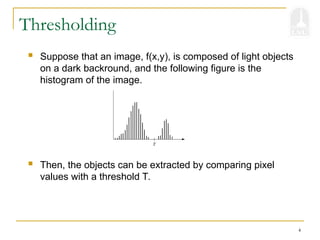
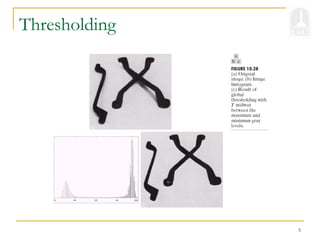
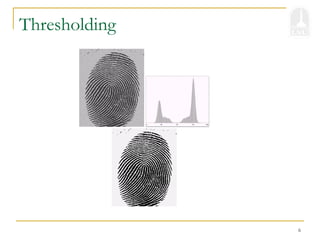
 Suppose that an image, f(x,y), is composed of light objects
on a dark backround, and the following figure is the
histogram of the image.
 Then, the objects can be extracted by comparing pixel
values with a threshold T.
5
Thresholding
6
Thresholding
7
Thresholding
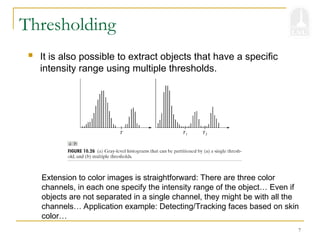
 It is also possible to extract objects that have a specific
intensity range using multiple thresholds.
Extension to color images is straightforward: There are three color
channels, in each one specify the intensity range of the object… Even if
objects are not separated in a single channel, they might be with all the
channels… Application example: Detecting/Tracking faces based on skin
color…
8
Thresholding
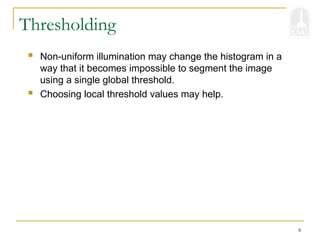
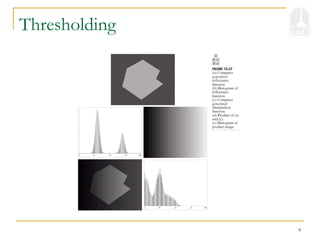
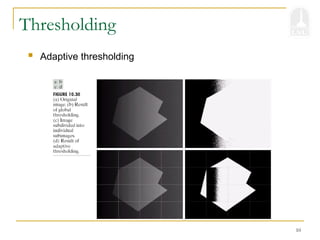
 Non-uniform illumination may change the histogram in a
way that it becomes impossible to segment the image
using a single global threshold.
 Choosing local threshold values may help.
9
Thresholding
10
Thresholding
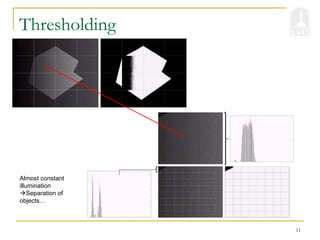
 Adaptive thresholding
11
Thresholding
Almost constant
illumination
Separation of
objects…
12
Region-Oriented Segmentation
 Region Growing
 Region growing is a procedure that groups pixels or
subregions into larger regions.
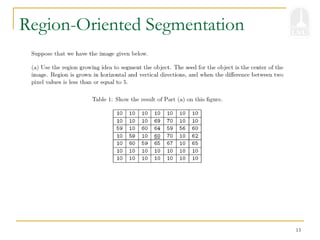
 The simplest of these approaches is pixel aggregation, which
starts with a set of “seed” points and from these grows
regions by appending to each seed points those neighboring
pixels that have similar properties (such as gray level,
texture, color, shape).
 Region growing based techniques are better than the edge-
based techniques in noisy images where edges are difficult to
detect.
13
Region-Oriented Segmentation
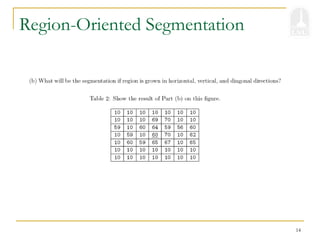
14
Region-Oriented Segmentation
15
Region-Oriented Segmentation
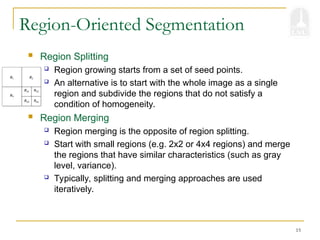
 Region Splitting
 Region growing starts from a set of seed points.
 An alternative is to start with the whole image as a single
region and subdivide the regions that do not satisfy a
condition of homogeneity.
 Region Merging
 Region merging is the opposite of region splitting.
 Start with small regions (e.g. 2x2 or 4x4 regions) and merge
the regions that have similar characteristics (such as gray
level, variance).
 Typically, splitting and merging approaches are used
iteratively.
16
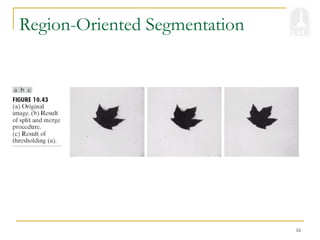
Region-Oriented Segmentation
17
Watershed Segmentation Algorithm
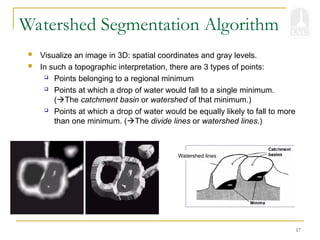
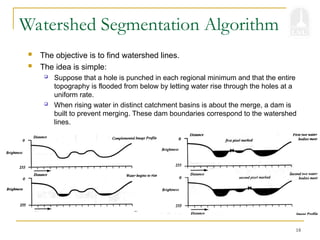
 Visualize an image in 3D: spatial coordinates and gray levels.
 In such a topographic interpretation, there are 3 types of points:
 Points belonging to a regional minimum
 Points at which a drop of water would fall to a single minimum.
(The catchment basin or watershed of that minimum.)
 Points at which a drop of water would be equally likely to fall to more
than one minimum. (The divide lines or watershed lines.)
Watershed lines
18
Watershed Segmentation Algorithm
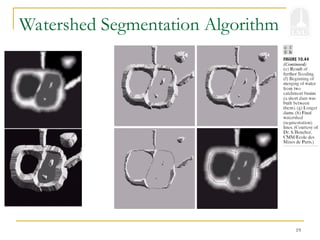
 The objective is to find watershed lines.
 The idea is simple:
 Suppose that a hole is punched in each regional minimum and that the entire
topography is flooded from below by letting water rise through the holes at a
uniform rate.
 When rising water in distinct catchment basins is about the merge, a dam is
built to prevent merging. These dam boundaries correspond to the watershed
lines.
19
Watershed Segmentation Algorithm
20
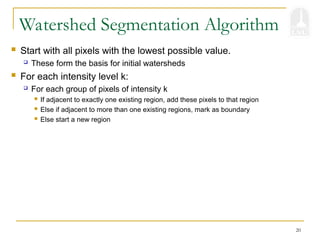
 Start with all pixels with the lowest possible value.
 These form the basis for initial watersheds
 For each intensity level k:
 For each group of pixels of intensity k
 If adjacent to exactly one existing region, add these pixels to that region
 Else if adjacent to more than one existing regions, mark as boundary
 Else start a new region
Watershed Segmentation Algorithm
21
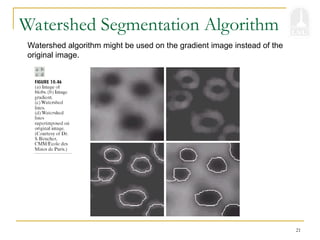
Watershed Segmentation Algorithm
Watershed algorithm might be used on the gradient image instead of the
original image.
22
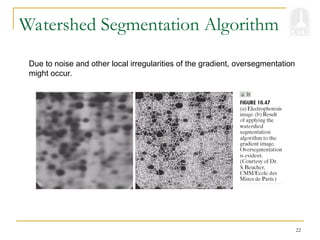
Watershed Segmentation Algorithm
Due to noise and other local irregularities of the gradient, oversegmentation
might occur.
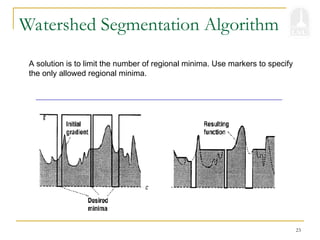
23
Watershed Segmentation Algorithm
A solution is to limit the number of regional minima. Use markers to specify
the only allowed regional minima.
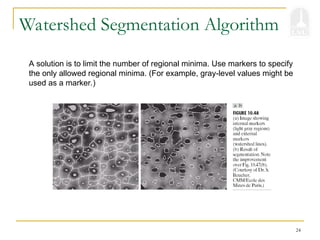
24
Watershed Segmentation Algorithm
A solution is to limit the number of regional minima. Use markers to specify
the only allowed regional minima. (For example, gray-level values might be
used as a marker.)
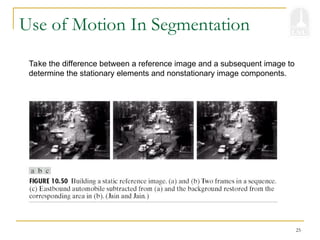
25
Use of Motion In Segmentation
Take the difference between a reference image and a subsequent image to
determine the stationary elements and nonstationary image components.
26
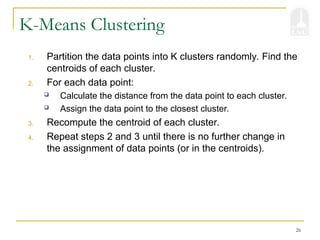
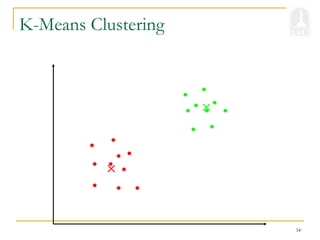
K-Means Clustering
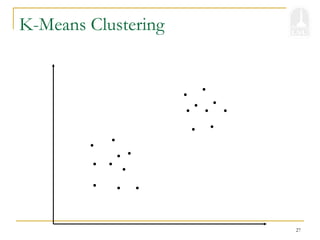
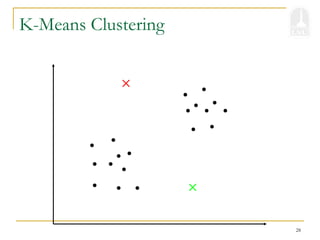
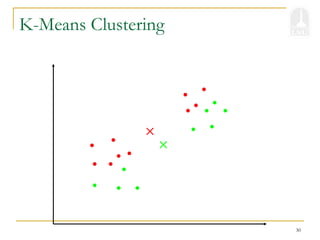
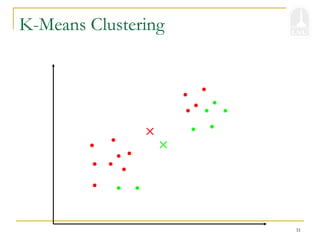
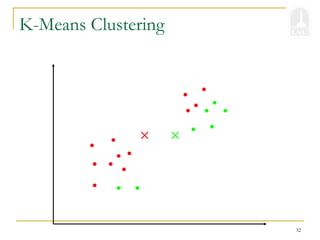
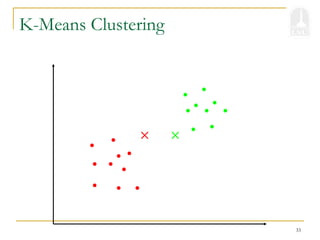
1. Partition the data points into K clusters randomly. Find the
centroids of each cluster.
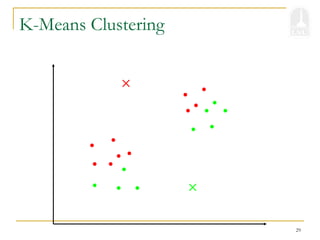
2. For each data point:
 Calculate the distance from the data point to each cluster.
 Assign the data point to the closest cluster.
3. Recompute the centroid of each cluster.
4. Repeat steps 2 and 3 until there is no further change in
the assignment of data points (or in the centroids).
27
K-Means Clustering
28
K-Means Clustering
29
K-Means Clustering
30
K-Means Clustering
31
K-Means Clustering
32
K-Means Clustering
33
K-Means Clustering
34
K-Means Clustering
35
K-Means Clustering
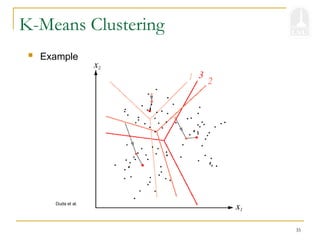
 Example
Duda et al.
36
K-Means Clustering
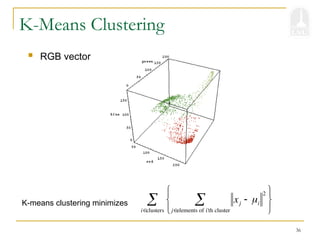
 RGB vector
xj  i
2
jelements of i'th cluster







iclusters

K-means clustering minimizes
37
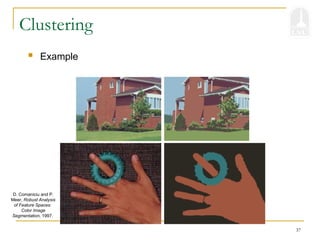
Clustering
 Example
D. Comaniciu and P.
Meer, Robust Analysis
of Feature Spaces:
Color Image
Segmentation, 1997.
38
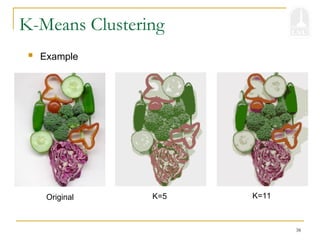
K-Means Clustering
 Example
Original K=5 K=11
39
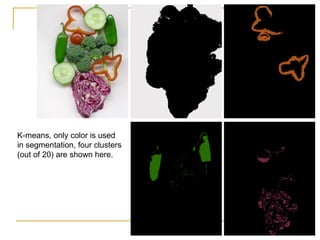
K-means, only color is used
in segmentation, four clusters
(out of 20) are shown here.
40
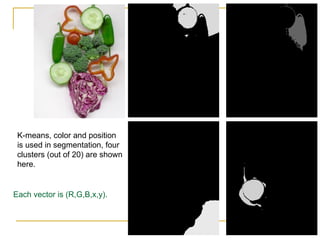
K-means, color and position
is used in segmentation, four
clusters (out of 20) are shown
here.
Each vector is (R,G,B,x,y).
41
K-Means Clustering: Axis Scaling
 Features of different types may have different scales.
 For example, pixel coordinates on a 100x100 image vs. RGB
color values in the range [0,1].
 Problem: Features with larger scales dominate
clustering.
 Solution: Scale the features.
Segmentation of Image practical applications.ppt

  • 1.
  • 2.
    2 Image Segmentation  Groupsimilar components (such as, pixels in an image, image frames in a video) to obtain a compact representation.  Applications: Finding tumors, veins, etc. in medical images, finding targets in satellite/aerial images, finding people in surveillance images, summarizing video, etc.  Methods: Thresholding, K-means clustering, etc.
  • 3.
    3 Image Segmentation  Segmentationalgorithms for monochrome images generally are based on one of two basic properties of gray- scale values:  Discontinuity  The approach is to partition an image based on abrupt changes in gray-scale levels.  The principal areas of interest within this category are detection of isolated points, lines, and edges in an image.  Similarity  The principal approaches in this category are based on thresholding, region growing, and region splitting/merging.
  • 4.
    4 Thresholding  Suppose thatan image, f(x,y), is composed of light objects on a dark backround, and the following figure is the histogram of the image.  Then, the objects can be extracted by comparing pixel values with a threshold T.
  • 5.
  • 6.
  • 7.
    7 Thresholding  It isalso possible to extract objects that have a specific intensity range using multiple thresholds. Extension to color images is straightforward: There are three color channels, in each one specify the intensity range of the object… Even if objects are not separated in a single channel, they might be with all the channels… Application example: Detecting/Tracking faces based on skin color…
  • 8.
    8 Thresholding  Non-uniform illuminationmay change the histogram in a way that it becomes impossible to segment the image using a single global threshold.  Choosing local threshold values may help.
  • 9.
  • 10.
  • 11.
  • 12.
    12 Region-Oriented Segmentation  RegionGrowing  Region growing is a procedure that groups pixels or subregions into larger regions.  The simplest of these approaches is pixel aggregation, which starts with a set of “seed” points and from these grows regions by appending to each seed points those neighboring pixels that have similar properties (such as gray level, texture, color, shape).  Region growing based techniques are better than the edge- based techniques in noisy images where edges are difficult to detect.
  • 13.
  • 14.
  • 15.
    15 Region-Oriented Segmentation  RegionSplitting  Region growing starts from a set of seed points.  An alternative is to start with the whole image as a single region and subdivide the regions that do not satisfy a condition of homogeneity.  Region Merging  Region merging is the opposite of region splitting.  Start with small regions (e.g. 2x2 or 4x4 regions) and merge the regions that have similar characteristics (such as gray level, variance).  Typically, splitting and merging approaches are used iteratively.
  • 16.
  • 17.
    17 Watershed Segmentation Algorithm Visualize an image in 3D: spatial coordinates and gray levels.  In such a topographic interpretation, there are 3 types of points:  Points belonging to a regional minimum  Points at which a drop of water would fall to a single minimum. (The catchment basin or watershed of that minimum.)  Points at which a drop of water would be equally likely to fall to more than one minimum. (The divide lines or watershed lines.) Watershed lines
  • 18.
    18 Watershed Segmentation Algorithm The objective is to find watershed lines.  The idea is simple:  Suppose that a hole is punched in each regional minimum and that the entire topography is flooded from below by letting water rise through the holes at a uniform rate.  When rising water in distinct catchment basins is about the merge, a dam is built to prevent merging. These dam boundaries correspond to the watershed lines.
  • 19.
  • 20.
    20  Start withall pixels with the lowest possible value.  These form the basis for initial watersheds  For each intensity level k:  For each group of pixels of intensity k  If adjacent to exactly one existing region, add these pixels to that region  Else if adjacent to more than one existing regions, mark as boundary  Else start a new region Watershed Segmentation Algorithm
  • 21.
    21 Watershed Segmentation Algorithm Watershedalgorithm might be used on the gradient image instead of the original image.
  • 22.
    22 Watershed Segmentation Algorithm Dueto noise and other local irregularities of the gradient, oversegmentation might occur.
  • 23.
    23 Watershed Segmentation Algorithm Asolution is to limit the number of regional minima. Use markers to specify the only allowed regional minima.
  • 24.
    24 Watershed Segmentation Algorithm Asolution is to limit the number of regional minima. Use markers to specify the only allowed regional minima. (For example, gray-level values might be used as a marker.)
  • 25.
    25 Use of MotionIn Segmentation Take the difference between a reference image and a subsequent image to determine the stationary elements and nonstationary image components.
  • 26.
    26 K-Means Clustering 1. Partitionthe data points into K clusters randomly. Find the centroids of each cluster. 2. For each data point:  Calculate the distance from the data point to each cluster.  Assign the data point to the closest cluster. 3. Recompute the centroid of each cluster. 4. Repeat steps 2 and 3 until there is no further change in the assignment of data points (or in the centroids).
  • 27.
  • 28.
  • 29.
  • 30.
  • 31.
  • 32.
  • 33.
  • 34.
  • 35.
  • 36.
    36 K-Means Clustering  RGBvector xj  i 2 jelements of i'th cluster        iclusters  K-means clustering minimizes
  • 37.
    37 Clustering  Example D. Comaniciuand P. Meer, Robust Analysis of Feature Spaces: Color Image Segmentation, 1997.
  • 38.
  • 39.
    39 K-means, only coloris used in segmentation, four clusters (out of 20) are shown here.
  • 40.
    40 K-means, color andposition is used in segmentation, four clusters (out of 20) are shown here. Each vector is (R,G,B,x,y).
  • 41.
    41 K-Means Clustering: AxisScaling  Features of different types may have different scales.  For example, pixel coordinates on a 100x100 image vs. RGB color values in the range [0,1].  Problem: Features with larger scales dominate clustering.  Solution: Scale the features.