PRESENTED BY - JITENDRA SINGH RATHOUR
WATERFALL AND PROTOTYPE MODEL
WATERFALL MODEL
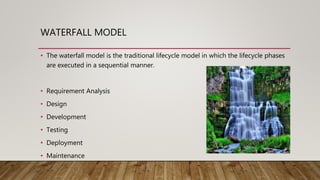
• The waterfall model is the traditional lifecycle model in which the lifecycle phases
are executed in a sequential manner.
• Requirement Analysis
• Design
• Development
• Testing
• Deployment
• Maintenance
CHARACTERISTICS-
1. The phases organized in a downward linear sequence.
2. There is a downward flow of information.
3. Each phase has a defined start point and end point.
4. The phases do not overlap with each other.
5. Each phase handled by a specific set of people.
ADVANTAGES
-
• The model is simple to understand and easy to use.
• The model has clearly defined phases.
• The model is easy to use.
DISADVANTAGE-
• This model does not provide any scope for changes.
WHERE TO USE-
• The Waterfall model works well in situation where requirements are well
understood and not likely to change.
PROTOTYPE MODEL
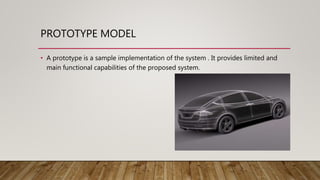
• A prototype is a sample implementation of the system . It provides limited and
main functional capabilities of the proposed system.
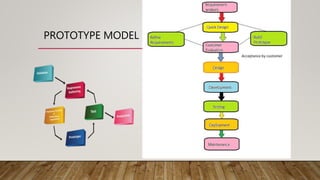
PROTOTYPE MODEL
VARIANTS OF PROTOTYPING
• ThrowAway Prototyping
• Evolutionary Prototyping
• Incremental Prototyping
ADVANTAGES
• User requirements become clear to developer.
• Changes are only done at design phase.
• The time of development is reduced.
• The costs are reduced.
DISADVANTAGES
• It gives false impression to customer.
• Compromise on the overall quality of the software.
• Cost of the software development may increase.
• The developer can get attached to the prototypes that they have developed.

Waterfall and Prototype model

  • 1.
    PRESENTED BY -JITENDRA SINGH RATHOUR WATERFALL AND PROTOTYPE MODEL
  • 2.
    WATERFALL MODEL • Thewaterfall model is the traditional lifecycle model in which the lifecycle phases are executed in a sequential manner. • Requirement Analysis • Design • Development • Testing • Deployment • Maintenance
  • 3.
    CHARACTERISTICS- 1. The phasesorganized in a downward linear sequence. 2. There is a downward flow of information. 3. Each phase has a defined start point and end point. 4. The phases do not overlap with each other. 5. Each phase handled by a specific set of people.
  • 4.
    ADVANTAGES - • The modelis simple to understand and easy to use. • The model has clearly defined phases. • The model is easy to use. DISADVANTAGE- • This model does not provide any scope for changes.
  • 5.
    WHERE TO USE- •The Waterfall model works well in situation where requirements are well understood and not likely to change.
  • 6.
    PROTOTYPE MODEL • Aprototype is a sample implementation of the system . It provides limited and main functional capabilities of the proposed system.
  • 7.
  • 8.
    VARIANTS OF PROTOTYPING •ThrowAway Prototyping • Evolutionary Prototyping • Incremental Prototyping
  • 9.
    ADVANTAGES • User requirementsbecome clear to developer. • Changes are only done at design phase. • The time of development is reduced. • The costs are reduced.
  • 10.
    DISADVANTAGES • It givesfalse impression to customer. • Compromise on the overall quality of the software. • Cost of the software development may increase. • The developer can get attached to the prototypes that they have developed.