PROJECT MANAGEMENT METHODOLOGY
PROJECT MANAGEMENT
METHODOLOGIES
WATERFALL MODEL
AGILE MODEL
WATERFALL MODEL
• The waterfall model is a traditional model and the
first model introduced
• The model develops systematically from one phase
to other in a downward fashion, like a waterfall
• Follows Linear-sequential life cycle
• Very simple to understand and use
• Each phase must be completed before the next
phase begins and there is no overlapping in the
phases
• Waterfall model works well for smaller projects
where requirements are very well understood.
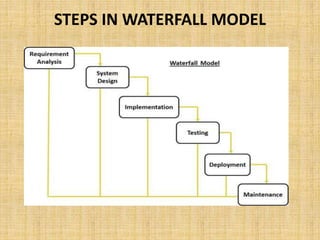
STEPS IN WATERFALL MODEL
AGILE MODEL
• Combination of iterative and incremental
process models
• Process adaptability and customer satisfaction
• Agile described as a freeform of software
design
• Software developers works on small modules
at a time
• Customers feedback occurs simultaneously
with development
• Agile can be especially beneficial in situations
where the end goals of projects are not clearly
defined
• Agile is an excellent option for experimental
software design
• Agile follows the sprint mechanism
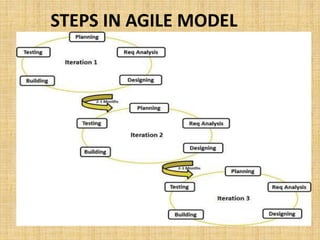
STEPS IN AGILE MODEL
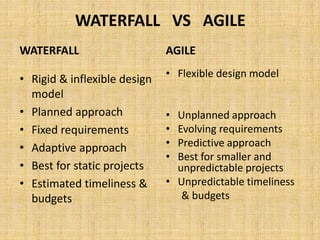
WATERFALL VS AGILE
WATERFALL
• Rigid & inflexible design
model
• Planned approach
• Fixed requirements
• Adaptive approach
• Best for static projects
• Estimated timeliness &
budgets
AGILE
• Flexible design model
• Unplanned approach
• Evolving requirements
• Predictive approach
• Best for smaller and
unpredictable projects
• Unpredictable timeliness
& budgets
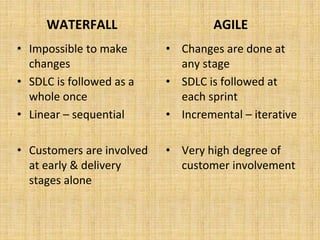
WATERFALL
• Impossible to make
changes
• SDLC is followed as a
whole once
• Linear – sequential
• Customers are involved
at early & delivery
stages alone
AGILE
• Changes are done at
any stage
• SDLC is followed at
each sprint
• Incremental – iterative
• Very high degree of
customer involvement
THANKYOU

Models in project management_Agile and Waterfall

  • 1.
  • 2.
  • 3.
    WATERFALL MODEL • Thewaterfall model is a traditional model and the first model introduced • The model develops systematically from one phase to other in a downward fashion, like a waterfall • Follows Linear-sequential life cycle • Very simple to understand and use • Each phase must be completed before the next phase begins and there is no overlapping in the phases • Waterfall model works well for smaller projects where requirements are very well understood.
  • 4.
  • 5.
    AGILE MODEL • Combinationof iterative and incremental process models • Process adaptability and customer satisfaction • Agile described as a freeform of software design • Software developers works on small modules at a time • Customers feedback occurs simultaneously with development
  • 6.
    • Agile canbe especially beneficial in situations where the end goals of projects are not clearly defined • Agile is an excellent option for experimental software design • Agile follows the sprint mechanism
  • 7.
  • 8.
    WATERFALL VS AGILE WATERFALL •Rigid & inflexible design model • Planned approach • Fixed requirements • Adaptive approach • Best for static projects • Estimated timeliness & budgets AGILE • Flexible design model • Unplanned approach • Evolving requirements • Predictive approach • Best for smaller and unpredictable projects • Unpredictable timeliness & budgets
  • 9.
    WATERFALL • Impossible tomake changes • SDLC is followed as a whole once • Linear – sequential • Customers are involved at early & delivery stages alone AGILE • Changes are done at any stage • SDLC is followed at each sprint • Incremental – iterative • Very high degree of customer involvement
  • 10.

Editor's Notes

  • #4 1__ Linear sequential model :Any phase in the development process begins only if the previous phase is complete 2__ Outcome of one phase will be the input of the next phase
  • #5 Requirement Gathering and analysis: All possible requirements of the system to be developed are captured in this phase and documented in a requirement specification doc. System Design: The requirement specifications from first phase are studied in this phase and system design is prepared. System Design helps in specifying hardware and system requirements and also helps in defining overall system architecture. Implementation: With inputs from system design, the system is first developed in small programs called units, which are integrated in the next phase. Each unit is developed and tested for its functionality which is referred to as Unit Testing. Integration and Testing: All the units developed in the implementation phase are integrated into a system after testing of each unit. Post integration the entire system is tested for any faults and failures. Deployment of system: Once the functional and non functional testing is done, the product is deployed in the customer environment or released into the market. Maintenance: There are some issues which come up in the client environment. To fix those issues patches are released. Also to enhance the product some better versions are released. Maintenance is done to deliver these changes in the customer environment. All these phases are cascaded to each other in which progress is seen as flowing steadily downwards (like a waterfall) through the phases. The next phase is started only after the defined set of goals are achieved for previous phase and it is signed off, so the name "Waterfall Model". In this model phases do not overlap.