





SEGMENTING RURAL CONSUMERS

  Rural consumers are heterogeneous and so
  Segmentation is required

Reasons for market Segmentation
• Understanding the needs of consumers
• Better position to spot marketing opportunities
• Allocation of marketing Budgets
• Meeting the competition effectively
• Effective marketing programmes

                                                    1
SEGMENTING RURAL CONSUMERS

•   Choosing of Advertising media
•   Increasing sales volume
•   Benefits the consumers
•   Better utilization of marketing resources
•   Discovering marketing opportunities
•   Specialized marketing
•   Provision of Information


                                                2
SEGMENTING RURAL CONSUMERS

•   Evaluation of marketing activities
•   Marketing efficiency
•   Formulation of marketing mix
•   Making of suitable adjustments


                                         3
SEGMENTING RURAL CONSUMERS
         Requirement for Effective Segmentation

•   Substantiality (Sufficiently large)
•   Measurability (Changes in the behaviour)
•   Accessibility (Promotion and distribution possible)
•   Representability(Individuality)
•   Effective demand
•   Responsiveness ( For Changes)


                                                          4
SEGMENTING RURAL CONSUMERS

BASES FOR SEGMENTATION

I Socio economic factors
• Sex- Male, Female
• Age- Children, young, adults, old
• Income- High, middle, low
• Education     level-    educated,   semi   educated,
   uneducated
• Size of family- large, medium, small
• Caste and Religion
• Business or Profession


                                                     5
SEGMENTING RURAL CONSUMERS

BASES FOR SEGMENTATION

II   Geographical factors
•    Rural
•    Urban
•    Regional
•    State
•    National
•    International
•    Plain
•    Hot
•    Cold
                                   6
SEGMENTING RURAL CONSUMERS

BASES FOR SEGMENTATION

III Psychographic or Personality factors
• Thinking
• Attitudes
• Buying motives
• Prestige and status
• Usefulness


                                           7
SEGMENTING RURAL CONSUMERS

BASES FOR SEGMENTATION

IV Consumer Behaviour factors

• Usage rate: non users, light users, middle users,
  heavy users
• Buying motives: quality of goods, reliability of goods,
  prestige
• Brand loyalty


                                                        8
SEGMENTING RURAL CONSUMERS

Rural consumers are heterogeneous as far as

•   Literacy
•   Economic condition
•   Life style
•   Buying behaviour


                                              9
BASES OF SEGMENTATION OF RURAL MARKETS

 I GEOGRAPHIC SEGMENTATION
a. Climate
    Favourable climate- Areas are prosperous
    Unfavourable climate- Areas are handicapped

b. Level of Irrigation
    Irrigated areas- prosperous
    Dry land areas- are not

c. Nearness to feeder town
   Closer to feeder town- frequent visit
   Away from feeder town- rare visit

                                                  10
II DEMOGRAPHIC SEGMENTATION

a.Population- Spread or Concentrated
b.Age of rural population- youth more buying
c.Literacy level
d.Income of rural people-
        Regular Income group
        Seasonal Income group
III BUYING BEHAVIOUR SEGMENTATION

a.High priced branded goods
b.Low priced non branded goods
                                          11
IV SOCIOLOGICAL FACTORS

a. Landlord
b. Small farmers
c. Tenants

V Occupational Factors

a.   Farmers
b.   Craftsmen
c.   Artisans
d.   Salaried employees


                          12
MARKETING MIX FOR RURAL MARKETS

1.Segmentation and Targeting
   Rural consumers are not homogeneous

2.Product Mix
   Smaller Packages
   Sturdy
   Utility products

3.Price Mix
   Low cost

                                         13
4. Distribution Mix
   It should be strong because
     less population density
     poor transport and communication
     scattered outlets

5. Promotion Mix
     TV
     Radio
     Print media – Not advisable
     Films with mobile vans


                                    14
RURAL MARKETING STRATEGIES

•   Fertilizers
•   Agro chemicals
•   Seeds
•   Feeds
•   Tractors and Tillers
•   Irrigation Equipments
•   Other farm machinery and inputs


                                      15
RURAL MARKETING STRATEGIES
1.   Product Strategies
2.   Price Strategies
3.   Physical Distribution Strategies
4.   Promotion Strategies


                                        16
1.PRODUCT STRATEGIES

      It is a company plan for marketing its
    products.
     The various issues involved in the product
    strategy are

•   Product line and product mix
•   Branding
•   Packaging
•   Product Warranties
•   After Sales Service
                                            17
PRODUCT LINE AND PRODUCT MIX
• Different Products
• Different Models
• Different Product Designs
• Sturdy Products
• Products of high utility
• Colour, shape, Safety, Size
• Quality of performance


                                18
BRANDING

•   National Brand
•   Regional Brand
•   Local Brand
•   Imitation products

•   Rin- Run
•   Nirma- Narima
•   Lifebuoy- Liteboy, Lifejoy
•   Fair and Lovely- Friends and Lovely
                                          19
BRANDING- Popular in Rural Area
• Nirma girl in frock
• Dettol sword
• Aravind Mills Ruff and Tuff
• HUL Lifebuoy
• Britannia Tiger
• Tata Sonata
• Godrej toothpaste
• Dalda Vanaspathi


                                  20
PACKAGING
   Small Packets
   Sachets
   Simple packets
   Polythin packets


                             21
PRODUCT WARRANTY
Consumer durables

       AFTER SALES SERVICE

Consumer durables


                             22
2. PRICING STRATEGIES

No costly products
Affordable price
Quality commensuration valid
    Eveready
     Hero Honda CD 100- More mileage and
   less maintenance
Rajdooth


                                       23
3.DISTRBUTION STRATEGIES
Mainly distribution through the distributors in
  the large towns
Efficient distribution system
   Covering villages with a population of 2000 and
    above
   Use of cooperative societies
   Use of PDS
   Utilization of Petrol pumps
   Use of agricultural users
   Use of sandys, jathras and melas
   Use of Vans
   Joining of two or more marketers

                                                 24
4.PROMOTION STRATEGIES
 Word of mouth

 Opinion leaders

 TV, Radio and Cinemas

 Press media

 Hoardings and Wall paintings

 Puppet shows and street plays

 Personal selling and Salesmanship


                                      25
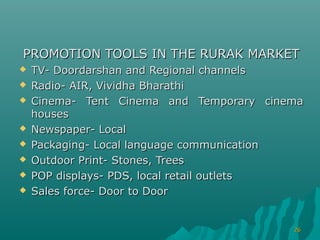
PROMOTION TOOLS IN THE RURAK MARKET
   TV- Doordarshan and Regional channels
   Radio- AIR, Vividha Bharathi
   Cinema- Tent Cinema and Temporary cinema
    houses
   Newspaper- Local
   Packaging- Local language communication
   Outdoor Print- Stones, Trees
   POP displays- PDS, local retail outlets
   Sales force- Door to Door


                                          26
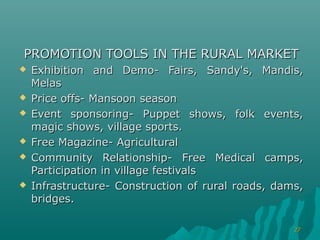
PROMOTION TOOLS IN THE RURAL MARKET
   Exhibition and Demo- Fairs, Sandy's, Mandis,
    Melas
   Price offs- Mansoon season
   Event sponsoring- Puppet shows, folk events,
    magic shows, village sports.
   Free Magazine- Agricultural
   Community Relationship- Free Medical camps,
    Participation in village festivals
   Infrastructure- Construction of rural roads, dams,
    bridges.

                                                    27
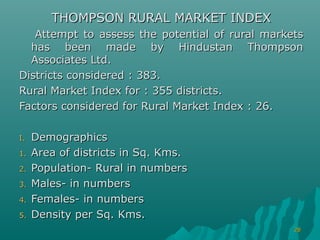
THOMPSON RURAL MARKET INDEX
   Attempt to assess the potential of rural markets
  has been made by Hindustan Thompson
  Associates Ltd.
Districts considered : 383.
Rural Market Index for : 355 districts.
Factors considered for Rural Market Index : 26.

I.   Demographics
1.   Area of districts in Sq. Kms.
2.   Population- Rural in numbers
3.   Males- in numbers
4.   Females- in numbers
5.   Density per Sq. Kms.
                                                 28
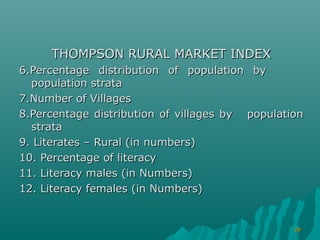
THOMPSON RURAL MARKET INDEX
6.Percentage distribution of population by
  population strata
7.Number of Villages
8.Percentage distribution of villages by population
  strata
9. Literates – Rural (in numbers)
10. Percentage of literacy
11. Literacy males (in Numbers)
12. Literacy females (in Numbers)


                                                 29
THOMPSON RURAL MARKET INDEX
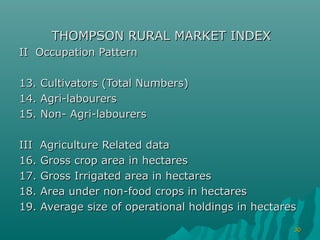
II Occupation Pattern

13.   Cultivators (Total Numbers)
14.   Agri-labourers
15.   Non- Agri-labourers

III Agriculture Related data
16. Gross crop area in hectares
17. Gross Irrigated area in hectares
18. Area under non-food crops in hectares
19. Average size of operational holdings in hectares
                                                   30
THOMPSON RURAL MARKET INDEX
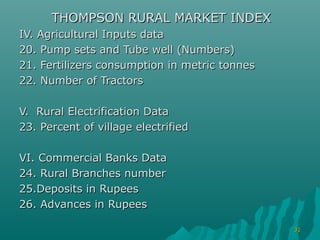
IV. Agricultural Inputs data
20. Pump sets and Tube well (Numbers)
21. Fertilizers consumption in metric tonnes
22. Number of Tractors

V. Rural Electrification Data
23. Percent of village electrified

VI. Commercial Banks Data
24. Rural Branches number
25.Deposits in Rupees
26. Advances in Rupees

                                               31
THOMPSON RURAL MARKET INDEX
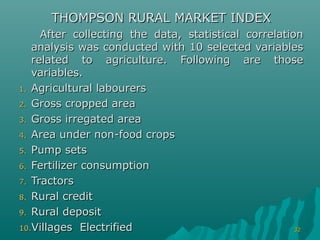
     After collecting the data, statistical correlation
   analysis was conducted with 10 selected variables
   related to agriculture. Following are those
   variables.
1. Agricultural labourers

2. Gross cropped area

3. Gross irregated area

4. Area under non-food crops

5. Pump sets

6. Fertilizer consumption

7. Tractors

8. Rural credit

9. Rural deposit

10.Villages Electrified                               32
THOMPSON RURAL MARKET INDEX
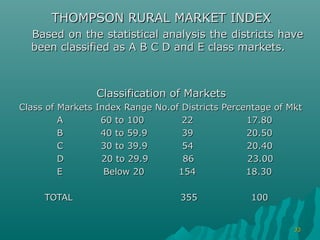
  Based on the statistical analysis the districts have
  been classified as A B C D and E class markets.


                   Classification of Markets
Class of Markets   Index Range No.of Districts Percentage of Mkt
         A          60 to 100        22             17.80
         B          40 to 59.9       39             20.50
         C          30 to 39.9       54             20.40
         D          20 to 29.9       86             23.00
         E           Below 20       154             18.30

     TOTAL                           355            100


                                                              33
THOMPSON RURAL MARKET INDEX
40% of the districts have high potential (A&B)
20% of the districts have medium potential (C)
  40% of the districts need more time to
 develop(D&E)

This Index can be used for evolving strategies for
marketing agricultural inputs and consumable and
durable items.


                                                 34
THANK YOU

            35

Rural marketing

  • 1.
    SEGMENTING RURAL CONSUMERS Rural consumers are heterogeneous and so Segmentation is required Reasons for market Segmentation • Understanding the needs of consumers • Better position to spot marketing opportunities • Allocation of marketing Budgets • Meeting the competition effectively • Effective marketing programmes 1
  • 2.
    SEGMENTING RURAL CONSUMERS • Choosing of Advertising media • Increasing sales volume • Benefits the consumers • Better utilization of marketing resources • Discovering marketing opportunities • Specialized marketing • Provision of Information 2
  • 3.
    SEGMENTING RURAL CONSUMERS • Evaluation of marketing activities • Marketing efficiency • Formulation of marketing mix • Making of suitable adjustments 3
  • 4.
    SEGMENTING RURAL CONSUMERS Requirement for Effective Segmentation • Substantiality (Sufficiently large) • Measurability (Changes in the behaviour) • Accessibility (Promotion and distribution possible) • Representability(Individuality) • Effective demand • Responsiveness ( For Changes) 4
  • 5.
    SEGMENTING RURAL CONSUMERS BASESFOR SEGMENTATION I Socio economic factors • Sex- Male, Female • Age- Children, young, adults, old • Income- High, middle, low • Education level- educated, semi educated, uneducated • Size of family- large, medium, small • Caste and Religion • Business or Profession 5
  • 6.
    SEGMENTING RURAL CONSUMERS BASESFOR SEGMENTATION II Geographical factors • Rural • Urban • Regional • State • National • International • Plain • Hot • Cold 6
  • 7.
    SEGMENTING RURAL CONSUMERS BASESFOR SEGMENTATION III Psychographic or Personality factors • Thinking • Attitudes • Buying motives • Prestige and status • Usefulness 7
  • 8.
    SEGMENTING RURAL CONSUMERS BASESFOR SEGMENTATION IV Consumer Behaviour factors • Usage rate: non users, light users, middle users, heavy users • Buying motives: quality of goods, reliability of goods, prestige • Brand loyalty 8
  • 9.
    SEGMENTING RURAL CONSUMERS Ruralconsumers are heterogeneous as far as • Literacy • Economic condition • Life style • Buying behaviour 9
  • 10.
    BASES OF SEGMENTATIONOF RURAL MARKETS I GEOGRAPHIC SEGMENTATION a. Climate Favourable climate- Areas are prosperous Unfavourable climate- Areas are handicapped b. Level of Irrigation Irrigated areas- prosperous Dry land areas- are not c. Nearness to feeder town Closer to feeder town- frequent visit Away from feeder town- rare visit 10
  • 11.
    II DEMOGRAPHIC SEGMENTATION a.Population-Spread or Concentrated b.Age of rural population- youth more buying c.Literacy level d.Income of rural people- Regular Income group Seasonal Income group III BUYING BEHAVIOUR SEGMENTATION a.High priced branded goods b.Low priced non branded goods 11
  • 12.
    IV SOCIOLOGICAL FACTORS a.Landlord b. Small farmers c. Tenants V Occupational Factors a. Farmers b. Craftsmen c. Artisans d. Salaried employees 12
  • 13.
    MARKETING MIX FORRURAL MARKETS 1.Segmentation and Targeting Rural consumers are not homogeneous 2.Product Mix Smaller Packages Sturdy Utility products 3.Price Mix Low cost 13
  • 14.
    4. Distribution Mix It should be strong because less population density poor transport and communication scattered outlets 5. Promotion Mix TV Radio Print media – Not advisable Films with mobile vans 14
  • 15.
    RURAL MARKETING STRATEGIES • Fertilizers • Agro chemicals • Seeds • Feeds • Tractors and Tillers • Irrigation Equipments • Other farm machinery and inputs 15
  • 16.
    RURAL MARKETING STRATEGIES 1. Product Strategies 2. Price Strategies 3. Physical Distribution Strategies 4. Promotion Strategies 16
  • 17.
    1.PRODUCT STRATEGIES It is a company plan for marketing its products. The various issues involved in the product strategy are • Product line and product mix • Branding • Packaging • Product Warranties • After Sales Service 17
  • 18.
    PRODUCT LINE ANDPRODUCT MIX • Different Products • Different Models • Different Product Designs • Sturdy Products • Products of high utility • Colour, shape, Safety, Size • Quality of performance 18
  • 19.
    BRANDING • National Brand • Regional Brand • Local Brand • Imitation products • Rin- Run • Nirma- Narima • Lifebuoy- Liteboy, Lifejoy • Fair and Lovely- Friends and Lovely 19
  • 20.
    BRANDING- Popular inRural Area • Nirma girl in frock • Dettol sword • Aravind Mills Ruff and Tuff • HUL Lifebuoy • Britannia Tiger • Tata Sonata • Godrej toothpaste • Dalda Vanaspathi 20
  • 21.
    PACKAGING  Small Packets  Sachets  Simple packets  Polythin packets 21
  • 22.
    PRODUCT WARRANTY Consumer durables AFTER SALES SERVICE Consumer durables 22
  • 23.
    2. PRICING STRATEGIES Nocostly products Affordable price Quality commensuration valid Eveready Hero Honda CD 100- More mileage and less maintenance Rajdooth 23
  • 24.
    3.DISTRBUTION STRATEGIES Mainly distributionthrough the distributors in the large towns Efficient distribution system  Covering villages with a population of 2000 and above  Use of cooperative societies  Use of PDS  Utilization of Petrol pumps  Use of agricultural users  Use of sandys, jathras and melas  Use of Vans  Joining of two or more marketers 24
  • 25.
    4.PROMOTION STRATEGIES  Wordof mouth  Opinion leaders  TV, Radio and Cinemas  Press media  Hoardings and Wall paintings  Puppet shows and street plays  Personal selling and Salesmanship 25
  • 26.
    PROMOTION TOOLS INTHE RURAK MARKET  TV- Doordarshan and Regional channels  Radio- AIR, Vividha Bharathi  Cinema- Tent Cinema and Temporary cinema houses  Newspaper- Local  Packaging- Local language communication  Outdoor Print- Stones, Trees  POP displays- PDS, local retail outlets  Sales force- Door to Door 26
  • 27.
    PROMOTION TOOLS INTHE RURAL MARKET  Exhibition and Demo- Fairs, Sandy's, Mandis, Melas  Price offs- Mansoon season  Event sponsoring- Puppet shows, folk events, magic shows, village sports.  Free Magazine- Agricultural  Community Relationship- Free Medical camps, Participation in village festivals  Infrastructure- Construction of rural roads, dams, bridges. 27
  • 28.
    THOMPSON RURAL MARKETINDEX Attempt to assess the potential of rural markets has been made by Hindustan Thompson Associates Ltd. Districts considered : 383. Rural Market Index for : 355 districts. Factors considered for Rural Market Index : 26. I. Demographics 1. Area of districts in Sq. Kms. 2. Population- Rural in numbers 3. Males- in numbers 4. Females- in numbers 5. Density per Sq. Kms. 28
  • 29.
    THOMPSON RURAL MARKETINDEX 6.Percentage distribution of population by population strata 7.Number of Villages 8.Percentage distribution of villages by population strata 9. Literates – Rural (in numbers) 10. Percentage of literacy 11. Literacy males (in Numbers) 12. Literacy females (in Numbers) 29
  • 30.
    THOMPSON RURAL MARKETINDEX II Occupation Pattern 13. Cultivators (Total Numbers) 14. Agri-labourers 15. Non- Agri-labourers III Agriculture Related data 16. Gross crop area in hectares 17. Gross Irrigated area in hectares 18. Area under non-food crops in hectares 19. Average size of operational holdings in hectares 30
  • 31.
    THOMPSON RURAL MARKETINDEX IV. Agricultural Inputs data 20. Pump sets and Tube well (Numbers) 21. Fertilizers consumption in metric tonnes 22. Number of Tractors V. Rural Electrification Data 23. Percent of village electrified VI. Commercial Banks Data 24. Rural Branches number 25.Deposits in Rupees 26. Advances in Rupees 31
  • 32.
    THOMPSON RURAL MARKETINDEX After collecting the data, statistical correlation analysis was conducted with 10 selected variables related to agriculture. Following are those variables. 1. Agricultural labourers 2. Gross cropped area 3. Gross irregated area 4. Area under non-food crops 5. Pump sets 6. Fertilizer consumption 7. Tractors 8. Rural credit 9. Rural deposit 10.Villages Electrified 32
  • 33.
    THOMPSON RURAL MARKETINDEX Based on the statistical analysis the districts have been classified as A B C D and E class markets. Classification of Markets Class of Markets Index Range No.of Districts Percentage of Mkt A 60 to 100 22 17.80 B 40 to 59.9 39 20.50 C 30 to 39.9 54 20.40 D 20 to 29.9 86 23.00 E Below 20 154 18.30 TOTAL 355 100 33
  • 34.
    THOMPSON RURAL MARKETINDEX 40% of the districts have high potential (A&B) 20% of the districts have medium potential (C) 40% of the districts need more time to develop(D&E) This Index can be used for evolving strategies for marketing agricultural inputs and consumable and durable items. 34
  • 35.