Water Preservation
Dr. Arkadeb Kar
3rd year post graduate trainee
Department of community medicine
Calcutta national medical college
1
At the end of the session learners will be able to -
• Enumerate the causes of water crisis
• Enumerate the methods for water preservation
2
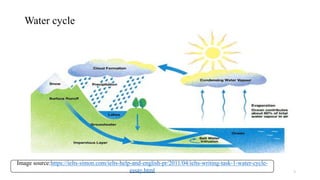
Water cycle
Image source:https://ielts-simon.com/ielts-help-and-english-pr/2011/04/ielts-writing-task-1-water-cycle-
essay.html 3
Current scenario
• Over 2 billion people in countries with
high water stress [2]
• 700 million people worldwide could
be displaced by intense water scarcity
by 2030 [2]
• In India –
• 600 million Indians face high to
extreme water stress [3]
• About two lakh people die every year
due to inadequate access to safe
water[3]
Image Source: World Water Assessment Programme (WWAP) -http://www.un.org/waterforlifedecade/scarcity.shtml
4
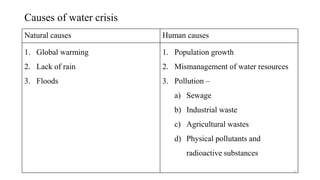
Causes of water crisis
Natural causes Human causes
1. Global warming
2. Lack of rain
3. Floods
1. Population growth
2. Mismanagement of water resources
3. Pollution –
a) Sewage
b) Industrial waste
c) Agricultural wastes
d) Physical pollutants and
radioactive substances
5
Water preservation
• All the policies, strategies and activities to -
• sustainably manage the natural resource of fresh water
• to meet the current and future human demand.
• Strategies –
1. Prevention of wastage
2. Water harvesting
6
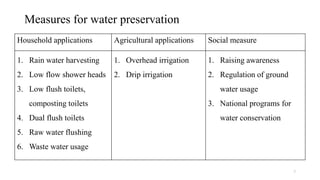
Measures for water preservation
Household applications Agricultural applications Social measure
1. Rain water harvesting
2. Low flow shower heads
3. Low flush toilets,
composting toilets
4. Dual flush toilets
5. Raw water flushing
6. Waste water usage
1. Overhead irrigation
2. Drip irrigation
1. Raising awareness
2. Regulation of ground
water usage
3. National programs for
water conservation
7
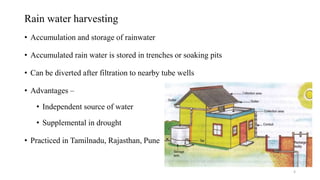
Rain water harvesting
• Accumulation and storage of rainwater
• Accumulated rain water is stored in trenches or soaking pits
• Can be diverted after filtration to nearby tube wells
• Advantages –
• Independent source of water
• Supplemental in drought
• Practiced in Tamilnadu, Rajasthan, Pune
8
World Water Day [5]
• International World Water Day – 22 March
• Theme of 2019 - ‘Leaving no one behind’
• Advocates sustainable management of freshwater resources
9
Summary
• Water crisis has become a significant problem
• Taking small and simple steps can save a lot of water
10
References
1. Competing for Clean Water Has Led to a Crisis. Clean Water Crisis Facts and
Information 2019.
https://www.nationalgeographic.com/environment/freshwater/freshwater-crisis/
(accessed January 20, 2020).
2. UN-Water. Scarcity: UN-Water. UN. https://www.unwater.org/water-
facts/scarcity/(accessed January 20, 2020).
3. NITI Aayog (2018). Composite Water Management Index-A tool for water
management. Government of India, New Delhi, India.
4. Jal Shakti Abhiyan. https://ejalshakti.gov.in/JSA/JSA/Home.aspx(accessed
January 20, 2020).
5. UN-Water: World Water Day 2019 - Theme. World Water Day.
https://www.worldwaterday.org/world-water-day-2019-water-for-
all/theme/(accessed January 20, 2020).
11
12

Water preservation

  • 1.
    Water Preservation Dr. ArkadebKar 3rd year post graduate trainee Department of community medicine Calcutta national medical college 1
  • 2.
    At the endof the session learners will be able to - • Enumerate the causes of water crisis • Enumerate the methods for water preservation 2
  • 3.
  • 4.
    Current scenario • Over2 billion people in countries with high water stress [2] • 700 million people worldwide could be displaced by intense water scarcity by 2030 [2] • In India – • 600 million Indians face high to extreme water stress [3] • About two lakh people die every year due to inadequate access to safe water[3] Image Source: World Water Assessment Programme (WWAP) -http://www.un.org/waterforlifedecade/scarcity.shtml 4
  • 5.
    Causes of watercrisis Natural causes Human causes 1. Global warming 2. Lack of rain 3. Floods 1. Population growth 2. Mismanagement of water resources 3. Pollution – a) Sewage b) Industrial waste c) Agricultural wastes d) Physical pollutants and radioactive substances 5
  • 6.
    Water preservation • Allthe policies, strategies and activities to - • sustainably manage the natural resource of fresh water • to meet the current and future human demand. • Strategies – 1. Prevention of wastage 2. Water harvesting 6
  • 7.
    Measures for waterpreservation Household applications Agricultural applications Social measure 1. Rain water harvesting 2. Low flow shower heads 3. Low flush toilets, composting toilets 4. Dual flush toilets 5. Raw water flushing 6. Waste water usage 1. Overhead irrigation 2. Drip irrigation 1. Raising awareness 2. Regulation of ground water usage 3. National programs for water conservation 7
  • 8.
    Rain water harvesting •Accumulation and storage of rainwater • Accumulated rain water is stored in trenches or soaking pits • Can be diverted after filtration to nearby tube wells • Advantages – • Independent source of water • Supplemental in drought • Practiced in Tamilnadu, Rajasthan, Pune 8
  • 9.
    World Water Day[5] • International World Water Day – 22 March • Theme of 2019 - ‘Leaving no one behind’ • Advocates sustainable management of freshwater resources 9
  • 10.
    Summary • Water crisishas become a significant problem • Taking small and simple steps can save a lot of water 10
  • 11.
    References 1. Competing forClean Water Has Led to a Crisis. Clean Water Crisis Facts and Information 2019. https://www.nationalgeographic.com/environment/freshwater/freshwater-crisis/ (accessed January 20, 2020). 2. UN-Water. Scarcity: UN-Water. UN. https://www.unwater.org/water- facts/scarcity/(accessed January 20, 2020). 3. NITI Aayog (2018). Composite Water Management Index-A tool for water management. Government of India, New Delhi, India. 4. Jal Shakti Abhiyan. https://ejalshakti.gov.in/JSA/JSA/Home.aspx(accessed January 20, 2020). 5. UN-Water: World Water Day 2019 - Theme. World Water Day. https://www.worldwaterday.org/world-water-day-2019-water-for- all/theme/(accessed January 20, 2020). 11
  • 12.