WATER
LEVEL
INDICATOR
PEOPLE INVOLVED
SAURABH(1411981206)
KANAV MAHAJAN(1411981293)
KARTIK MAHAJAN(1411981295)
KARTIK SHARMA(1411981296)
INTRODUCTION
What is Water level indicator?
The Water Level Indicator employs a
simple mechanism to detect and
indicate the water level in an overhead
tank or any other water container.
THE SITUATION
• The house where we live in has an overhead tank which is about 30 feet from the ground
level.
• We were getting bored going up the rooftop to check whether the tank has filled or the
water level was below to start the pump.
• We had to do this again and again. Then we sought for a solution.
• We always used to think of the possibilities of how can this problem be tackled in an
electronic way.
• After years of research and by trial and error, we found one and wanted to put
whatever we have done out here so that it may be helpful to someone who has a overhead
water tank at their homes.
• So we have tried our best efforts to optimise all the resources and have come up with a
bright project that could enlighten the future generations
FEATURES
 Easy installation.
 Low maintenance.
 Compact elegant design.
 Avoid seepage of roofs and walls due to overflowing tanks.
 Consume very little energy, ideal for continuous operation
 Shows clear indication of water levels in the overhead tank.
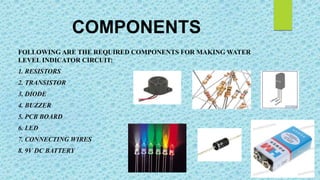
COMPONENTS
FOLLOWING ARE THE REQUIRED COMPONENTS FOR MAKING WATER
LEVEL INDICATOR CIRCUIT:
1. RESISTORS
2. TRANSISTOR
3. DIODE
4. BUZZER
5. PCB BOARD
6. LED
7. CONNECTING WIRES
8. 9V DC BATTERY
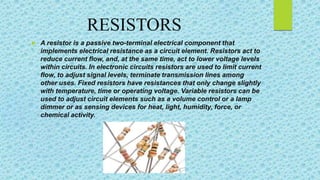
RESISTORS
 A resistor is a passive two-terminal electrical component that
implements electrical resistance as a circuit element. Resistors act to
reduce current flow, and, at the same time, act to lower voltage levels
within circuits. In electronic circuits resistors are used to limit current
flow, to adjust signal levels, terminate transmission lines among
other uses. Fixed resistors have resistances that only change slightly
with temperature, time or operating voltage. Variable resistors can be
used to adjust circuit elements such as a volume control or a lamp
dimmer or as sensing devices for heat, light, humidity, force, or
chemical activity.
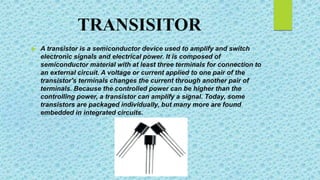
TRANSISITOR
 A transistor is a semiconductor device used to amplify and switch
electronic signals and electrical power. It is composed of
semiconductor material with at least three terminals for connection to
an external circuit. A voltage or current applied to one pair of the
transistor's terminals changes the current through another pair of
terminals. Because the controlled power can be higher than the
controlling power, a transistor can amplify a signal. Today, some
transistors are packaged individually, but many more are found
embedded in integrated circuits.
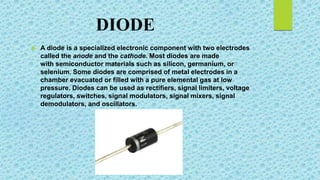
DIODE
 A diode is a specialized electronic component with two electrodes
called the anode and the cathode. Most diodes are made
with semiconductor materials such as silicon, germanium, or
selenium. Some diodes are comprised of metal electrodes in a
chamber evacuated or filled with a pure elemental gas at low
pressure. Diodes can be used as rectifiers, signal limiters, voltage
regulators, switches, signal modulators, signal mixers, signal
demodulators, and oscillators.
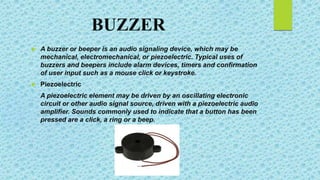
BUZZER
 A buzzer or beeper is an audio signaling device, which may be
mechanical, electromechanical, or piezoelectric. Typical uses of
buzzers and beepers include alarm devices, timers and confirmation
of user input such as a mouse click or keystroke.
 Piezoelectric
A piezoelectric element may be driven by an oscillating electronic
circuit or other audio signal source, driven with a piezoelectric audio
amplifier. Sounds commonly used to indicate that a button has been
pressed are a click, a ring or a beep.
PCB BOARD
 A printed circuit board (PCB) mechanically supports and electrically
connects electronic components using conductive tracks, pads and
other features etched from copper sheets laminated onto a non-
conductive substrate. PCBs can be single sided , double sided ( or
multi-layer .
 Printed circuit boards are used in all but the simplest electronic
products. PCBs require the additional design effort to lay out the
circuit, but manufacturing and assembly can be automated.
Manufacturing circuits with PCBs is cheaper and faster than with
other wiring methods as components are mounted and wired with
one single part. Furthermore, operator wiring errors are eliminated.
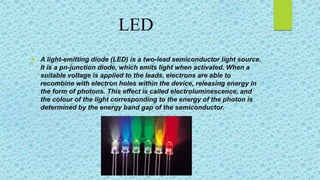
LED
 A light-emitting diode (LED) is a two-lead semiconductor light source.
It is a pn-junction diode, which emits light when activated. When a
suitable voltage is applied to the leads, electrons are able to
recombine with electron holes within the device, releasing energy in
the form of photons. This effect is called electroluminescence, and
the colour of the light corresponding to the energy of the photon is
determined by the energy band gap of the semiconductor.
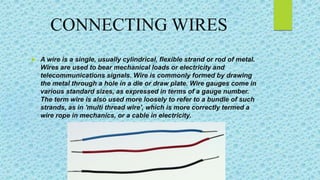
CONNECTING WIRES
 A wire is a single, usually cylindrical, flexible strand or rod of metal.
Wires are used to bear mechanical loads or electricity and
telecommunications signals. Wire is commonly formed by drawing
the metal through a hole in a die or draw plate. Wire gauges come in
various standard sizes, as expressed in terms of a gauge number.
The term wire is also used more loosely to refer to a bundle of such
strands, as in 'multi thread wire', which is more correctly termed a
wire rope in mechanics, or a cable in electricity.
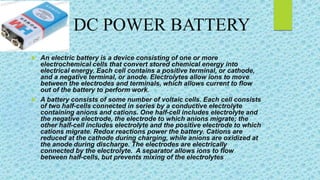
DC POWER BATTERY
 An electric battery is a device consisting of one or more
electrochemical cells that convert stored chemical energy into
electrical energy. Each cell contains a positive terminal, or cathode,
and a negative terminal, or anode. Electrolytes allow ions to move
between the electrodes and terminals, which allows current to flow
out of the battery to perform work.
 A battery consists of some number of voltaic cells. Each cell consists
of two half-cells connected in series by a conductive electrolyte
containing anions and cations. One half-cell includes electrolyte and
the negative electrode, the electrode to which anions migrate; the
other half-cell includes electrolyte and the positive electrode to which
cations migrate. Redox reactions power the battery. Cations are
reduced at the cathode during charging, while anions are oxidized at
the anode during discharge. The electrodes are electrically
connected by the electrolyte. A separator allows ions to flow
between half-cells, but prevents mixing of the electrolytes
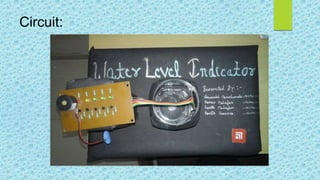
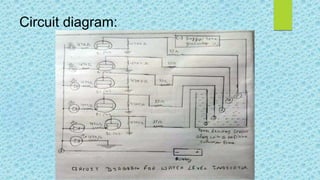
Circuit:
Circuit diagram:
WORKING:
 The operation of this project is very simple and can be understood
easily. In our project “water level indicator” there are 3 main
conditions:
 There is no water available in the source tank.
 Intermediate level i.e. either of 3rd to 5th level.
 There is sample amount of water available in the source tank.
 So let us discuss on the more about these 3 conditions
Condition 1:Water is not available
 When the tank is empty there is no conductive path between any of
the 3 indicating probes and the common probe (which is connected
to 9v+ supply) so the transistor base emitter region will not have
sufficient biasing voltage hence it remains in cut off region and the
output across its collector will be Vc approximately 9v and thus
indicates, the tank is empty.
Condition 2: intermediate levels
 Now as the water starts filling in the tank a conductive path is
established between the sensing probes and the common probe and
the corresponding transistors get sufficient biasing at their base,
they starts conducting and now the outputs will be Vce (i.e. 1.2v-1.8v)
approximately which is given to microcontroller. Here the
microcontroller is programmed as a priority encoder which detects
the highest priority input and displays corresponding water level in
the seven segment display. In this project while the water level
reaches the 7th level i.e. last but one level along with display in seven
segment a discontinuous buzzer is activated which warns user that
tank is going to be full soon.
Condition 3:Water full
 When the tank becomes full, the top level probe gets the conductive
path through water and the corresponding transistor gets into
conduction not only displays the level in Five segment display but
also activates the continuous buzzer by which user can understand
that tank is full and can switch off the motor and save water.
Need of water level indicator:
 Overflow problems
 To prevent wastage of energy
 To prevent wastage of water
 Observation
 Now no need to go on the roof to check the water level.
 Can be used to measure underground storage of water.
 Water level Indicator works to maintain a constant water level.
(Used in different Plants and Industries)
 Alarm starts ringing as soon as tank becomes full.
 It helps to check overflow and wastage of water
by warning the person when the tank is about to brim.
 It can also be used to calculate incoming and out going water
in large reservoirs.
 It is used to predict the arrival of floods.
APPLICATIONS
References
https://www.scribd.com
http://www.electronicsforyou.com
http://www.wikipedia.org
http://www.engineersgarage.com
ANY QUESTION?
THANKYOU
FOR
YOUR
ATTENTION

Water level indicator

  • 1.
  • 2.
    PEOPLE INVOLVED SAURABH(1411981206) KANAV MAHAJAN(1411981293) KARTIKMAHAJAN(1411981295) KARTIK SHARMA(1411981296)
  • 3.
    INTRODUCTION What is Waterlevel indicator? The Water Level Indicator employs a simple mechanism to detect and indicate the water level in an overhead tank or any other water container.
  • 4.
    THE SITUATION • Thehouse where we live in has an overhead tank which is about 30 feet from the ground level. • We were getting bored going up the rooftop to check whether the tank has filled or the water level was below to start the pump. • We had to do this again and again. Then we sought for a solution. • We always used to think of the possibilities of how can this problem be tackled in an electronic way. • After years of research and by trial and error, we found one and wanted to put whatever we have done out here so that it may be helpful to someone who has a overhead water tank at their homes. • So we have tried our best efforts to optimise all the resources and have come up with a bright project that could enlighten the future generations
  • 5.
    FEATURES  Easy installation. Low maintenance.  Compact elegant design.  Avoid seepage of roofs and walls due to overflowing tanks.  Consume very little energy, ideal for continuous operation  Shows clear indication of water levels in the overhead tank.
  • 6.
    COMPONENTS FOLLOWING ARE THEREQUIRED COMPONENTS FOR MAKING WATER LEVEL INDICATOR CIRCUIT: 1. RESISTORS 2. TRANSISTOR 3. DIODE 4. BUZZER 5. PCB BOARD 6. LED 7. CONNECTING WIRES 8. 9V DC BATTERY
  • 7.
    RESISTORS  A resistoris a passive two-terminal electrical component that implements electrical resistance as a circuit element. Resistors act to reduce current flow, and, at the same time, act to lower voltage levels within circuits. In electronic circuits resistors are used to limit current flow, to adjust signal levels, terminate transmission lines among other uses. Fixed resistors have resistances that only change slightly with temperature, time or operating voltage. Variable resistors can be used to adjust circuit elements such as a volume control or a lamp dimmer or as sensing devices for heat, light, humidity, force, or chemical activity.
  • 8.
    TRANSISITOR  A transistoris a semiconductor device used to amplify and switch electronic signals and electrical power. It is composed of semiconductor material with at least three terminals for connection to an external circuit. A voltage or current applied to one pair of the transistor's terminals changes the current through another pair of terminals. Because the controlled power can be higher than the controlling power, a transistor can amplify a signal. Today, some transistors are packaged individually, but many more are found embedded in integrated circuits.
  • 9.
    DIODE  A diodeis a specialized electronic component with two electrodes called the anode and the cathode. Most diodes are made with semiconductor materials such as silicon, germanium, or selenium. Some diodes are comprised of metal electrodes in a chamber evacuated or filled with a pure elemental gas at low pressure. Diodes can be used as rectifiers, signal limiters, voltage regulators, switches, signal modulators, signal mixers, signal demodulators, and oscillators.
  • 10.
    BUZZER  A buzzeror beeper is an audio signaling device, which may be mechanical, electromechanical, or piezoelectric. Typical uses of buzzers and beepers include alarm devices, timers and confirmation of user input such as a mouse click or keystroke.  Piezoelectric A piezoelectric element may be driven by an oscillating electronic circuit or other audio signal source, driven with a piezoelectric audio amplifier. Sounds commonly used to indicate that a button has been pressed are a click, a ring or a beep.
  • 11.
    PCB BOARD  Aprinted circuit board (PCB) mechanically supports and electrically connects electronic components using conductive tracks, pads and other features etched from copper sheets laminated onto a non- conductive substrate. PCBs can be single sided , double sided ( or multi-layer .  Printed circuit boards are used in all but the simplest electronic products. PCBs require the additional design effort to lay out the circuit, but manufacturing and assembly can be automated. Manufacturing circuits with PCBs is cheaper and faster than with other wiring methods as components are mounted and wired with one single part. Furthermore, operator wiring errors are eliminated.
  • 12.
    LED  A light-emittingdiode (LED) is a two-lead semiconductor light source. It is a pn-junction diode, which emits light when activated. When a suitable voltage is applied to the leads, electrons are able to recombine with electron holes within the device, releasing energy in the form of photons. This effect is called electroluminescence, and the colour of the light corresponding to the energy of the photon is determined by the energy band gap of the semiconductor.
  • 13.
    CONNECTING WIRES  Awire is a single, usually cylindrical, flexible strand or rod of metal. Wires are used to bear mechanical loads or electricity and telecommunications signals. Wire is commonly formed by drawing the metal through a hole in a die or draw plate. Wire gauges come in various standard sizes, as expressed in terms of a gauge number. The term wire is also used more loosely to refer to a bundle of such strands, as in 'multi thread wire', which is more correctly termed a wire rope in mechanics, or a cable in electricity.
  • 14.
    DC POWER BATTERY An electric battery is a device consisting of one or more electrochemical cells that convert stored chemical energy into electrical energy. Each cell contains a positive terminal, or cathode, and a negative terminal, or anode. Electrolytes allow ions to move between the electrodes and terminals, which allows current to flow out of the battery to perform work.  A battery consists of some number of voltaic cells. Each cell consists of two half-cells connected in series by a conductive electrolyte containing anions and cations. One half-cell includes electrolyte and the negative electrode, the electrode to which anions migrate; the other half-cell includes electrolyte and the positive electrode to which cations migrate. Redox reactions power the battery. Cations are reduced at the cathode during charging, while anions are oxidized at the anode during discharge. The electrodes are electrically connected by the electrolyte. A separator allows ions to flow between half-cells, but prevents mixing of the electrolytes
  • 15.
  • 16.
  • 17.
    WORKING:  The operationof this project is very simple and can be understood easily. In our project “water level indicator” there are 3 main conditions:  There is no water available in the source tank.  Intermediate level i.e. either of 3rd to 5th level.  There is sample amount of water available in the source tank.  So let us discuss on the more about these 3 conditions
  • 18.
    Condition 1:Water isnot available  When the tank is empty there is no conductive path between any of the 3 indicating probes and the common probe (which is connected to 9v+ supply) so the transistor base emitter region will not have sufficient biasing voltage hence it remains in cut off region and the output across its collector will be Vc approximately 9v and thus indicates, the tank is empty.
  • 19.
    Condition 2: intermediatelevels  Now as the water starts filling in the tank a conductive path is established between the sensing probes and the common probe and the corresponding transistors get sufficient biasing at their base, they starts conducting and now the outputs will be Vce (i.e. 1.2v-1.8v) approximately which is given to microcontroller. Here the microcontroller is programmed as a priority encoder which detects the highest priority input and displays corresponding water level in the seven segment display. In this project while the water level reaches the 7th level i.e. last but one level along with display in seven segment a discontinuous buzzer is activated which warns user that tank is going to be full soon.
  • 20.
    Condition 3:Water full When the tank becomes full, the top level probe gets the conductive path through water and the corresponding transistor gets into conduction not only displays the level in Five segment display but also activates the continuous buzzer by which user can understand that tank is full and can switch off the motor and save water.
  • 21.
    Need of waterlevel indicator:  Overflow problems  To prevent wastage of energy  To prevent wastage of water  Observation
  • 22.
     Now noneed to go on the roof to check the water level.  Can be used to measure underground storage of water.  Water level Indicator works to maintain a constant water level. (Used in different Plants and Industries)  Alarm starts ringing as soon as tank becomes full.  It helps to check overflow and wastage of water by warning the person when the tank is about to brim.  It can also be used to calculate incoming and out going water in large reservoirs.  It is used to predict the arrival of floods. APPLICATIONS
  • 23.
  • 24.
  • 25.