1

            KALASALINGAM UNIVERSITY

         Department of Electronics and Communication Engineering


    WATER LEVEL ALARM INDICATOR


Submitted By:                                     Guided By:
Anish Anand                                       Mr. M. K. Parmathma
9911005012                                        Assistant Professor
ECE „A‟                                           ECE , KLU
Aug-12
2


          COMPONENTS REQUIRED

 IC:-ICNE555

 Resistor:-R1(1K),R2(100K)

 Buzzer:-K1

 Capacitor :-C1(2.2µ,63V)

 Battery:-12Volts


                                Aug-12
3

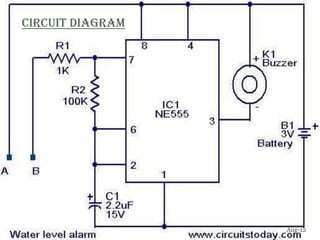
CIRCUIT DIAGRAM


                  Aug-12
4


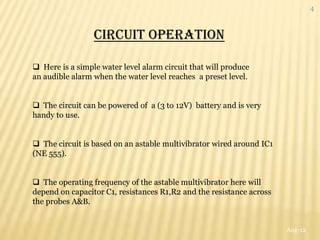
                 CIRCUIT OPERATION

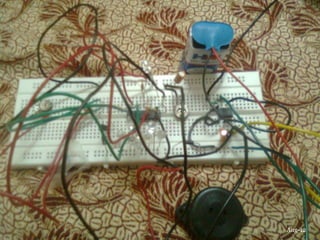
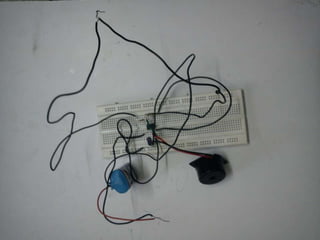
 Here is a simple water level alarm circuit that will produce
an audible alarm when the water level reaches a preset level.


 The circuit can be powered of a (3 to 12V) battery and is very
handy to use.


 The circuit is based on an astable multivibrator wired around IC1
(NE 555).


 The operating frequency of the astable multivibrator here will
depend on capacitor C1, resistances R1,R2 and the resistance across
the probes A&B.


                                                                      Aug-12
5


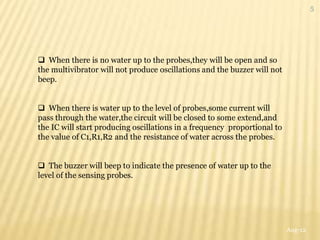
 When there is no water up to the probes,they will be open and so
the multivibrator will not produce oscillations and the buzzer will not
beep.


 When there is water up to the level of probes,some current will
pass through the water,the circuit will be closed to some extend,and
the IC will start producing oscillations in a frequency proportional to
the value of C1,R1,R2 and the resistance of water across the probes.


 The buzzer will beep to indicate the presence of water up to the
level of the sensing probes.


                                                                          Aug-12
6


COMPONENTS REQUIRED


                      Aug-12
7


COMPONENTS REQUIRED


                      Aug-12
8

                         IC NE555
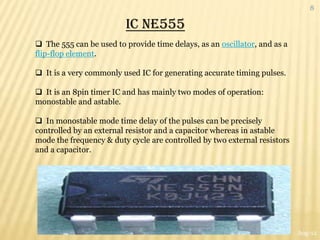
 The 555 can be used to provide time delays, as an oscillator, and as a
flip-flop element.

 It is a very commonly used IC for generating accurate timing pulses.

 It is an 8pin timer IC and has mainly two modes of operation:
monostable and astable.

 In monostable mode time delay of the pulses can be precisely
controlled by an external resistor and a capacitor whereas in astable
mode the frequency & duty cycle are controlled by two external resistors
and a capacitor.


                                                                           Aug-12
9

           IC NE555 [PIN DIAGRAM]


 PIN 1 “GROUND” low level (0 V)

 PIN 2 “TRIGGER” Voltage below 1/3 Vcc to trigger the pulse

 PIN 3 “OUT” Pulsating output


                                                               Aug-12
10


 PIN 4 “RESET” interrupts the timing interval at Output.


 PIN 5 “CONTROL VOLTAGE” Provides access to the internal
voltage divider; default 2/3 Vcc.


 PIN 6 “THRESHOLD “ The pulse ends when the voltage is
greater than Control.


 PIN 7 “DISCHARGE ” Open collector output; to discharge the
capacitor.


 PIN 8 “VCC” Positive supply voltage is usually between 3 and 15 V.


                                                                       Aug-12
11

                           RESISTOR
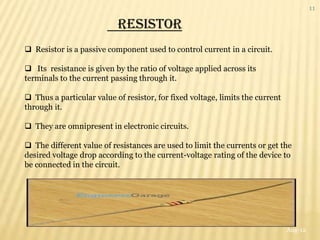
 Resistor is a passive component used to control current in a circuit.

 Its resistance is given by the ratio of voltage applied across its
terminals to the current passing through it.

 Thus a particular value of resistor, for fixed voltage, limits the current
through it.

 They are omnipresent in electronic circuits.

 The different value of resistances are used to limit the currents or get the
desired voltage drop according to the current-voltage rating of the device to
be connected in the circuit.


                                                                               Aug-12
12


 buzzer

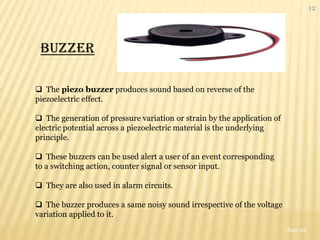
 The piezo buzzer produces sound based on reverse of the
piezoelectric effect.

 The generation of pressure variation or strain by the application of
electric potential across a piezoelectric material is the underlying
principle.

 These buzzers can be used alert a user of an event corresponding
to a switching action, counter signal or sensor input.

 They are also used in alarm circuits.

 The buzzer produces a same noisy sound irrespective of the voltage
variation applied to it.
                                                                         Aug-12
13


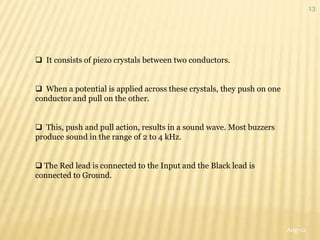
 It consists of piezo crystals between two conductors.


 When a potential is applied across these crystals, they push on one
conductor and pull on the other.


 This, push and pull action, results in a sound wave. Most buzzers
produce sound in the range of 2 to 4 kHz.


 The Red lead is connected to the Input and the Black lead is
connected to Ground.


                                                                        Aug-12
14


                            CAPACITOR
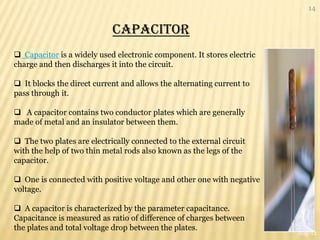
 Capacitor is a widely used electronic component. It stores electric
charge and then discharges it into the circuit.

 It blocks the direct current and allows the alternating current to
pass through it.

 A capacitor contains two conductor plates which are generally
made of metal and an insulator between them.

 The two plates are electrically connected to the external circuit
with the help of two thin metal rods also known as the legs of the
capacitor.

 One is connected with positive voltage and other one with negative
voltage.

 A capacitor is characterized by the parameter capacitance.
Capacitance is measured as ratio of difference of charges between
the plates and total voltage drop between the plates.
                                                                        Aug-12
15


                           BATTERY[12V]

 It is a collection of one or more electrochemical cells in which
stored chemical energy is converted into electrical energy.

 The principles of operation haven‟t changed much since the time
of Volta.

 Each cell consists of two half cells connected in series through an
electrolytic solution.

 One half cell houses the Anode to which the positive ions migrate
from the Electrolyte and the other houses the Cathode to which
the negative ones drift.

 The two cells are may be connected via a semi permeable
membranous structure allowing ions to flow but not the mixing of
electrolytes as in the case of most primary cells or in the same
solution as in secondary cells.
                                                                        Aug-12
16


     application & advantages


 Water level indicator is used in applications like storage
tanks, boilers etc. to indicate level of water inside.


 Easily indicate when water level is full in tank with beep
Sound.


 Low cost


                                                               Aug-12
17


Aug-12
THANK YOU   THE END   ANY QUERIES???


                                  Rx


                               Aug-12

water level indicator alarm

  • 1.
    1 KALASALINGAM UNIVERSITY Department of Electronics and Communication Engineering WATER LEVEL ALARM INDICATOR Submitted By: Guided By: Anish Anand Mr. M. K. Parmathma 9911005012 Assistant Professor ECE „A‟ ECE , KLU Aug-12
  • 2.
    2 COMPONENTS REQUIRED  IC:-ICNE555  Resistor:-R1(1K),R2(100K)  Buzzer:-K1  Capacitor :-C1(2.2µ,63V)  Battery:-12Volts Aug-12
  • 3.
  • 4.
    4 CIRCUIT OPERATION  Here is a simple water level alarm circuit that will produce an audible alarm when the water level reaches a preset level.  The circuit can be powered of a (3 to 12V) battery and is very handy to use.  The circuit is based on an astable multivibrator wired around IC1 (NE 555).  The operating frequency of the astable multivibrator here will depend on capacitor C1, resistances R1,R2 and the resistance across the probes A&B. Aug-12
  • 5.
    5  When thereis no water up to the probes,they will be open and so the multivibrator will not produce oscillations and the buzzer will not beep.  When there is water up to the level of probes,some current will pass through the water,the circuit will be closed to some extend,and the IC will start producing oscillations in a frequency proportional to the value of C1,R1,R2 and the resistance of water across the probes.  The buzzer will beep to indicate the presence of water up to the level of the sensing probes. Aug-12
  • 6.
  • 7.
  • 8.
    8 IC NE555  The 555 can be used to provide time delays, as an oscillator, and as a flip-flop element.  It is a very commonly used IC for generating accurate timing pulses.  It is an 8pin timer IC and has mainly two modes of operation: monostable and astable.  In monostable mode time delay of the pulses can be precisely controlled by an external resistor and a capacitor whereas in astable mode the frequency & duty cycle are controlled by two external resistors and a capacitor. Aug-12
  • 9.
    9 IC NE555 [PIN DIAGRAM]  PIN 1 “GROUND” low level (0 V)  PIN 2 “TRIGGER” Voltage below 1/3 Vcc to trigger the pulse  PIN 3 “OUT” Pulsating output Aug-12
  • 10.
    10  PIN 4“RESET” interrupts the timing interval at Output.  PIN 5 “CONTROL VOLTAGE” Provides access to the internal voltage divider; default 2/3 Vcc.  PIN 6 “THRESHOLD “ The pulse ends when the voltage is greater than Control.  PIN 7 “DISCHARGE ” Open collector output; to discharge the capacitor.  PIN 8 “VCC” Positive supply voltage is usually between 3 and 15 V. Aug-12
  • 11.
    11 RESISTOR  Resistor is a passive component used to control current in a circuit.  Its resistance is given by the ratio of voltage applied across its terminals to the current passing through it.  Thus a particular value of resistor, for fixed voltage, limits the current through it.  They are omnipresent in electronic circuits.  The different value of resistances are used to limit the currents or get the desired voltage drop according to the current-voltage rating of the device to be connected in the circuit. Aug-12
  • 12.
    12 buzzer  Thepiezo buzzer produces sound based on reverse of the piezoelectric effect.  The generation of pressure variation or strain by the application of electric potential across a piezoelectric material is the underlying principle.  These buzzers can be used alert a user of an event corresponding to a switching action, counter signal or sensor input.  They are also used in alarm circuits.  The buzzer produces a same noisy sound irrespective of the voltage variation applied to it. Aug-12
  • 13.
    13  It consistsof piezo crystals between two conductors.  When a potential is applied across these crystals, they push on one conductor and pull on the other.  This, push and pull action, results in a sound wave. Most buzzers produce sound in the range of 2 to 4 kHz.  The Red lead is connected to the Input and the Black lead is connected to Ground. Aug-12
  • 14.
    14 CAPACITOR  Capacitor is a widely used electronic component. It stores electric charge and then discharges it into the circuit.  It blocks the direct current and allows the alternating current to pass through it.  A capacitor contains two conductor plates which are generally made of metal and an insulator between them.  The two plates are electrically connected to the external circuit with the help of two thin metal rods also known as the legs of the capacitor.  One is connected with positive voltage and other one with negative voltage.  A capacitor is characterized by the parameter capacitance. Capacitance is measured as ratio of difference of charges between the plates and total voltage drop between the plates. Aug-12
  • 15.
    15 BATTERY[12V]  It is a collection of one or more electrochemical cells in which stored chemical energy is converted into electrical energy.  The principles of operation haven‟t changed much since the time of Volta.  Each cell consists of two half cells connected in series through an electrolytic solution.  One half cell houses the Anode to which the positive ions migrate from the Electrolyte and the other houses the Cathode to which the negative ones drift.  The two cells are may be connected via a semi permeable membranous structure allowing ions to flow but not the mixing of electrolytes as in the case of most primary cells or in the same solution as in secondary cells. Aug-12
  • 16.
    16 application & advantages  Water level indicator is used in applications like storage tanks, boilers etc. to indicate level of water inside.  Easily indicate when water level is full in tank with beep Sound.  Low cost Aug-12
  • 17.
  • 18.
    THANK YOU THE END ANY QUERIES??? Rx Aug-12