Hetauda School Of Management &
Social Sciences
Presentation On: WaterFall Process Model
Presented By:Purushottam
dahal
BIM 6th Semester
Contents
 History of waterfall process model
 What is waterfall process model?
 Phases of waterfall process model
 Advantages of waterfall process model
 Disadvantages of waterfall process model
 When to use waterfall process model
History of waterfall process model
 In 1970 Royce proposed what is now popularly
referred to as the waterfall model as an initial
concept, a model which he argued was flawed.
 His paper then explored how the initial model
could be developed into an iterative model,
with feedback from each phase influencing
previous phases, similar to many methods used
widely and highly regarded by many today.
What is waterfall process model?
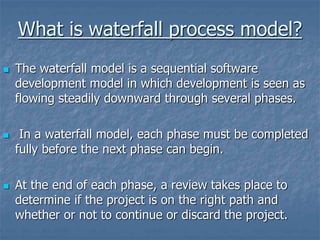
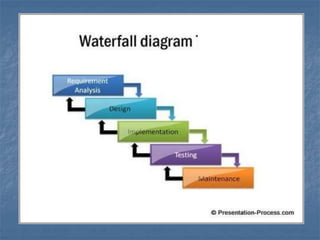
 The waterfall model is a sequential software
development model in which development is seen as
flowing steadily downward through several phases.
 In a waterfall model, each phase must be completed
fully before the next phase can begin.
 At the end of each phase, a review takes place to
determine if the project is on the right path and
whether or not to continue or discard the project.
Phases of waterfall process model
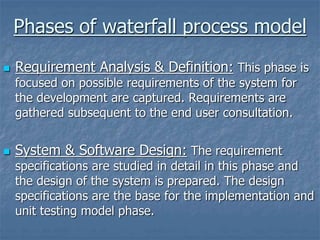
 Requirement Analysis & Definition: This phase is
focused on possible requirements of the system for
the development are captured. Requirements are
gathered subsequent to the end user consultation.
 System & Software Design: The requirement
specifications are studied in detail in this phase and
the design of the system is prepared. The design
specifications are the base for the implementation and
unit testing model phase.
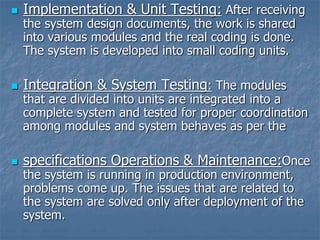
 Implementation & Unit Testing: After receiving
the system design documents, the work is shared
into various modules and the real coding is done.
The system is developed into small coding units.
 Integration & System Testing: The modules
that are divided into units are integrated into a
complete system and tested for proper coordination
among modules and system behaves as per the
 specifications Operations & Maintenance:Once
the system is running in production environment,
problems come up. The issues that are related to
the system are solved only after deployment of the
system.
Advantages
 Simple to understand and use.
 Easy to manage
 Phases are processed and completed one
at a time.
 Works well for smaller projects where
requirements are very well understood.
Disadvantages
 Once an application is in the testing stage, it is very
difficult to go back and change something that was
not well-thought out in the concept stage.
 High amounts of risk and uncertainty.
 Not a good model for complex and object-oriented
projects.
 Poor model for long and ongoing projects.
 Not suitable for the projects where requirements are
at a moderate to high risk of changing.
When to use:
 Requirements are very well known, clear
and fixed.
 Product definition is stable.
 Technology is understood.
 There are no ambiguous requirements
 The project is short.
THANK YOU!!!

Water fall process model

  • 1.
    Hetauda School OfManagement & Social Sciences Presentation On: WaterFall Process Model Presented By:Purushottam dahal BIM 6th Semester
  • 2.
    Contents  History ofwaterfall process model  What is waterfall process model?  Phases of waterfall process model  Advantages of waterfall process model  Disadvantages of waterfall process model  When to use waterfall process model
  • 3.
    History of waterfallprocess model  In 1970 Royce proposed what is now popularly referred to as the waterfall model as an initial concept, a model which he argued was flawed.  His paper then explored how the initial model could be developed into an iterative model, with feedback from each phase influencing previous phases, similar to many methods used widely and highly regarded by many today.
  • 4.
    What is waterfallprocess model?  The waterfall model is a sequential software development model in which development is seen as flowing steadily downward through several phases.  In a waterfall model, each phase must be completed fully before the next phase can begin.  At the end of each phase, a review takes place to determine if the project is on the right path and whether or not to continue or discard the project.
  • 6.
    Phases of waterfallprocess model  Requirement Analysis & Definition: This phase is focused on possible requirements of the system for the development are captured. Requirements are gathered subsequent to the end user consultation.  System & Software Design: The requirement specifications are studied in detail in this phase and the design of the system is prepared. The design specifications are the base for the implementation and unit testing model phase.
  • 7.
     Implementation &Unit Testing: After receiving the system design documents, the work is shared into various modules and the real coding is done. The system is developed into small coding units.  Integration & System Testing: The modules that are divided into units are integrated into a complete system and tested for proper coordination among modules and system behaves as per the  specifications Operations & Maintenance:Once the system is running in production environment, problems come up. The issues that are related to the system are solved only after deployment of the system.
  • 8.
    Advantages  Simple tounderstand and use.  Easy to manage  Phases are processed and completed one at a time.  Works well for smaller projects where requirements are very well understood.
  • 9.
    Disadvantages  Once anapplication is in the testing stage, it is very difficult to go back and change something that was not well-thought out in the concept stage.  High amounts of risk and uncertainty.  Not a good model for complex and object-oriented projects.  Poor model for long and ongoing projects.  Not suitable for the projects where requirements are at a moderate to high risk of changing.
  • 10.
    When to use: Requirements are very well known, clear and fixed.  Product definition is stable.  Technology is understood.  There are no ambiguous requirements  The project is short.
  • 11.