V-MODEL
• Before discussing the V-model, we will look at the model
which came before it.
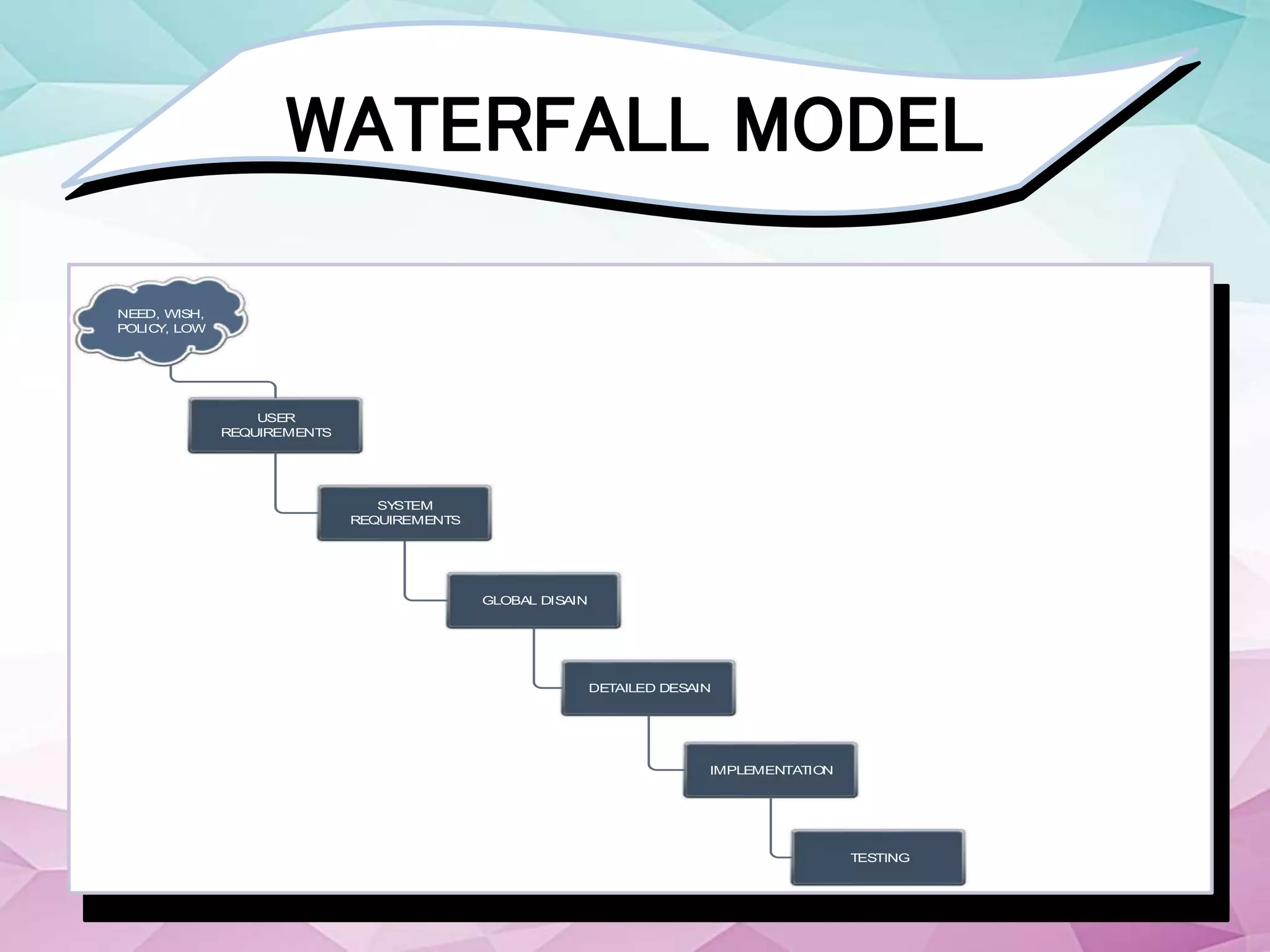
• The waterfall model was one of the earliest models to be
designed. It has a natural timeline where tasks are executed
in a sequential fashion.
• We start at the top of the waterfall with a feasibility study and
flow down through the various project tasks finishing with
implementation into the live environment.
• Design flows through into development, which in turn flows
into build, and finally on into test.
• Testing tends to happen towards the end of the project life
cycle so defects are detected close to the live implementation
date.
• With this model it has been difficult to get feedback passed
backwards up the waterfall and there are difficulties if we
need to carry out numerous iterations for a particular phase.
WATERFALL MODEL
NEED, WISH,
POLICY, LOW
USER
REQUIREMENTS
SYSTEM
REQUIREMENTS
GLOBAL DISAIN
DETAILED DESAIN
IMPLEMENTATION
TESTING
V-MODEL Cont.
• The V-model was developed to address some of the problems
experienced using the traditional waterfall approach.
• Defects were being found too late in the life cycle, as testing
was not involved until the end of the project.
• Testing also added lead time due to its late involvement. The
V-model provides guidance that testing needs to begin as
early as possible in the life cycle, is one of the fundamental
principles of structured testing.
• It also shows that testing is not only an execution-based
activity. There are a variety of activities that need to be
performed before the end of the coding phase.
V-MODEL Cont.
• These activities should be carried out in parallel with
development activities, and testers need to work with
developers and business analysts so they can perform these
activities and tasks and produce a set of test deliverables.
• The work products produced by the developers and business
analysts during development are the basis of testing in one or
more levels.
• By starting test design early, defects are often found in the
test basis documents.
• A good practice is to have testers involved even earlier, during
the review of the (draft) test basis documents.
V-MODEL Cont.
• The V-model is a model that illustrates how testing activities
(verification and validation) can be integrated into each phase
of the life cycle.
• Within the V-model, validation testing takes place especially
during the early stages, e.g. reviewing the user requirements,
and late in the life cycle, e.g. during user acceptance testing.
• Although variants of the V-model exist, a common type of V-
model uses four test levels.
V-MODEL Cont.
• The four test levels used, each with their own objectives, are:
1. 2.
component testing
: searches for
defects in and
verifies the
functioning of
software
components (e.g.
modules, programs,
objects, classes etc.)
that are separately
testable;
integration testing:
tests interfaces
between components,
interactions to different
parts of a system such
as an operating system,
file system and hard
ware or interfaces
between systems;
V-MODEL Cont.
• The four test levels used, each with their own objectives, are:
3. 4.
system testing:
concerned with the
behavior of the
whole
system/product as
defined by the scope
of a development
project or product.
The main focus of
system testing is
verification against
specified
requirements;
acceptance testing:
validation testing with
respect to user needs,
require ments, and
business processes
conducted to
determine whether or
not to accept the
system.
V-MODEL Cont.
• In practice, a V-model may have more, fewer or different levels
of development and testing, depending on the project and the
software product.
• For example, there may be component integration testing after
component testing and system integration testing after system
testing.
• Test levels can be combined or reorganized depending on the
nature of the project or the system architecture.
• For the integration of a commercial off-the-shelf (COTS)
software product into a system, a purchaser may perform only
integration testing at the system level (e.g. integration to the
infrastructure and other systems) and at a later stage
acceptance testing.
V-MODEL Cont.
V-MODEL Cont.
• Note that the types of work products mentioned in Figure 2.2
on the left side of the V-model are just an illustration.
• In practice they come under many different names.
• References for generic work products include the Capability
Maturity Model Integration (CMMi) or the 'Software life cycle
processes' from ISO/IEC 12207. The CMMi is a framework for
process improvement for both system engineering and
software engineering. It provides guidance on where to focus
and how, in order to increase the level of process maturity
[Chrissis et ah, 2004]. ISO/IEC 12207 is an integrated
software life cycle process standard that is rapidly becoming
more popular.
References
• Graham et.al. (2011). ISTQB-Fondation of Software Testing.
London: Cengage Learning EMEA.
References
• http://sif.uin-suska.ac.id/
• http://fst.uin-suska.ac.id/
• http://www.uin-suska.ac.id/
V model

V model

  • 2.
    V-MODEL • Before discussingthe V-model, we will look at the model which came before it. • The waterfall model was one of the earliest models to be designed. It has a natural timeline where tasks are executed in a sequential fashion. • We start at the top of the waterfall with a feasibility study and flow down through the various project tasks finishing with implementation into the live environment. • Design flows through into development, which in turn flows into build, and finally on into test. • Testing tends to happen towards the end of the project life cycle so defects are detected close to the live implementation date. • With this model it has been difficult to get feedback passed backwards up the waterfall and there are difficulties if we need to carry out numerous iterations for a particular phase.
  • 3.
    WATERFALL MODEL NEED, WISH, POLICY,LOW USER REQUIREMENTS SYSTEM REQUIREMENTS GLOBAL DISAIN DETAILED DESAIN IMPLEMENTATION TESTING
  • 4.
    V-MODEL Cont. • TheV-model was developed to address some of the problems experienced using the traditional waterfall approach. • Defects were being found too late in the life cycle, as testing was not involved until the end of the project. • Testing also added lead time due to its late involvement. The V-model provides guidance that testing needs to begin as early as possible in the life cycle, is one of the fundamental principles of structured testing. • It also shows that testing is not only an execution-based activity. There are a variety of activities that need to be performed before the end of the coding phase.
  • 5.
    V-MODEL Cont. • Theseactivities should be carried out in parallel with development activities, and testers need to work with developers and business analysts so they can perform these activities and tasks and produce a set of test deliverables. • The work products produced by the developers and business analysts during development are the basis of testing in one or more levels. • By starting test design early, defects are often found in the test basis documents. • A good practice is to have testers involved even earlier, during the review of the (draft) test basis documents.
  • 6.
    V-MODEL Cont. • TheV-model is a model that illustrates how testing activities (verification and validation) can be integrated into each phase of the life cycle. • Within the V-model, validation testing takes place especially during the early stages, e.g. reviewing the user requirements, and late in the life cycle, e.g. during user acceptance testing. • Although variants of the V-model exist, a common type of V- model uses four test levels.
  • 7.
    V-MODEL Cont. • Thefour test levels used, each with their own objectives, are: 1. 2. component testing : searches for defects in and verifies the functioning of software components (e.g. modules, programs, objects, classes etc.) that are separately testable; integration testing: tests interfaces between components, interactions to different parts of a system such as an operating system, file system and hard ware or interfaces between systems;
  • 8.
    V-MODEL Cont. • Thefour test levels used, each with their own objectives, are: 3. 4. system testing: concerned with the behavior of the whole system/product as defined by the scope of a development project or product. The main focus of system testing is verification against specified requirements; acceptance testing: validation testing with respect to user needs, require ments, and business processes conducted to determine whether or not to accept the system.
  • 9.
    V-MODEL Cont. • Inpractice, a V-model may have more, fewer or different levels of development and testing, depending on the project and the software product. • For example, there may be component integration testing after component testing and system integration testing after system testing. • Test levels can be combined or reorganized depending on the nature of the project or the system architecture. • For the integration of a commercial off-the-shelf (COTS) software product into a system, a purchaser may perform only integration testing at the system level (e.g. integration to the infrastructure and other systems) and at a later stage acceptance testing.
  • 10.
  • 11.
    V-MODEL Cont. • Notethat the types of work products mentioned in Figure 2.2 on the left side of the V-model are just an illustration. • In practice they come under many different names. • References for generic work products include the Capability Maturity Model Integration (CMMi) or the 'Software life cycle processes' from ISO/IEC 12207. The CMMi is a framework for process improvement for both system engineering and software engineering. It provides guidance on where to focus and how, in order to increase the level of process maturity [Chrissis et ah, 2004]. ISO/IEC 12207 is an integrated software life cycle process standard that is rapidly becoming more popular.
  • 12.
    References • Graham et.al.(2011). ISTQB-Fondation of Software Testing. London: Cengage Learning EMEA.
  • 13.