Introduction of
C Programming
www.programmingcampus.com


                     www.programmingcampus.com
What is Programming Language?

• An artificial language used to write instructions that can
  be translated into machine language and then executed
  by a computer.

• There are many programming languages. Like C, C++,
  Perl, BASIC, COBOL, Java, etc.


                     www.programmingcampus.com
Types of Programming Language

• Programming languages are fall into three broad
  categories.

• Machine Language.

• Assembly Language.

• High level Language.


                   www.programmingcampus.com
Machine Language

• Machine Language is basically the only language which
  computer can understand.
• machine code, which is represented inside the computer
  by a String of binary digits (bits) 0 and 1.
• The symbol 0 stands for the absence of Electric pulse
  and 1 for the presence of an electric pulse .

• For Example:
• 1 is written in machine language as 0001.


                    www.programmingcampus.com
Assembly language

• It was developed to overcome some of the many
  inconveniences of machine language.
• in which operation codes and operands are given in the
  form of alphanumeric symbols instead of 0’s and l’s.
• These alphanumeric symbols will be known as
  mnemonic codes and can have maximum up to 5 letter
  combination

• For example:
• ADD – Addition
• SUB – Subtraction.
                   www.programmingcampus.com
High-level Language

• High level computer languages give formats close to
  English language.
• High-level languages are basically symbolic languages
  that use English words and/or mathematical symbols
  rather than mnemonic codes.
• Each instruction in the high level language is translated
  into many machine language instructions thus showing
  one-to-many translation.


                    www.programmingcampus.com
Introduction to C Programming

• It is developed by Dennis Ritchie in 1970 at Bell Labs.
• In 1983 American National Standards Institute(ANSI)
  appointed a technical committee to define a standard for
  C.
• The committee approved a version of C in December
  1989 which is now known as ANSI C.
• Used to develop UNIX.


                    www.programmingcampus.com
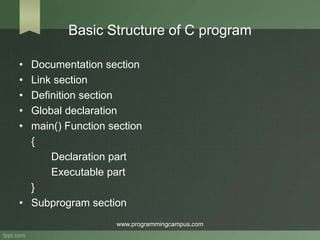
Basic Structure of C program

• Documentation section
• Link section
• Definition section
• Global declaration
• main() Function section
  {
      Declaration part
      Executable part
  }
• Subprogram section
                   www.programmingcampus.com
• Document Section
      It consists a set of comment lines giving program
  details.
• Link Section
      It provide the instruction to the compiler to link
  function from the system library.
• Definition Section
      It define all symbolic constants.
• Global Declaration Section
      It declare variable & function global which can be
  use in entire program. We can use them more than one
  function.
                   www.programmingcampus.com
• main() function section
   – This section content two parts..Declaration part & Execution part.
   – Declaration part declare all variables used in execution part.
• Subprogram Section
   – Subprogram section contain all the user define functions which
     are called in main() function.


                       www.programmingcampus.com
Simple C Program

#include<stdio.h >
void main()
{
       printf(“ProgrammingCampus”);
}

Output:
ProgrammingCampus


                   www.programmingcampus.com

Introduction to c programming

  • 1.
  • 2.
    What is ProgrammingLanguage? • An artificial language used to write instructions that can be translated into machine language and then executed by a computer. • There are many programming languages. Like C, C++, Perl, BASIC, COBOL, Java, etc. www.programmingcampus.com
  • 3.
    Types of ProgrammingLanguage • Programming languages are fall into three broad categories. • Machine Language. • Assembly Language. • High level Language. www.programmingcampus.com
  • 4.
    Machine Language • MachineLanguage is basically the only language which computer can understand. • machine code, which is represented inside the computer by a String of binary digits (bits) 0 and 1. • The symbol 0 stands for the absence of Electric pulse and 1 for the presence of an electric pulse . • For Example: • 1 is written in machine language as 0001. www.programmingcampus.com
  • 5.
    Assembly language • Itwas developed to overcome some of the many inconveniences of machine language. • in which operation codes and operands are given in the form of alphanumeric symbols instead of 0’s and l’s. • These alphanumeric symbols will be known as mnemonic codes and can have maximum up to 5 letter combination • For example: • ADD – Addition • SUB – Subtraction. www.programmingcampus.com
  • 6.
    High-level Language • Highlevel computer languages give formats close to English language. • High-level languages are basically symbolic languages that use English words and/or mathematical symbols rather than mnemonic codes. • Each instruction in the high level language is translated into many machine language instructions thus showing one-to-many translation. www.programmingcampus.com
  • 7.
    Introduction to CProgramming • It is developed by Dennis Ritchie in 1970 at Bell Labs. • In 1983 American National Standards Institute(ANSI) appointed a technical committee to define a standard for C. • The committee approved a version of C in December 1989 which is now known as ANSI C. • Used to develop UNIX. www.programmingcampus.com
  • 8.
    Basic Structure ofC program • Documentation section • Link section • Definition section • Global declaration • main() Function section { Declaration part Executable part } • Subprogram section www.programmingcampus.com
  • 9.
    • Document Section It consists a set of comment lines giving program details. • Link Section It provide the instruction to the compiler to link function from the system library. • Definition Section It define all symbolic constants. • Global Declaration Section It declare variable & function global which can be use in entire program. We can use them more than one function. www.programmingcampus.com
  • 10.
    • main() functionsection – This section content two parts..Declaration part & Execution part. – Declaration part declare all variables used in execution part. • Subprogram Section – Subprogram section contain all the user define functions which are called in main() function. www.programmingcampus.com
  • 11.
    Simple C Program #include<stdio.h> void main() { printf(“ProgrammingCampus”); } Output: ProgrammingCampus www.programmingcampus.com