WASTE MANAGEMENT
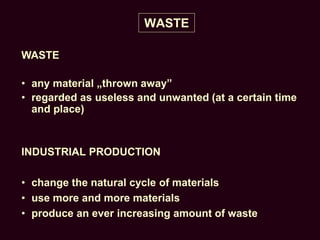
WASTE
INDUSTRIAL PRODUCTION
• change the natural cycle of materials
• use more and more materials
• produce an ever increasing amount of waste
WASTE
• any material „thrown away”
• regarded as useless and unwanted (at a certain time
and place)
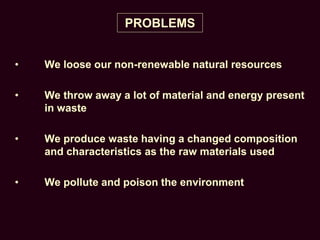
PROBLEMS
• We loose our non-renewable natural resources
• We throw away a lot of material and energy present
in waste
• We produce waste having a changed composition
and characteristics as the raw materials used
• We pollute and poison the environment
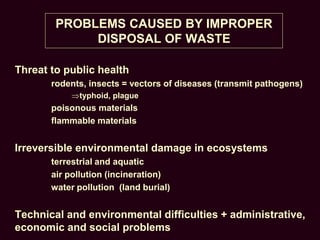
PROBLEMS CAUSED BY IMPROPER
DISPOSAL OF WASTE
Threat to public health
rodents, insects = vectors of diseases (transmit pathogens)
typhoid, plague
poisonous materials
flammable materials
Irreversible environmental damage in ecosystems
terrestrial and aquatic
air pollution (incineration)
water pollution (land burial)
Technical and environmental difficulties + administrative,
economic and social problems
PROBLEMS WITH LAND DISPOSAL OF WASTE
 too little space for disposal
 costs
 harm to the environment and public health
 landfills are unreliable in long run
 aesthetics
 public opposition
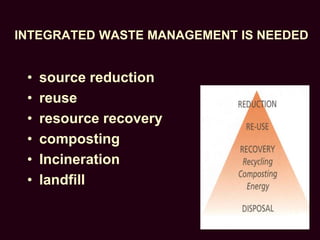
INTEGRATED WASTE MANAGEMENT IS NEEDED
• source reduction
• reuse
• resource recovery
• composting
• Incineration
• landfill
WASTE MANAGEMENT
Solve the technical and environmental difficulties,
administrative, economic and social problems
Tasks to be done:
–Planning
–Design
–Construction
–Operation of facilities for
In the field of:
–Collecting,
–Transporting,
–Processing,
–Disposing of the waste material
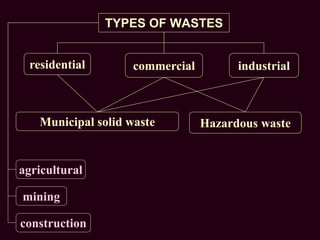
TYPES OF WASTES
residential industrial
commercial
agricultural
mining
construction
Municipal solid waste Hazardous waste
MUNICIPAL SOLID WASTE
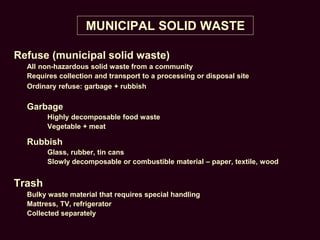
Refuse (municipal solid waste)
All non-hazardous solid waste from a community
Requires collection and transport to a processing or disposal site
Ordinary refuse: garbage + rubbish
Garbage
Highly decomposable food waste
Vegetable + meat
Rubbish
Glass, rubber, tin cans
Slowly decomposable or combustible material – paper, textile, wood
Trash
Bulky waste material that requires special handling
Mattress, TV, refrigerator
Collected separately
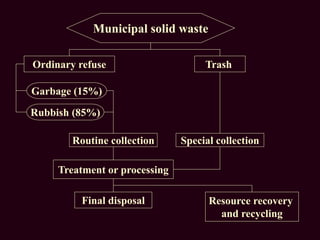
Municipal solid waste
Ordinary refuse Trash
Garbage (15%)
Rubbish (85%)
Routine collection Special collection
Treatment or processing
Resource recovery
and recycling
Final disposal
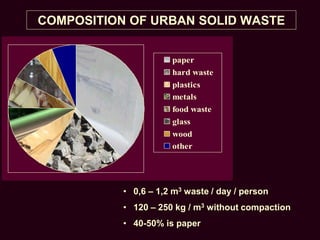
COMPOSITION OF URBAN SOLID WASTE
paper
hard waste
plastics
metals
food waste
glass
wood
other
• 0,6 – 1,2 m3 waste / day / person
• 120 – 250 kg / m3 without compaction
• 40-50% is paper
HAZARDOUS WASTE
can cause serious illness, injury, death
serious threat to the environment
TOXIC WASTE
Generated by industry
Poisonous even in small amount
Arsenic, asbestos, heavy metals, dioxin, chloroform, etc
HAZARDOUS WASTE
REACTIVE WASTES
Unstable, tend to react vigorously with air, water, etc.
Reaction causes explosions, form toxic vapour and fumes
IGNITABLE WASTE
Organic solvents – benzene, toluene
Burn at relatively low temperatures
Present an immediate fire hazard
CORROSIVE
Strong alkaline and acidic substances
Destroy materials and living tissues by chemical reaction
HAZARDOUS WASTE
reactive wastes
ignitable waste
corrosive
• Can cause immediate harmful effects on living
organisms or on the physical environment
• Problems related to transport, storage and disposal
• Must be managed with special care
HAZARDOUS WASTE
INFECTIOUS
Biological waste material
Human tissue from surgery, used bandages and
hypodermic needles, microbial materials
Waste from hospitals and biological research centers
RADIOACTIVE
Ionizing radiation harms living organisms
Persist in the environment for thousands of years before
decay appreciably
Separated from other wastes
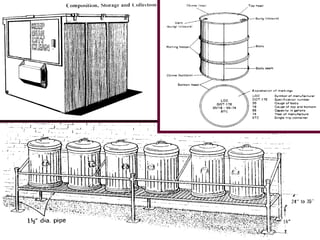
COLLECTION AND TRANSPORT
80% of the cost of waste management is spent for
collection and transport
PROPER STORAGE PRIOR TO COLLECTION
– To protect public health (rodent, insects, odor)
– Aesthetic reasons
– Municipal waste – containers with tight lids
– Containers and storage areas have to be washed
– Waste has to be removed at least weekly
– Individual residences – galvanized metal or plastic
containers
– Apartment residences – larger portable containers – can be
removed and emptied into collection trucks
COLLECTION OF WASTE
responsibility of the local municipality
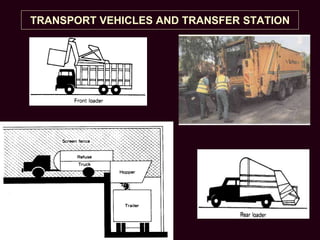
refuse collection vehicles
enclosed, compacting type with a capacity of 15 m3
compaction: 50% reduction
frequency of collection and the point of pickup depends:
type of community
population density
land use in the collection area
combined collection of garbage and rubbish is cheaper
for recycling it is essential to separate
separated collection!!! (paper, metal, plastic, glass,
organics, chemicals, batteries)
TRANSPORT VEHICLES AND TRANSFER STATION
WASTE TREATMENT AND RESOURCE
RECOVERY
Goals:
1. Reduce the total volume and weight of material
that requires disposal
Help to conserve land resources
2. Change the form or characteristic of waste
Composting, neutralizing, shredding, incineration
3. Recover natural resources and energy in the
waste material
Recycling and reuse!!! (it takes 17 trees to make 1 ton of paper)
Requiring extra costs!
REDUCE, RECYCLE, AND REUSE
Reduce waste production:
“consuming and throwing away less” – partly proactive!
•better design of packages: 10%
•recycling programs: 30%
•composting: 10%
•integrated waste management: 50%
Reuse
Usage of the product itself without changing it’s form and
composition. Works rather for trash than for daily garbage
(old cloths, machinery, bottles, jars, boxes, tools…)
REDUCE, RECYCLE, AND REUSE
Recycle
Usage of the resources (matter and energy) stored in the
waste by processing it.
Recyclable garbage
newsprint (paper: 50% by weight, 70% by volume)
glass
aluminum cans and other metals
rubber
plastic
organic material – food waste
REDUCE, RECYCLE, AND REUSE
 We have to separate recyclables in the households
 Packaging has to be minimized
 Recycled products has to be preferred
 Lot of people don’t care
– Extra attention is needed
– Not enough information available for public
 Not enough appropriate recycling centers
 No separated transport (cost is high)
RECYCLING
-
Not yet economical (regulations can help)
Does not eliminate the waste disposal problem
non recyclable residue
Requires selection
Recycled paper is never as good as new but can be used
+
Protection of environment (eg. less harvesting of trees)
Save our resources (they are less and less)
Al cans, glass, rubber, plastic – more and better
technologies for recycling
Energy saving (96% of E is saved by recycling Al cans)
SOLID-WASTE DISPOSAL
• On-site disposal
• Composting
• Incineration
• Open dumps
• Sanitary landfills
ON-SITE DISPOSAL
MECHANICAL GRINDING OF KITCHEN FOOD WASTE
devices in the ww pipe system from a kitchen sink
ground and flushed into the sewer system

- reduces the amount of handling food waste
- easy and quick

- problem is transported (wwtp has to dispose)
- hazardous liquid chemicals
- illegal dumping in urban sewers
COMPOSTING
• biochemical process
• organic materials decompose to a humuslike
material
• aerobic organisms
• in mechanical digesters
• presence of oxygen
• T can reach 65 c because of aerobic microbial action
• V reduction = 50%
• end product is compost or humus – utilizable
–like potting soil
–earthy odor
–can be used as soil conditioner
COMPOSTING
 stabilize the organic material
 agricultural use
 no air pollution
 we save land
 need for separation of organic waste
COMPOSTING
1. Sorting and separating
• Isolate the organic, decomposable part
2. Size reduction
• Shredding and pulverizing
• Relatively uniform mass of material
• Optimize biological activity
• Better handling, moisture control, aeration
3. Composting
4. Product upgrading
5. Marketing (low market need)
COMPOSTING
Open field composting
5-8 weeks
pile of solid waste (<3 m wide, < 2 m high)
mixed at least twice a week – aeration
65 °C – destroy most of pathogens
require large areas (250 000 pe – 24 ha)
COMPOSTING
Enclosed composting
Faster – 1 week
Requires less land
One or more enclosed tanks equipped with stirring
devices rotating flows for mixing and aeration
Air can be used (blown into the waste)
INCINERATION
Reduction of combustible waste to inert residue by
burning at high temperatures (900-1000 °C)
Chemical process
Combustible part is combined with O2  CO2 + H2O (oxidation)
Releases energy
For complete oxidation
waste must be mixed with air
proper temperature for a certain length of time
INCINERATION
Residue
• Ash
• Glass
• Metal cans
• Other unburned substances
• 20% of the original waste volume
• Gaseous products
• Fly ash (cinders, mineral dust, soot)
INCINERATION

- effective conversion of large volumes of combustible
waste
- Simple and robust process
- Heat produced can be recovered
- Stream or electricity
- Existing fossil fuels are preserved
- Good in densely populated urban areas where large
sites suitable for landfilling are not available
- May destroy certain types of hazardous waste material
INCINERATION

- need for separation of organic waste
- air pollution
- toxic ash
- devices to trap the pollutants expensive
- incineration itself is very expensive
- adequate chimney heights are needed
- suitable temperature is needed
- high level technical supervision and skilled emloyees
- use only in larger towns
AIR POLLUTION FROM INCINERATION
nitrogen oxides
sulfur oxides
carbon monoxide
heavy metals (Pb, Cd, Hg)
dust
INCINERATION
Burning 25% of USA’s waste = recycle and compost 75%
Economic viability depends on the sale of energy
produced by burning
volume reduction with 75-95%
maintenance and waste supply problems  50%
525 incineration plants in Europe in 1991
Lots of them are simple mass burning systems without
energy recovery

Waste Management.ppt

  • 1.
  • 2.
    WASTE INDUSTRIAL PRODUCTION • changethe natural cycle of materials • use more and more materials • produce an ever increasing amount of waste WASTE • any material „thrown away” • regarded as useless and unwanted (at a certain time and place)
  • 3.
    PROBLEMS • We looseour non-renewable natural resources • We throw away a lot of material and energy present in waste • We produce waste having a changed composition and characteristics as the raw materials used • We pollute and poison the environment
  • 4.
    PROBLEMS CAUSED BYIMPROPER DISPOSAL OF WASTE Threat to public health rodents, insects = vectors of diseases (transmit pathogens) typhoid, plague poisonous materials flammable materials Irreversible environmental damage in ecosystems terrestrial and aquatic air pollution (incineration) water pollution (land burial) Technical and environmental difficulties + administrative, economic and social problems
  • 5.
    PROBLEMS WITH LANDDISPOSAL OF WASTE  too little space for disposal  costs  harm to the environment and public health  landfills are unreliable in long run  aesthetics  public opposition
  • 6.
    INTEGRATED WASTE MANAGEMENTIS NEEDED • source reduction • reuse • resource recovery • composting • Incineration • landfill
  • 7.
    WASTE MANAGEMENT Solve thetechnical and environmental difficulties, administrative, economic and social problems Tasks to be done: –Planning –Design –Construction –Operation of facilities for In the field of: –Collecting, –Transporting, –Processing, –Disposing of the waste material
  • 8.
    TYPES OF WASTES residentialindustrial commercial agricultural mining construction Municipal solid waste Hazardous waste
  • 9.
    MUNICIPAL SOLID WASTE Refuse(municipal solid waste) All non-hazardous solid waste from a community Requires collection and transport to a processing or disposal site Ordinary refuse: garbage + rubbish Garbage Highly decomposable food waste Vegetable + meat Rubbish Glass, rubber, tin cans Slowly decomposable or combustible material – paper, textile, wood Trash Bulky waste material that requires special handling Mattress, TV, refrigerator Collected separately
  • 10.
    Municipal solid waste Ordinaryrefuse Trash Garbage (15%) Rubbish (85%) Routine collection Special collection Treatment or processing Resource recovery and recycling Final disposal
  • 11.
    COMPOSITION OF URBANSOLID WASTE paper hard waste plastics metals food waste glass wood other • 0,6 – 1,2 m3 waste / day / person • 120 – 250 kg / m3 without compaction • 40-50% is paper
  • 12.
    HAZARDOUS WASTE can causeserious illness, injury, death serious threat to the environment TOXIC WASTE Generated by industry Poisonous even in small amount Arsenic, asbestos, heavy metals, dioxin, chloroform, etc
  • 13.
    HAZARDOUS WASTE REACTIVE WASTES Unstable,tend to react vigorously with air, water, etc. Reaction causes explosions, form toxic vapour and fumes IGNITABLE WASTE Organic solvents – benzene, toluene Burn at relatively low temperatures Present an immediate fire hazard CORROSIVE Strong alkaline and acidic substances Destroy materials and living tissues by chemical reaction
  • 14.
    HAZARDOUS WASTE reactive wastes ignitablewaste corrosive • Can cause immediate harmful effects on living organisms or on the physical environment • Problems related to transport, storage and disposal • Must be managed with special care
  • 15.
    HAZARDOUS WASTE INFECTIOUS Biological wastematerial Human tissue from surgery, used bandages and hypodermic needles, microbial materials Waste from hospitals and biological research centers RADIOACTIVE Ionizing radiation harms living organisms Persist in the environment for thousands of years before decay appreciably Separated from other wastes
  • 16.
    COLLECTION AND TRANSPORT 80%of the cost of waste management is spent for collection and transport PROPER STORAGE PRIOR TO COLLECTION – To protect public health (rodent, insects, odor) – Aesthetic reasons – Municipal waste – containers with tight lids – Containers and storage areas have to be washed – Waste has to be removed at least weekly – Individual residences – galvanized metal or plastic containers – Apartment residences – larger portable containers – can be removed and emptied into collection trucks
  • 18.
    COLLECTION OF WASTE responsibilityof the local municipality refuse collection vehicles enclosed, compacting type with a capacity of 15 m3 compaction: 50% reduction frequency of collection and the point of pickup depends: type of community population density land use in the collection area combined collection of garbage and rubbish is cheaper for recycling it is essential to separate separated collection!!! (paper, metal, plastic, glass, organics, chemicals, batteries)
  • 19.
    TRANSPORT VEHICLES ANDTRANSFER STATION
  • 20.
    WASTE TREATMENT ANDRESOURCE RECOVERY Goals: 1. Reduce the total volume and weight of material that requires disposal Help to conserve land resources 2. Change the form or characteristic of waste Composting, neutralizing, shredding, incineration 3. Recover natural resources and energy in the waste material Recycling and reuse!!! (it takes 17 trees to make 1 ton of paper) Requiring extra costs!
  • 21.
    REDUCE, RECYCLE, ANDREUSE Reduce waste production: “consuming and throwing away less” – partly proactive! •better design of packages: 10% •recycling programs: 30% •composting: 10% •integrated waste management: 50% Reuse Usage of the product itself without changing it’s form and composition. Works rather for trash than for daily garbage (old cloths, machinery, bottles, jars, boxes, tools…)
  • 22.
    REDUCE, RECYCLE, ANDREUSE Recycle Usage of the resources (matter and energy) stored in the waste by processing it. Recyclable garbage newsprint (paper: 50% by weight, 70% by volume) glass aluminum cans and other metals rubber plastic organic material – food waste
  • 23.
    REDUCE, RECYCLE, ANDREUSE  We have to separate recyclables in the households  Packaging has to be minimized  Recycled products has to be preferred  Lot of people don’t care – Extra attention is needed – Not enough information available for public  Not enough appropriate recycling centers  No separated transport (cost is high)
  • 24.
    RECYCLING - Not yet economical(regulations can help) Does not eliminate the waste disposal problem non recyclable residue Requires selection Recycled paper is never as good as new but can be used + Protection of environment (eg. less harvesting of trees) Save our resources (they are less and less) Al cans, glass, rubber, plastic – more and better technologies for recycling Energy saving (96% of E is saved by recycling Al cans)
  • 25.
    SOLID-WASTE DISPOSAL • On-sitedisposal • Composting • Incineration • Open dumps • Sanitary landfills
  • 26.
    ON-SITE DISPOSAL MECHANICAL GRINDINGOF KITCHEN FOOD WASTE devices in the ww pipe system from a kitchen sink ground and flushed into the sewer system  - reduces the amount of handling food waste - easy and quick  - problem is transported (wwtp has to dispose) - hazardous liquid chemicals - illegal dumping in urban sewers
  • 27.
    COMPOSTING • biochemical process •organic materials decompose to a humuslike material • aerobic organisms • in mechanical digesters • presence of oxygen • T can reach 65 c because of aerobic microbial action • V reduction = 50% • end product is compost or humus – utilizable –like potting soil –earthy odor –can be used as soil conditioner
  • 28.
    COMPOSTING  stabilize theorganic material  agricultural use  no air pollution  we save land  need for separation of organic waste
  • 29.
    COMPOSTING 1. Sorting andseparating • Isolate the organic, decomposable part 2. Size reduction • Shredding and pulverizing • Relatively uniform mass of material • Optimize biological activity • Better handling, moisture control, aeration 3. Composting 4. Product upgrading 5. Marketing (low market need)
  • 30.
    COMPOSTING Open field composting 5-8weeks pile of solid waste (<3 m wide, < 2 m high) mixed at least twice a week – aeration 65 °C – destroy most of pathogens require large areas (250 000 pe – 24 ha)
  • 31.
    COMPOSTING Enclosed composting Faster –1 week Requires less land One or more enclosed tanks equipped with stirring devices rotating flows for mixing and aeration Air can be used (blown into the waste)
  • 32.
    INCINERATION Reduction of combustiblewaste to inert residue by burning at high temperatures (900-1000 °C) Chemical process Combustible part is combined with O2  CO2 + H2O (oxidation) Releases energy For complete oxidation waste must be mixed with air proper temperature for a certain length of time
  • 33.
    INCINERATION Residue • Ash • Glass •Metal cans • Other unburned substances • 20% of the original waste volume • Gaseous products • Fly ash (cinders, mineral dust, soot)
  • 34.
    INCINERATION  - effective conversionof large volumes of combustible waste - Simple and robust process - Heat produced can be recovered - Stream or electricity - Existing fossil fuels are preserved - Good in densely populated urban areas where large sites suitable for landfilling are not available - May destroy certain types of hazardous waste material
  • 35.
    INCINERATION  - need forseparation of organic waste - air pollution - toxic ash - devices to trap the pollutants expensive - incineration itself is very expensive - adequate chimney heights are needed - suitable temperature is needed - high level technical supervision and skilled emloyees - use only in larger towns
  • 36.
    AIR POLLUTION FROMINCINERATION nitrogen oxides sulfur oxides carbon monoxide heavy metals (Pb, Cd, Hg) dust
  • 37.
    INCINERATION Burning 25% ofUSA’s waste = recycle and compost 75% Economic viability depends on the sale of energy produced by burning volume reduction with 75-95% maintenance and waste supply problems  50% 525 incineration plants in Europe in 1991 Lots of them are simple mass burning systems without energy recovery