“SURVIVING TERTIARY EDUCATION WITH
GRADE OF “1.0”:
COMPILATION OF ADVICE FOR PHYSICAL
EDUCATION MAJORS”
KRISTELA MAE C. COLOMA
Masters of Arts in Physical Education
Graduate School
Cagayan State University
Carig Campus
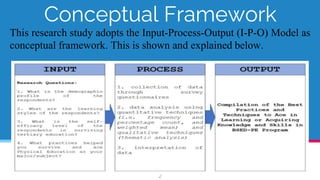
Conceptual Framework
2
This research study adopts the Input-Process-Output (I-P-O) Model as
conceptual framework. This is shown and explained below.
“
▷ a. What is the demographic profile of the respondents, in terms of
▷ a.1. age; and
▷ a.2. sex/gender?
3
Statement of the Problem
“
4
Statement of the Problem
b. What are the learning styles of the respondents?
c. What is the self-efficacy level of the respondents in surviving
tertiary education?
“
5
Statement of the Problem
d. What practices helped you survive and ace Physical Education as your
major/subject, in terms of:
d.1. quizzes;
d.2. recitations;
d.3. performance tasks;
d.4. exams;
d.5. memorization of concepts or theories; and
d.6. memorization of steps/skills (e.g., in sports)?
6
DATA GATHERING INSTRUMENT
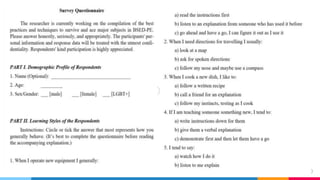
Part I. Demographic Profile of Respondents
The researcher aims at identifying the age and sex/gender of the research
participants by letting them answer the research questionnaires’ first part.
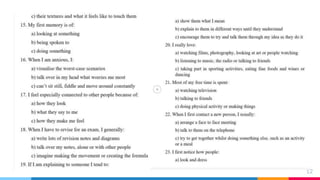
Part II. Learning Styles of the Respondents
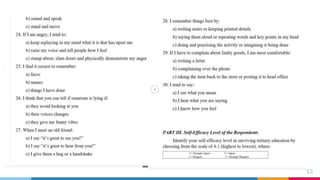
The researcher aims at identifying learning styles of the respondents by letting
them answer 30-item close-ended questionnaire adopted from V Chislett MSc & A
Chapman 2005.
7
DATA GATHERING INSTRUMENT
Part III. Self-Efficacy Level of the Respondents
The researcher aims at identifying level of self-efficacy of the research
participants by letting them answer the Student Self-Efficacy Questionnaire
adopted from Rowbotham and Schmitz (2013).
8
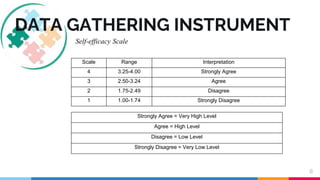
DATA GATHERING INSTRUMENT
Scale Range Interpretation
4 3.25-4.00 Strongly Agree
3 2.50-3.24 Agree
2 1.75-2.49 Disagree
1 1.00-1.74 Strongly Disagree
Strongly Agree = Very High Level
Agree = High Level
Disagree = Low Level
Strongly Disagree = Very Low Level
Self-efficacy Scale
9
DATA GATHERING INSTRUMENT
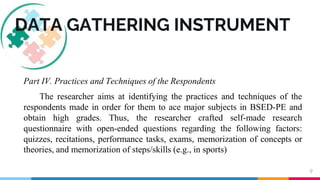
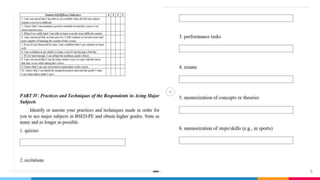
Part IV. Practices and Techniques of the Respondents
The researcher aims at identifying the practices and techniques of the
respondents made in order for them to ace major subjects in BSED-PE and
obtain high grades. Thus, the researcher crafted self-made research
questionnaire with open-ended questions regarding the following factors:
quizzes, recitations, performance tasks, exams, memorization of concepts or
theories, and memorization of steps/skills (e.g., in sports)
10
11
12
13
14
15
Thank You!
KRISTELA MAE C. COLOMA
Masters of Arts in Physical Education
Graduate School
Cagayan State University
Carig Campus

THESES PROPOSAL 2.pptx

  • 1.
    “SURVIVING TERTIARY EDUCATIONWITH GRADE OF “1.0”: COMPILATION OF ADVICE FOR PHYSICAL EDUCATION MAJORS” KRISTELA MAE C. COLOMA Masters of Arts in Physical Education Graduate School Cagayan State University Carig Campus
  • 2.
    Conceptual Framework 2 This researchstudy adopts the Input-Process-Output (I-P-O) Model as conceptual framework. This is shown and explained below.
  • 3.
    “ ▷ a. Whatis the demographic profile of the respondents, in terms of ▷ a.1. age; and ▷ a.2. sex/gender? 3 Statement of the Problem
  • 4.
    “ 4 Statement of theProblem b. What are the learning styles of the respondents? c. What is the self-efficacy level of the respondents in surviving tertiary education?
  • 5.
    “ 5 Statement of theProblem d. What practices helped you survive and ace Physical Education as your major/subject, in terms of: d.1. quizzes; d.2. recitations; d.3. performance tasks; d.4. exams; d.5. memorization of concepts or theories; and d.6. memorization of steps/skills (e.g., in sports)?
  • 6.
    6 DATA GATHERING INSTRUMENT PartI. Demographic Profile of Respondents The researcher aims at identifying the age and sex/gender of the research participants by letting them answer the research questionnaires’ first part. Part II. Learning Styles of the Respondents The researcher aims at identifying learning styles of the respondents by letting them answer 30-item close-ended questionnaire adopted from V Chislett MSc & A Chapman 2005.
  • 7.
    7 DATA GATHERING INSTRUMENT PartIII. Self-Efficacy Level of the Respondents The researcher aims at identifying level of self-efficacy of the research participants by letting them answer the Student Self-Efficacy Questionnaire adopted from Rowbotham and Schmitz (2013).
  • 8.
    8 DATA GATHERING INSTRUMENT ScaleRange Interpretation 4 3.25-4.00 Strongly Agree 3 2.50-3.24 Agree 2 1.75-2.49 Disagree 1 1.00-1.74 Strongly Disagree Strongly Agree = Very High Level Agree = High Level Disagree = Low Level Strongly Disagree = Very Low Level Self-efficacy Scale
  • 9.
    9 DATA GATHERING INSTRUMENT PartIV. Practices and Techniques of the Respondents The researcher aims at identifying the practices and techniques of the respondents made in order for them to ace major subjects in BSED-PE and obtain high grades. Thus, the researcher crafted self-made research questionnaire with open-ended questions regarding the following factors: quizzes, recitations, performance tasks, exams, memorization of concepts or theories, and memorization of steps/skills (e.g., in sports)
  • 10.
  • 11.
  • 12.
  • 13.
  • 14.
  • 15.
    15 Thank You! KRISTELA MAEC. COLOMA Masters of Arts in Physical Education Graduate School Cagayan State University Carig Campus

Editor's Notes

  • #3 Figure 1 shows the research paradigm of the study in I-P-O Model. In the conduct of the study, first, the researcher will address the following research questions: (1) What is the demographic profile of the respondents, in terms of age and sex/gender?; (2) What are the learning styles of the respondents?; (3) What is the self-efficacy level of the respondents in surviving tertiary education?; (4) What practices helped you survive and ace Physical Education as your major/subject? [INPUT]. In data collection, the researcher will use survey questionnaires. Additionally, in data analysis, the researcher will use/utilize the following, namely frequency and percentage count, weighted mean, and thematic analysis [PROCESS]. These are all geared towards the compilation of the best practices and techniques to ace in learning or acquiring knowledge and skills in BSED-PE Program [OUTPUT].
  • #4 This study aims to explore the best practices that the newly/recently graduated Physical Education (PE) majors used or wished to have used in surviving and acing Physical Education (PE) major/subject during their tertiary education life. It specifically aims to answer the following research questions:
  • #5 As mentioned in the research paper of Chetty, Handayani, Sahabudin, Ali, Hamzah, Rahman, and Kasim (2019) entitled “Learning Styles and Teaching Styles Determine Students' Academic Performances,” the academic performance of students (which is mostly materialized in their grades) is being determined by their learning styles – VAK. According to MacMillan (2018), the model of learning known as VAK Learning Style was designed by Burke Barbe and developed by Neil Fleming. The VAK learning model categorizes learners into three types: visual learners, auditory learners, and kinesthetic learners. Visual learners take in information or knowledge through sight. Auditory learners take in information or knowledge through sound. Kinesthetic learners take in information or knowledge through movement. People learn in one of three ways: visually, auditorily, or kinesthetically. Though every learner includes components of the other two forms, individuals are more likely to gain from learning if they focus on their major or primary learning style. As mentioned by Rowbotham and Schmitz (2013), self-efficacy refers to a confidence of an individual in his or her ability to bring about the results s/he wants. The task selection, effort spent, and degree of performance by students are all thought to be influenced by their perception of their own self-efficacy. Various learners may have different levels of self-efficacy which may affect the way they compose or come up with some strategies or techniques in their learning or acquiring knowledge and skills in order to ace major subjects in the BSED-PE Program. Hence, the researcher also employs Self-Efficacy Theory as a consideration in the study.
  • #7 Regarding research questions number one, two, and three the researcher adopts survey questionnaire with close-ended questions to describe the demographic profile, learning style, and the self-efficacy level of the respondents. *Steps in interpreting the raw data: 1. After the respondents answered the Part II, the researcher will add up how many A’s, B’s and C’s they selected. 2. If the highest total is A’s, the respondent has visual learning style. If the highest total is B’s, the respondent has auditory learning style. If the highest total is C’s, the respondent has kinesthetic learning style. 3. The researcher tally all the responses and identifies the overall learning style of the respondents.
  • #9 On the other hand, regarding research questions number four, the researcher makes use of researcher-made survey questionnaire with open-ended questions identifying the practices and techniques of the respondents.
  • #10 On the other hand, regarding research questions number four, the researcher makes use of researcher-made survey questionnaire with open-ended questions identifying the practices and techniques of the respondents.
  • #16 There is a study on identification of the learning styles of Service PE students and it is local in scope; and there are also studies on self-efficacy among Physical Education students, they are non-local in scope and do not tackle or discuss regarding self-efficacy in surviving BSED-PE course. As of the moment, the literature lacks empirical efforts, researches and studies regarding the exploration or assessment of the strategies or techniques used by different learners to survive and ace major subjects in BSED-PE program, particularly in the local context. it is perceived vital and helpful to compile real-life strategies and techniques used by BSED-PE graduates regarding on how they approach specific tasks in learning or acquiring skills and knowledge to be used not only in tests or exams within the program, but also outside the school or during their professional or actual career in the future. Various learners may have different levels of self-efficacy which may affect the way they compose or come up with some strategies or techniques in their learning or acquiring knowledge and skills in order to ace major subjects in the BSED-PE Program. Hence, the researcher also employs Self-Efficacy Theory as a consideration in the study.