SOLID WASTE MANAGEMENT
• PRESENTATION BY,
• shusrusha Bezugam.
SOLID WASTE MANAGEMENT.
• solid-waste management, the collecting, treating,
and disposing of solid material that is discarded .
• Improper disposal of municipal solid waste can
create unsanitary conditions, and these conditions in
turn can lead to pollution of the environment and to
outbreaks of vector-borne diseases.
TYPES OF SOLID WASTE
• Solid waste can be classified into different
types depending on their source:
a) Household waste is generally classified as
municipal waste,
b) Industrial waste as hazardous waste, and
c) Biomedical waste or hospital waste as
infectious waste.
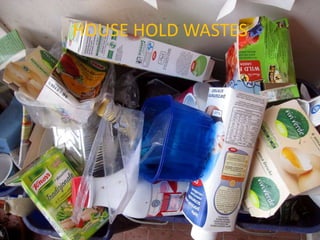
HOUSE HOLD WASTES
INDUSTRIAL WASTE
consists of a large number of materials including factory
rubbish, packaging material, organic wastes, acids, alkalis
and metals etc.
Radioactive wastes are generated by nuclear power plants.
Thermal power plants produce fly ash in large quantities.
In Europe and North America the environmental laws and
safety laws are becoming more stringent due to which
disposal of hazardous wastes is becoming a problem.
Cost of disposal of such wastes is increasing.
Therefore, these wastes are being exported to developing
countries which do not even have sufficient knowledge or
technique for their disposal
BIOMEDICAL WASTES
• Biomedical waste
• Includes anatomical wastes, pathological
wastes, infectious wastes etc.
EFFECTS OF SOLID WASTES
• The common effect of solid waste
management is the failure to eliminate
pathogenic agents.
• The failure to immobilize heavy metals by
landfill contractors and operators on the basis
of waste is also another effect.
• Solid waste management deals with the way
resources are used in the deposition of
materials.
MANAGEMENT OF SOLID WASTE
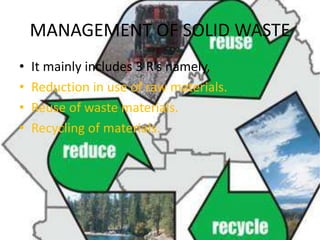
• It mainly includes 3 R’s namely,
• Reduction in use of raw materials.
• Reuse of waste materials.
• Recycling of materials.
REDUCTION IN USE OF RAW
MATERIALS
• Reduction in the use of raw materials will
correspondingly decrease the production of
waste. Reduced demand for any metallic
product will decrease the mining of their
metal and cause less production of waste
REUSE OF WASTE MATERIALS
• The refillable containers which are discarded
after use can be reused. Villagers make
casseroles and silos from waste paper and
other waste materials. Making rubber rings
from the discarded cycle tubes which are
used by the newspaper vendors, instead of
rubber bands , reduces the waste generation
during manufacturing of rubber bands.
Because of financial constraints poor people
reuse their materials to the maximum.
HOW TO DISCARD WASTE?
•Sanitary Landfill.
•Compositing.
•Incineration
SANITARY LANDFILL.
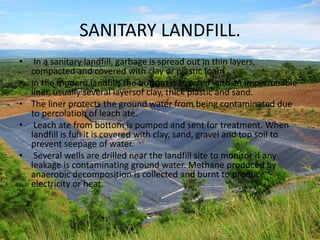
• In a sanitary landfill, garbage is spread out in thin layers,
compacted and covered with clay or plastic foam .
• In the modern landfills the bottom is covered with an impermeable
liner, usually several layersof clay, thick plastic and sand.
• The liner protects the ground water from being contaminated due
to percolation of leach ate.
• Leach ate from bottom is pumped and sent for treatment. When
landfill is full it is covered with clay, sand, gravel and top soil to
prevent seepage of water.
• Several wells are drilled near the landfill site to monitor if any
leakage is contaminating ground water. Methane produced by
anaerobic decomposition is collected and burnt to produce
electricity or heat.
COMPOSITING.
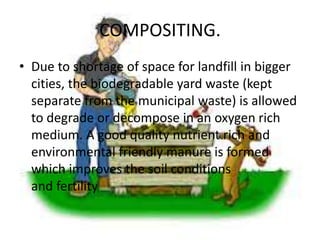
• Due to shortage of space for landfill in bigger
cities, the biodegradable yard waste (kept
separate from the municipal waste) is allowed
to degrade or decompose in an oxygen rich
medium. A good quality nutrient rich and
environmental friendly manure is formed
which improves the soil conditions
and fertility
INCINERATION.
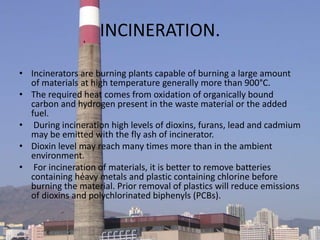
• Incinerators are burning plants capable of burning a large amount
of materials at high temperature generally more than 900°C.
• The required heat comes from oxidation of organically bound
carbon and hydrogen present in the waste material or the added
fuel.
• During incineration high levels of dioxins, furans, lead and cadmium
may be emitted with the fly ash of incinerator.
• Dioxin level may reach many times more than in the ambient
environment.
• For incineration of materials, it is better to remove batteries
containing heavy metals and plastic containing chlorine before
burning the material. Prior removal of plastics will reduce emissions
of dioxins and polychlorinated biphenyls (PCBs).
Solid waste management

Solid waste management

  • 1.
    SOLID WASTE MANAGEMENT •PRESENTATION BY, • shusrusha Bezugam.
  • 2.
    SOLID WASTE MANAGEMENT. •solid-waste management, the collecting, treating, and disposing of solid material that is discarded . • Improper disposal of municipal solid waste can create unsanitary conditions, and these conditions in turn can lead to pollution of the environment and to outbreaks of vector-borne diseases.
  • 3.
    TYPES OF SOLIDWASTE • Solid waste can be classified into different types depending on their source: a) Household waste is generally classified as municipal waste, b) Industrial waste as hazardous waste, and c) Biomedical waste or hospital waste as infectious waste.
  • 4.
  • 5.
    INDUSTRIAL WASTE consists ofa large number of materials including factory rubbish, packaging material, organic wastes, acids, alkalis and metals etc. Radioactive wastes are generated by nuclear power plants. Thermal power plants produce fly ash in large quantities. In Europe and North America the environmental laws and safety laws are becoming more stringent due to which disposal of hazardous wastes is becoming a problem. Cost of disposal of such wastes is increasing. Therefore, these wastes are being exported to developing countries which do not even have sufficient knowledge or technique for their disposal
  • 6.
    BIOMEDICAL WASTES • Biomedicalwaste • Includes anatomical wastes, pathological wastes, infectious wastes etc.
  • 7.
    EFFECTS OF SOLIDWASTES • The common effect of solid waste management is the failure to eliminate pathogenic agents. • The failure to immobilize heavy metals by landfill contractors and operators on the basis of waste is also another effect. • Solid waste management deals with the way resources are used in the deposition of materials.
  • 8.
    MANAGEMENT OF SOLIDWASTE • It mainly includes 3 R’s namely, • Reduction in use of raw materials. • Reuse of waste materials. • Recycling of materials.
  • 9.
    REDUCTION IN USEOF RAW MATERIALS • Reduction in the use of raw materials will correspondingly decrease the production of waste. Reduced demand for any metallic product will decrease the mining of their metal and cause less production of waste
  • 10.
    REUSE OF WASTEMATERIALS • The refillable containers which are discarded after use can be reused. Villagers make casseroles and silos from waste paper and other waste materials. Making rubber rings from the discarded cycle tubes which are used by the newspaper vendors, instead of rubber bands , reduces the waste generation during manufacturing of rubber bands. Because of financial constraints poor people reuse their materials to the maximum.
  • 11.
    HOW TO DISCARDWASTE? •Sanitary Landfill. •Compositing. •Incineration
  • 12.
    SANITARY LANDFILL. • Ina sanitary landfill, garbage is spread out in thin layers, compacted and covered with clay or plastic foam . • In the modern landfills the bottom is covered with an impermeable liner, usually several layersof clay, thick plastic and sand. • The liner protects the ground water from being contaminated due to percolation of leach ate. • Leach ate from bottom is pumped and sent for treatment. When landfill is full it is covered with clay, sand, gravel and top soil to prevent seepage of water. • Several wells are drilled near the landfill site to monitor if any leakage is contaminating ground water. Methane produced by anaerobic decomposition is collected and burnt to produce electricity or heat.
  • 13.
    COMPOSITING. • Due toshortage of space for landfill in bigger cities, the biodegradable yard waste (kept separate from the municipal waste) is allowed to degrade or decompose in an oxygen rich medium. A good quality nutrient rich and environmental friendly manure is formed which improves the soil conditions and fertility
  • 14.
    INCINERATION. • Incinerators areburning plants capable of burning a large amount of materials at high temperature generally more than 900°C. • The required heat comes from oxidation of organically bound carbon and hydrogen present in the waste material or the added fuel. • During incineration high levels of dioxins, furans, lead and cadmium may be emitted with the fly ash of incinerator. • Dioxin level may reach many times more than in the ambient environment. • For incineration of materials, it is better to remove batteries containing heavy metals and plastic containing chlorine before burning the material. Prior removal of plastics will reduce emissions of dioxins and polychlorinated biphenyls (PCBs).