 supply chain is a technique whose component parts
include material suppliers, manufacture facilities,
delivery services, and clients, all connected by a
feedforward run of materials and a feedback run in
sequence.
 Waste is any step or action in a process that is not required to
complete a process (called “Non Value-Adding”) successfully.
When Waste is removed, only the steps that are required
(called “Value-Adding”) to deliver a satisfactory product or
service to the customer remain in the process.
 Defects – Products or services that are out of specification that require
resources to correct.
 Overproduction – Producing too much of a product before it is ready
to be sold.
 Waiting – Waiting for the previous step in the process to complete.
 Non-Utilized Talent – Employees that are not effectively engaged in
the process
 Transportation – Transporting items or information that is not required
to perform the process from one location to another.
 Inventory – Inventory or information that is sitting idle (not being
processed).
 Motion – People, information or equipment making unnecessary
motion due to workspace layout, ergonomic issues or searching for
misplaced items.
 Extra Processing – Performing any activity that is not necessary to
produce a functioning product or service.
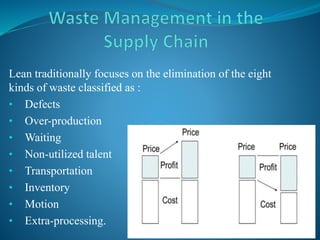
Lean traditionally focuses on the elimination of the eight
kinds of waste classified as :
• Defects
• Over-production
• Waiting
• Non-utilized talent
• Transportation
• Inventory
• Motion
• Extra-processing.
Intel One of the world’s largest manufacturers of computer
chips, Intel needs little introduction. However, the company
needed to make some significant supply chain cost reductions
after bringing its low-cost “Atom” chip to market. Supply chain
costs of around $5.50 per chip were bearable for units selling for
$100, but the price of the new chip was a fraction of that, at
about $20.
The Supply Chain Cost Reduction Challenge:
 Somehow Intel had to reduce the supply chain costs for the Atom
chip, but had only one area of leverage—inventory.
 The chip had to work, so there were no service trade-offs that
could be made. Being a single component, there was also no way
to pay less in the way of duties.
 The only option was to try to reduce levels of inventory, which, up
to that point, had been kept very high in order to support a nine-
week order cycle. The only way Intel could find to make supply
chain cost reductions was to bring this cycle time down and
therefore reduce inventory.
 The Path to Cost Reduction: Intel decided to try what was considered
an unlikely supply chain strategy for the semiconductor industry: a true
make-to-order scenario. The company began with a pilot operation using
a manufacturer in Malaysia. Through a process of iteration, they gradually
sought out and eliminated supply chain inefficiencies to incrementally
reduce order cycle time. Further improvement initiatives included:
 Reduced the chip assembly test window from a five-day schedule, to a bi-
weekly, 2-day-long process
 Introduced a formal S&OP planning process
 Moved to a vendor-managed inventory model wherever it was possible to
do so
 Supply Chain Cost Management Results:
Through its incremental approach to cycle time improvement, Intel
eventually drove the order cycle time for the Atom chip down from
nine weeks to just two. As a result, the company achieved a supply
chain cost reduction of more than $4 per unit for the $20 Atom chip—a
far more palatable rate than the original figure of $5.50.
waste management in supply chain  using lean tool with case study

waste management in supply chain using lean tool with case study

  • 2.
     supply chainis a technique whose component parts include material suppliers, manufacture facilities, delivery services, and clients, all connected by a feedforward run of materials and a feedback run in sequence.
  • 3.
     Waste isany step or action in a process that is not required to complete a process (called “Non Value-Adding”) successfully. When Waste is removed, only the steps that are required (called “Value-Adding”) to deliver a satisfactory product or service to the customer remain in the process.
  • 4.
     Defects –Products or services that are out of specification that require resources to correct.  Overproduction – Producing too much of a product before it is ready to be sold.  Waiting – Waiting for the previous step in the process to complete.  Non-Utilized Talent – Employees that are not effectively engaged in the process  Transportation – Transporting items or information that is not required to perform the process from one location to another.  Inventory – Inventory or information that is sitting idle (not being processed).  Motion – People, information or equipment making unnecessary motion due to workspace layout, ergonomic issues or searching for misplaced items.  Extra Processing – Performing any activity that is not necessary to produce a functioning product or service.
  • 5.
    Lean traditionally focuseson the elimination of the eight kinds of waste classified as : • Defects • Over-production • Waiting • Non-utilized talent • Transportation • Inventory • Motion • Extra-processing.
  • 6.
    Intel One ofthe world’s largest manufacturers of computer chips, Intel needs little introduction. However, the company needed to make some significant supply chain cost reductions after bringing its low-cost “Atom” chip to market. Supply chain costs of around $5.50 per chip were bearable for units selling for $100, but the price of the new chip was a fraction of that, at about $20.
  • 7.
    The Supply ChainCost Reduction Challenge:  Somehow Intel had to reduce the supply chain costs for the Atom chip, but had only one area of leverage—inventory.  The chip had to work, so there were no service trade-offs that could be made. Being a single component, there was also no way to pay less in the way of duties.  The only option was to try to reduce levels of inventory, which, up to that point, had been kept very high in order to support a nine- week order cycle. The only way Intel could find to make supply chain cost reductions was to bring this cycle time down and therefore reduce inventory.
  • 8.
     The Pathto Cost Reduction: Intel decided to try what was considered an unlikely supply chain strategy for the semiconductor industry: a true make-to-order scenario. The company began with a pilot operation using a manufacturer in Malaysia. Through a process of iteration, they gradually sought out and eliminated supply chain inefficiencies to incrementally reduce order cycle time. Further improvement initiatives included:  Reduced the chip assembly test window from a five-day schedule, to a bi- weekly, 2-day-long process  Introduced a formal S&OP planning process  Moved to a vendor-managed inventory model wherever it was possible to do so
  • 9.
     Supply ChainCost Management Results: Through its incremental approach to cycle time improvement, Intel eventually drove the order cycle time for the Atom chip down from nine weeks to just two. As a result, the company achieved a supply chain cost reduction of more than $4 per unit for the $20 Atom chip—a far more palatable rate than the original figure of $5.50.