Introduction to
Supply Chain
Management
BY: DRL
Learning Objectives
You should be able to:
 Describe a supply chain and define supply chain
management.
 Describe the objectives and elements of supply chain
management.
Definition
The design and management of seamless, value-added processes across
organizational boundaries to meet the real needs of the end customer
Institute for Supply Management
Managing supply and demand, sourcing raw materials and parts, manufacturing and
assembly, warehousing and inventory tracking, order entry and order management,
distribution across all channels, and delivery to the customer
The Supply Chain Council
The planning and management of all activities involved in sourcing and procurement,
conversion, and all logistics management activities … also includes coordination
with channel partners, which can be suppliers, intermediaries, third party service
providers, and customers.
Council of Supply Chain Management Professionals
Source: Principles of Supply Chain Management: : A Balanced Approach by Wisner Tan Leong
Definition (Cont.)
 Old paradigm - Firm gained synergy as a vertically integrated firm encompassing
the ownership and coordination of several supply chain activities. Organizational
cultures emphasized short-term, company focused performance.
 New paradigm - Firm in a supply chain focuses activities in its area of
specialization and enters into voluntary and trust-based relationships with
supplier and customer firms.
 All participants in the supply chain benefit.
 Boundaries are dynamic and extend from “the firm’s suppliers’ suppliers to
its customers’ customers (i.e., second tier suppliers and customers).”
 Supply chains now deal with reverse logistics to handle returned products,
warranty repairs, and recycling.
Source: Principles of Supply Chain Management: : A Balanced Approach by Wisner Tan Leong
Summary of Definition
The design and management of seamless, value-added processes
across organizational boundaries to meet the real needs of the end
customer
Institute for Supply Management
 Which not only cut across organizational boundaries but also must
be tightly integrated
 To be integrated, the processes must be appropriately designed
and systematically managed to allow information to flow and be
deployed within and across them.
Source: Operations Management by Roger Schroeder, Susan Goldstein, M Jonny Rungtusanathan
Upstream or backward materials & information flow
Downstream or forward materials & information flow
Physical Distribution
Physical Supply
1st
-Tier
Suppliers
2nd
-Tier
Suppliers
Flow of materials from
upstream nodes into Z
Flow of materials from Z through
downstream process toward the
end customers
What is a Supply Chain?
A supply chain consists of the flow of products and services from:
 Raw materials manufacturers
 Component and intermediate manufacturers
 Final product manufacturers
 Wholesalers and distributors and
 Retailers
Connected by transportation and storage activities, and Integrated through information, planning, and
integration activities..
Many large firms are moving away from in-house Vertically Integrated structures to Supply Chain
Management
Set of entities and relationships that cumulatively define materials and information flows both
downstream toward the customer and upstream toward the very first supplier.
Source: Operations Management by Roger Schroeder, Susan Goldstein, M Jonny Rungtusanathan
Example: Apple’s iPod
Many high-tech consumer products are not manufactured by the companies whose
brands they carry but are instead manufactured by a host of other companies that act as 1st
-tier,
2nd
-tier, and perhaps 3rd
-tier suppliers to the branding companies. The iPod, the portable digital
audio player, marketed by Apple Inc. is a perfect example.
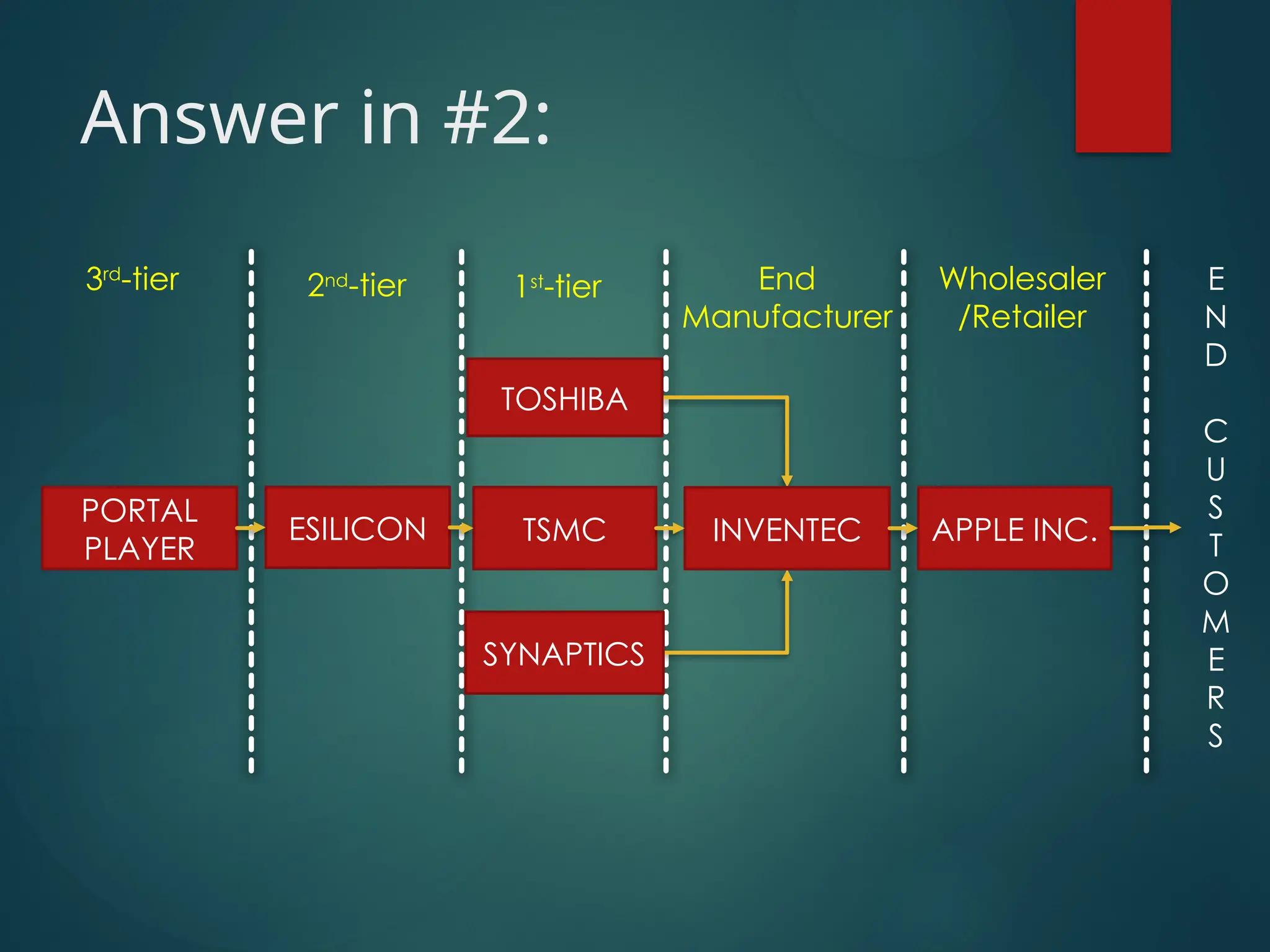
The product idea originated with Apple Inc. The manufacturing of the product itself is
outsourced to Inventec, based in Taipei, Taiwan. Inventec in turn sources the necessary parts
from many other suppliers (Toshiba, Synaptics, etc.) to assemble the iPod on behalf of Apple Inc.
One part critical to the operations of the iPod is the computer chip responsible for
controlling the various functions. For these computer chips, Inventec and Apple work jointly to
select PortalPlayer, based in San Jose, California, to design the computer chip according to
specifications from Apple Inc. The design then turned over to be produced by eSilicon
Corporation, headquartered in Sunnyvale, California. eSilicon in turn contracts with TSMC or
Taiwan Semiconductor Manufacturing Company, Ltd., to actually manufacture the computer chips,
which, once fabricated, are shipped to Inventec. Completed iPods are then shipped to Apple Inc.
for subsequent distribution.
Objective of a Supply Chain
 MAXIMIZE THE OVERALL VALUE GENERATED
VALUE– is the difference of the final product worth to customer between the costs the
supply chain incurs in filling customers’ request
Supply Chain Profitability or Supply Chain Surplus – is the difference between
revenue generated from the customer and the overall cost across the supply chain
Therefore, supply chain’s success is measured in terms of
supply chain profitability.
Source: Operations Management by Roger Schroeder, Susan Goldstein, M Jonny Rungtusanathan
SHORT QUIZ
1.) Discuss the goal of a supply chain
and explain the impact of supply chain
decisions on the success of a firm.
2.) Draw the supply chain for Apple
iPod from the first source of raw
materials to final customer.
ANSWERS
1.) Discuss the goal of a supply chain and explain the impact of supply chain decisions
on the success of a firm.
The goal of a supply chain should be to maximize overall supply chain
profitability. Supply chain profitability is the difference between the revenue
generated from the customer and the total cost incurred across all stages of the
supply chain. Supply chain decisions have a large impact on the success or failure of
each firm because they significantly influence both the revenue generated and the
cost incurred. Successful supply chains manage flows of product, information, and
funds to provide a high level of product availability to the customer while keeping low
cost.
2.) Draw the supply chain for Apple iPod from the first source of raw materials to
final customer.
Answer in #2:
APPLE INC.
INVENTEC
TOSHIBA
PORTAL
PLAYER
SYNAPTICS
ESILICON TSMC
E
N
D
C
U
S
T
O
M
E
R
S
3rd
-tier 2nd
-tier 1st
-tier End
Manufacturer
Wholesaler
/Retailer
Check-up Quiz 1:
1. The design and management of seamless, value-added processes
across organizational boundaries to meet the real needs of the end
customer.
2. The old paradigm where firm encompassing the ownership and
coordination of several supply chain activities.
3. – 7. The five components or composition of a supply chain?
8. It is the difference of the final product worth to customer between
the costs the supply chain incurs in filling customers’ request.
9. The other term for physical distribution.
10. The supply chain success is measured by _____________.

SCM - Lesson 1 Introduction and the Organization.pptx

  • 1.
  • 2.
    Learning Objectives You shouldbe able to:  Describe a supply chain and define supply chain management.  Describe the objectives and elements of supply chain management.
  • 3.
    Definition The design andmanagement of seamless, value-added processes across organizational boundaries to meet the real needs of the end customer Institute for Supply Management Managing supply and demand, sourcing raw materials and parts, manufacturing and assembly, warehousing and inventory tracking, order entry and order management, distribution across all channels, and delivery to the customer The Supply Chain Council The planning and management of all activities involved in sourcing and procurement, conversion, and all logistics management activities … also includes coordination with channel partners, which can be suppliers, intermediaries, third party service providers, and customers. Council of Supply Chain Management Professionals Source: Principles of Supply Chain Management: : A Balanced Approach by Wisner Tan Leong
  • 4.
    Definition (Cont.)  Oldparadigm - Firm gained synergy as a vertically integrated firm encompassing the ownership and coordination of several supply chain activities. Organizational cultures emphasized short-term, company focused performance.  New paradigm - Firm in a supply chain focuses activities in its area of specialization and enters into voluntary and trust-based relationships with supplier and customer firms.  All participants in the supply chain benefit.  Boundaries are dynamic and extend from “the firm’s suppliers’ suppliers to its customers’ customers (i.e., second tier suppliers and customers).”  Supply chains now deal with reverse logistics to handle returned products, warranty repairs, and recycling. Source: Principles of Supply Chain Management: : A Balanced Approach by Wisner Tan Leong
  • 5.
    Summary of Definition Thedesign and management of seamless, value-added processes across organizational boundaries to meet the real needs of the end customer Institute for Supply Management  Which not only cut across organizational boundaries but also must be tightly integrated  To be integrated, the processes must be appropriately designed and systematically managed to allow information to flow and be deployed within and across them. Source: Operations Management by Roger Schroeder, Susan Goldstein, M Jonny Rungtusanathan
  • 6.
    Upstream or backwardmaterials & information flow Downstream or forward materials & information flow Physical Distribution Physical Supply 1st -Tier Suppliers 2nd -Tier Suppliers Flow of materials from upstream nodes into Z Flow of materials from Z through downstream process toward the end customers
  • 7.
    What is aSupply Chain? A supply chain consists of the flow of products and services from:  Raw materials manufacturers  Component and intermediate manufacturers  Final product manufacturers  Wholesalers and distributors and  Retailers Connected by transportation and storage activities, and Integrated through information, planning, and integration activities.. Many large firms are moving away from in-house Vertically Integrated structures to Supply Chain Management Set of entities and relationships that cumulatively define materials and information flows both downstream toward the customer and upstream toward the very first supplier. Source: Operations Management by Roger Schroeder, Susan Goldstein, M Jonny Rungtusanathan
  • 8.
    Example: Apple’s iPod Manyhigh-tech consumer products are not manufactured by the companies whose brands they carry but are instead manufactured by a host of other companies that act as 1st -tier, 2nd -tier, and perhaps 3rd -tier suppliers to the branding companies. The iPod, the portable digital audio player, marketed by Apple Inc. is a perfect example. The product idea originated with Apple Inc. The manufacturing of the product itself is outsourced to Inventec, based in Taipei, Taiwan. Inventec in turn sources the necessary parts from many other suppliers (Toshiba, Synaptics, etc.) to assemble the iPod on behalf of Apple Inc. One part critical to the operations of the iPod is the computer chip responsible for controlling the various functions. For these computer chips, Inventec and Apple work jointly to select PortalPlayer, based in San Jose, California, to design the computer chip according to specifications from Apple Inc. The design then turned over to be produced by eSilicon Corporation, headquartered in Sunnyvale, California. eSilicon in turn contracts with TSMC or Taiwan Semiconductor Manufacturing Company, Ltd., to actually manufacture the computer chips, which, once fabricated, are shipped to Inventec. Completed iPods are then shipped to Apple Inc. for subsequent distribution.
  • 9.
    Objective of aSupply Chain  MAXIMIZE THE OVERALL VALUE GENERATED VALUE– is the difference of the final product worth to customer between the costs the supply chain incurs in filling customers’ request Supply Chain Profitability or Supply Chain Surplus – is the difference between revenue generated from the customer and the overall cost across the supply chain Therefore, supply chain’s success is measured in terms of supply chain profitability. Source: Operations Management by Roger Schroeder, Susan Goldstein, M Jonny Rungtusanathan
  • 10.
    SHORT QUIZ 1.) Discussthe goal of a supply chain and explain the impact of supply chain decisions on the success of a firm. 2.) Draw the supply chain for Apple iPod from the first source of raw materials to final customer.
  • 11.
    ANSWERS 1.) Discuss thegoal of a supply chain and explain the impact of supply chain decisions on the success of a firm. The goal of a supply chain should be to maximize overall supply chain profitability. Supply chain profitability is the difference between the revenue generated from the customer and the total cost incurred across all stages of the supply chain. Supply chain decisions have a large impact on the success or failure of each firm because they significantly influence both the revenue generated and the cost incurred. Successful supply chains manage flows of product, information, and funds to provide a high level of product availability to the customer while keeping low cost. 2.) Draw the supply chain for Apple iPod from the first source of raw materials to final customer.
  • 12.
    Answer in #2: APPLEINC. INVENTEC TOSHIBA PORTAL PLAYER SYNAPTICS ESILICON TSMC E N D C U S T O M E R S 3rd -tier 2nd -tier 1st -tier End Manufacturer Wholesaler /Retailer
  • 13.
    Check-up Quiz 1: 1.The design and management of seamless, value-added processes across organizational boundaries to meet the real needs of the end customer. 2. The old paradigm where firm encompassing the ownership and coordination of several supply chain activities. 3. – 7. The five components or composition of a supply chain? 8. It is the difference of the final product worth to customer between the costs the supply chain incurs in filling customers’ request. 9. The other term for physical distribution. 10. The supply chain success is measured by _____________.

Editor's Notes

  • #2 In the end of this session, you will be able to:
  • #3 According to these three departments, these are their definition
  • #5 Here’s the summary from Institute for Supply Management. It is the design and management of seamless, value-added processes across organizational boundaries to meet the real needs of the end customer.
  • #6 We will clearly understand how supply chain works through this diagram.