A presentation on
Lean Logistics
Agenda
 What is Lean Logistics?
 What is Lean Thinking?
 Lean Principles
 Where can lean logistics be used
 Steps on how to achieve lean logistics
 7 Wastes of logistics and production
 Lean Supply Chain
 Lean Case Study: Lean Supply Chain
Reduces "Fat" by 13 Percent
What is
Lean Logistics?
 A process to identify and eliminate waste of time, effort and material
from the supply chain to increase efficiency - this could be a
manufacturing process, warehousing, shipping, or any number of
other things
 Achieved by optimizing teamwork, productive management, and
cross-functional operations to make their operations move faster and
cheaper
 Removes unnecessary touch points, wasteful processes, and wasteful
packaging from the supply chain
 Also centered on reducing delays in wait time, picking, and shipping
 Helps companies achieve a fluid position with demand volatility
because there are fewer steps to complete
What is
Lean Thinking?
 In order to achieve Lean Logistics; organizations need to implement
lean thinking
 Lean thinking in supply chain ensures improved customer service,
reduced environmental impact by reducing waste and even overall
corporate citizenship
 Involves a constant cycle of seeking perfection by eliminating waste
and maximizing product value
 End-customers do not pay for organization inefficiency and waste
What is Lean Thinking? (Contd.)
Seeking
perfection
= Minimal
waste
1.
Specify
value
2. Map
out value
stream
3. Create
a product
flow
4.
Establish
customer
pull
• Involves a constant cycle of seeking perfection by
eliminating waste and maximizing product value
• Four principles are involved in achieving minimal waste
Waste
Waste
Waste
Waste
Lean Principles
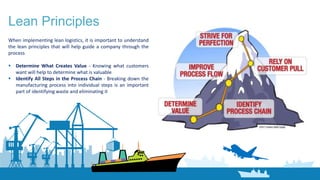
When implementing lean logistics, it is important to understand
the lean principles that will help guide a company through the
process
 Determine What Creates Value - Knowing what customers
want will help to determine what is valuable
 Identify All Steps in the Process Chain - Breaking down the
manufacturing process into individual steps is an important
part of identifying waste and eliminating it
Lean Principles (Contd.)
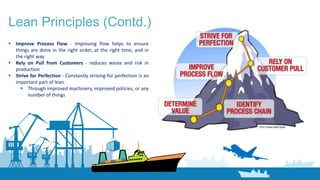
 Improve Process Flow - Improving flow helps to ensure
things are done in the right order, at the right time, and in
the right way
 Rely on Pull from Customers - reduces waste and risk in
production
 Strive for Perfection - Constantly striving for perfection is an
important part of lean.
 Through improved machinery, improved policies, or any
number of things
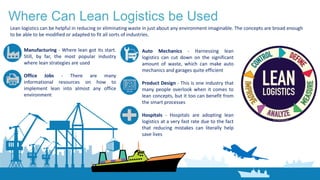
Where Can Lean Logistics be Used
Manufacturing - Where lean got its start.
Still, by far, the most popular industry
where lean strategies are used
Office Jobs - There are many
informational resources on how to
implement lean into almost any office
environment
Lean logistics can be helpful in reducing or eliminating waste in just about any environment imaginable. The concepts are broad enough
to be able to be modified or adapted to fit all sorts of industries.
Auto Mechanics - Harnessing lean
logistics can cut down on the significant
amount of waste, which can make auto
mechanics and garages quite efficient
Product Design - This is one industry that
many people overlook when it comes to
lean concepts, but it too can benefit from
the smart processes
Hospitals - Hospitals are adopting lean
logistics at a very fast rate due to the fact
that reducing mistakes can literally help
save lives
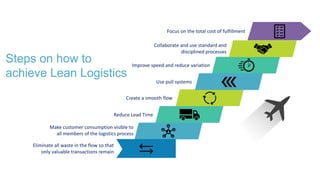
Focus on the total cost of fulfillment
Collaborate and use standard and
disciplined processes
Improve speed and reduce variation
Use pull systems
Create a smooth flow
Reduce Lead Time
Make customer consumption visible to
all members of the logistics process
Eliminate all waste in the flow so that
only valuable transactions remain
Steps on how to
achieve Lean Logistics
7 Wastes of Logistics
Elaborate scheduling
systems and managers
who work on the
differences in normal
scheduling and current
needs
Complexity of Systems
Too long from one step
to the other of the
process
Lead Time
All inventory at
distribution points is
wasteful
Inventory
An excessive path
between the facilities,
the plant, and the
suppliers
Transportation
All the square meters
that are used to
accumulate inventory
are wasteful
Space
An incorrect type of
asset in the wrong
quantity can create
damage and excessive
inventory
Packaging
All the people who are
involved in the logistics
process who do re-
working, confusion and
excess movement
Human effort
7 Wastes of Production
Customer does not pay
to have goods moved
around.
Any movement of
material is waste
Transportation
Having no inventory is a
goal that can never be
attained,
inventory is the enemy
of quality and
productivity
Inventory
Overprocessing refers to
the waste of using a
hammer to crack a nut
Overprocessing
It refers to ergonomy and
people moving around.
An operator that is
moving around searching
for Materials, Tools,
Information
in not value added at all
Motion
The waste of waiting is
probably the second
most important waste.
It is directly relevant to
flow
Waiting
You pay someone to
produce
something wrong
Defects
Most serious of all the
7 waste in lean
manufacturing
Overproduction
Lean Supply Chain
Inventory - Companies should aim to keep inventory at a
minimum at all times. Having just enough to meet customer
demands will reduce excess expenses related to storing the items,
as well as the risk of them getting damaged.
Warehousing - Warehousing products is always wasteful, even if
it is sometimes unavoidable. A warehouse is typically an extra stop
in the lean supply chain, which introduces increased costs and risks
to the manufacturing and sales process.
Implementing a lean supply chain is one of the best ways to reduce waste, and cut the overall cost of operations. In a supply chain, there
are many resources that can be looked at to see where waste may exist. Some of the most common areas include:
Trucks - Whenever a product is loaded on a truck, it is creating
motion, which is a form of waste. Minimizing the number of trucks
a product has to go on will help to reduce this excess motion and
streamline the transportation process.
Travel Time- The time the products are ‘on the road‘ is another
form of waste that should be minimized. Some travel time is
required, but whenever it can be reduced, it should be. Combining
multiple products into single shipments can also help to reduce
waste.
People - There are many people involved in the packing, loading,
and shipping process. When using a lean supply chain, some of
these people can be reallocated to more productive tasks that don't
produce waste.
Lean Case Study: Lean
Supply Chain Reduces "Fat"
by 13 Percent
 Fujitsu’s Sourcing & Supply Services operation provides
purchasing and supply services for its major customers
 Technical Integration Centre (TIC) offers IT
engineering, configuration and repair services, recycle
and disposal solutions
 Both supported by a warehousing and distribution
facility that provides secure bonding and storage
 With customers in areas such as banking, government
and defense, Fujitsu's Supply Chain operation has to
run without error or delay
Annual Turnover: £2.46 billion
($3.59 billion)
No. of employees: 19,000 in
20 countries
 In 2006, Delivery to customers on time was down to
95 from 99.9 percent
 Significant costs being incurred for rearranged
engineer visits and penalties for late installations
 Picking errors were running at over 4 percent, which
meant having to rework many orders
 Morale was low, with 14 percent absenteeism
 Productivity was running at a minus figure, SLAs were
being missed
 They had to pay for off-site storage to handle 1,000
pallets of kit as their own 141,000 sq. ft. warehouse
was full
 In short, Fujitsu’s reputation was badly damaged -
customer expectations were low, complaints were
increasing and new and key contracts were in serious
risk of being lost
Customer’s Challenge
 Lean operational practices + Fujitsu's own unique Sense and Respond
approach to continuous service improvement
 Analysis of the situation - They had a significant amount of customer-
owned stock, much of it aging, and kit that needed to be recycled, but
they had no instructions about what to do with it
 Almost 90,000 units of redundant stock taking up space and just getting
in the way physically and logistically - inhibiting efficiency, morale was
low and accidents were happening
 Lean program: "The TIC Way" - a vision of where it wanted to get to
and how it would measure its progress and success
 Detailed Transformation Plan - Everything from leadership and
processes, through to inventory controls and management
 The team - People directly involved in either identifying or creating
the issues that need to be addressed, because of their key role in
the problem solving sessions
 Visual Management techniques to monitor performance against
targets, ensure actions from problem solving sessions and to
monitoring ongoing results once solutions are applied
 These measures are openly displayed in each department used as a
"Communication Hub” for use across Sourcing & Supply Services
 The vision was simple: Get it right first time and with minimal
touch points
Fujitsu Solution
“Through the use of Lean we have restructured our operation and processes to ensure the work flows
and relationships with suppliers and customers are enhanced and we are more flexible within a highly
controlled environment. As a result, we have a very capable back-end to a very efficient and proficient
front-end capability in the procurement of equipment and the delivery of engineering services, such as
our break-fix and recycling capabilities.
We are now a leader in our field, because we understand what our customers want – and can deliver it.”
- Paul Fraser, Head of Logistics, Fujitsu
 Enhanced customer service - The identification and resolution of key
operational issues enables faster and higher quality service delivery, which
has seen customer satisfaction increase by 10 percent from 6.8 to 7.8 out
of 10
 Increased staff satisfaction - Active involvement of staff in the change
process has improved morale and absenteeism has fallen from 14 percent
to just 3 percent, largely because there are fewer injuries
 Improved resource usage - Productivity has increased by over 23 percent
and has enabled headcount to be reduced by over 14 percent, with the
development of staff skills allowing them to work in other parts of the
business
 Reduced costs – Fujitsu has delivered 13.6 percent cost savings on a
budget of £12.6 million, saving of £1.7 million in the first year. In
particular, supplier deviations have been reduced by 18 percent,
inventory is down by 19 percent, the need for off-site storage has
been removed as redundant stock has dropped by over 90 percent to
just 7,500 units, and costs of third-party handling and transport have
been reduced.
 Created new revenue opportunities - Better use of resources has
enabled Fujitsu to increase volume throughput by 10 percent and
develop new service offerings, such as engineering and workshop
repair facilities
 Enabled continuous improvement - Involving and empowering people
has created a sustainable internal capability, which is focused on
continually identifying and permanently eradicating problems and
waste
Benefits to Fujitsu’s Customer
 Identifying and eliminating waste or unnecessary activities through
continuous improvement of the product or service in response to
customer needs
 Involvement, inclusion and development of employees is key as it enables
new processes to be put in place much more quickly
 Team of people who question, recommend, advise, and are always
looking for involvement in customers' needs
 By tapping into the experience of employees in many cases Fujitsu
knows what the customers want before they've recognized it
themselves
Fujitsu’s Approach
Thank You

Lean logistics

  • 1.
  • 2.
    Agenda  What isLean Logistics?  What is Lean Thinking?  Lean Principles  Where can lean logistics be used  Where can lean logistics be used  Where can lean logistics be used  Steps on how to achieve lean logistics  7 Wastes of logistics and production  Lean Supply Chain  Lean Case Study: Lean Supply Chain Reduces "Fat" by 13 Percent
  • 3.
    What is Lean Logistics? A process to identify and eliminate waste of time, effort and material from the supply chain to increase efficiency - this could be a manufacturing process, warehousing, shipping, or any number of other things  Achieved by optimizing teamwork, productive management, and cross-functional operations to make their operations move faster and cheaper  Removes unnecessary touch points, wasteful processes, and wasteful packaging from the supply chain  Also centered on reducing delays in wait time, picking, and shipping  Helps companies achieve a fluid position with demand volatility because there are fewer steps to complete
  • 4.
    What is Lean Thinking? In order to achieve Lean Logistics; organizations need to implement lean thinking  Lean thinking in supply chain ensures improved customer service, reduced environmental impact by reducing waste and even overall corporate citizenship  Involves a constant cycle of seeking perfection by eliminating waste and maximizing product value  End-customers do not pay for organization inefficiency and waste
  • 5.
    What is LeanThinking? (Contd.) Seeking perfection = Minimal waste 1. Specify value 2. Map out value stream 3. Create a product flow 4. Establish customer pull • Involves a constant cycle of seeking perfection by eliminating waste and maximizing product value • Four principles are involved in achieving minimal waste Waste Waste Waste Waste
  • 6.
    Lean Principles When implementinglean logistics, it is important to understand the lean principles that will help guide a company through the process  Determine What Creates Value - Knowing what customers want will help to determine what is valuable  Identify All Steps in the Process Chain - Breaking down the manufacturing process into individual steps is an important part of identifying waste and eliminating it
  • 7.
    Lean Principles (Contd.) Improve Process Flow - Improving flow helps to ensure things are done in the right order, at the right time, and in the right way  Rely on Pull from Customers - reduces waste and risk in production  Strive for Perfection - Constantly striving for perfection is an important part of lean.  Through improved machinery, improved policies, or any number of things
  • 8.
    Where Can LeanLogistics be Used Manufacturing - Where lean got its start. Still, by far, the most popular industry where lean strategies are used Office Jobs - There are many informational resources on how to implement lean into almost any office environment Lean logistics can be helpful in reducing or eliminating waste in just about any environment imaginable. The concepts are broad enough to be able to be modified or adapted to fit all sorts of industries. Auto Mechanics - Harnessing lean logistics can cut down on the significant amount of waste, which can make auto mechanics and garages quite efficient Product Design - This is one industry that many people overlook when it comes to lean concepts, but it too can benefit from the smart processes Hospitals - Hospitals are adopting lean logistics at a very fast rate due to the fact that reducing mistakes can literally help save lives
  • 9.
    Focus on thetotal cost of fulfillment Collaborate and use standard and disciplined processes Improve speed and reduce variation Use pull systems Create a smooth flow Reduce Lead Time Make customer consumption visible to all members of the logistics process Eliminate all waste in the flow so that only valuable transactions remain Steps on how to achieve Lean Logistics
  • 10.
    7 Wastes ofLogistics Elaborate scheduling systems and managers who work on the differences in normal scheduling and current needs Complexity of Systems Too long from one step to the other of the process Lead Time All inventory at distribution points is wasteful Inventory An excessive path between the facilities, the plant, and the suppliers Transportation All the square meters that are used to accumulate inventory are wasteful Space An incorrect type of asset in the wrong quantity can create damage and excessive inventory Packaging All the people who are involved in the logistics process who do re- working, confusion and excess movement Human effort
  • 11.
    7 Wastes ofProduction Customer does not pay to have goods moved around. Any movement of material is waste Transportation Having no inventory is a goal that can never be attained, inventory is the enemy of quality and productivity Inventory Overprocessing refers to the waste of using a hammer to crack a nut Overprocessing It refers to ergonomy and people moving around. An operator that is moving around searching for Materials, Tools, Information in not value added at all Motion The waste of waiting is probably the second most important waste. It is directly relevant to flow Waiting You pay someone to produce something wrong Defects Most serious of all the 7 waste in lean manufacturing Overproduction
  • 12.
    Lean Supply Chain Inventory- Companies should aim to keep inventory at a minimum at all times. Having just enough to meet customer demands will reduce excess expenses related to storing the items, as well as the risk of them getting damaged. Warehousing - Warehousing products is always wasteful, even if it is sometimes unavoidable. A warehouse is typically an extra stop in the lean supply chain, which introduces increased costs and risks to the manufacturing and sales process. Implementing a lean supply chain is one of the best ways to reduce waste, and cut the overall cost of operations. In a supply chain, there are many resources that can be looked at to see where waste may exist. Some of the most common areas include: Trucks - Whenever a product is loaded on a truck, it is creating motion, which is a form of waste. Minimizing the number of trucks a product has to go on will help to reduce this excess motion and streamline the transportation process. Travel Time- The time the products are ‘on the road‘ is another form of waste that should be minimized. Some travel time is required, but whenever it can be reduced, it should be. Combining multiple products into single shipments can also help to reduce waste. People - There are many people involved in the packing, loading, and shipping process. When using a lean supply chain, some of these people can be reallocated to more productive tasks that don't produce waste.
  • 13.
    Lean Case Study:Lean Supply Chain Reduces "Fat" by 13 Percent
  • 14.
     Fujitsu’s Sourcing& Supply Services operation provides purchasing and supply services for its major customers  Technical Integration Centre (TIC) offers IT engineering, configuration and repair services, recycle and disposal solutions  Both supported by a warehousing and distribution facility that provides secure bonding and storage  With customers in areas such as banking, government and defense, Fujitsu's Supply Chain operation has to run without error or delay Annual Turnover: £2.46 billion ($3.59 billion) No. of employees: 19,000 in 20 countries  In 2006, Delivery to customers on time was down to 95 from 99.9 percent  Significant costs being incurred for rearranged engineer visits and penalties for late installations  Picking errors were running at over 4 percent, which meant having to rework many orders  Morale was low, with 14 percent absenteeism  Productivity was running at a minus figure, SLAs were being missed  They had to pay for off-site storage to handle 1,000 pallets of kit as their own 141,000 sq. ft. warehouse was full  In short, Fujitsu’s reputation was badly damaged - customer expectations were low, complaints were increasing and new and key contracts were in serious risk of being lost Customer’s Challenge
  • 15.
     Lean operationalpractices + Fujitsu's own unique Sense and Respond approach to continuous service improvement  Analysis of the situation - They had a significant amount of customer- owned stock, much of it aging, and kit that needed to be recycled, but they had no instructions about what to do with it  Almost 90,000 units of redundant stock taking up space and just getting in the way physically and logistically - inhibiting efficiency, morale was low and accidents were happening  Lean program: "The TIC Way" - a vision of where it wanted to get to and how it would measure its progress and success  Detailed Transformation Plan - Everything from leadership and processes, through to inventory controls and management  The team - People directly involved in either identifying or creating the issues that need to be addressed, because of their key role in the problem solving sessions  Visual Management techniques to monitor performance against targets, ensure actions from problem solving sessions and to monitoring ongoing results once solutions are applied  These measures are openly displayed in each department used as a "Communication Hub” for use across Sourcing & Supply Services  The vision was simple: Get it right first time and with minimal touch points Fujitsu Solution
  • 16.
    “Through the useof Lean we have restructured our operation and processes to ensure the work flows and relationships with suppliers and customers are enhanced and we are more flexible within a highly controlled environment. As a result, we have a very capable back-end to a very efficient and proficient front-end capability in the procurement of equipment and the delivery of engineering services, such as our break-fix and recycling capabilities. We are now a leader in our field, because we understand what our customers want – and can deliver it.” - Paul Fraser, Head of Logistics, Fujitsu
  • 17.
     Enhanced customerservice - The identification and resolution of key operational issues enables faster and higher quality service delivery, which has seen customer satisfaction increase by 10 percent from 6.8 to 7.8 out of 10  Increased staff satisfaction - Active involvement of staff in the change process has improved morale and absenteeism has fallen from 14 percent to just 3 percent, largely because there are fewer injuries  Improved resource usage - Productivity has increased by over 23 percent and has enabled headcount to be reduced by over 14 percent, with the development of staff skills allowing them to work in other parts of the business  Reduced costs – Fujitsu has delivered 13.6 percent cost savings on a budget of £12.6 million, saving of £1.7 million in the first year. In particular, supplier deviations have been reduced by 18 percent, inventory is down by 19 percent, the need for off-site storage has been removed as redundant stock has dropped by over 90 percent to just 7,500 units, and costs of third-party handling and transport have been reduced.  Created new revenue opportunities - Better use of resources has enabled Fujitsu to increase volume throughput by 10 percent and develop new service offerings, such as engineering and workshop repair facilities  Enabled continuous improvement - Involving and empowering people has created a sustainable internal capability, which is focused on continually identifying and permanently eradicating problems and waste Benefits to Fujitsu’s Customer
  • 18.
     Identifying andeliminating waste or unnecessary activities through continuous improvement of the product or service in response to customer needs  Involvement, inclusion and development of employees is key as it enables new processes to be put in place much more quickly  Team of people who question, recommend, advise, and are always looking for involvement in customers' needs  By tapping into the experience of employees in many cases Fujitsu knows what the customers want before they've recognized it themselves Fujitsu’s Approach
  • 19.