Welcome to a
  Continuous
 Improvement
    Event!
The team looks forward to
your input on helping us get
better as we couldn’t do it
without you!
Ground Rules
   Don’t just hear, Listen to understand
   Regard each other as adults with significant life experiences
   Be non-judgmental; ask questions and hold each other
    accountable
   Respect each other’s ideas, feelings, and experiences
   Take risks and allow for new thinking and behavior
   Provide constructive feedback/”feed forward”
   Speak with data and share freely within the group
   Keep comments focused on the topic
   Don’t make assumptions; check for disagreement
   Stay on task
   Have fun!
Change doesn’t come easy
   “If you do what you’ve always done, you’ll get what you’ve always
    gotten.” - Tony Robbins

   “Man cannot discover new oceans unless he has the courage to lose
    sight of the shore.” - Andre Gide

   “The best thing you can do is the right thing; the next best thing you can
    do is the wrong thing; the worst thing you can do is nothing.”
    -Theodore Roosevelt

   “Fear, uncertainty and discomfort are your compasses toward growth.”

   “I can accept failure, everyone fails at something. But I can’t accept
    not trying.” – Michael Jordan

   “The world as we have created it is a process of our thinking. It cannot
    be changed without changing our thinking.”
    ― Albert Einstein
Why is change important?
 We  live in a time where anyone can order
  anything from anyone. So why choose
  Red Wing Shoes?
 Quality (more consistent results?)
 Variety (more equals more variability)
 Value (more efficient = better cost)
 Reduction in Lead time (faster to the
  customer)
 We must continue to change to meet our
  customer’s changing expectations to be
                   successful.
Will CI just go away already!


    More companies are utilizing continuous
improvement than ever before, so climb on board
              or get left behind!
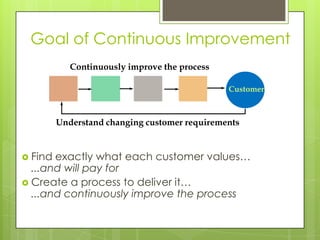
Goal of Continuous Improvement
            Continuously improve the process

                                               Customer


         Understand changing customer requirements


 Find exactly what each customer values…
  ...and will pay for
 Create a process to deliver it…
  ...and continuously improve the process
Value added vs. Non-value added
   Value added:
 Any process that adds value to the product
 that the customer is willing to pay for.
 Example: Putting eyelets in a shoe.

   Non-value  added (Waste):
 Any process that doesn’t add value to the
 product and that the customer will not pay
 for.
 Example: Moving the shoe across the plant
 to put a sole on it.
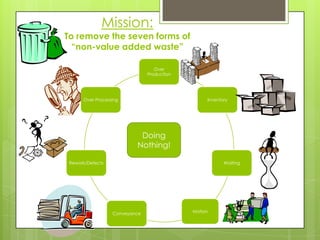
Mission:
To remove the seven forms of
  “non-value added waste”

                                  Over
                               Production


      Over Processing                            Inventory


                           Doing
                          Nothing!

 Rework/Defects                                         Waiting


                  Conveyance                Motion
Overproduction
 Making more parts or information than is
 required.

 Lean tool: Pacing material flow through
 production to match customer demand
 can help to minimize overproduction, and
 is more cost-efficient in the long run.
Inventory
 Raw  material, work in process (WIP), and
 finished goods waiting to be processed.

 Lean tool: Excess or just-in-case inventory
 can result in lost money and resources
 caused by storage. Aiming for just-in-time
 inventory reduces downtime associated
 with inventory problems.
Waiting
 Time
     spent waiting on something, or
 someone, to complete a task.

 Leantool: Design processes so that flow is
 continuous, and there are minimal (or no)
 buffers between steps in production.
Motion
   Any unnecessary movement of
    people/material that does not add value to
    the product or service.

   Lean tool: Ensure that work areas are logically
    organized, e.g., rather than having a worker
    walk 20 feet to pick up spare parts every half-
    hour, minimize the distance to 5 feet to
    significantly reduce excess motion.
Conveyance
 Unnecessarymovement to get goods
 from one process to the next.

 Lean tool: The transportation of goods or
 material can be risky. Damages or delays
 incurred while goods are in transit uses up
 resources. Effective planning can ensure
 that excess wastes in terms of moving do
 not occur.
Rework/Defects
   Time spent repairing or reworking material or
    information.

   Lean tool: The cost of fixing defects or
    mistakes is often cheaper the sooner they are
    found. For example, mistakes found at raw-
    materials inspection may cost only $10 to
    isolate and fix, whereas fixing a product at the
    work-in-progress stage may cost hundreds of
    dollars.
Over Processing
   Using more energy or activity than is needed
    to produce a product and that the customer
    won’t pay for.

   Lean tool: Look for potential simplifications to
    the manufacturing process, e.g., instead of
    completing 100-percent inspections on parts
    that never fail, reduce the number of parts
    inspected to greatly reduce processing time.
The worst waste of all…

                Doing Nothing!

By doing nothing we are allowing wasteful activities to
continue to not allow us to reach our full potential as a
                workforce/company.
CI requires a culture change
 Where  people are free to make and
  admit mistakes
 Where people work together cross-
  functionally
 Where people focus on processes to
  make improvements
 Where improvement is the way work is
  done, not just an event
Immediate Opportunities
•   Find out what your internal customers
    require and provide it
•   Identify and eliminate waste in current
    work process
•   Organize the workplace
•   Review core work for consistent
    standardization
•   Start with yourself and influence others

        Remember, Continuous Improvement is
         a journey that truly is never finished so
         keep pushing to get better everyday!

Ci training doc

  • 1.
    Welcome to a Continuous Improvement Event! The team looks forward to your input on helping us get better as we couldn’t do it without you!
  • 2.
    Ground Rules  Don’t just hear, Listen to understand  Regard each other as adults with significant life experiences  Be non-judgmental; ask questions and hold each other accountable  Respect each other’s ideas, feelings, and experiences  Take risks and allow for new thinking and behavior  Provide constructive feedback/”feed forward”  Speak with data and share freely within the group  Keep comments focused on the topic  Don’t make assumptions; check for disagreement  Stay on task  Have fun!
  • 3.
    Change doesn’t comeeasy  “If you do what you’ve always done, you’ll get what you’ve always gotten.” - Tony Robbins  “Man cannot discover new oceans unless he has the courage to lose sight of the shore.” - Andre Gide  “The best thing you can do is the right thing; the next best thing you can do is the wrong thing; the worst thing you can do is nothing.” -Theodore Roosevelt  “Fear, uncertainty and discomfort are your compasses toward growth.”  “I can accept failure, everyone fails at something. But I can’t accept not trying.” – Michael Jordan  “The world as we have created it is a process of our thinking. It cannot be changed without changing our thinking.” ― Albert Einstein
  • 4.
    Why is changeimportant?  We live in a time where anyone can order anything from anyone. So why choose Red Wing Shoes?  Quality (more consistent results?)  Variety (more equals more variability)  Value (more efficient = better cost)  Reduction in Lead time (faster to the customer) We must continue to change to meet our customer’s changing expectations to be successful.
  • 5.
    Will CI justgo away already! More companies are utilizing continuous improvement than ever before, so climb on board or get left behind!
  • 6.
    Goal of ContinuousImprovement Continuously improve the process Customer Understand changing customer requirements  Find exactly what each customer values… ...and will pay for  Create a process to deliver it… ...and continuously improve the process
  • 7.
    Value added vs.Non-value added  Value added: Any process that adds value to the product that the customer is willing to pay for. Example: Putting eyelets in a shoe.  Non-value added (Waste): Any process that doesn’t add value to the product and that the customer will not pay for. Example: Moving the shoe across the plant to put a sole on it.
  • 8.
    Mission: To remove theseven forms of “non-value added waste” Over Production Over Processing Inventory Doing Nothing! Rework/Defects Waiting Conveyance Motion
  • 9.
    Overproduction  Making moreparts or information than is required.  Lean tool: Pacing material flow through production to match customer demand can help to minimize overproduction, and is more cost-efficient in the long run.
  • 10.
    Inventory  Raw material, work in process (WIP), and finished goods waiting to be processed.  Lean tool: Excess or just-in-case inventory can result in lost money and resources caused by storage. Aiming for just-in-time inventory reduces downtime associated with inventory problems.
  • 11.
    Waiting  Time spent waiting on something, or someone, to complete a task.  Leantool: Design processes so that flow is continuous, and there are minimal (or no) buffers between steps in production.
  • 12.
    Motion  Any unnecessary movement of people/material that does not add value to the product or service.  Lean tool: Ensure that work areas are logically organized, e.g., rather than having a worker walk 20 feet to pick up spare parts every half- hour, minimize the distance to 5 feet to significantly reduce excess motion.
  • 13.
    Conveyance  Unnecessarymovement toget goods from one process to the next.  Lean tool: The transportation of goods or material can be risky. Damages or delays incurred while goods are in transit uses up resources. Effective planning can ensure that excess wastes in terms of moving do not occur.
  • 14.
    Rework/Defects  Time spent repairing or reworking material or information.  Lean tool: The cost of fixing defects or mistakes is often cheaper the sooner they are found. For example, mistakes found at raw- materials inspection may cost only $10 to isolate and fix, whereas fixing a product at the work-in-progress stage may cost hundreds of dollars.
  • 15.
    Over Processing  Using more energy or activity than is needed to produce a product and that the customer won’t pay for.  Lean tool: Look for potential simplifications to the manufacturing process, e.g., instead of completing 100-percent inspections on parts that never fail, reduce the number of parts inspected to greatly reduce processing time.
  • 16.
    The worst wasteof all… Doing Nothing! By doing nothing we are allowing wasteful activities to continue to not allow us to reach our full potential as a workforce/company.
  • 17.
    CI requires aculture change  Where people are free to make and admit mistakes  Where people work together cross- functionally  Where people focus on processes to make improvements  Where improvement is the way work is done, not just an event
  • 18.
    Immediate Opportunities • Find out what your internal customers require and provide it • Identify and eliminate waste in current work process • Organize the workplace • Review core work for consistent standardization • Start with yourself and influence others Remember, Continuous Improvement is a journey that truly is never finished so keep pushing to get better everyday!