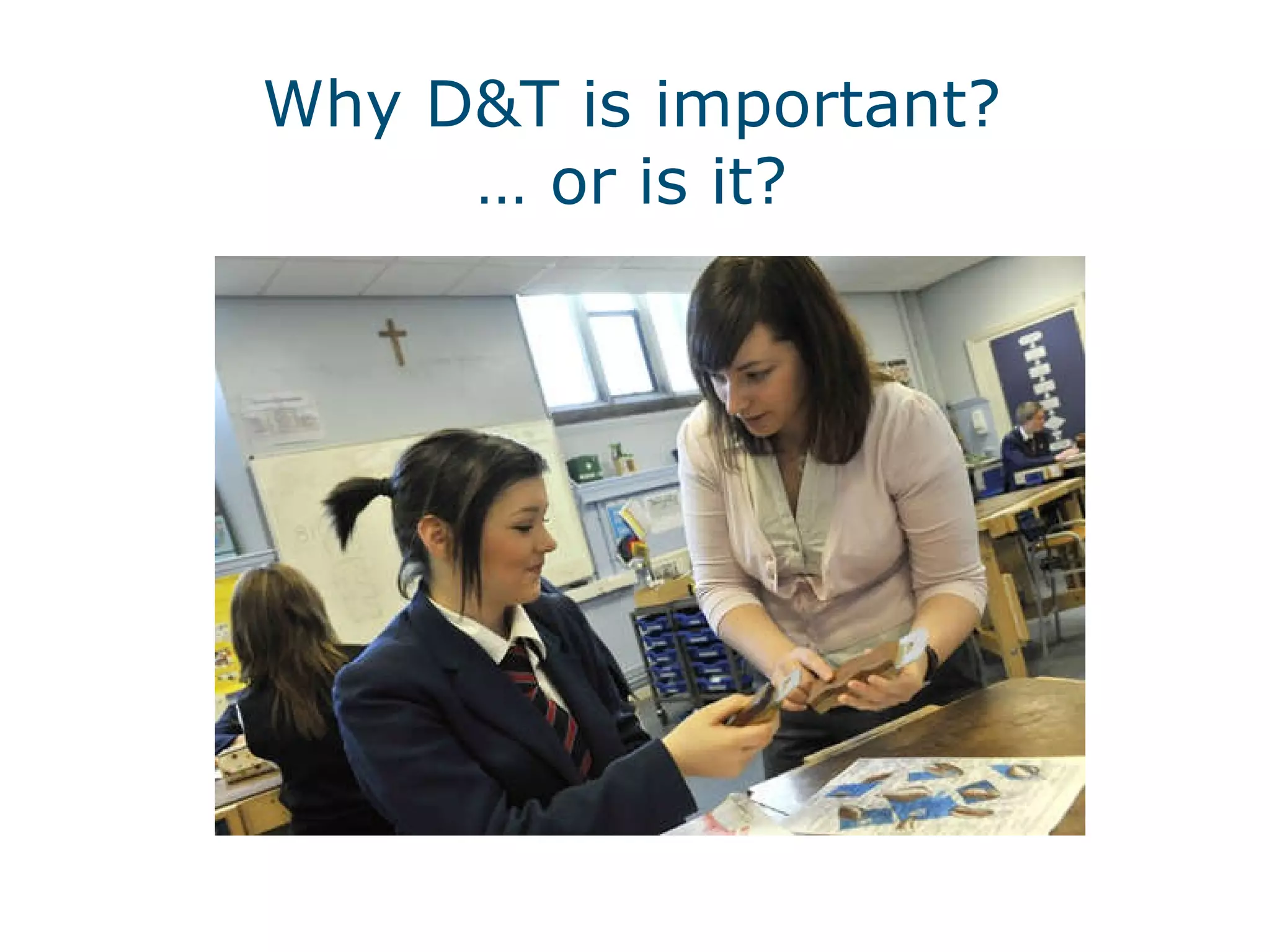
Why D&T is important? … or is it?
 
Justification of D&T in the school curriculum Economy Creativity Digital literacies Contribution to STEM Life skills Making things Application of theory from other subjects, I.e. underpins other school subjects
Facts Concepts Principles Fundamental operations National Curriculum Review:  Content - the ministerial position
Teaching - the ministerial position HOW  that will be taught teachers will decide
D&T @ NTU New team Updated programme: Review of ITT Review of school curriculum  (focus on content) D&TA campaign D&TA manifesto Future proofing’ our graduates
D&T Education Team at NTU Alison Hardy (2010): RM/ design/ technology in context Paul Boyd (2010): STEM/ electronics Sarah Davies (2007): design/ textiles Beverley Lawe (2009): food/ education studies Jamie Tinney (2010): design/ E-design/ technology in context
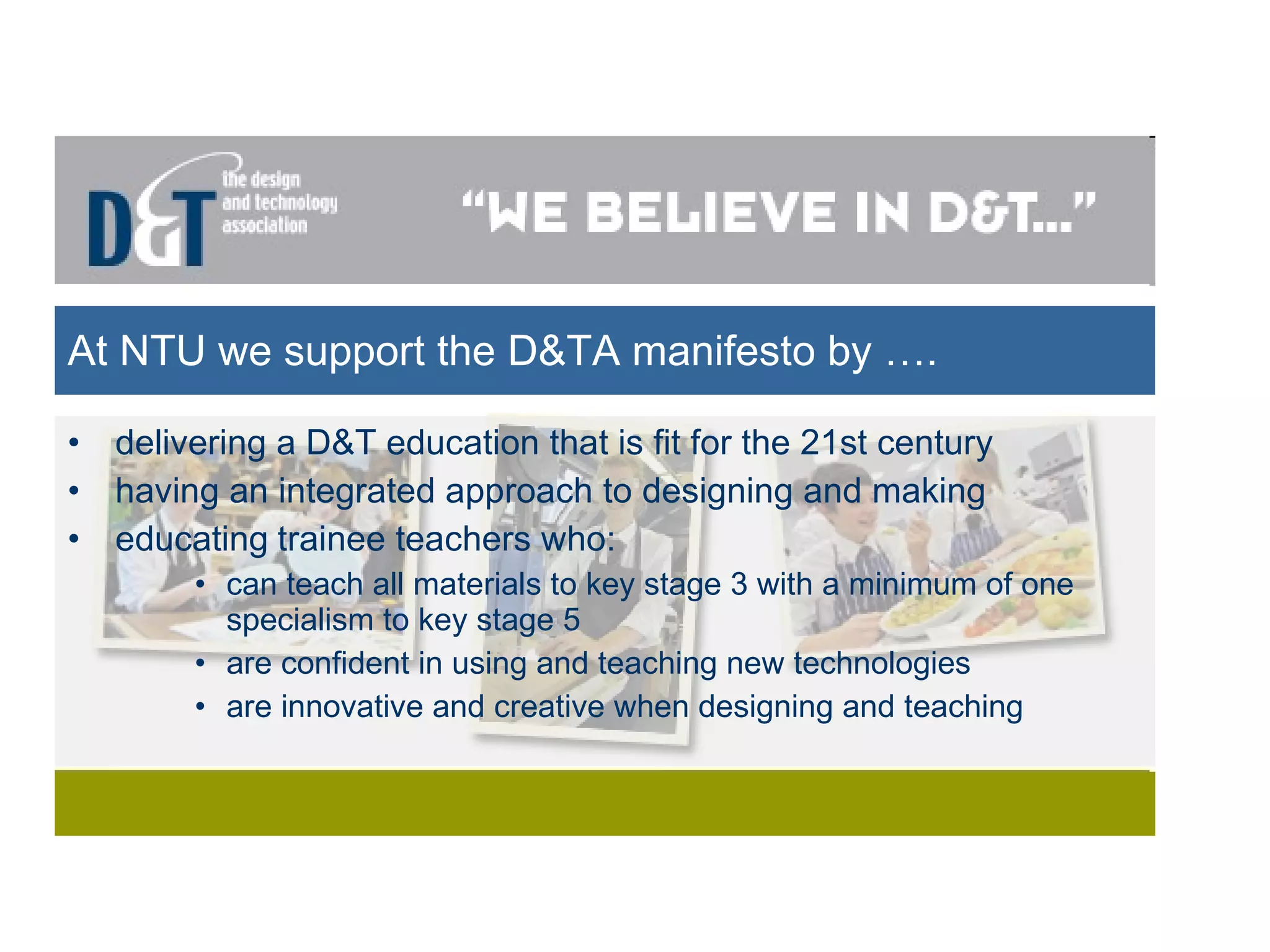
At NTU we support the D&TA manifesto by …. delivering a D&T education that is fit for the 21st century having an integrated approach to designing and making  educating   trainee teachers who: can teach all materials to key stage 3 with a minimum of one specialism to key stage 5 are confident in using and teaching new technologies are innovative and creative when designing and teaching
Congruent teaching? Taking it a step further Teacher educators want to be  ‘good models of the kind of teaching they are trying to promote’ (Swennen et al, 2008)  Teacher educators in D&T ITT at NTU take this a step further: The programme design reflects the model for the type of delivery and teaching we believe in for D&T in secondary education
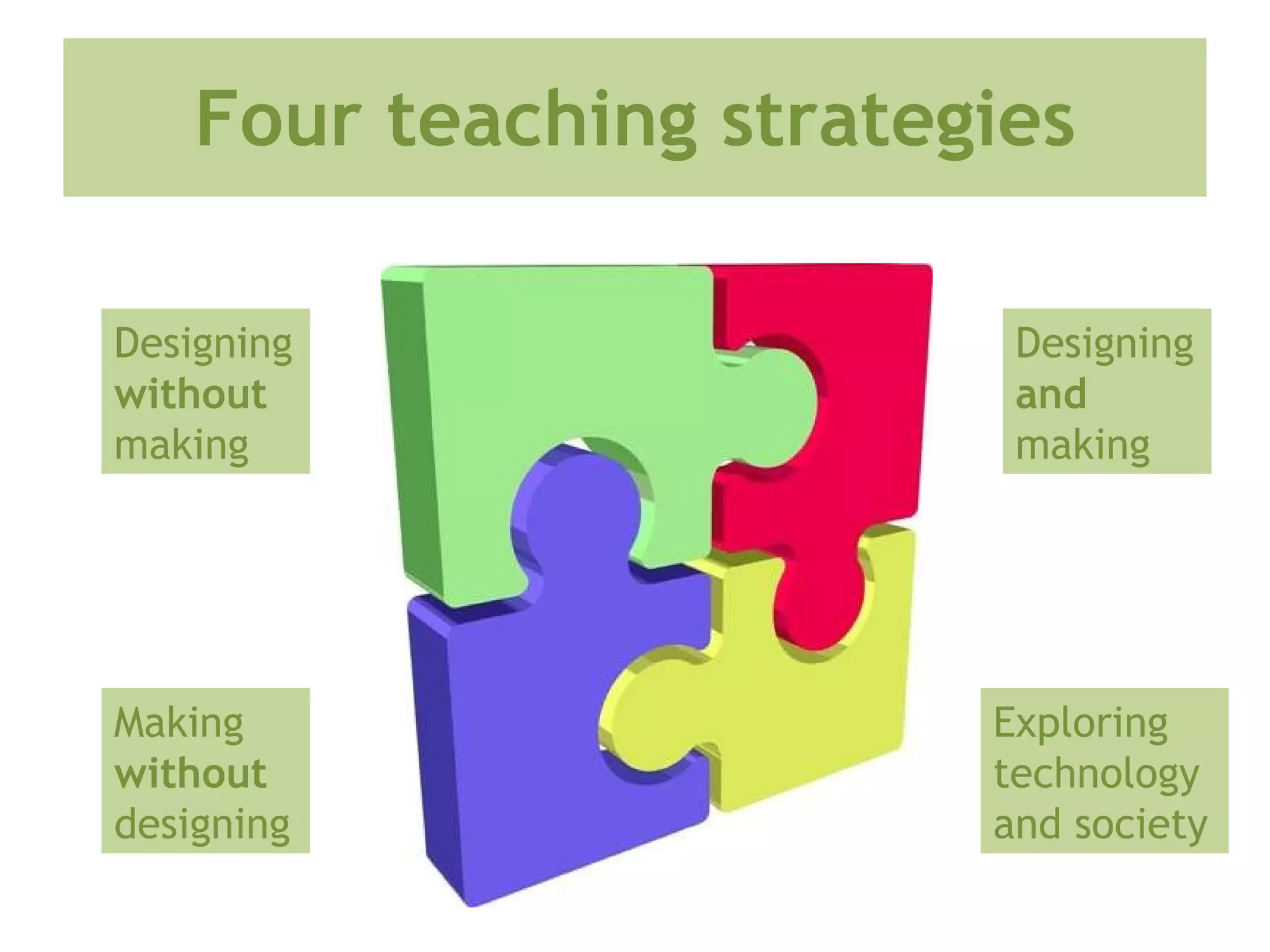
Four teaching strategies Designing  without  making Designing  and  making Making  without  designing Exploring technology and society
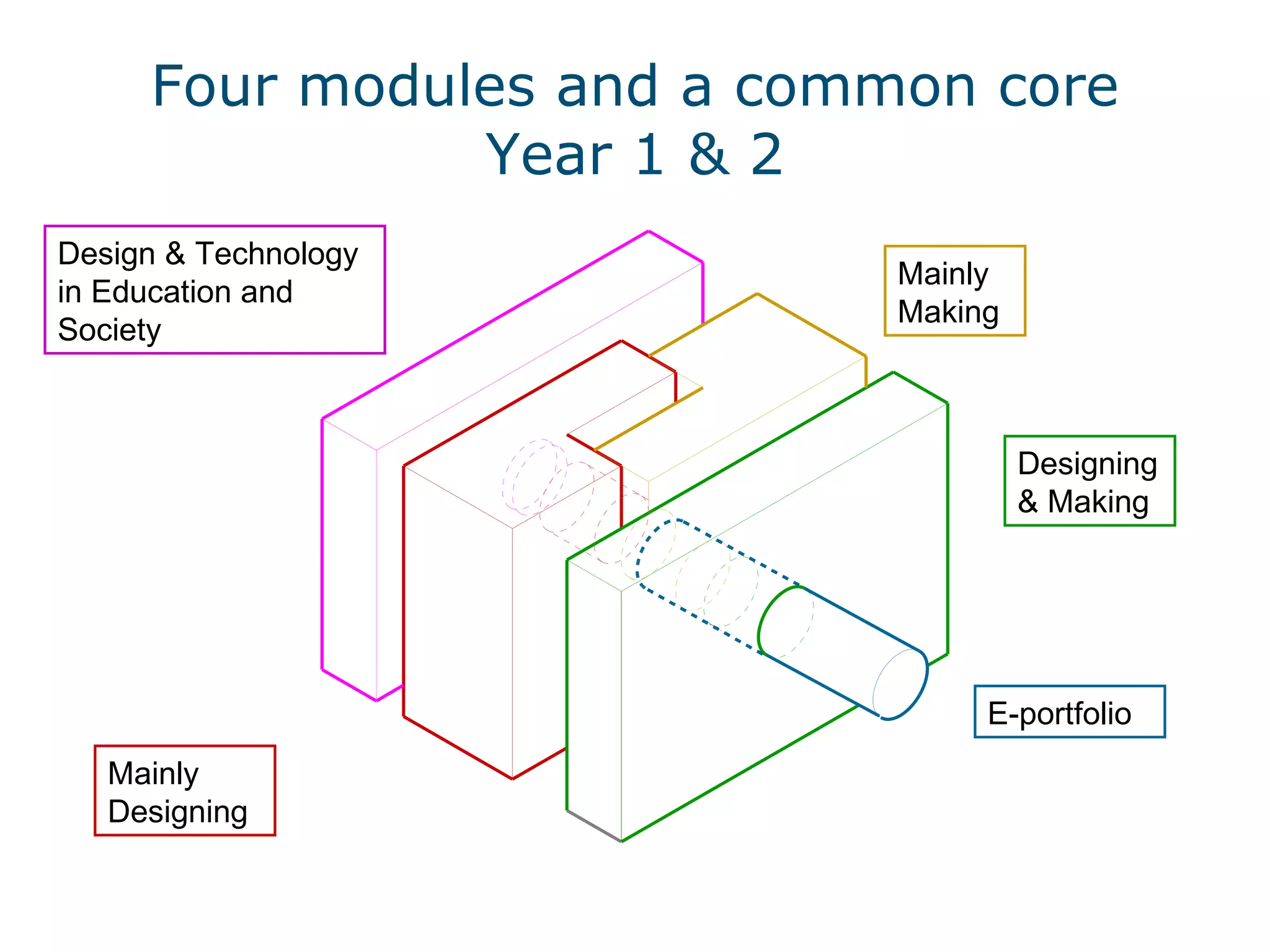
Four modules and a common core Year 1 & 2 Design & Technology in Education and Society Mainly Designing Mainly Making Designing & Making E-portfolio
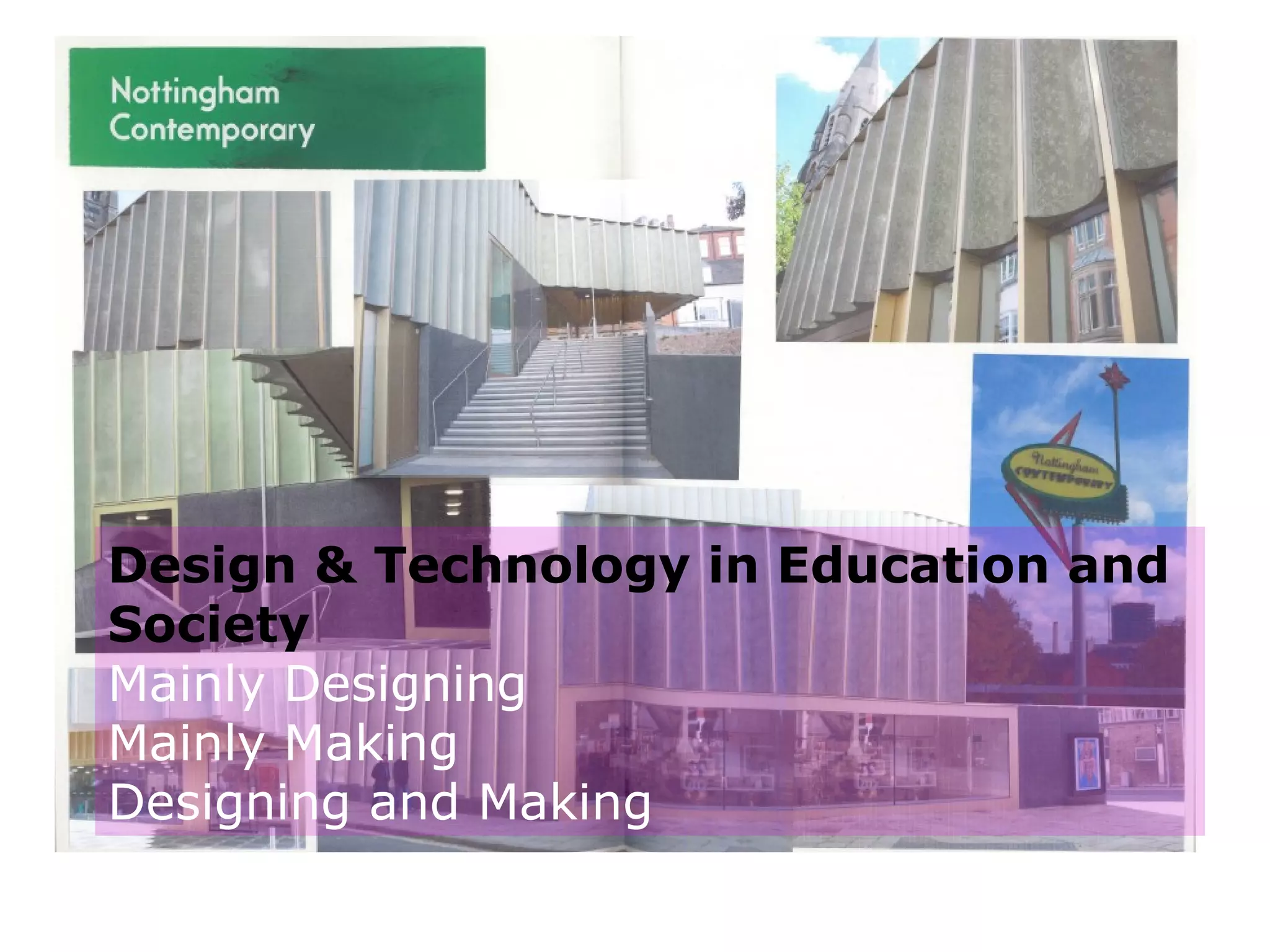
Design & Technology in Education and Society Mainly Designing Mainly Making  Designing and Making
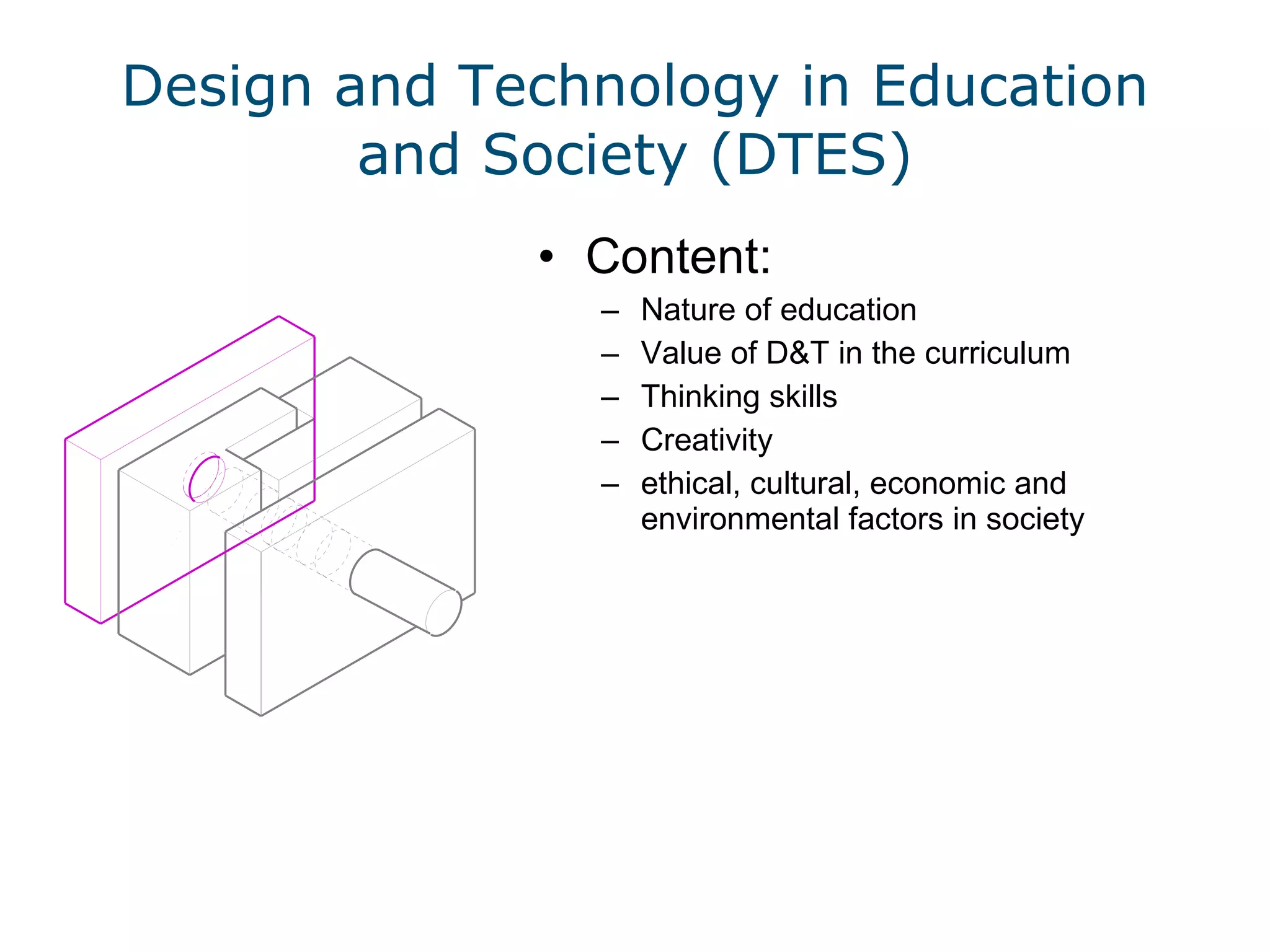
Design and Technology in Education and Society (DTES) Content: Nature of education Value of D&T in the curriculum Thinking skills Creativity ethical, cultural, economic and environmental factors in society
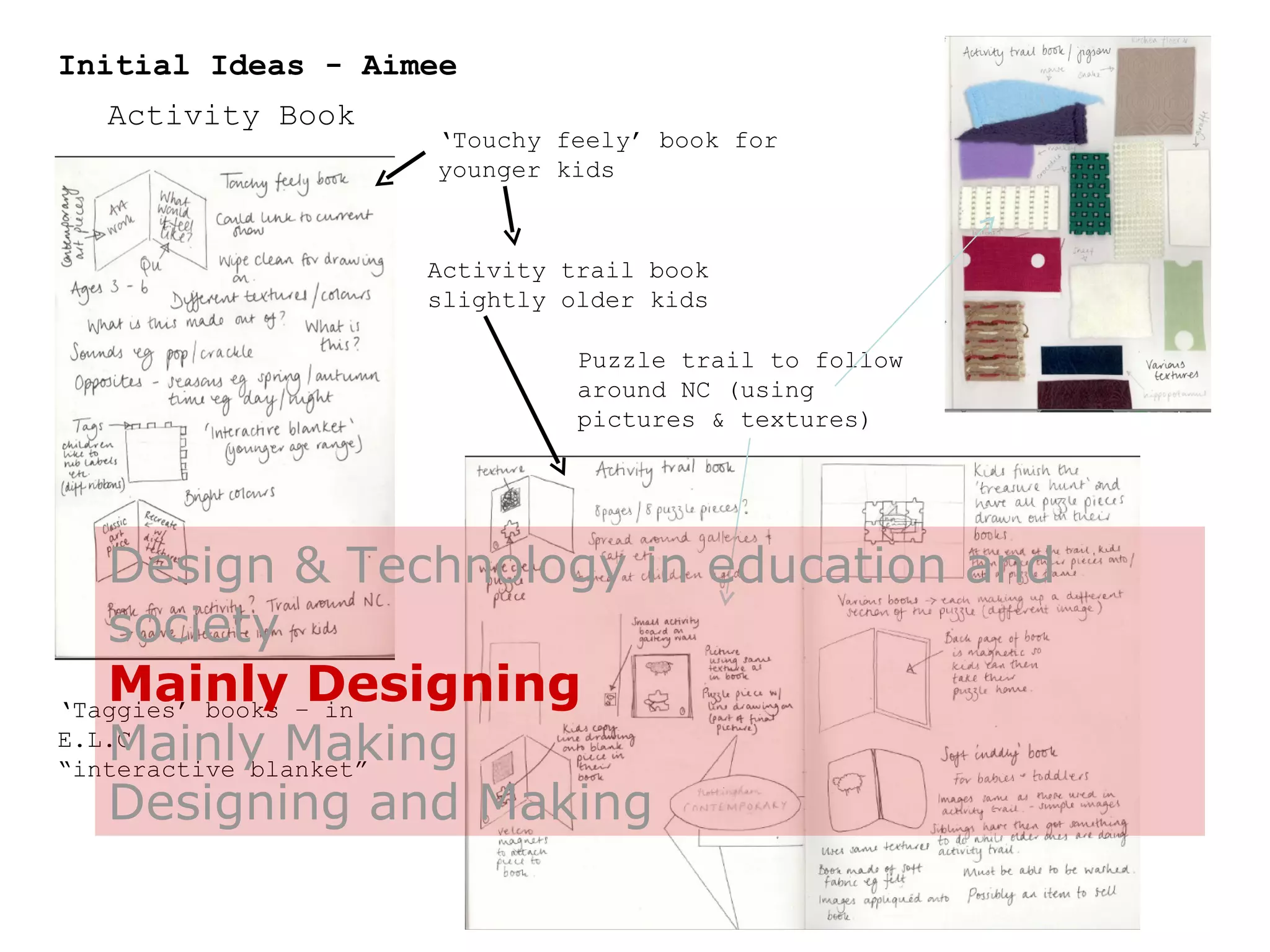
Initial Ideas - Aimee Activity Book ‘ Touchy feely’ book for younger kids ‘ Taggies’ books – in E.L.C  “ interactive blanket” Activity trail book slightly older kids Puzzle trail to follow around NC (using pictures & textures) Design & Technology in education and society  Mainly Designing   Mainly Making Designing and Making
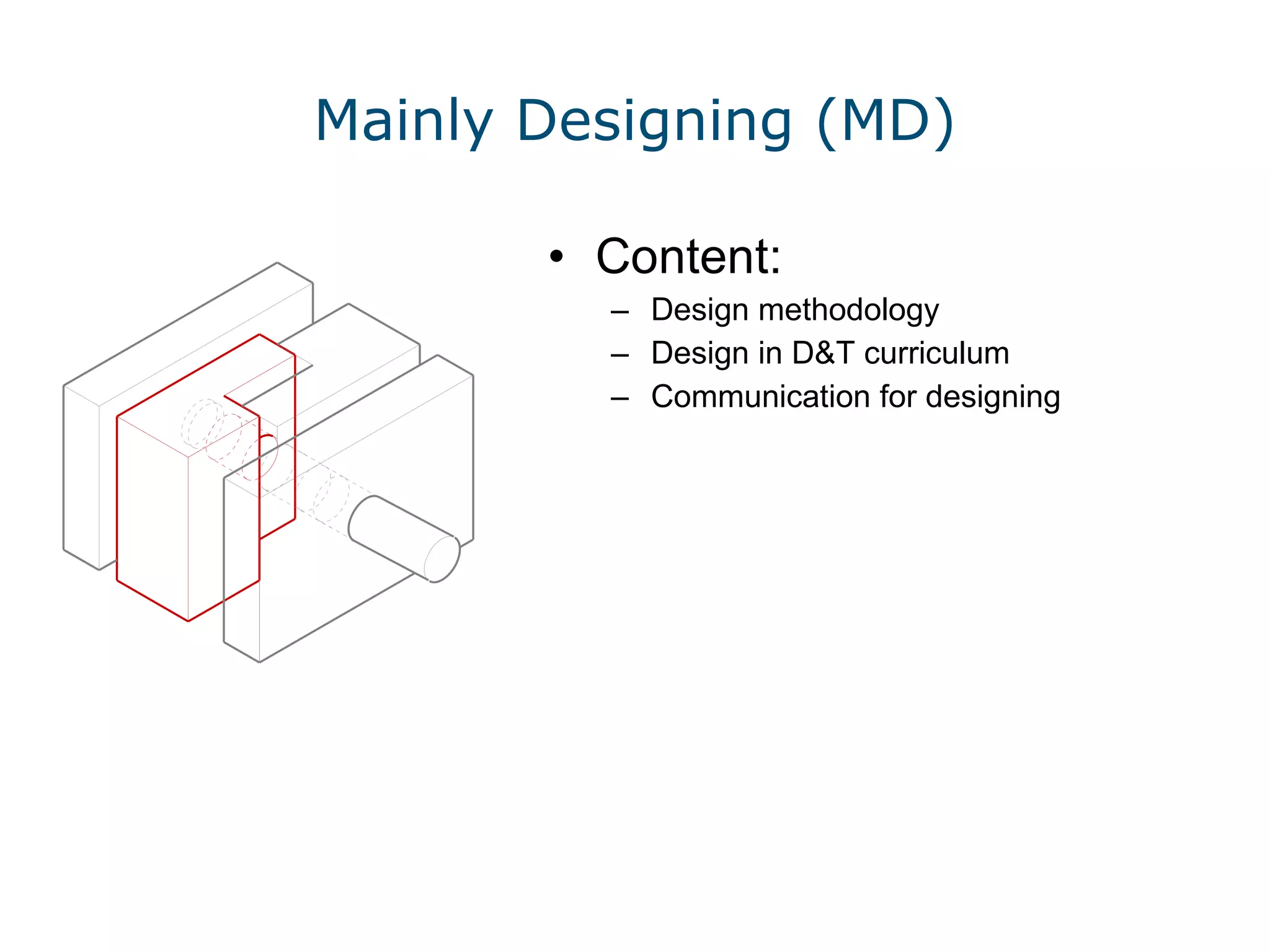
Mainly Designing (MD) Content: Design methodology Design in D&T curriculum Communication for designing
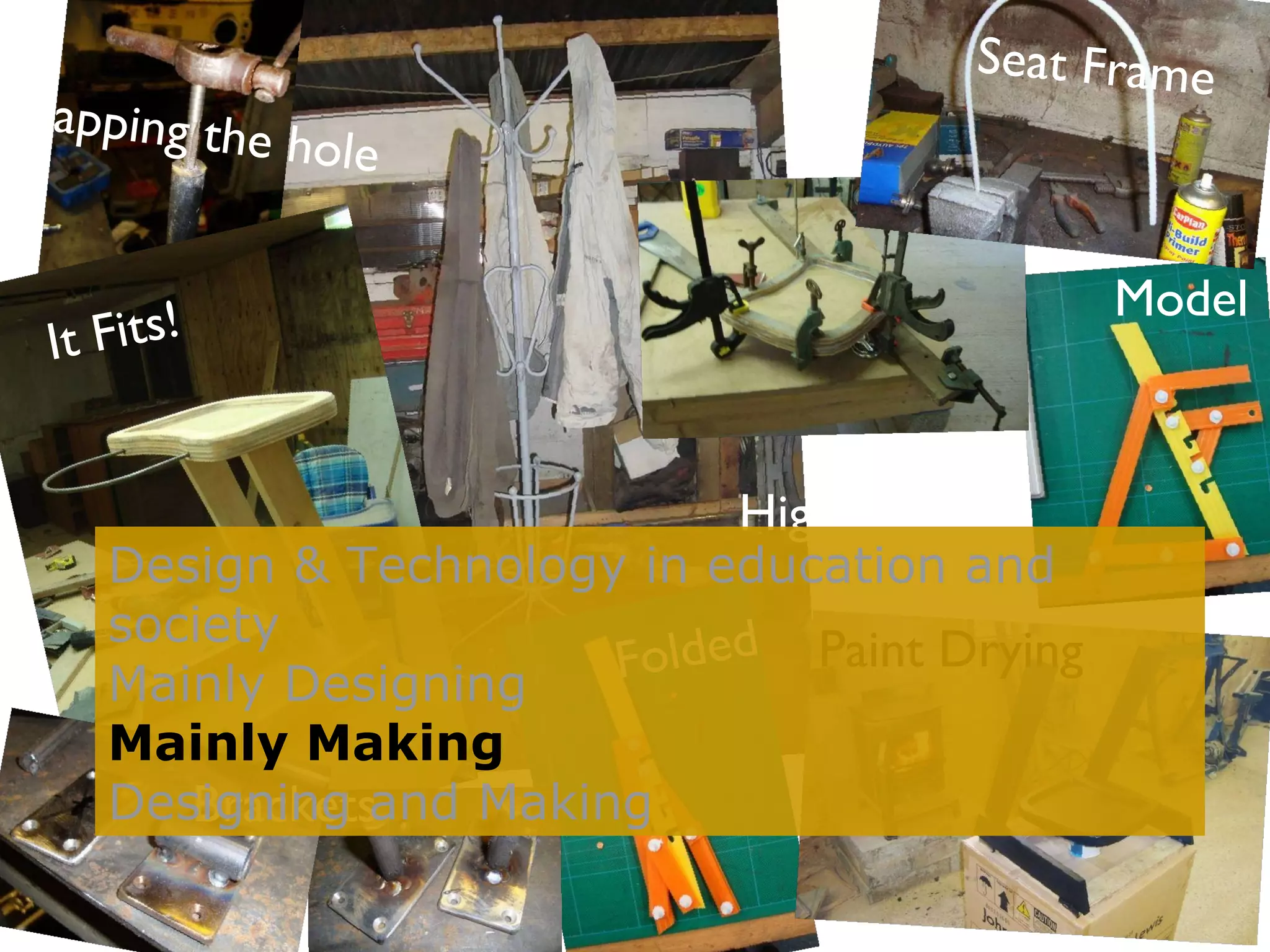
High Chair Paint Drying  Model Folded Brackets   It Fits! Seat Frame Tapping the hole Design & Technology in education and society Mainly Designing Mainly Making Designing and Making
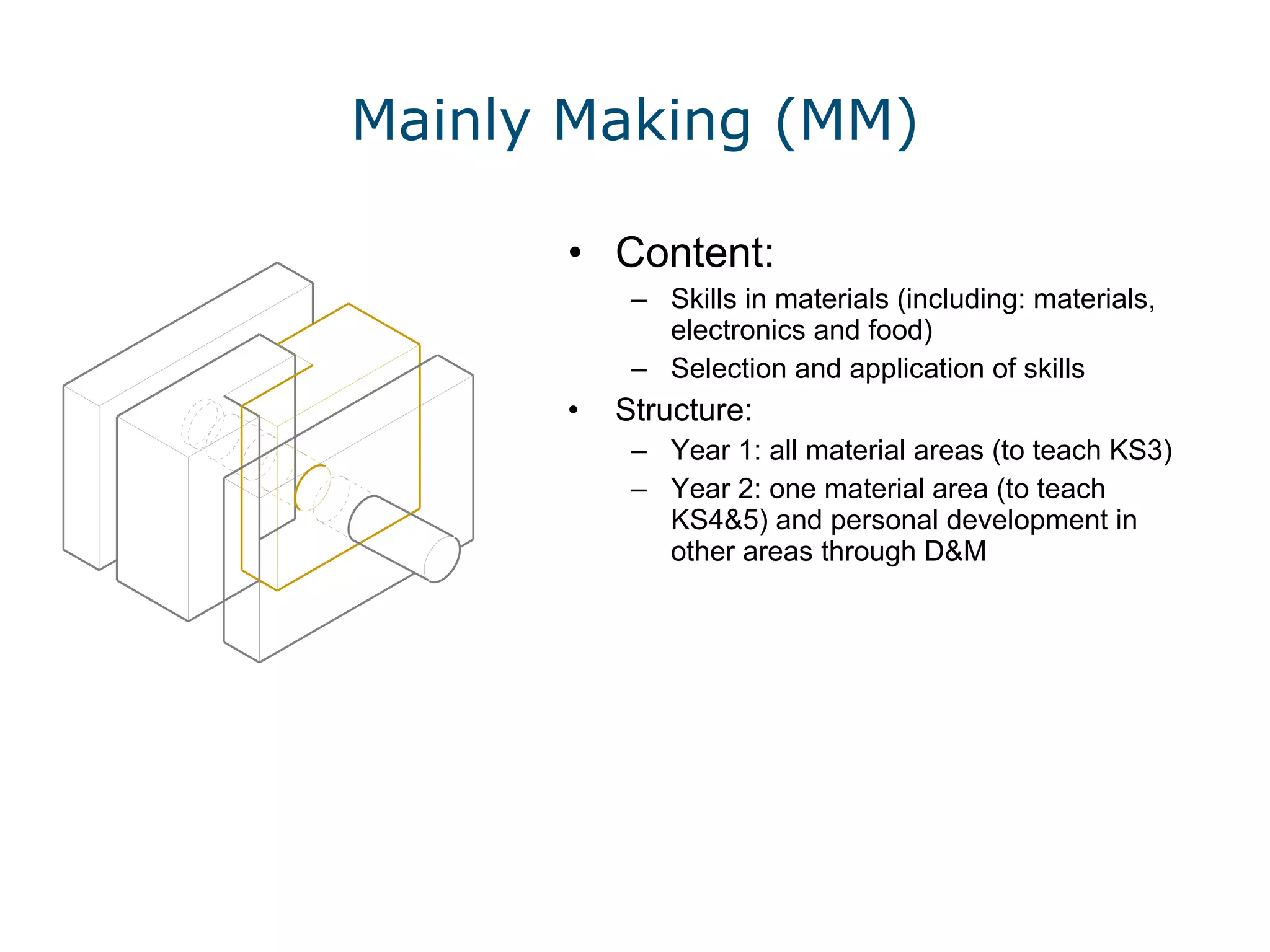
Mainly Making (MM) Content: Skills in materials (including: materials, electronics and food) Selection and application of skills Structure: Year 1: all material areas (to teach KS3) Year 2: one material area (to teach KS4&5) and personal development in other areas through D&M
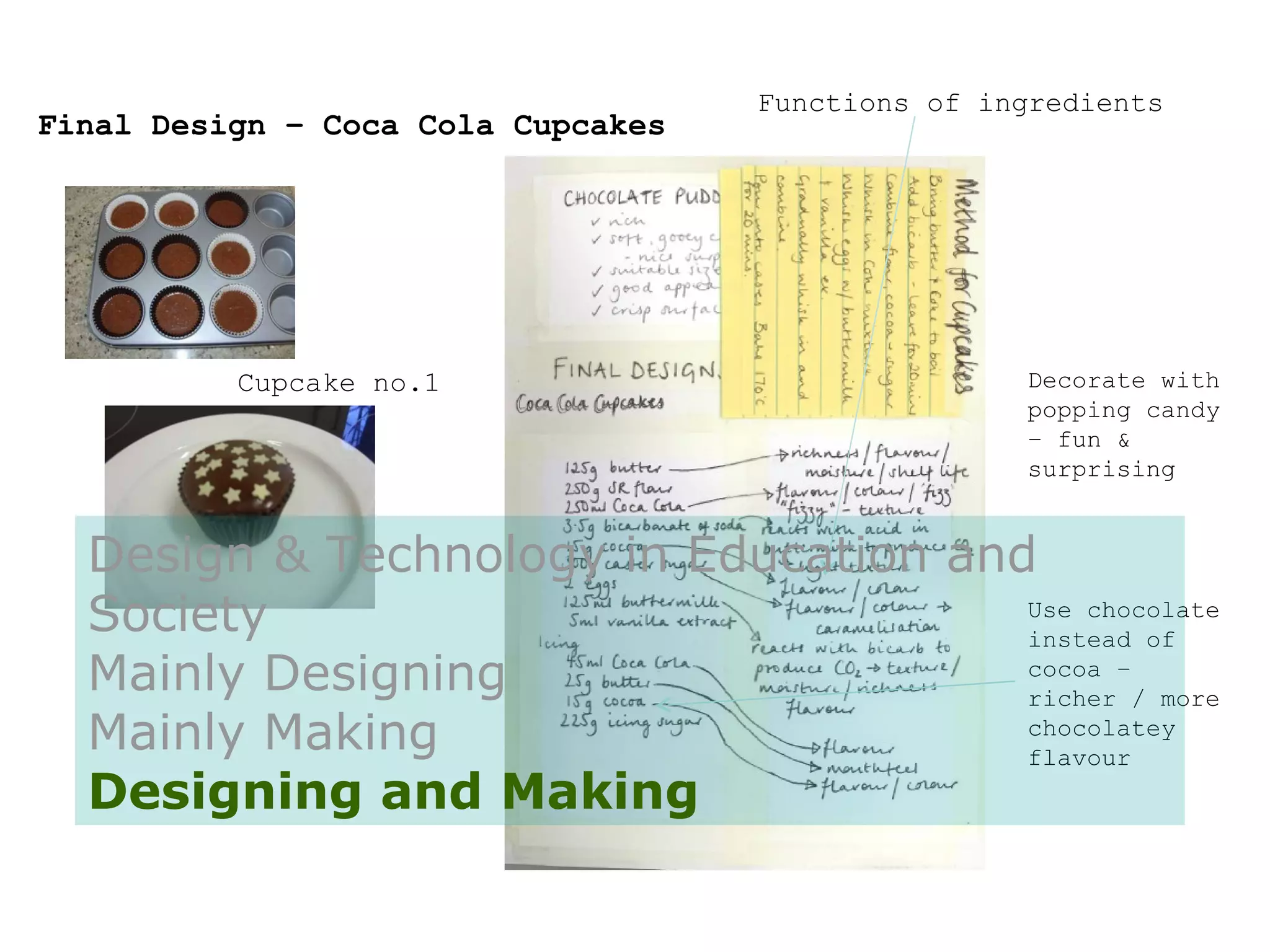
Final Design – Coca Cola Cupcakes Cupcake no.1 Functions of ingredients Decorate with popping candy – fun & surprising Use chocolate instead of cocoa – richer / more chocolatey flavour Design & Technology in Education and Society Mainly Designing Mainly Making Designing and Making
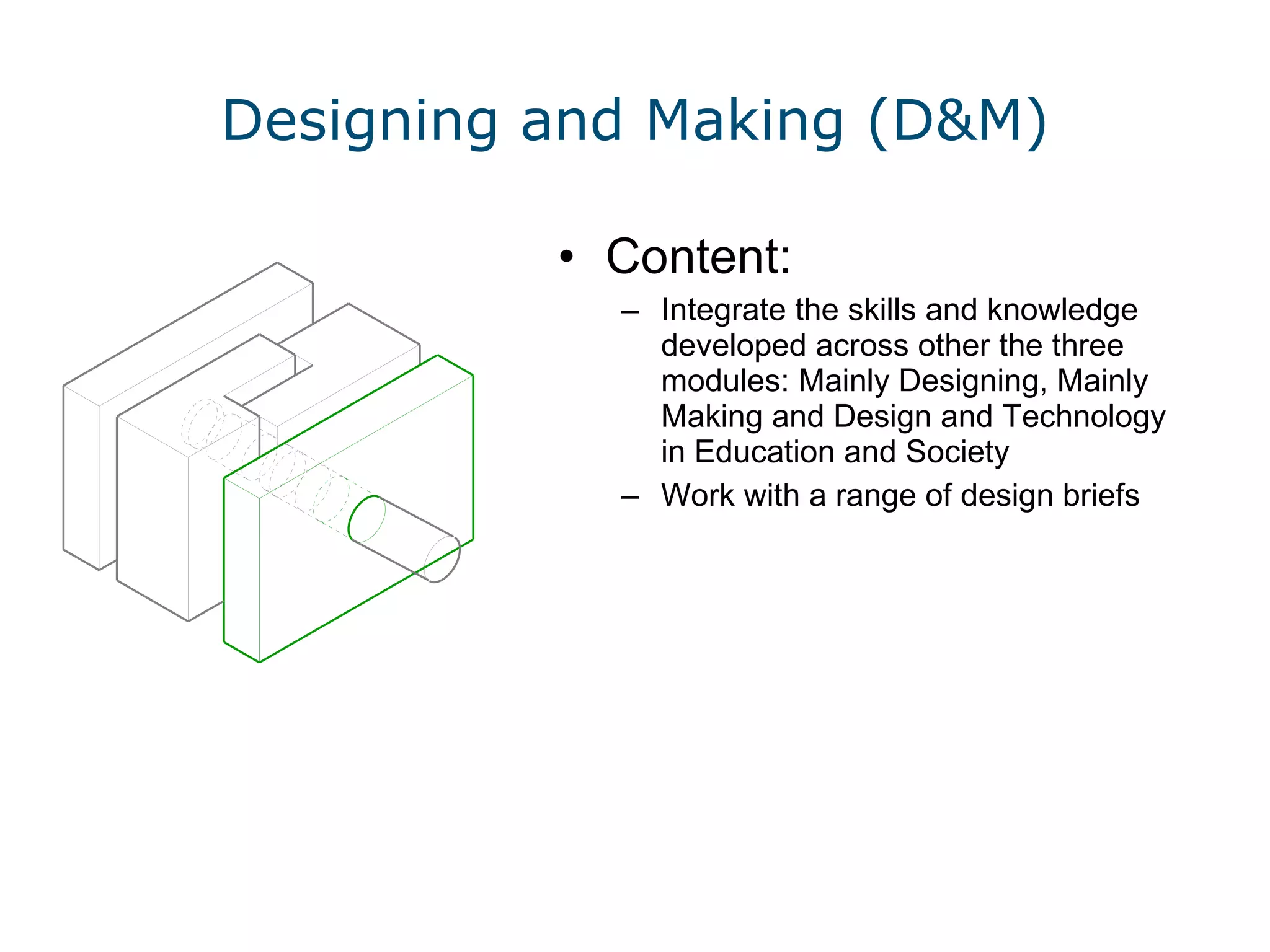
Designing and Making (D&M) Content: Integrate the skills and knowledge developed across other the three modules: Mainly Designing, Mainly Making and Design and Technology in Education and Society Work with a range of design briefs
E-portfolio
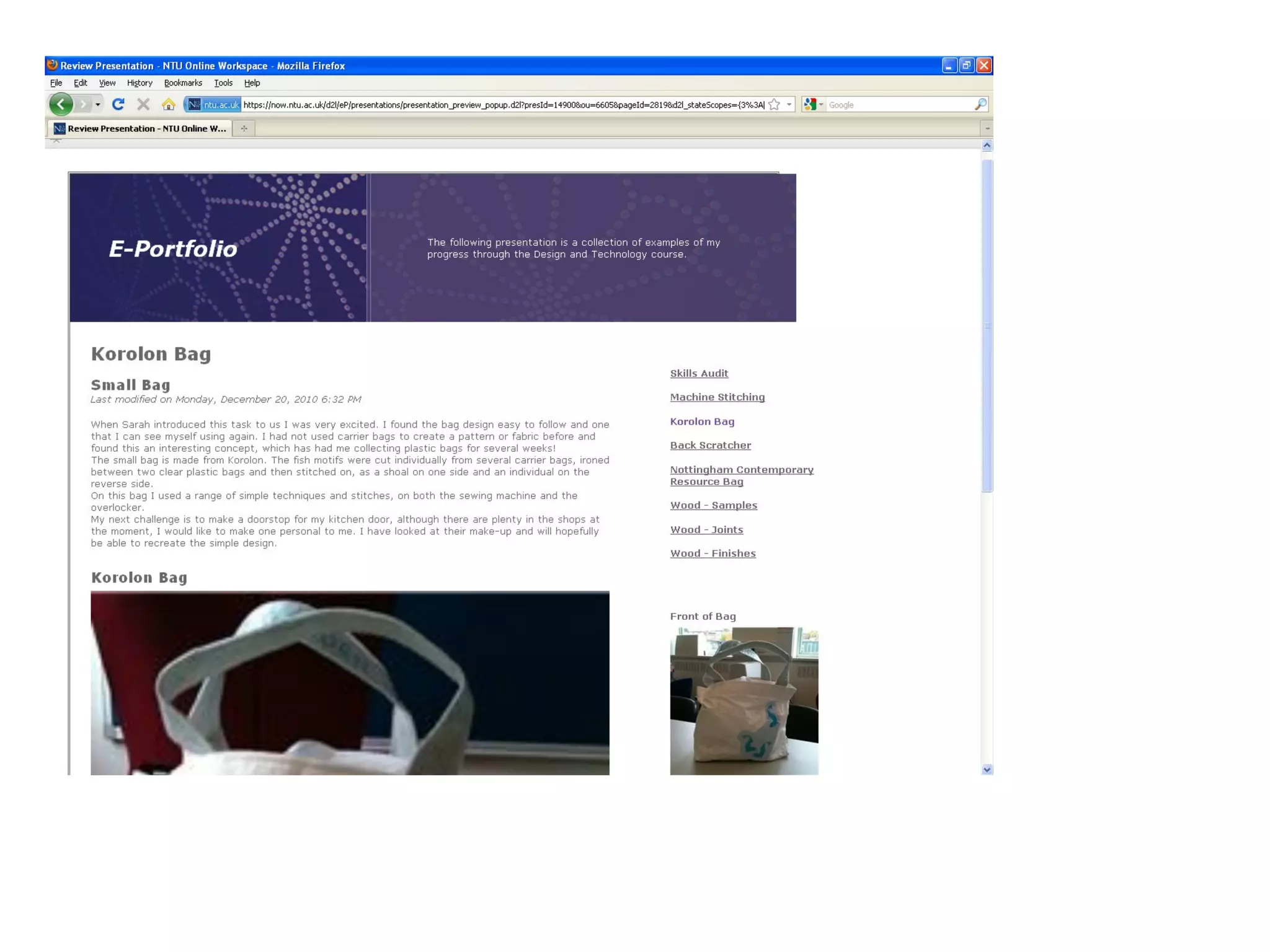
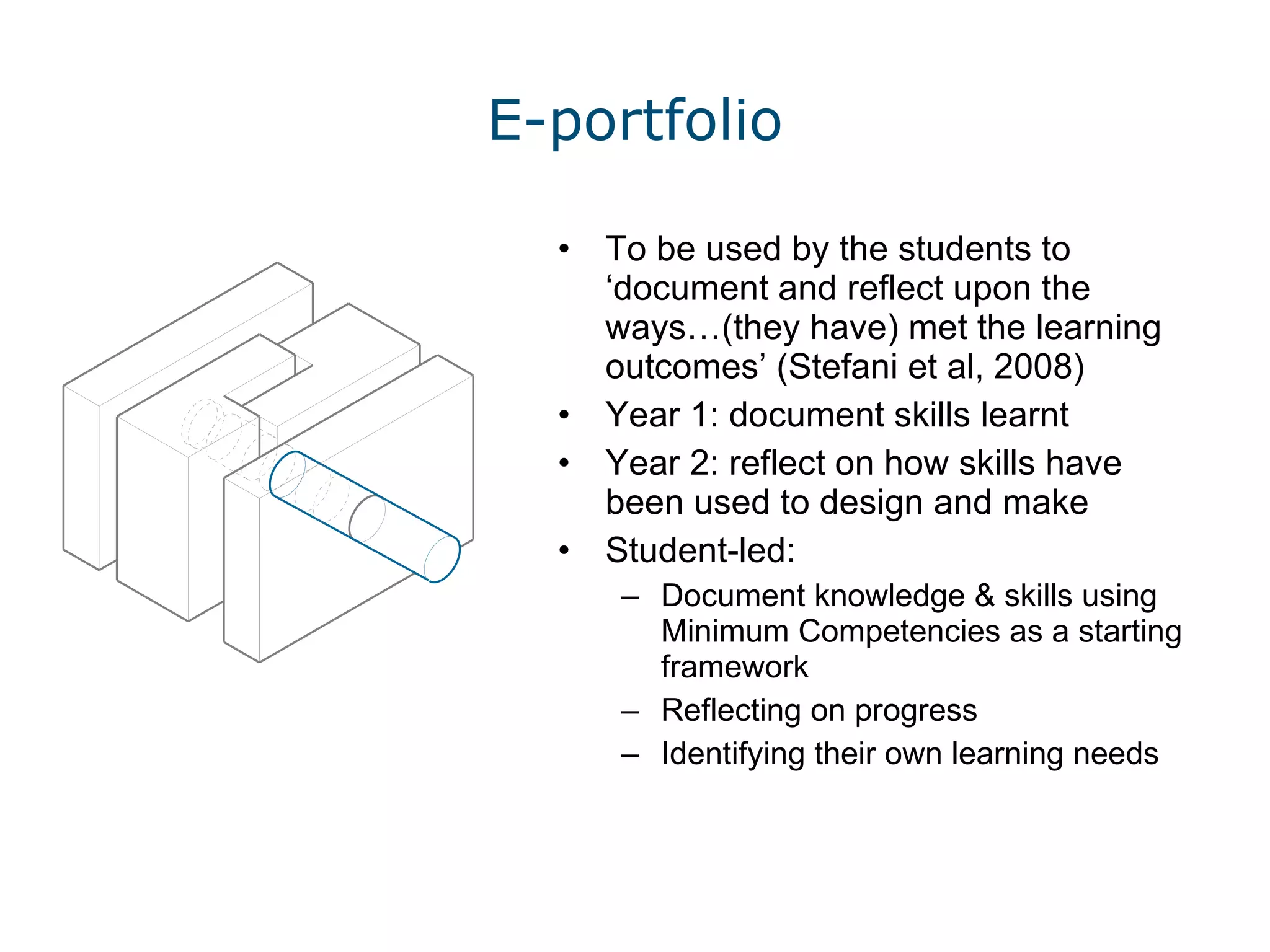
E-portfolio To be used by the students to  ‘document and reflect upon the ways…(they have) met the learning outcomes’ (Stefani et al, 2008) Year 1: document skills learnt Year 2: reflect on how skills have been used to design and make Student-led: Document knowledge & skills using Minimum Competencies as a starting framework Reflecting on progress Identifying their own learning needs
Year 3 Runs alongside PGCE year Modules: Subject Application Studies: pedagogy, subject knowledge School experience Education and Professional Studies
References Design and Technology Association (2010).  Minimum Competenices for Trainees to Teach Design and Technology in Secondary Schools.  Warwick: Design and Technology Association Stefani L., Mason R. and Pegler C., (2008)  The Educational Potential of E-Portfolios.  London:   Routledge Swennen, A., Lunenberd, M. and Korthagen, F., 2008.  Preach what you teach! teacher educators and congruent teaching.  Teachers and Teaching: Theory and Practice,   (14(5-6)), 531-542.

Importance of d and t

  • 1.
    Why D&T isimportant? … or is it?
  • 2.
  • 3.
    Justification of D&Tin the school curriculum Economy Creativity Digital literacies Contribution to STEM Life skills Making things Application of theory from other subjects, I.e. underpins other school subjects
  • 4.
    Facts Concepts PrinciplesFundamental operations National Curriculum Review: Content - the ministerial position
  • 5.
    Teaching - theministerial position HOW that will be taught teachers will decide
  • 6.
    D&T @ NTUNew team Updated programme: Review of ITT Review of school curriculum (focus on content) D&TA campaign D&TA manifesto Future proofing’ our graduates
  • 7.
    D&T Education Teamat NTU Alison Hardy (2010): RM/ design/ technology in context Paul Boyd (2010): STEM/ electronics Sarah Davies (2007): design/ textiles Beverley Lawe (2009): food/ education studies Jamie Tinney (2010): design/ E-design/ technology in context
  • 8.
    At NTU wesupport the D&TA manifesto by …. delivering a D&T education that is fit for the 21st century having an integrated approach to designing and making educating trainee teachers who: can teach all materials to key stage 3 with a minimum of one specialism to key stage 5 are confident in using and teaching new technologies are innovative and creative when designing and teaching
  • 9.
    Congruent teaching? Takingit a step further Teacher educators want to be ‘good models of the kind of teaching they are trying to promote’ (Swennen et al, 2008) Teacher educators in D&T ITT at NTU take this a step further: The programme design reflects the model for the type of delivery and teaching we believe in for D&T in secondary education
  • 10.
    Four teaching strategiesDesigning without making Designing and making Making without designing Exploring technology and society
  • 11.
    Four modules anda common core Year 1 & 2 Design & Technology in Education and Society Mainly Designing Mainly Making Designing & Making E-portfolio
  • 12.
    Design & Technologyin Education and Society Mainly Designing Mainly Making Designing and Making
  • 13.
    Design and Technologyin Education and Society (DTES) Content: Nature of education Value of D&T in the curriculum Thinking skills Creativity ethical, cultural, economic and environmental factors in society
  • 14.
    Initial Ideas -Aimee Activity Book ‘ Touchy feely’ book for younger kids ‘ Taggies’ books – in E.L.C “ interactive blanket” Activity trail book slightly older kids Puzzle trail to follow around NC (using pictures & textures) Design & Technology in education and society Mainly Designing Mainly Making Designing and Making
  • 15.
    Mainly Designing (MD)Content: Design methodology Design in D&T curriculum Communication for designing
  • 16.
    High Chair PaintDrying Model Folded Brackets It Fits! Seat Frame Tapping the hole Design & Technology in education and society Mainly Designing Mainly Making Designing and Making
  • 17.
    Mainly Making (MM)Content: Skills in materials (including: materials, electronics and food) Selection and application of skills Structure: Year 1: all material areas (to teach KS3) Year 2: one material area (to teach KS4&5) and personal development in other areas through D&M
  • 18.
    Final Design –Coca Cola Cupcakes Cupcake no.1 Functions of ingredients Decorate with popping candy – fun & surprising Use chocolate instead of cocoa – richer / more chocolatey flavour Design & Technology in Education and Society Mainly Designing Mainly Making Designing and Making
  • 19.
    Designing and Making(D&M) Content: Integrate the skills and knowledge developed across other the three modules: Mainly Designing, Mainly Making and Design and Technology in Education and Society Work with a range of design briefs
  • 20.
  • 21.
    E-portfolio To beused by the students to ‘document and reflect upon the ways…(they have) met the learning outcomes’ (Stefani et al, 2008) Year 1: document skills learnt Year 2: reflect on how skills have been used to design and make Student-led: Document knowledge & skills using Minimum Competencies as a starting framework Reflecting on progress Identifying their own learning needs
  • 22.
    Year 3 Runsalongside PGCE year Modules: Subject Application Studies: pedagogy, subject knowledge School experience Education and Professional Studies
  • 23.
    References Design andTechnology Association (2010). Minimum Competenices for Trainees to Teach Design and Technology in Secondary Schools. Warwick: Design and Technology Association Stefani L., Mason R. and Pegler C., (2008) The Educational Potential of E-Portfolios. London: Routledge Swennen, A., Lunenberd, M. and Korthagen, F., 2008. Preach what you teach! teacher educators and congruent teaching. Teachers and Teaching: Theory and Practice, (14(5-6)), 531-542.

Editor's Notes

  • #21 Purpose: Assessment against criteria from Minimum standards Learning – guide and advance learning over 3 years