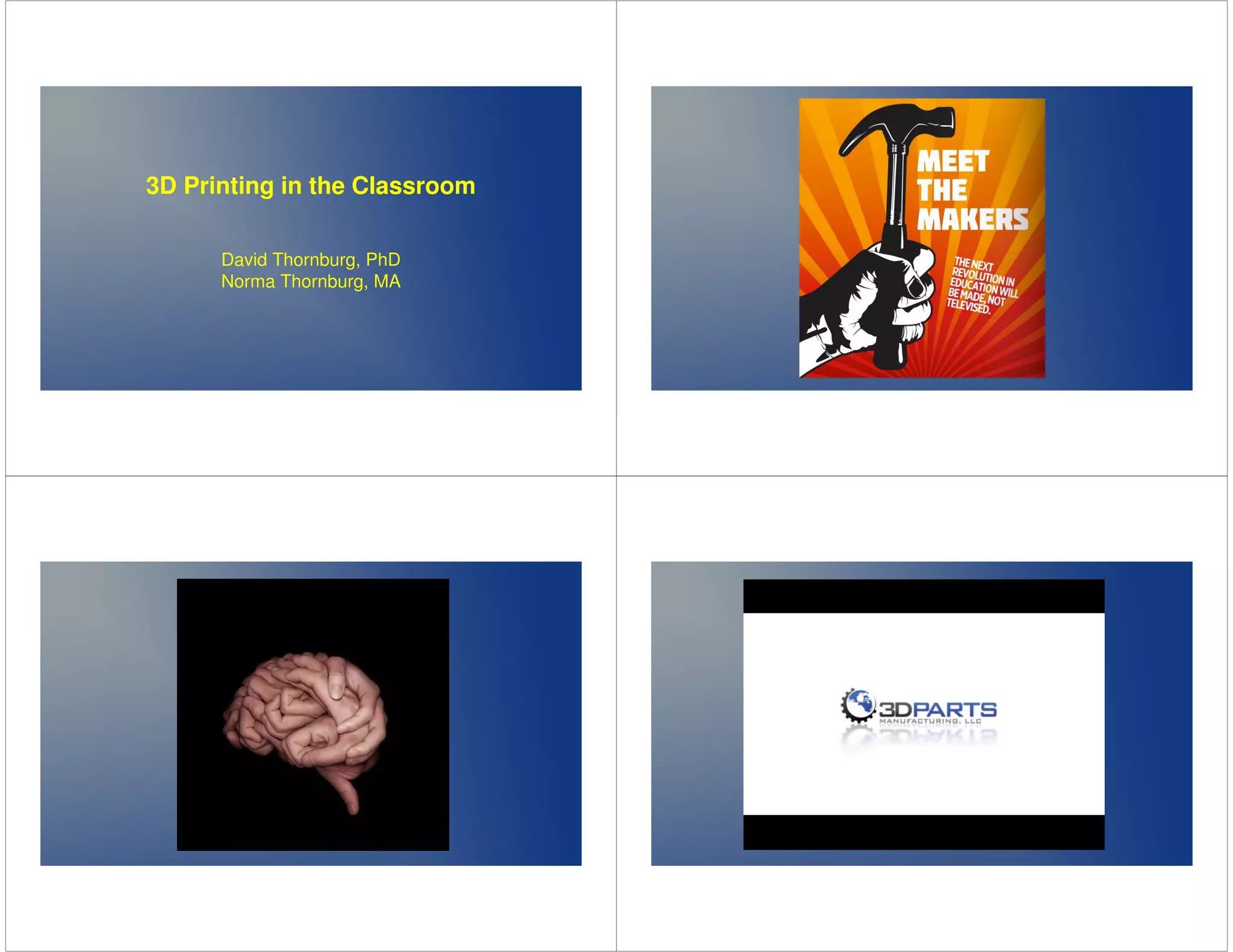
3D Printing in the Classroom 
David Thornburg, PhD 
Norma Thornburg, MA
Google searches on 3D Printers 
Recent Evolution of 3D Printers: 
Something for everyone... 
Phase 1: Hobbyists 
Kits
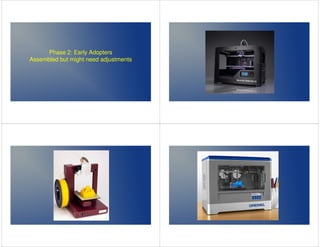
Phase 2: Early Adopters 
Assembled but might need adjustments
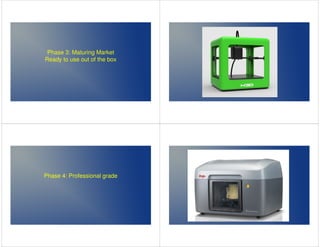
Phase 3: Maturing Market 
Ready to use out of the box 
Phase 4: Professional grade
3D Printing 
 Not a new topic 
 Constantly changing 
 Increasingly important 
 Strong connections to education 
 but first... 
3D Printing is the Next 
Industrial Revolution
What educational projects can be 
“crowdsourced”?
Hybrid technology 
Recycled materials
3D Printing comes to school... 
Libraries need to become more like kitchens and less like 
grocery stores - a place where patrons are able to 
construct knowledge, where they can create, build, make 
and be actively engaged. 
Erica Compton 
Idaho Commission for Libraries 
Printing in the classroom... 
 Recovers from the loss of tinkering - pride in making 
something from scratch 
 Connects to new Science standards 
 Connects to Common Core State Standards in 
Mathematics
Educational printer requirements... 
 Good out of the box experience 
 Reasonable price 
 Reliable 
 Remember it is still early in the game but schools 
should start now! 
What should students make? 
 Avoid just downloading cool things from Thingiverse. 
 Design is the primary task - printing is the reward. 
 Create age-appropriate tasks.
NGSS elements 
 K-12 Science Education Should Reflect the Interconnected Nature of Science 
as it is Practiced and Experienced in the Real World. 
 The Next Generation Science Standards are student performance 
expectations – NOT curriculum. 
 The Science Concepts in the NGSS Build Coherently from K–12. 
 The NGSS Focus on Deeper Understanding of Content as well as Application 
of Content. 
 Science and Engineering are Integrated in the NGSS, from K–12. 
 The NGSS are designed to prepare students for college, career, and 
citizenship. 
 The NGSS and Common Core State Standards (English Language Arts and 
Mathematics) are Aligned. 
Eight Math Standards: 3D Printing 
1. Make sense of problems and persevere in solving them. 
2. Reason abstractly and quantitatively. 
3. Construct viable arguments and critique the reasoning of others. 
4. Model with mathematics. 
5. Use appropriate tools strategically. 
6. Attend to precision. 
7. Look for and make use of structure. 
8. Look for and express regularity in repeated reasoning. 
3D Printing is a wonderful tool for 
developing engineering skills.
We are all designers now. We may as well get 
good at it. 
Chris Anderson – Former editor of Wired 
Magazine, author of Makers: The New 
Industrial Revolution 
We are all designers now. We may as well get 
good at it. 
Chris Anderson – Former editor of Wired 
Magazine, author of Makers: The New 
Industrial Revolution
Clark Barnett bugs
//round piece// 
$fn=100; 
difference() { 
sphere (30); 
cylinder (70, 18, 18, center=true); 
rotate ([0, 90, 0]) { 
cylinder (70, 18, 18, 
center=true); 
} 
rotate ([90, 0 ,0]) { 
cylinder (70, 18, 18, 
center=true); 
} 
} 
Other approaches...
Process for student projects 
1.Choose the project 
2.Determine the optimal software to use 
3.Do the design and export to STL 
4.Fabricate the project
Empowering kids 
From: Aaron Bruno 
Sent: Wednesday, June 11, 2014 11:48 AM 
To: Kim Brand 
Subject: Happy to help 
I would be very happy to attend the camp and if possible I 
would love to help teach. I can have the list of top ten 
finished by tomorrow morning and I do have quite a few 
models, I have been working with tinker cad For about 3 
weeks now and i know quite a bit of information about it, 
so I am very confident in my teaching abilities, so if 
possible I would like to help teach. 
Dthornburg@aol.com 
Nthornburg@gmail.com 
http://thornburgthoughts.wordpress.com

Inside3DPrinting_DavidThornburg

  • 1.
    3D Printing inthe Classroom David Thornburg, PhD Norma Thornburg, MA
  • 2.
    Google searches on3D Printers Recent Evolution of 3D Printers: Something for everyone... Phase 1: Hobbyists Kits
  • 3.
    Phase 2: EarlyAdopters Assembled but might need adjustments
  • 4.
    Phase 3: MaturingMarket Ready to use out of the box Phase 4: Professional grade
  • 5.
    3D Printing Not a new topic Constantly changing Increasingly important Strong connections to education but first... 3D Printing is the Next Industrial Revolution
  • 9.
    What educational projectscan be “crowdsourced”?
  • 10.
  • 11.
    3D Printing comesto school... Libraries need to become more like kitchens and less like grocery stores - a place where patrons are able to construct knowledge, where they can create, build, make and be actively engaged. Erica Compton Idaho Commission for Libraries Printing in the classroom... Recovers from the loss of tinkering - pride in making something from scratch Connects to new Science standards Connects to Common Core State Standards in Mathematics
  • 12.
    Educational printer requirements... Good out of the box experience Reasonable price Reliable Remember it is still early in the game but schools should start now! What should students make? Avoid just downloading cool things from Thingiverse. Design is the primary task - printing is the reward. Create age-appropriate tasks.
  • 13.
    NGSS elements K-12 Science Education Should Reflect the Interconnected Nature of Science as it is Practiced and Experienced in the Real World. The Next Generation Science Standards are student performance expectations – NOT curriculum. The Science Concepts in the NGSS Build Coherently from K–12. The NGSS Focus on Deeper Understanding of Content as well as Application of Content. Science and Engineering are Integrated in the NGSS, from K–12. The NGSS are designed to prepare students for college, career, and citizenship. The NGSS and Common Core State Standards (English Language Arts and Mathematics) are Aligned. Eight Math Standards: 3D Printing 1. Make sense of problems and persevere in solving them. 2. Reason abstractly and quantitatively. 3. Construct viable arguments and critique the reasoning of others. 4. Model with mathematics. 5. Use appropriate tools strategically. 6. Attend to precision. 7. Look for and make use of structure. 8. Look for and express regularity in repeated reasoning. 3D Printing is a wonderful tool for developing engineering skills.
  • 14.
    We are alldesigners now. We may as well get good at it. Chris Anderson – Former editor of Wired Magazine, author of Makers: The New Industrial Revolution We are all designers now. We may as well get good at it. Chris Anderson – Former editor of Wired Magazine, author of Makers: The New Industrial Revolution
  • 15.
  • 16.
    //round piece// $fn=100; difference() { sphere (30); cylinder (70, 18, 18, center=true); rotate ([0, 90, 0]) { cylinder (70, 18, 18, center=true); } rotate ([90, 0 ,0]) { cylinder (70, 18, 18, center=true); } } Other approaches...
  • 19.
    Process for studentprojects 1.Choose the project 2.Determine the optimal software to use 3.Do the design and export to STL 4.Fabricate the project
  • 21.
    Empowering kids From:Aaron Bruno Sent: Wednesday, June 11, 2014 11:48 AM To: Kim Brand Subject: Happy to help I would be very happy to attend the camp and if possible I would love to help teach. I can have the list of top ten finished by tomorrow morning and I do have quite a few models, I have been working with tinker cad For about 3 weeks now and i know quite a bit of information about it, so I am very confident in my teaching abilities, so if possible I would like to help teach. Dthornburg@aol.com Nthornburg@gmail.com http://thornburgthoughts.wordpress.com