Jewish
Warsaw
Warsaw, the capital of Poland and its largest city. Warsaw has gone under this
name since the 13th century, and became the capital in 1596. The city sits on
the banks of the Vistula River, which divides the city so that two thirds of the
city are on the west bank, and the rest on the east. In 1935, Warsaw's size was
approx. 55 square miles, with some 1.3 million inhabitants.
After World War I, Warsaw was a major center, not only for European Jewish
community for world Jewry as well. The city boasted major Jewish political
parties, aid groups, trade unions, and cultural and religious institutions. In
contrast to the harsh financial condition, and in fact widespread poverty of
most Jews of the city, the Warsaw Jewish community featured a vibrant
cultural life, in the fields of art and literature, in the publishing world, and in
theaters and clubs. In the months leading up the war, tensions arose between
Jews and the Polish population, with a degree of discomfort and uncertainty.
Jewish
Warsaw
The Jews in Warsaw
Jewish demographics of Warsaw
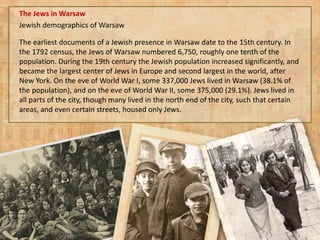
The earliest documents of a Jewish presence in Warsaw date to the 15th century. In
the 1792 census, the Jews of Warsaw numbered 6,750, roughly one tenth of the
population. During the 19th century the Jewish population increased significantly, and
became the largest center of Jews in Europe and second largest in the world, after
New York. On the eve of World War I, some 337,000 Jews lived in Warsaw (38.1% of
the population), and on the eve of World War II, some 375,000 (29.1%). Jews lived in
all parts of the city, though many lived in the north end of the city, such that certain
areas, and even certain streets, housed only Jews.
Jews Economic Life in Warsaw
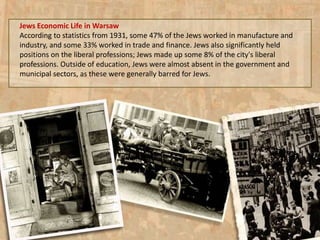
According to statistics from 1931, some 47% of the Jews worked in manufacture and
industry, and some 33% worked in trade and finance. Jews also significantly held
positions on the liberal professions; Jews made up some 8% of the city's liberal
professions. Outside of education, Jews were almost absent in the government and
municipal sectors, as these were generally barred for Jews.
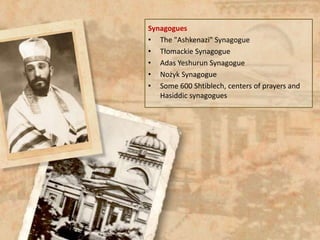
Synagogues
• The "Ashkenazi" Synagogue
• Tłomackie Synagogue
• Adas Yeshurun Synagogue
• Nożyk Synagogue
• Some 600 Shtiblech, centers of prayers and
Hasiddic synagogues
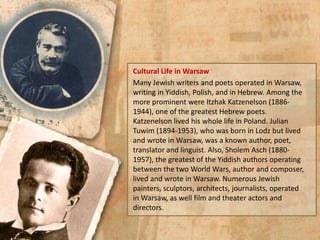
Cultural Life in Warsaw
Many Jewish writers and poets operated in Warsaw,
writing in Yiddish, Polish, and in Hebrew. Among the
more prominent were Itzhak Katzenelson (1886-
1944), one of the greatest Hebrew poets.
Katzenelson lived his whole life in Poland. Julian
Tuwim (1894-1953), who was born in Lodz but lived
and wrote in Warsaw, was a known author, poet,
translator and linguist. Also, Sholem Asch (1880-
1957), the greatest of the Yiddish authors operating
between the two World Wars, author and composer,
lived and wrote in Warsaw. Numerous Jewish
painters, sculptors, architects, journalists, operated
in Warsaw, as well film and theater actors and
directors.
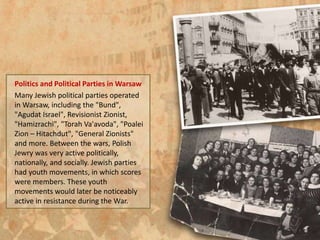
Politics and Political Parties in Warsaw
Many Jewish political parties operated
in Warsaw, including the "Bund",
"Agudat Israel", Revisionist Zionist,
"Hamizrachi", "Torah Va'avoda", "Poalei
Zion – Hitachdut", "General Zionists"
and more. Between the wars, Polish
Jewry was very active politically,
nationally, and socially. Jewish parties
had youth movements, in which scores
were members. These youth
movements would later be noticeably
active in resistance during the War.
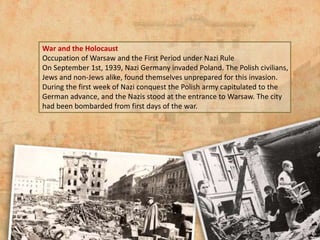
War and the Holocaust
Occupation of Warsaw and the First Period under Nazi Rule
On September 1st, 1939, Nazi Germany invaded Poland. The Polish civilians,
Jews and non-Jews alike, found themselves unprepared for this invasion.
During the first week of Nazi conquest the Polish army capitulated to the
German advance, and the Nazis stood at the entrance to Warsaw. The city
had been bombarded from first days of the war.
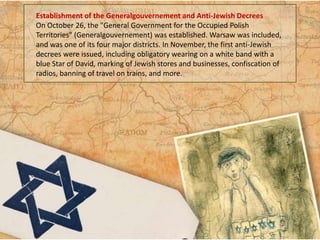
Establishment of the Generalgouvernement and Anti-Jewish Decrees
On October 26, the "General Government for the Occupied Polish
Territories" (Generalgouvernement) was established. Warsaw was included,
and was one of its four major districts. In November, the first anti-Jewish
decrees were issued, including obligatory wearing on a white band with a
blue Star of David, marking of Jewish stores and businesses, confiscation of
radios, banning of travel on trains, and more.
Establishment of the Ghetto
In mid-November 1940, an area in the middle of the northern Jewish neighborhood was
sealed off, including inside it the predominantly Jewish streets.
"[T]he ghetto was sealed off. They concentrated all in the people in a few streets, in one
particular quarter. Those who lived in the streets that weren't to be part of this ghetto,
had to move to the streets that the Germans had designated for the Jews. Our street was
divided in the middle by the wall, with the non-even side for the Christians. We lived in
Number 30, and stayed. It was forbidden to leave through this street. They made an
entrance in the parallel street, and that's where we would leave."
Testimony of Rachel Rubin, Yad Vashem Archives, O.3/10316
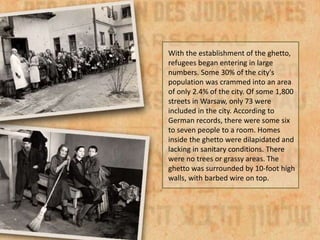
With the establishment of the ghetto,
refugees began entering in large
numbers. Some 30% of the city's
population was crammed into an area
of only 2.4% of the city. Of some 1,800
streets in Warsaw, only 73 were
included in the city. According to
German records, there were some six
to seven people to a room. Homes
inside the ghetto were dilapidated and
lacking in sanitary conditions. There
were no trees or grassy areas. The
ghetto was surrounded by 10-foot high
walls, with barbed wire on top.
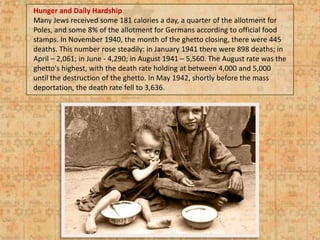
Hunger and Daily Hardship
Many Jews received some 181 calories a day, a quarter of the allotment for
Poles, and some 8% of the allotment for Germans according to official food
stamps. In November 1940, the month of the ghetto closing, there were 445
deaths. This number rose steadily: in January 1941 there were 898 deaths; in
April – 2,061; in June - 4,290; in August 1941 – 5,560. The August rate was the
ghetto's highest, with the death rate holding at between 4,000 and 5,000
until the destruction of the ghetto. In May 1942, shortly before the mass
deportation, the death rate fell to 3,636.
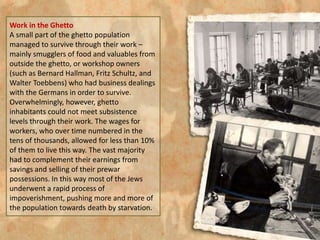
Work in the Ghetto
A small part of the ghetto population
managed to survive through their work –
mainly smugglers of food and valuables from
outside the ghetto, or workshop owners
(such as Bernard Hallman, Fritz Schultz, and
Walter Toebbens) who had business dealings
with the Germans in order to survive.
Overwhelmingly, however, ghetto
inhabitants could not meet subsistence
levels through their work. The wages for
workers, who over time numbered in the
tens of thousands, allowed for less than 10%
of them to live this way. The vast majority
had to complement their earnings from
savings and selling of their prewar
possessions. In this way most of the Jews
underwent a rapid process of
impoverishment, pushing more and more of
the population towards death by starvation.
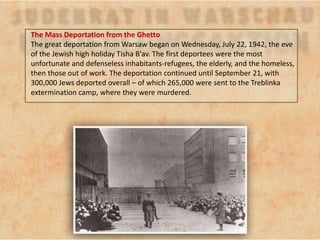
The Mass Deportation from the Ghetto
The great deportation from Warsaw began on Wednesday, July 22, 1942, the eve
of the Jewish high holiday Tisha B'av. The first deportees were the most
unfortunate and defenseless inhabitants-refugees, the elderly, and the homeless,
then those out of work. The deportation continued until September 21, with
300,000 Jews deported overall – of which 265,000 were sent to the Treblinka
extermination camp, where they were murdered.
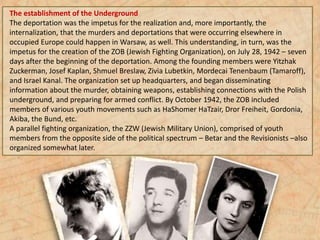
The establishment of the Underground
The deportation was the impetus for the realization and, more importantly, the
internalization, that the murders and deportations that were occurring elsewhere in
occupied Europe could happen in Warsaw, as well. This understanding, in turn, was the
impetus for the creation of the ZOB (Jewish Fighting Organization), on July 28, 1942 – seven
days after the beginning of the deportation. Among the founding members were Yitzhak
Zuckerman, Josef Kaplan, Shmuel Breslaw, Zivia Lubetkin, Mordecai Tenenbaum (Tamaroff),
and Israel Kanal. The organization set up headquarters, and began disseminating
information about the murder, obtaining weapons, establishing connections with the Polish
underground, and preparing for armed conflict. By October 1942, the ZOB included
members of various youth movements such as HaShomer HaTzair, Dror Freiheit, Gordonia,
Akiba, the Bund, etc.
A parallel fighting organization, the ZZW (Jewish Military Union), comprised of youth
members from the opposite side of the political spectrum – Betar and the Revisionists –also
organized somewhat later.
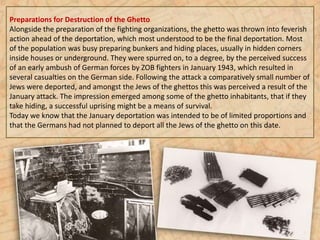
Preparations for Destruction of the Ghetto
Alongside the preparation of the fighting organizations, the ghetto was thrown into feverish
action ahead of the deportation, which most understood to be the final deportation. Most
of the population was busy preparing bunkers and hiding places, usually in hidden corners
inside houses or underground. They were spurred on, to a degree, by the perceived success
of an early ambush of German forces by ZOB fighters in January 1943, which resulted in
several casualties on the German side. Following the attack a comparatively small number of
Jews were deported, and amongst the Jews of the ghettos this was perceived a result of the
January attack. The impression emerged among some of the ghetto inhabitants, that if they
take hiding, a successful uprising might be a means of survival.
Today we know that the January deportation was intended to be of limited proportions and
that the Germans had not planned to deport all the Jews of the ghetto on this date.
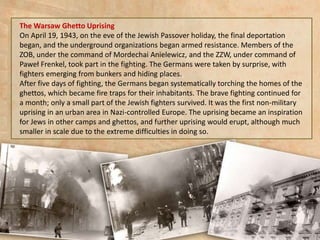
The Warsaw Ghetto Uprising
On April 19, 1943, on the eve of the Jewish Passover holiday, the final deportation
began, and the underground organizations began armed resistance. Members of the
ZOB, under the command of Mordechai Anielewicz, and the ZZW, under command of
Paweł Frenkel, took part in the fighting. The Germans were taken by surprise, with
fighters emerging from bunkers and hiding places.
After five days of fighting, the Germans began systematically torching the homes of the
ghettos, which became fire traps for their inhabitants. The brave fighting continued for
a month; only a small part of the Jewish fighters survived. It was the first non-military
uprising in an urban area in Nazi-controlled Europe. The uprising became an inspiration
for Jews in other camps and ghettos, and further uprising would erupt, although much
smaller in scale due to the extreme difficulties in doing so.
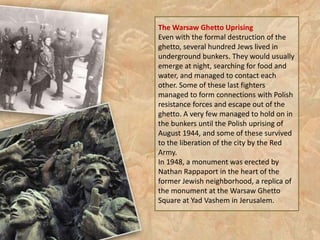
The Warsaw Ghetto Uprising
Even with the formal destruction of the
ghetto, several hundred Jews lived in
underground bunkers. They would usually
emerge at night, searching for food and
water, and managed to contact each
other. Some of these last fighters
managed to form connections with Polish
resistance forces and escape out of the
ghetto. A very few managed to hold on in
the bunkers until the Polish uprising of
August 1944, and some of these survived
to the liberation of the city by the Red
Army.
In 1948, a monument was erected by
Nathan Rappaport in the heart of the
former Jewish neighborhood, a replica of
the monument at the Warsaw Ghetto
Square at Yad Vashem in Jerusalem.
Sources:
Havi Ben Sasson and Hava Baruch (ed.), Warsaw: Polish Jewry Between the Two
World Wars (Student's Booklet) [heb.], Yad Vashem, Jerusalem.
Israel Gutman, Warsaw entry, The Encyclopedia of the Holocaust [Heb.], Yad
Vashem and Sifriyat Hapoalim, 1990.
Yad Vashem Photo Archives

Warsaw Ghetto

  • 1.
  • 2.
    Warsaw, the capitalof Poland and its largest city. Warsaw has gone under this name since the 13th century, and became the capital in 1596. The city sits on the banks of the Vistula River, which divides the city so that two thirds of the city are on the west bank, and the rest on the east. In 1935, Warsaw's size was approx. 55 square miles, with some 1.3 million inhabitants. After World War I, Warsaw was a major center, not only for European Jewish community for world Jewry as well. The city boasted major Jewish political parties, aid groups, trade unions, and cultural and religious institutions. In contrast to the harsh financial condition, and in fact widespread poverty of most Jews of the city, the Warsaw Jewish community featured a vibrant cultural life, in the fields of art and literature, in the publishing world, and in theaters and clubs. In the months leading up the war, tensions arose between Jews and the Polish population, with a degree of discomfort and uncertainty. Jewish Warsaw
  • 3.
    The Jews inWarsaw Jewish demographics of Warsaw The earliest documents of a Jewish presence in Warsaw date to the 15th century. In the 1792 census, the Jews of Warsaw numbered 6,750, roughly one tenth of the population. During the 19th century the Jewish population increased significantly, and became the largest center of Jews in Europe and second largest in the world, after New York. On the eve of World War I, some 337,000 Jews lived in Warsaw (38.1% of the population), and on the eve of World War II, some 375,000 (29.1%). Jews lived in all parts of the city, though many lived in the north end of the city, such that certain areas, and even certain streets, housed only Jews.
  • 4.
    Jews Economic Lifein Warsaw According to statistics from 1931, some 47% of the Jews worked in manufacture and industry, and some 33% worked in trade and finance. Jews also significantly held positions on the liberal professions; Jews made up some 8% of the city's liberal professions. Outside of education, Jews were almost absent in the government and municipal sectors, as these were generally barred for Jews.
  • 5.
    Synagogues • The "Ashkenazi"Synagogue • Tłomackie Synagogue • Adas Yeshurun Synagogue • Nożyk Synagogue • Some 600 Shtiblech, centers of prayers and Hasiddic synagogues
  • 6.
    Cultural Life inWarsaw Many Jewish writers and poets operated in Warsaw, writing in Yiddish, Polish, and in Hebrew. Among the more prominent were Itzhak Katzenelson (1886- 1944), one of the greatest Hebrew poets. Katzenelson lived his whole life in Poland. Julian Tuwim (1894-1953), who was born in Lodz but lived and wrote in Warsaw, was a known author, poet, translator and linguist. Also, Sholem Asch (1880- 1957), the greatest of the Yiddish authors operating between the two World Wars, author and composer, lived and wrote in Warsaw. Numerous Jewish painters, sculptors, architects, journalists, operated in Warsaw, as well film and theater actors and directors.
  • 7.
    Politics and PoliticalParties in Warsaw Many Jewish political parties operated in Warsaw, including the "Bund", "Agudat Israel", Revisionist Zionist, "Hamizrachi", "Torah Va'avoda", "Poalei Zion – Hitachdut", "General Zionists" and more. Between the wars, Polish Jewry was very active politically, nationally, and socially. Jewish parties had youth movements, in which scores were members. These youth movements would later be noticeably active in resistance during the War.
  • 8.
    War and theHolocaust Occupation of Warsaw and the First Period under Nazi Rule On September 1st, 1939, Nazi Germany invaded Poland. The Polish civilians, Jews and non-Jews alike, found themselves unprepared for this invasion. During the first week of Nazi conquest the Polish army capitulated to the German advance, and the Nazis stood at the entrance to Warsaw. The city had been bombarded from first days of the war.
  • 9.
    Establishment of theGeneralgouvernement and Anti-Jewish Decrees On October 26, the "General Government for the Occupied Polish Territories" (Generalgouvernement) was established. Warsaw was included, and was one of its four major districts. In November, the first anti-Jewish decrees were issued, including obligatory wearing on a white band with a blue Star of David, marking of Jewish stores and businesses, confiscation of radios, banning of travel on trains, and more.
  • 10.
    Establishment of theGhetto In mid-November 1940, an area in the middle of the northern Jewish neighborhood was sealed off, including inside it the predominantly Jewish streets. "[T]he ghetto was sealed off. They concentrated all in the people in a few streets, in one particular quarter. Those who lived in the streets that weren't to be part of this ghetto, had to move to the streets that the Germans had designated for the Jews. Our street was divided in the middle by the wall, with the non-even side for the Christians. We lived in Number 30, and stayed. It was forbidden to leave through this street. They made an entrance in the parallel street, and that's where we would leave." Testimony of Rachel Rubin, Yad Vashem Archives, O.3/10316
  • 11.
    With the establishmentof the ghetto, refugees began entering in large numbers. Some 30% of the city's population was crammed into an area of only 2.4% of the city. Of some 1,800 streets in Warsaw, only 73 were included in the city. According to German records, there were some six to seven people to a room. Homes inside the ghetto were dilapidated and lacking in sanitary conditions. There were no trees or grassy areas. The ghetto was surrounded by 10-foot high walls, with barbed wire on top.
  • 12.
    Hunger and DailyHardship Many Jews received some 181 calories a day, a quarter of the allotment for Poles, and some 8% of the allotment for Germans according to official food stamps. In November 1940, the month of the ghetto closing, there were 445 deaths. This number rose steadily: in January 1941 there were 898 deaths; in April – 2,061; in June - 4,290; in August 1941 – 5,560. The August rate was the ghetto's highest, with the death rate holding at between 4,000 and 5,000 until the destruction of the ghetto. In May 1942, shortly before the mass deportation, the death rate fell to 3,636.
  • 13.
    Work in theGhetto A small part of the ghetto population managed to survive through their work – mainly smugglers of food and valuables from outside the ghetto, or workshop owners (such as Bernard Hallman, Fritz Schultz, and Walter Toebbens) who had business dealings with the Germans in order to survive. Overwhelmingly, however, ghetto inhabitants could not meet subsistence levels through their work. The wages for workers, who over time numbered in the tens of thousands, allowed for less than 10% of them to live this way. The vast majority had to complement their earnings from savings and selling of their prewar possessions. In this way most of the Jews underwent a rapid process of impoverishment, pushing more and more of the population towards death by starvation.
  • 14.
    The Mass Deportationfrom the Ghetto The great deportation from Warsaw began on Wednesday, July 22, 1942, the eve of the Jewish high holiday Tisha B'av. The first deportees were the most unfortunate and defenseless inhabitants-refugees, the elderly, and the homeless, then those out of work. The deportation continued until September 21, with 300,000 Jews deported overall – of which 265,000 were sent to the Treblinka extermination camp, where they were murdered.
  • 15.
    The establishment ofthe Underground The deportation was the impetus for the realization and, more importantly, the internalization, that the murders and deportations that were occurring elsewhere in occupied Europe could happen in Warsaw, as well. This understanding, in turn, was the impetus for the creation of the ZOB (Jewish Fighting Organization), on July 28, 1942 – seven days after the beginning of the deportation. Among the founding members were Yitzhak Zuckerman, Josef Kaplan, Shmuel Breslaw, Zivia Lubetkin, Mordecai Tenenbaum (Tamaroff), and Israel Kanal. The organization set up headquarters, and began disseminating information about the murder, obtaining weapons, establishing connections with the Polish underground, and preparing for armed conflict. By October 1942, the ZOB included members of various youth movements such as HaShomer HaTzair, Dror Freiheit, Gordonia, Akiba, the Bund, etc. A parallel fighting organization, the ZZW (Jewish Military Union), comprised of youth members from the opposite side of the political spectrum – Betar and the Revisionists –also organized somewhat later.
  • 16.
    Preparations for Destructionof the Ghetto Alongside the preparation of the fighting organizations, the ghetto was thrown into feverish action ahead of the deportation, which most understood to be the final deportation. Most of the population was busy preparing bunkers and hiding places, usually in hidden corners inside houses or underground. They were spurred on, to a degree, by the perceived success of an early ambush of German forces by ZOB fighters in January 1943, which resulted in several casualties on the German side. Following the attack a comparatively small number of Jews were deported, and amongst the Jews of the ghettos this was perceived a result of the January attack. The impression emerged among some of the ghetto inhabitants, that if they take hiding, a successful uprising might be a means of survival. Today we know that the January deportation was intended to be of limited proportions and that the Germans had not planned to deport all the Jews of the ghetto on this date.
  • 17.
    The Warsaw GhettoUprising On April 19, 1943, on the eve of the Jewish Passover holiday, the final deportation began, and the underground organizations began armed resistance. Members of the ZOB, under the command of Mordechai Anielewicz, and the ZZW, under command of Paweł Frenkel, took part in the fighting. The Germans were taken by surprise, with fighters emerging from bunkers and hiding places. After five days of fighting, the Germans began systematically torching the homes of the ghettos, which became fire traps for their inhabitants. The brave fighting continued for a month; only a small part of the Jewish fighters survived. It was the first non-military uprising in an urban area in Nazi-controlled Europe. The uprising became an inspiration for Jews in other camps and ghettos, and further uprising would erupt, although much smaller in scale due to the extreme difficulties in doing so.
  • 18.
    The Warsaw GhettoUprising Even with the formal destruction of the ghetto, several hundred Jews lived in underground bunkers. They would usually emerge at night, searching for food and water, and managed to contact each other. Some of these last fighters managed to form connections with Polish resistance forces and escape out of the ghetto. A very few managed to hold on in the bunkers until the Polish uprising of August 1944, and some of these survived to the liberation of the city by the Red Army. In 1948, a monument was erected by Nathan Rappaport in the heart of the former Jewish neighborhood, a replica of the monument at the Warsaw Ghetto Square at Yad Vashem in Jerusalem.
  • 19.
    Sources: Havi Ben Sassonand Hava Baruch (ed.), Warsaw: Polish Jewry Between the Two World Wars (Student's Booklet) [heb.], Yad Vashem, Jerusalem. Israel Gutman, Warsaw entry, The Encyclopedia of the Holocaust [Heb.], Yad Vashem and Sifriyat Hapoalim, 1990. Yad Vashem Photo Archives