The Holocaust
Bell Ringer	What 2 major events led to Japan’s surrender?Discuss with Partner30 seconds
The Holocaust
Pre-WarJews were living in every country in Europe before the Nazis came into power in 1933Approximately 9 million JewsPoland and the Soviet Union had the largest populationsJews could be found in all walks of life: farmers, factory workers, business people, doctors, teachers, and craftsmen
Pre-WarGroup portrait of members of the Jewish community of Sighet (Transylvania/Romania) in front of a wooden synagogue - 1930-1939.
Anti-Semitism“the intense hatred for and discrimination against the Jewish people”over 2,000 yearsJews were scapegoats for many problems  Example: “Black Death”
Anti-SemitismPogrom: an organized, often officially encouraged massacre or persecution of a minority group, especially one conducted against JewsLate 1800s - Russian EmpireMobs murdered Jews and looted their homes and stores
Anti-SemitismPolitical leaders (like Hitler) who used anti-Semitism as a tool relied on the ideas of “racial science” to portray Jews as a race instead of a religion
AntisemitismNazi teachers began to apply the “principles” of racial science by measured skull size and nose length recorded students’ eye color and hair to determine if students belonged the “Aryan race”
Etymology of “Aryan”From Sanskrit word meaning “noble”Used in Nazi ideology to mean "member of a Caucasian Gentile race of Nordic type."- a means to weed out “inferior” religions, races & nationalitiesIt DOES NOT mean “blonde hair, blue eyes”
Weimar RepublicExtremists blamed Jews for Germany’s defeat in WWI  Treaty of Versaillesblamed the German Foreign Minister (a Jew) for his role in reaching a settlement with the Allies
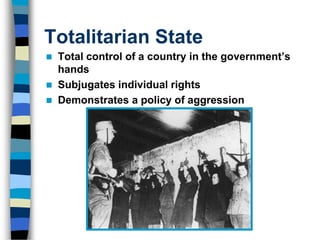
Totalitarian StateTotal control of a country in the government’s handsSubjugates individual rightsDemonstrates a policy of aggression
Totalitarian StateParanoia and fear dominateGovernment maintains total control over the cultureGovernment is capable of indiscriminate killingDuring this time in Germany, the Nazis passed laws which restricted the rights of Jews:  including the Nuremberg Laws
Totalitarian StateThe Nuremberg Laws:Stripped Jews of their German citizenshipThey were prohibited from marrying or having sexual relations with people of “German or related blood”
Totalitarian StateJews, like all other German citizens, were required to carry identity cards, but their cards were stamped with a red “J.”  This allowed police to easily identify them.
Totalitarian StateThe Nazis used propaganda to promote their anti-Semitic ideasOne such book was the children’s book, The Poisonous Mushroom.
PersecutionThe Nazi plan for dealing with the “Jewish Question” evolved in three steps:1. Expulsion:  Get them out of Germany2. Containment:  Put them all together in one place – namely ghettos3. “Final Solution”:  annihilation
PersecutionNazis targeted other individuals and groups in addition to the Jews:Gypsies Homosexual menJehovah’s WitnessHandicapped GermansPolesPolitical dissidents
PersecutionKristallnachtwas the “Night of Broken Glass” on November 9-10, 1938Germans attacked synagogues and Jewish homes and businesses
U.S. and World ResponseThe Evian Conference took place in the summer of 1938 in Evian, France.32 countries met to discuss what to do about the Jewish refugees who were trying to leave Germany and Austria.Despite voicing feelings of sympathy, most countries made excuses for not accepting more refugees.
U.S. and World ResponseSome American congressmen proposed the Wagner-Rogers Bill, which offered to let 20,000 endangered Jewish refugee children into the country, but the bill was not supported in the Senate.Anti-Semitic attitudes played a role in the failure to help refugees.
U.S. and World Response	The SS St. Louis, carrying refugees with Cuban visas,were denied admittance both in Cuba and in Florida.  After being turned back to Europe, most of the passengers perished in the Holocaust.
Video Clips
Final SolutionThe Nazis aimed to control the Jewish population by forcing them to live in areas that were designated for Jews only, called ghettosGhettos were established across all of occupied Europe, especially in areas where there was already a large Jewish population
Final SolutionMany ghettos were closed by barbed wire or walls and were guarded by SS or local police.Jews sometimes had to use bridges to go over Aryan streets that ran through the ghetto.
Final SolutionLife in the ghettos was hard:  food was rationed; several families often shared a small space; disease spread rapidly; heating, ventilation, and sanitation were limitedMany children were orphaned in the ghettos
Final SolutionEinsatzgruppen were mobile killing squads made up of Nazi (SS) units and police.  They killed Jews in mass shooting actions throughout eastern Poland and the western Soviet Union.
Final SolutionOn January 20, 1942, 15 high-ranking Nazi officials met at the Wannsee Conference to learn about how the Jewish Question would be solved.The Final Solution was outlined by Reinhard Heydrich who detailed the plan to establish death camps with gas chambers.
Final SolutionDeath camps were the means the Nazis used to achieve the “final solution.”There were six death camps:  Auschwitz-Birkenau, Treblinka, Chelmno, Sobibor, Majdanek, and Belzec.Each used gas chambers to murder the Jews. At Auschwitz prisoners were told the gas chambers were “showers.”
Final SolutionMost of the gas chambers used carbon monoxide from diesel engines.In Auschwitz and Majdanek “Zyklon B” pellets, which were a highly poisonous insecticide, supplied the gas.After the gassings, prisoners removed hair, gold teeth and fillings from the Jews before the bodies were burned in the crematoria or buried in mass graves.
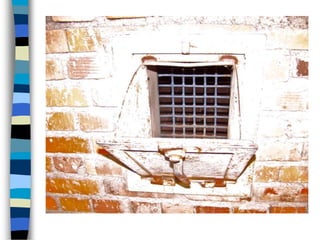
Auschwitz Gas Chamber
Auschwitz Crematorium/Trolleys
Final SolutionThere were many concentration and labor camps where many people died from exposure, lack of food, extreme working conditions, torture, and executions.
Dachau
Gate into Dachau
Dachau Appelplatz
ResistanceDespite the high risk, some individuals attempted to resist Nazism.
ResistanceSome famous acts of resistance include:The Warsaw Ghetto Uprising (as seen in the movie, “The Pianist”)
The Sobibor Revolt
Sonderkommando blowing up Crematorium IV at Birkenau
 Jewish partisans who escaped to fight in the forests (i.e. movie, “Defiance” based on the life of the Bielski brothers)RescueLess than one percent of the non-Jewish European population helped any Jew in some form of rescue.Denmark and Bulgaria were the most successful national resistance movements
RescueDenmark: 7,220 of the 8,000 Jews were saved by ferrying them to neutral Sweden.
AftermathSoviet soldiers were the first to liberate camp prisoners on July 23, 1944, at Majdanek in PolandBritish, Canadian, American, and French troops also liberated camp prisonersTroops were shocked at what they saw…
Video ClipFrom Band of Brothers
	“The memory of starved dazed men who dropped their eyes and heads when we looked at them through the chain-link fence, in the same manner that a beaten, mistreated dog would cringe, leaves feelings that cannot be described and will never be forgotten. The impact of seeing those people behind that fence left me saying, only to myself, ‘Now I know why I am here!’”Dick Winters, 101st Airborne (Band of Brothers (pg. 263) by Stephen E. Ambrose)
AftermathMost prisoners were emaciated to the point of being skeletalMany camps had dead bodies lying in pilesMany prisoners died even after liberation
Country                	Jewish Population           Number of Jews  	         Percentage of                        		                      September, 1939         	   Murdered    	       Jews MurderedPoland    	        3,300,000                	    2,800,000        		 85.0 USSR      	       2,100.000                       1,500,000         		71.4 Romania                         850,000          	      425,000       		50.0 Hungary                          404,000            	      200,000        		49.5 Czechoslovakia               315,000             	       260,000       	  	 82.5 France                             300,000              	         90,000         		 30.0 Germany                         210,000             	       171,000         		81.0Lithuania                         150,000             	        135,000        		 90.0 Holland                            150,000              	          90,000         		 60.0Latvia                                95,000              	         85,000         		 89.5Belgium                            90,000                             40,000         		44.41Greece                              75,000                            65,000         		 80.0Yugoslavia                        75,000             	         55,000         		  73.3Austria                              60,000              	         40,000         		 66.6Italy                                  57,000              	         15,000         		26.31Bulgaria                            50,000               	            7,000         		  14.0Others                               20,000               	            6,000        	 	  30.0   Totals            8,301,000           5,978,000    		72.0___________________________________________________________________________________Source: Cited in Landau, The Nazi Holocaust, Chicago: Ivan R. Dee, 1994.These data originally appeared in Poliakov and Wulf (eds), Das Dritte Reichund die Juden: Documente und Aufsatze (Arani Verlag, GmbH, Berlin, 1955).
AftermathMany of the camp prisoners had nowhere to go, so they became “displaced persons” (DPs).These survivors stayed in DP camps in Germany, which were organized and run by the Allies.Initially, the conditions were often very poor in the DP camps.
AftermathJewish displaced people eager to leave Europe (“Zionists”), pushed for the founding of a Jewish state in British-controlled PalestineModern day IsraelU.S. President Harry Truman issued an executive order allowing Jewish refugees to enter the United States without normal immigration restrictions

Holocaust

  • 1.
  • 2.
    Bell Ringer What 2major events led to Japan’s surrender?Discuss with Partner30 seconds
  • 3.
  • 4.
    Pre-WarJews were livingin every country in Europe before the Nazis came into power in 1933Approximately 9 million JewsPoland and the Soviet Union had the largest populationsJews could be found in all walks of life: farmers, factory workers, business people, doctors, teachers, and craftsmen
  • 5.
    Pre-WarGroup portrait ofmembers of the Jewish community of Sighet (Transylvania/Romania) in front of a wooden synagogue - 1930-1939.
  • 6.
    Anti-Semitism“the intense hatredfor and discrimination against the Jewish people”over 2,000 yearsJews were scapegoats for many problems Example: “Black Death”
  • 7.
    Anti-SemitismPogrom: an organized,often officially encouraged massacre or persecution of a minority group, especially one conducted against JewsLate 1800s - Russian EmpireMobs murdered Jews and looted their homes and stores
  • 8.
    Anti-SemitismPolitical leaders (likeHitler) who used anti-Semitism as a tool relied on the ideas of “racial science” to portray Jews as a race instead of a religion
  • 9.
    AntisemitismNazi teachers beganto apply the “principles” of racial science by measured skull size and nose length recorded students’ eye color and hair to determine if students belonged the “Aryan race”
  • 11.
    Etymology of “Aryan”FromSanskrit word meaning “noble”Used in Nazi ideology to mean "member of a Caucasian Gentile race of Nordic type."- a means to weed out “inferior” religions, races & nationalitiesIt DOES NOT mean “blonde hair, blue eyes”
  • 12.
    Weimar RepublicExtremists blamedJews for Germany’s defeat in WWI Treaty of Versaillesblamed the German Foreign Minister (a Jew) for his role in reaching a settlement with the Allies
  • 13.
    Totalitarian StateTotal controlof a country in the government’s handsSubjugates individual rightsDemonstrates a policy of aggression
  • 14.
    Totalitarian StateParanoia andfear dominateGovernment maintains total control over the cultureGovernment is capable of indiscriminate killingDuring this time in Germany, the Nazis passed laws which restricted the rights of Jews: including the Nuremberg Laws
  • 15.
    Totalitarian StateThe NurembergLaws:Stripped Jews of their German citizenshipThey were prohibited from marrying or having sexual relations with people of “German or related blood”
  • 16.
    Totalitarian StateJews, likeall other German citizens, were required to carry identity cards, but their cards were stamped with a red “J.” This allowed police to easily identify them.
  • 17.
    Totalitarian StateThe Nazisused propaganda to promote their anti-Semitic ideasOne such book was the children’s book, The Poisonous Mushroom.
  • 18.
    PersecutionThe Nazi planfor dealing with the “Jewish Question” evolved in three steps:1. Expulsion: Get them out of Germany2. Containment: Put them all together in one place – namely ghettos3. “Final Solution”: annihilation
  • 19.
    PersecutionNazis targeted otherindividuals and groups in addition to the Jews:Gypsies Homosexual menJehovah’s WitnessHandicapped GermansPolesPolitical dissidents
  • 20.
    PersecutionKristallnachtwas the “Nightof Broken Glass” on November 9-10, 1938Germans attacked synagogues and Jewish homes and businesses
  • 21.
    U.S. and WorldResponseThe Evian Conference took place in the summer of 1938 in Evian, France.32 countries met to discuss what to do about the Jewish refugees who were trying to leave Germany and Austria.Despite voicing feelings of sympathy, most countries made excuses for not accepting more refugees.
  • 22.
    U.S. and WorldResponseSome American congressmen proposed the Wagner-Rogers Bill, which offered to let 20,000 endangered Jewish refugee children into the country, but the bill was not supported in the Senate.Anti-Semitic attitudes played a role in the failure to help refugees.
  • 23.
    U.S. and WorldResponse The SS St. Louis, carrying refugees with Cuban visas,were denied admittance both in Cuba and in Florida. After being turned back to Europe, most of the passengers perished in the Holocaust.
  • 24.
  • 25.
    Final SolutionThe Nazisaimed to control the Jewish population by forcing them to live in areas that were designated for Jews only, called ghettosGhettos were established across all of occupied Europe, especially in areas where there was already a large Jewish population
  • 26.
    Final SolutionMany ghettoswere closed by barbed wire or walls and were guarded by SS or local police.Jews sometimes had to use bridges to go over Aryan streets that ran through the ghetto.
  • 27.
    Final SolutionLife inthe ghettos was hard: food was rationed; several families often shared a small space; disease spread rapidly; heating, ventilation, and sanitation were limitedMany children were orphaned in the ghettos
  • 28.
    Final SolutionEinsatzgruppen weremobile killing squads made up of Nazi (SS) units and police. They killed Jews in mass shooting actions throughout eastern Poland and the western Soviet Union.
  • 29.
    Final SolutionOn January20, 1942, 15 high-ranking Nazi officials met at the Wannsee Conference to learn about how the Jewish Question would be solved.The Final Solution was outlined by Reinhard Heydrich who detailed the plan to establish death camps with gas chambers.
  • 30.
    Final SolutionDeath campswere the means the Nazis used to achieve the “final solution.”There were six death camps: Auschwitz-Birkenau, Treblinka, Chelmno, Sobibor, Majdanek, and Belzec.Each used gas chambers to murder the Jews. At Auschwitz prisoners were told the gas chambers were “showers.”
  • 32.
    Final SolutionMost ofthe gas chambers used carbon monoxide from diesel engines.In Auschwitz and Majdanek “Zyklon B” pellets, which were a highly poisonous insecticide, supplied the gas.After the gassings, prisoners removed hair, gold teeth and fillings from the Jews before the bodies were burned in the crematoria or buried in mass graves.
  • 33.
  • 34.
  • 35.
    Final SolutionThere weremany concentration and labor camps where many people died from exposure, lack of food, extreme working conditions, torture, and executions.
  • 36.
  • 37.
  • 38.
  • 59.
    ResistanceDespite the highrisk, some individuals attempted to resist Nazism.
  • 60.
    ResistanceSome famous actsof resistance include:The Warsaw Ghetto Uprising (as seen in the movie, “The Pianist”)
  • 61.
  • 62.
    Sonderkommando blowing upCrematorium IV at Birkenau
  • 63.
    Jewish partisanswho escaped to fight in the forests (i.e. movie, “Defiance” based on the life of the Bielski brothers)RescueLess than one percent of the non-Jewish European population helped any Jew in some form of rescue.Denmark and Bulgaria were the most successful national resistance movements
  • 64.
    RescueDenmark: 7,220 ofthe 8,000 Jews were saved by ferrying them to neutral Sweden.
  • 65.
    AftermathSoviet soldiers werethe first to liberate camp prisoners on July 23, 1944, at Majdanek in PolandBritish, Canadian, American, and French troops also liberated camp prisonersTroops were shocked at what they saw…
  • 66.
  • 67.
    “The memory ofstarved dazed men who dropped their eyes and heads when we looked at them through the chain-link fence, in the same manner that a beaten, mistreated dog would cringe, leaves feelings that cannot be described and will never be forgotten. The impact of seeing those people behind that fence left me saying, only to myself, ‘Now I know why I am here!’”Dick Winters, 101st Airborne (Band of Brothers (pg. 263) by Stephen E. Ambrose)
  • 68.
    AftermathMost prisoners wereemaciated to the point of being skeletalMany camps had dead bodies lying in pilesMany prisoners died even after liberation
  • 69.
    Country Jewish Population Number of Jews Percentage of September, 1939 Murdered Jews MurderedPoland 3,300,000 2,800,000 85.0 USSR 2,100.000 1,500,000 71.4 Romania 850,000 425,000 50.0 Hungary 404,000 200,000 49.5 Czechoslovakia 315,000 260,000 82.5 France 300,000 90,000 30.0 Germany 210,000 171,000 81.0Lithuania 150,000 135,000 90.0 Holland 150,000 90,000 60.0Latvia 95,000 85,000 89.5Belgium 90,000 40,000 44.41Greece 75,000 65,000 80.0Yugoslavia 75,000 55,000 73.3Austria 60,000 40,000 66.6Italy 57,000 15,000 26.31Bulgaria 50,000 7,000 14.0Others 20,000 6,000 30.0 Totals 8,301,000 5,978,000 72.0___________________________________________________________________________________Source: Cited in Landau, The Nazi Holocaust, Chicago: Ivan R. Dee, 1994.These data originally appeared in Poliakov and Wulf (eds), Das Dritte Reichund die Juden: Documente und Aufsatze (Arani Verlag, GmbH, Berlin, 1955).
  • 70.
    AftermathMany of thecamp prisoners had nowhere to go, so they became “displaced persons” (DPs).These survivors stayed in DP camps in Germany, which were organized and run by the Allies.Initially, the conditions were often very poor in the DP camps.
  • 71.
    AftermathJewish displaced peopleeager to leave Europe (“Zionists”), pushed for the founding of a Jewish state in British-controlled PalestineModern day IsraelU.S. President Harry Truman issued an executive order allowing Jewish refugees to enter the United States without normal immigration restrictions