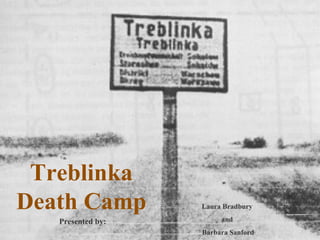
Treblinka Death Camp Laura Bradbury  and  Barbara Sanford Presented by:
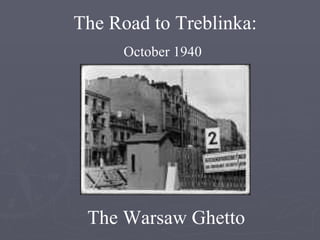
The Road to Treblinka: October 1940 The Warsaw Ghetto
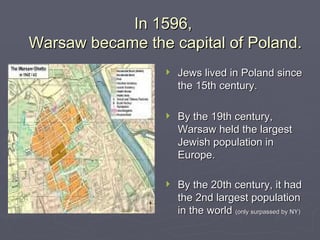
In 1596,  Warsaw became the capital of Poland. Jews lived in Poland since the 15th century. By the 19th century, Warsaw held the largest Jewish population in Europe. By the 20th century, it had the 2nd largest population in the world  (only surpassed by NY)
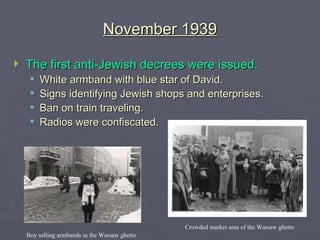
November 1939 The first anti-Jewish decrees were issued. White armband with blue star of David. Signs identifying Jewish shops and enterprises. Ban on train traveling. Radios were confiscated. Boy selling armbands in the Warsaw ghetto Crowded market area of the Warsaw ghetto
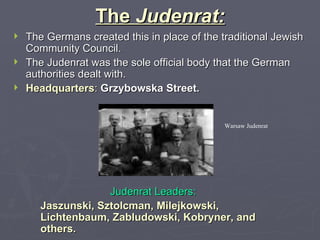
The  Judenrat: The Germans created this in place of the traditional Jewish Community Council. The Judenrat was the sole official body that the German authorities dealt with. Headquarters :   Grzybowska Street. Judenrat Leaders:  Jaszunski, Sztolcman, Milejkowski, Lichtenbaum, Zabludowski, Kobryner, and others. Warsaw Judenrat
The Judenrat’s Dilema: The Germans demanded lists of deportees for Treblinka from the Judenrat. If they refused, Germans could select anyone in any fashion… “ The Council faced problems of conscience and responsibility at the same time…There were two alternatives…Either to comply, announce the Gestapo order to the ghetto inhabitants; or openly sabotage the order by disregarding it.  The Council felt that if it followed the first alternative, part of the ghetto might yet be rescued at least for a time.  Should, however, the other alternative be chosen, heavy measures of persecution would follow against the entire ghetto, and possibly its immediate liquidation might result.”
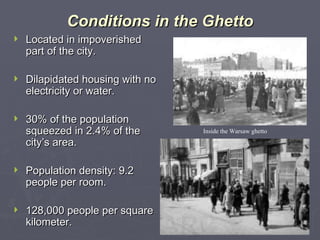
Conditions in the Ghetto Located in impoverished part of the city. Dilapidated housing with no electricity or water. 30% of the population squeezed in 2.4% of the city’s area. Population density: 9.2 people per room. 128,000 people per square kilometer. Inside the Warsaw ghetto
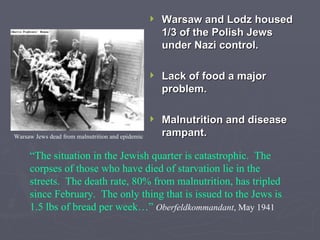
Warsaw and Lodz housed 1/3 of the Polish Jews under Nazi control. Lack of food a major problem. Malnutrition and disease rampant. “ The situation in the Jewish quarter is catastrophic.  The corpses of those who have died of starvation lie in the streets.  The death rate, 80% from malnutrition, has tripled since February.  The only thing that is issued to the Jews is 1.5 lbs of bread per week…”   Oberfeldkommandant , May 1941 Warsaw Jews dead from malnutrition and epidemic
Liquidation of the Ghetto Immediately after completion of Treblinka the  Grosse Umsiedlungsaktion [Great Resettlement Action] started on July 22, 1942. By December 31, 1942, Warsaw became a  Sammellager  (de facto concentration camp). Jews were being rounded up for “deportation,” “evacuation,” “relocation,” and “resettlement in the East.” The  Aktion Reinhard  squad oversaw the selection process in Warsaw and those who were too old, too young, or mentally and physically handicapped were “relocated” to Treblinka. Jews being deported to Treblinka
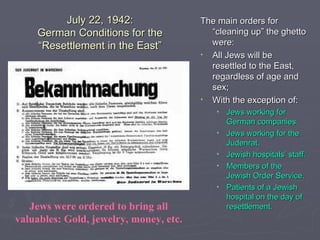
July 22, 1942: German Conditions for the “Resettlement in the East” The main orders for “cleaning up” the ghetto were: All Jews will be resettled to the East, regardless of age and sex; With the exception of: Jews working for German companies. Jews working for the Judenrat. Jewish hospitals’ staff. Members of the Jewish Order Service. Patients of a Jewish hospital on the day of resettlement. Jews were ordered to bring all valuables: Gold, jewelry, money, etc.
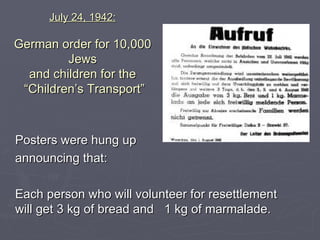
July 24, 1942: German order for 10,000 Jews and children for the  “Children’s Transport” Posters were hung up announcing that: Each person who will volunteer for resettlement will get 3 kg of bread and  1 kg of marmalade.
Deportation: In July 1942, 64,606 Jews were deported to Treblinka. [This number does not include those shot in the streets and in houses during the “cleaning” of buildings.]  Warsaw after Liquidation Warsaw Jews rounded up for deportation to Treblinka
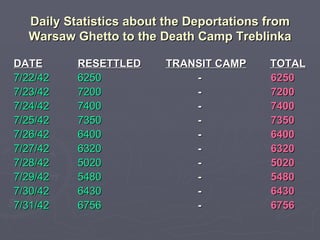
Daily Statistics about the Deportations from Warsaw Ghetto to the Death Camp Treblinka DATE RESETTLED 7/22/42 6250 7/23/42 7200 7/24/42 7400 7/25/42 7350 7/26/42 6400 7/27/42 6320 7/28/42 5020 7/29/42 5480 7/30/42 6430 7/31/42 6756 TRANSIT CAMP   TOTAL -   6250 -   7200 -   7400 -   7350 -   6400 -   6320 -   5020 -   5480 -   6430 -   6756
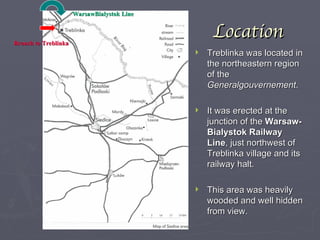
Location Treblinka was located in the northeastern region of the  Generalgouvernement . It was erected at the junction of the  Warsaw-Bialystok Railway Line , just northwest of Treblinka village and its railway halt. This area was heavily wooded and well hidden from view. WarsawBialystok Line Branch to Treblinka
FIND ID CARDS FIND ARTICLES MAPSTreblinka German administration of Europe, 1942 Extermination camps in occupied Poland, 1942 Treblinka environs, spring 1943 Treblinka camp, spring 1943
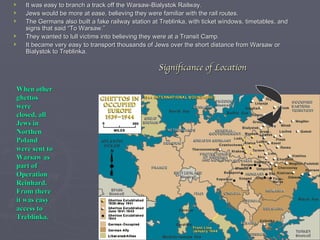
Significance of Location It was easy to branch a track off the Warsaw-Bialystok Railway. Jews would be more at ease, believing they were familiar with the rail routes. The Germans also built a fake railway station at Treblinka, with ticket windows, timetables, and signs that said “To Warsaw.” They wanted to lull victims into believing they were at a Transit Camp. It became very easy to transport thousands of Jews over the short distance from Warsaw or Bialystok to Treblinka. When other ghettos were closed, all Jews in Northen Poland were sent to Warsaw as part of Operation Reinhard.  From there it was easy access to Treblinka.
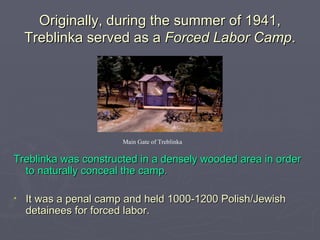
Originally, during the summer of 1941, Treblinka served as a  Forced Labor Camp . Treblinka was constructed in a densely wooded area in order to naturally conceal the camp. It was a penal camp and held 1000-1200 Polish/Jewish detainees for forced labor. Main Gate of Treblinka
Early May, 1942: The SS Team Arrives! Camp Architect: SS Obersturmfüher , Richard Thomalla. By late May/early June Construction of the Death Camp begins Created 3 zones: Wohnlager  [Living area] Auffanglager  [Reception]   Tolenlager  [Extermination]
Treblinka II: An Aktion Reinhard Death Camp [Extermination of the Polish Jews] Opens July 1942
Victims Majority=Polish Jews from Warsaw Others: 7,000 Slovakia 4,000 Greece 7,000 Macedonia Portion of Bulgaria 2,000 Gypsies
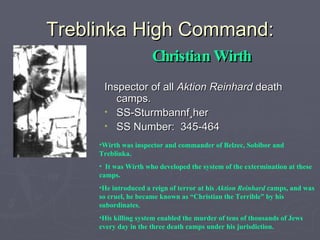
Treblinka High Command: Christian Wirth Inspector of all  Aktion Reinhard  death camps. SS-Sturmbannfüher SS Number:  345-464 Wirth was inspector and commander of Belzec, Sobibor and Treblinka. It was Wirth who developed the system of the extermination at these camps.  He introduced a reign of terror at his  Aktion Reinhard  camps, and was so cruel, he became known as “Christian the Terrible” by his subordinates.  His killing system enabled the murder of tens of thousands of Jews every day in the three death camps under his jurisdiction.
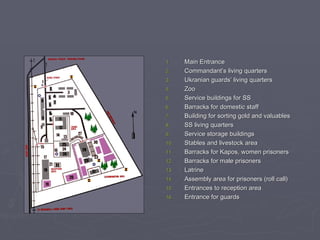
Main Entrance Commandant’s living quarters Ukranian guards’ living quarters Zoo Service buildings for SS Barracks for domestic staff Building for sorting gold and valuables SS living quarters Service storage buildings Stables and livestock area Barracks for Kapos, women prisoners Barracks for male prisoners Latrine Assembly area for prisoners (roll call) Entrances to reception area Entrance for guards
17. Station platform 18. Storehouse for victims’ property 19. Burial pits 20. Executioin site [disguised as a hospital] 21. Reception square [sorting area] 22. Latrine 23. Cremation pyres 24. Deportation area 25. Barracks where women undressed, surrendered their valuables, and had head shaved 26. Barracks where men undressed 27. Approach to the gas chambers 28. Ten new gas chambers 29. Three old gas chambers 30. Cremation pyres 31. Barracks for prisoners
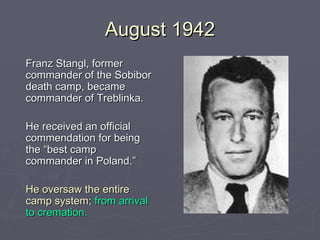
August 1942 Franz Stangl, former commander of the Sobibor death camp, became commander of Treblinka. He received an official commendation for being the “best camp commander in Poland.”  He oversaw the entire camp system;   from arrival to cremation.
Arrival SS squads received prisoners with clubs and whips on a platform when deportations arrived. Willy Mätzig  [a book-keeper and accountant] told them that  “they were a resettlement transport, that they would be given a bath and that they would receive new clothes. They were also instructed to maintain quiet and discipline.  They were told they would continue their journey the following day.” Willy Mätzig
Sorting the Sick from the Strong After departing the train, new arrivals were taken to a reception area. Ill or weak arrivals, unaccompanied children, and injured persons were led to the  Lazarett  [a small execution site]. Victims’ belongings were brought to two sorting barracks. All others were brought to a fenced in area called  Entkleidungsplatz  [Undressing Square]
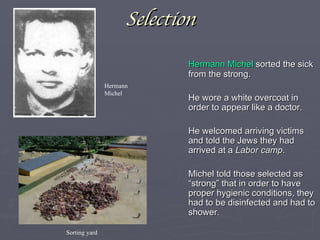
Selection Hermann Michel  sorted the sick from the strong. He wore a white overcoat in order to appear like a doctor. He welcomed arriving victims and told the Jews they had arrived at a  Labor camp . Michel told those selected as “strong” that in order to have proper hygienic conditions, they had to be disinfected and had to shower. Hermann Michel Sorting yard
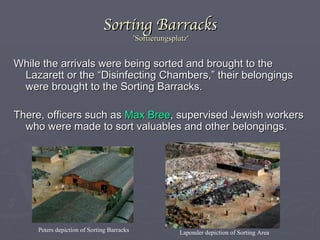
Sorting Barracks  'Sortierungsplatz' While the arrivals were being sorted and brought to the Lazarett or the   “Disinfecting Chambers,” their belongings were brought to the Sorting Barracks. There, officers such as  Max Bree , supervised Jewish workers who were made to sort valuables and other belongings. Laponder depiction of Sorting Area Peters depiction of Sorting Barracks
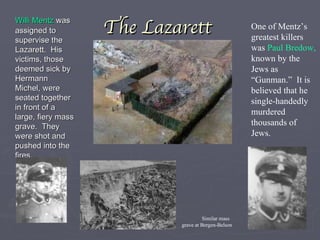
The Lazarett Willi Mentz  was assigned to supervise the Lazarett.  His victims, those deemed sick by Hermann Michel, were seated together in front of a large, fiery mass grave.  They were shot and pushed into the fires. One of Mentz’s greatest killers was  Paul Bredow,  known by the Jews as “Gunman.”  It is believed that he single-handedly murdered thousands of Jews. Similar mass grave at Bergen-Belson
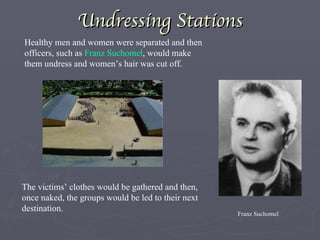
Undressing Stations Franz Suchomel Healthy men and women were separated and then officers, such as  Franz Suchomel , would make them undress and women’s hair was cut off. The victims’ clothes would be gathered and then, once naked, the groups would be led to their next destination.
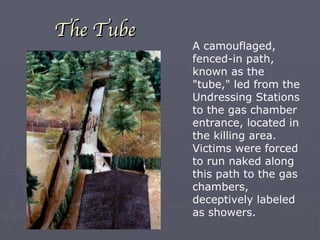
The Tube A camouflaged, fenced-in path, known as the "tube," led from the Undressing Stations to the gas chamber entrance, located in the killing area. Victims were forced to run naked along this path to the gas chambers, deceptively labeled as showers.
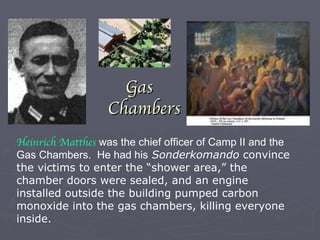
Gas  Chambers Heinrich Matthes   was the chief officer of Camp II and the Gas Chambers.  He had his   Sonderkomando  convince the victims to enter the “shower area,” the chamber doors were sealed, and an engine installed outside the building pumped carbon monoxide into the gas chambers, killing everyone inside.
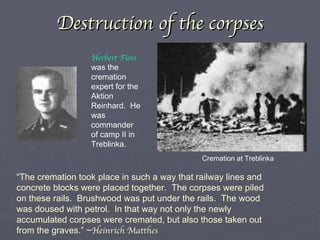
Destruction of the corpses Herbert Floss  was the cremation expert for the Aktion Reinhard.  He was commander of camp II in Treblinka. “ The cremation took place in such a way that railway lines and concrete blocks were placed together.  The corpses were piled on these rails.  Brushwood was put under the rails.  The wood was doused with petrol.  In that way not only the newly accumulated corpses were cremated, but also those taken out from the graves.” ~ Heinrich Matthes Cremation at Treblinka
August 28th, 1942 Aktion Reinhard Headquarters, led by Christian Wirth, intervenes to reorganize Treblinka. REASONS: Chaotic situation Overstocked No more room to unload Too many corpses SOLUTION: Suspension of transports Clear corpses Have Jews still at camp clean up the bodies
Uprising Similar to Sobibor August 2, 1943 Of 850 at the camp: 100 captured alive in the camp 350-400 Killed inside camp of near fences 350-400 Escaped Half were killed in the first 24 hours Of the 200 that survived, 100 escaped successfully
The camp only ran for 1 year… By fall 1943, evacuation of the camp began. Orders were given to destroy the camp so that the were  NO TRACES OF EXISTENCE . A farm was built to cover up where the camp was. Officers gave it to a Ukrainian farmer to run for an income. Total victims was approximately 800,000
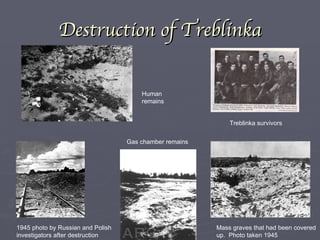
Destruction of Treblinka Treblinka survivors 1945 photo by Russian and Polish investigators after destruction Mass graves that had been covered up.  Photo taken 1945 Gas chamber remains Human remains
Daily Life Orchestra Boxing Matches “The Anthem of Treblinka” Plays Art: Untitled Art by Maryl Winningham
Until Dec 1942, prisoners could help themselves to the food brought in by transportees, once stopped starvation. 6 cooked potatoes w/peel Slice of bread for the morning
Treblinka Today All photos from Treblinka Memorial’s site: http:// fcit . usf . edu /Holocaust/RESOURCE/GALLERY/TREBLINK.HTM
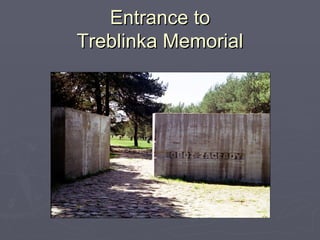
Entrance to Treblinka Memorial
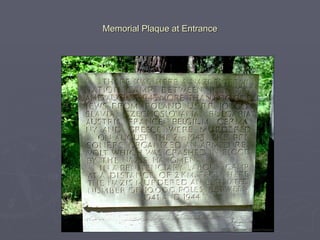
Memorial Plaque at Entrance
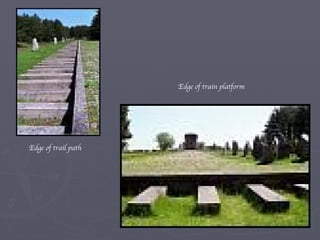
Edge of trail path Edge of train platform
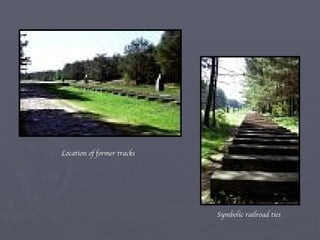
Location of former tracks Symbolic railroad ties
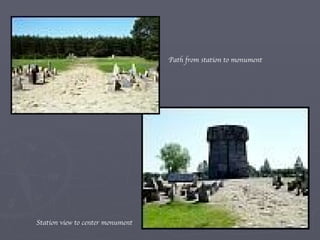
Station view to center monument Path from station to monument
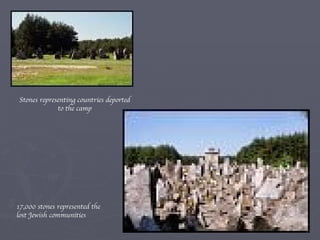
Stones representing countries deported to the camp 17,000 stones represented the lost Jewish communities
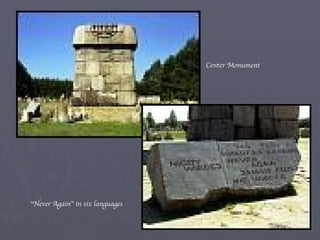
Center Monument “ Never Again” in six languages
Bibliography Books Arad, Yitzhak.  Belzec, Sobibor, Treblinka: The Operation Reinhard  Death Camps . Indiana: Indiana University Press, 1987. Hilberg, Raul.  Perpetrators, Victims, Bystanders: The Jewish  Catastrophe, 1933-1945 . NY: Harper Collins, 1992. Wiernik, Yankel.  A Year in Treblinka . NY: American Representation of  the Jewish Workers’ Union of Poland, 1945. Willenberg, Samuel.  Surviving Treblinka . NY: Basil Blackwell, 1989.
Articles Kugelmass, Jack. “Bloody Memories: Encountering the Past in Contemporary Poland.”  Cultural Anthropology.  Volume 10, No. 3 (August 1995): 279-301. Kulisiewicz, Aleksander.  “Polish Camp Songs, 1933-1945.”  Modern Language Studies.  Volume 16, No. 1 (Winter 1986): 3-9.  Database on-line Salem State College, JSTOR; accessed June 10, 2008.
Websites DeathCamps.org . 10 Jun. 2008. Treblinka.  www.deathcamps.org/treblinka/ Jewish Virtual Library.org . 10 Jun. 2008. Treblinka. www.Jewishvirtuallibrary.org/Jsource/Holocaust/Treblinkatoc.html Niss, Caven Keller.  “Treblinka.”  JewishGen: An Affiliate of the Museum of Jewish Heritage . 10 Jun. 2008. www.Jewishgen.org/ForgottenCamps/Camps/TreblinkaEng.html Nizkor.org . 10 Jun. 2008. “Treblinka.”  www.nizkor.org/hweb/camps/aktion-reinhard/treblinka PBS.org . 10 Jun. 2008. “Treblinka.”  www.PBS.org/wgbh/pages/frontline/shtetl/treblinka/

Treblinkafinal 3

  • 1.
    Treblinka Death CampLaura Bradbury and Barbara Sanford Presented by:
  • 2.
    The Road toTreblinka: October 1940 The Warsaw Ghetto
  • 3.
    In 1596, Warsaw became the capital of Poland. Jews lived in Poland since the 15th century. By the 19th century, Warsaw held the largest Jewish population in Europe. By the 20th century, it had the 2nd largest population in the world (only surpassed by NY)
  • 4.
    November 1939 Thefirst anti-Jewish decrees were issued. White armband with blue star of David. Signs identifying Jewish shops and enterprises. Ban on train traveling. Radios were confiscated. Boy selling armbands in the Warsaw ghetto Crowded market area of the Warsaw ghetto
  • 5.
    The Judenrat:The Germans created this in place of the traditional Jewish Community Council. The Judenrat was the sole official body that the German authorities dealt with. Headquarters : Grzybowska Street. Judenrat Leaders: Jaszunski, Sztolcman, Milejkowski, Lichtenbaum, Zabludowski, Kobryner, and others. Warsaw Judenrat
  • 6.
    The Judenrat’s Dilema:The Germans demanded lists of deportees for Treblinka from the Judenrat. If they refused, Germans could select anyone in any fashion… “ The Council faced problems of conscience and responsibility at the same time…There were two alternatives…Either to comply, announce the Gestapo order to the ghetto inhabitants; or openly sabotage the order by disregarding it. The Council felt that if it followed the first alternative, part of the ghetto might yet be rescued at least for a time. Should, however, the other alternative be chosen, heavy measures of persecution would follow against the entire ghetto, and possibly its immediate liquidation might result.”
  • 7.
    Conditions in theGhetto Located in impoverished part of the city. Dilapidated housing with no electricity or water. 30% of the population squeezed in 2.4% of the city’s area. Population density: 9.2 people per room. 128,000 people per square kilometer. Inside the Warsaw ghetto
  • 8.
    Warsaw and Lodzhoused 1/3 of the Polish Jews under Nazi control. Lack of food a major problem. Malnutrition and disease rampant. “ The situation in the Jewish quarter is catastrophic. The corpses of those who have died of starvation lie in the streets. The death rate, 80% from malnutrition, has tripled since February. The only thing that is issued to the Jews is 1.5 lbs of bread per week…” Oberfeldkommandant , May 1941 Warsaw Jews dead from malnutrition and epidemic
  • 9.
    Liquidation of theGhetto Immediately after completion of Treblinka the Grosse Umsiedlungsaktion [Great Resettlement Action] started on July 22, 1942. By December 31, 1942, Warsaw became a Sammellager (de facto concentration camp). Jews were being rounded up for “deportation,” “evacuation,” “relocation,” and “resettlement in the East.” The Aktion Reinhard squad oversaw the selection process in Warsaw and those who were too old, too young, or mentally and physically handicapped were “relocated” to Treblinka. Jews being deported to Treblinka
  • 10.
    July 22, 1942:German Conditions for the “Resettlement in the East” The main orders for “cleaning up” the ghetto were: All Jews will be resettled to the East, regardless of age and sex; With the exception of: Jews working for German companies. Jews working for the Judenrat. Jewish hospitals’ staff. Members of the Jewish Order Service. Patients of a Jewish hospital on the day of resettlement. Jews were ordered to bring all valuables: Gold, jewelry, money, etc.
  • 11.
    July 24, 1942:German order for 10,000 Jews and children for the “Children’s Transport” Posters were hung up announcing that: Each person who will volunteer for resettlement will get 3 kg of bread and 1 kg of marmalade.
  • 12.
    Deportation: In July1942, 64,606 Jews were deported to Treblinka. [This number does not include those shot in the streets and in houses during the “cleaning” of buildings.] Warsaw after Liquidation Warsaw Jews rounded up for deportation to Treblinka
  • 13.
    Daily Statistics aboutthe Deportations from Warsaw Ghetto to the Death Camp Treblinka DATE RESETTLED 7/22/42 6250 7/23/42 7200 7/24/42 7400 7/25/42 7350 7/26/42 6400 7/27/42 6320 7/28/42 5020 7/29/42 5480 7/30/42 6430 7/31/42 6756 TRANSIT CAMP TOTAL - 6250 - 7200 - 7400 - 7350 - 6400 - 6320 - 5020 - 5480 - 6430 - 6756
  • 14.
    Location Treblinka waslocated in the northeastern region of the Generalgouvernement . It was erected at the junction of the Warsaw-Bialystok Railway Line , just northwest of Treblinka village and its railway halt. This area was heavily wooded and well hidden from view. WarsawBialystok Line Branch to Treblinka
  • 15.
    FIND ID CARDSFIND ARTICLES MAPSTreblinka German administration of Europe, 1942 Extermination camps in occupied Poland, 1942 Treblinka environs, spring 1943 Treblinka camp, spring 1943
  • 16.
    Significance of LocationIt was easy to branch a track off the Warsaw-Bialystok Railway. Jews would be more at ease, believing they were familiar with the rail routes. The Germans also built a fake railway station at Treblinka, with ticket windows, timetables, and signs that said “To Warsaw.” They wanted to lull victims into believing they were at a Transit Camp. It became very easy to transport thousands of Jews over the short distance from Warsaw or Bialystok to Treblinka. When other ghettos were closed, all Jews in Northen Poland were sent to Warsaw as part of Operation Reinhard. From there it was easy access to Treblinka.
  • 17.
    Originally, during thesummer of 1941, Treblinka served as a Forced Labor Camp . Treblinka was constructed in a densely wooded area in order to naturally conceal the camp. It was a penal camp and held 1000-1200 Polish/Jewish detainees for forced labor. Main Gate of Treblinka
  • 18.
    Early May, 1942:The SS Team Arrives! Camp Architect: SS Obersturmfüher , Richard Thomalla. By late May/early June Construction of the Death Camp begins Created 3 zones: Wohnlager [Living area] Auffanglager [Reception] Tolenlager [Extermination]
  • 19.
    Treblinka II: AnAktion Reinhard Death Camp [Extermination of the Polish Jews] Opens July 1942
  • 20.
    Victims Majority=Polish Jewsfrom Warsaw Others: 7,000 Slovakia 4,000 Greece 7,000 Macedonia Portion of Bulgaria 2,000 Gypsies
  • 21.
    Treblinka High Command:Christian Wirth Inspector of all Aktion Reinhard death camps. SS-Sturmbannfüher SS Number: 345-464 Wirth was inspector and commander of Belzec, Sobibor and Treblinka. It was Wirth who developed the system of the extermination at these camps. He introduced a reign of terror at his Aktion Reinhard camps, and was so cruel, he became known as “Christian the Terrible” by his subordinates. His killing system enabled the murder of tens of thousands of Jews every day in the three death camps under his jurisdiction.
  • 22.
    Main Entrance Commandant’sliving quarters Ukranian guards’ living quarters Zoo Service buildings for SS Barracks for domestic staff Building for sorting gold and valuables SS living quarters Service storage buildings Stables and livestock area Barracks for Kapos, women prisoners Barracks for male prisoners Latrine Assembly area for prisoners (roll call) Entrances to reception area Entrance for guards
  • 23.
    17. Station platform18. Storehouse for victims’ property 19. Burial pits 20. Executioin site [disguised as a hospital] 21. Reception square [sorting area] 22. Latrine 23. Cremation pyres 24. Deportation area 25. Barracks where women undressed, surrendered their valuables, and had head shaved 26. Barracks where men undressed 27. Approach to the gas chambers 28. Ten new gas chambers 29. Three old gas chambers 30. Cremation pyres 31. Barracks for prisoners
  • 24.
    August 1942 FranzStangl, former commander of the Sobibor death camp, became commander of Treblinka. He received an official commendation for being the “best camp commander in Poland.” He oversaw the entire camp system; from arrival to cremation.
  • 25.
    Arrival SS squadsreceived prisoners with clubs and whips on a platform when deportations arrived. Willy Mätzig [a book-keeper and accountant] told them that “they were a resettlement transport, that they would be given a bath and that they would receive new clothes. They were also instructed to maintain quiet and discipline. They were told they would continue their journey the following day.” Willy Mätzig
  • 26.
    Sorting the Sickfrom the Strong After departing the train, new arrivals were taken to a reception area. Ill or weak arrivals, unaccompanied children, and injured persons were led to the Lazarett [a small execution site]. Victims’ belongings were brought to two sorting barracks. All others were brought to a fenced in area called Entkleidungsplatz [Undressing Square]
  • 27.
    Selection Hermann Michel sorted the sick from the strong. He wore a white overcoat in order to appear like a doctor. He welcomed arriving victims and told the Jews they had arrived at a Labor camp . Michel told those selected as “strong” that in order to have proper hygienic conditions, they had to be disinfected and had to shower. Hermann Michel Sorting yard
  • 28.
    Sorting Barracks 'Sortierungsplatz' While the arrivals were being sorted and brought to the Lazarett or the “Disinfecting Chambers,” their belongings were brought to the Sorting Barracks. There, officers such as Max Bree , supervised Jewish workers who were made to sort valuables and other belongings. Laponder depiction of Sorting Area Peters depiction of Sorting Barracks
  • 29.
    The Lazarett WilliMentz was assigned to supervise the Lazarett. His victims, those deemed sick by Hermann Michel, were seated together in front of a large, fiery mass grave. They were shot and pushed into the fires. One of Mentz’s greatest killers was Paul Bredow, known by the Jews as “Gunman.” It is believed that he single-handedly murdered thousands of Jews. Similar mass grave at Bergen-Belson
  • 30.
    Undressing Stations FranzSuchomel Healthy men and women were separated and then officers, such as Franz Suchomel , would make them undress and women’s hair was cut off. The victims’ clothes would be gathered and then, once naked, the groups would be led to their next destination.
  • 31.
    The Tube Acamouflaged, fenced-in path, known as the "tube," led from the Undressing Stations to the gas chamber entrance, located in the killing area. Victims were forced to run naked along this path to the gas chambers, deceptively labeled as showers.
  • 32.
    Gas ChambersHeinrich Matthes was the chief officer of Camp II and the Gas Chambers. He had his Sonderkomando convince the victims to enter the “shower area,” the chamber doors were sealed, and an engine installed outside the building pumped carbon monoxide into the gas chambers, killing everyone inside.
  • 33.
    Destruction of thecorpses Herbert Floss was the cremation expert for the Aktion Reinhard. He was commander of camp II in Treblinka. “ The cremation took place in such a way that railway lines and concrete blocks were placed together. The corpses were piled on these rails. Brushwood was put under the rails. The wood was doused with petrol. In that way not only the newly accumulated corpses were cremated, but also those taken out from the graves.” ~ Heinrich Matthes Cremation at Treblinka
  • 34.
    August 28th, 1942Aktion Reinhard Headquarters, led by Christian Wirth, intervenes to reorganize Treblinka. REASONS: Chaotic situation Overstocked No more room to unload Too many corpses SOLUTION: Suspension of transports Clear corpses Have Jews still at camp clean up the bodies
  • 35.
    Uprising Similar toSobibor August 2, 1943 Of 850 at the camp: 100 captured alive in the camp 350-400 Killed inside camp of near fences 350-400 Escaped Half were killed in the first 24 hours Of the 200 that survived, 100 escaped successfully
  • 36.
    The camp onlyran for 1 year… By fall 1943, evacuation of the camp began. Orders were given to destroy the camp so that the were NO TRACES OF EXISTENCE . A farm was built to cover up where the camp was. Officers gave it to a Ukrainian farmer to run for an income. Total victims was approximately 800,000
  • 37.
    Destruction of TreblinkaTreblinka survivors 1945 photo by Russian and Polish investigators after destruction Mass graves that had been covered up. Photo taken 1945 Gas chamber remains Human remains
  • 38.
    Daily Life OrchestraBoxing Matches “The Anthem of Treblinka” Plays Art: Untitled Art by Maryl Winningham
  • 39.
    Until Dec 1942,prisoners could help themselves to the food brought in by transportees, once stopped starvation. 6 cooked potatoes w/peel Slice of bread for the morning
  • 40.
    Treblinka Today Allphotos from Treblinka Memorial’s site: http:// fcit . usf . edu /Holocaust/RESOURCE/GALLERY/TREBLINK.HTM
  • 41.
  • 42.
  • 43.
    Edge of trailpath Edge of train platform
  • 44.
    Location of formertracks Symbolic railroad ties
  • 45.
    Station view tocenter monument Path from station to monument
  • 46.
    Stones representing countriesdeported to the camp 17,000 stones represented the lost Jewish communities
  • 47.
    Center Monument “Never Again” in six languages
  • 48.
    Bibliography Books Arad,Yitzhak. Belzec, Sobibor, Treblinka: The Operation Reinhard Death Camps . Indiana: Indiana University Press, 1987. Hilberg, Raul. Perpetrators, Victims, Bystanders: The Jewish Catastrophe, 1933-1945 . NY: Harper Collins, 1992. Wiernik, Yankel. A Year in Treblinka . NY: American Representation of the Jewish Workers’ Union of Poland, 1945. Willenberg, Samuel. Surviving Treblinka . NY: Basil Blackwell, 1989.
  • 49.
    Articles Kugelmass, Jack.“Bloody Memories: Encountering the Past in Contemporary Poland.” Cultural Anthropology. Volume 10, No. 3 (August 1995): 279-301. Kulisiewicz, Aleksander. “Polish Camp Songs, 1933-1945.” Modern Language Studies. Volume 16, No. 1 (Winter 1986): 3-9. Database on-line Salem State College, JSTOR; accessed June 10, 2008.
  • 50.
    Websites DeathCamps.org .10 Jun. 2008. Treblinka. www.deathcamps.org/treblinka/ Jewish Virtual Library.org . 10 Jun. 2008. Treblinka. www.Jewishvirtuallibrary.org/Jsource/Holocaust/Treblinkatoc.html Niss, Caven Keller. “Treblinka.” JewishGen: An Affiliate of the Museum of Jewish Heritage . 10 Jun. 2008. www.Jewishgen.org/ForgottenCamps/Camps/TreblinkaEng.html Nizkor.org . 10 Jun. 2008. “Treblinka.” www.nizkor.org/hweb/camps/aktion-reinhard/treblinka PBS.org . 10 Jun. 2008. “Treblinka.” www.PBS.org/wgbh/pages/frontline/shtetl/treblinka/