Faces of
             Resistance


Arianna Bornhof, Sergio Vargas, Rashi Kacker, Anna-Marie Hosking   1
What is Resistance?
• The meaning of Resistance is the acton of
  opposing something that you disapprove or
  disagree with.
• In World War II, the act of resistance can be
  subjected to many meanings ranging from non-
  violent acts such as protestng, violent uprisings
  found in and out of the concentraton camps,
  hiding Jews, espionage, politcal slander, forgery
  of documents, ataining weaponry, assistng in
  escape, and strategically disruptng Nazi
  actvites.

                                                      2
J e w is h R e s is ta n c e :
P a rtis a n U n its in th e
          F o re s ts
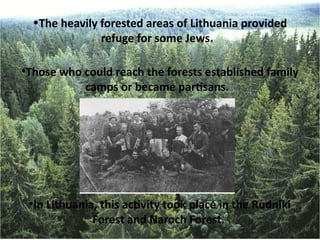
•The heavily forested areas of Lithuania provided
               refuge for some Jews.

•Those who could reach the forests established family
           camps or became partsans.


 •In Lithuania, this actvity took place in the Rudniki
              Forest and Naroch Forest.
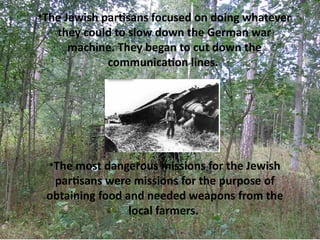
•The Jewish partsans focused on doing whatever
   they could to slow down the German war
      machine. They began to cut down the
             communicaton lines.


 •The most dangerous missions for the Jewish
  partsans were missions for the purpose of
 obtaining food and needed weapons from the
                 local farmers.
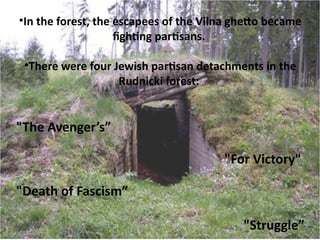
•In the forest, the escapees of the Vilna gheto became
                    fghtng partsans.

 •There were four Jewish partsan detachments in the
                   Rudnicki forest:


"The Avenger’s”

                                       "For Victory"

"Death of Fascism”

                                          "Struggle”
•An estmated 20,000 to 30,000 Jews
 fought in partsan groups based in the
       forests of eastern Europe.


  •There were about 30 Jewish partsan
  detachments and some 21 additonal
non-Jewish partsan groups in which Jews
                fought.
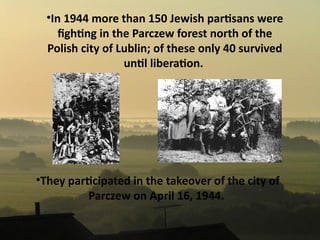
•In 1944 more than 150 Jewish partsans were
     fghtng in the Parczew forest north of the
  Polish city of Lublin; of these only 40 survived
                  untl liberaton.


•They partcipated in the takeover of the city of
         Parczew on April 16, 1944.
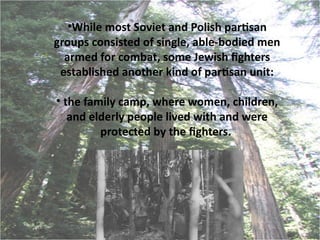
•While most Soviet and Polish partsan
groups consisted of single, able-bodied men
  armed for combat, some Jewish fghters
 established another kind of partsan unit:

• the family camp, where women, children,
   and elderly people lived with and were
         protected by the fghters.
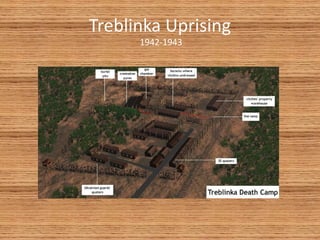
Treblinka Uprising
      1942-1943
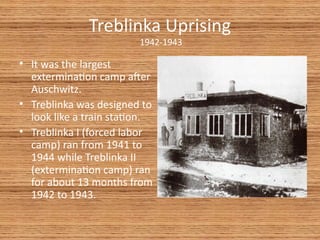
Treblinka Uprising
                        1942-1943

• It was the largest
  exterminaton camp afer
  Auschwitz.
• Treblinka was designed to
  look like a train staton.
• Treblinka I (forced labor
  camp) ran from 1941 to
  1944 while Treblinka II
  (exterminaton camp) ran
  for about 13 months from
  1942 to 1943.
Treblinka Uprising
      1942-1943

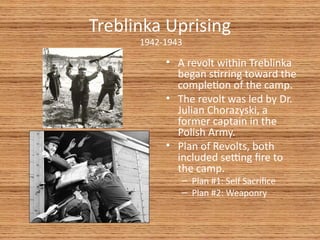
           • A revolt within Treblinka
             began strring toward the
             completon of the camp.
           • The revolt was led by Dr.
             Julian Chorazyski, a
             former captain in the
             Polish Army.
           • Plan of Revolts, both
             included setng fre to
             the camp.
              – Plan #1: Self Sacrifce
              – Plan #2: Weaponry
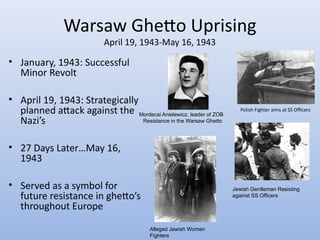
Warsaw Gheto Uprising
                           April 19, 1943-May 16, 1943

• January, 1943: Successful
  Minor Revolt

• April 19, 1943: Strategically
  planned atack against the Mordecai Anielewicz, leader of ZOB       Polish Fighter aims at SS Ofcers

  Nazi’s                        Resistance in the Warsaw Ghetto


• 27 Days Later…May 16,
  1943

• Served as a symbol for                                          Jewish Gentleman Resisting
  future resistance in gheto’s                                    against SS Officers

  throughout Europe

                                         Alleged Jewish Women
                                         Fighters
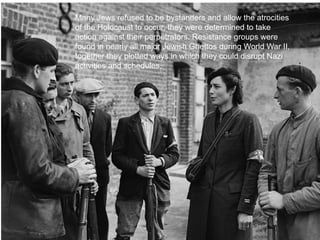
Many Jews refused to be bystanders and allow the atrocities
of the Holocaust to occur, they were determined to take
action against their perpetrators. Resistance groups were
found in nearly all major Jewish Ghettos during World War II,
together they plotted ways in which they could disrupt Nazi
activities and schedules.


                                                                14
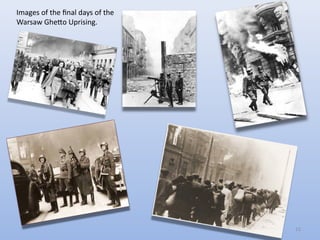
Images of the fnal days of the
Warsaw Gheto Uprising.


                                 15
The Revolt of the
       Sonderkommando in Birkenau
                                  October 7, 1944

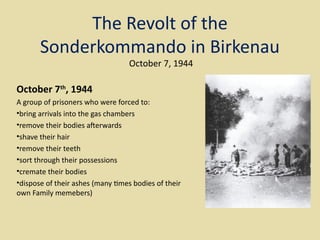
October 7th, 1944
A group of prisoners who were forced to:
•bring arrivals into the gas chambers
•remove their bodies aferwards
•shave their hair
•remove their teeth
•sort through their possessions
•cremate their bodies
•dispose of their ashes (many tmes bodies of their
own Family memebers)
Plotng for the revoluton of the
     12th Sonderkommando
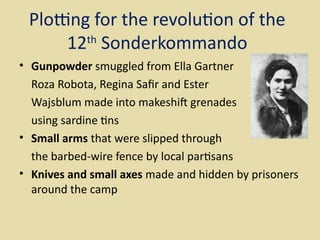
• Gunpowder smuggled from Ella Gartner
  Roza Robota, Regina Safr and Ester
  Wajsblum made into makeshif grenades
  using sardine tns
• Small arms that were slipped through
  the barbed-wire fence by local partsans
• Knives and small axes made and hidden by prisoners
  around the camp
Sonderkommando Take Acton
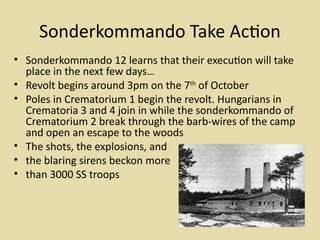
• Sonderkommando 12 learns that their executon will take
  place in the next few days…
• Revolt begins around 3pm on the 7th of October
• Poles in Crematorium 1 begin the revolt. Hungarians in
  Crematoria 3 and 4 join in while the sonderkommando of
  Crematorium 2 break through the barb-wires of the camp
  and open an escape to the woods
• The shots, the explosions, and
• the blaring sirens beckon more
• than 3000 SS troops
Thank You Anna for sharing your
story with us; it will forever be told
      for centuries to come.
      -Sergio, Rashi, Anna, and Ari


                                         19
ibliography
ckerfeld, Lance. "The Revolt of the Sonderkommando in Birkenau." JewishGen, Inc., 20 Nov. 2001. Web.
<http://www.jewishgen.org/yizkor/oswiecim1/osw475.html >.


aranova, Galina. "Svintsyan Partisans." Svencionys. Ed. Marjorie S. Rosenfeld. JewishGen-erosity, 2000.
Web. 26 Feb. 2010. <http://www.shtetlinks.jewishgen.org/ Svencionys/     partisan_movement.html>.


ard, Mitchell. “Warsaw Ghetto Uprising.” Jewish Viritual Library. 2010.
<http://www.jewishvirtuallibrary.org/jsource/Holocaust/uprising1.html>.


art, Michael. "Jewish Partisan Resistance & Sabotage." UNTIL OUR LAST BREATH. St. Martin's Press, 2008.
       Web. 26 Feb. 2010. <http://www.untilourlastbreath.com/Bart4 sabatogefacts.html>.


The Holocaust.” Holocaust Encyclopedia United States Holocaust Memorial Museum. 8 Sept. 1997
<http://www.ushmm.org/wlc/en/?ModuleId=10005143>.


ajzman, Samuel. "Uprising In Treblinka". House Committee of Foreign Affairs. 1 Mar.   2010
<http://www.holocaust-history.org/operation-reinhard/uprising-in-treblinka.shtml>.


Resistance During the Holocaust." The Holocaust/Genocide Project: AN END TOINTOLERANCE.          iEARN,
2005. Web. 26 Feb. 2010. <http://iearn.org/hgp/aeti/aeti-1998-no- frames/resistance.htm>.

                                                                                                          20
The Revolt at Auschwitz-Birkenau." Jewish Virtual Library - Homepage. Web. 07 Mar. 2010.

Faces of resistance

  • 1.
    Faces of Resistance Arianna Bornhof, Sergio Vargas, Rashi Kacker, Anna-Marie Hosking 1
  • 2.
    What is Resistance? •The meaning of Resistance is the acton of opposing something that you disapprove or disagree with. • In World War II, the act of resistance can be subjected to many meanings ranging from non- violent acts such as protestng, violent uprisings found in and out of the concentraton camps, hiding Jews, espionage, politcal slander, forgery of documents, ataining weaponry, assistng in escape, and strategically disruptng Nazi actvites. 2
  • 3.
    J e wis h R e s is ta n c e : P a rtis a n U n its in th e F o re s ts
  • 4.
    •The heavily forestedareas of Lithuania provided refuge for some Jews. •Those who could reach the forests established family camps or became partsans. •In Lithuania, this actvity took place in the Rudniki Forest and Naroch Forest.
  • 5.
    •The Jewish partsansfocused on doing whatever they could to slow down the German war machine. They began to cut down the communicaton lines. •The most dangerous missions for the Jewish partsans were missions for the purpose of obtaining food and needed weapons from the local farmers.
  • 6.
    •In the forest,the escapees of the Vilna gheto became fghtng partsans. •There were four Jewish partsan detachments in the Rudnicki forest: "The Avenger’s” "For Victory" "Death of Fascism” "Struggle”
  • 7.
    •An estmated 20,000to 30,000 Jews fought in partsan groups based in the forests of eastern Europe. •There were about 30 Jewish partsan detachments and some 21 additonal non-Jewish partsan groups in which Jews fought.
  • 8.
    •In 1944 morethan 150 Jewish partsans were fghtng in the Parczew forest north of the Polish city of Lublin; of these only 40 survived untl liberaton. •They partcipated in the takeover of the city of Parczew on April 16, 1944.
  • 9.
    •While most Sovietand Polish partsan groups consisted of single, able-bodied men armed for combat, some Jewish fghters established another kind of partsan unit: • the family camp, where women, children, and elderly people lived with and were protected by the fghters.
  • 10.
  • 11.
    Treblinka Uprising 1942-1943 • It was the largest exterminaton camp afer Auschwitz. • Treblinka was designed to look like a train staton. • Treblinka I (forced labor camp) ran from 1941 to 1944 while Treblinka II (exterminaton camp) ran for about 13 months from 1942 to 1943.
  • 12.
    Treblinka Uprising 1942-1943 • A revolt within Treblinka began strring toward the completon of the camp. • The revolt was led by Dr. Julian Chorazyski, a former captain in the Polish Army. • Plan of Revolts, both included setng fre to the camp. – Plan #1: Self Sacrifce – Plan #2: Weaponry
  • 13.
    Warsaw Gheto Uprising April 19, 1943-May 16, 1943 • January, 1943: Successful Minor Revolt • April 19, 1943: Strategically planned atack against the Mordecai Anielewicz, leader of ZOB Polish Fighter aims at SS Ofcers Nazi’s Resistance in the Warsaw Ghetto • 27 Days Later…May 16, 1943 • Served as a symbol for Jewish Gentleman Resisting future resistance in gheto’s against SS Officers throughout Europe Alleged Jewish Women Fighters
  • 14.
    Many Jews refusedto be bystanders and allow the atrocities of the Holocaust to occur, they were determined to take action against their perpetrators. Resistance groups were found in nearly all major Jewish Ghettos during World War II, together they plotted ways in which they could disrupt Nazi activities and schedules. 14
  • 15.
    Images of thefnal days of the Warsaw Gheto Uprising. 15
  • 16.
    The Revolt ofthe Sonderkommando in Birkenau October 7, 1944 October 7th, 1944 A group of prisoners who were forced to: •bring arrivals into the gas chambers •remove their bodies aferwards •shave their hair •remove their teeth •sort through their possessions •cremate their bodies •dispose of their ashes (many tmes bodies of their own Family memebers)
  • 17.
    Plotng for therevoluton of the 12th Sonderkommando • Gunpowder smuggled from Ella Gartner Roza Robota, Regina Safr and Ester Wajsblum made into makeshif grenades using sardine tns • Small arms that were slipped through the barbed-wire fence by local partsans • Knives and small axes made and hidden by prisoners around the camp
  • 18.
    Sonderkommando Take Acton •Sonderkommando 12 learns that their executon will take place in the next few days… • Revolt begins around 3pm on the 7th of October • Poles in Crematorium 1 begin the revolt. Hungarians in Crematoria 3 and 4 join in while the sonderkommando of Crematorium 2 break through the barb-wires of the camp and open an escape to the woods • The shots, the explosions, and • the blaring sirens beckon more • than 3000 SS troops
  • 19.
    Thank You Annafor sharing your story with us; it will forever be told for centuries to come. -Sergio, Rashi, Anna, and Ari 19
  • 20.
    ibliography ckerfeld, Lance. "TheRevolt of the Sonderkommando in Birkenau." JewishGen, Inc., 20 Nov. 2001. Web. <http://www.jewishgen.org/yizkor/oswiecim1/osw475.html >. aranova, Galina. "Svintsyan Partisans." Svencionys. Ed. Marjorie S. Rosenfeld. JewishGen-erosity, 2000. Web. 26 Feb. 2010. <http://www.shtetlinks.jewishgen.org/ Svencionys/ partisan_movement.html>. ard, Mitchell. “Warsaw Ghetto Uprising.” Jewish Viritual Library. 2010. <http://www.jewishvirtuallibrary.org/jsource/Holocaust/uprising1.html>. art, Michael. "Jewish Partisan Resistance & Sabotage." UNTIL OUR LAST BREATH. St. Martin's Press, 2008. Web. 26 Feb. 2010. <http://www.untilourlastbreath.com/Bart4 sabatogefacts.html>. The Holocaust.” Holocaust Encyclopedia United States Holocaust Memorial Museum. 8 Sept. 1997 <http://www.ushmm.org/wlc/en/?ModuleId=10005143>. ajzman, Samuel. "Uprising In Treblinka". House Committee of Foreign Affairs. 1 Mar. 2010 <http://www.holocaust-history.org/operation-reinhard/uprising-in-treblinka.shtml>. Resistance During the Holocaust." The Holocaust/Genocide Project: AN END TOINTOLERANCE. iEARN, 2005. Web. 26 Feb. 2010. <http://iearn.org/hgp/aeti/aeti-1998-no- frames/resistance.htm>. 20 The Revolt at Auschwitz-Birkenau." Jewish Virtual Library - Homepage. Web. 07 Mar. 2010.