Resistance in the Warsaw Ghetto An overview By Andrew King
Warsaw The capital of Poland, where about 375,000 Jews lived on the eve of World War I1.  In October-November 1940, Germans established the Warsaw ghetto, into which some 500,000 Jews were crowded.  On average 5,000 to 6,000 died each month from starvation, disease, exposure to cold, and shootings.
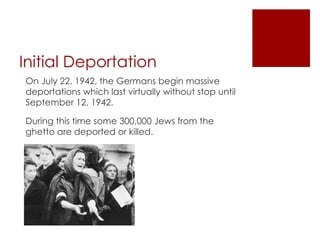
Initial Deportation On July 22, 1942, the Germans begin massive deportations which last virtually without stop until September 12, 1942.  During this time some 300,000 Jews from the ghetto are deported or killed.
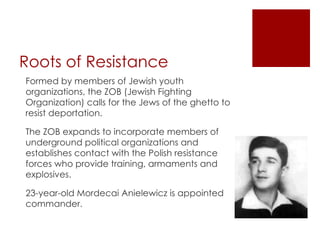
Roots of Resistance Formed by members of Jewish youth organizations, the ZOB (Jewish Fighting Organization) calls for the Jews of the ghetto to resist deportation.  The ZOB expands to incorporate members of underground political organizations and establishes contact with the Polish resistance forces who provide training, armaments and explosives.  23-year-old Mordecai Anielewicz is appointed commander.
First Action ZOB issued a proclamation calling for the Jewish people to resist going to the railroad cars: “ Jewish masses, the hour is drawing near.  You must be prepared to resist.  Not a single Jew should go to the railroad cars.  Those who are not able to put up active resistance should resist passively, should go into hiding… Our slogan must be: All are ready to die as human beings.” From a public manifesto of the ZOB (Jewish Fighting Organization), Fall 1942
First Victory In January 1943, Warsaw ghetto fighters fired upon German troops as they tried to round up another group of ghetto inhabitants for deportation.  Fighters used a small supply of weapons that had been smuggled into the ghetto.  After a few days, German troops retreated.  This small victory inspired the ghetto fighters to prepare for future resistance.
January 18-21, 1943 In retaliation for the acts of the ZOB, German units massacre approximately 1,000 Jews in the main square of the Warsaw Ghetto. All deportation activities are also suspended. In the meantime, encouraged by initial resistance efforts, the ZOB and Jewish retaliation units continue to orchestrate a larger, full-scale uprising against the Germans.
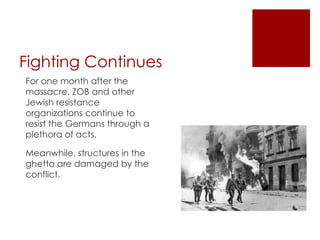
Fighting Continues For one month after the massacre, ZOB and other Jewish resistance organizations continue to resist the Germans through a plethora of acts. Meanwhile, structures in the ghetto are damaged by the conflict.
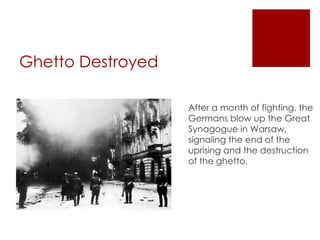
Ghetto Destroyed After a month of fighting, the Germans blow up the Great Synagogue in Warsaw, signaling the end of the uprising and the destruction of the ghetto.
A Last Stand On April 19, 1943, the Germans under the command of SS General Juergen Stroop, began the final actual destruction of the ghetto and the deportation of the remaining Jews. However, the ghetto population does not report for deportation to concentration camps. The ZOB and other resistance organizations barricaded themselves inside of structures and prepared to resist the Germans until the very end.
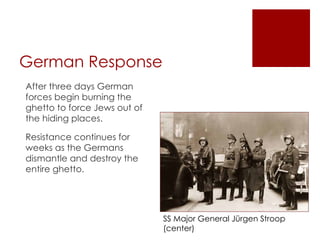
German Response After three days German forces begin burning the ghetto to force Jews out of the hiding places.  Resistance continues for weeks as the Germans dismantle and destroy the entire ghetto.  SS Major General Jürgen Stroop (center)
Outcome Approximately 50,000 Jews are  left in the ghetto after the January 1943 deportations. General Stroop reports after the destruction of the ghetto that 56,065 Jews have been captured.  Of those, 7,000 were deported to the Treblinka extermination camp, and the remainder were sent to forced-labor camps and the Majdanek extermination camp.  Some of the resistance fighters escape from the ghetto and join partisan groups in the forests around Warsaw.
Further Information/Bibliography United States Holocaust History Museum:  http://www.ushmm.org/outreach/wswchr.htm Holocaust Survivors’ Encyclopedia:  http://www.holocaustsurvivors.org/cgi-bin/data.show.pl?di=record&da=encyclopedia&ke=118 Photos: The Warsaw Ghetto Uprising:  http://fcit.usf.edu/HOLOCAUST/RESOURCE/GALLERY/G1941WGU.HTM AISH.com:  http://www.aish.com/holocaust/overview/he05n27.htm Jewish Virtual Library:  http://www.jewishvirtuallibrary.org/jsource/Holocaust/warsawtoc.html

Warsaw Ghetto Resistance Presentation

  • 1.
    Resistance in theWarsaw Ghetto An overview By Andrew King
  • 2.
    Warsaw The capitalof Poland, where about 375,000 Jews lived on the eve of World War I1. In October-November 1940, Germans established the Warsaw ghetto, into which some 500,000 Jews were crowded. On average 5,000 to 6,000 died each month from starvation, disease, exposure to cold, and shootings.
  • 3.
    Initial Deportation OnJuly 22, 1942, the Germans begin massive deportations which last virtually without stop until September 12, 1942. During this time some 300,000 Jews from the ghetto are deported or killed.
  • 4.
    Roots of ResistanceFormed by members of Jewish youth organizations, the ZOB (Jewish Fighting Organization) calls for the Jews of the ghetto to resist deportation. The ZOB expands to incorporate members of underground political organizations and establishes contact with the Polish resistance forces who provide training, armaments and explosives. 23-year-old Mordecai Anielewicz is appointed commander.
  • 5.
    First Action ZOBissued a proclamation calling for the Jewish people to resist going to the railroad cars: “ Jewish masses, the hour is drawing near. You must be prepared to resist. Not a single Jew should go to the railroad cars. Those who are not able to put up active resistance should resist passively, should go into hiding… Our slogan must be: All are ready to die as human beings.” From a public manifesto of the ZOB (Jewish Fighting Organization), Fall 1942
  • 6.
    First Victory InJanuary 1943, Warsaw ghetto fighters fired upon German troops as they tried to round up another group of ghetto inhabitants for deportation. Fighters used a small supply of weapons that had been smuggled into the ghetto. After a few days, German troops retreated. This small victory inspired the ghetto fighters to prepare for future resistance.
  • 7.
    January 18-21, 1943In retaliation for the acts of the ZOB, German units massacre approximately 1,000 Jews in the main square of the Warsaw Ghetto. All deportation activities are also suspended. In the meantime, encouraged by initial resistance efforts, the ZOB and Jewish retaliation units continue to orchestrate a larger, full-scale uprising against the Germans.
  • 8.
    Fighting Continues Forone month after the massacre, ZOB and other Jewish resistance organizations continue to resist the Germans through a plethora of acts. Meanwhile, structures in the ghetto are damaged by the conflict.
  • 9.
    Ghetto Destroyed Aftera month of fighting, the Germans blow up the Great Synagogue in Warsaw, signaling the end of the uprising and the destruction of the ghetto.
  • 10.
    A Last StandOn April 19, 1943, the Germans under the command of SS General Juergen Stroop, began the final actual destruction of the ghetto and the deportation of the remaining Jews. However, the ghetto population does not report for deportation to concentration camps. The ZOB and other resistance organizations barricaded themselves inside of structures and prepared to resist the Germans until the very end.
  • 11.
    German Response Afterthree days German forces begin burning the ghetto to force Jews out of the hiding places. Resistance continues for weeks as the Germans dismantle and destroy the entire ghetto. SS Major General Jürgen Stroop (center)
  • 12.
    Outcome Approximately 50,000Jews are left in the ghetto after the January 1943 deportations. General Stroop reports after the destruction of the ghetto that 56,065 Jews have been captured. Of those, 7,000 were deported to the Treblinka extermination camp, and the remainder were sent to forced-labor camps and the Majdanek extermination camp. Some of the resistance fighters escape from the ghetto and join partisan groups in the forests around Warsaw.
  • 13.
    Further Information/Bibliography UnitedStates Holocaust History Museum: http://www.ushmm.org/outreach/wswchr.htm Holocaust Survivors’ Encyclopedia: http://www.holocaustsurvivors.org/cgi-bin/data.show.pl?di=record&da=encyclopedia&ke=118 Photos: The Warsaw Ghetto Uprising: http://fcit.usf.edu/HOLOCAUST/RESOURCE/GALLERY/G1941WGU.HTM AISH.com: http://www.aish.com/holocaust/overview/he05n27.htm Jewish Virtual Library: http://www.jewishvirtuallibrary.org/jsource/Holocaust/warsawtoc.html