RACKING AND MAPPING
PRESENTED BY
ABHISHEK(1), MOHIT (29), SAURABH (41) SIMPLE ( 46)
PRESENTED TO-
O.P MISHRA SIR
Warehouse
WAREHOUSE (concept)
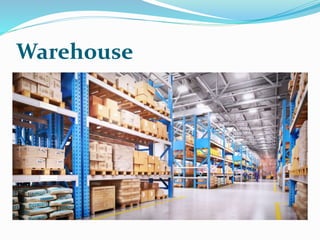
 A warehouse is a building for storing goods. They are used
by manufacturers, importers, exporters, wholesalers, transport
businesses, customs, etc
 Large exporters and manufacturers use warehouses as
distribution points for developing retail outlets in a particular
region or country.
 Warehouse provides necessary facilities to the businessmen for
storing their goods when they are not required for sale.
 It provides protection to the stocks, ensures their safety and
prevents wastage.
 It minimises losses from breakage, deterioration in quality,
spoilage etc. Warehouses usually adopt latest technologies to
avoid losses, as far as possible.
Functions of Warehousing
 Storage:
This is the basic function of warehousing. Surplus
commodities which are not needed immediately can
be stored in warehouses. They can be supplied as and
when needed by the customers.
Price Stabilization:
 Warehouses play an important role in the process of
price stabilization. It is achieved by the creation of
time utility by warehousing. Fall in the prices of goods
when their supply is in abundance and rise in their
prices during the slack season are avoided.
Risk bearing:
 When the goods are stored in warehouses they are
exposed to many risks in the form of theft,
exploration, fire etc. Warehouses are constructed in
such a way as to minimise these risks.
 Contract of bailment operates when the goods are
stored in wave-houses.
Grading and Packing:
 Warehouses nowadays provide the facilities of
packing, processing and grading of goods. Goods can
be packed in convenient sizes as per the instructions of
the owner
Financing
 Banks and other financial institutions also advance
loans against warehouse receipts. In this manner,
warehousing acts as a source of finance for the
businessmen for meeting business operations.
Racking
Racking
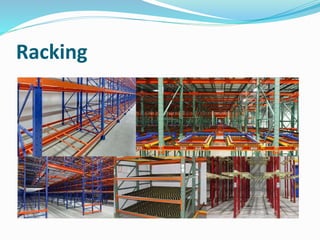
 Rack is a material handling storage aid system
designed to store materials.
 With proper warehouse racking, warehouse managers
maximize space and optimize warehouse
organization for efficiency and a streamlined picking
process.
 Warehouse layout plays a major role in warehouse
racking, as width, docking locations, shipping
areas, and other warehouse components affect
warehouse racking options.
How to Design a Warehouse
Racking Layout?
Here are some steps and
recommendations for Efficient
Planning :
1- Listen to Your Contractors
 We may be attempted to jump
straight into planning our warehouse
racking layout, but that would be a
mistake.
 Talk to knowledgeable
contractors (like your material
handling company), your warehouse
manager(s), and even your drivers:
They have years of experience in
warehouse facility operations and
planning
 Explain your goals and requirements,
and then listen to their suggestions.
2. Understand Your Storage
Requirements
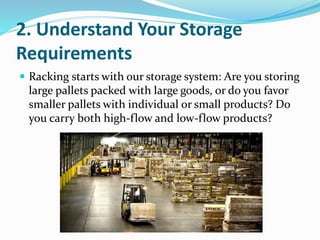
 Racking starts with our storage system: Are you storing
large pallets packed with large goods, or do you favor
smaller pallets with individual or small products? Do
you carry both high-flow and low-flow products?
3. Maximize Your Physical Storage
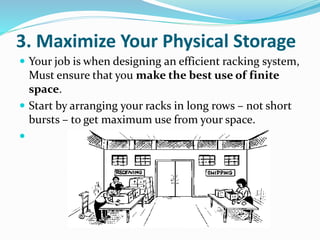
 Your job is when designing an efficient racking system,
Must ensure that you make the best use of finite
space.
 Start by arranging your racks in long rows – not short
bursts – to get maximum use from your space.

4. Plan for Expansion
 If there’s a good chance you’ll someday want to
increase your warehouse storage space, start planning
for that now. A good manager know each and every
thing about a warehouse. Observe each and every
function.
 Select those racking solution, which is easily
adjustable, versatile, and expandable.
5. Bank on Durability
 Racking, storage are not a small investment, so make
the most of your money by investing in a durable,
made-to-last racking system. Consider product weight,
durability, shape, size.
 Then opt for a racking system with a good cost-lifespan
balance
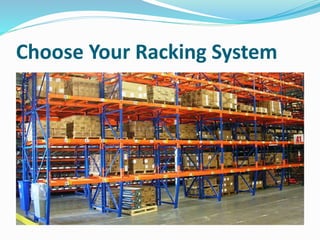
Choose Your Racking System
6. Choose Your Racking System
Several types of racking systems are available –
selective racks (ex. for narrow aisle racking)
drive-in racks and drive-through racks (ex. for high-
density storage)
push back racking (ex. for bulk storage),
flow racks (ex. for high-density storage)
 The type you choose depends on your
warehousing needs.
Budget
7. Determine Your Budget
 Once you understand your basic racking system needs,
one of the first considerations is budget: the total
cost for racking equipment, plus design and
installation.
 Don’t cut corners: the goal is not the cheapest total,
but rather the “best cost solution,”
 Once you’ve defined your needs and developed an
ideal racking layout, then you’re ready to price-shop
for the best deal.
8. Map Your Warehouse
 Before you buy, map your warehouse layout. Account
for all the considerations above, and add to them other
important concerns, like shipping and receiving areas,
the employee lunch room, managers’ offices, etc.
 A physical map will force you to consider
all unmovable or unchangeable factors – columns,
doors, and other obstructions – that you must design
around, as you plan an efficient racking system.
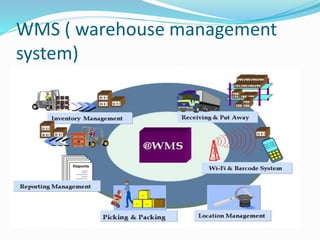
WMS ( warehouse management
system)
9. Implement a Warehouse
Management System (WMS)
 An efficient racking system doesn’t do you any favour if
your employees don’t know where things are stored. A
good warehouse management system will keep your
inventory and operations as well organized as
your new racks.
Types of Racking
Types of Racking
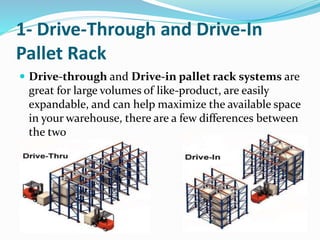
 Drive-through and drive-in pallet rack systems are
great for large volumes of like-product, are easily
expandable, and can help maximize the available space
in your warehouse, there are a few differences between
the two that will determine which fits your facility
best.
1- Drive-Through and Drive-In
Pallet Rack
 Drive-through and Drive-in pallet rack systems are
great for large volumes of like-product, are easily
expandable, and can help maximize the available space
in your warehouse, there are a few differences between
the two
A- Drive-Through
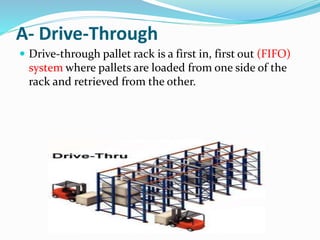
 Drive-through pallet rack is a first in, first out (FIFO)
system where pallets are loaded from one side of the
rack and retrieved from the other.
B- Drive-In
 As opposed to drive-through racking, this system
is first in, last out (FILO), meaning it isn’t good for
inventory with a short shelf life or a warehouse with a
quick inventory turnaround. This system is great for
freezer applications since it maximizes space. This
system requires skilled forklift operators to follow all
safety guidelines and report any damage promptly
2- Selective racking system
Selective racking
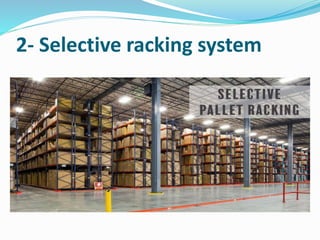
 Selective racking is simply one pallet deep and has a
maximum of two racks that is placed back to back.
 Selective pallet racking will allow for a direct access in
every pallet storage. For product lines that have high
differentiation and low.
 The selective racking therefore is a First in First Out
racking system type.
 This means that the stock which is added first is also
the one that is first removed from the pack in contrast
to the last in last out system
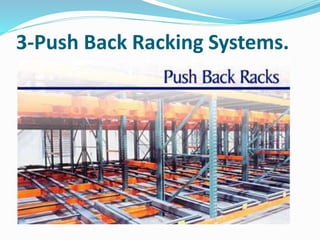
3-Push Back Racking Systems.
Push Back Racking Systems.
 When removing a pallet from the front position the
remaining pallets immediately stage themselves
forward so that the next available pallet can be
accessed.
 Push-back Racking is a LIFO (last in, first out) storage
systemused for bulk storage,
 2 to 5 pallets are used.
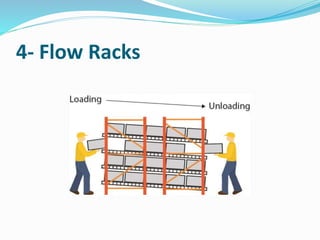
4- Flow Racks
Flow Racks
 gravity racks, are commonly used for high-density
storage.
 With this type of warehouse racking system, items are
loaded at the higher end and removed at the lower end
using a FIFO system.
 The rotation of products becomes automatic as the
racks flow with loading and unloading.
 Flow racks make use of gravity rollers that move in
conjunction with the rack load and feature brakes or
speed controllers to regulate item movement.
 They do not require electricity for operation because
gravity powers them
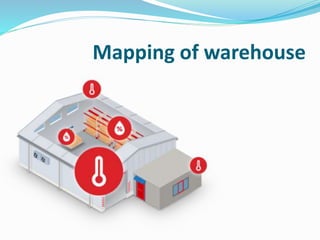
Mapping of warehouse
Warehouse mapping
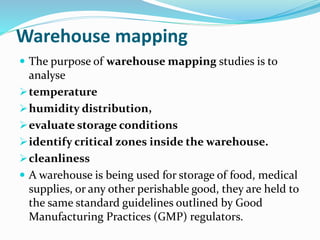
 The purpose of warehouse mapping studies is to
analyse
temperature
humidity distribution,
evaluate storage conditions
identify critical zones inside the warehouse.
cleanliness
 A warehouse is being used for storage of food, medical
supplies, or any other perishable good, they are held to
the same standard guidelines outlined by Good
Manufacturing Practices (GMP) regulators.
 India's GMP (Good Manufacturing Practices)
regulations are now more aligned with ISO 13485.
 Warehouse mapping must be performed to ensure
that the entire space is maintaining safe temperature
and humidity levels, depending on the product being
stored.
 Even with controlled environment inside the
warehouse, the exterior weather conditions may
influence the overall storage temperature and relative
humidity. To measure those changes we install
Temperature Sensors
This is a critical aspect of quality assurance and
compliance in any industry dealing with thermal-
sensitive products
Temperature Mapping
• Sensor Distribution
Arrange The sensing points such a way that they are according
to length, width and height of the space mapping.
Locate Critical Mapping Points
Controlling temperature across large, open
facilities is difficult, So look for problem areas.
These include are as near ceilings, windows, doors,
machinery etc.
Poor storage planning and air circulation can also
cause certain spots to heat up, so make sure that
temperatures at these points Are measured
carefully
Automated systems
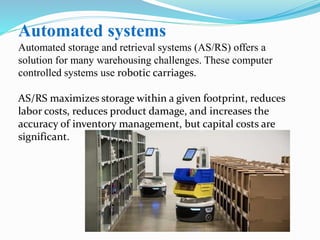
Automated storage and retrieval systems (AS/RS) offers a
solution for many warehousing challenges. These computer
controlled systems use robotic carriages.
AS/RS maximizes storage within a given footprint, reduces
labor costs, reduces product damage, and increases the
accuracy of inventory management, but capital costs are
significant.
Conclusion
So we conclude that Racking and mapping are the main
lifeline concept of warehousing system.
Description about the diff. types of racking system and
their suitability.
Warehouse racking layout
Mapping system and temperature mapping concept.
Warehouse system racking and mapping

Warehouse system racking and mapping

  • 1.
    RACKING AND MAPPING PRESENTEDBY ABHISHEK(1), MOHIT (29), SAURABH (41) SIMPLE ( 46) PRESENTED TO- O.P MISHRA SIR
  • 2.
  • 3.
    WAREHOUSE (concept)  Awarehouse is a building for storing goods. They are used by manufacturers, importers, exporters, wholesalers, transport businesses, customs, etc  Large exporters and manufacturers use warehouses as distribution points for developing retail outlets in a particular region or country.  Warehouse provides necessary facilities to the businessmen for storing their goods when they are not required for sale.  It provides protection to the stocks, ensures their safety and prevents wastage.  It minimises losses from breakage, deterioration in quality, spoilage etc. Warehouses usually adopt latest technologies to avoid losses, as far as possible.
  • 4.
    Functions of Warehousing Storage: This is the basic function of warehousing. Surplus commodities which are not needed immediately can be stored in warehouses. They can be supplied as and when needed by the customers.
  • 5.
    Price Stabilization:  Warehousesplay an important role in the process of price stabilization. It is achieved by the creation of time utility by warehousing. Fall in the prices of goods when their supply is in abundance and rise in their prices during the slack season are avoided.
  • 6.
    Risk bearing:  Whenthe goods are stored in warehouses they are exposed to many risks in the form of theft, exploration, fire etc. Warehouses are constructed in such a way as to minimise these risks.  Contract of bailment operates when the goods are stored in wave-houses.
  • 7.
    Grading and Packing: Warehouses nowadays provide the facilities of packing, processing and grading of goods. Goods can be packed in convenient sizes as per the instructions of the owner
  • 8.
    Financing  Banks andother financial institutions also advance loans against warehouse receipts. In this manner, warehousing acts as a source of finance for the businessmen for meeting business operations.
  • 9.
  • 10.
    Racking  Rack isa material handling storage aid system designed to store materials.  With proper warehouse racking, warehouse managers maximize space and optimize warehouse organization for efficiency and a streamlined picking process.  Warehouse layout plays a major role in warehouse racking, as width, docking locations, shipping areas, and other warehouse components affect warehouse racking options.
  • 11.
    How to Designa Warehouse Racking Layout?
  • 12.
    Here are somesteps and recommendations for Efficient Planning :
  • 13.
    1- Listen toYour Contractors  We may be attempted to jump straight into planning our warehouse racking layout, but that would be a mistake.  Talk to knowledgeable contractors (like your material handling company), your warehouse manager(s), and even your drivers: They have years of experience in warehouse facility operations and planning  Explain your goals and requirements, and then listen to their suggestions.
  • 14.
    2. Understand YourStorage Requirements  Racking starts with our storage system: Are you storing large pallets packed with large goods, or do you favor smaller pallets with individual or small products? Do you carry both high-flow and low-flow products?
  • 15.
    3. Maximize YourPhysical Storage  Your job is when designing an efficient racking system, Must ensure that you make the best use of finite space.  Start by arranging your racks in long rows – not short bursts – to get maximum use from your space. 
  • 16.
    4. Plan forExpansion  If there’s a good chance you’ll someday want to increase your warehouse storage space, start planning for that now. A good manager know each and every thing about a warehouse. Observe each and every function.  Select those racking solution, which is easily adjustable, versatile, and expandable.
  • 17.
    5. Bank onDurability  Racking, storage are not a small investment, so make the most of your money by investing in a durable, made-to-last racking system. Consider product weight, durability, shape, size.  Then opt for a racking system with a good cost-lifespan balance
  • 18.
  • 19.
    6. Choose YourRacking System Several types of racking systems are available – selective racks (ex. for narrow aisle racking) drive-in racks and drive-through racks (ex. for high- density storage) push back racking (ex. for bulk storage), flow racks (ex. for high-density storage)  The type you choose depends on your warehousing needs.
  • 20.
  • 21.
    7. Determine YourBudget  Once you understand your basic racking system needs, one of the first considerations is budget: the total cost for racking equipment, plus design and installation.  Don’t cut corners: the goal is not the cheapest total, but rather the “best cost solution,”  Once you’ve defined your needs and developed an ideal racking layout, then you’re ready to price-shop for the best deal.
  • 22.
    8. Map YourWarehouse  Before you buy, map your warehouse layout. Account for all the considerations above, and add to them other important concerns, like shipping and receiving areas, the employee lunch room, managers’ offices, etc.  A physical map will force you to consider all unmovable or unchangeable factors – columns, doors, and other obstructions – that you must design around, as you plan an efficient racking system.
  • 23.
    WMS ( warehousemanagement system)
  • 24.
    9. Implement aWarehouse Management System (WMS)  An efficient racking system doesn’t do you any favour if your employees don’t know where things are stored. A good warehouse management system will keep your inventory and operations as well organized as your new racks.
  • 25.
  • 26.
    Types of Racking Drive-through and drive-in pallet rack systems are great for large volumes of like-product, are easily expandable, and can help maximize the available space in your warehouse, there are a few differences between the two that will determine which fits your facility best.
  • 27.
    1- Drive-Through andDrive-In Pallet Rack  Drive-through and Drive-in pallet rack systems are great for large volumes of like-product, are easily expandable, and can help maximize the available space in your warehouse, there are a few differences between the two
  • 28.
    A- Drive-Through  Drive-throughpallet rack is a first in, first out (FIFO) system where pallets are loaded from one side of the rack and retrieved from the other.
  • 29.
    B- Drive-In  Asopposed to drive-through racking, this system is first in, last out (FILO), meaning it isn’t good for inventory with a short shelf life or a warehouse with a quick inventory turnaround. This system is great for freezer applications since it maximizes space. This system requires skilled forklift operators to follow all safety guidelines and report any damage promptly
  • 30.
  • 31.
    Selective racking  Selectiveracking is simply one pallet deep and has a maximum of two racks that is placed back to back.  Selective pallet racking will allow for a direct access in every pallet storage. For product lines that have high differentiation and low.  The selective racking therefore is a First in First Out racking system type.  This means that the stock which is added first is also the one that is first removed from the pack in contrast to the last in last out system
  • 32.
  • 33.
    Push Back RackingSystems.  When removing a pallet from the front position the remaining pallets immediately stage themselves forward so that the next available pallet can be accessed.  Push-back Racking is a LIFO (last in, first out) storage systemused for bulk storage,  2 to 5 pallets are used.
  • 34.
  • 35.
    Flow Racks  gravityracks, are commonly used for high-density storage.  With this type of warehouse racking system, items are loaded at the higher end and removed at the lower end using a FIFO system.  The rotation of products becomes automatic as the racks flow with loading and unloading.  Flow racks make use of gravity rollers that move in conjunction with the rack load and feature brakes or speed controllers to regulate item movement.  They do not require electricity for operation because gravity powers them
  • 36.
  • 37.
    Warehouse mapping  Thepurpose of warehouse mapping studies is to analyse temperature humidity distribution, evaluate storage conditions identify critical zones inside the warehouse. cleanliness  A warehouse is being used for storage of food, medical supplies, or any other perishable good, they are held to the same standard guidelines outlined by Good Manufacturing Practices (GMP) regulators.
  • 38.
     India's GMP(Good Manufacturing Practices) regulations are now more aligned with ISO 13485.  Warehouse mapping must be performed to ensure that the entire space is maintaining safe temperature and humidity levels, depending on the product being stored.  Even with controlled environment inside the warehouse, the exterior weather conditions may influence the overall storage temperature and relative humidity. To measure those changes we install Temperature Sensors This is a critical aspect of quality assurance and compliance in any industry dealing with thermal- sensitive products
  • 39.
    Temperature Mapping • SensorDistribution Arrange The sensing points such a way that they are according to length, width and height of the space mapping.
  • 40.
    Locate Critical MappingPoints Controlling temperature across large, open facilities is difficult, So look for problem areas. These include are as near ceilings, windows, doors, machinery etc. Poor storage planning and air circulation can also cause certain spots to heat up, so make sure that temperatures at these points Are measured carefully
  • 41.
    Automated systems Automated storageand retrieval systems (AS/RS) offers a solution for many warehousing challenges. These computer controlled systems use robotic carriages. AS/RS maximizes storage within a given footprint, reduces labor costs, reduces product damage, and increases the accuracy of inventory management, but capital costs are significant.
  • 42.
    Conclusion So we concludethat Racking and mapping are the main lifeline concept of warehousing system. Description about the diff. types of racking system and their suitability. Warehouse racking layout Mapping system and temperature mapping concept.