STRATEGIC
MANAGEMENT
Case Study Analysis –
(Walmart Discount
Operations) Submitted to – Dr. MA Akbar
Submitted by – GROUP 3
Himanshu Talmale – 20DM084
Manish Jindal – 20DM114
Mihir Manchanda – 20DM120
Mohammad Sohail – 20DM122
Pallavi Goel – 20DM147
Piyush Hirwani – 20DM151
Historyof
Walmart
In 1945 Sam Walton opened the first Ben Franklin
franchise in Newport Arkansas and operated them with
his wife, Helen and brother, Bud.
In November of 1962 Sam Walton started first
discount store but faced stiff competition from Kmart
and Target and until mid 1970’s that Wal-Mart began to
grow.
1967: Wal-Mart's 24 stores total $12.6 million in sales.
1970: Wal-Mart opens first distribution center and
home office and 1st IPO in 1970.
By 1980’s Walmart was one of the most successful
retailers in America and annual sales grew from $1
billion in 1980 to $26 Billion in 1989
Then 100 shares were worth $1,650 dollars and
now the same 100 shares are worth more than $6
million dollars.
In 1987 two new concepts were implemented
• Hypermarkets, which sell everything including food
• Supercenters which are scaled down to
supermarkets
Contoso Ltd.
Q1. What, historically, has been Wal-Mart’s key
sources of Competitive advantage in discount
retailing?
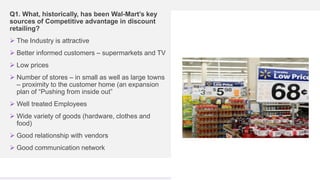
 The Industry is attractive
 Better informed customers – supermarkets and TV
 Low prices
 Number of stores – in small as well as large towns
– proximity to the customer home (an expansion
plan of “Pushing from inside out”
 Well treated Employees
 Wide variety of goods (hardware, clothes and
food)
 Good relationship with vendors
 Good communication network
Firm Infrastructure:
•High store volume
•No regional Headquarters
•IT support systems for
managerial decisions
•Human Resource
Management:
•Introduction of senior
manager with background
outside retailing (IT)
•Higher sales volume /
employee
SUPPORT
ACTIVITIES
Technological
Development
 It uses centralized purchasing
system.
 Installed computerized system to
track inventory.
 Switching to electronic scanning of
the Uniform Product Code (UPC)
at the point of sale.
 Using computer aided design.
Q2.) How sustainable is Wal-Mart’s
CompetitiveAdvantage in discount
retailing in 1986?
 Sustainability at the top place is
the most important job that
makes its managers strives
hard to frame the policies and
strategy to compete with its
rivals in the market.
 Wal-Mart with its visionary goal
of attaining zero waste status
and reaching 100% renewable
energy has planned to launch
number of sustainability
initiatives.
 Wal-Mart is planning to open
convenience stores as Tesco
has started and operating in US
called Fresh & Easy
Neighborhood Markets.
Contoso Ltd.
 Sustainable due to size and relationship with
suppliers
 Some aspects can be replicated by
competitors
– Hub and spoke model
– Buying directly from the manufacturer
 However difficult to replicate due to necessary
capital and size
DistributionNetwork
Sustainability
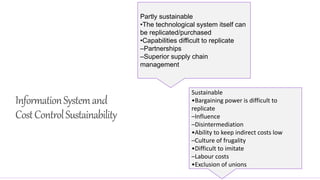
InformationSystemand
CostControlSustainability
Partly sustainable
•The technological system itself can
be replicated/purchased
•Capabilities difficult to replicate
–Partnerships
–Superior supply chain
management
Sustainable
•Bargaining power is difficult to
replicate
–Influence
–Disintermediation
•Ability to keep indirect costs low
–Culture of frugality
•Difficult to imitate
–Labour costs
•Exclusion of unions
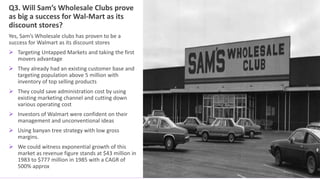
Q3. Will Sam’s Wholesale Clubs prove
as big a success for Wal-Mart as its
discount stores?
Yes, Sam’s Wholesale clubs has proven to be a
success for Walmart as its discount stores
 Targeting Untapped Markets and taking the first
movers advantage
 They already had an existing customer base and
targeting population above 5 million with
inventory of top selling products
 They could save administration cost by using
existing marketing channel and cutting down
various operating cost
 Investors of Walmart were confident on their
management and unconventional ideas
 Using banyan tree strategy with low gross
margins.
 We could witness exponential growth of this
market as revenue figure stands at $43 million in
1983 to $777 million in 1985 with a CAGR of
500% approx
 walmart ppt

walmart ppt

  • 1.
    STRATEGIC MANAGEMENT Case Study Analysis– (Walmart Discount Operations) Submitted to – Dr. MA Akbar Submitted by – GROUP 3 Himanshu Talmale – 20DM084 Manish Jindal – 20DM114 Mihir Manchanda – 20DM120 Mohammad Sohail – 20DM122 Pallavi Goel – 20DM147 Piyush Hirwani – 20DM151
  • 2.
    Historyof Walmart In 1945 SamWalton opened the first Ben Franklin franchise in Newport Arkansas and operated them with his wife, Helen and brother, Bud. In November of 1962 Sam Walton started first discount store but faced stiff competition from Kmart and Target and until mid 1970’s that Wal-Mart began to grow. 1967: Wal-Mart's 24 stores total $12.6 million in sales. 1970: Wal-Mart opens first distribution center and home office and 1st IPO in 1970. By 1980’s Walmart was one of the most successful retailers in America and annual sales grew from $1 billion in 1980 to $26 Billion in 1989 Then 100 shares were worth $1,650 dollars and now the same 100 shares are worth more than $6 million dollars. In 1987 two new concepts were implemented • Hypermarkets, which sell everything including food • Supercenters which are scaled down to supermarkets
  • 3.
    Contoso Ltd. Q1. What,historically, has been Wal-Mart’s key sources of Competitive advantage in discount retailing?  The Industry is attractive  Better informed customers – supermarkets and TV  Low prices  Number of stores – in small as well as large towns – proximity to the customer home (an expansion plan of “Pushing from inside out”  Well treated Employees  Wide variety of goods (hardware, clothes and food)  Good relationship with vendors  Good communication network
  • 4.
    Firm Infrastructure: •High storevolume •No regional Headquarters •IT support systems for managerial decisions •Human Resource Management: •Introduction of senior manager with background outside retailing (IT) •Higher sales volume / employee SUPPORT ACTIVITIES
  • 5.
    Technological Development  It usescentralized purchasing system.  Installed computerized system to track inventory.  Switching to electronic scanning of the Uniform Product Code (UPC) at the point of sale.  Using computer aided design.
  • 6.
    Q2.) How sustainableis Wal-Mart’s CompetitiveAdvantage in discount retailing in 1986?  Sustainability at the top place is the most important job that makes its managers strives hard to frame the policies and strategy to compete with its rivals in the market.  Wal-Mart with its visionary goal of attaining zero waste status and reaching 100% renewable energy has planned to launch number of sustainability initiatives.  Wal-Mart is planning to open convenience stores as Tesco has started and operating in US called Fresh & Easy Neighborhood Markets.
  • 7.
    Contoso Ltd.  Sustainabledue to size and relationship with suppliers  Some aspects can be replicated by competitors – Hub and spoke model – Buying directly from the manufacturer  However difficult to replicate due to necessary capital and size DistributionNetwork Sustainability
  • 8.
    InformationSystemand CostControlSustainability Partly sustainable •The technologicalsystem itself can be replicated/purchased •Capabilities difficult to replicate –Partnerships –Superior supply chain management Sustainable •Bargaining power is difficult to replicate –Influence –Disintermediation •Ability to keep indirect costs low –Culture of frugality •Difficult to imitate –Labour costs •Exclusion of unions
  • 9.
    Q3. Will Sam’sWholesale Clubs prove as big a success for Wal-Mart as its discount stores? Yes, Sam’s Wholesale clubs has proven to be a success for Walmart as its discount stores  Targeting Untapped Markets and taking the first movers advantage  They already had an existing customer base and targeting population above 5 million with inventory of top selling products  They could save administration cost by using existing marketing channel and cutting down various operating cost  Investors of Walmart were confident on their management and unconventional ideas  Using banyan tree strategy with low gross margins.  We could witness exponential growth of this market as revenue figure stands at $43 million in 1983 to $777 million in 1985 with a CAGR of 500% approx